


Nehemiah 12:16
Bible text: King James Version (1769 Blayney text) · Public domain
Bible text: Berean Standard Bible · Public domain
Bible text: American Standard Version (1901) · Public domain
Bible text: World English Bible, Messianic edition · Public domain
Bible text: Geneva Bible (1599) · Public domain
Bible text: Young's Literal Translation · Public domain
- לְעִדּוֹאla·'a·da·ya'of IddoH5714Prep-l ¦ N-proper-mNoun Proper MasculineלְofעִדּוֹאIddo
- זְכַרְיָהze·khar·YahZechariahH2148N-proper-mNoun Proper Masculine
- לְגִנְּתוֹןle·gi·ne·Tonof GinnethonH1599Prep-l ¦ N-proper-mNoun Proper MasculineלְofגִנְּתוֹןGinnethon
- מְשֻׁלָּםme·shu·LamMeshullamH4918N-proper-mNoun Proper Masculine
English is a literal word-by-word gloss of the Hebrew, not the KJV's wording. Why?
This is the original text the KJV's translators worked from — each Hebrew word with its own literal English meaning in this verse, prepared by scholars at Tyndale House, Cambridge. The KJV translates whole sentences, not word by word, so its wording differs: one Hebrew word can become several English words, and the KJV may choose “the LORD” where the gloss reads “Yahweh”. Both are faithful — they answer different questions. For the KJV's own rendering, switch to the KJV text.
Details
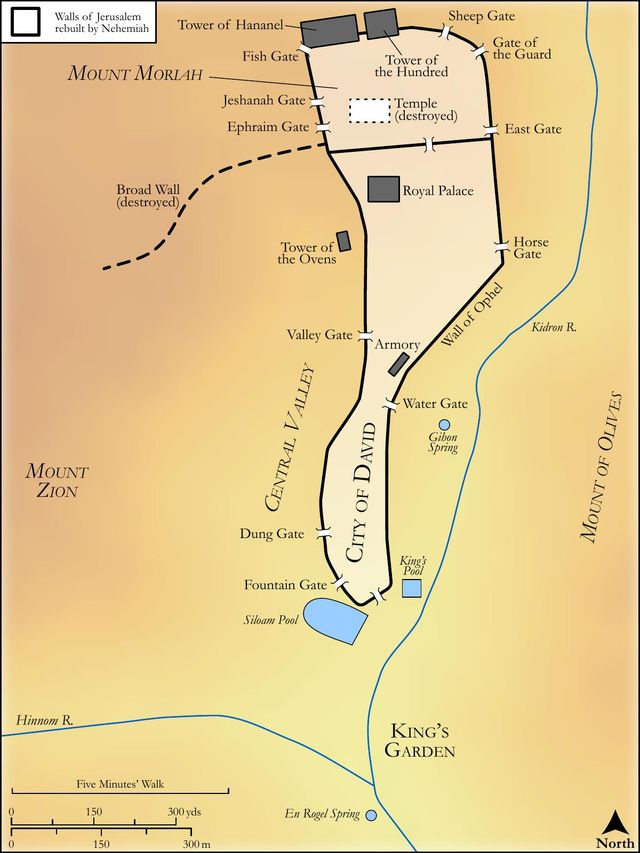
See on the biblical-era map
Study this verse
Public-domain commentary
Matthew Henry
From his Commentary on the Whole Bible. Henry comments on passages, not single verses — this entry covers Nehemiah 12:1–26.
We have here the names, and little more than the names, of a great many priests and Levites, that were eminent in their day among the returned Jews. Why this register should be here inserted by Nehemiah does not appear, perhaps to keep in remembrance those good men, that posterity might know to whom they were beholden, under God, for the happy revival and re-establishment of their religion among them. Thus must we contribute towards the performance of that promise, Psa 112:6, The righteous shall be in everlasting remembrance. Let the memory of the just be blessed, be perpetuated. It is a debt we still owe to faithful ministers to remember our guides, who have spoken to us the word of God, Heb 13:7. Perhaps it is intended to stir up their posterity, who succeeded them in the priest's office and inherited their dignities and preferments, to imitate their courage and fidelity. It is good to know what our godly ancestors and predecessors were, that we may learn thereby what we should be. We have here, 1. The names of the priests and Levites that came up with the first out of Babylon, when Jeshua was high priest. Jeremiah and Ezra are mentioned with the first (Neh 12:1), but, it is supposed, not Jeremiah the prophet nor Ezra the scribe; the fame of the one was long before and that of the other some time after, though both of them were priests. Of one of the Levites it is said (Neh 12:8) that he was over the thanksgiving, that is, he was entrusted to see that the psalms, the thanksgiving psalms, were constantly sung in the temple in due time and manner. The Levites kept their turns in their watches, reliving one another as becomes brethren, fellow-labourers, and fellow-soldiers. 2. The succession of high priests during the Persian monarchy, from Jeshua (or Jesus), who was high priest at the time of the restoration, to Jaddua (or Jaddus), who was high priest when Alexander the Great, after the conquest of Tyre, came to Jerusalem, and paid great respect to this Jaddus, who met him in his pontifical habit, and showed him the prophecy of Daniel, which foretold his conquests. 3. The next generation of priests, who were chief men, and active in the days of Joiakim, sons of the first set. Note, We have reason to acknowledge God's favour to his church, and care of it, in that, as one generation of ministers passes away, another comes. All those who are mentioned Neh 12:1, etc., as eminent in their generation, are again mentioned, though with some variation in several of the names, Neh 12:12, etc., except two, as having sons that were likewise eminent in their generation - a rare instance, that twenty good fathers should leave behind them twenty good sons (for so many here are) that filled up their places. 4. The next generation of Levites, or rather a latter generation; for those priests who are mentioned flourished in the days of Joiakim the high priest, these Levites in the days of Eliashib, Neh 12:22. Perhaps then the forementioned families of the priests began to degenerate, and the third generation of them came short of the first two; but the work of God shall never fail for want of instruments. Then a generation of Levites was raised up, who were recorded chief of the fathers (Neh 12:22), and were eminently serviceable to the interests of the church, and their service not the less acceptable either to God or to his people for their being Levites only, of the lower rank of ministers. Eliashib the high priest being allied to Tobiah (Neh 13:4), the other priests grew remiss; but then the Levites appeared the more zealous, as appears by this, that those who were now employed in expounding (Neh 8:7) and in praying (Neh 9:4, Neh 9:5) were all Levites, not priests, regard being had to their personal qualifications more than to their order. These Levites were some of them singers (Neh 12:24), to praise and give thanks, others of them porters (Neh 12:25), keeping the ward at the thresholds of the gates, and both according to the command of David.
Continue studying Nehemiah 12:16 across the web’s major study libraries — every link below opens this exact verse, chapter, or book on the destination site.
Read & Compare
 BibleGatewayThis verse in more than 200 translations and 70 languages.
 Bible.comThe YouVersion reader — hundreds of translations, reading plans, and highlights.
 ESV.orgCrossway's official English Standard Version reader.
 NET BibleThe NET translation with 60,000+ translators' notes on every rendering decision.
 STEP BibleTyndale House's free study tool — original text, vocabulary, and scholarly resources.
 BibliaLogos Bible Software's free web reader.
 USCCBThe New American Bible (Revised Edition) with the U.S. bishops' study notes.
Commentaries
 BibleHub CommentariesDozens of classic commentaries on this verse, gathered on one page.
 StudyLightMore than 100 commentary sets — the largest collection on the web.
 BibleRefPlain-English commentary on what this verse means, verse by verse.
 Enduring WordDavid Guzik's free commentary on this chapter, widely used by Bible teachers.
 Bible Study ToolsVerse commentary alongside Greek and Hebrew study aids.
Original Language & Research
- BibleHub InterlinearThe verse word by word — original language, transliteration, and English.
- BibleHub LexiconEvery word's original-language definition and Strong's entry.
 Blue Letter BibleDeep-study tools — Strong's numbers, concordance, and word studies.
 SefariaThe Hebrew text with Rashi and centuries of Jewish commentary.
Sermons, Hymns & Audio


TrulyRandomVerse is not affiliated with these sites and doesn’t control their content. They’re linked because they’re genuinely useful.
Summary
Nehemiah 12:16 is a concise administrative record embedded within a larger genealogical register, meticulously identifying Zechariah as the head of the priestly family of Iddo and Meshullam as the head of the priestly family of Ginnethon. This verse, part of a detailed accounting of priests and Levites serving during the post-exilic period under High Priest Joiakim, underscores the meticulous organization, continuity, and legitimacy of temple service, which was foundational for the spiritual life of the restored community in Jerusalem.
Context
ShowHideLiterary Context
Nehemiah 12 serves primarily as a comprehensive register of the priests and Levites who played a crucial role in the restoration of Jerusalem and its temple worship after the Babylonian exile. The chapter naturally divides into several sections: verses 1-7 list the initial priests and Levites who returned with Zerubbabel and Jeshua, representing the first wave of returnees. Verses 12-21, where Nehemiah 12:16 is situated, then provide an updated list of the heads of these same priestly families in the subsequent generation, specifically during the high priesthood of Joiakim, Jeshua's son. This meticulous record-keeping was not merely bureaucratic; it was essential for establishing the legitimacy and ensuring the continuity of the priestly lines, guaranteeing that only those with confirmed lineage could serve in the sacred offices, thereby maintaining ritual purity and proper worship according to Mosaic Law. The strategic placement of these detailed lists immediately preceding the grand dedication of the wall in Nehemiah 12:27-47 powerfully emphasizes that the spiritual foundation of the community, embodied by its leadership and worship, was considered as vital, if not more so, than its physical defenses.
Historical & Cultural Context
The events described in the book of Nehemiah unfold in the mid-5th century BC, a period when Judah was a province under the vast Persian Empire. The Jewish people had endured the Babylonian exile and were now, under the leadership of figures like Zerubbabel, Jeshua, Ezra, and Nehemiah, actively engaged in rebuilding both their physical city (especially the walls) and their spiritual infrastructure (the Temple and its administrative functions). In this critical post-exilic era, maintaining strict genealogical records was of paramount importance for several interconnected reasons: it validated claims to land inheritance, confirmed tribal identity, and, most crucially, authenticated eligibility for priestly or Levitical service. Only direct descendants of Aaron were permitted to serve as priests, and only those from the tribe of Levi could assist them in temple duties. The meticulous lists found throughout Nehemiah 12, including the specific entries like Nehemiah 12:16, vividly reflect a society deeply committed to re-establishing its unique identity and religious practices in strict accordance with the Torah, thereby ensuring that the restored worship was both legitimate and orderly in the eyes of God and the community.
Key Themes
ShowHideNehemiah 12:16, as an integral part of this broader register, significantly contributes to several profound theological and narrative themes within the book. Firstly, it powerfully highlights the continuity of God's covenant people and their worship. Despite the devastating rupture of the Babylonian exile, God faithfully preserved a remnant and ensured the unbroken chain of priestly ministry, demonstrating His unwavering faithfulness to His promises. Secondly, the detailed nature of these lists underscores the importance of order and administration in God's house. These genealogical records were not mere bureaucratic formalities but were vital for the proper assignment of duties, the management of resources, and the maintenance of accountability within the religious hierarchy, thereby reflecting God's own character as a God of order and not of confusion, as articulated in 1 Corinthians 14:33. Thirdly, the very inclusion of specific names, even within a seemingly dry list, subtly points to the value of individual contribution to the collective spiritual life of the community. Each named individual represented a family dedicated to God's service, serving as a quiet reminder that every person, no matter how briefly mentioned, plays a significant and divinely purposed part in God's larger redemptive plan for His people.
Exposition and Analysis
ShowHideKey Word Analysis
ShowHideThis name, derived from a root meaning "to pass over" or "to appoint," suggests "timely" or "his appointed time." In the context of the post-exilic restoration, the presence of a priestly family headed by someone named Iddo subtly hints at the divine providence and precise timing involved in the re-establishment of the priestly order. It implies that God's plan for His people's return and the resumption of proper worship was unfolding exactly according to His sovereign schedule.
A very common and significant Hebrew name, meaning "Yahweh remembers" or "the Lord has remembered." Its frequent appearance, often associated with prophets or priests, carries profound theological weight. In this specific context, the name Zechariah subtly reinforces the overarching theme that despite the trauma of exile and dispersion, God remained faithful; He remembered His covenant people, their priestly lineage, and His promises, thereby ensuring the continuation of His worship and the fulfillment of His purposes.
This name, possibly related to "gardener" or "garden," is less common than the others but signifies another distinct priestly family. Its inclusion alongside Iddo's family emphasizes the comprehensive nature of the record. The fact that various priestly families, each with their own unique lineage and history, were meticulously documented underscores the broad scope of the restoration effort and the commitment to re-establish the full complement of temple servants.
Meaning "allied," "repaid," "at peace," or "made whole," this name also appears multiple times across the Old Testament. Its presence here, serving as the head of the Ginnethon family, can be interpreted as a quiet affirmation of the restoration and peace that God was bringing to His people after the turmoil of exile. As their worship system was being meticulously re-established and made whole, so too was the community finding a measure of spiritual and communal peace.
Verse Breakdown
ShowHide"Of Iddo, Zechariah;"
This clause identifies Zechariah as the leading priest or head of the priestly family that traced its lineage back to Iddo. Within the specific context of Nehemiah 12:12-21, this means Zechariah was the current representative and head of the house of Iddo during the generation when Joiakim served as the high priest. This structured identification confirms the generational continuity of the priestly office, effectively tracing the lineage from the initial returnees to the current generation actively serving in the rebuilt Temple. It highlights the importance of an unbroken chain of succession for legitimate ministry.
"of Ginnethon, Meshullam;"
In a parallel and equally concise manner, this clause states that Meshullam was the head of the priestly family of Ginnethon (a name also known as Ginnetho, as seen in Nehemiah 10:6). This parallel structure reinforces the systematic and thorough nature of the record-keeping within Nehemiah. It ensures that all established priestly lines had their current representatives meticulously documented for the essential purposes of temple service, administration, and accountability. The succinctness of the verse itself underscores its primary function as a precise administrative entry within a larger, vital register of temple personnel.
Literary Devices
ShowHideThe primary literary device employed in Nehemiah 12:16, and indeed throughout much of Nehemiah 12, is Genealogy or List. This is not merely a dry enumeration but a purposeful literary form that serves several critical functions: to establish legitimacy, confirm identity, and demonstrate continuity. By meticulously listing the heads of priestly families, the text underscores the divine order and the unbroken chain of covenant service, which was absolutely crucial for a community striving to re-establish its religious and national identity after the profound disruption of exile. The use of Formulaic Language ("Of X, Y") creates a rhythmic and authoritative tone, emphasizing the systematic and official nature of these records, lending them weight and credibility. Furthermore, the very names themselves, as explored in the Key Word Analysis, can be seen as a form of Symbolism, with their inherent meanings (e.g., "Yahweh remembers," "at peace," "timely") subtly reinforcing the overarching themes of divine faithfulness, restoration, and providential care that permeate the entire book of Nehemiah.
Theological and Thematic Connections
ShowHideNehemiah 12:16, though a simple listing of names, holds deep theological significance for its contribution to the overarching narrative of God's unwavering faithfulness and the meticulous care He extends to His people and their worship. It powerfully speaks to the divine preservation of a remnant, ensuring that the Levitical priesthood, despite its inherent imperfections and temporary nature, remained intact for the continuation of sacrificial worship. This seemingly administrative detail profoundly reflects God's character as a God of order, who desires His people to serve Him with structure, accountability, and purity. It also subtly highlights the profound importance of every individual's role within the larger community of faith, affirming that even those briefly mentioned in a register contribute meaningfully to God's grand design. The persistence of these priestly lines, against the backdrop of the devastating exile, stands as a powerful testimony to God's unwavering commitment to His covenant promises and His unyielding determination to restore His people to proper, legitimate worship.
Reflection and Application
ShowHideThe seemingly mundane listing of names in Nehemiah 12:16 carries profound and enduring lessons for contemporary believers. It serves as a powerful reminder that God is intricately invested in the smallest details of His work and the lives of His people. Just as He meticulously preserved priestly lineages for the continuation of sacred worship, He orchestrates the seemingly small, administrative, or routine aspects of our lives and communities for His greater, sovereign purposes. This verse encourages us to cultivate a deep appreciation for faithfulness in "small tasks," recognizing that every act of diligent service, every commitment to orderly administration, and every meticulous record contributes significantly to the larger, beautiful tapestry of God's unfolding kingdom. It also powerfully underscores the vital importance of generational continuity in faith – the imperative of raising up new leaders, intentionally mentoring the next generation, and faithfully passing on a rich legacy of devotion, service, and sound doctrine. We are called to be diligent stewards of the spiritual heritage we have received, ensuring that the "lists" of faithful servants continue through our unwavering commitment to discipleship, orderly church life, and a vibrant, living faith that transcends generations.
Questions for Reflection
ShowHideFAQ
ShowHideWhy are these lists of names so important in the Bible, especially in books like Nehemiah?
ShowHideThese lists, like the one in Nehemiah 12:16, are profoundly crucial for several interconnected reasons. First, they establish legitimacy and continuity, particularly for priestly and royal lines. In ancient Israel, one's lineage was the primary determinant of eligibility for sacred office (e.g., only direct descendants of Aaron could serve as priests) and for inheritance rights within the tribal system. These meticulous records ensured that the restored worship in Jerusalem was conducted by those divinely appointed and that the community's identity was preserved. Second, they powerfully demonstrate God's unwavering faithfulness in preserving His covenant people and their divinely established institutions, even through the devastating trials of exile and dispersion. The fact that these lines could be so meticulously traced and re-established after such profound upheaval is a remarkable testament to divine providence and commitment. Third, they underscore the vital importance of order and accountability in God's service. The detailed organization of the temple personnel ensured that duties were properly assigned, resources were managed efficiently, and proper, pure worship was maintained, thereby reflecting the very character of a God who is not a God of confusion but of peace and order (1 Corinthians 14:33). Finally, beyond their theological and administrative significance, they serve as invaluable historical documents, providing a tangible link to the past and validating the historical claims of the biblical narrative itself.
Christ-Centered Fulfillment
ShowHideThe meticulous genealogical records of the Old Testament, including the detailed priestly lists found in Nehemiah 12, and specifically Nehemiah 12:16, ultimately serve as profound pointers to the perfect and final fulfillment found in the person and work of Jesus Christ. While these lists meticulously trace the human lineage of the Levitical priesthood, they simultaneously highlight its inherent limitations and temporary nature. The Old Covenant priesthood, though divinely ordained, was by design imperfect; priests died, and their sacrifices had to be continually offered year after year, thereby foreshadowing the urgent need for a better, eternal way. Jesus, our Great High Priest, perfectly fulfills and gloriously transcends this earthly, temporary system. He is not from the tribe of Levi, but from Judah, and His priesthood is established "not on the basis of a legal requirement concerning bodily descent but by the power of an indestructible life" (Hebrews 7:16). He is the ultimate "Zechariah" ("Yahweh remembers"), for in Him, God perfectly remembered His eternal covenant and brought forth the ultimate salvation for humanity. Through His once-for-all, perfect sacrifice on the cross, He makes us "Meshullam" ("at peace" or "made whole") with God, achieving once and for all what the repeated, imperfect sacrifices of the Levitical priests could never truly accomplish (Hebrews 10:10-14). The very precision and detail of these Old Testament lists underscore the divine precision of God's grand redemptive plan, a plan that culminates in Christ, who is the true and eternal head of a new, spiritual priesthood of all believers, empowering us to offer spiritual sacrifices acceptable to God through Him (1 Peter 2:9).