


Old Testament · Minor Prophets · Book 32 of 66
Jonah
Sent to cry against Nineveh, Jonah flees and is swallowed by a great fish; sent again, he preaches, the city repents, and he is angry when God spares it.
- 4 chapters
- 48 verses
- About 6 minutes to read
- The Hebrew Prophets, c. 800–400 BC
Among the twelve Minor Prophets, Jonah alone is a narrative about the prophet rather than a record of his oracles. His message to Nineveh, as the book gives it, is one sentence: “Yet forty days, and Nineveh shall be overthrown” (Jonah 3:4). The rest of the book is what happens around it. The wind, the sea, the lot, the fish, a gourd and a worm all do the LORD’s bidding. The sailors fear the LORD and offer sacrifice, and Nineveh believes God, from its king to its cattle in sackcloth. The one who resists is the prophet, who “rose up to flee unto Tarshish from the presence of the LORD” (1:3).
One verb marks his course: he went down to Joppa, down into the ship and down into its sides, and in his prayer he went “down to the bottoms of the mountains” (2:6) before the LORD brought up his life. His reason for fleeing waits until the last chapter (4:2), and the book closes on the LORD’s question, not on Jonah’s answer. Christ named the three days in the fish as the sign of his own burial (Matthew 12:40).
And he prayed unto the LORD, and said, I pray thee, O LORD, was not this my saying, when I was yet in my country? Therefore I fled before unto Tarshish: for I knew that thou art a gracious God, and merciful, slow to anger, and of great kindness, and repentest thee of the evil.
Jonah 4:2 KJV
Before you read
- Who wrote it
- Not named in the book, which tells of Jonah in the third person; traditionally Jonah himself.
- When it happens
- Jonah son of Amittai, of Gath-hepher, prophesied in the reign of Jeroboam II of Israel, in the eighth century BC (2 Kings 14:23–25); the book does not date the mission. Nineveh was a city of Assyria (2 Kings 19:36), the power that later carried Israel captive (2 Kings 17:6).
How Jonah is laid out
4 movements · 9 passages · 48 verses
Fleeing from the presence
1:1–16 · 16 verses
The word of the LORD sends Jonah to cry against Nineveh, and he goes down to Joppa and takes ship for Tarshish instead. The LORD sends a great wind. The sailors cry to their gods and cast lots, and the lot falls on Jonah. He confesses the God who made the sea and bids them cast him in; the sea ceases, and they fear the LORD.
Three days and three nights
1:17–2:10 · 11 verses
The LORD has prepared a great fish to swallow Jonah, and he is in its belly three days and three nights. He prays in the words of the Psalms: cast into the deep and gone down to the bottoms of the mountains, he remembered the LORD and was heard. He ends, “Salvation is of the LORD,” and at the LORD’s word the fish vomits him onto dry land.
Nineveh believes God
Chapter 3 · 10 verses
Sent a second time, Jonah goes. A day’s journey into the city he cries, “Yet forty days, and Nineveh shall be overthrown.” The people believe God and proclaim a fast. The king lays aside his robe, sits in ashes and decrees sackcloth for man and beast. God sees them turn from their evil way and repents of the evil he had said he would do.
Doest thou well to be angry?
Chapter 4 · 11 verses
Jonah is very angry and asks to die: he had fled because he knew the LORD is gracious and merciful. He sits east of the city to watch. God prepares a gourd to shade him, then a worm to smite it and a vehement east wind. The book ends on the LORD’s question: Jonah has pity on a gourd; should not the LORD spare Nineveh?
The words Jonah turns on
Jonah goes down while sailors and Ninevites cry to God. The LORD prepares each turn, repents of the evil he threatened, and asks whether he should not spare.
What Jonah teaches
mânâh · prepare
The LORD prepared
Every turn in the book is the LORD’s doing. He “sent out a great wind into the sea” (1:4) and “prepared a great fish to swallow up Jonah” (1:17), and in the last chapter he prepares a gourd, a worm and “a vehement east wind” (4:8). The sailors’ lot falls on Jonah, for “the whole disposing thereof is of the LORD” (Proverbs 16:33). Jonah confesses “the God of heaven, which hath made the sea and the dry land” (1:9) while running from him across that sea. David had asked, “whither shall I flee from thy presence?” (Psalm 139:7), and the voyage answers him. Paulinus of Nola: Jonah surely teaches us that the sea and stars are moved under God’s control.
yᵉshûwʻâh · salvation
Salvation is of the LORD
Jonah prays from the fish’s belly in the words of the Psalms. His line “all thy billows and thy waves passed over me” (2:3) repeats Psalm 42:7 almost word for word, and “I cried by reason of mine affliction unto the LORD, and he heard me” (2:2) answers to Psalm 120:1. He speaks as one already among the dead, cast out of God’s sight and shut in by the earth’s bars, yet the prayer is thanksgiving: “yet hast thou brought up my life from corruption, O LORD my God” (2:6). Jerome marked the tense: He does not pray for the future, but gives thanks for the past.
The prayer ends on its sum, “Salvation is of the LORD” (2:9), and then the LORD speaks to the fish.
nâcham · repent
Who can tell if God will turn
Jonah’s message named no condition: “Yet forty days, and Nineveh shall be overthrown” (3:4). The king answered it with a hope, “Who can tell if God will turn and repent, and turn away from his fierce anger, that we perish not?” (3:9), and “God repented of the evil, that he had said that he would do unto them; and he did it not” (3:10). This is no change in the LORD, who says, “I change not” (Malachi 3:6). Through Jeremiah he states how his word against a nation stands: “If that nation, against whom I have pronounced, turn from their evil, I will repent of the evil that I thought to do unto them” (Jeremiah 18:8). The warning was sent to be heeded. Chrysostom: God threatens to destroy the city of Nineveh for the very reason that He might not destroy it.
chârâh · be angry
Doest thou well to be angry?
When Nineveh is spared, “it displeased Jonah exceedingly, and he was very angry” (4:1). He gives his reason for the flight: “I knew that thou art a gracious God, and merciful, slow to anger, and of great kindness, and repentest thee of the evil” (4:2). The Fathers read the grief two ways. Cyril of Alexandria held that he grieved not because the city had escaped destruction
but because he seemed to be a liar
. Jerome saw a prophet who despairs of Israel's safety
. The LORD answers with questions. Jonah “had pity on the gourd” (4:10), and the word is the one the LORD uses of sparing Nineveh, with its “sixscore thousand persons that cannot discern between their right hand and their left hand; and also much cattle” (4:11).
Christ in Jonah
Christ took this book as the sign of his own death and rising. Asked for a sign, he said that none would be given “but the sign of the prophet Jonas: For as Jonas was three days and three nights in the whale's belly; so shall the Son of man be three days and three nights in the heart of the earth” (Matthew 12:39–40). He set Nineveh beside the men who heard him: “they repented at the preaching of Jonas; and, behold, a greater than Jonas is here” (Matthew 12:41). He speaks of the prophet, the fish and the city’s repentance as things that happened.
The likeness is in the event, not in the man. Jonah went into the sea for his own disobedience; Christ “suffered for sins, the just for the unjust” (1 Peter 3:18). Tertullian saw in what Jonah endured a type of the Lord’s suffering, by which pagan penitents also would be redeemed
. Jonah preached to one city and was angry when it was spared; the risen Christ sent “repentance and remission of sins” to be “preached in his name among all nations” (Luke 24:47).
People
By how many verses name them
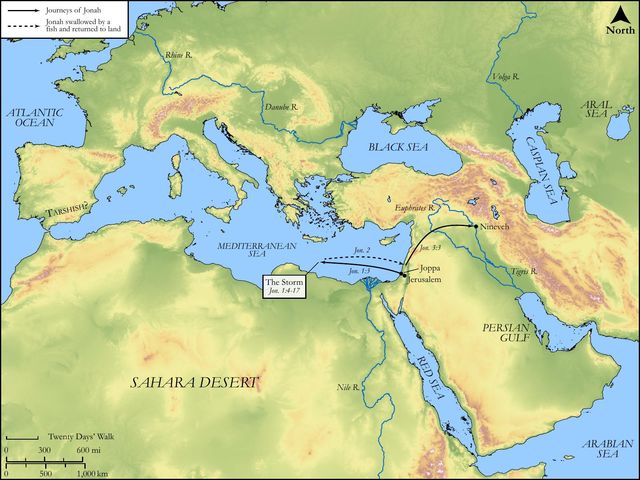
Where Jonah reaches
The passages it leans on, and the ones that lean on it
Exodus 34:6 Jonah 4:2 Joel 2:13–14
The name proclaimed before Moses: Jonah fled because he knew it, and Joel calls Judah to repent on the strength of it.
The rule behind Nineveh’s reprieve: a nation that turns from its evil is spared the evil pronounced against it.
Elijah under the juniper tree makes the same prayer: “O LORD, take away my life.”
A storm, men afraid of perishing, and a sleeper in the ship; this sleeper rises and rebukes the wind and the sea.
Three days and three nights in the fish: the sign Christ gives of his own burial.
Books Jonah links to most
The Church Fathers on Jonah
130 quotations from 24 writers before AD 800 · the ten most quoted, in date order
- Clement99
- Tertullian220
- Gregory390
- Ambrose397
- Chrysostom407
- Jerome420
- Augustine430
- Paulinus431
- Cyril444
- Caesarius542
Gregory of Nazianzus held that Jonah knew a change of place was no escape from God.
Jonah knew better than anyone the purpose of his message to the Ninevites and that, in planning his flight, although he changed his location, he did not escape from God. … For God alone of all things cannot be escaped from or contended with.
Irenaeus set Jonah beside Elijah: nothing created can stand against the will of God.
… Jonah, when he had been cast into the deep, and swallowed down into the whale's belly, was by the command of God again thrown out safe upon the land. Neither the nature of any created thing, therefore, nor the weakness of the flesh, can prevail against the will of God.
Cyril of Jerusalem heard Christ’s burial in the prayer from the fish.
Jonah fulfilled a type of our Savior when he prayed from the belly of the fish and said, “I cried for help from the midst of the netherworld.” … While he was in the sea, Jonah says, “I went down into the earth,” for he typified Christ, who went down into the heart of the earth.
Clement of Rome, the earliest voice here, counted Nineveh among the proofs that God grants repentance in every age.
Let us turn to every age that has passed, and learn that, from generation to generation, the Lord has granted a place of repentance to all such as would be converted unto Him... Jonah proclaimed destruction to the Ninevites; but they, repenting of their sins, propitiated God by prayer, and obtained salvation, although they were aliens [to the covenant] of God.
Keep studying
Articles