


Old Testament · Minor Prophets · Book 33 of 66
Micah
Micah of Moresheth warns Samaria and Jerusalem of judgment for their idols and their rulers’ greed, and promises a remnant, a ruler from Bethlehem, and a God who pardons.
- 7 chapters
- 105 verses
- About 14 minutes to read
- The Hebrew Prophets, c. 800–400 BC
Micah the Morasthite prophesied in the days of Jotham, Ahaz and Hezekiah against both capitals, Samaria and Jerusalem (Micah 1:1). His charges are concrete. Men lie awake devising how to take fields and houses (2:1–2). “The heads thereof judge for reward, and the priests thereof teach for hire, and the prophets thereof divine for money,” yet they say, “Is not the LORD among us?” (3:11). Against all this the LORD sets what he had already shown: “to do justly, and to love mercy, and to walk humbly with thy God” (6:8).
The book is built on three calls to hear (1:2; 3:1; 6:1), and each passes from judgment to hope. Watch for the reversals. Zion is “plowed as a field” in the last verse of chapter 3 and set “in the top of the mountains” in the first verse of chapter 4. Bethlehem, “little among the thousands of Judah,” is the town of the everlasting ruler (5:2). And the book that opens with the LORD coming down in judgment closes on a God who “delighteth in mercy” (7:18).
He hath shewed thee, O man, what is good; and what doth the LORD require of thee, but to do justly, and to love mercy, and to walk humbly with thy God?
Micah 6:8 KJV
How Micah is laid out
8 movements · 26 passages · 105 verses
Chapter 1 · 16 verses
The LORD comes down
The LORD comes forth out of his place, and the mountains melt under him “as wax before the fire.” Samaria will become “as an heap of the field,” her images beaten to pieces. Micah goes stripped and naked in mourning, for the wound has reached the gate of Jerusalem, and he names the towns of Judah one by one, from Gath to Adullam.
Chapter 2 · 13 verses
Fields coveted, prophets silenced
Woe to those who devise evil on their beds and by morning “covet fields, and take them by violence.” Against that family the LORD devises an evil of his own, and their fields pass to others. They tell the prophets, “Prophesy ye not,” and would welcome a prophet of wine and strong drink. Yet the LORD will gather the remnant like a flock, with the breaker going before them.
Chapter 3 · 12 verses
Rulers who hate the good
The second call to hear goes to the heads of Jacob, who should know judgment and instead flay the people like meat for the pot. Prophets cry peace to whoever feeds them; Micah is “full of power by the spirit of the LORD.” Because rulers judge for reward and priests teach for hire, Zion will “be plowed as a field.”
4:1–5:1 · 14 verses
The mountain of the LORD
In the last days the mountain of the LORD’s house is set above the hills, the nations go up to be taught, and “the law shall go forth of Zion.” The LORD gathers her that halteth and reigns in mount Zion for ever. But first the daughter of Zion must go to Babylon and be redeemed there, and the judge of Israel is smitten upon the cheek.
5:2–15 · 14 verses
The ruler from Bethlehem
Out of little Bethlehem Ephratah comes the ruler “whose goings forth have been from of old, from everlasting.” Israel is given up until she that travaileth has brought forth; then he will feed his flock in the strength of the LORD and be their peace against the Assyrian. The remnant of Jacob lives among the nations like dew, and the LORD cuts off horses, witchcrafts and graven images.
Chapter 6 · 16 verses
The LORD’s controversy
The third call to hear opens a trial before the mountains: “O my people, what have I done unto thee?” The LORD recalls Egypt, Moses, Aaron and Miriam, and Balaam’s answer to Balak. The people ask what offering would please him; he answers with what he has already shown. Wicked balances and the statutes of Omri will bring hunger and desolation.
7:1–6 · 6 verses
The good man is perished
Micah is like one who comes after the vintage and finds no cluster to eat. The good man is perished from the earth; the prince and the judge ask for a reward, and every man hunts his brother with a net. No friend or guide can be trusted, and “a man’s enemies are the men of his own house.”
7:7–20 · 14 verses
Who is a God like thee?
“Therefore I will look unto the LORD.” Speaking for his people, the prophet bears the LORD’s indignation because he has sinned, and waits until the LORD pleads his cause and brings him to the light. The walls will be built, the flock fed as in the days of old, and the book closes on the God who pardons iniquity and keeps his oath to Abraham.
The words Micah turns on
Three of them meet in the closing question of 7:18: the transgression passed by, the remnant kept, and the mercy God delights in.
What Micah teaches
har · mountain
Zion plowed, Zion exalted
Chapter 3 ends with the mountain of the house laid waste: “Zion for your sake be plowed as a field, and Jerusalem shall become heaps” (3:12). The next verse sets the same mountain “in the top of the mountains,” with many nations going up to be taught (4:1–2). The judgment was real, and in Hezekiah’s day it was held back: the king “besought the LORD, and the LORD repented him of the evil which he had pronounced against them” (Jeremiah 26:19). The promise is larger than a rebuilt city. Isaiah was given the same words (Isaiah 2:2–4), and the risen Lord told his disciples that repentance and remission of sins should be preached “among all nations, beginning at Jerusalem” (Luke 24:47). The law goes forth from Zion, and the LORD reigns there “from henceforth, even for ever” (4:7).
mishpâṭ · judgment
What the LORD requires
The third call to hear opens a trial with the mountains for witnesses: “O my people, what have I done unto thee?” (6:3). The LORD brought them out of Egypt, “redeemed thee out of the house of servants,” and sent Moses, Aaron and Miriam (6:4). The people reply with offers that climb from yearling calves to rivers of oil to “my firstborn for my transgression” (6:7). The answer is not new: “He hath shewed thee, O man, what is good” (6:8), as Moses had told Israel what the LORD required (Deuteronomy 10:12). Judgment is what the heads of Jacob should have known and abhorred instead (3:1, 3:9); mercy is what God delights in (7:18). This is the walk of a people already redeemed, not a price for redemption. Augustine put it plainly: You ask what you should offer: offer yourself.
shᵉʼêrîyth · remnant
A remnant and its shepherd
Micah’s promises gather around what is left. The LORD will “surely gather the remnant of Israel” and put them together “as the flock in the midst of their fold” (2:12). He will assemble “her that halteth” and “make her that halted a remnant” (4:6–7): the lame and the driven out, not the strong. “The remnant of Jacob shall be in the midst of many people as a dew from the LORD,” which “tarrieth not for man” (5:7). The flock has a shepherd. The ruler from Bethlehem “shall stand and feed in the strength of the LORD” (5:4), and the book’s last prayer is “Feed thy people with thy rod” (7:14). Paul found the same in his own day: “there is a remnant according to the election of grace” (Romans 11:5).
peshaʻ · transgression
Who is a God like thee?
Micah’s name is a short form of Micaiah, who is like Jah?, and the book ends by asking it: “Who is a God like unto thee, that pardoneth iniquity, and passeth by the transgression of the remnant of his heritage?” (7:18). It opened on “the transgression of Jacob” (1:5), which the prophet was filled with the Spirit to declare (3:8). The question echoes the song at the sea, “Who is like unto thee, O LORD, among the gods?” (Exodus 15:11), and the LORD has just promised marvels “according to the days of thy coming out of the land of Egypt” (7:15). As Pharaoh’s host was cast into the sea (Exodus 15:4), he will “cast all their sins into the depths of the sea” (7:19). The pardon rests on his oath: “the mercy to Abraham, which thou hast sworn unto our fathers” (7:20).
Christ in Micah
When Herod demanded where Christ should be born, the chief priests and scribes answered from this book: “And thou Bethlehem, in the land of Juda, art not the least among the princes of Juda” (Matthew 2:4–6). Some at the feast knew it too: Christ comes “out of the town of Bethlehem, where David was” (John 7:42). Micah’s ruler is born in David’s small town, yet his “goings forth have been from of old, from everlasting” (Micah 5:2). Cyril of Jerusalem read it of the Son, who did not begin to be when he was born in Bethlehem but is before all ages
.
The book’s closing question points the same way. Only God pardons iniquity (7:18), and the scribes said so when Jesus forgave the sick of the palsy: “who can forgive sins but God only?” (Mark 2:5–7). Chrysostom has Christ answer the scribes from their own rule: forgiveness of sins is an attribute of God alone; my equality therefore is unquestionable
. And Zacharias, at John’s birth, blessed God “to perform the mercy promised to our fathers,” “the oath which he sware to our father Abraham” (Luke 1:72–73).
People
By how many verses name them
- Micah1
- JothamA son of Uzziah and Jerusha; father of Ahaz1
- AhazA son of Jotham; husband of Abi; father of Hezekiah and Maaseiah1
- HezekiahSon of Ahaz and Abi; a brother of Maaseiah; husband of Hephzibah; father of Manasseh1
- MosesSon of Amram and Jochebed; a brother of Aaron and Miriam; husband of Zipporah1
- AaronSon of Amram and Jochebed; a brother of Moses and Miriam; husband of Elisheba1
- MiriamDaughter of Amram and Jochebed; a sister of Moses and Aaron1
- AbrahamSon of Terah; a brother of Nahor, Haran and Sarah1
6 more are named.
Places
25 named
- JerusalemCapital of Judah: built with iniquity, to become heaps8
- ZionBuilt up with blood, plowed as a field, then exalted8
- SamariaCapital of Israel, to become “as an heap of the field”3
- AssyriaThe invader of 5:5–6, from which many come to Zion2
- EgyptThe house of servants from which the LORD redeemed his people2
- AchzibIts houses will be “a lie to the kings of Israel”1
- AdullamWhere David hid; “the glory of Israel” will come there1
- BabylonWhere the daughter of Zion goes captive and is redeemed1
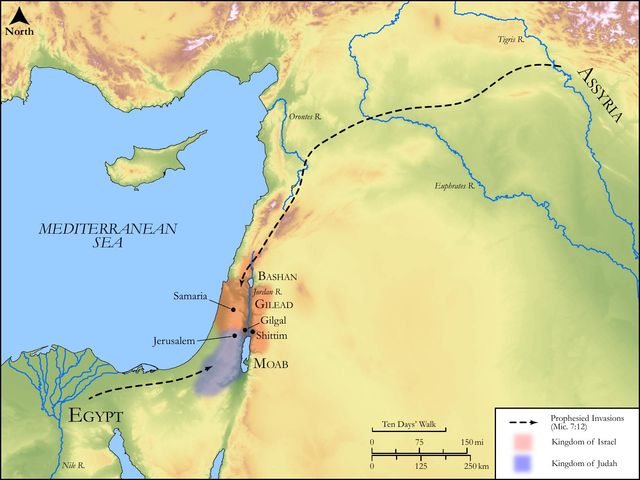
Where Micah reaches
The passages it leans on, and the ones that lean on it
In Jeremiah’s day the elders quote Micah against Zion and recall how Hezekiah feared the LORD and the evil was held back.
The same prophecy of the mountain of the LORD’s house, given almost word for word to Isaiah.
Micah 5:2 Matthew 2:4–6 John 7:42
The chief priests answer Herod from Micah, and some at the feast know Christ must come from Bethlehem.
Deuteronomy 10:12–13 Micah 6:8
Moses had asked Israel the same question, and answered it with fear, love and walking in his ways.
Jesus takes Micah’s words for the division his coming brings into a man’s own household.
Books Micah links to most
The Church Fathers on Micah
101 quotations from 26 writers before AD 800 · the ten most quoted, in date order
- Origen253
- Ephrem373
- Cyril386
- Gregory390
- Ambrose397
- Chrysostom407
- Jerome420
- Augustine430
- Cyril444
- Theodoret458
Jerome, on the mountains melting like wax at the LORD’s coming.
As wax cannot endure the nearness of the fire, and as the waters are carried headlong, so all of the ungodly, when the Lord comes, shall be dissolved and disappear.
Augustine, on the nations flowing to the mountain of the LORD.
The prophet Micah employed the symbol of a high mountain to speak of the gathering of the nations in Christ.
Chrysostom heard in one verse both the Son before all ages and his birth in the flesh.
He revealed his existence before all ages. When he said “there will come the leader who will shepherd my people, Israel,” he revealed Christ’s birth in the flesh.
Ambrose, on the fallen who say “I shall arise.”
Do not rejoice over me, my enemy; for though I have fallen, I will rise again. The ruin of weakness is not severe, if there is also not a desire to not rise from it. Have the will to rise, there is someone present who will make you rise.
Keep studying
Articles