


Micah 7:20
Bible text: King James Version (1769 Blayney text) · Public domain
Bible text: Berean Standard Bible · Public domain
Bible text: American Standard Version (1901) · Public domain
Bible text: World English Bible, Messianic edition · Public domain
Bible text: Geneva Bible (1599) · Public domain
Bible text: Young's Literal Translation · Public domain
- תִּתֵּןti·Tenyou will giveH5414V-Qal-Imperf-2msVerb Qal Imperfect 2nd Singular Masculine
- אֱמֶת'e·MetfaithfulnessH571N-fsNoun Singular Feminine Absolute
- לְיַעֲקֹבle·ya·'a·Koto JacobH3290Prep-l ¦ N-proper-mNoun Proper MasculineלְtoיַעֲקֹבJacob
- חֶסֶדChe·sedcovenant loyaltyH2617N-msNoun Singular Masculine Absolute
- לְאַבְרָהָםle·'av·ra·Hamto AbrahamH85Prep-l ¦ N-proper-mNoun Proper MasculineלְtoאַבְרָהָםAbraham
- אֲשֶׁר'a·SherwhichH834RelParticle Relative
- נִשְׁבַּעְתָּnish·Ba'·tayou sworeH7650V-Niphal-Perf-2msVerb Niphal Perfect 2nd Singular Masculine
- לַאֲבֹתֵינוּla·'a·vo·Tei·nuto our fathersH1Prep-l ¦ N-fpc ¦ 1cpNoun Plural Feminine Constructלַtoאֲבֹתֵיfathersנוּour
- מִימֵיMi·meifrom days ofH3117Prep-m ¦ N-mpcNoun Plural Masculine Constructמִfromימֵיdays of
- קֶדֶםKe·demantiquityH6924N-msNoun Singular Masculine Absolute
English is a literal word-by-word gloss of the Hebrew, not the KJV's wording. Why?
This is the original text the KJV's translators worked from — each Hebrew word with its own literal English meaning in this verse, prepared by scholars at Tyndale House, Cambridge. The KJV translates whole sentences, not word by word, so its wording differs: one Hebrew word can become several English words, and the KJV may choose “the LORD” where the gloss reads “Yahweh”. Both are faithful — they answer different questions. For the KJV's own rendering, switch to the KJV text.
Details
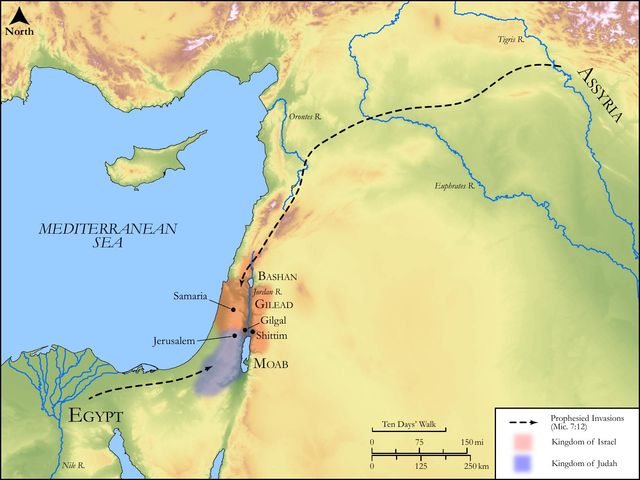
See on the biblical-era map
Study this verse
Public-domain commentary
Matthew Henry
From his Commentary on the Whole Bible. Henry comments on passages, not single verses — this entry covers Micah 7:14–20. His four-level outline is real structure in the source text, so it is rendered as structure.
Here is, I. The prophet's prayer to God to take care of his own people, and of their cause and interest, Mic 7:14. When God is about to deliver his people he stirs up their friends to pray for them, and pours out a spirit of grace and supplication, Zac 12:10. And when we see God coming towards us in ways of mercy, we must go forth to meet him by prayer. It is a prophetic prayer, which amounts to a promise of the good prayed for; what God directed his prophet to ask no doubt he designed to give. Now, 1. The people of Israel are here called the flock of God's heritage, for they are the sheep of his hand, the sheep of his pasture, his little flock in the world; and they are his heritage, his portion in the world. Jacob is the lot of his inheritance. 2. This flock dwells solitarily in the wood, or forest, in the midst of Carmel, a high mountain. Israel was a peculiar people, that dwelt alone, and was not reckoned among the nations, like a flock of sheep in a wood. They were now a desolate people (Mic 7:13), were in the land of their captivity as sheep in a forest, in danger of being lost and made a prey of to the beasts of the forest. They are scattered upon the mountains as sheep having no shepherd. 3. He prays that God would feed them there with his rod, that is, that he would take care of them in their captivity, would protect them, and provide for them, and do the part of a good shepherd to them: "Let thy rod and staff comfort them, even in that darksome valley; and even there let them want nothing that is good for them. Let them be governed by thy rod, not the rod of their enemies, for they are thy people." 4. He prays that God would in due time bring them back to feed in the plains of Bashan and Gilead, and no longer to be fed in the woods and mountains. Let them feed in their own country again, as in the days of old. Some apply this spiritually, and make it either the prophet's prayer to Christ or his Father's charge to him, to take care of his church, as the great Shepherd of the sheep, and to go in and out before them while they are here in this world as in a wood, that they may find pasture as in Carmel, as in Bashan and Gilead.
II.God's promise, in answer to this prayer; and we may well take God's promises as real answers to the prayers of faith, and embrace them accordingly, for with him saying and doing are not two things. The prophet prayed that God would feed them, and do kind things for them; but God answers that he will show them marvellous things (Mic 7:15), will do for them more than they are able to ask or think, will out-do their hopes and expectations; he will show them his marvellous lovingkindness, Psa 17:7.
1.He will do that for them which shall be the repetition of the wonders and miracles of former ages - according to the days of thy coming out of the land of Egypt. Their deliverance out of Babylon shall be a work of wonder and grace not inferior to their deliverance out of Egypt, nay, it shall eclipse the lustre of that (Jer 16:14, Jer 16:15), much more shall the work of redemption by Christ. Note, God's former favours to his church are patterns of future favours, and shall again be copied out as there is occasion.
2.He will do that for them which shall be matter of wonder and amazement to the present age, Mic 7:16, Mic 7:17. The nations about shall take notice of it, and it shall be said among the heathen, The Lord has done great things for them, Psa 126:2. The impression which the deliverance of the Jews out of Babylon shall make upon the neighbouring nations shall be very much for the honour both of God and his church.
(1.)Those that had insulted over the people of God in their distress, and gloried that when they had them down they would keep them down, shall be confounded, when they see them thus surprisingly rising up; they shall be confounded at all the might with which the captives shall now exert themselves, whom they thought for ever disabled. They shall now lay their hands upon their mouths, as being ashamed of what they have said, and not able to say more, by way of triumph over Israel. Nay, their ears shall be deaf too, so much shall they be ashamed at the wonderful deliverance; they shall stop their ears, as being not willing to hear any more of God's wonders wrought for that people, whom they had so despised and insulted over.
(2.)Those that had impudently confronted God himself shall now be struck with a fear of him, and thereby brought, in profession at least, to submit to him (v. 17): They shall lick the dust like a serpent, they shall be so mortified, as if they were sentenced to the same curse the serpent was laid under (Gen 3:14), Upon thy belly shalt thou go, and dust shalt thou eat. They shall be brought to the lowest abasements imaginable, and shall be so dispirited that they shall tamely submit to them. His enemies shall lick the dust, Psa 72:9. Nay, they shall lick the dust of the church's feet, Isa 49:23. Proud oppressors shall now be made sensible how mean, how little, they are, before the great God, and they shall with trembling and the lowest submission move out of the holes into which they had crept (Isa 2:21), like worms of the earth as they are, being ashamed and afraid to show their heads; so low shall they be brought, and such abjects shall they be, when they are abased. When God did wonders for his church many of the people of the land became Jews, because the fear of the Jews, and of their God, fell upon them, Est 8:17. So it is promised here: They shall be afraid of the Lord our God, and shall fear because of thee, O Israel! Forced submissions are often but feigned submissions; yet they redound to the glory of God and the church, though not to the benefit of the dissemblers themselves.
III.The prophet's thankful acknowledgment of God's mercy, in the name of the church, with a believing dependence upon his promise, Mic 7:18-20. We are here taught,
1.To give to God the glory of his pardoning mercy, Mic 7:18. God having promised to bring back the captivity of his people, the prophet, on that occasion, admires pardoning mercy, as that which was at the bottom of it. As it was their sin that brought them into bondage, so it was God's pardoning their sin that brought them our of it; Psa 85:1, Psa 85:2, and Isa 33:24; Isa 38:17; Isa 60:1, Isa 60:2. The pardon of sin is the foundation of all other covenant-mercies, Heb 8:12. This the prophet stands amazed at, while the surrounding nations stood amazed only at those deliverances which were but the fruits of this. Note,
(1.)God's people, who are the remnant of his heritage, stand charged with many transgressions; being but a remnant, a very few, one would hope they should all be very good, but they are not so; God's children have their spots, and often offend their Father.
(2.)The gracious God is ready to pass by and pardon the iniquity and transgression of his people, upon their repentance and return to him. God's people are a pardoned people, and to this they owe their all. When God pardons sin, he passes it by, does not punish it as justly he might, nor deal with the sinner according to the desert of it.
(3.)Though God may for a time lay his own people under the tokens of his displeasure, yet he will not retain his anger for ever, but though he cause grief he will have compassion; he is not implacable; yet against those that are not of the remnant of his heritage, that are unpardoned, he will keep his anger for ever.
(4.)The reasons why God pardons sin, and keeps not his anger for ever, are all taken from within himself; it is because he delights in mercy, and the salvation of sinners is what he has pleasure in, not their death and damnation.
(5.)The glory of God in forgiving sin is, as in other things, matchless, and without compare. There is no God like unto him for this; no magistrate, no common person, forgives as God does. In this his thoughts and ways are infinitely above ours; in this he is God, and not man.
(6.)All those that have experienced pardoning mercy cannot but admire that mercy; it is what we have reason to stand amazed at, if we know what it is. Has God forgiven us our transgressions? We may well say, Who is a God like unto thee? Our holy wonder at pardoning mercy will be a good evidence of our interest in it.
2.To take to ourselves the comfort of that mercy and all the grace and truth that go along with it. God's people here, as they look back with thankfulness upon God's pardoning their sins, so they look forward with assurance upon what he would yet further do for them. His mercy endures for ever, and therefore as he has shown mercy so he will, Mic 7:19, Mic 7:20.
(1.)He will renew his favours to us: He will turn again; he will have compassion; that is, he will again have compassion upon us as formerly he had; his compassions shall be new every morning; he seemed to be departing from us in anger, but he will turn again and pity us. He will turn us to himself, and then will turn to us, and have mercy upon us.
(2.)He will renew us, to prepare and qualify us for his favour: He will subdue our iniquities; when he takes away the guilt of sin, that it may not damn us, he will break the power of sin, that it may not have dominion over us, that we may not fear sin, nor be led captive by it. Sin is an enemy that fights against us, a tyrant that oppresses us; nothing less than almighty grace can subdue it, so great is its power in fallen man and so long has it kept possession. But, if God forgive the sin that has been committed by us, he will subdue the sin that dwells in us, and in that there is none like him in forgiving; and all those whose sins are pardoned earnestly desire and hope; to have their corruptions mortified and their iniquities subdued, and please themselves with the hopes of it. If we be left to ourselves, our iniquities will be too hard for us; but God's grace, we trust, shall be sufficient for us to subdue them, so that they shall not rule us, and then they shall not ruin us.
(3.)He will confirm this good work, and effectually provide that his act of grace shall never be repealed: Thou wilt cast all their sins into the depth of the sea, as when he brought them out of Egypt (to which he has an eye in the promises here, Mic 7:15) he subdued Pharaoh and the Egyptians, and cast them into the depth of the sea. It intimates that when God forgives sin he remembers it no more, and takes care that it shall never be remembered more against the sinner. Eze 18:22, His transgressions shall not be mentioned unto him; they are blotted out as a cloud which never appears more. He casts them into the sea, not near the shore-side, where they may appear again next low water, but into the depth of the sea, never to rise again. All their sins shall be cast there without exception, for when God forgives sin he forgives all.
(4.)He will perfect that which concerns us, and with this good work will do all that for us which our case requires and which he has promised (Mic 7:20): Then wilt thou perform thy truth to Jacob and thy mercy to Abraham. It is in pursuance of the covenant that our sins are pardoned and our lusts mortified; from that spring all these streams flow, and with these he shall freely give us all things. The promise is said to be mercy to Abraham, because, as made to him first, it was mere mercy, preventing mercy, considering what state it found him in. But it was truth to Jacob, because the faithfulness of God was engaged to make good to him and his seed, as heirs to Abraham, all that was graciously promised to Abraham. See here,
[1.]With what solemnity the covenant of grace is ratified to us; it was not only spoken, written, and sealed, but which is the highest confirmation, it was sworn to our fathers; nor is it a modern project, but is confirmed by antiquity too; it was sworn from the days of old; it is an ancient charter.
[2.]With what satisfaction it may be applied and relied upon by us; we may say with the highest assurance, Thou wilt perform the truth and mercy; not one iota or tittle of it shall fall to the ground. Faithful is he that has promised, who also will do it.
Historical interpretation
Historical reception
1 surviving comment on this verse from the historical church.
(Verse 18-20.) Who is God like you? You who take away iniquity and pass over the sin of the remnant of your inheritance. He will not continue to be angry, for he delights in showing mercy. He will again have compassion on us; he will tread our iniquities underfoot and hurl all our sins into the depths of the sea. You will be faithful to Jacob, and show mercy to Abraham, as you swore to our fathers long ago. LXX: Who is like you, O God? You who removes iniquities and surpasses injustices for those who remain as your heritage? He did not retain his anger as testimony because he desires mercies. He will return and have mercy on us, he will submerge our sins, and all our sins will be cast into the deep sea. He will give Jacob truth and Abraham mercy, as you swore to our fathers in the days of old. The wise prophet, seeing the multitude of nations disturbed in its conclusion, is amazed and afraid of God, and therefore the Lord rages in order to take away sins and grant salvation. He praises and marvels at the Lord, saying: Who is like you, O God, taking away iniquities and surpassing injustices (Exodus 12): just as the exterminator passed over the people of Israel in Egypt and did not destroy them (hence the name Passover, which means passing over), so you spare the nations, not counting their iniquities against them. Furthermore, what follows is this: Those who remain of his inheritance have not held his wrath as a testimony. This is the meaning: If he spared the nations that did not want to believe in his Law, and those who were left from the people are abandoned, he did not want to impute their injustices to them nor did he inflict his wrath as a testimony of just punishment. What will he do with his flock, which grazes in the middle of Carmel, and in Bashan, and in Gilead? For he is willing to show mercy, and he will have compassion on us, and he will carry our sins, and the iniquities that weigh upon us like a talent of lead, he himself will bear and plunge into the sea, and he will not allow them to be. He will give truth to Jacob, and mercy to Abraham, in order to restore his people, who are like supplanters and novelties, and who are always in strife. In Christ, he will fulfill his promise, and he will grant mercy to the multitude of nations (for Abraham is called the father of many nations), just as he swore to our ancestors who were witnesses to our ancient faith, that he would save some from the whole multitude of humanity in truth and others in mercy. But when we have interpreted, he will no longer unleash his fury; 'ultra' Symmachus rendered as 'forever'; Theodotio as 'to the end'; Seventy-five edition as a testimony: 'for whom it is placed in the Hebrew Led' (); and both 'ultra' and 'forever' can be understood as testimony. I, too, will speak at the end of my work, by sealing the labor of my booklet with the invocation of the Lord: O God, who is like you? Take away the iniquity of your servant; pass over the sin of the rest of my soul, lest you unleash your fury upon me, nor chastise me in your anger: for you are merciful, and abundant in your mercies. Turn back, and have mercy on me: throw down my iniquities, and cast them into the depths of the sea: so that the saltiness and bitterness of vices may perish in the false region. Give the truth which you promised to your servant Jacob, and the mercy which you promised to your friend Abraham, and deliver my soul from the persecutors of your prophets, Ahab and Jezebel, as you swore to my fathers in ancient days, saying: As I live, says the Lord, I do not desire the death of the sinner, but only that he may turn back and live (Ezek. 33:11). And elsewhere: Immediately when you turn and groan, you will be saved. Then my enemy will see, and she will be covered with confusion, who now says to me: Where is your Lord God (Ps. XLI, 4, 11)? I will see your vengeance in her, and it will be like the mud of the streets, and she will be trampled on, so that she may no longer build Egyptian cities with mud and straw.
Continue studying Micah 7:20 across the web’s major study libraries — every link below opens this exact verse, chapter, or book on the destination site.
Read & Compare
 BibleGatewayThis verse in more than 200 translations and 70 languages.
 Bible.comThe YouVersion reader — hundreds of translations, reading plans, and highlights.
 ESV.orgCrossway's official English Standard Version reader.
 NET BibleThe NET translation with 60,000+ translators' notes on every rendering decision.
 STEP BibleTyndale House's free study tool — original text, vocabulary, and scholarly resources.
 BibliaLogos Bible Software's free web reader.
 USCCBThe New American Bible (Revised Edition) with the U.S. bishops' study notes.
Commentaries
 BibleHub CommentariesDozens of classic commentaries on this verse, gathered on one page.
 StudyLightMore than 100 commentary sets — the largest collection on the web.
 BibleRefPlain-English commentary on what this verse means, verse by verse.
 Enduring WordDavid Guzik's free commentary on this chapter, widely used by Bible teachers.
 Bible Study ToolsVerse commentary alongside Greek and Hebrew study aids.
Original Language & Research
- BibleHub InterlinearThe verse word by word — original language, transliteration, and English.
- BibleHub LexiconEvery word's original-language definition and Strong's entry.
 Blue Letter BibleDeep-study tools — Strong's numbers, concordance, and word studies.
 SefariaThe Hebrew text with Rashi and centuries of Jewish commentary.
Sermons, Hymns & Audio


TrulyRandomVerse is not affiliated with these sites and doesn’t control their content. They’re linked because they’re genuinely useful.
Summary
Micah 7:20 stands as a triumphant and hopeful conclusion to the prophet Micah's message, serving as a powerful affirmation of God's unwavering commitment to His ancient covenant promises. Despite Israel's profound moral failures and the impending divine judgment, this verse highlights God's steadfast faithfulness, His enduring truth, and His boundless mercy, assuring His people that the oaths sworn to their patriarchs, Abraham and Jacob, will be fully and eternally performed.
Context
ShowHideLiterary Context
This verse provides the climactic assurance at the very end of the book of Micah, following a dramatic shift in tone. The preceding verses in Micah 7 depict a nation in deep moral decay, marked by injustice, treachery, and a complete breakdown of trust, even within families (Micah 7:1-6). This bleak outlook is then transformed by the prophet's personal lament and a profound expression of hope and trust in God's ultimate deliverance and restoration (Micah 7:7-10). The immediate verses, Micah 7:18-19, celebrate God's unique character as one who delights in mercy and pardons iniquity, casting all sins into the depths of the sea. Verse 20 then grounds this hope firmly in the historical faithfulness of God and the unbreakable nature of His covenant promises to the patriarchs, providing a final, resounding declaration of divine reliability.
Historical & Cultural Context
Micah prophesied during the reigns of Jotham, Ahaz, and Hezekiah (circa 750-700 BC), a turbulent period for both the Northern Kingdom of Israel and the Southern Kingdom of Judah. The Assyrian Empire was a dominant and terrifying force, threatening and eventually conquering Israel (722 BC) and besieging Judah. Within Israel and Judah, there was widespread oppression, corruption among leaders, false prophecy, and idolatry, leading to moral decay that mirrored the political instability. The concept of "covenant" was central to Israelite identity, defining their unique relationship with Yahweh, established through figures like Abraham and Moses. Oaths sworn by God were considered absolutely binding and irrevocable, a cornerstone of their understanding of divine character. The reference to "fathers from the days of old" evokes a deep historical memory and the foundational promises upon which their national existence and hope for the future were built.
Key Themes
ShowHideMicah 7:20 powerfully encapsulates several major themes woven throughout the book and broader biblical narrative. It underscores Divine Faithfulness and Truth, emphasizing God's absolute reliability and integrity in fulfilling His word, a stark contrast to the unfaithfulness of His people. The mention of "mercy" (Hebrew: hesed) highlights God's Unfailing Mercy and Steadfast Love, demonstrating His loyal, benevolent commitment to His covenant partners, even when they are undeserving. This hesed is the bedrock of His relationship with humanity, extending grace and forgiveness. Most significantly, the verse reaffirms Covenant Continuity, explicitly referencing the foundational promises made to Abraham in Genesis 12 and reaffirmed to Jacob in Genesis 28. This serves as an assurance that God's overarching plan for Israel, including their ultimate restoration and blessing, is rooted in these ancient, unbreakable oaths, providing hope beyond immediate judgment. The themes of judgment and restoration, prominent throughout Micah, find their ultimate resolution in God's covenant fidelity.
Exposition and Analysis
ShowHideKey Word Analysis
ShowHideThis primitive root (H5414) is highly versatile, meaning "to give," but used with immense latitude to signify putting, making, adding, appointing, assigning, delivering, granting, laying, or yielding. In the context of "performing truth" and "mercy," it conveys the active, decisive act of God bringing His promises into full reality. It's not merely a passive declaration but an active, faithful execution of His word.
Contracted from H539 (aman), this word (H571) signifies stability, certainty, trustworthiness, and firmness. It speaks to the absolute integrity of God's character and His word. When God "performs the truth," it means He acts in accordance with His unchangeable, reliable nature and fulfills His promises with absolute fidelity, demonstrating His inherent reliability and the certainty of His declarations.
Derived from H2623 (chasad), this rich theological term (H2617) denotes kindness, piety, favor, good deed, and especially "loving-kindness" or "steadfast love." It describes God's loyal and benevolent commitment to His covenant partners, a love that goes beyond mere pity and is actively demonstrated in keeping His promises despite human unworthiness. It is the enduring, covenantal love that undergirds God's relationship with His people.
Verse Breakdown
ShowHide"Thou wilt perform the truth to Jacob"
This clause emphasizes God's active commitment to His covenant promises. "Truth" (Hebrew: emet) here signifies God's faithfulness, reliability, and the certainty of His word. To "perform the truth" means God will act consistently with His character and fulfill every promise He has made to Jacob, who represents the nation of Israel. This is a declaration of God's unwavering integrity and the surety of His divine word.
"and the mercy to Abraham"
This parallel clause highlights God's steadfast love and loyal commitment (Hebrew: hesed). "Mercy" here is not just pity, but a deep, covenantal loving-kindness. God's hesed to Abraham, the father of the nation, signifies His enduring grace and benevolent faithfulness that extends through generations, ensuring the continuity of His redemptive plan despite human failure.
"which thou hast sworn unto our fathers from the days of old"
This concluding phrase grounds the preceding declarations in historical reality and divine oath. The promises to Jacob and Abraham are not new or conditional on Israel's current behavior, but are rooted in solemn, unchangeable oaths made by God Himself "from the days of old"—meaning from ancient times. This underscores the eternal and unbreakable nature of God's covenant, providing an ultimate foundation for hope and assurance.
Literary Devices
ShowHideMicah 7:20 is rich in Covenant Language, directly referencing the oaths "sworn unto our fathers from the days of old," specifically to Abraham and Jacob. This immediately places the verse within the grand narrative of God's redemptive history, emphasizing the continuity and binding nature of His divine commitments. The verse employs Parallelism through the pairing of "truth to Jacob" and "mercy to Abraham," creating a balanced and reinforcing statement. This specific type of parallelism, where two distinct but related concepts (truth and mercy) are linked to two foundational figures (Jacob and Abraham), underscores the comprehensive nature of God's covenant fidelity. Furthermore, there is a profound Historical Allusion to the foundational promises of the Abrahamic and Jacobic covenants, recalling a time of divine initiative and promise-making that predates Israel's current failures. The phrase "from the days of old" functions as a Merism or a way of referring to the entirety of Israel's history, from its very beginning. Finally, the concept of God "swearing" is an Anthropomorphism, attributing a human action (taking an oath) to God to convey the absolute certainty and solemnity of His commitment, making His promises as binding as humanly possible, but with divine, unshakeable authority.
Theological and Thematic Connections
ShowHideMicah 7:20 serves as a profound theological anchor, affirming God's immutable character as a covenant-keeping God. It teaches that divine faithfulness and mercy are not contingent upon human performance, but are rooted in God's own nature and His self-initiated, unbreakable oaths. This verse beautifully reconciles the themes of judgment and grace, demonstrating that even in the face of profound sin and deserved punishment, God's ultimate plan is one of restoration, driven by His steadfast love and unwavering commitment to His ancient promises. It highlights the enduring nature of God's redemptive purposes, assuring His people that His covenant with Abraham and Jacob remains active and will be fully realized, providing a secure foundation for hope in all generations.
Reflection and Application
ShowHideMicah 7:20 offers a powerful and enduring source of comfort and hope for believers today. In a world characterized by broken promises, shifting loyalties, and uncertain futures, this verse reminds us of the unshakeable foundation of God's character. It assures us that God's truth and mercy are not fleeting emotions or conditional responses, but are intrinsic to His very being and the bedrock of His relationship with humanity. When we face personal failures, societal upheaval, or the consequences of our own sin, we can lean into the absolute certainty that God remains faithful to His word. His past performance of promises to ancient patriarchs serves as an undeniable guarantee of His future actions, including His promises of salvation, forgiveness, and ultimate restoration through Christ. This verse invites us to trust in God's enduring hesed—His loyal, covenantal love—which never fails, providing a secure hope that transcends all circumstances.
Questions for Reflection
ShowHideFAQ
ShowHideWhat is the significance of God "swearing" an oath to Abraham and Jacob?
ShowHideWhen God "swears" an oath, it signifies the absolute, unchangeable, and irrevocable nature of His promise. Unlike human oaths, which can be broken, God's oath is a self-binding declaration, relying on His own perfect character and omnipotence. It provides the highest possible assurance of His commitment, demonstrating that His promises are entirely trustworthy and will certainly come to pass. This is why the author of Hebrews emphasizes that God's oath, combined with His promise, provides "strong encouragement" for those who have fled to Him for refuge (Hebrews 6:17-18).
How does this verse relate to the broader theme of judgment and restoration in Micah?
ShowHideMicah's prophecy is characterized by a stark contrast between severe judgment for Israel's sin and a glorious promise of future restoration. Micah 7:20 serves as the ultimate theological resolution to this tension. It declares that despite the necessity of judgment due to Israel's unfaithfulness, God's underlying covenant promises of truth and mercy, sworn "from the days of old," will ultimately prevail. This means that judgment is not God's final word, but a means to bring about His ultimate redemptive purposes, which are rooted in His unchangeable character and His commitment to His people. The book ends not on a note of despair, but with a resounding affirmation of God's enduring faithfulness and His power to restore.
Christ-Centered Fulfillment
ShowHideMicah 7:20 finds its ultimate and most profound fulfillment in Jesus Christ. He is the very embodiment of God's "truth" and "mercy" performed to Jacob and Abraham. Christ is the "Amen, the faithful and true witness" (Revelation 3:14), the one through whom all of God's promises find their "Yes" and "Amen" (2 Corinthians 1:20). The mercy promised to Abraham, the blessing for all nations, is realized through Christ's atoning work, making Gentiles fellow heirs with Israel through faith (Galatians 3:14; Ephesians 2:11-22). Jesus is the faithful Son who perfectly fulfills the covenant God made with His fathers, establishing a new and better covenant sealed by His own blood (Hebrews 8:6-13). Through Christ, the ancient oaths of God are not merely remembered, but actively and eternally fulfilled, bringing salvation and restoration to all who believe, demonstrating God's unwavering truth and boundless mercy in the most tangible way possible.