


Old Testament · Minor Prophets · Book 34 of 66
Nahum
The burden of Nineveh: the LORD, slow to anger but never acquitting the wicked, foretells the fall of Assyria’s great city and the breaking of its yoke from Judah.
- 3 chapters
- 47 verses
- About 6 minutes to read
- The Hebrew Prophets, c. 800–400 BC
Nahum is one burden against one city. Nineveh, which turned from its evil way at Jonah’s preaching (Jonah 3:10), is now “the bloody city,” “all full of lies and robbery” (Nahum 3:1), and the book foretells its fall from the first verse to the last. Yet Nahum begins with the LORD, not with Nineveh: jealous and avenging, “slow to anger, and great in power,” one who “will not at all acquit the wicked” (1:3). Everything after is that character turned against one empire.
The book speaks to two hearers. Nineveh twice hears “Behold, I am against thee, saith the LORD of hosts” (2:13; 3:5). Judah hears that the oppressor’s yoke will be broken (1:13) and that a herald is coming over the mountains with peace (1:15). The same visitation is ruin to the one and rescue to the other, because “The LORD is good, a strong hold in the day of trouble” (1:7). The book closes on a question that is its own verdict: “for upon whom hath not thy wickedness passed continually?” (3:19).
The LORD is good, a strong hold in the day of trouble; and he knoweth them that trust in him.
Nahum 1:7 KJV
Before you read
- Who wrote it
- Nahum the Elkoshite, named in the title (Nahum 1:1); nothing more is told of him. His name comes from nâcham, to comfort. Elkosh appears nowhere else in Scripture. Cyril of Alexandria took it for
a village somewhere in the land of the Jews
. - When it was written
- After the fall of No, which the book recounts as past (Nahum 3:8–10), and before the fall of Nineveh, which it foretells. Judah is still under the Assyrian yoke (1:13).
How Nahum is laid out
6 movements · 12 passages · 47 verses
The LORD who avenges
1:1–8 · 8 verses
The burden of Nineveh, in the vision of Nahum the Elkoshite, opens on the LORD himself: jealous and avenging, slow to anger, never acquitting the wicked. He dries the sea and the rivers; Bashan, Carmel and Lebanon languish, and the mountains quake at his presence. He is good, a strong hold to those who trust him, and an overrunning flood to his enemies.
1 passages
Yoke broken, peace proclaimed
1:9–15 · 7 verses
The words turn between Nineveh and Judah. Nothing plotted against the LORD will stand: he will make an utter end, and affliction will not rise up the second time. One has come out who imagines evil against the LORD, a wicked counsellor; his name and the images in the house of his gods will be cut off. Judah’s yoke will be broken, and a herald on the mountains publishes peace.
Nineveh taken and plundered
2:1–10 · 10 verses
“He that dasheth in pieces” comes up against Nineveh, and the city is told to keep the munition. Shields are red, chariots rage in the streets like torches, the gates of the rivers are opened and the palace is dissolved. Nineveh is like a pool of water, but its people flee, and none looks back at the cry “Stand, stand.” The city is left “empty, and void, and waste.”
The lions’ den emptied
2:11–13 · 3 verses
A taunt over the den where the old lion walked with his whelps and none made them afraid, where he tore prey enough for them and filled his holes with ravin. Then the LORD of hosts speaks: “Behold, I am against thee.” Nineveh’s chariots will burn, the sword will devour its young lions, and its prey will be cut off from the earth.
1 passages
Woe to the bloody city
3:1–7 · 7 verses
Woe to the bloody city, full of lies and robbery, where the prey never departs. Whips crack, wheels rattle, and horsemen charge over corpses past counting. The cause is named: the whoredoms of “the wellfavoured harlot, the mistress of witchcrafts,” who sold nations. The LORD will shew the nations her nakedness and make her a gazingstock, and none will bemoan her.
No better than No
3:8–19 · 12 verses
Nineveh is no better than populous No, which had the waters for its wall and Ethiopia, Egypt, Put and Lubim for its helpers, and still went into captivity. Nineveh’s strong holds will fall like ripe figs into the eater’s mouth, and its captains fly off like locusts. Its shepherds slumber, its people are scattered, and its wound has no healing.
The words Nahum turns on
The LORD who avenges is a strong hold to his own; Nineveh’s prey is cut off, and no one is found to comfort her.
What Nahum teaches
nâqam · avenge
Slow to anger, and great in power
Nahum describes the LORD in the words he proclaimed of himself at Sinai: “merciful and gracious, longsuffering,” and one “that will by no means clear the guilty” (Exodus 34:6–7). When Nineveh was spared, Jonah complained of the first half: “thou art a gracious God, and merciful, slow to anger” (Jonah 4:2). Nahum, when its time is spent, holds both halves in one sentence: “The LORD is slow to anger, and great in power, and will not at all acquit the wicked” (1:3). The verse before names his vengeance three times (1:2). It is not a loss of temper but the act of the judge against his adversaries, and for that reason it belongs to him alone: “Vengeance is mine; I will repay, saith the Lord” (Romans 12:19).
mâʻôwz · strong hold
A strong hold in the day of trouble
In the middle of the storm stands one sentence of rest: “The LORD is good, a strong hold in the day of trouble; and he knoweth them that trust in him” (1:7). The same coming that makes “an utter end” of Nineveh (1:8) ends Judah’s affliction: “Though I have afflicted thee, I will afflict thee no more” (1:12). The word for strong hold, mâʻôwz, comes once more, at Nineveh’s end: “thou also shalt seek strength because of the enemy” (3:11). Nineveh will look for a refuge and find none; those who trust the LORD have one. Paul gives the church the same assurance: “The Lord knoweth them that are his” (2 Timothy 2:19).
ṭereph · prey
The lion, the harlot and the prey
Nahum names Nineveh’s sins in three images. It is a lion that “filled his holes with prey, and his dens with ravin” (2:12), a city where “the prey departeth not” (3:1), a harlot “that selleth nations through her whoredoms, and families through her witchcrafts” (3:4). Each judgment answers its image. The lion loses what it took: “I will cut off thy prey from the earth” (2:13). The harlot is shamed before the kingdoms she sold (3:5). The city is no safer than No, which fell with all its waters and allies (3:8–10). When it falls, none will bemoan it: “whence shall I seek comforters for thee?” (3:7). The verb is the root of Nahum’s own name, and the one Jonah uses when “God repented of the evil” he had said he would do to Nineveh (Jonah 3:10).
Christ in Nahum
Nahum’s herald on the mountains announces that the oppressor “is utterly cut off,” and Judah may keep its feasts (Nahum 1:15). Isaiah’s herald, in the same words, says to Zion, “Thy God reigneth!” (Isaiah 52:7), and Paul cites Isaiah’s form of the line for those sent with the gospel: “How beautiful are the feet of them that preach the gospel of peace” (Romans 10:15). Theodoret read Assyria’s fall as a figure of that greater deliverance: let us take the Assyrians’ kingdom that was destroyed as the devil’s tyranny brought to an end through Christ the Lord
.
The LORD who “rebuketh the sea” (1:4) is the one who arose in the ship and “rebuked the winds and the sea” (Matthew 8:26); then, Tertullian wrote, Nahum is also verified
. Nahum asks, “Who can stand before his indignation?” (1:6), and Revelation asks it again at the day of the Lamb’s wrath (Revelation 6:16–17). The New Testament’s answer is a name: “Jesus, which delivered us from the wrath to come” (1 Thessalonians 1:10).
People
By how many verses name them
Places
11 named
- NinevehThe city of the burden, “the bloody city” of chapter 33
- AssyriaNineveh’s kingdom; its king is addressed in the last verses1
- BashanLanguishes at the LORD’s rebuke, with Carmel and Lebanon1
- CarmelLanguishes with Bashan when the LORD rebukes the sea1
- CushEthiopia, the strength of No before its fall1
- EgyptWith Ethiopia, the strength that could not save No1
- ElkoshNahum’s home, named only in the title1
- LebanonIts flower languishes in the hymn of the LORD’s power1
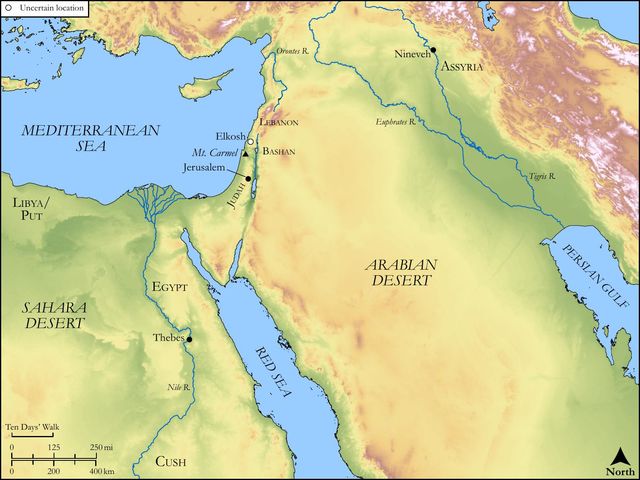
Where Nahum reaches
The passages it leans on, and the ones that lean on it
Exodus 34:6–7 Nahum 1:3 Jonah 4:2
The name proclaimed at Sinai. Jonah appeals to its mercy for Nineveh; Nahum to its warning that he will by no means clear the guilty.
The LORD rebukes the sea; Christ arises in the ship and rebukes the winds and the sea.
Isaiah had promised that the Assyrian’s yoke would be taken from off Zion’s neck.
Nahum 1:15 Isaiah 52:7 Romans 10:15
The herald on the mountains: Judah freed from Assyria, Zion told its God reigns, the gospel of peace preached.
The city that sold nations by its witchcrafts, and Babylon the great, by whose sorceries all nations were deceived.
Books Nahum links to most
The Church Fathers on Nahum
44 quotations from 11 writers before AD 800 · the ten most quoted, in date order
- Tertullian220
- Origen253
- Athanasius373
- Cyril386
- Ambrose397
- Chrysostom407
- Jerome420
- Theodore428
- Cyril444
- Theodoret458
Theodoret on 1:3: the Ninevites themselves were witnesses of God’s longsuffering before the punishment came.
He does not suddenly and all at once inflict punishment, but only after exercising extreme longsuffering. You Ninevites are witnesses to this, practicing repentance and finding salvation, and then guilty of extreme wickedness and for a time not paying the penalty for it.
Jerome read 1:7 with Paul’s seal, “The Lord knoweth them that are his.”
When He begins to be angry with the nations, and to destroy once powerful kingdoms, He will know those who are His, and He will not overwhelm those who sail with one storm.
Augustine, reading the Septuagint of 1:15 and 2:1, saw the risen Christ breathing the Spirit on his disciples.
Anyone who knows the Gospels will recognize who it was that came up from hell and breathed the Holy Spirit into the face of Judah, that is, into the face of his Jewish disciples.
Keep studying
Articles