


Isaiah 10:27
Bible text: King James Version (1769 Blayney text) · Public domain
Bible text: King James Version with Strong's numbers · Public domain
Bible text: Berean Standard Bible · Public domain
Bible text: American Standard Version (1901) · Public domain
Bible text: World English Bible, Messianic edition · Public domain
Bible text: Geneva Bible (1599) · Public domain
Bible text: Young's Literal Translation · Public domain
- וְהָיָהve·ha·Yahand it will beH1961Conj-w ¦ V-Qal-ConsecPerf-3msVerb Qal Consecutive Perfect 3rd Singular Masculineוְandהָיָהit will be
- בַּיּוֹםbai·Yomin the dayH3117Prep-b ¦ N-msNoun Singular Masculine Absoluteבַּin theיּוֹםday
- הַהוּאha·Hu'<the> thatH1931Art ¦ Pro-3msPronoun Personal 3rd Singular Masculineהַ<the>הוּאthat
- יָסוּרya·Surit will be removedH5493V-Qal-Imperf-3msVerb Qal Imperfect 3rd Singular Masculine
- סֻבֳּלוֹsu·bo·Loits burdenH5448N-msc ¦ 3msNoun Singular Masculine Constructסֻבֳּלburdenוֹits
- מֵעַלme·'Alfrom onH5921Prep-m ¦ PrepPrepositionמֵfromעַלon
- שִׁכְמֶךָshikh·Me·khayour shoulderH7926N-msc ¦ 2msNoun Singular Masculine Constructשִׁכְמֶshoulderךָyour
- וְעֻלּוֹve·'u·Loand its yokeH5923Conj-w ¦ N-msc ¦ 3msNoun Singular Masculine Constructוְandעֻלּyokeוֹits
- מֵעַלme·'Alfrom onH5921Prep-m ¦ PrepPrepositionמֵfromעַלon
- צַוָּארֶךָtza·va·Re·khayour neckH6677N-msc ¦ 2msNoun Singular Masculine Constructצַוָּארֶneckךָyour
- וְחֻבַּלve·chu·Baland it will be brokenH2254Conj-w ¦ V-Pual-ConsecPerf-3msVerb Pual Consecutive Perfect 3rd Singular Masculineוְandחֻבַּלit will be broken
- עֹל'ol[the] yokeH5923N-msNoun Singular Masculine Absolute
- מִפְּנֵיmi·pe·nei<from> because ofH6440Prep-m ¦ N-mpcNoun Plural Masculine Constructמִ<from>פְּנֵיbecause of
- שָׁמֶןSha·menfatnessH8081N-msNoun Singular Masculine Absolute
English is a literal word-by-word gloss of the Hebrew, not the KJV's wording. Why?
This is the original text the KJV's translators worked from — each Hebrew word with its own literal English meaning in this verse, prepared by scholars at Tyndale House, Cambridge. The KJV translates whole sentences, not word by word, so its wording differs: one Hebrew word can become several English words, and the KJV may choose “the LORD” where the gloss reads “Yahweh”. Both are faithful — they answer different questions. For the KJV's own rendering, switch to the KJV text.
Details
See on the biblical-era map
Study this verse
Public-domain commentary
Matthew Henry
From his Commentary on the Whole Bible. Henry comments on passages, not single verses — this entry covers Isaiah 10:24–34. His three-level outline is real structure in the source text, so it is rendered as structure.
The prophet, in his preaching, distinguishes between the precious and the vile; for God in his providence, even in the same providence, does so. He speaks terror, in Sennacherib's invasion, to the hypocrites, who were the people of God's wrath, Isa 10:6. But here he speaks comfort to the sincere, who were the people of God's love. The judgment was sent for the sake of the former; the deliverance was wrought for the sake of the latter. Here we have,
I.An exhortation to God's people not to be frightened at this threatening calamity, nor to be put into any confusion or consternation by it.
Let the sinners in Zion be afraid (Isa 33:14): but O my people, that dwellest in Zion, be not afraid of the Assyrian, Isa 10:24. Note, It is against the mind and will of God that his people, whatever may happen, should give way to that fear which has torment and amazement. Those that dwell in Zion, where God dwells and where his people attend him, and are employed in his service, that are under the protection of the bulwarks that are round about Zion (Psa 48:13), need not be afraid of any enemy. Let their souls dwell at ease in God.
II.Considerations offered for the silencing of their fear.
1.The Assyrian shall do nothing against them but what God has appointed and determined. They are here told before hand what he shall do, that it may be no surprise to them: "He shall smite thee by the divine permission, but it shall be only with a rod to correct thee, not with a sword to wound and kill; nay, he shall but lift up his staff against thee, threaten thee, and frighten thee, and shake the rod at thee, after the manner of Egypt, as the Egyptians shook their staff against your fathers at the Red Sea, when they said, We will pursue, we will overtake (Exo 15:9), but could not reach to do them any hurt." Note, We should not be frightened at those enemies that can do no more than frighten us.
2.The storm shall soon blow over (Isa 10:25): Yet a very little while - a little, little while (so the word is), and the indignation shall cease, even my anger, which is the staff in their hand (Isa 10:5), so that when that ceases they are disarmed and disabled to do any further mischief. Note, God's anger against his people is but for a moment (Psa 30:5), and when that ceases, and is turned away from us, we need not fear the fury of any man, for it is impotent passion.
3.The enemy that threatens them shall himself be reckoned with. God's anger against his people shall cease in the destruction of their enemies; when he turns away his wrath from Israel he shall turn it against the Assyrian; and the rod with which he corrected his people shall not only be laid aside, but thrown into the fire. He lifted up his staff against Zion, but God shall stir up a scourge for him (Isa 10:26); he is a terror to God's people, but God will be a terror to him. The destroying angel shall be this scourge, which he can neither flee from nor contend with. The prophet, for the encouragement of God's people, quotes precedents, and puts them in mind of what God had done formerly against the enemies of his church, who were very strong and formidable, but were brought to ruin. The destruction of the Assyrian shall be,
(1.)According to the slaughter of Midian (which was effected by an invisible power, but effected suddenly, and it was a total rout); and as, at the rock of Oreb, one of the princes of Midian, after the battle, was slain, so shall Sennacherib be in the temple of his god Nisroch, after the defeat of his forces, when he thinks the bitterness of death is past. Compare with this Psa 83:11, Make their nobles like Oreb and like Zeeb; and see how God's promises and his people's prayers agree.
(2.)As his rod was upon the sea, the Red Sea, as Moses' rod was upon that, to divide it first for the escape of Israel and then to close it again for the destruction of their pursuers, so shall his rod now be lifted up, after the manner of Egypt, for the deliverance of Jerusalem and the destruction of the Assyrian. Note, It is good to observe a resemblance between God's latter and former appearances for his people, and against his and their enemies.
4.They shall be wholly delivered from the power of the Assyrian, and from the fear of it, Isa 10:27. "They shall not only be eased of the Assyrian army, which is now quartered upon them and which is a grievous yoke and burden to them, but they shall no more pay that tribute to the king of Assyria which before this invasion he exacted from them (Kg2 18:14), shall be no longer at his service, nor lie at his mercy, as they have done; nor shall he ever again put the country under contribution." Some think it looks further, to the deliverance of the Jews out of their captivity in Babylon; and further yet, to the redemption of believers from the tyranny of sin and Satan. The yoke shall not only be taken away, but it shall be destroyed. The enemy shall no more recover his strength, to do the mischief he has done; and this because of the anointing, for their sakes who were partakers of the anointing.
(1.)For Hezekiah's sake, who was the anointed of the Lord, who had been an active reformer, and was dear to God.
(2.)For David's sake. This is particularly given as the reason why God would defend Jerusalem from Sennacherib (Isa 37:35), For my own sake, and for my servant David's sake.
(3.)For his people Israel's sake, the good people among them that had received the unction of divine grace.
(4.)For the sake of the Messiah, the Anointed of God, whom God had an eye to in all the deliverances of the Old Testament church, and hath still an eye to in all the favours he shows to his people. It is for his sake that the yoke is broken, and that we are made free indeed.
III.A description both of the terror of the enemy and the terror with which many were struck by it, and the folly of both exposed, Isa 10:28, to the end. Here observe,
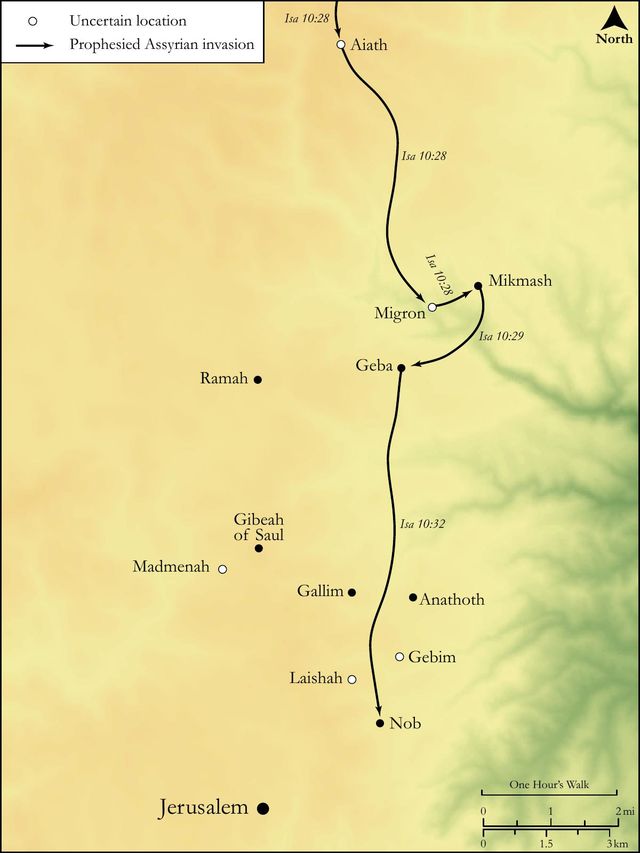
1.How formidable the Assyrians were and how daring and threatening they affected to appear. Here is a particular description of the march of Sennacherib, what course he steered, what swift advances he made: He has come to Aiath, etc. "This and the other place he has made himself master of, and has met with no opposition." At Michmash he has laid up his carriages, as if he had no further occasion for his heavy artillery, so easily was every place he came to reduced; or the store-cities of Judah, which were fortified for that purpose, had now become his magazines. Some remarkable pass, and an important one, he had taken: They have gone over the passage.
2.How cowardly the men of Judah were, the degenerate seed of that lion's whelp. They were afraid; they fled upon the first alarm, and did not offer to make any head against the enemy. Their apostasy from God had dispirited them, so that one chased a thousand of them. Instead of a valiant shout, to animate one another, nothing was heard by lamentation, to discourage and weaken one another. And poor Anathoth, a priests' city, that should have been a pattern of courage, shrieks louder than any, Isa 10:30. With respect to those that gathered themselves together, it was not to fight, but to flee by consent, Isa 10:31. This is designed either,
(1.)To show how fast the news of the enemy's progress flew through the kingdom: He has come to Aiath, says one; nay, says another, He has passed to Migron, etc. And yet, perhaps, it was not altogether so bad as common fame represented it. But we must watch against the fear, not only of evil things, but of evil tidings, which often make things worse than really they are, Psa 112:7. Or,
(2.)To show what imminent danger Jerusalem was in, when its enemies made so many bold advances towards it and its friends could not make one bold stand to defend it. Note, The more daring the church's enemies are, and the more dastardly those are that should appear for her, the more will God be exalted in his own strength, when, notwithstanding this, he works deliverance for her.
3.How impotent his attempt upon Jerusalem shall be: he shall remain at Nob, whence he may see Mount Zion, and there he shall shake his hand against it, Isa 10:32. He shall threaten it, and that shall be all; it shall be safe, and shall set him at defiance. The daughter of Jerusalem, to be even with him, shall shake her head at him, Isa 37:22.
4.How fatal it would prove, in the issue, to himself. When he shakes his hand at Jerusalem, and is about to lay hands on it, then is God's time to appear against him; for Zion is the place of which God has said, This is my rest for ever; therefore those who threaten it affront God himself. Then the Lord shall lop the bough with terror and cut down the thickets of the forest, Isa 10:33, Isa 10:34.
(1.)The pride of the enemy shall be humbled, the boughs that are lifted up on high shall be lopped off, the high and stately trees shall be hewn down; that is, the haughty shall be humbled. Those that lift up themselves in competition with God or opposition to him shall be abased.
(2.)The power of the enemy shall be broken: The thickets of the forest he shall cut down. When the Assyrian soldiers were under their arms, and their spears erect, they looked like a forest, like Lebanon; but, when in one night they all became as dead corpses, the pikes were laid on the ground, and Lebanon was of a sudden cut down by a mighty one, by the destroying angel, who in a little time slew so many thousands of them: and, if this shall be the exit of that proud invader, let not God's people be afraid of him. Who art thou, that thou shouldst be afraid of a man that shall die?
Historical interpretation
Two Centuries of Reception
3 surviving comments on this verse. Each one is dated, so this reads as a timeline rather than a list.
Select a marker to jump to its quote. Markers stagger vertically where authors wrote within a few decades of each other.
(v. 24 seqq.) Therefore thus says the Lord God of hosts: Do not fear, my people who dwell in Zion, from Assyria, who shall strike you with a rod and lift up his staff against you, as the Egyptians did. For yet a little while and my indignation will be fulfilled and my anger will be directed towards their wickedness. And the Lord of hosts will raise a whip against them, as he did against Midian at the rock of Oreb, and his staff against the sea, and he will lift it up in the manner of the Egyptians. And it shall come to pass in that day: his burden shall be taken away from your shoulder, and his yoke from your neck, and the yoke shall be destroyed because of the anointing oil. Regarding the stone, which in Hebrew is interpreted as Aquila, Symmachus, and Theodotion put the Hebrew word Sur Oreb. Regarding this, the LXX interpreted as the place of tribulation, about which we will say in its proper place. It seems difficult to you, O inhabitant of Zion, that while all the surrounding nations are subjugated by the Assyrians, you alone would be liberated from their hands. Listen to what I say: do not be afraid, my people, because you will be captured by Assyria when it conquers. For in the fourteenth year of King Hezekiah's reign (2 Kings 18), Sennacherib, the Assyrian king, will come to attack all the fortified cities of Judah and capture them. He will send his commander-in-chief, Rabshakeh, to terrify the besieged people of Jerusalem. However, you should know that he will not strike you with a sword, but with a rod. He will march against King Tirhakah of Ethiopia, the Egyptians, and the Red Sea by way of Egypt. He will only raise his staff against you, and he will not be able to strike you. For a little while longer, I will return from Egypt with an infinite multitude of army and wishing to besiege you, I will immediately strike with my indignation, and I will raise that whip, which once I used against the Midianites under Gideon (Judges 7), who was also called Jerubbaal. When Oreb and Zebah, the leaders of the Midianites, were killed on a very hard rock, that is, flint, which is called Sur in Hebrew, so that from the rock and from the king who was killed on it, the place received the name Rock of Oreb. So he shall lift up his rod over the Red Sea, going against the Ethiopians, and he shall lift it up again on his return to you by the way of Egypt; but as soon as he comes from Egypt, the burden shall be taken away from your shoulders and the yoke of his rule shall be removed, and you shall cease to serve. This yoke, that is, the power of the Assyrians, will decay in the presence of oil, that is, the mercy of God. We can also understand what he said: 'He shall strike you with a rod and shall lift up his staff over you on the way to Egypt.' And again: 'He shall lift up his rod over the sea and he shall lift it up on the way to Egypt.' This can also be understood as why he struck many from the tribe of Judah and captured cities around the kingdom of Jerusalem, because they had put their trust not in God, but in the Egyptians. Then Rabsaces taunts them, saying: Behold thou trustest upon the reed upon Egypt; upon which if a man lean, it will go into his hand, and pierce it. (IV Kings 18:21) So is Pharao king of Egypt to all that trust in him. The history also of the Madianites is written in the book of Judges (Judges 7), which we read also in the psalm: Make their princes like Oreb, and Zeb, and Zebbee, and Salmana (Psalm 82:11-12). Therefore those who believe that it signifies the time when in the book of Numbers (Chap. 25) the Midianites killed by Israel are referred to from the desert of Sur to the mountain of God, Horeb, with which time they were not on Mount Horeb, but in the desert of Shittim. According to the anagoge, it is commanded to the people dwelling in the Church not to fear their adversaries, who are always ready for battle, and have overturned many souls with their disputes. For this reason, they can receive only a little power against the people of God, and not strike with a sword, but with a rod, that is, not to kill, but to threaten, because they have walked in the way of Egypt and have not trusted in the Lord. But when they have returned to God and have left the path of Egypt, then the scourge of God is to be raised up by judgment against the adversaries. For Midian is interpreted as meaning 'by judgment,' so that with the breath of his mouth and the oil of mercy the yoke of the enemies may decay.
It is possible that the Holy Spirit himself was denoted by the name of oil, concerning which it is said through the prophet: “and the yoke will rot at the presence of the oil.” The yoke rotted at the presence of oil because when we are anointed with the grace of the Holy Spirit, we are liberated from the bondage of our slavery. Then, with the prideful tyranny of the evil spirit broken, the yoke with which the necks of our freedom was oppressed is destroyed. Again, it is written about the oil: “My beloved had a vineyard on a hill called the son of oil.” The son of oil represents the faithful people, whose faith in God is generated by the interior anointing of the Holy Spirit.Although it has been burdened in the past with many tribulations, therefore, let the holy church call to mind the gifts of the Spirit and the marvelous prophecies which it now possesses, and let it lament its silence, saying, “The rock poured out for me streams with oil.”
It was said by Moses, “They drew honey from the rock, and oil from the hardest rock.” … But because according to Paul, “the rock was Christ,” they drew honey from the rock who saw the deeds and miracles of our Redeemer; and they drew oil from the hard rock because they were found worthy to be anointed with the outpouring of the Holy Spirit after his resurrection.… The gift of the holy anointing flowed out of him through the breathing forth of the Spirit. Of this oil the prophet said, “The yoke will be destroyed from before the oil.”
Continue studying Isaiah 10:27 across the web’s major study libraries — every link below opens this exact verse, chapter, or book on the destination site.
Read & Compare
 BibleGatewayThis verse in more than 200 translations and 70 languages.
 Bible.comThe YouVersion reader — hundreds of translations, reading plans, and highlights.
 ESV.orgCrossway's official English Standard Version reader.
 NET BibleThe NET translation with 60,000+ translators' notes on every rendering decision.
 STEP BibleTyndale House's free study tool — original text, vocabulary, and scholarly resources.
 BibliaLogos Bible Software's free web reader.
 USCCBThe New American Bible (Revised Edition) with the U.S. bishops' study notes.
Commentaries
 BibleHub CommentariesDozens of classic commentaries on this verse, gathered on one page.
 StudyLightMore than 100 commentary sets — the largest collection on the web.
 BibleRefPlain-English commentary on what this verse means, verse by verse.
 Enduring WordDavid Guzik's free commentary on this chapter, widely used by Bible teachers.
 Bible Study ToolsVerse commentary alongside Greek and Hebrew study aids.
Original Language & Research
- BibleHub InterlinearThe verse word by word — original language, transliteration, and English.
- BibleHub LexiconEvery word's original-language definition and Strong's entry.
 Blue Letter BibleDeep-study tools — Strong's numbers, concordance, and word studies.
 SefariaThe Hebrew text with Rashi and centuries of Jewish commentary.
Sermons, Hymns & Audio


TrulyRandomVerse is not affiliated with these sites and doesn’t control their content. They’re linked because they’re genuinely useful.
Summary
Isaiah 10:27 presents a powerful prophetic declaration of divine liberation, assuring God's people that the oppressive burden and heavy yoke imposed by their adversaries will be supernaturally removed and utterly destroyed. This promised deliverance is not attributed to human strength or strategic maneuvering but to a unique divine intervention, specifically "because of the anointing," signifying God's consecrated power and presence at work to break every form of bondage and restore freedom.
Context
ShowHideLiterary Context
Isaiah 10:27 is situated within a significant prophetic oracle (Isaiah 7-12) primarily addressing the impending threat and eventual downfall of the formidable Assyrian Empire. Chapters 7-9 focus on the immediate Assyrian menace to Judah and the foundational promise of Immanuel, while chapter 10 specifically details Assyria's arrogant pride, its role as God's unwitting instrument of judgment against rebellious Israel, and its ultimate, certain destruction. The verse immediately precedes a vivid and dramatic description of Assyria's final march toward Jerusalem and its subsequent divine defeat (Isaiah 10:28-34), culminating in the glorious messianic prophecy of the Branch from Jesse (Isaiah 11:1-16). This verse serves as a pivotal turning point, transitioning from the description of Assyrian oppression to the certain hope of God's miraculous deliverance for His faithful remnant.
Historical & Cultural Context
In the 8th century BC, the Neo-Assyrian Empire was the dominant global superpower, infamous for its brutal military campaigns, forced deportations of conquered populations, and the imposition of heavy tribute and forced labor on subjugated nations. The "burden" (Hebrew: çôbel) and "yoke" (Hebrew: ʻôl) were common, deeply resonant metaphors for severe political, economic, and military subjugation, reflecting the crushing taxes, forced labor, and loss of national sovereignty experienced by the nations that served Assyria. Nations like Judah lived under constant existential threat of Assyrian invasion and relentless oppression. The imagery of a yoke being broken was profoundly significant, directly referencing the experience of slavery and bondage, thus making the promise of its complete removal a powerful symbol of total freedom, restoration of dignity, and divine intervention.
Key Themes
ShowHideThis verse powerfully contributes to several overarching themes within the book of Isaiah and the broader prophetic literature. It highlights God's Sovereignty over Nations, demonstrating His absolute control even over pagan empires, using them as instruments of His will, yet holding them fully accountable for their pride and cruelty, as seen throughout Isaiah 10. A central theme is Divine Deliverance from Oppression, where God, not human strength or political maneuvering, provides ultimate freedom from physical, economic, and spiritual bondage. This liberation is intrinsically tied to God's Faithfulness to His Covenant, assuring His remnant that despite periods of judgment, His promises of restoration and protection remain steadfast. Finally, the phrase "because of the anointing" introduces the profound theme of Messianic Hope and Divine Empowerment, subtly pointing towards a future deliverer who would embody God's consecrated power, echoing the promises found in Isaiah 9:6-7.
Exposition and Analysis
ShowHideKey Word Analysis
ShowHideFrom a root meaning "to impose on the neck," this word literally refers to the heavy wooden bar placed on the necks of draft animals (or sometimes captives) for drawing loads or for control. Figuratively, as used here, it powerfully represents bondage, servitude, and oppressive authority. Its destruction signifies complete liberation from the control and burden imposed by an external, tyrannical power.
This primitive root means "to wind tightly," "to bind," but also carries the strong sense of "to pervert," "destroy," or "spoil." In the context of a yoke, it implies a violent, complete breaking or shattering, rendering the instrument of bondage utterly useless and incapable of further oppression. It suggests an irreversible act of demolition, not just a temporary removal or loosening.
Though often referring literally to "oil" or "ointment," especially perfumed oil used for various purposes, the term here carries a profound figurative sense of richness, fatness, or, more significantly, the act of anointing. In the Old Testament, anointing with oil symbolized divine consecration, empowerment, and the impartation of God's Spirit for specific roles (priests, kings, prophets). Its presence as the cause of the yoke's destruction points to a supernatural, divinely empowered agency, rather than human effort or military might. It implies the powerful, consecrated presence or work of God Himself, or His specially chosen and empowered agent.
Verse Breakdown
ShowHide"And it shall come to pass in that day,"
This introductory phrase signals a future, divinely appointed time. "That day" is a common prophetic idiom, often referring to a significant moment of God's decisive intervention, whether for judgment or salvation. Here, it underscores the certainty and specific timing of the promised deliverance, emphasizing its divine origin and orchestration.
"that his burden shall be taken away from off thy shoulder,"
"His burden" refers to the heavy load, tribute, or oppression imposed by the oppressor (specifically Assyria in the immediate context). The "shoulder" is the primary anatomical place where heavy loads are carried, symbolizing the physical and psychological weight of subjugation. "Taken away" (Hebrew: çûwr) implies a complete and decisive removal, a lifting of the crushing weight and responsibility of forced subjugation.
"and his yoke from off thy neck,"
This clause powerfully reiterates and intensifies the imagery of oppression. The "yoke" on the "neck" signifies forced servitude, loss of freedom, and the dehumanizing control characteristic of conquered peoples. Its removal emphasizes total emancipation from the oppressor's coercive control and the restoration of dignity and autonomy.
"and the yoke shall be destroyed because of the anointing."
This is the climactic and most profound declaration of the verse. The repetition of "the yoke" underscores the complete and final nature of the deliverance. Crucially, the destruction is attributed to "the anointing," indicating that this liberation is not a result of human strength, military prowess, or political maneuvering, but a direct, supernatural act of God's consecrated power, His empowering presence, or the work of His specially anointed agent.
Literary Devices
ShowHideIsaiah 10:27 is rich in Metaphor and Symbolism. The "burden" and "yoke" are potent metaphors for the oppressive political, economic, and military subjugation imposed by the Assyrian Empire. These images evoke the physical toil, dehumanizing control, and loss of freedom associated with slavery, making the promise of their removal profoundly impactful and relatable. The "shoulder" and "neck" function as Synecdoche, representing the entire person bearing the weight of oppression and the site of forced submission. The phrase "in that day" is a prophetic Idiom, signaling a specific, divinely ordained time of significant intervention and eschatological fulfillment. Most significantly, "the anointing" functions as a powerful Symbol of divine power, consecration, and the active presence of God's Spirit. Its role as the direct cause of the yoke's destruction underscores that the liberation is supernatural, not human-achieved, pointing to God's unique, set-apart power as the ultimate source of freedom and breakthrough.
Theological and Thematic Connections
ShowHideIsaiah 10:27 articulates a core biblical truth: God's sovereign power to deliver His people from all forms of bondage. This promise of a broken yoke resonates deeply with the broader biblical narrative of redemption, where God consistently intervenes to free His people from oppression, whether it be physical slavery (as in the Exodus), political subjugation, or spiritual bondage. The "anointing" as the source of this power points to the divine Spirit at work, a theme that culminates in the New Testament's understanding of the Holy Spirit's empowering presence in the lives of believers and, preeminently, in the person and redemptive work of Jesus Christ, the Anointed One. This verse, therefore, serves as a powerful testament to God's unwavering commitment to liberation, foreshadowing the ultimate freedom found in Him.
Reflection and Application
ShowHideIsaiah 10:27 offers profound encouragement and a vital spiritual principle for believers facing any form of burden or yoke today. While the original context was physical and political oppression, the underlying truth extends powerfully to spiritual, emotional, and psychological burdens—the heavy weight of sin, despair, anxiety, addiction, overwhelming circumstances, or relational bondage that feel insurmountable. This verse reminds us that our ultimate deliverance is not dependent on our own strength, ingenuity, or relentless effort, but on the supernatural, consecrated power of God, symbolized by "the anointing." It calls us to trust in the Holy Spirit, who indwells every believer, as the divine agent uniquely capable of breaking what no human effort can. When we feel overwhelmed, bound, or crushed by life's pressures, this promise invites us to lean into God's active presence, believing that His consecrated power is more than sufficient to destroy every oppressive yoke, leading us into the freedom, peace, and rest that He alone provides.
Questions for Reflection
ShowHideFAQ
ShowHideWhat does "the anointing" refer to in this verse, and how is it understood theologically?
ShowHideIn Isaiah 10:27, "the anointing" (Hebrew: shemen) refers to a divinely consecrated power or presence that causes the destruction of the oppressive yoke. While literally meaning "oil" or "ointment," which was used for various purposes including medicinal and cosmetic, in a theological context, it symbolizes the empowering presence of God's Spirit. This power was typically imparted through the ritual act of anointing priests, kings, and prophets for sacred service, signifying their divine appointment and enablement. Therefore, the phrase signifies that the liberation is not due to human effort or military might, but to a supernatural, God-given authority and power. Many theological interpretations also see this as a veiled messianic prophecy, pointing to the ultimate "Anointed One" (Messiah) who would bring true and lasting freedom, as prophesied elsewhere in Isaiah (e.g., Isaiah 61:1).
Christ-Centered Fulfillment
ShowHideIsaiah 10:27 finds its ultimate and most profound fulfillment in the person and work of Jesus Christ, who is uniquely and preeminently the true "Anointed One" (Messiah). The Old Testament "anointing" with oil foreshadowed the Spirit of God resting upon and empowering individuals for specific tasks and divine service. Jesus, however, was uniquely anointed with the Holy Spirit without measure (as seen in John 3:34), perfectly fulfilling the prophecy in Isaiah 61:1, which He Himself famously claimed as His mission statement in Luke 4:18-19. He came precisely to proclaim liberty to the captives and to set the oppressed free. The "burden" and "yoke" of sin, death, and the crushing condemnation of the Law, which no human could possibly remove, were decisively and eternally broken by Christ's sacrificial death on the cross and His glorious resurrection. He extends an invitation to all who are weary and burdened to come to Him, promising that His "yoke is easy and His burden is light," and that in Him, they will find true rest for their souls (Matthew 11:28-30). Through His finished work and the indwelling of the Holy Spirit, believers now experience the destruction of every spiritual yoke, living in the glorious freedom purchased by the Anointed One, who conquered sin and death once for all (Romans 8:2).