


Micah 1:6
Bible text: King James Version (1769 Blayney text) · Public domain
Bible text: King James Version with Strong's numbers · Public domain
Bible text: Berean Standard Bible · Public domain
Bible text: American Standard Version (1901) · Public domain
Bible text: World English Bible, Messianic edition · Public domain
Bible text: Geneva Bible (1599) · Public domain
Bible text: Young's Literal Translation · Public domain
- וְשַׂמְתִּיve·sam·Tiand I will makeH7760Conj-w ¦ V-Qal-ConsecPerf-1csVerb Qal Consecutive Perfect 1st Singular common genderוְandשַׂמְתִּיI will make
- שֹׁמְרוֹןsho·me·RonSamariaH8111N-properNoun Proper Location
- לְעִיle·'Iinto [the] heap of ruins ofH5856Prep-l ¦ N-mscNoun Singular Masculine Constructלְintoעִי[the] heap of ruins of
- הַשָּׂדֶהha·sa·Dehthe fieldH7704Art ¦ N-msNoun Singular Masculine Absoluteהַtheשָּׂדֶהfield
- לְמַטָּעֵיle·ma·Ta·'eiinto a planting place ofH4302Prep-l ¦ N-mpcNoun Plural Masculine Constructלְintoמַטָּעֵיa planting place of
- כָרֶםKha·rema vineyardH3754N-msNoun Singular Masculine Absolute
- וְהִגַּרְתִּיve·hi·gar·Tiand I will pour downH5064Conj-w ¦ V-Hiphil-ConsecPerf-1csVerb Hiphil Consecutive Perfect 1st Singular common genderוְandהִגַּרְתִּיI will pour down
- לַגַּיla·Gaito the valleyH1516Prep-l ¦ N-csNoun Singular common gender Absoluteלַto theגַּיvalley
- אֲבָנֶיהָ'a·va·Nei·haits stonesH68N-fpc ¦ 3fsNoun Plural Feminine Constructאֲבָנֶיstonesהָits
- וִיסֹדֶיהָvi·so·Dei·haand its foundationsH3247Conj-w ¦ N-mpc ¦ 3fsNoun Plural Masculine Constructוִandיסֹדֶיfoundationsהָits
- אֲגַלֶּה'a·ga·LehI will uncoverH1540V-Piel-Imperf-1csVerb Piel Imperfect 1st Singular common gender
English is a literal word-by-word gloss of the Hebrew, not the KJV's wording. Why?
This is the original text the KJV's translators worked from — each Hebrew word with its own literal English meaning in this verse, prepared by scholars at Tyndale House, Cambridge. The KJV translates whole sentences, not word by word, so its wording differs: one Hebrew word can become several English words, and the KJV may choose “the LORD” where the gloss reads “Yahweh”. Both are faithful — they answer different questions. For the KJV's own rendering, switch to the KJV text.
Details
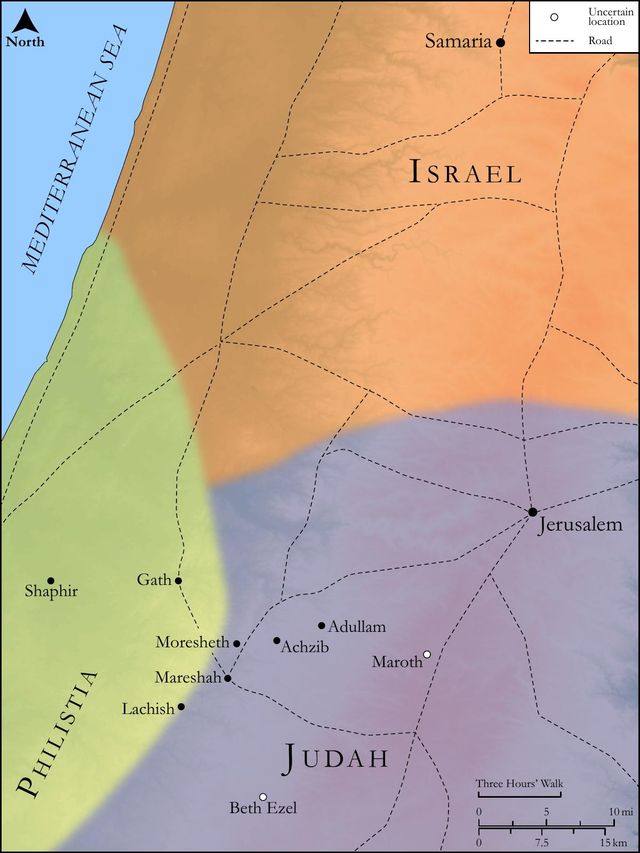
See on the biblical-era map
Study this verse
Public-domain commentary
Matthew Henry
From his Commentary on the Whole Bible. Henry comments on passages, not single verses — this entry covers Micah 1:1–7. His two-level outline is real structure in the source text, so it is rendered as structure.
Here is, I. A general account of this prophet and his prophecy, Mic 1:1. This is prefixed for the satisfaction of all that read and hear the prophecy of this book, who will give the more credit to it when they know the author and his authority. 1. The prophecy is the word of the Lord; it is a divine revelation. Note, What is written in the Bible, and what is preached by the ministers of Christ according to what is written there, must be heard and received, not as the word of dying men, which we may be judges of, but as the word of the living God, which we must be judged by, for so it is. This word of the Lord came to the prophet, came plainly, came powerfully, came in a preventing way, and he saw it, saw the vision in which it was conveyed to him, saw the things themselves which he foretold, with as much clearness and certainty as if they had been already accomplished. 2. The prophet is Micah the Morasthite; his name Micah is a contraction of Micaiah, the name of a prophet some ages before (in Ahab's time, Kg1 22:8); his surname, the Morasthite, signifies that he was born, or lived, at Moresheth, which is mentioned here (Mic 1:14), or Mareshah, which is mentioned Mic 1:15, and Jos 15:44. The place of his abode is mentioned, that any one might enquire in that place, at that time, and might find there was, or had been, such a one there, who was generally reputed to be a prophet. 3. The date of his prophecy is in the reigns of three kings of Judah - Jotham, Ahaz, and Hezekiah. Ahaz was one of the worst of Judah's kings, and Hezekiah one of the best; such variety of times pass over God's ministers, times that frown and times that smile, to each of which they must study to accommodate themselves, and to arm themselves against the temptations of both. The promises and threatenings of this book are interwoven, by which it appears that even in the wicked reign he preached comfort, and said to the righteous then that it should be well with them; and that in the pious reign he preached conviction, and said to the wicked then that it should be ill with them; for, however the times change, the word of the Lord is still the same. 4. The parties concerned in this prophecy; it is concerning Samaria and Jerusalem, the head cities of the two kingdoms of Israel and Judah, under the influence of which the kingdoms themselves were. Though the ten tribes have deserted the houses both of David and Aaron, yet God is pleased to send prophets to them.
II.A very solemn introduction to the following prophecy (Mic 1:2), in which,
1.The people are summoned to draw near and give their attendance, as upon a court of judicature: Hear, all you people, Note, Where God has a mouth to speak we must have an ear to hear; we all must, for we are all concerned in what is delivered. "Hear, you people" (all of them, so the margin reads it), "all you that are now within hearing, and all others that hear it at second hand." It is an unusual construction; but those words with which Micah begins his prophecy are the very same in the original with those wherewith Micaiah ended his, Kg1 22:28.
2.The earth is called upon, with all that therein is, to hear what the prophet has to say: Hearken, O earth! The earth shall be made to shake under the stroke and weight of the judgments coming; sooner will the earth hear than this stupid senseless people; but God will be heard when he pleads. If the church, and those in it, will not hear, the earth, and those in it, shall, and shame them.
3.God himself is appealed to, and his omniscience, power, and justice, are vouched in testimony against this people: "Let the Lord God be witness against you, a witness that you had fair warning given you, that your prophets did their duty faithfully as watchmen, but you would not take the warning; let the accomplishment of the prophecy be a witness against your contempt and disbelief of it, and prove, to your conviction and confusion, that it was the word of God, and no word of his shall fall to the ground." Note, God himself will be a witness, by the judgments of his hand, against those that would not receive his testimony in the judgments of his mouth. He will be a witness from his holy temple in heaven, when he comes down to execute judgment (Mic 1:3) against those that turned a deaf ear to his oracles, wherein he witnessed to them, out of his holy temple at Jerusalem.
III.A terrible prediction of destroying judgments which should come upon Judah and Israel, which had its accomplishment soon after in Israel, and at length in Judah; for it is foretold,
1.That God himself will appear against them, Mic 1:3. They boasted of themselves and their relation to God, as if that would secure them; but, though God never deceives the faith of the upright, he will disappoint the presumption of the hypocrites, for, behold, the Lord comes forth out of his place, quits his mercy-seat, where they thought they had him fast, and prepares his throne for judgment; his glory departs, for they drive it from them. God's way towards this people had long been a way of mercy, but now he changes his way, he comes out of his place, and will come down. He had seemed to retire, as one regardless of what was done, but now he will show himself, he will rend the heavens, and will come down, not as sometimes, in surprising mercies, but in surprising judgments, to do things not for them, but against them, which they looked not for, Isa 64:1; Isa 26:21.
2.That when the Creator appears against them it shall be in vain for any creature to appear for them. He will tread with contempt and disdain upon the high places of the earth, upon all the powers that are advanced in competition with him or in opposition to him; and he will so tread upon them as to tread them down and level them. High places, set up for the worship of idols or for military fortifications, shall all be trodden down and trampled into the dust. Do men trust to the height and strength of the mountains and rocks, as if they were sufficient to bear up their hopes and bear off their fears? They shall be molten under him, melted down as wax before the fire, Psa 68:2. Do they trust to the fruitfulness of the valleys, and their products? They shall be cleft, or rent, with those fiery streams that shall come pouring down from the mountains when they are melted. They shall be ploughed and washed away as the ground is by the waters that are poured down a steep place. God is said to cleave the earth with rivers, Hab 3:9. Neither men of high degree, as the mountains, nor men of low degree, as the valleys, shall be able to secure either themselves or the land from judgments of God, when they are sent with commission to lay all waste, and, like a sweeping rain, to leave no food, Pro 28:3. This is applied particularly to the head city of Israel, which they hoped would be a protection to the kingdom (Mic 1:6.) I will make Samaria, that is now a rich and populous city, as a heap of the field, as a heap of dung laid there to be spread, or as a heap of stones gathered together to be carried away, and as plantings of a vineyard, as hillocks of earth raised to plant vines in. God will make of that city a heap, of that defenced city a ruin, Isa 25:2. Their altars had been as heaps in the furrows of the fields (Hos 12:11) and now their houses shall be so, as ruinous heaps. The stones of the city are poured down into the valley by the fury of the conqueror, who will thus be revenged on those walls that so long held out against him. They shall be quite pulled down, so that the very foundations shall be discovered, that had been covered by the superstructure; and not one stone shall be left upon another.
IV.A charge of sin upon them, as the procuring cause of these desolating judgments (Mic 1:5):
For the transgression of Jacob is all this. If it be asked, "Why is God so angry, and why are Jacob and Israel thus brought to ruin by his anger?" the answer is ready: Sin has done all the mischief; sin has laid all waste; all the calamities of Jacob and Israel are owing to their transgressions; if they had not gone away from God, he would never have appeared thus against them. Note, External privileges and professions will not secure a sinful people from the judgments of God. If sin be found in the house of Israel, if Jacob be guilty of transgression and rebellion, God will not spare them; no, he will punish them first, for their sins are of all others most provoking to him, for they are most reproaching. But it is asked, What is the transgression of Jacob? Note, When we feel the smart of sin it concerns us to enquire what the sin is which we smart for, that we may particularly war against that which wars against us. And what is it?
1.It is idolatry; it is the high places; that is the transgression, the great transgression which reigns in Israel; that is spiritual whoredom, the violation of the marriage-covenant, which merits a divorce. Even the high places of Judah, though not so bad as the transgression of Jacob, were yet offensive enough to God, and a remaining blemish upon some of the good reigns. Howbeit the high places were not taken away.
2.It is the idolatry of Samaria and Jerusalem, the royal cities of those two kingdoms. These were the most populous places, and where there were most people there was most wickedness, and they made one another worse. These were the most pompous places; there men lived most in wealth and pleasure, and they forgot God. These were the places that had the greatest influence upon the country, by authority and example; so that from them idolatry and profaneness went forth throughout all the land, Jer 23:15. Note, Spiritual distempers are most contagious in persons and places that are most conspicuous. If the head city of a kingdom, or the chief family in a parish, be vicious and profane, many will follow their pernicious ways, and write after a bad copy when great ones set it for them. The vices of leaders and rulers are leading ruling vices, and therefore shall be surely and sorely punished. Those have a great deal to answer for indeed that not only sin, but make Israel to sin. Those must expect to be made examples that have been examples of wickedness. If the transgression of Jacob is Samaria, therefore shall Samaria become a heap. Let the ringleaders in sin hear this and fear.
V.The punishment made to answer the sin, in the particular destruction of the idols, Mic 1:7.
1.The gods they worshipped shall be destroyed: The graven images shall be beaten to pieces by the army of the Assyrians, and all the idols shall be laid desolate. Samaria and her idols were ruined together by Sennacherib (Isa 10:11), and their gods cast into the fire, for they were no gods (Isa 37:19); and this was the Lord's doing: I will lay the idols desolate. Note, If the law of God prevail not to make men in authority destroy idols, God will take the work into his own hands, and will do it himself.
2.The gifts that passed between them and their gods shall be destroyed; for all the hires thereof shall be burnt with fire, which may be meant either of the presents they made to their idols for the replenishing of their altars, and the adorning of their statues and temples (these shall become a prey to the victorious army, which shall rifle not only private houses, but the houses of their gods), or of the corn, and wine, and oil, which they called the rewards, or hires, which their idols, their lovers, gave them (Hos 2:12); these shall be taken from them by him whom (by ascribing them to their dear idols) they had defrauded of the honour due to him. Note, That cannot prosper by which men either are hired to sin or hire others to sin; for the wages of sin will be death. She gathered it of the hire of the harlot, and it shall return to the hire of a harlot. They enriched themselves by their leagues with the idolatrous nations, who gave them advantages, to court them into the service of their idols, and their idols' temples were enriched with gifts by those who went a whoring after them. And all this wealth shall become a prey to the idolatrous nations, and so be the hire of a harlot again, wages to an army of idolaters, who shall take it as a reward given them by their gods. It shall be a present to king Jareb, Hos 10:6. What they gave to their idols, and what they thought they got by them, shall be as the hire of a harlot; the curse of God shall be upon it, and it shall never prosper, nor do them any good. It is common that what is squeezed out by one lust is squandered away upon another.
Historical interpretation
Historical reception
1 surviving comment on this verse from the historical church.
(Verse 6 onwards): And I will make Samaria a heap of stones in the field, when a vineyard is planted, and I will pour down her stones into the valley, and will lay bare her foundations. And all her carved images shall be beaten to pieces, and all her wages shall be burned with fire, and all her idols will I lay desolate: for she gathered it of the hire of an harlot, and they shall return to the hire of a harlot. Therefore I will wail and howl, I will go stripped and naked: I will make a wailing like the dragons, and mourning as the owls. For her wound is incurable; for it is come unto Judah; he is come unto the gate of my people, even to Jerusalem. LXX: And I will make Samaria a caretaker of fruits in the field, and a plantation of vineyards; and I will uncover its foundations and reveal all of its carved images, and all of its wages will be burned with fire, and all of its idols I will put to destruction, because it gathered them from the wages of prostitution, and destroyed them with the wages of prostitution. Because of this, it will lament and mourn, it will go barefoot and naked, it will make a lamentation like the dragons, and a mourning like the daughters of Sirens, because its wound has obtained, because it has come to Judah and has touched the gate of my people, even Jerusalem. According to the order of sins, there is an order of punishments. Samaria was the first to sin, and they made idols and worshiped calves instead of the Lord: therefore, let it perish first. I will destroy it when the Assyrians come, and I will make it like a heap of stones when a vineyard is planted, so that it is turned into mounds. And I will remove its stones into the valley. It was indeed situated in the mountains, where Sebaste is now, and it is where the bones of the holy John the Baptist are buried. And I will reveal its foundations. Such will be the ruin and the destruction of the city, that not only the walls and buildings will collapse, but even the foundations will be exposed to the very last stone. And all its sculptures and treasures, which were gathered by various kings, will be brought down and burned by fire, and reduced to nothingness. For the riches and abundant possessions, which were presumed to be the result of idolatry, will be taken to another harlot, that is, to Nineveh. Just as they committed fornication with the idols they made in their own land, so they will go to another land of idols and prostitution, that is, to the Assyrians. So far concerning Samaria. And because the same calamity will happen to Jerusalem (for it also sinned with a similar error, abandoning its God and making idols), therefore the prophet attributes a kind of personification to God, and under his own persona he expresses a lamenting affection, and says: About this I will mourn and wail; I will go stripped and naked (for I have lost ten tribes), and I will make a lamentation like jackals, and mourning like ostriches. For just as dragons roar with a terrifying hiss, according to the accounts of those who have written about natural history, at the time when they are defeated by elephants; and just as ostriches are forgetful of their eggs, as if they had not laid them, and leave their young to be trampled on by the feet of beasts in the sand (Job 39); as it is more fully described in the book of Job: so I also, stripped of children and naked, will go on my way. And I shall do this, because her wound is desperate, that is, Samaria. And the same sin, or rather the same punishment of sin, which destroyed Samaria, will come even to Judah, and even to the gate of my city Jerusalem. For just as Samaria was overthrown by the Assyrians, so Judah and Jerusalem will be overthrown by the Chaldeans. And indeed, as we understand, Samaria was once the Church of heretics, which, separated from God, became a gathering of the people; the Lord himself threatens that he will make it a place for the keeping of apples, an orchard and a planting ground for a vineyard. For it is much better to overthrow an useless city, and its stones with which it was built, to be thrown down, and to prepare it as an orchard and a plantation of vineyards, than to remain in the worst kind of construction. For when it has been destroyed, and its foundations have been revealed (by which it seemed to hide its mysteries, and to have firm doctrines on which it stood, and all idols appeared to have a kind of beauty, composed by skillful craftsmanship, and have been cut down by the ministers of God, that is, by the Ecclesiastical men), then in the place of the worst construction, various fruits of the Church will be born, and not only will they be born, but they will also be guarded, and the vineyard of Sorek will be planted, from which wine will be made, which the Lord promised to drink in the kingdom of the Father (Mark 14). Not only, however, will the foundations of that which was previously hidden in the earth be opened and brought forth into the open, and the idols which they had fashioned for themselves be overthrown; but even the glory and wealth which she seemed to possess through her fornication and her error will be consumed by my fire, of which I spoke in the Gospel: I have come to cast fire upon the earth, and how I wish that it were already kindled (Luke 12:49): and they shall be burned up and reduced to nothing, for they have been contracted not from the truth of doctrines, but from the fornication of the soul and from errors collected from here and there. For heretics, indeed, do not have riches coming from paternal inheritance, but daily they find what they cultivate, and they fashion idols for themselves with skillful hand and curious mind. Therefore, when their field has been converted into a custody of fruits, and prepared for vineyards, and the stones with which the city was built have been removed into the depths, and their foundations have been revealed, and all the carved and burnt images, and the rewards that they promised themselves with empty hope, and whatever they seemed to worship as God, have been reduced to nothing, because in the fornication of the soul, they had obtained all their price for themselves: then, understanding their former error, having turned back upon themselves, they will lament in those things at which they previously laughed, and they will mourn in those things in which before, in a certain manner, they rejoiced in their fornication. And the deponents will cast off from their feet whatever is deadly, and they will be barefoot, for the ground on which they stand is holy, and they will throw away all the clothes of their fornication, and they will be naked so that they can be clothed in the garment of Christ, and they will lament like dragons. For sometimes even dragons lament when they see the greatest dragon captured and hanging on the hook of a fisherman, and the sea deserted. And they shall lament like the daughters of the Sirens, for the songs of heretics are sweet, and deceive the people with their sweet voices. None can pass by their songs unless they stop up their ears and become deaf. Therefore, Samaria shall weep and mourn for these things, for the arrow of the Lord has wounded her, and she shall recognize the error of her ways. Not only has she sinned herself, but she also desires to bring her iniquity and error into the gates of Judah. It is said of her: She came up to Judea and touched up to the gates of my people, up to Jerusalem. She touched the gates, as we understand them with our ears. However, she could not enter the middle city: for if she had entered, she would have made Samaria from Jerusalem. How often we see some in the Church scandalized by the heretical teachings and seeking how to answer their questions, yet not leaving the Church, let us say, she came to Samaria, or the region of Samaria up to the confessing people, up to the ears of God's people, up to the ears of Jerusalem. For what is said touches as well the gates of my people, it is to be understood in general, so that it may be supplied, it also touches even the gates of Jerusalem. Up to this point, against Samaria and against Jerusalem, let us see the rest, which follows.
Continue studying Micah 1:6 across the web’s major study libraries — every link below opens this exact verse, chapter, or book on the destination site.
Read & Compare
 BibleGatewayThis verse in more than 200 translations and 70 languages.
 Bible.comThe YouVersion reader — hundreds of translations, reading plans, and highlights.
 ESV.orgCrossway's official English Standard Version reader.
 NET BibleThe NET translation with 60,000+ translators' notes on every rendering decision.
 STEP BibleTyndale House's free study tool — original text, vocabulary, and scholarly resources.
 BibliaLogos Bible Software's free web reader.
 USCCBThe New American Bible (Revised Edition) with the U.S. bishops' study notes.
Commentaries
 BibleHub CommentariesDozens of classic commentaries on this verse, gathered on one page.
 StudyLightMore than 100 commentary sets — the largest collection on the web.
 BibleRefPlain-English commentary on what this verse means, verse by verse.
 Enduring WordDavid Guzik's free commentary on this chapter, widely used by Bible teachers.
 Bible Study ToolsVerse commentary alongside Greek and Hebrew study aids.
Original Language & Research
- BibleHub InterlinearThe verse word by word — original language, transliteration, and English.
- BibleHub LexiconEvery word's original-language definition and Strong's entry.
 Blue Letter BibleDeep-study tools — Strong's numbers, concordance, and word studies.
 SefariaThe Hebrew text with Rashi and centuries of Jewish commentary.
Sermons, Hymns & Audio


TrulyRandomVerse is not affiliated with these sites and doesn’t control their content. They’re linked because they’re genuinely useful.
Summary
Micah 1:6 presents a stark prophecy of divine judgment against Samaria, the capital of the Northern Kingdom of Israel. The Lord declares His intent to utterly dismantle the city, reducing it to a heap of rubble in a field, suitable only for agricultural planting. This pronouncement signifies a complete and irreversible desolation, where the very stones of the city will be cast into the valley, and its hidden foundations exposed, illustrating the thoroughness of God's righteous wrath against its deep-seated sin and idolatry.
Context
ShowHideLiterary Context
This verse immediately follows the declaration of Samaria's transgression and Israel's sin in Micah 1:5. Micah 1 opens with a dramatic scene of God descending from His holy temple to execute judgment upon the earth, specifically targeting the sins of Jacob and the house of Israel. Verses 2-4 describe the shaking of the earth and the melting of the mountains as God approaches. Verse 5 identifies Samaria as the "transgression of Jacob" and Jerusalem as the "sins of the house of Judah," setting the stage for the specific judgments to follow. Micah 1:6 is the direct, concrete articulation of this impending judgment on Samaria, detailing the extent of its destruction before the prophecy turns to Judah and Jerusalem in subsequent verses. The imagery here is one of complete eradication, preparing the reader for the lament that follows in Micah 1:8-16.
Historical & Cultural Context
Micah prophesied during the late 8th century BC, a tumultuous period for both Israel and Judah. The Northern Kingdom of Israel, with Samaria as its capital, had a long history of idolatry, beginning with Jeroboam I's establishment of golden calves at Dan and Bethel (1 Kings 12:28-30). By Micah's time, this idolatry was deeply entrenched, often mingled with Baal worship introduced by figures like Ahab and Jezebel. Samaria itself was a strategically important city, built on a prominent hill, signifying its strength and prominence. Its wealth, derived from trade and fertile lands, often led to injustice and oppression of the poor, which Micah frequently condemns. The looming threat was the Assyrian Empire, a brutal and efficient military power that had already begun to exert its dominance over the region. The prophecy in Micah 1:6 foreshadows the Assyrian conquest and destruction of Samaria in 722 BC, as recorded in 2 Kings 17:5-6.
Key Themes
ShowHideMicah 1 introduces several pervasive themes found throughout the book. The most prominent is Divine Judgment and Justice, where God, as the righteous judge, actively intervenes in history to punish the unfaithfulness and injustice of His people. This judgment is a direct consequence of Covenant Violation, as both Israel and Judah had repeatedly broken their covenant with Yahweh through idolatry, social oppression, and moral corruption. The theme of Desolation and Ruin is vividly portrayed in Micah 1:6, emphasizing the complete dismantling of human institutions and strongholds that stand in defiance of God. Conversely, this judgment highlights God's Sovereignty and Prophetic Fulfillment, demonstrating that His word is certain and His plans will be accomplished, as seen in the historical fulfillment of Samaria's fall.
Exposition and Analysis
ShowHideKey Word Analysis
ShowHideThis word, derived from a root meaning "to overturn," signifies a ruin or a pile of rubble. In the context of the field, it evokes the image of stones cleared from cultivated land, suggesting that Samaria will be reduced to mere debris, indistinguishable from natural mounds or piles of waste in an agricultural setting. It implies a complete loss of its urban identity and structural integrity.
A primitive root meaning "to flow" or "to pour out or down." Here, it is used causatively, indicating God's active role in dislodging and casting the stones of Samaria from its elevated position into the valley below. This is not a passive collapse but a forceful, deliberate act of demolition, emphasizing the divine agency behind the city's destruction.
From a root meaning "to lay a foundation," this term refers to the lowest, most fundamental part of a structure. To "discover" or "uncover" the foundations implies an absolute and total destruction, where even the hidden, underlying elements of the city are exposed and dismantled. It signifies a complete stripping away, leaving nothing intact or concealed, a profound symbol of utter desolation and the deep exposure of sin.
Verse Breakdown
ShowHide"Therefore I will make Samaria as an heap of the field, and as plantings of a vineyard:"
This opening clause declares God's direct intention to transform Samaria. The city, once a proud capital on a hill, will be reduced to a pile of rubble, like stones cleared from a field. The second simile, "as plantings of a vineyard," further emphasizes the complete desolation and repurposing of the land; the site of the city will be leveled and prepared for agricultural use, specifically for grapevines. This imagery underscores the complete loss of its urban identity and its reduction to basic, cultivated farmland.
"and I will pour down the stones thereof into the valley,"
This phrase elaborates on the method and extent of destruction. Samaria, built on a hill, will have its very building materials—its stones—dislodged and cast forcefully into the surrounding valleys. This signifies a thorough and destructive demolition, where nothing of the city's structure will remain in place. It paints a picture of violent upheaval and complete dismantling.
"and I will discover the foundations thereof."
This final clause represents the ultimate act of destruction and exposure. Not only will the city be leveled and its stones scattered, but its very foundations, normally hidden beneath the surface, will be laid bare. This implies a complete stripping away of every layer, leaving nothing hidden or intact. It is a powerful symbol of God's thorough judgment, exposing the root and depth of Samaria's sin, leaving no part of its rebellious structure untouched.
Literary Devices
ShowHideMicah 1:6 is rich in Imagery, painting vivid pictures of destruction. The primary devices employed are Simile and Metaphor. The city of Samaria is explicitly compared "as an heap of the field" and "as plantings of a vineyard," using the comparative "as" to draw direct parallels between the once-grand city and a desolate, cleared agricultural plot. This transformation is also a powerful Metaphor for the complete loss of its identity and purpose. The act of "pouring down the stones thereof into the valley" employs strong Kinetic Imagery, conveying violent motion and thorough demolition. Finally, "discovering the foundations thereof" uses Symbolism to represent the total exposure and eradication of the city, implying that even its deepest, hidden structures and the underlying sins they represent will be brought to light and destroyed. The entire verse is an example of Prophetic Hyperbole, where the language emphasizes the absolute and devastating nature of the coming judgment, though historically, the destruction was indeed severe.
Theological and Thematic Connections
ShowHideMicah 1:6 profoundly illustrates God's unyielding justice and His commitment to covenant faithfulness. The utter destruction of Samaria serves as a stark reminder that persistent rebellion, particularly through idolatry and oppression, will inevitably incur divine wrath. This judgment is not arbitrary but a righteous response to a people who had repeatedly turned away from the Lord, defiling the land and their covenant obligations. It underscores the severity of sin and the certainty of God's word, demonstrating that His warnings are not empty threats but sure declarations of what will come to pass for those who refuse to repent. The exposure of Samaria's foundations signifies that God sees beyond superficial appearances, reaching into the very core of human and societal structures to expose and judge their deepest corruptions.
Reflection and Application
ShowHideMicah 1:6 stands as a powerful testament to the consequences of spiritual apostasy and moral decay, serving as a timeless warning for individuals and nations alike. It challenges us to examine our own lives and societies, asking whether our foundations are built on the shifting sands of worldly values and self-interest, or on the unshakeable rock of God's truth and righteousness. The complete desolation of Samaria reminds us that God is not mocked; His justice, though sometimes delayed, is always certain and thorough. This should instill a healthy fear of the Lord, prompting genuine repentance and a commitment to living in accordance with His will. Furthermore, the fulfillment of this prophecy reinforces the absolute reliability of God's Word, encouraging us to trust His promises and warnings implicitly. It calls us to live with an awareness that our choices have eternal consequences and that true security is found only in obedience to the One who judges both the visible and the hidden aspects of our lives.
Questions for Reflection
ShowHideFAQ
ShowHideWhat was the primary sin of Samaria that led to this severe judgment?
ShowHideThe primary sin of Samaria, as the capital of the Northern Kingdom of Israel, was widespread and persistent idolatry, particularly the worship of golden calves established by Jeroboam I (1 Kings 12:28-30), and later the adoption of Baal worship. This spiritual apostasy was often accompanied by severe injustices, oppression of the poor, and moral corruption, all of which constituted a direct violation of their covenant with Yahweh (Micah 1:5).
How was this prophecy fulfilled historically?
ShowHideThis prophecy was fulfilled by the Assyrian conquest of Samaria. In 722 BC, the Assyrian king Shalmaneser V, and later Sargon II, besieged and captured Samaria, leading to the deportation of the Israelite population and the complete destruction and desolation of the city, as recorded in 2 Kings 17:5-6. The city was indeed reduced to rubble, its inhabitants exiled, and its prominence utterly erased, confirming Micah's prophetic word.
Christ-Centered Fulfillment
ShowHideMicah 1:6, with its vivid depiction of divine judgment and the utter desolation of a rebellious city, ultimately points to the profound reality of sin's consequence and, more significantly, to Christ as the one who fully bears that judgment and establishes an unshakeable kingdom. The exposure of Samaria's foundations symbolizes the divine scrutiny of all human structures and systems built apart from God. In Christ, we see the ultimate fulfillment of God's judgment against sin, not in the destruction of a city, but in the voluntary sacrifice of the Lamb of God on the cross. He became the "heap of the field," bearing the full weight of God's wrath, so that those who believe in Him might be spared from eternal desolation. Furthermore, while Samaria's foundations were discovered and destroyed, Christ himself is the cornerstone and foundation of a new, spiritual temple—the Church—whose foundations can never be shaken (1 Corinthians 3:11). The temporary, earthly judgment on Samaria foreshadows the final, perfect judgment executed by Christ, and simultaneously highlights His redemptive work in building a new, eternal city, the New Jerusalem, whose foundations are secure in Him (Revelation 21:14).