


New Testament · Pauline Epistles · Book 54 of 66
1 Timothy
Paul’s charge to Timothy at Ephesus: how the church of the living God prays, chooses bishops and deacons, cares for its own and keeps sound doctrine.
- 6 chapters
- 113 verses
- About 10 minutes to read
- Letters to the Churches, c. AD 48–96
Paul had left Timothy at Ephesus to “charge some that they teach no other doctrine” (1:3), and this letter puts the charge in writing. It tells him “how thou oughtest to behave thyself in the house of God, which is the church of the living God, the pillar and ground of the truth” (3:15): how the church prays, whom it takes as bishops and deacons, how it honours its widows and elders, and how its minister keeps himself and the doctrine.
The order rests on the gospel. Among the instructions stand the letter’s faithful sayings, the first of them “that Christ Jesus came into the world to save sinners; of whom I am chief” (1:15), and the confession Paul calls “the mystery of godliness” (3:16). Two words run through the letter: doctrine, the truth the church holds, and godliness, the life that truth produces. The false teachers had parted them, offering fables and endless genealogies, and supposing “that gain is godliness” (6:5). Paul joins them again, and ends by charging Timothy to “keep that which is committed to thy trust” (6:20).
But if I tarry long, that thou mayest know how thou oughtest to behave thyself in the house of God, which is the church of the living God, the pillar and ground of the truth.
1 Timothy 3:15 KJV
Before you read
- Who wrote it
- Paul, who names himself “an apostle of Jesus Christ by the commandment of God our Saviour” (1:1) and recalls that he was once “a blasphemer, and a persecutor, and injurious” (1:13).
- To whom
- Timothy, “my own son in the faith” (1:2), whom Paul had left at Ephesus when he went into Macedonia (1:3). He was young (4:12), and Paul writes of “thine often infirmities” (5:23).
- When it happens
- The church at Ephesus, where Paul had warned its elders that men would arise “speaking perverse things, to draw away disciples after them” (Acts 20:30). The letter names two who have made shipwreck of the faith, Hymenaeus and Alexander (1:19–20).
- When it was written
- After Paul went into Macedonia, leaving Timothy at Ephesus (1:3), and while he was “hoping to come unto thee shortly” (3:14). The letter does not say which journey this was, and readers have placed it in two ways.
Those who place it after Acts 28 Paul was released from the imprisonment that closes Acts, as he expected (Philippians 1:25), and preached again before a second imprisonment and death at Rome. Eusebius records that
the apostle, after defending himself, was again sent upon the ministry of preaching
. In Acts, Timothy went ahead into Macedonia (Acts 19:22) rather than staying at Ephesus.Grounds Acts 28:30Philippians 1:25Acts 19:22Eusebius of Caesarea 339 · Ecclesiastical History 2.22
Those who place it within the years Acts records Paul wrote soon after he left Ephesus for Macedonia at the close of his long ministry there (Acts 20:1). Timothy’s youth (4:12) is taken to fit this earlier date.
Grounds Acts 20:11 Timothy 4:12
How 1 Timothy is laid out
7 movements · 22 passages · 113 verses
No other doctrine
1:1–11 · 11 verses
Paul greets Timothy, his “own son in the faith,” and recalls why he left him at Ephesus: to charge some that they teach no other doctrine and give no heed to fables and endless genealogies. The end of the commandment is charity out of a pure heart. The law is good if used lawfully; it is made for the lawless, and for whatever is contrary to sound doctrine.
Mercy to the chief of sinners
1:12–20 · 9 verses
Paul thanks Christ for putting him into the ministry, though he was “a blasphemer, and a persecutor, and injurious.” He obtained mercy as a pattern to all who would believe, and gives the first faithful saying: Christ Jesus came into the world to save sinners. A doxology follows, then the charge to war a good warfare. Hymenaeus and Alexander have made shipwreck and are delivered unto Satan.
Prayer for all men
Chapter 2 · 15 verses
Prayers are to be made for all men and for kings, for God “will have all men to be saved,” and there is one mediator, “the man Christ Jesus.” Men are to pray lifting up holy hands. Women are to adorn themselves with good works and learn in silence; Paul does not permit a woman to teach or usurp authority over the man, for Adam was first formed.
Bishops and deacons
Chapter 3 · 16 verses
A bishop must be blameless, the husband of one wife, apt to teach, and one who rules his own house well; deacons must be grave, first proved, and hold the mystery of the faith in a pure conscience. Paul writes so that Timothy may know how to behave in the house of God, the pillar and ground of the truth, and closes with the mystery of godliness.
A good minister of Jesus Christ
Chapter 4 · 16 verses
The Spirit foretells a departure from the faith, with teachers who forbid marriage and command abstinence from meats; but every creature of God is good, sanctified by the word and prayer. Timothy is to exercise himself unto godliness, let no man despise his youth, give attendance to reading, exhortation and doctrine, and not neglect the gift given him with the laying on of hands.
Widows, elders and servants
5:1–6:2 · 27 verses
Timothy is to treat older men as fathers and younger as brethren. Those who are “widows indeed” are honoured, and only a widow of threescore years is taken into the number; families provide for their own, and younger widows marry. Elders who rule well are worthy of double honour, and an accusation against one needs two or three witnesses. Servants are to count their masters worthy of all honour.
Godliness with contentment
6:3–21 · 19 verses
Those who teach otherwise suppose that gain is godliness; but godliness with contentment is great gain, and the love of money is the root of all evil. Timothy, the man of God, is to flee these things and fight the good fight of faith until the appearing of Christ. The rich are charged to be rich in good works, and Timothy to keep what is committed to his trust.
The words 1 Timothy turns on
Paul gives Timothy a charge: keep sound doctrine and the faithful sayings in God’s house, where they bear fruit in godliness.
What 1 Timothy teaches
didaskalía · doctrine
Sound doctrine
Paul left Timothy at Ephesus to “charge some that they teach no other doctrine” (1:3). Paul answers two errors. One gave heed “to fables and endless genealogies” (1:4) and wanted to teach the law, “understanding neither what they say, nor whereof they affirm” (1:7). The other, foretold by the Spirit, would forbid marriage and meats (4:3), though “every creature of God is good, and nothing to be refused, if it be received with thanksgiving” (4:4). Against both Paul sets “sound doctrine” (1:10), the “wholesome words, even the words of our Lord Jesus Christ” (6:3). Doctrine and life belong together: the charge aims at “charity out of a pure heart” (1:5), and Timothy is told, “Take heed unto thyself, and unto the doctrine” (4:16).
oîkos · house
The house of God
The church is “the house of God” (3:15), and Paul orders it as a household. A bishop must rule his own house well: “For if a man know not how to rule his own house, how shall he take care of the church of God?” (3:5). Timothy is to entreat an elder “as a father; and the younger men as brethren” (5:1), and the older women as mothers. Children are “to shew piety at home” (5:4) by providing for a widowed parent, so that the church may relieve “them that are widows indeed” (5:16). This household is also “the pillar and ground of the truth” (3:15). It holds up the truth that the confession of the next verse sets out.
eusébeia · godliness
Godliness and gain
Eusébeia, godliness, is in eight verses of this letter and seven in the rest of the New Testament. It is the life that answers to the truth. Prayer is made so that believers may live “in all godliness and honesty” (2:2), and the confession of Christ is “the mystery of godliness” (3:16). Timothy is told to “exercise thyself rather unto godliness” (4:7), for “bodily exercise profiteth little: but godliness is profitable unto all things” (4:8). The false teachers suppose “that gain is godliness” (6:5), and Paul turns their words round: “But godliness with contentment is great gain. For we brought nothing into this world, and it is certain we can carry nothing out” (6:6–7).
hēsychía · quietness
Learning in quietness
Prayer is made for kings, “that we may lead a quiet and peaceable life” (2:2), and the woman is to “learn in silence with all subjection” (2:11). The word is hēsychía, quietness, kin to the “peaceable” of verse 2. Paul does not permit a woman “to teach, nor to usurp authority over the man” (2:12), and grounds it in Genesis: “For Adam was first formed, then Eve” (2:13). From the Fathers on, many have held it as a standing rule for the church’s teaching: While Paul forbids women teaching in church, he very much wants them to exercise their authority in the home as the teachers of virtue
. Others read it as answering the deception then at work among the women of Ephesus (5:13–15; 2 Timothy 3:6), and so as bounded by that occasion.
Christ in 1 Timothy
The letter’s first faithful saying is the gospel in one line: “Christ Jesus came into the world to save sinners” (1:15). It repeats the Lord’s own account of his coming, “For the Son of man is come to seek and to save that which was lost” (Luke 19:10), and Paul is its proof. In him, the persecutor, Christ showed “all longsuffering, for a pattern to them which should hereafter believe on him” (1:16).
Chapter 2 names him the one “mediator between God and men, the man Christ Jesus; Who gave himself a ransom for all” (2:5–6), in the language of his own saying that he came “to give his life a ransom for many” (Mark 10:45). He stands between God and men as a man, and gives himself in their place. The confession of 3:16 traces his course from “God was manifest in the flesh” to “received up into glory.” The last charge is given before Christ Jesus, “who before Pontius Pilate witnessed a good confession” (6:13), and runs “until the appearing of our Lord Jesus Christ” (6:14).
People
By how many verses name them
Places
2 named
- EphesusWhere Paul left Timothy to charge the false teachers1
- MacedoniaWhere Paul was going when he left Timothy at Ephesus1
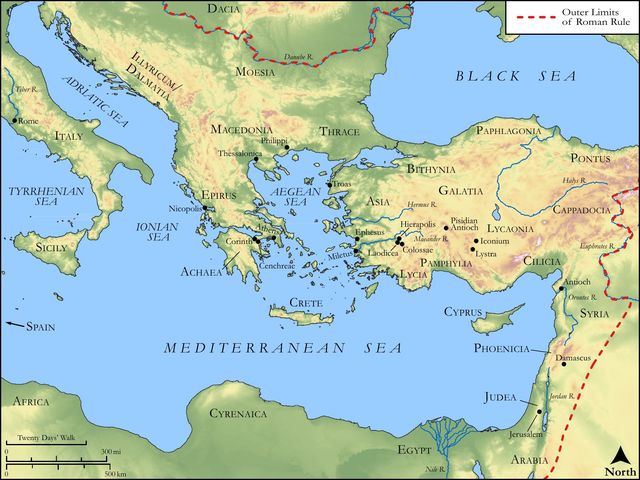
Where 1 Timothy reaches
The passages it leans on, and the ones that lean on it
The faithful saying restates the Lord’s own reason for his coming: to seek and to save the lost.
1 Timothy 2:5 1 Corinthians 8:6
Paul’s two confessions of one God, with Christ as the one Lord and the one mediator.
1 Timothy 5:18 Deuteronomy 25:4 Luke 10:7
Paul sets the law of the unmuzzled ox beside the Lord’s word, “the labourer is worthy of his hire.”
Nothing brought in and nothing carried out: Job’s confession stands behind Paul’s call to contentment.
1 Timothy 6:15 Revelation 19:16
Paul’s title for God, “King of kings, and Lord of lords,” written on the vesture of Christ at his coming.
Books 1 Timothy links to most
The Church Fathers on 1 Timothy
717 quotations from 62 writers before AD 800 · the ten most quoted, in date order
- Ignatius108
- Clement215
- Tertullian220
- Origen253
- Cyprian258
- Ambrose397
- Chrysostom407
- Jerome420
- Theodore428
- Augustine430
Jerome kept the Greek reading of 1:15 against Latin copies that had changed it.
They may choose to read, “It is a man’s saying, and worthy of all acceptation.” We are content to err with the Greeks, that is to say, with the apostle himself, who spoke Greek. Our version, therefore, is, “it is a faithful saying, and worthy of all acceptation.”
Irenaeus, on the mediator who restored men to God’s friendship by his incarnation.
And therefore in the last times the Lord has restored us into friendship through His incarnation, having become "the Mediator between God and men; "
Chrysostom, on the church as pillar and ground of the truth.
For it is this that maintains the faith and the preaching of the Word. For the truth is the pillar and the ground of the Church.
Vincent of Lérins read the deposit of 6:20 as doctrine kept the same in every age.
Of course, this means the catholic and universal doctrine, which remains one and the same through all successive ages in the uncorrupted tradition of truth and which will remain so without end for ever and ever.
Keep studying
Articles