


New Testament · Pauline Epistles · Book 55 of 66
2 Timothy
Paul’s last letter, written from prison in Rome as his death drew near, charging Timothy to guard the gospel, to suffer for it and to hand it on.
- 4 chapters
- 83 verses
- About 8 minutes to read
- Letters to the Churches, c. AD 48–96
Second Timothy is Paul’s last letter. He writes from prison in Rome, bound “as an evil doer” (2:9), deserted by “all they which are in Asia” (1:15), with only Luke beside him (4:11), and he knows his death is near: “I am now ready to be offered, and the time of my departure is at hand” (4:6). What he leaves Timothy is a charge. The gospel was committed to Paul; Timothy is to guard it, suffer for it and commit it “to faithful men, who shall be able to teach others also” (2:2).
The letter sets those who failed Paul beside those who stood by him. Phygellus and Hermogenes turned away, Demas forsook him, and Alexander the coppersmith “did me much evil” (4:14); Onesiphorus “was not ashamed of my chain” (1:16), and Luke stayed. Where men fail him, Paul rests on two things: the Scriptures Timothy has known from a child, and the Lord, who “stood with me, and strengthened me” (4:17). The letter looks past his death to a crown laid up “at that day” (4:8).
I have fought a good fight, I have finished my course, I have kept the faith:
2 Timothy 4:7 KJV
Before you read
- Who wrote it
- Paul, who names himself “an apostle of Jesus Christ by the will of God” (1:1) and writes of his own prayers, chains, first defence and coming death.
- When it was written
- At the end of Paul’s life, while he was a prisoner at Rome and had already made his “first answer”, at which “no man stood with me” (4:16). He expects to die: “the time of my departure is at hand” (4:6). Readers have placed this imprisonment in two ways.
Those who place it in a second Roman imprisonment Paul was released from the imprisonment that closes Acts and was later taken again. He has left Trophimus “at Miletum sick” (4:20), though on the journey Acts records Trophimus went on with him to Jerusalem (Acts 21:29). Eusebius records that Paul,
coming a second time to the same city met death by martyrdom under Nero
.Grounds 2 Timothy 4:20Acts 21:292 Timothy 4:16Eusebius of Caesarea 339 · Ecclesiastical History 2.22
Those who place it in the imprisonment Acts records Paul wrote near the end of the two years at Rome with which Acts closes (Acts 28:30). Luke, Demas and Mark, all named in this letter, were with him in the bonds from which he wrote Colossians and Philemon (Colossians 4:10, 14; Philemon 24).
Grounds Acts 28:30Colossians 4:10Colossians 4:14Philemon 1:24
- Where
- Rome. Of Onesiphorus Paul writes, “when he was in Rome, he sought me out very diligently, and found me” (1:17).
How 2 Timothy is laid out
6 movements · 16 passages · 83 verses
Not ashamed of the testimony
Chapter 1 · 18 verses
Paul thanks God for Timothy’s unfeigned faith, which dwelt first in Lois and Eunice, and bids him stir up the gift of God. He is not to be ashamed of the Lord’s testimony or of Paul the prisoner, but to share the gospel’s afflictions and keep what was committed to him. All in Asia have turned away; Onesiphorus sought Paul out in Rome.
Soldier, athlete and husbandman
2:1–13 · 13 verses
Timothy is to be strong in grace and commit what he heard from Paul to faithful men who will teach others. Like a soldier, an athlete and a husbandman he must endure hardness and labour for the reward. Paul suffers bonds as an evil doer, but the word of God is not bound, and the faithful saying holds: “If we suffer, we shall also reign with him.”
A workman approved unto God
2:14–26 · 13 verses
Timothy is to rightly divide the word of truth and shun profane and vain babblings. Hymenaeus and Philetus say the resurrection is past already and overthrow the faith of some, yet the foundation of God stands sure. In a great house are vessels to honour and to dishonour. The Lord’s servant must not strive, but instruct opponents in meekness, “if God peradventure will give them repentance.”
Perilous times and the Scriptures
Chapter 3 · 17 verses
In the last days men will be lovers of their own selves, having a form of godliness but denying its power, and resisting the truth as Jannes and Jambres withstood Moses. Timothy has fully known Paul’s doctrine and his persecutions at Antioch, Iconium and Lystra. He is to continue in the holy scriptures he has known from a child, all given by inspiration of God.
Preach the word
4:1–8 · 8 verses
Before God and the Lord Jesus Christ, judge of the quick and the dead, Paul charges Timothy to preach the word in season and out of season, for men will turn from sound doctrine to fables. Paul is now ready to be offered. He has fought a good fight, finished his course and kept the faith, and a crown of righteousness is laid up for him.
The Lord stood with me
4:9–22 · 14 verses
Demas has forsaken Paul for this present world, Crescens and Titus are gone, and only Luke is with him. Timothy is to come before winter, bringing Mark, the cloak left at Troas, the books and the parchments. At Paul’s first answer no man stood with him, but the Lord stood with him and strengthened him. Greetings to Prisca, Aquila and the household of Onesiphorus close the letter.
The words 2 Timothy turns on
Chapter 1 turns on the deposit and on not being ashamed, chapter 2 on hardship, chapter 3 on Scripture God-breathed; Christ’s appearing opens and closes the charge.
What 2 Timothy teaches
parathḗkē · deposit
The good deposit
Paul hands on a deposit, parathēkē: something placed in another’s keeping. “Hold fast the form of sound words, which thou hast heard of me” (1:13). “That good thing which was committed unto thee keep by the Holy Ghost which dwelleth in us” (1:14). Timothy is to pass it on: “the same commit thou to faithful men” (2:2). Paul has a deposit of his own, and is “persuaded that he is able to keep that which I have committed unto him against that day” (1:12). Some read this as what Paul has entrusted to God, as Peter bids sufferers “commit the keeping of their souls to him” (1 Peter 4:19). Theodoret read it as what God entrusted to Paul: The ‘deposit’ is the power and grace offered to Paul by the Spirit for serving the Lord.
In either reading the keeper is God.
kakopathéō · suffer hardship
Partaker of the afflictions
Paul asks Timothy to suffer with him, not in his place. “Be thou partaker of the afflictions of the gospel according to the power of God” (1:8) is one compound verb, to suffer hardship together, and the simple verb returns three times: “endure hardness, as a good soldier of Jesus Christ” (2:3); “I suffer trouble, as an evil doer, even unto bonds” (2:9); “endure afflictions” (4:5). The soldier, the athlete and the husbandman of chapter 2 all labour toward an end, and so does the believer: “If we suffer, we shall also reign with him” (2:12). Hardship is the expected portion, for “all that will live godly in Christ Jesus shall suffer persecution” (3:12). The chains bind Paul, but “the word of God is not bound” (2:9).
theópneustos · God-breathed
All scripture breathed out by God
Chapter 3 sets men “ever learning, and never able to come to the knowledge of the truth” (3:7) beside Timothy, who from a child has known “the holy scriptures, which are able to make thee wise unto salvation through faith which is in Christ Jesus” (3:15). Their power lies in their source. “All scripture is given by inspiration of God” (3:16) renders one word, theopneustos, breathed out by God. Scripture is his own speech, and so it is profitable for doctrine, reproof, correction and instruction, “that the man of God may be perfect, throughly furnished unto all good works” (3:17). The scriptures Timothy learned as a child were Moses and the prophets; Peter counts Paul’s own letters among “the other scriptures” (2 Peter 3:16). The charge that follows rests on all of it: “Preach the word” (4:2).
Christ in 2 Timothy
The letter sets Timothy’s charge between two appearings of Christ, and uses one word, epiphaneia, for both. The first is past. God’s grace “was given us in Christ Jesus before the world began” (1:9), and is “now made manifest by the appearing of our Saviour Jesus Christ, who hath abolished death, and hath brought life and immortality to light through the gospel” (1:10). The second is to come. Christ “shall judge the quick and the dead at his appearing and his kingdom” (4:1), and the crown of righteousness is laid up for “all them also that love his appearing” (4:8).
Between the two stands the gospel Paul suffers for, in one sentence: “Remember that Jesus Christ of the seed of David was raised from the dead according to my gospel” (2:8). The faithful saying that follows ends not on the believer but on Christ: “If we believe not, yet he abideth faithful: he cannot deny himself” (2:13). Forsaken by all at his first answer, Paul is sure the Lord “will preserve me unto his heavenly kingdom” (4:18).
People
By how many verses name them
- Paul1
- TimothyHis mother was Eunice1
- LoisMother of Eunice1
- EuniceHer mother was Lois; mother of Timothy1
- Onesiphorus2
- Demas1
- Luke1
- MarkHis mother was Mary1
20 more are named.
Places
12 named
- EphesusWhere Onesiphorus served, and where Tychicus is sent2
- AntiochAntioch in Pisidia, where Paul was persecuted and expelled1
- AsiaThe province around Ephesus, where all turned away from Paul1
- CorinthWhere Erastus stayed behind1
- DalmatiaWhere Titus has gone1
- GalatiaWhere Crescens has gone1
- IconiumWhere Paul was persecuted, after Antioch and before Lystra1
- LystraWhere Paul was stoned; the brethren there spoke well of Timothy1
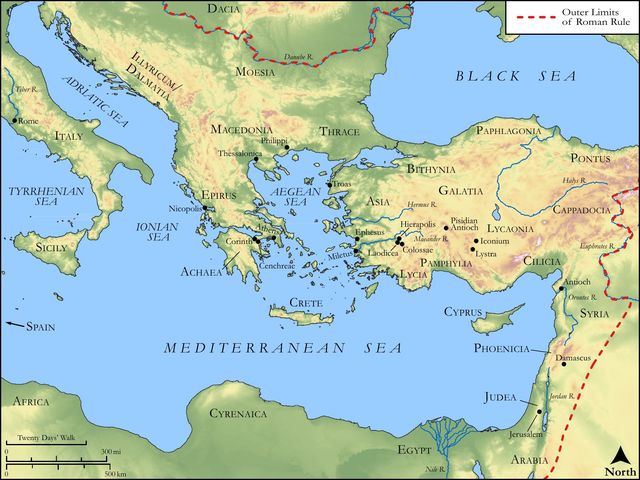
Where 2 Timothy reaches
The passages it leans on, and the ones that lean on it
Romans 1:16 2 Timothy 1:8 2 Timothy 1:12
Not ashamed of the gospel, because it is “the power of God”.
Moses’ word to Korah, “the LORD will shew who are his,” becomes the seal on God’s foundation.
The magicians of Egypt who withstood Moses; Scripture names them, Jannes and Jambres, only here.
The good fight Paul charged Timothy to fight in the first letter, which he now says he has fought.
Mark, over whom Paul and Barnabas parted, is now “profitable to me for the ministry”.
Books 2 Timothy links to most
The Church Fathers on 2 Timothy
371 quotations from 45 writers before AD 800 · the ten most quoted, in date order
- Ignatius108
- Tertullian220
- Origen253
- Cyprian258
- Basil379
- Chrysostom407
- Theodore428
- Augustine430
- Theodoret458
- John Damascene749
Theodore of Mopsuestia, on grace given “before the world began” and shown at Christ’s appearing.
The gospel is ancient in the will of the Giver, even if new in the chain of events. God has demonstrated his eternal will in Christ.
Tertullian, on 2:2: what Timothy was to commit to faithful men was no hidden gospel.
Nor, again, must the circumstance of his having wished him to "commit these things to faithful men, who should be able to teach others also," be construed into a proof of there being some occult gospel.
Theodoret, on 4:6, where “offered” is the pouring out of a drink offering.
Paul calls his destruction a libation, as if his blood were poured out for the sake of true religion.
Clement of Rome, the earliest voice here, on how Paul’s course ended.
Owing to envy, Paul also obtained the reward of patient endurance, after being seven times thrown into captivity, compelled to flee, and stoned. … having taught righteousness to the whole world, and come to the extreme limit of the west, and suffered martyrdom under the prefects.
Keep studying
Articles