


New Testament · Pauline Epistles · Book 56 of 66
Titus
Paul writes to Titus, whom he left in Crete to ordain elders, on sound doctrine for every household and the grace that saves a people for good works.
- 3 chapters
- 46 verses
- About 4 minutes to read
- Letters to the Churches, c. AD 48–96
Paul had left Titus in Crete with the work unfinished: towns without elders, and talkers “of the circumcision” who were upsetting whole houses for gain (1:5, 10–11). This short letter is his charge for that work. It says what kind of men to ordain, how to answer the false teachers, what to teach aged men and women, young women and men, and servants, and how the whole church is to live under rulers and among its neighbours.
The letter turns on the word “For.” Each block of instruction rests on a statement of the gospel. After the charges to each household comes “For the grace of God that bringeth salvation hath appeared to all men” (2:11). After the call to gentleness comes “For we ourselves also were sometimes foolish” (3:3), and the mercy that saved “Not by works of righteousness which we have done” (3:5). In Titus good works are never the ground of salvation and always its purpose: Christ gave himself to purify “a peculiar people, zealous of good works” (2:14).
Who gave himself for us, that he might redeem us from all iniquity, and purify unto himself a peculiar people, zealous of good works.
Titus 2:14 KJV
Before you read
- Who wrote it
- Paul, who names himself “a servant of God, and an apostle of Jesus Christ” (1:1).
- To whom
- Titus, “mine own son after the common faith” (1:4): a Greek whom Paul took to Jerusalem uncircumcised (Galatians 2:1–3), and later his envoy to Corinth (2 Corinthians 8:16–17). The closing “Grace be with you all” (3:15) is plural: the churches were to hear it too.
- When it was written
- Not dated in the letter. Paul is free to travel and means to winter at Nicopolis (3:12). Acts records no mission to Crete, and has Paul only sail past the island as a prisoner (Acts 27:7–8).
Those who place it after a release from Rome Paul was released from the house arrest with which Acts closes, as he had expected to be, and worked again in the east. Titus and 1 Timothy come from those years, and 2 Timothy from the imprisonment that followed.
Those who place it within the years Acts covers Paul visited Crete within the years Acts covers, on one of the journeys Luke passes over; his own letters name shipwrecks that Acts does not record. Apollos, whom Titus is to send on, was travelling among the churches then.
How Titus is laid out
6 movements · 8 passages · 46 verses · gold dots mark key verses
Paul to his son Titus
1:1–4 · 4 verses
Paul opens with one long sentence on his apostleship. It serves “the faith of God’s elect” and the truth “which is after godliness,” and rests on the hope of eternal life that God, “that cannot lie,” promised before the world began and has now made known through preaching committed to Paul. He greets Titus as “mine own son after the common faith.”
Elders for every city
1:5–16 · 12 verses
Titus was left in Crete to set things in order and ordain elders in every city. An elder must be blameless in marriage, children and character, and hold fast the faithful word, able “both to exhort and to convince the gainsayers.” They are needed: many vain talkers, chiefly of the circumcision, are subverting whole houses for gain. They profess to know God, but in works deny him.
Sound doctrine in every household
2:1–10 · 10 verses
Titus is to speak what becomes sound doctrine, group by group. Aged men are to be sober; aged women, reverent, teaching the young women to love their husbands and children; young men, sober minded, with Titus their pattern; servants, honest and faithful. The charges carry their reasons: that “the word of God be not blasphemed,” and that believers “adorn the doctrine of God our Saviour in all things.”
1 passages
The grace that teaches
2:11–15 · 5 verses
The ground of every charge follows: the grace of God that brings salvation has appeared to all men, teaching believers to deny ungodliness and live soberly, righteously and godly while they wait for “the glorious appearing of the great God and our Saviour Jesus Christ.” He gave himself to redeem a people zealous of good works. Titus is to speak this “with all authority.”
1 passages
Saved by his mercy
3:1–8 · 8 verses
Believers are to be subject to rulers, ready to every good work and gentle toward all men: “we ourselves also were sometimes foolish.” Then the kindness and love of God our Saviour appeared, and he saved them, not by their works but by his mercy, through the washing of regeneration and the renewing of the Holy Ghost. Titus must affirm this, so that believers maintain good works.
Last charges and greetings
3:9–15 · 7 verses
Titus is to avoid foolish questions, genealogies and strivings about the law, and to reject a heretic after a first and second admonition. When Artemas or Tychicus arrives, Titus is to join Paul at Nicopolis for the winter. Zenas the lawyer and Apollos are to be sent on their way with nothing lacking, and the believers are to learn good works for necessary uses.
The words Titus turns on
Saviour is God’s title and Christ’s in every chapter. The saved are to be sound, sober and zealous of good works, because his grace has appeared.
What Titus teaches
hygiaínō · sound
Sound doctrine, sound lives
The word Paul uses for sound doctrine, hygiainō, means to be in health. An elder holds fast the faithful word, “that he may be able by sound doctrine both to exhort and to convince the gainsayers” (1:9), and the false teachers are to be rebuked sharply, “that they may be sound in the faith” (1:13). Doctrine shows its health in the lives it produces. Theirs subverts “whole houses” (1:11): “They profess that they know God; but in works they deny him” (1:16). Titus is to speak “the things which become sound doctrine” (2:1), and each charge that follows is given for that doctrine’s good name: “that the word of God be not blasphemed” (2:5), “that they may adorn the doctrine of God our Saviour in all things” (2:10).
paideúō · teaching
Grace that teaches
The grace that brings salvation also teaches (2:11–12). Paul’s verb, paideuō, is the training of a child, correction included, and its lesson is the life the chapter has just described: “denying ungodliness and worldly lusts, we should live soberly, righteously, and godly, in this present world.” Soberly belongs to a family of words that runs through the letter, rendered sober, temperate, discreet and sober minded, and asked of elders (1:8), aged men (2:2), young women (2:4–5) and young men (2:6). What Titus teaches each group, grace teaches them all. Its end is a people redeemed and purified, “zealous of good works” (2:14), waiting for “that blessed hope” (2:13).
palingenesía · regeneration
The washing of regeneration
Paul includes himself: “we ourselves also were sometimes foolish, disobedient, deceived” (3:3). The change came from God’s side: “Not by works of righteousness which we have done, but according to his mercy he saved us, by the washing of regeneration, and renewing of the Holy Ghost” (3:5). Christians have read the washing in two ways. Augustine saw baptism in it: if anyone should ask of me whether we have been saved by baptism, I shall not be able to deny it
. Others read it as the Spirit’s own cleansing, which baptism signifies, promised in Ezekiel: “Then will I sprinkle clean water upon you … A new heart also will I give you” (Ezekiel 36:25–26). Both readings hold what the verse states: the saving is by mercy, the renewing is the Holy Ghost’s, and the saved are “justified by his grace” (3:7).
Christ in Titus
Each chapter gives the title Saviour first to God, then to Jesus Christ: “God our Saviour” at 1:3, 2:10 and 3:4, and Christ “our Saviour” at 1:4, 2:13 and 3:6. At 2:13 the church awaits “the glorious appearing of the great God and our Saviour Jesus Christ.” One Greek article governs both titles, as at 2 Peter 1:1, and Theodoret read them of one person: Here he calls the same one both Savior and great God and Jesus Christ.
Others read the Father and the Son named together, as in 1:4. Either way, the one who appears is Christ.
The same word marks his first coming: grace “hath appeared to all men” (2:11), and “the kindness and love of God our Saviour toward man appeared” (3:4). He “gave himself for us, that he might redeem us from all iniquity, and purify unto himself a peculiar people” (2:14). Those are the LORD’s words for Israel: he “shall redeem Israel from all his iniquities” (Psalm 130:8), and chose them “to be a peculiar people unto himself” (Deuteronomy 14:2). In Titus, Christ does what the LORD promised.
Places
2 named
- CreteThe island where Paul left Titus to ordain elders1
- NicopolisWhere Paul meant to winter, and called Titus to join him1
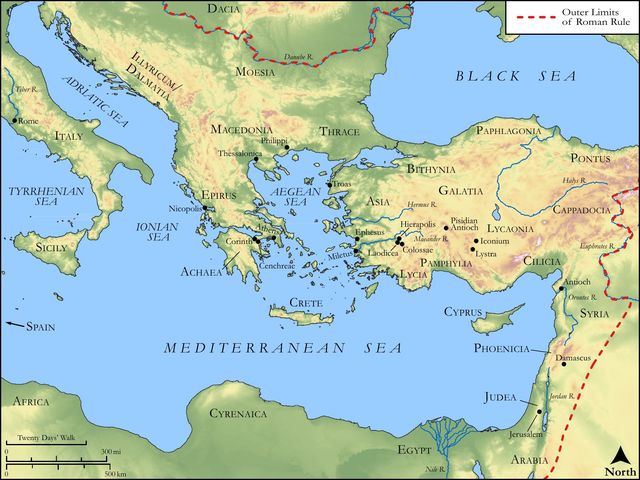
Where Titus reaches
The passages it leans on, and the ones that lean on it
Paul’s practice from his first journey: elders ordained “in every church,” as Titus is to ordain them “in every city.”
The same marks of an overseer, given to Timothy at Ephesus: blameless, “the husband of one wife,” “given to hospitality.”
Titus 1:14–16 Isaiah 29:13 Mark 7:6–8
Honour with the lips, a heart far off, and “the commandments of men”: Isaiah’s charge, which Christ turned on the Pharisees.
Saved by grace, “Not of works,” yet “created in Christ Jesus unto good works”: the same order as Titus 3:5–8.
The Spirit promised “upon all flesh,” poured out at Pentecost, and “shed on us abundantly through Jesus Christ our Saviour.”
Books Titus links to most
The Church Fathers on Titus
187 quotations from 35 writers before AD 800 · the ten most quoted, in date order
- Clement215
- Tertullian220
- Origen253
- Cyprian258
- Ambrose397
- Chrysostom407
- Jerome420
- Theodore428
- Augustine430
- Theodoret458
Clement of Rome, the earliest voice here, on the God “that cannot lie.”
Having then this hope [in the resurrection], let our souls be bound to him who is faithful in his promises and just in his judgments. He who has commanded us not to lie shall much more himself not lie; for nothing is impossible with God, except to lie.
Theodore of Mopsuestia, on elders and bishops in Paul’s day and after it.
Paul here shows that at this time ‘elders’ and ‘bishops’ were interchangeable and that some were put in charge of towns, some of whole regions. These latter became the bishops of later times.
Chrysostom, on the “Jewish fables” of 1:14.
For if thou believest the Faith, why dost thou add other things, as if the faith were not sufficient to justify? Why dost thou enslave thyself by subjection to the Law? … This is a mark of an unsound and unbelieving mind.
Gregory of Nyssa, on what the appearing of grace did to the worship of idols.
But as the apostle says, from the moment that God’s saving grace appeared among men and dwelt in human nature, all this vanished into nothing, like smoke.
Keep studying
Articles