


New Testament · General Epistles · Book 60 of 66
1 Peter
Peter’s letter to Christians scattered through five provinces of Asia Minor, teaching them to hope, to live as strangers, and to suffer for doing good as Christ did.
- 5 chapters
- 105 verses
- About 11 minutes to read
- Letters to the Churches, c. AD 48–96
Peter writes to Christians in five provinces of Asia Minor whom he calls “strangers” (1 Peter 1:1). Their new life has made them strange to their neighbours, who “think it strange that ye run not with them” (4:4), and the letter prepares them for worse. Peter does not explain the suffering away. He sets it in the order the prophets had seen in Christ, “the sufferings of Christ, and the glory that should follow” (1:11), and that order governs everything he asks of his readers.
Three things run through it. The Old Testament carries the argument: Isaiah, the Psalms and the law are quoted throughout, and Israel’s titles from Sinai are given to the church (2:9). Every duty, of servants, wives, husbands and elders, is set under Christ’s example. And the writer is the disciple who met Christ’s first word about his sufferings with “Be it far from thee, Lord” (Matthew 16:22), and who now calls himself “a witness of the sufferings of Christ” (5:1). He states his purpose at the close: “that this is the true grace of God wherein ye stand” (5:12).
But the God of all grace, who hath called us unto his eternal glory by Christ Jesus, after that ye have suffered a while, make you perfect, stablish, strengthen, settle you.
1 Peter 5:10 KJV
Before you read
- Who wrote it
- Peter, “an apostle of Jesus Christ” (1 Peter 1:1), who writes as “an elder, and a witness of the sufferings of Christ” (5:1). He wrote by Silvanus (5:12), the Silas who travelled with Paul (Acts 15:40).
- When it was written
- Not dated in the letter. It was written in Peter’s lifetime, to churches already “reproached for the name of Christ” (4:14) and facing “the fiery trial” (4:12).
- To whom
- Written “to the strangers scattered throughout Pontus, Galatia, Cappadocia, Asia, and Bithynia” (1:1). The letter does not say whether they were born Jews or Gentiles.
Eusebius and Andreas of Caesarea Jewish believers of the dispersion, to whom Peter is said to have preached in those provinces. He was sent to the circumcision, and James addresses the scattered tribes with the same word.
Grounds Eusebius of Caesarea 339 · History Of The Church 3.1Andreas of Caesarea 614 · CatenaGalatians 2:8James 1:1
Others, from what the letter says of its readers Mostly Gentile converts. They once lived in “the former lusts in your ignorance,” received a “vain conversation” from their fathers, “wrought the will of the Gentiles,” and “in time past were not a people.”
- Where
- The letter closes with greetings from “The church that is at Babylon” and from Marcus (5:13).
Eusebius, Andreas of Caesarea and Bede Rome, called Babylon by a figure, as Revelation gives the name Babylon to a great city. Bede gives the reason as the city’s many idols.
Grounds Eusebius of Caesarea 339 · History Of The Church 2.15Andreas of Caesarea 614 · CatenaBede 735 · Commentary on the Catholic EpistlesRevelation 17:5Revelation 17:18
Others, reading the place name literally Babylon on the Euphrates, named as plainly as the five provinces of the opening verse. Peter’s apostleship was to the circumcision.
How 1 Peter is laid out
5 movements · 22 passages · 105 verses
Born again to a living hope
1:1–12 · 12 verses
Peter greets the elect strangers of five provinces and blesses God, who has begotten them again “unto a lively hope” by Christ’s resurrection. Their inheritance is reserved in heaven and they are kept for it, so they rejoice while their faith is tried like gold in the fire. The prophets searched for this salvation, and angels desire to look into it.
A holy people, a spiritual house
1:13–2:10 · 23 verses
Hope calls for holiness: “Be ye holy; for I am holy.” They were redeemed not with silver and gold but with the precious blood of Christ, and born again by the word that endures for ever. Coming to Christ, the living stone, they are built up a spiritual house and given Israel’s titles: “a chosen generation, a royal priesthood.”
Strangers who do good
2:11–3:12 · 27 verses
As strangers and pilgrims they are to keep their conduct honest among the Gentiles. They submit to every ordinance of man for the Lord’s sake, servants to their masters, even the froward, after the pattern of Christ, who suffered without threatening and bore their sins. Wives win husbands by their conduct, husbands honour their wives, and all return blessing for evil.
Suffering for well doing
3:13–4:19 · 29 verses
Those who suffer for righteousness are happy, and must be ready to give a reason for their hope. Christ suffered once, the just for the unjust, preached to the spirits in prison, and is at God’s right hand. Armed with his mind, they cease from sin and serve one another, for the end is near. The fiery trial is no strange thing; judgment begins at God’s house.
The flock and the chief Shepherd
Chapter 5 · 14 verses
Peter, himself an elder, charges the elders to feed the flock of God willingly, looking for the chief Shepherd’s crown of glory. The younger submit, and all are clothed with humility, casting their care on God and resisting the devil, stedfast in the faith. Peter prays that the God of all grace will settle them. The church at Babylon and Marcus send greetings.
The words 1 Peter turns on
Suffer and glory run through the letter as a pair; grace opens and closes it, and conversation is the strangers’ way of life, watched by their neighbours.
What 1 Peter teaches
elpís · hope
A lively hope
The letter opens by blessing God, who “hath begotten us again unto a lively hope by the resurrection of Jesus Christ from the dead” (1:3). The hope lives because the one it rests on lives. It looks to “an inheritance incorruptible, and undefiled, and that fadeth not away, reserved in heaven for you” (1:4), and the heirs themselves “are kept by the power of God through faith” (1:5). Peter tells them to “hope to the end for the grace that is to be brought unto you at the revelation of Jesus Christ” (1:13), and to be ready with “a reason of the hope that is in you” (3:15). The hope rests on a past event, the resurrection, and waits for a future one, Christ’s appearing; the trials between last “for a season” (1:6).
parepídēmos · stranger
Strangers, and the people of God
Peter calls his readers “strangers” in his first verse and “strangers and pilgrims” at 2:11, and tells them to “pass the time of your sojourning here in fear” (1:17). They are strangers because God has made them a people. The titles he gave Israel at Sinai, “a kingdom of priests, and an holy nation” (Exodus 19:6), now belong to them: “a chosen generation, a royal priesthood, an holy nation, a peculiar people” (2:9). Peter applies Hosea’s promise to them: they “in time past were not a people, but are now the people of God” (2:10). The faithful before them had confessed “that they were strangers and pilgrims on the earth” (Hebrews 11:13). Belonging to God makes them foreigners at home, and their neighbours are watching: “Having your conversation honest among the Gentiles” (2:12).
páschō · suffer
Suffering, then glory
Eleven verses of this short letter use the verb suffer, more than a quarter of the New Testament verses that do. Peter gives his readers the order the prophets saw in Christ (1:11): “rejoice, inasmuch as ye are partakers of Christ’s sufferings; that, when his glory shall be revealed, ye may be glad also with exceeding joy” (4:13). None is to suffer “as a murderer, or as a thief”; “Yet if any man suffer as a Christian, let him not be ashamed” (4:15–16). Suffering for well doing has Christ for its pattern, who “suffered for us, leaving us an example, that ye should follow his steps” (2:21), and who “when he suffered, he threatened not; but committed himself to him that judgeth righteously” (2:23). And it is short: “after that ye have suffered a while” (5:10).
phylakḗ · prison
The spirits in prison
Christ was “put to death in the flesh, but quickened by the Spirit: By which also he went and preached unto the spirits in prison” (3:18–19). Irenaeus read a descent to the dead: the Lord descended into the regions beneath the earth, preaching His advent there also
, and 4:6 speaks of the gospel “preached also to them that are dead.” Bede read a preaching through Noah, “a preacher of righteousness” (2 Peter 2:5), to the disobedient of his day, now in prison: Christ was in Noah and the other saints of that time through the Holy Spirit
, as “the Spirit of Christ” was in the prophets (1:11). A third reading takes the spirits as “the angels that sinned” (2 Peter 2:4). Peter goes on to the flood: “eight souls were saved by water,” and baptism answers to it (3:20–21).
Christ in 1 Peter
Peter says the prophets spoke by “the Spirit of Christ which was in them,” which “testified beforehand the sufferings of Christ, and the glory that should follow” (1:11). His letter reads the prophets that way. Its passage on Christ’s sufferings is Isaiah 53 applied line by line (Isaiah 53:4–9): he “did no sin, neither was guile found in his mouth” (2:22); he “bare our sins in his own body on the tree,” and “by whose stripes ye were healed” (2:24); the readers had been “as sheep going astray” (2:25). He suffered “the just for the unjust, that he might bring us to God” (3:18).
He is the lamb “without blemish and without spot” (1:19), as the Passover lamb was to be (Exodus 12:5), and the stone of Isaiah 28:16 and Psalm 118:22, which Jesus applied to himself (Matthew 21:42) and Peter preached to the council (Acts 4:11). He is “the chief Shepherd” (5:4). Peter, told “Feed my sheep” (John 21:17), passes the charge to the elders: “Feed the flock of God” (5:2).
People
By how many verses name them
- PeterSon of Jona (Matthew 16:17); a brother of Andrew1
- SaraDaughter of Terah; a sister of Abraham, Nahor and Haran; wife of Abraham; mother of Isaac1
- AbrahamSon of Terah; a brother of Nahor, Haran and Sarah1
- NoahHusband of Naamah(?); a son of Lamech; father of Shem, Ham and Japheth1
- Silvanus1
- MarcusHis mother was Mary1
Places
7 named
- AsiaThe province of Asia, fourth of the five addressed1
- BabylonNamed in the closing greeting: Rome by a figure, or Babylon itself1
- BithyniaLast province named; the Spirit once kept Paul from it1
- CappadociaThird province named; its dwellers heard Peter at Pentecost1
- GalatiaSecond province named; Paul went through its country twice1
- PontusFirst province named; dwellers in Pontus heard Peter at Pentecost1
- SionSion, where God lays the chief corner stone1
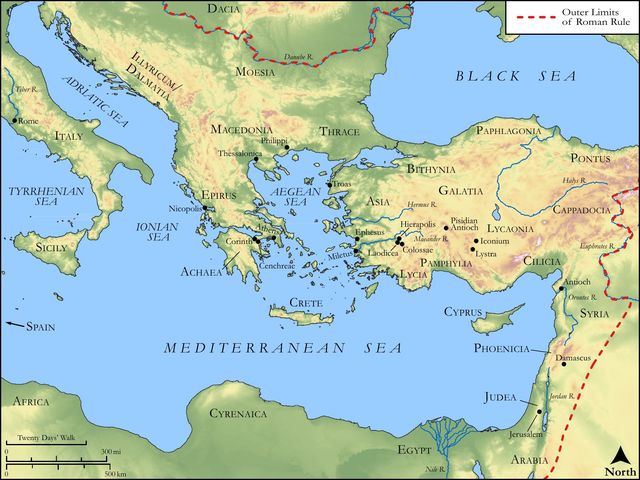
Where 1 Peter reaches
The passages it leans on, and the ones that lean on it
Exodus 19:5–6 1 Peter 2:9–10 Hosea 2:23
Israel’s titles at Sinai given to the church, and Hosea’s promise to those who were not God’s people.
1 Peter 2:6–8 Isaiah 28:16 Psalms 118:22
Two stone texts joined: the corner stone laid in Sion, and the stone the builders refused.
The suffering Servant: no deceit in his mouth, sins borne, healing by his stripes, sheep gone astray.
All flesh is grass, but the word stands for ever; Peter names that word as the gospel preached to them.
Psalms 34:12–16 1 Peter 3:10–12
Peter quotes David’s psalm on seeing good days; he has already drawn on it at 2:3.
Books 1 Peter links to most
The Church Fathers on 1 Peter
534 quotations from 57 writers before AD 800 · the ten most quoted, in date order
- Polycarp155
- Clement215
- Tertullian220
- Origen253
- Cyprian258
- Didymus398
- Augustine430
- Hilary449
- Andreas614
- Bede735
Hilary of Arles set the inheritance of the second Adam against the first.
An incorruptible inheritance must be an infinite one, since everything finite is corruptible. The inheritance of the first Adam was corrupted by sin, but the inheritance of the second Adam can never be touched by the stain of sin.
Augustine on the royal priesthood: an anointing once given to one, now to all.
In ancient times only one high priest was anointed, but now all Christians are anointed.
Theodoret on the healing by stripes in 2:24.
This is a new and strange kind of healing. For in this case it is the doctor who receives the honor but the patient who is healed.
Bede on the fiery trial of 4:12.
For it is very ancient and common for the chosen of God to endure adversities in this present life for eternal salvation.
Keep studying
Articles