


1 Timothy 2:13
- ἈδὰμAdamAdamG76N-NSM-PNoun Nominative Singular Masculine Individual
- γὰρgarforG1063CONJConjunction
- πρῶτοςprōtosfirstG4413A-NSMAdjective Nominative Singular Masculine
- ἐπλάσθηeplasthēwas formedG4111V-API-3SVerb Aorist Passive Indicative 3rd Singular
- εἶταeitathenG1534ADVAdverb
- ΕὕαHeuaEveG2096N-NSF-PNoun Nominative Singular Feminine Individual
English is a literal word-by-word gloss of the Greek, not the KJV's wording. Why?
This is the original text the KJV's translators worked from — each Greek word with its own literal English meaning in this verse, prepared by scholars at Tyndale House, Cambridge. The KJV translates whole sentences, not word by word, so its wording differs: one Greek word can become several English words, and the KJV may choose “charity” where the gloss reads “love”. Both are faithful — they answer different questions. For the KJV's own rendering, switch to the KJV text.
Details
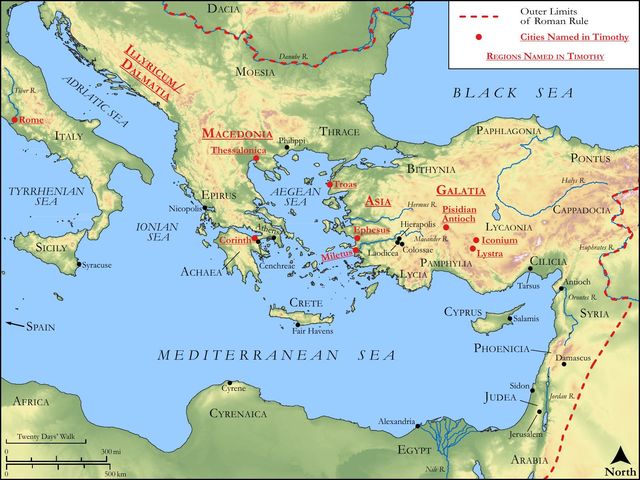
See on the biblical-era map

Study this verse
Public-domain commentary
Matthew Henry
From his Commentary on the Whole Bible. Henry comments on passages, not single verses — this entry covers 1 Timothy 2:9–15. His two-level outline is real structure in the source text, so it is rendered as structure.
I.Here is a charge, that women who profess the Christian religion should be modest, sober, silent, and submissive, as becomes their place.
1.They must be very modest in their apparel, not affecting gaudiness, gaiety, or costliness (you may read the vanity of a person's mind in the gaiety and gaudiness of his habit), because they have better ornaments with which they should adorn themselves, with good works. Note, Good works are the best ornament; these are, in the sight of God, of great price. Those that profess godliness should, in their dress, as well as other things, act as becomes their profession; instead of laying out their money on fine clothes, they must lay it out in works of piety and charity, which are properly called good works.
2.Women must learn the principles of their religion, learn Christ, learn the scriptures; they must not think that their sex excuses them from that learning which is necessary to salvation.
3.They must be silent, submissive, and subject, and not usurp authority. The reason given is because Adam was first formed, then Eve out of him, to denote her subordination to him and dependence upon him; and that she was made for him, to be a help-meet for him. And as she was last in the creation, which is one reason for her subjection, so she was first in the transgression, and that is another reason. Adam was not deceived, that is, not first; the serpent did not immediately set upon him, but the woman was first in the transgression (Co2 11:3), and it was part of the sentence, Thy desire shall be to thy husband, and he shall rule over thee, Gen 3:16. But it is a word of comfort (Ti1 2:15) that those who continue in sobriety shall be saved in child-bearing, or with child-bearing - the Messiah, who was born of a woman, should break the serpent's head (Gen 3:15); or the sentence which they are under for sin shall be no bar to their acceptance with Christ, if they continue in faith, and charity, and holiness, with sobriety.
II.Here observe,
1.The extensiveness of the rules of Christianity; they reach not only to men, but to women, not only to their persons, but also to their dress, which must be modest, like their sex; and to their outward deportment and behaviour, it must be in silence, with all subjection.
2.Women are to profess godliness as well as men; for they are baptized, and thereby stand engaged to exercise themselves to godliness; and, to their honour be it spoken, many of them were eminent professors of Christianity in the days of the apostles, as the book of Acts will inform us.
3.Women being more in danger of exceeding in their apparel, it was more necessary to caution them in this respect.
4.The best ornaments for professors of godliness are good works.
5.According to Paul, women must be learners, and are not allowed to be public teachers in the church; for teaching is an office of authority, and the woman must not usurp authority over the man, but is to be in silence. But, notwithstanding this prohibition, good women may and ought to teach their children at home the principles of religion. Timothy from a child had known the holy scriptures; and who should teach him but his mother and grandmother? Ti2 3:15. Aquila and his wife Priscilla expounded unto Apollos the way of God more perfectly; but then they did it privately, for they took him unto them, Act 18:26.
6.Here are two very good reasons given for the man's authority over the woman, and her subjection to the man, Ti1 2:13, Ti1 2:14. Adam was first formed, then Eve; she was created for the man, and not the man for the woman (Co1 11:9); then she was deceived, and brought the man into the transgression.
7.Though the difficulties and dangers of childbearing are many and great, as they are part of the punishment inflicted on the sex for Eve's transgression, yet here is much for her support and encouragement: Notwithstanding she shall be saved, etc. Though in sorrow, yet she shall bring forth, and be a living mother of living children; with this proviso, that they continue in faith, and charity, and holiness, with sobriety: and women, under the circumstance of child-bearing should by faith lay hold of this promise for their support in the needful time.
Historical interpretation
Seventeen Centuries of Reception
5 surviving comments on this verse. Each one is dated, so this reads as a timeline rather than a list.
Select a marker to jump to its quote. Markers stagger vertically where authors wrote within a few decades of each other.
But you should not be surprised that she [the church] who is gathered out of the dispersion of the nations and prepared to be the bride of Christ has sometimes been guilty of these faults. Remember how the first woman was seduced and was in the transgression and could find her salvation, so the Scripture says, only in bearing children, which for our present purpose means those who continue in faith and love with sanctity. The apostle, therefore, declares what is written about Adam and Eve thus, “This is a great mystery in Christ and in the church.” Christ so loved her that he gave himself for her, while she was yet undutiful, even as he says, “When as yet we were ungodly according to the time, Christ died for us”; and again, “While we were yet sinners, Christ died for us.”
It was said, moreover, that it was not good for man to be alone. Yet we know that Adam did not commit sin before woman was created. However, after creation, she was the first to disobey the divine command and even allured her husband to sin. If, therefore, the woman is responsible for the sin, how then can her coming be considered a good? But, if you consider that the universe is in the care of God, then you will discover this fact, namely, that the Lord must have gained more pleasure for himself in being responsible for all creation than condemnation from us for providing the basis for sin. Accordingly, the Lord declared that it was not good for man to be alone, because the human race could not have been propagated from man alone.… For the sake therefore of the successive generations of men it followed that woman had to be joined to man. Thus we must interpret the very words of God when he said that it was not good for the man to be alone. If the woman was to be the first one to sin, the fact that she was the one destined to bring forth redemption must not be excluded from the operations of divine Providence. Although “Adam was not deceived, the woman was deceived and was in sin.” Yet woman, we are told, “will be saved by childbearing,” in the course of which Christ became born of woman.
If it be asked, what has this to do with women of the present day? it shows that the male sex enjoyed the higher honor. Man was first formed; and elsewhere he shows their superiority. "Neither was the man created for the woman, but the woman for the man." Why then does he say this? He wishes the man to have the preeminence in every way; both for the reason given above, he means, let him have precedence, and on account of what occurred afterwards. For the woman taught the man once, and made him guilty of disobedience, and wrought our ruin. Therefore because she made a bad use of her power over the man, or rather her equality with him, God made her subject to her husband. "Thy desire shall be to thy husband?" This had not been said to her before.
For Adam was formed first, then Eve; and Adam was not deceived, but the woman being deceived fell into transgression.
For Adam was formed first. Since Adam was formed first, the woman should not have authority over the man, but should be in submission to him.
Adam was not deceived. As to the comparison with the deceit with which the woman was deceived, the behavior of Adam is neither deceit nor trickery. For it is much more reasonable to be deceived by the serpent than to accept the fruit from the woman and eat it. Therefore, in his defense, Paul says that he was not deceived, but that "The woman whom you gave to be my helper, she gave to me and I ate." (Gen. 3:12) Calmly showing that Adam did not even err after listening to his helper. "He was not deceived." Note that what precedes is to be understood as implied.
In another way also. How was Adam not deceived? Because neither does Scripture say this, but the woman indeed: "The serpent deceived me." (Gen. 3:13) But Adam does not say; "The woman deceived me," but, "She gave me." She gave to me: For it is not the same to be persuaded by a fellow and companion, and to be persuaded by a beast, slave, and one who is subordinated. Therefore, that was the deception. But neither did Adam see the tree that it was beautiful to eat, but the woman.
but the woman being deceived. And Paul brings this forward to prevent a woman from teaching. For once a woman has taught, Paul says, she overturns everything and makes the man subject to disobedience: for she was the author herself and advised him to eat. Therefore, he does not say: Eve was deceived; but the woman was deceived, indicating a nature that is easily deceived.
but the woman being deceived fell into transgression. Not only Eve became accountable to transgression, but also the whole sisterhood of women. For as in Adam we all die, so in Eve all have sinned.
I heard that the Church of England was being advised to declare women capable of Priests' Orders. I am, indeed, informed that such a proposal is very unlikely to be seriously considered by the authorities. To take such a revolutionary step at the present moment, to cut ourselves off from the Christian past and to widen the divisions between ourselves and other Churches by establishing an order of priestesses in our midst, would be an almost wanton degree of imprudence. And the Church of England herself would be torn in shreds by the operation. My concern with the proposal is of a more theoretical kind. The question involves something even deeper than a revolution in order...
To us a priest is primarily a representative, a double representative, who represents us to God and God to us. Our very eyes teach us this in church. Sometimes the priest turns his back on us and faces the East - he speaks to God for us: sometimes he faces us and speaks to us for God. We have no objection to a woman doing the first: the whole difficulty is about the second. But why? Why should a woman not in this sense represent God? [...]
Suppose the reformer stops saying that a good woman may be like God and begins saying that God is like a good woman. Suppose he says that we might just as well pray to 'Our Mother which art in heaven' as to 'Our Father'. Suppose he suggests that the Incarnation might just as well have taken a female as a male form, and the Second Person of the Trinity be as well called the Daughter as the Son. Suppose, finally, that the mystical marriage were reversed, that the Church were the Bridegroom and Christ the Bride. All this, as it seems to me, is involved in the claim that a woman can represent God as a priest does.
Now it is surely the case that if all these supposals were ever carried into effect we should be embarked on a different religion. Goddesses have, of course, been worshipped: many religions have had priestesses. But they are religions quite different in character from Christianity...
Christians think that God Himself has taught us how to speak of Him...
We men may often make very bad priests. That is because we are insufficiently masculine. It is no cure to call in those who are not masculine at all...
Lady Nunburnholme has claimed that the equality of men and women is a Christian principle... Unless "equal" means "interchangeable", equality makes nothing for the priesthood of women.
Continue studying 1 Timothy 2:13 across the web’s major study libraries — every link below opens this exact verse, chapter, or book on the destination site.
Read & Compare
 BibleGatewayThis verse in more than 200 translations and 70 languages.
 Bible.comThe YouVersion reader — hundreds of translations, reading plans, and highlights.
 ESV.orgCrossway's official English Standard Version reader.
 NET BibleThe NET translation with 60,000+ translators' notes on every rendering decision.
 STEP BibleTyndale House's free study tool — original text, vocabulary, and scholarly resources.
 BibliaLogos Bible Software's free web reader.
 USCCBThe New American Bible (Revised Edition) with the U.S. bishops' study notes.
Commentaries
 BibleHub CommentariesDozens of classic commentaries on this verse, gathered on one page.
 StudyLightMore than 100 commentary sets — the largest collection on the web.
 BibleRefPlain-English commentary on what this verse means, verse by verse.
 Enduring WordDavid Guzik's free commentary on this chapter, widely used by Bible teachers.
 Bible Study ToolsVerse commentary alongside Greek and Hebrew study aids.
Original Language & Research
- BibleHub InterlinearThe verse word by word — original language, transliteration, and English.
- BibleHub LexiconEvery word's original-language definition and Strong's entry.
 Blue Letter BibleDeep-study tools — Strong's numbers, concordance, and word studies.
 CNTR CollationThe earliest Greek manuscripts of this verse, collated letter by letter.
Sermons, Hymns & Audio


TrulyRandomVerse is not affiliated with these sites and doesn’t control their content. They’re linked because they’re genuinely useful.
Summary
Paul grounds his instructions regarding order and roles within the Ephesian church in the foundational act of creation, asserting that Adam's prior formation to Eve establishes a divine sequence. This concise statement serves as a theological rationale for the preceding directives concerning conduct, teaching, and authority, emphasizing a pattern established by God from the very beginning of human history.
Context
ShowHideLiterary Context
This verse is a pivotal part of Paul's comprehensive pastoral guidance to Timothy concerning the conduct and order of the church in Ephesus, found in 1 Timothy 2. Specifically, it immediately follows Paul's instruction in 1 Timothy 2:11-12 that women should "learn in quietness and full submission" and that he does "not permit a woman to teach or to assume authority over a man; she must be quiet." The conjunction "For" (Greek: gar) at the beginning of verse 13 indicates that the creation order of Adam and Eve is presented as the primary theological justification for these specific directives, grounding them not in cultural norms but in the very fabric of God's original design.
Historical & Cultural Context
The letter to Timothy addresses issues pertinent to the nascent Christian community in Ephesus, a bustling Roman city known for its prominent temple to Artemis (Diana). The worship of Artemis involved female leadership and priestesses, which may have presented a cultural challenge or influence on the roles within the early church. Paul's emphasis on order and sound doctrine in 1 Timothy is a consistent theme, countering potential disruptions from false teachers and ensuring the church's integrity. By appealing to the creation narrative, Paul transcends contemporary cultural practices, grounding his instructions in trans-cultural, divine principles rather than merely local customs.
Key Themes
ShowHideThe verse powerfully contributes to several key themes within 1 Timothy and Pauline theology. Foremost is the Divine Order of Creation, which posits that God established a specific sequence and design from the beginning of humanity, as detailed in Genesis 2. This order is presented as a foundational principle, not merely a historical anecdote. Secondly, it underscores the Foundational Basis for Authority and Roles within the community of faith. Paul uses the chronological "firstness" of Adam's creation as a theological argument for the distinct, complementary roles he outlines for men and women in the church, particularly concerning teaching and authority. This points to God's Intentional Design, suggesting that the structure and relationships within the church should reflect the wise and purposeful design of the Creator, rather than being solely dictated by human preference or societal trends.
Exposition and Analysis
ShowHideKey Word Analysis
ShowHideThis primary particle serves to introduce a reason or explanation. In this context, it signals that the statement about Adam's prior formation is the theological ground or justification for the preceding instructions regarding women's roles in teaching and authority within the church. It is not merely an additional piece of information but the foundational premise.
This word, a superlative, denotes priority in time, place, order, or importance. Here, it emphatically highlights the chronological sequence of creation, asserting Adam's initial formation before Eve. This "firstness" is not simply a historical detail but carries theological weight, implying a corresponding order of headship or responsibility that Paul applies to the church's structure.
This verb signifies "to mould," "to shape," or "to fabricate." It emphasizes the deliberate, personal, and hands-on act of God in creating Adam from the dust of the earth (Genesis 2:7). The use of this specific word underscores the intentionality and direct involvement of the Creator in establishing the order and nature of humanity.
Verse Breakdown
ShowHide"For Adam was first formed"
This clause establishes the theological premise for Paul's preceding instructions. It points to the direct and intentional act of God in creating Adam from the dust of the ground as the initial human being. The emphasis on "first" highlights the chronological priority of Adam's creation, which Paul uses as a foundational principle for understanding roles and order within the church. This "firstness" implies a certain headship or representative role, as Adam was the first to receive God's commands and was the representative head of humanity.
"then Eve"
This subsequent clause completes the chronological statement, indicating that Eve was created after Adam and from Adam's side (Genesis 2:21-22). The word "then" (Greek: eîta) denotes a succession in time, reinforcing the established order. This sequence of creation—Adam first, then Eve from him and for him—is presented as a divine pattern that informs Paul's understanding of complementary roles and authority structures within the Christian community.
Literary Devices
ShowHideThe primary literary device employed in 1 Timothy 2:13 is Causal Conjunction, specifically through the use of the Greek particle gár ("For"). This word establishes a direct logical link between the preceding instructions (regarding women's roles in teaching and authority in 1 Timothy 2:11-12) and the historical fact of Adam's prior creation. Paul is not merely stating a historical fact but presenting it as the reason or basis for his directives. Furthermore, the verse utilizes Chronological Ordering ("first... then") to highlight the sequence of creation as a significant theological principle. This simple, declarative statement serves as an Allusion to the Genesis creation narrative, drawing upon a foundational text of Jewish and Christian theology to provide a universal and timeless justification for the specific church practices Paul outlines.
Theological and Thematic Connections
ShowHideThe theological significance of 1 Timothy 2:13 lies in its grounding of practical church order in the divine act of creation. Paul appeals to the historical sequence of Adam's formation before Eve not as a mere historical detail, but as a theological principle establishing a pattern of order and headship. This principle suggests that God's design for humanity, as revealed in creation, has implications for how men and women function in complementary roles within the church and marriage. It underscores that distinct roles do not imply inferiority or superiority, but rather reflect a divine wisdom intended for harmony, flourishing, and the proper functioning of the body of Christ. This verse reinforces the idea that God is a God of order, and His original design provides a blueprint for human relationships and ecclesiastical structure.
Reflection and Application
ShowHide1 Timothy 2:13 invites believers to consider the profound implications of God's original design for humanity. While the specific applications of Paul's instructions in 1 Timothy 2 continue to be a subject of careful theological discussion and diverse interpretations within the church, the underlying principle of divine order rooted in creation remains universally relevant. This verse challenges us to look beyond cultural trends and personal preferences to discern God's intentional design for relationships, roles, and responsibilities within the family and the church. It calls us to embrace a complementary understanding of gender, where distinct roles are valued as part of God's wise plan, promoting mutual respect, love, and harmonious functioning rather than competition or subjugation. Reflecting on this verse encourages us to seek unity and peace by aligning ourselves with God's established patterns, trusting that His design leads to true flourishing.
Questions for Reflection
ShowHideFAQ
ShowHideDoes this verse imply the inferiority of women?
ShowHideNo, this verse does not imply the inferiority of women. Paul's argument is based on the sequence of creation, not on the inherent worth or dignity of either Adam or Eve. Both male and female are created in the image of God (Genesis 1:27) and are equally valuable in His sight. The New Testament consistently affirms the spiritual equality of men and women in Christ, as stated in Galatians 3:28: "There is neither Jew nor Gentile, neither slave nor free, nor is there male and female, for you are all one in Christ Jesus." The point in 1 Timothy 2:13 pertains to functional roles and order within the church context, deriving from a specific theological rationale rooted in creation, rather than a statement about intrinsic worth.
Christ-Centered Fulfillment
ShowHideWhile 1 Timothy 2:13 directly addresses the historical sequence of creation to establish church order, its deeper Christ-centered fulfillment lies in how the "firstness" of Adam foreshadows and is ultimately superseded by the "firstness" and preeminence of Christ. Adam, as the "first man," brought sin and death into the world (Romans 5:12), establishing an order of fallen humanity where "in Adam all die" (1 Corinthians 15:22). However, Christ is presented as the "last Adam" or "second man" (1 Corinthians 15:45-47), who inaugurates a new creation and a new order. His "firstness" is not merely chronological but one of ultimate authority and supremacy – He is "the firstborn over all creation" (Colossians 1:15), "the firstborn from among the dead" (Colossians 1:18), and the one through whom all things are reconciled to God (Colossians 1:20). Thus, the divinely established order referenced in 1 Timothy 2:13 finds its ultimate purpose and perfection in Christ, who is the head of all things and the one who brings true order, life, and redemption to humanity.