


1 Corinthians 11:8
- οὐouNotG3756PRT-NNegative Particle Negative
- γάρgarforG1063CONJConjunction
- ἐστινestinisG1510V-PAI-3SVerb Present Active Indicative 3rd Singular
- ἀνὴρanērmanG435N-NSMNoun Nominative Singular Masculine
- ἐκekofG1537PREPPreposition
- γυναικὸςgunaikoswomanG1135N-GSFNoun Genitive Singular Feminine
- ἀλλὰallabutG235CONJConjunction
- γυνὴgunēwomanG1135N-NSFNoun Nominative Singular Feminine
- ἐξexofG1537PREPPreposition
- ἀνδρός·androsmanG435N-GSMNoun Genitive Singular Masculine
English is a literal word-by-word gloss of the Greek, not the KJV's wording. Why?
This is the original text the KJV's translators worked from — each Greek word with its own literal English meaning in this verse, prepared by scholars at Tyndale House, Cambridge. The KJV translates whole sentences, not word by word, so its wording differs: one Greek word can become several English words, and the KJV may choose “charity” where the gloss reads “love”. Both are faithful — they answer different questions. For the KJV's own rendering, switch to the KJV text.
Details
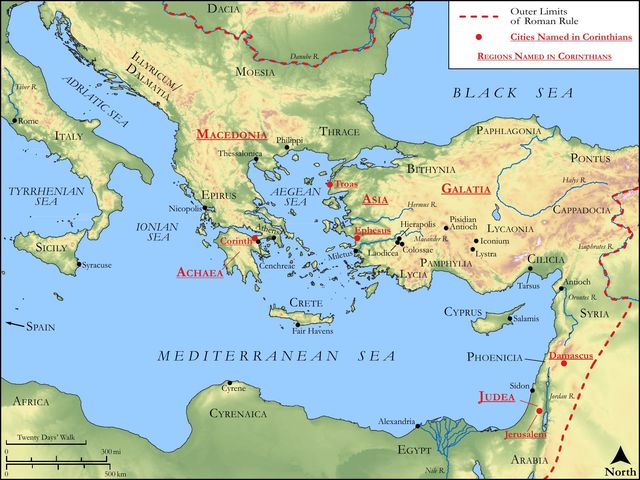
See on the biblical-era maps

Study this verse
Public-domain commentary
Matthew Henry
From his Commentary on the Whole Bible. Henry comments on passages, not single verses — this entry covers 1 Corinthians 11:1–16. His two-level outline is real structure in the source text, so it is rendered as structure.
Paul, having answered the cases put to him, proceeds in this chapter to the redress of grievances. The first verse of the chapter is put, by those who divided the epistle into chapters, as a preface to the rest of the epistle, but seems to have been a more proper close to the last, in which he had enforced the cautions he had given against the abuse of liberty, by his own example: Be ye followers of me, as I also am of Christ (Co1 11:1), fitly closes his argument; and the way of speaking in the next verse looks like a transition to another. But, whether it more properly belong to this or the last chapter, it is plain from it that Paul not only preached such doctrine as they ought to believe, but led such a life as they ought to imitate. "Be ye followers of me," that is, "Be imitators of me; live as you see me live." Note, Ministers are likely to preach most to the purpose when they can press their hearers to follow their example. Yet would not Paul be followed blindly neither. He encourages neither implicit faith nor obedience. He would be followed himself no further than he followed Christ. Christ's pattern is a copy without a blot; so is no man's else. Note, We should follow no leader further than he follows Christ. Apostles should be left by us when they deviate from the example of their Master. He passes next to reprehend and reform an indecency among them, of which the women were more especially guilty, concerning which observe,
I.How he prefaces it.
He begins with a commendation of what was praiseworthy in them (Co1 11:2): I praise you, that you remember me in all things, and keep the ordinances as I delivered them to you. Many of them, it is probable, did this in the strictest sense of the expression: and he takes occasion thence to address the body of the church under this good character; and the body might, in the main, have continued to observe the ordinances and institutions of Christ, though in some things they deviated fRom. and corrupted, them. Note, When we reprove what is amiss in any, it is very prudent and fit to commend what is good in them; it will show that the reproof is not from ill-will, and a humour of censuring and finding fault; and it will therefore procure the more regard to it.
II.How he lays the foundation for his reprehension by asserting the superiority of the man over the woman:
I would have you know that the head of every man is Christ, and the head of the woman is the man, and the head of Christ is God. Christ, in his mediatorial character and glorified humanity, is at the head of mankind. He is not only first of the kind, but Lord and Sovereign. He has a name above every name: though in this high office and authority he has a superior, God being his head. And as God is the head of Christ, and Christ the head of the whole human kind, so the man is the head of the tow sexes: not indeed with such dominion as Christ has over the kind or God has over the man Christ Jesus; but a superiority and headship he has, and the woman should be in subjection and not assume or usurp the man's place. This is the situation in which God has placed her; and for that reason she should have a mind suited to her rank, and not do any thing that looks like an affectation of changing places. Something like this the women of the church of Corinth seem to have been guilty of, who were under inspiration, and prayed and prophesied even in their assemblies, Co1 11:5. It is indeed an apostolical canon, that the women should keep silence in the churches (Co1 14:34; Ti1 2:12), which some understand without limitation, as if a woman under inspiration also must keep silence, which seems very well to agree with the connection of the apostle's discourse, ch. 14. Others with a limitation: though a woman might not from her own abilities pretend to teach, or so much as question and debate any thing in the church yet when under inspiration the case was altered, she had liberty to speak. Or, though she might not preach even by inspiration (because teaching is the business of a superior), yet she might pray or utter hymns by inspiration, even in the public assembly. She did not show any affectation of superiority over the man by such acts of public worship. It is plain the apostle does not in this place prohibit the thing, but reprehend the manner of doing it. And yet he might utterly disallow the thing and lay an unlimited restraint on the woman in another part of the epistle. These things are not contradictory. It is to his present purpose to reprehend the manner wherein the women prayed and prophesied in the church, without determining in this place whether they did well or ill in praying or prophesying. Note, The manner of doing a thing enters into the morality of it. We must not only be concerned to do good, but that the good we do be well done.
III.The thing he reprehends is the woman's praying or prophesying uncovered, or the man's doing either covered, Co1 11:4, Co1 11:5.
To understand this, it must be observed that it was a signification either of shame or subjection for persons to be veiled, or covered, in the eastern countries, contrary to the custom of ours, where the being bare-headed betokens subjection, and being covered superiority and dominion. And this will help us the better to understand,
IV.The reasons on which he grounds his reprehension.
1.The man that prays or prophesies with his head covered dishonoureth his head, namely, Christ, the head of every man (Co1 11:3), by appearing in a habit unsuitable to the rank in which God has placed him. Note, We should, even in our dress and habits, avoid every thing that may dishonour Christ. The woman, on the other hand, who prays or prophesies with her head uncovered dishonoureth her head, namely, the man, Co1 11:3. She appears in the dress of her superior, and throws off the token of her subjection. She might, with equal decency, cut her hair short, or cut it close, which was the custom of the man in that age. This would be in a manner to declare that she was desirous of changing sexes, a manifest affectation of that superiority which God had conferred on the other sex. And this was probably the fault of these prophetesses in the church of Corinth. It was doing a thing which, in that age of the world, betokened superiority, and therefore a tacit claim of what did not belong to them but the other sex. Note, The sexes should not affect to change places. The order in which divine wisdom has placed persons and things is best and fittest: to endeavour to amend it is to destroy all order, and introduce confusion. The woman should keep to the rank God has chosen for her, and not dishonour her head; for this, in the result, is to dishonour God. If she was made out of the man, and for the man, and made to be the glory of the man, she should do nothing, especially in public, that looks like a wish of having this order inverted.
2.Another reason against this conduct is that the man is the image and glory of God, the representative of that glorious dominion and headship which God has over the world. It is the man who is set at the head of this lower creation, and therein he bears the resemblance of God. The woman, on the other hand, is the glory of the man (Co1 11:7): she is his representative. Not but she has dominion over the inferior creatures, as she is a partaker of human nature, and so far is God's representative too, but it is at second-hand. She is the image of God, inasmuch as she is the image of the man: For the man was not made out of the woman, but the woman out of the man, Co1 11:8. The man was first made, and made head of the creation here below, and therein the image of the divine dominion; and the woman was made out of the man, and shone with a reflection of his glory, being made superior to the other creatures here below, but in subjection to her husband, and deriving that honour from him out of whom she was made.
3.The woman was made for the man, to be his help-meet, and not the man for the woman. She was naturally, therefore, made subject to him, because made for him, for his use, and help, and comfort. And she who was intended to be always in subjection to the man should do nothing, in Christian assemblies, that looks like an affectation of equality.
4.She ought to have power on her head, because of the angels. Power, that is, a veil, the token, not of her having the power or superiority, but being under the power of her husband, subjected to him, and inferior to the other sex. Rebekah, when she met Isaac, and was delivering herself into his possession, put on her veil, in token of her subjection, Gen 24:65. Thus would the apostle have the women appear In Christian assemblies, even though they spoke there by inspiration, because of the angels, that is, say some, because of the evil angels. The woman was first in the transgression, being deceived by the devil (Ti1 2:14), which increased her subjection to man, Gen 3:16. Now, believe evil angels will be sure to mix in all Christian assemblies, therefore should women wear the token of their shamefacedness and subjection, which in that age and country, was a veil. Others say because of the good angels. Jews and Christians have had an opinion that these ministering spirits are many of them present in their assemblies. Their presence should restrain Christians from all indecencies in the worship of God. Note, We should learn from all to behave in the public assemblies of divine worship so as to express a reverence for God, and a content and satisfaction with that rank in which he has placed us.
V.He thinks fit to guard his argument with a caution lest the inference be carried too far (Co1 11:11, Co1 11:12):
Nevertheless, neither is the man without the woman, nor the woman without the man in the Lord. They were made for one another. It is not good for him to be alone (Gen 2:18), and therefore was a woman made, and made for the man; and the man was intended to be a comfort, and help, and defence, to the woman, though not so directly and immediately made for her. They were made to be a mutual comfort and blessing, not one a slave and the other a tyrant. Both were to be one flesh (Gen 2:24), and this for the propagation of a race of mankind. They are reciprocal instruments of each other's production. As the woman was first formed out of the man, the man is ever since propagated by the woman (Co1 11:12), all by the divine wisdom and power of the First Cause so ordaining it. The authority and subjection should be no greater than are suitable to two in such near relation and close union to each other. Note, As it is the will of God that the woman know her place, so it is his will also that the man abuse not his power.
VI.He enforces his argument from the natural covering provided for the woman (Co1 11:13-15):
"Judge in yourselves - consult your own reason, hearken to what nature suggests - is it comely for a woman to pray to God uncovered? Should there not be a distinction kept up between the sexes in wearing their hair, since nature has made one? Is it not a distinction which nature has kept up among all civilized nations? The woman's hair is a natural covering; to wear it long is a glory to her; but for a man to have long hair, or cherish it, is a token of softness and effeminacy." Note, It should be our concern, especially in Christian and religious assemblies, to make no breach upon the rules of natural decency.
VII.He sums up all by referring those who were contentious to the usages and customs of the churches, Co1 11:16.
Custom is in a great measure the rule of decency. And the common practice of the churches is what would have them govern themselves by. He does not silence the contentious by mere authority, but lets them know that they would appear to the world as very odd and singular in their humour if they would quarrel for a custom to which all the churches of Christ were at that time utter strangers, or against a custom in which they all concurred, and that upon the ground of natural decency. It was the common usage of the churches for women to appear in public assemblies, and join in public worship, veiled; and it was manifestly decent that they should do so. Those must be very contentious indeed who would quarrel with this, or lay it aside.
Historical interpretation
Historical reception
3 surviving comments on this verse. Each one is dated, so this reads as a timeline rather than a list.
Select a marker to jump to its quote. Markers stagger vertically where authors wrote within a few decades of each other.
For even if women among them [the Montanists] are appointed to the office of bishop and presbyter by appealing to Eve, they hear the Lord saying: “Your resort shall be to your husband, and he shall rule over you.” And the apostolic word has also escaped their notice: “I do not permit a woman to teach in such a way as to exercise authority over men. She is to preserve the virtue of quietness.” And again, “For man is not from woman, but woman from man.”
Then, having affirmed his point, he states again other reasons and causes also, leading thee to the first creation, and saying thus:
"For the man is not of the woman, but the woman of the man."
But if to be of any one, is a glory to him of whom one is, much more the being an image of him.
"For neither was the man created for the woman, but the woman for the man."
This is again a second superiority, nay, rather also a third, and a fourth, the first being, that Christ is the head of us, and we of the woman; a second, that we are the glory of God, but the woman of us; a third, that we are not of the woman, but she of us; a fourth, that we are not for her, but she for us.
Man has the first place because of the order of creation.
Continue studying 1 Corinthians 11:8 across the web’s major study libraries — every link below opens this exact verse, chapter, or book on the destination site.
Read & Compare
 BibleGatewayThis verse in more than 200 translations and 70 languages.
 Bible.comThe YouVersion reader — hundreds of translations, reading plans, and highlights.
 ESV.orgCrossway's official English Standard Version reader.
 NET BibleThe NET translation with 60,000+ translators' notes on every rendering decision.
 STEP BibleTyndale House's free study tool — original text, vocabulary, and scholarly resources.
 BibliaLogos Bible Software's free web reader.
 USCCBThe New American Bible (Revised Edition) with the U.S. bishops' study notes.
Commentaries
 BibleHub CommentariesDozens of classic commentaries on this verse, gathered on one page.
 StudyLightMore than 100 commentary sets — the largest collection on the web.
 BibleRefPlain-English commentary on what this verse means, verse by verse.
 Enduring WordDavid Guzik's free commentary on this chapter, widely used by Bible teachers.
 Bible Study ToolsVerse commentary alongside Greek and Hebrew study aids.
Original Language & Research
- BibleHub InterlinearThe verse word by word — original language, transliteration, and English.
- BibleHub LexiconEvery word's original-language definition and Strong's entry.
 Blue Letter BibleDeep-study tools — Strong's numbers, concordance, and word studies.
 CNTR CollationThe earliest Greek manuscripts of this verse, collated letter by letter.
Sermons, Hymns & Audio


TrulyRandomVerse is not affiliated with these sites and doesn’t control their content. They’re linked because they’re genuinely useful.
Summary
First Corinthians 11:8 is a foundational statement within Paul's broader discussion on head coverings and order in public worship, asserting a divinely established sequence in creation: man was not derived from woman, but woman was created from man. This verse grounds Paul's theological argument in the Genesis account of creation, highlighting the distinct yet complementary origins of humanity as a basis for understanding roles and relationships within the Christian community.
Context
ShowHideLiterary Context
This verse is an integral part of Paul's instructions regarding headship and appropriate conduct in corporate worship, specifically concerning men and women. It follows immediately after Paul's declaration of a divine hierarchy of headship in 1 Corinthians 11:3, where God is the head of Christ, Christ is the head of every man, and the man is the head of the woman. Verse 8, along with 1 Corinthians 11:9, provides the theological rationale for this order, drawing directly from the Genesis creation narrative. Paul is building a coherent argument, moving from a general principle of headship to specific applications within the Corinthian church's practices.
Historical & Cultural Context
The Corinthian church was a diverse community situated in a major Roman port city, characterized by a blend of Greek, Roman, and Jewish influences. Public decorum and social status were highly significant. In Greco-Roman society, the appearance of women in public, particularly in religious settings, often conveyed messages about their honor, status, and modesty. While some women in Corinth might have sought to express newfound freedom in Christ by discarding traditional markers of status or modesty, Paul's instructions aimed to ensure that Christian worship did not inadvertently undermine the gospel's witness by appearing disorderly or culturally transgressive in ways that would hinder its acceptance. His appeal to creation order was a common rhetorical strategy in both Jewish and Hellenistic thought to establish universal principles.
Key Themes
ShowHideThe primary theme is the Order of Creation, which Paul uses as a theological bedrock. He directly references the account in Genesis 2:18-23, where Eve was formed from Adam, not the other way around. This historical sequence is presented not as a statement of inherent superiority or inferiority, but as a basis for Complementary Roles within a divinely ordained structure. While men and women are equally made in God's image and equally heirs of grace, as affirmed in Galatians 3:28, Paul argues that their distinct origins imply distinct, yet mutually dependent, functions. This verse thus serves as a Foundation for Headship, providing a theological grounding for the specific applications of headship and submission that Paul outlines for the public life of the church, ensuring order and reflecting God's design.
Exposition and Analysis
ShowHideKey Word Analysis
ShowHideThis particle introduces a reason or explanation, indicating that Paul is providing the theological basis for the preceding statements about headship and order. It signals that what follows is an argument drawn from foundational truth.
A primary preposition denoting origin, source, or derivation. When Paul states "not of the woman" and "but the woman of the man," he is emphasizing the chronological and material source of creation. Adam was not derived from Eve, but Eve was taken "out of" or "from" Adam, underscoring the sequence of their formation.
This term refers to an adult female, and in context, specifically Eve as the first woman. Its repeated use highlights the central point of the verse: the woman's origin from the man, which is crucial to Paul's argument about the creation order.
Verse Breakdown
ShowHide"For the man is not of the woman"
This clause directly refutes any notion that the male human being originated from the female. Paul is appealing to the Genesis account where Adam (the man) was formed directly by God from the dust of the ground, prior to the creation of Eve. This establishes a chronological and foundational priority of man in the creation narrative.
"but the woman of the man"
This contrasting clause affirms the Genesis account of Eve's creation. Eve (the woman) was supernaturally formed by God from a rib taken from Adam (the man) while he was in a deep sleep. This highlights her derivative origin, emphasizing that she was taken "out of" him, making her distinct yet intrinsically linked to him. This sequence is presented as a divine pattern.
Literary Devices
ShowHidePaul employs Antithesis in this verse, presenting two contrasting clauses ("not of the woman; but the woman of the man") to emphasize a singular point about origin. This creates a clear, memorable statement that highlights the specific sequence of creation. The verse also functions as an Argument from Origin, a rhetorical strategy where the foundational beginning of something (in this case, humanity) is used to establish principles or justify practices in the present. By appealing to the Genesis narrative, Paul lends divine authority and timeless relevance to his instructions regarding order within the church. Furthermore, the Repetition of "man," "woman," and "of" reinforces the core idea of their distinct yet interconnected origins.
Theological and Thematic Connections
ShowHideThis verse, by rooting its argument in the creation narrative, underscores the profound theological truth that God is a God of order, not chaos. The sequence of creation, where man was formed first and woman from man, is presented as an intentional divine design, not a random occurrence. This order is not meant to diminish the value or dignity of either gender, as both are equally bearers of God's image and equally redeemed in Christ. Instead, it provides a framework for understanding complementary roles and relationships, particularly within the context of the church and family, where mutual respect and submission to God's design lead to flourishing. The distinct origins highlight interdependence rather than independence, reflecting the relational nature of the Trinity itself.
Reflection and Application
ShowHide1 Corinthians 11:8 invites us to ponder the significance of God's creation order in our contemporary understanding of gender, roles, and relationships. Rather than viewing this verse as a hierarchical imposition, we are called to see it as a revelation of God's wise and beautiful design for humanity, where distinct origins lead to complementary functions that ultimately bring glory to Him. It challenges us to move beyond cultural biases and embrace a biblical anthropology that affirms both the equal worth and the unique design of men and women. For believers, this means seeking to understand and live out God's intended order in our homes, churches, and communities, fostering environments where both men and women can thrive according to their God-given identities and callings, all while upholding the unity and love that characterize the body of Christ.
Questions for Reflection
ShowHideFAQ
ShowHideDoes 1 Corinthians 11:8 imply that women are inferior to men?
ShowHideNo, 1 Corinthians 11:8 does not imply that women are inferior to men. Paul's argument is based on the sequence of creation, not on inherent worth or capability. The Bible consistently teaches that both men and women are created in the image of God (Genesis 1:27) and are equally valuable in His sight. Furthermore, in Christ, there is spiritual equality, as Galatians 3:28 states, "There is neither Jew nor Gentile, neither slave nor free, nor is there male and female, for you are all one in Christ Jesus." The verse speaks to a divinely established order and distinction in roles, particularly within the context of the early church's public worship, rather than a statement of one gender's lesser value.
Christ-Centered Fulfillment
ShowHideWhile 1 Corinthians 11:8 focuses on the creation order of man and woman, its underlying principle of headship and derivation finds its ultimate fulfillment and most profound expression in Christ. Just as the woman was "of the man" (derived from him), so too the Church, the bride of Christ, is "of Christ," being formed from His side through His sacrificial death on the cross, much like Eve was formed from Adam's rib (Ephesians 5:25-27). Christ is the "head of every man" and the "head of the church" (1 Corinthians 11:3; Ephesians 5:23), establishing a divine order that culminates in His supreme authority and loving leadership. The creation narrative, referenced by Paul, foreshadows the new creation in Christ, where all distinctions find their harmonious place under His headship, leading to unity and purpose in Him (Colossians 1:18).