


Revelation 21:7
Bible text: King James Version (1769 Blayney text) · Public domain
Bible text: Berean Standard Bible · Public domain
Bible text: American Standard Version (1901) · Public domain
Bible text: World English Bible, Messianic edition · Public domain
Bible text: Geneva Bible (1599) · Public domain
Bible text: Young's Literal Translation · Public domain
- ὁhoThe [one]G3588T-NSMDefinite article Nominative Singular Masculine
- νικῶνnikōnovercomingG3528V-PAP-NSMVerb Present Active Participle Nominative Singular Masculine
- κληρονομήσειklēronomēseihe will inheritG2816V-FAI-3SVerb Future Active Indicative 3rd Singular
- ταῦταtautathese [things]G3778D-APNDemonstrative pronoun Accusative Plural Neuter
- καὶkaiandG2532CONJConjunction
- ἔσομαιesomaiI will beG1510V-FDI-1SVerb Future Middle Deponent Indicative 1st Singular
- αὐτῷautōto himG846P-DSMPersonal pronoun Dative Singular Masculine
- θεόςtheosGodG2316N-NSM-TNoun Nominative Singular Masculine Title
- καὶkaiandG2532CONJConjunction
- αὐτὸςautoshe himselfG846P-NSMPersonal pronoun Nominative Singular Masculine
- ἔσταιestaiwill beG1510V-FDI-3SVerb Future Middle Deponent Indicative 3rd Singular
- μοιmoiMyG3165P-1DSPersonal pronoun Dative 1st Singular
- ὁho<the>G3588T-NSMDefinite article Nominative Singular Masculine
- υἱόςhuiossonG5207N-NSMNoun Nominative Singular Masculine
English is a literal word-by-word gloss of the Greek, not the KJV's wording. Why?
This is the original text the KJV's translators worked from — each Greek word with its own literal English meaning in this verse, prepared by scholars at Tyndale House, Cambridge. The KJV translates whole sentences, not word by word, so its wording differs: one Greek word can become several English words, and the KJV may choose “charity” where the gloss reads “love”. Both are faithful — they answer different questions. For the KJV's own rendering, switch to the KJV text.
Details
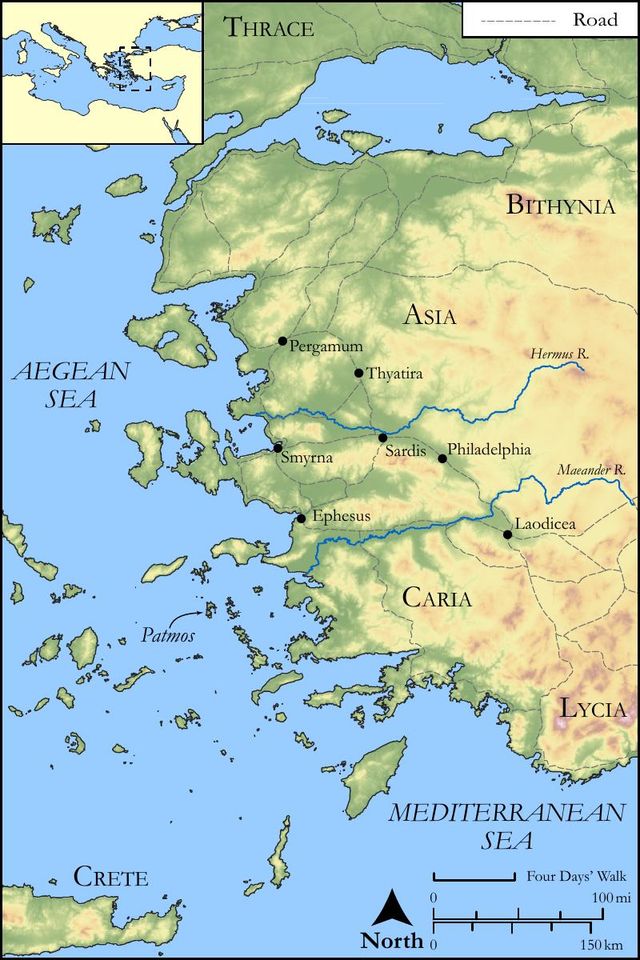
See on the biblical-era maps

Study this verse
Public-domain commentary
Matthew Henry
From his Commentary on the Whole Bible. Henry comments on passages, not single verses — this entry covers Revelation 21:1–8. His four-level outline is real structure in the source text, so it is rendered as structure.
We have here a more general account of the happiness of the church of God in the future state, by which it seems most safe to understand the heavenly state.
I.A new world now opens to our view (Rev 21:1):
I saw a new heaven and a new earth; that is, a new universe; for we suppose the world to be made up of heaven and earth. By the new earth we may understand a new state for the bodies of men, as well as a heaven for their souls. This world is not now newly created, but newly opened, and filled with all those who were the heirs of it. The new heaven and the new earth will not then be distinct; the very earth of the saints, their glorified bodies, will now be spiritual and heavenly, and suited to those pure and bright mansions. To make way for the commencement of this new world, the old world, with all its troubles and commotions, passed away.
II.In this new world the apostle saw the holy city, the new Jerusalem, coming down from heaven, not locally, but as to its original:
this new Jerusalem is the church of God in its new and perfect state, prepared as a bride adorned for her husband, beautified with all perfection of wisdom and holiness, meet for the full fruition of the Lord Jesus Christ in glory.
III.The blessed presence of God with his people is here proclaimed and admired:
I heard a great voice out of heaven, saying, Behold, the tabernacle of God is with men, etc., Rev 21:3. Observe,
1.The presence of God with his church is the glory of the church.
2.It is matter of wonder that a holy God should ever dwell with any of the children of men.
3.The presence of God with his people in heaven will not be interrupted as it is on earth, but he will dwell with them continually.
4.The covenant, interest, and relation, that there are now between God and his people, will be filled up and perfected in heaven. They shall be his people; their souls shall be assimilated to him, filled with all the love, honour, and delight in God which their relation to him requires, and this will constitute their perfect holiness; and he will be their God: God himself will be their God; his immediate presence with them, his love fully manifested to them, and his glory put upon them, will be their perfect happiness; then he will fully answer the character of the relation on his part, as they shall do on their part.
IV.This new and blessed state will be free from all trouble and sorrow; for,
1.All the effects of former trouble shall be done away. They have been often before in tears, by reason of sin, of affliction, of the calamities of the church; but now all tears shall be wiped away; no signs, no remembrance of former sorrows shall remain, any further than to make their present felicity the greater. God himself, as their tender Father, with his own kind hand, shall wipe away the tears of his children; and they would not have been without those tears when God shall come and wipe them away.
2.All the causes of future sorrow shall be for ever removed: There shall be neither death nor pain; and therefore no sorrow nor crying; these are things incident to that state in which they were before, but now all former things have passed away.
V.The truth and certainty of this blessed state are ratified by the word and promise of God, and ordered to be committed to writing, as matter of perpetual record, Rev 21:5, Rev 21:6. The subject-matter of this vision is so great, and of such great importance to the church and people of God, that they have need of the fullest assurances of it; and God therefore from heaven repeats and ratifies the truth thereof. Besides, many ages must pass between the time when this vision was given forth and the accomplishment of it, and many great trials must intervene; and therefore God would have it committed to writing, for perpetual memory, and continual use to his people. Observe,
1.The certainty of the promise averred: These words are faithful and true; and it follows, It is done, is as sure as if it were done already. We may and ought to take God's promise as present payment; if he has said that he makes all things new, it is done.
2.He gives us his titles of honour as a pledge or surety of the full performance, even those titles of Alpha and Omega, the beginning and the end. As it was his glory that he gave the rise and beginning to the world and to his church, it will be his glory to finish the work begin, and not to leave it imperfect. As his power and will were the first cause of all things, his pleasure and glory are the last end, and he will not lose his design; for then he would no longer be the Alpha and Omega. Men may begin designs which they can never bring to perfection; but the counsel of God shall stand, and he will do all his pleasure.
3.The desires of his people towards this blessed state furnish another evidence of the truth and certainty of it. They thirst after a state of sinless perfection and the uninterrupted enjoyment of God, and God has wrought in them these longing desires, which cannot be satisfied with any thing else, and therefore would be the torment of the soul if they were disappointed but it would be inconsistent with the goodness of God, and his love to his people, to create in them holy and heavenly desires, and then deny them their proper satisfaction; and therefore they may be assured that, when they have overcome their present difficulties, he will give them of the fountain of the water of life freely.
VI.The greatness of this future felicity is declared and illustrated,
1.By the freeness of it - it is the free gift of God: He gives of the water of life freely; this will not make it less but more grateful to his people.
2.The fulness of it. The people of God then lie at the fountain-head of all blessedness: they inherit all things (Rev 21:7); enjoying God, they enjoy all things. He is all in all.
3.By the tenure and title by which they enjoy this blessedness - by right of inheritance, as the sons of God, a title of all others the most honourable, as resulting from so near and endeared a relation to God himself, and the most sure and indefeasible, that can no more cease than the relation from which it results.
4.By the vastly different state of the wicked. Their misery helps to illustrate the glory and blessedness of the saints, and the distinguishing goodness of God towards them, Rev 21:8. Here observe,
(1.)The sins of those who perish, among which are first mentioned their cowardliness and unbelief. The fearful lead the van in this black list. They durst not encounter the difficulties of religion, and their slavish fear proceeded from their unbelief; but those who were so dastardly as not to dare to take up the cross of Christ, and discharge their duty to him, were yet so desperate as to run into all manner of abominable wickedness - murder, adultery, sorcery, idolatry, and lying.
(2.)Their punishment: They have their part in the lake that burns with fire and brimstone, which is the second death.
[1.]They could not burn at a stake for Christ, but they must burn in hell for sin.
[2.]They must die another death after their natural death; the agonies and terrors of the first death will consign them over to the far greater terrors and agonies of eternal death, to die and to be always dying.
[3.]This misery will be their proper part and portion, what they have justly deserved, what they have in effect chosen, and what they have prepared themselves for by their sins. Thus the misery of the damned will illustrate the blessedness of those that are saved, and the blessedness of the saved will aggravate the misery of those that are damned.
Historical interpretation
Eight Centuries of Reception
4 surviving comments on this verse. Each one is dated, so this reads as a timeline rather than a list.
Select a marker to jump to its quote. Markers stagger vertically where authors wrote within a few decades of each other.
But we do confess that a kingdom is promised to us upon the earth, although before heaven, only in another state of existence; inasmuch as it will be after the resurrection for a thousand years in the divinely-built city of Jerusalem, "let down from heaven," [Revelation 21:2] which the apostle also calls "our mother from above;" [Galatians 4:26] and, while declaring that our πολίτευμα, or citizenship, is in heaven, he predicates of it that it is really a city in heaven. This both Ezekiel had knowledge of [Ezekiel 48:30-35] and the Apostle John beheld. [Revelation 21:10-23] And the word of the new prophecy which is a part of our belief, attests how it foretold that there would be for a sign a picture of this very city exhibited to view previous to its manifestation. This prophecy, indeed, has been very lately fulfilled in an expedition to the East. For it is evident from the testimony of even heathen witnesses, that in Judæa there was suspended in the sky a city early every morning for forty days. As the day advanced, the entire figure of its walls would wane gradually, and sometimes it would vanish instantly. We say that this city has been provided by God for receiving the saints on their resurrection, and refreshing them with the abundance of all really spiritual blessings, as a recompense for those which in the world we have either despised or lost; since it is both just and God-worthy that His servants should have their joy in the place where they have also suffered affliction for His name's sake. Of the heavenly kingdom this is the process. After its thousand years are over, within which period is completed the resurrection of the saints, who rise sooner or later according to their deserts there will ensue the destruction of the world and the conflagration of all things at the judgment: we shall then be changed in a moment into the substance of angels, even by the investiture of an incorruptible nature, and so be removed to that kingdom in heaven of which we have now been treating, just as if it had not been predicted by the Creator, and as if it were proving Christ to belong to the other god and as if he were the first and sole revealer of it.
Let those who are hungry come, that being fed with heavenly food, they may lay aside their lasting hunger; let those who are athirst come, that they may with full mouth draw forth the water of salvation from an ever-flowing fountain.
He who conquers in the war against the invisible demons will receive these good things, becoming a son of God and reveling in the good gifts of the Father.
The one who conquers, he says, will inherit both the passions and the evil beast, the Devil; will inherit these things. Therefore, the one who conquers.
Continue studying Revelation 21:7 across the web’s major study libraries — every link below opens this exact verse, chapter, or book on the destination site.
Read & Compare
 BibleGatewayThis verse in more than 200 translations and 70 languages.
 Bible.comThe YouVersion reader — hundreds of translations, reading plans, and highlights.
 ESV.orgCrossway's official English Standard Version reader.
 NET BibleThe NET translation with 60,000+ translators' notes on every rendering decision.
 STEP BibleTyndale House's free study tool — original text, vocabulary, and scholarly resources.
 BibliaLogos Bible Software's free web reader.
 USCCBThe New American Bible (Revised Edition) with the U.S. bishops' study notes.
Commentaries
 BibleHub CommentariesDozens of classic commentaries on this verse, gathered on one page.
 StudyLightMore than 100 commentary sets — the largest collection on the web.
 BibleRefPlain-English commentary on what this verse means, verse by verse.
 Enduring WordDavid Guzik's free commentary on this chapter, widely used by Bible teachers.
 Bible Study ToolsVerse commentary alongside Greek and Hebrew study aids.
Original Language & Research
- BibleHub InterlinearThe verse word by word — original language, transliteration, and English.
- BibleHub LexiconEvery word's original-language definition and Strong's entry.
 Blue Letter BibleDeep-study tools — Strong's numbers, concordance, and word studies.
 CNTR CollationThe earliest Greek manuscripts of this verse, collated letter by letter.
Sermons, Hymns & Audio


TrulyRandomVerse is not affiliated with these sites and doesn’t control their content. They’re linked because they’re genuinely useful.
Summary
Revelation 21:7 unveils a profound and multifaceted promise to those who demonstrate faithful endurance: they will inherit the fullness of God's new creation, experiencing an intimate, covenantal relationship where God is their Father and they are His beloved children. This declaration serves as a capstone to the vision of the New Jerusalem, cementing the eternal blessedness and secure identity of the redeemed in the presence of the Almighty.
Context
ShowHideLiterary Context
Revelation 21:7 is situated within the climactic vision of the new heavens and new earth, immediately following the description of the New Jerusalem's descent and God's declaration of dwelling with humanity (Revelation 21:1-6). This verse acts as a divine affirmation of the inheritance and relationship for those who belong to this renewed reality. It stands in stark contrast to the subsequent verse, Revelation 21:8, which details the tragic fate of the unbelieving and unfaithful, highlighting the critical distinction between those who "overcome" and those who do not. The entire chapter paints a picture of ultimate restoration, intimacy, and the fulfillment of God's redemptive plan.
Historical & Cultural Context
John's audience in the first century Roman Empire faced significant persecution, social pressure, and the pervasive influence of the imperial cult, which demanded worship of the emperor. The call to "overcome" (Greek: nikáō) would have resonated deeply with believers struggling to maintain their faith amidst these trials. The concept of "inheritance" was well-understood in both Jewish and Roman cultures, signifying a secure future and a place within a family or lineage. The promise of God being "his God" and the believer being "my son" draws heavily on Old Testament covenant language, particularly the promises made to Abraham, Israel, and David, which established a unique, familial relationship between God and His chosen people. This promise would have offered immense comfort and hope to those enduring hardship for their faith.
Key Themes
ShowHideThis verse powerfully encapsulates several key themes prevalent throughout the book of Revelation and the broader biblical narrative. The theme of "overcoming" is a recurring motif, particularly in the letters to the seven churches (e.g., Revelation 2:7, Revelation 3:21), signifying spiritual victory through steadfast faith in Christ amidst tribulation. The "divine inheritance" speaks to the comprehensive blessings of the new creation, including access to the tree of life and the city of God, as promised to the faithful (e.g., Revelation 22:14). Most profoundly, the declaration "I will be his God, and he shall be my son" underscores the theme of intimate covenant relationship and divine adoption, echoing Old Testament promises where God establishes a father-son relationship with His people (e.g., 2 Samuel 7:14, Jeremiah 31:33). This verse thus brings to a glorious crescendo the themes of perseverance, reward, and restored fellowship that permeate Revelation chapter 21.
Exposition and Analysis
ShowHideKey Word Analysis
ShowHideThis verb means to subdue, conquer, prevail, or get the victory. It is a recurring and crucial term in Revelation, used seven times in the letters to the churches (Revelation 2-3) to describe those who remain faithful to Christ despite persecution, false teaching, and worldly pressures. The victory is not achieved by human strength but through steadfast faith in Christ, who has already overcome the world (John 16:33).
Meaning to be an heir to, or to obtain by inheritance. This word emphasizes a legal and familial right to receive something. In a theological sense, it signifies participation in God's kingdom and blessings, not as a earned reward, but as a gift of grace through sonship. It implies a comprehensive and secure possession of all that God has prepared for His children.
This term denotes a male offspring, but in a broader sense, it signifies a child or someone in a filial relationship. In the context of divine sonship, it speaks of adoption into God's family, a profound identity that grants privileges, responsibilities, and an intimate relationship with God as Father. This spiritual sonship is the ultimate fulfillment of God's desire for a people who belong to Him.
Verse Breakdown
ShowHide"He that overcometh"
This phrase identifies the recipient of the promise: those who, through faith in Christ, persevere through trials, temptations, and the pressures of the world, remaining loyal to God until the end. This is not a self-achieved victory but one enabled by Christ's power.
"shall inherit all things"
This clause describes the comprehensive nature of the reward. "All things" encompasses the entirety of the new creation, the New Jerusalem, and the full blessings of God's eternal kingdom. It signifies complete participation in God's glory, joy, and presence, far exceeding any earthly possession or human imagination.
"and I will be his God"
This is a profound declaration of restored covenant relationship, echoing ancient promises where God pledges His divine presence and protection to His people. It signifies God's complete commitment, faithfulness, and intimate fellowship with the overcomer, fulfilling His ultimate desire to dwell among humanity.
"and he shall be my son"
This final clause establishes the deepest level of intimacy and identity. It signifies divine adoption, where the overcomer is brought into a filial relationship with God, enjoying the privileges, love, and security of a beloved child. This sonship is the pinnacle of the believer's identity and relationship with the Creator.
Literary Devices
ShowHideRevelation 21:7 employs several powerful literary devices to convey its profound message. Covenant Language is central, particularly in the phrases "I will be his God, and he shall be my son," which directly echoes ancient biblical covenant formulas (e.g., Jeremiah 31:33). This establishes a deep, unbreakable, and familial bond between God and the faithful. The concept of "inheriting all things" functions as Hyperbole, emphasizing the immeasurable and comprehensive nature of the blessings, going beyond literal enumeration to convey boundless abundance. Furthermore, the entire verse serves as a Promise, offering a future hope and motivation for present perseverance. The recurring motif of "overcoming" throughout Revelation creates a Leitmotif, reinforcing the theme of spiritual victory and endurance as a prerequisite for eternal blessedness.
Theological and Thematic Connections
ShowHideRevelation 21:7 stands as a cornerstone of eschatological hope, weaving together threads of divine sovereignty, human perseverance, and ultimate restoration. The promise of inheriting "all things" speaks to the comprehensive nature of God's redemptive work, which extends beyond individual salvation to the renewal of all creation. The declaration of God as "his God" and the believer as "my son" signifies the culmination of God's covenantal desire for intimate fellowship with humanity, fulfilling the deepest longings for belonging and identity. This verse underscores the biblical teaching of adoption, where believers, through Christ, are grafted into God's family, receiving the full rights and privileges of sonship, an identity that secures their eternal future and access to God's boundless grace. It is a powerful affirmation of God's faithfulness to His promises and the glorious destiny awaiting those who remain faithful.
Reflection and Application
ShowHideRevelation 21:7 offers profound comfort, motivation, and a clear vision for the life of a believer. In a world fraught with challenges, temptations, and the erosion of faith, this verse serves as a powerful anchor, reminding us that our present struggles are temporary and purposeful. The call to "overcome" is not a call to self-reliance, but to faithful dependence on Christ, who has already triumphed over sin, death, and the world. Knowing that perseverance leads to inheriting "all things" provides an eternal perspective that redefines our values and priorities, shifting our focus from fleeting earthly gains to enduring heavenly treasures. Furthermore, the promise of intimate sonship with God assures us of His unwavering love, provision, and presence, inviting us to live with the confidence and security of beloved children. This verse challenges us to examine where our true allegiances lie and to live in a manner consistent with our glorious future, demonstrating the character of God's children in every aspect of our lives.
Questions for Reflection
ShowHideFAQ
ShowHideWhat does it mean to "overcome" in the context of Revelation?
ShowHideTo "overcome" (Greek: nikáō) in Revelation means to remain steadfastly faithful to Jesus Christ despite intense pressure, persecution, false teachings, and the allure of the world. It is not about human strength or moral perfection, but about persevering in faith, trusting in Christ's ultimate victory, and refusing to compromise one's allegiance to Him. This theme is central to the letters to the seven churches (e.g., Revelation 2:7, Revelation 3:5), where specific promises are given to those who overcome. It implies a spiritual battle against evil forces and worldly systems, won through Christ's power.
What is implied by "inherit all things"?
ShowHide"Inherit all things" signifies a comprehensive and boundless blessing that awaits the faithful. It refers to a full participation in God's eternal kingdom, the new heavens and new earth, and the New Jerusalem, as described in Revelation 21:1-6. This inheritance includes eternal life, freedom from sorrow and pain, dwelling in God's presence, and experiencing the fullness of His glory and joy. It is a secure, divinely granted possession, far exceeding any earthly inheritance, and it underscores the immeasurable generosity of God towards His children.
How does "I will be his God, and he shall be my son" relate to Old Testament promises?
ShowHideThis declaration is a powerful echo and ultimate fulfillment of Old Testament covenant promises, particularly the "I will be your God and you will be my people" formula (e.g., Jeremiah 31:33). The specific promise of father-son relationship also recalls God's covenant with David in 2 Samuel 7:14, where God promises to be a father to David's offspring. In Revelation 21:7, this promise is extended to all who overcome through Christ, signifying a restored, intimate, and eternal familial relationship with God, where believers are adopted as His beloved children, enjoying all the privileges and security of divine sonship.
Christ-Centered Fulfillment
ShowHideRevelation 21:7 finds its ultimate and profound fulfillment in Jesus Christ, for it is through Him alone that anyone can "overcome," "inherit all things," and be brought into a filial relationship with God. Christ Himself is the quintessential Overcomer, having triumphed over sin, death, and the powers of darkness through His crucifixion and resurrection (Colossians 2:15). It is by faith in His finished work that believers are empowered to overcome the world (1 John 5:4-5) and persevere through trials. Furthermore, Christ is the ultimate Heir, through whom all things were created and for whom all things exist (Colossians 1:16-17). As co-heirs with Him (Romans 8:17), believers inherit the boundless blessings of God's kingdom, not by their own merit, but by grace through their union with Christ. Most significantly, it is through Christ's atoning sacrifice and adoption by the Spirit that believers receive the Spirit of adoption, by whom they cry "Abba, Father!" (Galatians 4:5-7). Thus, the promise of God being "his God" and the believer being "my son" is fully realized in and through Jesus, who reconciles humanity to the Father, establishing an eternal, intimate, and secure family bond that culminates in the glorious vision of the New Jerusalem.