


John 15:23
Bible text: King James Version (1769 Blayney text) · Public domain
Bible text: Berean Standard Bible · Public domain
Bible text: American Standard Version (1901) · Public domain
Bible text: World English Bible, Messianic edition · Public domain
Bible text: Geneva Bible (1599) · Public domain
Bible text: Young's Literal Translation · Public domain
- ὁhoThe [one]G3588T-NSMDefinite article Nominative Singular Masculine
- ἐμὲemeMe myselfG1473P-1ASPersonal pronoun Accusative 1st Singular
- μισῶνmisōnhatingG3404V-PAP-NSMVerb Present Active Participle Nominative Singular Masculine
- καὶkaialsoG2532CONJConjunction
- τὸνtontheG3588T-ASMDefinite article Accusative Singular Masculine
- πατέραpateraFatherG3962N-ASM-TNoun Accusative Singular Masculine Title
- μουmouof MineG3165P-1GSPersonal pronoun Genitive 1st Singular
- μισεῖmiseihatesG3404V-PAI-3SVerb Present Active Indicative 3rd Singular
English is a literal word-by-word gloss of the Greek, not the KJV's wording. Why?
This is the original text the KJV's translators worked from — each Greek word with its own literal English meaning in this verse, prepared by scholars at Tyndale House, Cambridge. The KJV translates whole sentences, not word by word, so its wording differs: one Greek word can become several English words, and the KJV may choose “charity” where the gloss reads “love”. Both are faithful — they answer different questions. For the KJV's own rendering, switch to the KJV text.
Details
See on the biblical-era maps
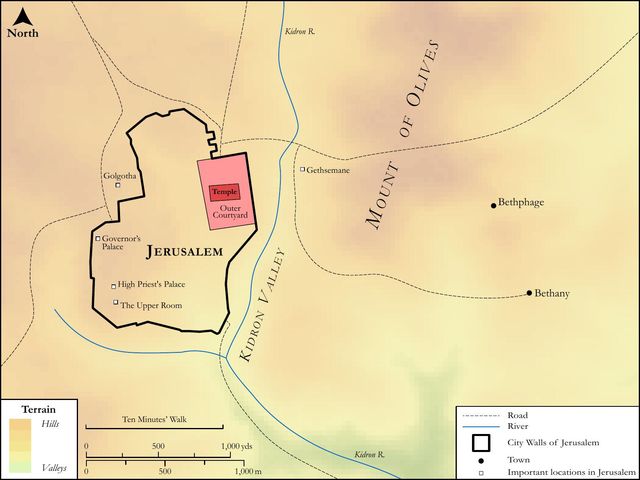
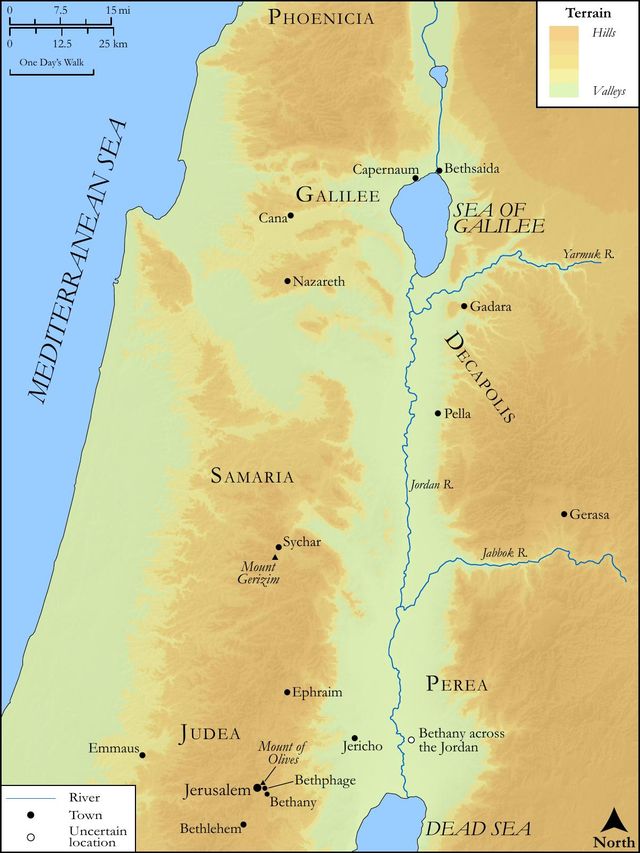
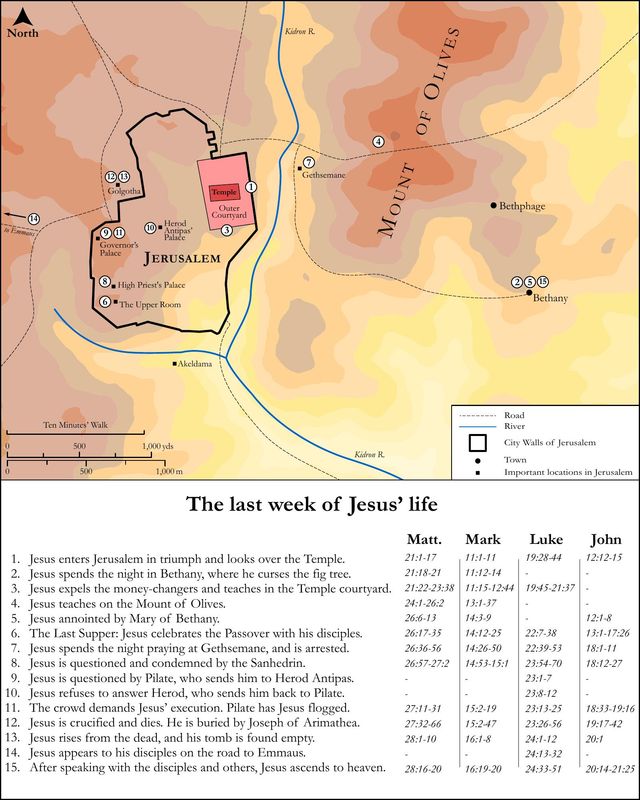
Study this verse
Public-domain commentary
Matthew Henry
From his Commentary on the Whole Bible. Henry comments on passages, not single verses — this entry covers John 15:18–25. His four-level outline is real structure in the source text, so it is rendered as structure.
Here Christ discourses concerning hatred, which is the character and genius of the devil's kingdom, as love is of the kingdom of Christ. Observe here,
I.Who they are in whom this hatred is found - the world, the children of this world, as distinguished from the children of God; those who are in the interests of the god of this world, whose image they bear, and whose power they are subject to; all those, whether Jews or Gentiles, who would not come into the church of Christ, which he audibly called, and visibly separates from this evil world. The calling of these the world intimates,
1.Their number; there were a world of people that opposed Christ and Christianity. Lord, how were they increased that troubled the Son of David! I fear, if we should put it to the vote between Christ and Satan, Satan would out-poll us quite.
2.Their confederacy and combination; these numerous hosts are embodied, and are as one, Psa 83:5. Jews and Gentiles, that could agree in nothing else, agreed to persecute Christ's minister.
3.Their spirit and disposition; they are men of the world (Psa 17:13, Psa 17:14), wholly devoted to this world and the things of it, and never thinking of another world. The people of God, though they are taught to hate the sins of sinners, yet not their persons, but to love and do good to all men. A malicious, spiteful, envious spirit, is not the spirit of Christ, but of the world.
II.Who are they against whom this hatred is levelled-against the disciples of Christ, against Christ himself, and against the Father.
1.The world hates the disciples of Christ: The world hateth you (Joh 15:19); and he speaks of it as that which they must expect and count upon, Joh 15:18, as Jo1 3:13.
(1.)Observe how this comes in here.
[1.]Christ had expressed the great kindness he had for them as friends; but, lest they should be puffed up with this, there was given them, as there was to Paul, a thorn in the flesh, that is, as it is explained there, reproaches and persecutions for Christ's sake, Co2 12:7, Co2 12:10.
[2.]He had appointed them their work, but tells them what hardships they should meet with in it, that it might not be a surprise to them, and that they might prepare accordingly.
[3.]He had charged them to love one another, and need enough they had to love one another, for the world would hate them; to be kind to one another, for they would have a great deal of unkindness and ill-will from those that were without. "Keep peace among yourselves, and this will fortify you against the world's quarrels with you." Those that are in the midst of enemies are concerned to hold together.
(2.)Observe what is here included.
[1.]The world's enmity against the followers of Christ: it hateth them. Note, Whom Christ blesseth the world curseth. The favourites and heirs of heaven have never been the darlings of this world, since the old enmity was put between the seed of the woman and of the serpent. Why did Cain hate Abel, but because his works were righteous? Esau hated Jacob because of the blessing; Joseph's brethren hated him because his father loved him; Saul hated David because the Lord was with him; Ahab hated Micaiah because of his prophecies; such are the causeless causes of the world's hatred.
[2.]The fruits of that enmity, two of which we have here, Joh 15:20. First, They will persecute you, because they hate you, for hatred is a restless passion. It is the common lot of those who will live godly in Christ Jesus to suffer persecution, Ti2 3:12. Christ foresaw what ill usage his ambassadors would meet with in the world, and yet, for the sake of those few that by their ministry were to be called out of the world, he sent them forth as sheep in the midst of wolves. Secondly, Another fruit of their enmity is implied, that they would reject their doctrine. When Christ says, If they have kept my sayings, they will keep yours, he means, They will keep yours, and regard yours, no more than they have regarded and kept mine. Note, The preachers of the gospel cannot but take the despising of their message to be the greatest injury that can be done to themselves; as it was a great affront to Jeremiah to say, Let us not give heed to any of his words, Jer 18:18.
[3.]The causes of that enmity. The world will hate them,
First, Because they do not belong to it (Joh 15:19): "If you were of the world, of its spirit, and in its interests, if you were carnal and worldly, the world would love you as its own; but, because you are called out of the world, it hates you, and ever will." Note, 1. We are not to wonder if those that are devoted to the world are caressed by it as its friends; most men bless the covetous, Psa 10:3; Psa 49:18. 2. Nor are we to wonder if those that are delivered from the world are maligned by it as its enemies; when Israel is rescued out of Egypt, the Egyptians will pursue them. Observe, The reason why Christ's disciples are not of the world is not because they have by their own wisdom and virtue distinguished themselves from the world, but because Christ hath chosen them out of it, to set them apart for himself; and this is the reason why the world hates them; for, (1.) The glory which by virtue of this choice they are designed for sets them above the world, and so makes them the objects of its envy. The saints shall judge the world, and the upright have dominion, and therefore they are hated. (2.) The grace which by virtue of this choice they are endued with sets them against the world; they swim against the stream of the world, and are not conformed to it; they witness against it, and are not conformed to it. This would support them under all the calamities which the world's hatred would bring upon them, that they were hated because they were the choice and the chosen ones of the Lord Jesus, and were not of the world. Now, [1.] This was no just cause for the world's hatred of them. If we do any thing to make ourselves hateful, we have reason to lament it; but, if men hate us for that for which they should love and value us, we have reason to pity them, but no reason to perplex ourselves. Nay, [2.] This was just cause for their own joy. He that is hated because he is rich and prospers cares not who has the vexation of it, while he has the satisfaction of it.
- Populus me sibilat, at mihi plaudo
Ipse domi -
- Let them hiss on, he cries,
While in my own opinion fully blessed.
- Timon in Hor.
Much more may those hug themselves whom the world hates, but whom Christ loves.
Secondly, "Another cause of the world's hating you will be because you do belong to Christ (Joh 15:21): For my name's sake." Here is the core of the controversy; whatever is pretended, this is the ground of the quarrel, they hate Christ's disciples because they bear his name, and bear up his name in the world. Note, 1. It is the character of Christ's disciples that they stand up for his name. The name into which they were baptized is that which they will live and die by. 2. It has commonly been the lot of those that appear for Christ's name to suffer for so doing, to suffer many things, and hard things, all these things. It is matter of comfort to the greatest sufferers if they suffer for Christ's name's sake. If you be reproached for the name of Christ, happy are you (Pe1 4:14), happy indeed, considering not only the honour that is imprinted upon those sufferings (Act 5:41), but the comfort that is infused into them, and especially the crown of glory which those sufferings lead to. If we suffer with Christ, and for Christ, we shall reign with him.
Thirdly, After all, it is the world's ignorance that is the true cause of its enmity to the disciples of Christ (Joh 15:21): Because they know not him that sent me. 1. They know not God. If men had but a due acquaintance with the very first principles of natural religion, and did but know God, though they did not embrace Christianity, yet they could not hate and persecute it. Those have no knowledge who eat up God's people, Psa 14:4. 2. They know not God as he that sent our Lord Jesus, and authorized him to be the great Mediator of the peace. We do not rightly know God if we do not know him in Christ, and those who persecute those whom he sends make it to appear that they know not that he was sent of God. See Co1 2:8.
2.The world hates Christ himself. And this is spoken of here for two ends: -
(1.)To mitigate the trouble of his followers, arising from the world's hatred, and to make it the less strange, and the less grievous (Joh 15:18): You know that it hated me before you, prōton humōn. We read it as signifying priority of time; he began in the bitter cup of suffering, and then left us to pledge him; but it may be read as expressing his superiority over them: "You know that it hated me, your first, your chief and captain, your leader and commander." [1.] If Christ, who excelled in goodness, and was perfectly innocent and universally beneficent, was hated, can we expect that any virtue or merit of ours should screen us from malice? [2.] If our Master, the founder of our religion, met with so much opposition in the planting of it, his servants and followers can look for no other in propagating and professing it. For this he refers them (Joh 15:20) to his own word, at their admission into discipleship: Remember the word that I said unto you. It would help us to understand Christ's latter sayings to compare them with his former sayings. Nor would any thing contribute more to the making of us easy than remembering the words of Christ, which will expound his providences. Now in this word there is, First, A plain truth: The servant is not greater than his Lord. This he had said to them. Mat 10:24. Christ is our Lord, and therefore we must diligently attend all his motions, and patiently acquiesce in all his disposals, for the servant is inferior to his lord. The plainest truths are sometimes the strongest arguments for the hardest duties; Elihu answers a multitude of Job's murmurings with this one self-evident truth, that God is greater than man, Job 33:12. So here is, Secondly, A proper inference drawn from it: "If they have persecuted men, as you have seen, and are likely to see much more, they will also persecute you; you may expect it and count upon it: for," 1. "You will do the same that I have done to provoke them; you will reprove them for their sins, and call them to repentance, and give them strict rules of holy living, which they will not bear." 2. "You cannot do more than I have done to oblige them; after so great an instance, let none wonder if they suffer ill for doing well." He adds, "If they have kept my sayings, they will keep yours also; as there have been a few, and but a few, that have been wrought upon by my preaching, so there will be by yours a few, and but a few." Some give another sense of this, making etērēsan to be put for parētērēsan. "If they have lain in wait for my sayings, with a design to ensnare me, they will in like manner lie in wait to entangle you in your talk."
(2.)To aggravate the wickedness of this unbelieving world, and to discover its exceeding sinfulness; to hate and persecute the apostles was bad enough, but in them to hate and persecute Christ himself was much worse. The world is generally in an ill name in scripture, and nothing can put it into a worse name than this, that it hated Jesus Christ. There is a world of people that are haters of Christ. Two things he insists upon to aggravate the wickedness of those that hated him: -
[1.]That there was the greatest reason imaginable why they should love him; men's good words and good works usually recommend them; now as to Christ,
First, His words were such as merited their love (Joh 15:22): "If I had not spoken unto them, to court their love, they had not had sin, their opposition had not amounted to a hatred of me, their sin had been comparatively no sin. But now that I have said so much to them to recommend myself to their best affections they have no pretence, no excuse for their sin." Observe here, 1. The advantage which those have that enjoy the gospel; Christ in it comes and speaks to them; he spoke in person to the men of that generation, and is still speaking to us by our Bibles and ministers, and as one that has the most unquestionable authority over us, and affection for us. Every word of his is pure, carries with it a commanding majesty, and yet a condescending tenderness, able, one would think, to charm the deafest adder. 2. The excuse which those have that enjoy not the gospel: "If I had not spoken to them, if they had ever heard of Christ and of salvation by him, they had not had sin." (1.) Not this kind of sin. They had not been chargeable with a contempt of Christ if he had not come and made a tender of his grace to them. As sin is not imputed where there is no law, so unbelief is not imputed where there is no gospel; and, where it is imputed, it is thus far the only damning sin, that, being a sin against the remedy, other sin would not damn if the guilt of them were not bound on with this. (2.) Not such a degree of sin. If they had not had the gospel among them, their other sins had not been so bad; for the times of ignorance God winked at, Luk 12:47, Luk 12:48. 3. The aggravated guilt which those lie under to whom Christ has come and spoken in vain, whom he has called and invited in vain, with whom he has reasoned and pleaded in vain; They have no cloak for their sin; they are altogether inexcusable, and in the judgment day will be speechless, and will not have a word to say for themselves. Note, The clearer and fuller the discoveries are which are made to us of the grace and truth of Jesus Christ, the more is said to us that is convincing and endearing, the greater is our sin if we do not love him and believe in him. The word of Christ strips sin of its cloak, that it may appear sin.
Secondly, His works were such as merited their love, as well as his words (Joh 15:24): "If I had not done among them, in their country, and before their eyes, such works as no other man ever did, they had not had sin; their unbelief and enmity had been excusable, and they might have had some colour to say that my word was not to be credited, if not otherwise confirmed;" but he produced satisfactory proofs of his divine mission, works which no other man did. Note, 1. As the Creator demonstrates his power and Godhead by his works (Rom 1:20), so doth the Redeemer. His miracles, his mercies, works of wonder and works of grace, prove him sent of God, and sent on a kind errand. 2. Christ's works were such as no man ever did. No common person that had not a commission from heaven, and God with him, could work miracles, Joh 3:2. And no prophet ever wrought such miracles, so many, so illustrious. Moses and Elias wrought miracles as servants, by a derived power; but Christ, as a Son, by his own power. This was it that amazed the people, that with authority he commanded diseases and devils (Mar 1:27); they owned they never saw the like, Mar 2:12. They were all good works, works of mercy; and this seems especially intended here, for he is upbraiding them with this, that they hated him. One that was so universally useful, more than ever any man was, one would think, should have been universally beloved, and yet even he is hated. 3. The works of Christ enhance the guilt of sinners' infidelity and enmity to him, to the last degree of wickedness and absurdity. If they had only heard his words, and not seen his works, - if we had only his sermons upon record, and not his miracles, unbelief might have pleaded want of proof; but now it has no excuse. Nay, the rejecting of Christ, both by them and us, has in it the sin, not only of obstinate unbelief, but of base ingratitude. They saw Christ to be most amiable, and studious to do them a kindness; yet they hated him, and studied to do him mischief. And we see in his word that great love wherewith he loved us, and yet are not wrought upon by it.
[2.]That there was no reason at all why they should hate him. Some that at one time will say and do that which is recommending, yet at another time will say and do that which is provoking and disobliging; but our Lord Jesus not only did much to merit men's esteem and good-will, but never did any thing justly to incur their displeasure; this he pleads by quoting a scripture for it (Joh 15:25): "This comes to pass, this unreasonable hatred of me, and of my disciples for my sake, that the word might be fulfilled which is written in their law" (that is, in the Old Testament, which is a law, and was received by them as a law), "They hated me without a cause;" this David speaks of himself as a type of Christ, Psa 35:19; Psa 69:4. Not, First, Those that hate Christ hate him without any just cause; enmity to Christ is unreasonable enmity. We think those deserve to be hated that are haughty and froward, but Christ is meek and lowly, compassionate and tender; those also that under colour of complaisance are malicious, envious, and revengeful, but Christ devoted himself to the service of those that used him, nay, and of those that abused him; toiled for others' ease, and impoverished himself to enrich us. Those we think hateful that are hurtful to kings and provinces, and disturbers of the public peace; but Christ, on the contrary, was the greatest blessing imaginable to his country, and yet was hated. He testified indeed that their works were evil, with a design to make them good, but to hate him for this cause was to hate him without cause. Secondly, Herein the scripture was fulfilled, and the antitype answered the type. Saul and his courtiers hated David without cause, for he had been serviceable to him with his harp, and with his sword; Absalom and his party hated him, though to him he had been an indulgent father, and to them a great benefactor. Thus was the Son of David hated, and hunted most unjustly. Those that hated Christ did not design there in to fulfil the scripture; but God, in permitting it, had that in his eye; and it confirms our faith in Christ as the Messiah that even this was foretold concerning him, and, being foretold, was accomplished in him. And we must not think it strange or hard if it have a further accomplishment in us. We are apt to justify our complaints of injuries done us with this, that they are causeless, whereas the more they are so the more they are like the sufferings of Christ, and may be the more easily borne.
3.In Christ the world hates God himself; this is twice said here (Joh 15:23): He that hateth me, though he thinks his hatred goes no further, yet really he hates my Father also. And again, Joh 15:24, They have seen and hated both me and my Father. Note,
(1.)There are those that hate God, notwithstanding the beauty of his nature and the bounty of his providence; they are enraged at his justice, as the devils that believe it and tremble, are vexed at his dominion, and would gladly break his bands asunder. Those who cannot bring themselves to deny that there is a God, and yet wish there were none, they see and hate him.
(2.)Hatred of Christ will be construed and adjudged hatred of God, for he is in his person his Father's express image, and in his office his great agent and ambassador. God will have all men to honour the Son as they honour the Father, and therefore what entertainment the Son has, that the Father has. Hence it is easy to infer that those who are enemies to the Christian religion, however they may cry up natural religion, are really enemies to all religion. Deists are in effect atheists, and those that ridicule the light of the gospel would, if they could, extinguish even natural light, and shake off all obligations of conscience and the fear of God. Let an unbelieving malignant world know that their enmity to the gospel of Christ will be looked upon in the great day as an enmity to the blessed God himself; and let all that suffer for righteousness' sake, according to the will of God, take comfort from this; if God himself be hated in them, and struck at through him, they need not be either ashamed of their cause or afraid of the issue.
Historical interpretation
Five Centuries of Reception
12 surviving comments on this verse. Each one is dated, so this reads as a timeline rather than a list.
Select a marker to jump to its quote. Markers stagger vertically where authors wrote within a few decades of each other.
Ye think, indeed, under a pretence of piety, to avenge the glory of God, not understanding that he that despiseth Me despiseth My Father also.
“Hates my Father also.” This my is the assertion of a relation to the Father that is shared by no one else.… He condemns the man who claims God as his Father and does not love the Son as using a wrongful liberty with the Father’s name, since he who hates him, that is, the Son, must hate the Father also. And none can be devoted to the Father except those who love the Son. For the one and only reason that he gives for loving the Son is his origin from the Father. The Son, therefore, is from the Father, not by his advent but by his birth. And love for the Father is only possible to those who believe that the Son is from him.
"He that hateth Me, hateth My Father also."
From this also proclaiming beforehand no small punishment against them. For, since they continually pretended that they persecuted Him on account of the Father, to deprive them of this excuse He spake these words. "They have no excuse. I gave them the teaching which is by words, that by works I added, according to the Law of Moses, who bade all men obey one speaking and doing such things, when he should both lead to piety, and exhibit the greatest miracles."
(Hom. lxxvii. 2) As the Jews persecuted Him out of professed regard for the Father, He takes away this excuse: He that hateth Me, hateth My Father also.
But in such cases our credulity is frequently at fault; for sometimes even history, and still more ordinary report, turns out to be false. Yet, it ought to be our concern, in order not to be misled by an injurious opinion, seeing we cannot search into the consciences of men, to have a true and certain sentiment about things themselves. I mean, that in regard to this or that man, if we know not whether he is immodest or modest, we should at all events hate immodesty and love modesty: and if in regard to some one or other we know not whether he is unjust or just, we should at any rate love justice and abhor injustice; not such things as we erroneously fancy to ourselves, but such as we believingly perceive according to God's truth, the one to be desired, the other to be shunned; so that, when in regard to things themselves we do desire what ought to be desired, and utterly avoid what ought to be avoided, we may find pardon for the mistaken feelings which we at times, yea, at all times, entertain regarding the actual state of others which is hidden from our eyes. For this, I think, has to do with human temptation, without which we cannot pass through this life, so that the apostle said, "No temptation should befall you but such as is common to man." For what is so common to man as inability to inspect the heart of man; and therefore, instead of scrutinizing its inmost recesses, to suspect for the most, part something very different from what is going on therein? And although in these dark regions of human realities, that is, of other people's inward thoughts, we cannot clear up our suspicions, because we are only men, yet we ought to restrain our judgments, that is, all definite and fixed opinions, and not judge anything before the time, until the Lord come, and bring to light the hidden things of darkness, and make manifest the counsels of the hearts; and then shall every man have praise of God. When, therefore, we are falling into no error in regard to the thing itself, so that there is an accordance with right in our reprobation of vice and approbation of virtue; surely, if a mistake is committed in connection with individuals, a temptation so characteristic of man is within the scope of forgiveness.
(Tr. xc. 1) But He has just said, Because they know not Him that sent Me. How could they hate one whom they did not know? For if they hated God, believing Him to be something else, and not God, this was not hatred of God. In the case of men, it often happens that we hate or love persons whom we have never seen, simply in consequence of what we have heard of them. But if a man's character is known to us, he cannot properly be said to be unknown. And a man's character is not shown by his face, but by his habits and way of life: else we should not be able to know ourselves, for we cannot see our own face. But history and fame sometimes lie; and our faith is imposed upon. We cannot penetrate into men's hearts; we only know that such things are right, and others wrong; and if we escape error here, to be mistaken in men is a venial matter. A good man may hate a good man ignorantly, or rather love him ignorantly, for he loves the good man, though he hates the man whom he supposes him to be. A bad man may love a good man, supposing him to be a bad man like himself, and therefore not, properly speaking, loving him, but the person whom he takes him to be. And in the same way with respect to God. If the Jews were asked whether they loved God, they would reply that they did love Him, not intending to lie, but only being mistaken in so saying. For how could they who hated the Truth, love the Father of the Truth? They did not wish their actions to be judged, and this the Truth did. They hated the Truth then, because they hated the punishment which He would inflict upon such as they. But at the same time they did not know that He was the Truth, who came to condemn them. They did not know that the Truth was born of God the Father, and therefore they did not know God the Father Himself. Thus they both hated, and also knew not, the Father.
But amid all these darknesses of human hearts, it happens as a thing much to be wondered at and mourned over, that one, whom we account unjust, and who nevertheless is just, and in whom, without knowing it, we love justice, we sometimes avoid, and turn away from, and hinder from approaching us, and refuse to have life and living in common with him; and, if necessity compel the infliction of discipline, whether to save others from harm or bring the person himself back to rectitude, we even pursue him with a salutary harshness; and so afflict a good man as if he were wicked, and one whom unknowingly we love. This takes place if one, for example's sake, who is modest is believed by us to be the opposite. For, beyond doubt, if I love a modest person, he is himself the very object that I love; and therefore I love the man himself, and know it not. And if I hate an immodest person, it is on that account, not him that I hate: for he is not the thing that I hate; and yet to that object of my love, with whom my heart makes continual abode in the love of modesty, I am ignorantly doing an injury, erring as I do, not in the distinction I make between virtue and vice, but in the thick darkness of the human heart. Accordingly, as it may so happen that a good man may unknowingly hate a good man, or rather loves him without knowing it (for the man himself he loves in loving that which is good; for what the other is, is the very thing that he loves); and without knowing it, hates not the man himself, but that which he supposes him to be: so may it also be the case that an unjust man hates a just man, and, while he opines that he loves one who is unjust like himself, unknowingly loves the just man; and yet so long as he believes him to be unjust, he loves not the man himself, but that which he imagines him to be. And as it is with another man, so is it also with God. For, to conclude, had the Jews been asked if they loved God, what other answer would they have given but that they did love Him, and that not with any intentional falsehood, but because erroneously fancying that they did so? For how could they love the Father of the truth, who were filled with hatred to the truth itself? For they do not wish their own conduct to be condemned, and it is the truth's task to condemn such conduct; and thus they hated the truth as much as they hated their own punishment, which the truth awards to such. But they know not that to be the truth which lays its condemnation on such as they: therefore they hate that which they know not; and hating it, they certainly cannot but also hate Him of whom it is born. And in this way, because they know not the truth, by whose judgment they are condemned, as that which is born of God the Father; of a surety also they both know not, and hate the Father Himself. Miserable men! who, because wishing to be wicked, deny that to be the truth whereby the wicked are condemned. For they refuse to own that to be what it is, when they ought themselves to refuse to be what they are; in order that, while it remains the same, they may be changed, lest by its judgment they fall into condemnation.
"He that hateth me," He says, "hateth my Father also." Here it may be said to us, Who can hate one whom he knows not? And certainly before saying, "If I had not come and spoken unto them, they had not had sin," He had said to His disciples, "These things will they do unto you, because they know not Him that sent me." How, then, do they both know not, and hate? For if the notion they have formed of Him is not that which He is in Himself, but some unknown conjecture of their own, then certainly it is not Himself they are found to hate, but that figment which they devise or rather suspect in their error. And yet, were it not that men could hate that which they know not, the Truth would not have asserted both, namely, that they both know not, and hate His Father. But such a possibility, if by the Lord's help we are able to show it, cannot be demonstrated at present, as this discourse must now be brought to a close.
The Lord says, as you have just been hearing, "He that hateth me, hateth my Father also:" and yet He had said a little before, "These things will they do unto you, because they know not Him that sent me." A question therefore arises that cannot be overlooked, how they can hate one whom they know not? For if it is not God as He really is, but something else, I know not what, that they suspect or believe Him to be, and hate this; then assuredly it is not God Himself that they hate, but the thing they conceive in their own erroneous suspicion or baseless credulity; and if they think of Him as He really is, how can they be said to know Him not? It may be the case, indeed, with regard to men, that we frequently love those whom we have never seen; and in this way it can, on the other hand, be none the less impossible that we should hate those whom we have never seen. The report, for instance, whether good or bad, about some preacher, leads us not improperly to love or to hate the unknown. But if the report is truthful, how can one, of whom we have got such true accounts, be spoken of as unknown? Is it because we have not seen his face? And yet, though he himself does not see it, he can be known to no one better than to himself. The knowledge of any one, therefore, is not conveyed to us in his bodily countenance, but only lies open to our apprehension when his life and character are revealed. Otherwise no one would be able to know himself, because unable to see his own face. But surely he knows himself more certainly than he is known to others, inasmuch as by inward inspection he can the more certainly see what he is conscious of, what he desires, what he is living for; and it is when these are likewise laid open to us, that he becomes truly known to ourselves. And as these, accordingly, are commonly brought to us regarding the absent, or even the dead, either by hearsay or correspondence, it thus comes about that people whom we have never seen by face (and yet of whom we are not entirely ignorant), we frequently either hate or love.
He makes a definite charge of atheism against those who choose, in the impiety of their minds and the estrangement of their hearts, to hate Him. And the charge is a true one. For those who dishonour the Son will not be guiltless of transgression against the Father, convinced of the justice of their hatred. For just as those who depreciate the shining of the sun, because it appears and exists for no necessary purpose, bring charges of uselessness, and direct their censure also against its Author; and just as whoever sees fit to despise the scent of flowers will cast reproach on this account against that from whence it was derived----the case will be the same, I suppose, with respect to the Only-begotten and His Father. For it is impossible for those who censure what proceeds from anything else to praise its author. For this reason Christ said to the Jews: A good tree cannot bring forth evil fruit: neither can a corrupt tree bring forth good fruit; when He further told them to make this accurate and unexceptionable distinction in this matter: Either make the tree corrupt and its fruit corrupt. For whatever one could truly predicate of one of such things as these, that I suppose he must necessarily make applicable to both. For when there is one nature, surely the attributes are entirely common even though they are capable of separate manifestation; and whatever a man might do against what proceeds from any fountain, that he would plainly do against the fountain itself. Wherefore Christ says that he that hateth Me, hateth My Father also. And He appropriately attributes a reference to the Person of the Father to any charges that men may make against Himself. And He will none the less satisfy us by this discourse that He is not distinct from Him by reason of the complete identity of Their Natures. And besides He terrifies His hearers by showing how very perilous it is to choose to transgress by hating Him, and He assures them that the man who rejects His worship will be defenceless and an easy prey to his enemies, inasmuch as he insults the Person of the Father Himself. For since insolence against His Son affects Him too, He will also be offended.
Is it not quite clear that the reception of this belief raised the confidence of His holy disciples? At the same time, Christ illustrated another essential and profound truth----I mean this of which I will speak. Some thought in their unparalleled madness and excessive folly, that when they were transgressing against the Son, and opposing the words of the Saviour, they were giving pleasure to God, Who was the Giver of the Law; and while they continued to confer the meed of victory on the prophetic dispensation of Moses, they showed themselves true guardians of the love of God. It was necessary therefore to show the falsity of their boast, and to teach the world that those who act counter to the laws of the Saviour set themselves as it were against the entire Divine Nature, insulted in the Person of the Son by their contumacy, and by their persistent and inexcusable disobedience, which He clearly declares is not merely aimed against His own Person, but also affects all who preach the Word for Him and through Him. He then that enters upon opposition against the holy Apostles themselves is an enemy of God, and shows insolence towards Him, and is altogether hostile to the ineffable and unspeakable Nature of the Divine Being, for the Apostles do not preach themselves, but the God and Lord of all, that is. Christ.
(xxv. Moral.) It is one thing not to do good, another to hate the teacher of goodness; as there is a difference between sudden and deliberate sins. Our state generally is that we love what is good, but from infirmity cannot perform it. But to sin of set purpose, is neither to do nor to love what is good. As then it is sometimes a heavier offence to love than to do, so is it more wicked to hate justice than not to do it. There are some in the Church, who not only do not do what is good, but even persecute it, and hate in others what they neglect to do themselves. The sin of these men is not that of infirmity or ignorance, but deliberate wilful sin.
For as he who loves the Son, loves the Father also, the love of the Father being one with that of the Son, even as their nature is one: so he who hateth the Son, hateth the Father also.
Continue studying John 15:23 across the web’s major study libraries — every link below opens this exact verse, chapter, or book on the destination site.
Read & Compare
 BibleGatewayThis verse in more than 200 translations and 70 languages.
 Bible.comThe YouVersion reader — hundreds of translations, reading plans, and highlights.
 ESV.orgCrossway's official English Standard Version reader.
 NET BibleThe NET translation with 60,000+ translators' notes on every rendering decision.
 STEP BibleTyndale House's free study tool — original text, vocabulary, and scholarly resources.
 BibliaLogos Bible Software's free web reader.
 USCCBThe New American Bible (Revised Edition) with the U.S. bishops' study notes.
Commentaries
 BibleHub CommentariesDozens of classic commentaries on this verse, gathered on one page.
 StudyLightMore than 100 commentary sets — the largest collection on the web.
 BibleRefPlain-English commentary on what this verse means, verse by verse.
 Enduring WordDavid Guzik's free commentary on this chapter, widely used by Bible teachers.
 Bible Study ToolsVerse commentary alongside Greek and Hebrew study aids.
Original Language & Research
- BibleHub InterlinearThe verse word by word — original language, transliteration, and English.
- BibleHub LexiconEvery word's original-language definition and Strong's entry.
 Blue Letter BibleDeep-study tools — Strong's numbers, concordance, and word studies.
 CNTR CollationThe earliest Greek manuscripts of this verse, collated letter by letter.
Sermons, Hymns & Audio


TrulyRandomVerse is not affiliated with these sites and doesn’t control their content. They’re linked because they’re genuinely useful.
Summary
In John 15:23, Jesus unequivocally declares that those who harbor hatred for Him also hate God the Father. This profound statement, delivered during His Farewell Discourse, underscores the indivisible unity of the Son and the Father, revealing that rejection of Jesus is not merely a personal affront but a fundamental rejection of God Himself and His ultimate self-revelation to humanity.
Context
ShowHideLiterary Context
This verse is situated within Jesus' extensive Farewell Discourse, spanning John 13-17, delivered to His disciples just hours before His crucifixion. Specifically, John 15 focuses on the relationship between Jesus and His followers, portraying Him as the "True Vine" and believers as branches. The immediate context, John 15:18-25, prepares the disciples for the inevitable hostility they will face from the world, mirroring the hatred directed at Jesus Himself. Jesus explains that the world's hatred is not arbitrary but rooted in its ignorance of God, as stated in John 15:21. He emphasizes that their sin of unbelief is inexcusable because they have witnessed His miraculous works and heard His divine words, yet they choose to reject Him, thereby fulfilling Old Testament prophecies of unjust hatred, as referenced in John 15:25.
Historical & Cultural Context
In ancient Jewish thought, the concept of God's unity (monotheism) was paramount, enshrined in the Shema (Deuteronomy 6:4). Any claim to divinity or equality with God was considered blasphemous, punishable by death. Jesus' consistent claims of divine sonship and unity with the Father (John 10:30; John 14:9) directly challenged these deeply held beliefs for many Jewish leaders, leading to intense opposition. The cultural expectation was that a prophet or Messiah would be easily recognizable and universally embraced, yet Jesus' humble origins and unconventional ministry defied these expectations. The world's "hatred" was not merely a personal dislike but a profound theological and spiritual rejection of Jesus' identity and mission, which they perceived as an affront to their understanding of God and the Law.
Key Themes
ShowHideJohn 15:23 powerfully reinforces several core themes within John's Gospel. Firstly, it underscores the Divine Unity and Identity of Jesus with God the Father, a recurring motif throughout the Gospel, as seen in Jesus' declaration, "I and my Father are one" and His assertion that "He that hath seen me hath seen the Father". Secondly, it highlights the Rejection of Truth and Light, portraying the world's hatred not as a mere personal animosity but as a deliberate antagonism towards the divine revelation and salvation that Jesus embodies. This aligns with the theme introduced in John 1:5, where "the darkness comprehended it not." Finally, the verse speaks to Accountability for Unbelief, emphasizing that those who reject Jesus, having witnessed His works and heard His words, are without excuse, as their hatred stems from a willful choice to remain in spiritual darkness rather than embrace the light, a concept explored further in John 3:19.
Exposition and Analysis
ShowHideKey Word Analysis
ShowHideThis term signifies a strong aversion, active hostility, or deep-seated opposition, not merely a mild dislike. It implies a deliberate and often intense rejection, extending to persecution. In the context of Jesus, it refers to a profound spiritual antagonism against His person, claims, and teachings.
This is a direct personal pronoun referring to Jesus Himself. The hatred is not directed at an idea or a movement, but specifically at the person of Jesus, emphasizing His unique and central role in God's revelation.
This term denotes a "father" literally or figuratively. Here, it emphasizes the intimate, filial relationship between Jesus and God, reinforcing that the Son perfectly represents the Father's character and will. To hate Jesus is therefore to hate the very essence and revelation of God the Father.
Verse Breakdown
ShowHide"He that hateth me"
This clause identifies the subject of the statement: anyone who harbors active hostility, deep aversion, or deliberate rejection towards Jesus. The hatred is not passive but an active, conscious opposition to who Jesus is and what He represents. This hatred is often rooted in a refusal to acknowledge His divine authority and saving mission.
"hateth my Father also."
This second clause reveals the profound implication of hating Jesus. Because Jesus is in perfect unity and identity with God the Father, sharing His nature, will, and mission, hatred directed at the Son is inherently hatred directed at the Father. There is no possibility of accepting the Father while rejecting the Son, as the Son is the ultimate revelation of the Father. This underscores the indivisible nature of the Godhead and the absolute necessity of acknowledging Jesus for a true relationship with God.
Literary Devices
ShowHideThe primary literary device employed in John 15:23 is Parallelism, specifically a form of Synonymous Parallelism. The two clauses, "He that hateth me" and "hateth my Father also," express the same core idea from slightly different perspectives, reinforcing the central truth of divine unity. The second clause intensifies the first, revealing the ultimate object of the hatred. This parallelism serves to underscore the profound and inseparable connection between Jesus and the Father. Additionally, there is an element of Hyperbole or strong assertion, as Jesus uses definitive language ("hateth... hateth") to convey the absolute nature of this spiritual reality, leaving no room for ambiguity. The statement also functions as a Theological Assertion, directly articulating a fundamental truth about the nature of God and the consequences of rejecting His Son.
Theological and Thematic Connections
ShowHideJohn 15:23 is a foundational statement on the indivisible nature of the Godhead and the essential role of Jesus as the unique revealer of the Father. It asserts that there is no true knowledge or acceptance of God the Father apart from Jesus Christ. The world's hatred for Jesus is not merely a personal dislike but a profound spiritual antagonism against the very essence of God's love, truth, and light as embodied in His Son. This verse challenges any notion that one can claim to love or worship God while simultaneously rejecting Jesus, His divine Son and the perfect image of His being. It underscores the exclusivity of Christ's claim to be "the way, the truth, and the life," through whom alone one can come to the Father.
Reflection and Application
ShowHideJohn 15:23 serves as a profound call to introspection and commitment for believers, while also offering a stark warning to those who remain in opposition to Christ. For followers of Jesus, this verse deepens our understanding of His divine nature and His inseparable union with the Father. It reminds us that our faith in Jesus is not merely adherence to a historical figure or a set of teachings, but a direct relationship with God Himself. When we face opposition or misunderstanding for our faith, this verse offers solace: the hatred experienced is ultimately directed at Christ and His truth, not necessarily at us personally, affirming that we are sharing in His suffering. For those who have not yet embraced Christ, this verse presents a sobering truth: to reject Jesus is to reject God Himself, placing one outside of a saving relationship with the Creator. It compels us to consider the eternal implications of our stance towards Jesus and to respond in faith and obedience.
Questions for Reflection
ShowHideFAQ
ShowHideDoes "hateth" in this verse mean a mild dislike, or something more intense?
ShowHideThe Greek word translated "hateth" (G3404, miséō) signifies a strong, active aversion, deep-seated opposition, or even persecution, not merely a mild dislike. It implies a deliberate and often intense rejection. In the context of John 15:23, it refers to a profound spiritual antagonism against Jesus' person, claims, and teachings, which is ultimately directed at God the Father because of their indivisible unity. This is not a casual sentiment but a fundamental opposition to divine truth and light.
How can someone hate God if they claim to be religious or believe in a higher power?
ShowHideJesus' statement in John 15:23 implies that true knowledge and acceptance of God the Father are inextricably linked to accepting Jesus, His Son. Many may claim to believe in God or be religious, but if they reject Jesus as the unique Son of God, the Messiah, and the only way to the Father, then their "belief" in God is fundamentally flawed or incomplete according to Christian theology. Jesus states in John 14:6 that "No man cometh unto the Father, but by me." Therefore, rejecting Jesus, who perfectly reveals the Father, is tantamount to rejecting the Father Himself, regardless of other religious or spiritual claims. Their "hatred" may manifest as active opposition to Christian truth, persecution of believers, or simply a willful refusal to acknowledge Jesus' divine claims despite the evidence of His words and works, as described in John 15:24.
Christ-Centered Fulfillment
ShowHideJohn 15:23 finds its Christ-centered fulfillment in the person and work of Jesus as the ultimate revelation of God. Jesus is not merely a prophet or a teacher; He is the incarnate Son, the perfect image of the invisible God, as affirmed in Colossians 1:15. His life, teachings, miracles, and ultimately His atoning death and resurrection, are the Father's definitive self-disclosure to humanity. Therefore, the world's hatred for Jesus, culminating in His crucifixion, was not just a rejection of a man, but a profound act of rebellion against God Himself. This hatred, though seemingly victorious at the cross, was ultimately defeated by Christ's resurrection, demonstrating God's power and vindicating Jesus' divine claims. Through His sacrifice, Jesus provided the means for humanity to overcome this spiritual hatred and be reconciled to the Father, fulfilling His mission to "give his life a ransom for many" and to "draw all men unto me". The call to believe in Jesus is thus the call to embrace God, and the refusal to do so is a rejection of the only path to the Father, making Christ the central figure in both humanity's rebellion and its redemption.