


John 15:25
Bible text: King James Version (1769 Blayney text) · Public domain
Bible text: Berean Standard Bible · Public domain
Bible text: American Standard Version (1901) · Public domain
Bible text: World English Bible, Messianic edition · Public domain
Bible text: Geneva Bible (1599) · Public domain
Bible text: Young's Literal Translation · Public domain
- ἀλλ᾽all᾽But [this is]G235CONJConjunction
- ἵναinathatG2443CONJConjunction
- πληρωθῇplērōthēamay be fulfilledG4137V-APS-3SVerb Aorist Passive Subjunctive 3rd Singular
- ὁhotheG3588T-NSMDefinite article Nominative Singular Masculine
- λόγοςlogoswordG3056N-NSMNoun Nominative Singular Masculine
- ὁho<the>G3588T-NSMDefinite article Nominative Singular Masculine
- ἐνeninG1722PREPPreposition
- τῷtōtheG3588T-DSMDefinite article Dative Singular Masculine
- νόμῳnomōlawG3551N-DSMNoun Dative Singular Masculine
- αὐτῶνautōnof themG846P-GPMPersonal pronoun Genitive Plural Masculine
- γεγραμμένοςgegrammenoswrittenG1125V-RPP-NSMVerb Perfect Passive Participle Nominative Singular Masculine
- ὅτιhotithatG3754CONJConjunction
- ἐμίσησάνemisēsanThey hatedG3404V-AAI-3PVerb Aorist Active Indicative 3rd Plural
- μεmeMeG3165P-1ASPersonal pronoun Accusative 1st Singular
- δωρεάνdōreanwithout cause.’G1432ADVAdverb
English is a literal word-by-word gloss of the Greek, not the KJV's wording. Why?
This is the original text the KJV's translators worked from — each Greek word with its own literal English meaning in this verse, prepared by scholars at Tyndale House, Cambridge. The KJV translates whole sentences, not word by word, so its wording differs: one Greek word can become several English words, and the KJV may choose “charity” where the gloss reads “love”. Both are faithful — they answer different questions. For the KJV's own rendering, switch to the KJV text.
Details
See on the biblical-era maps
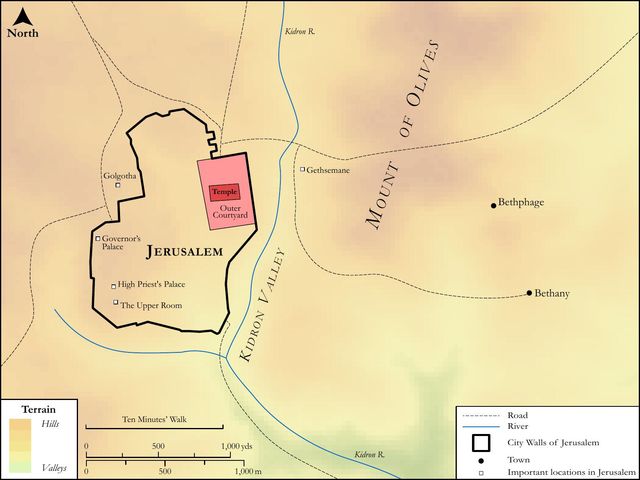
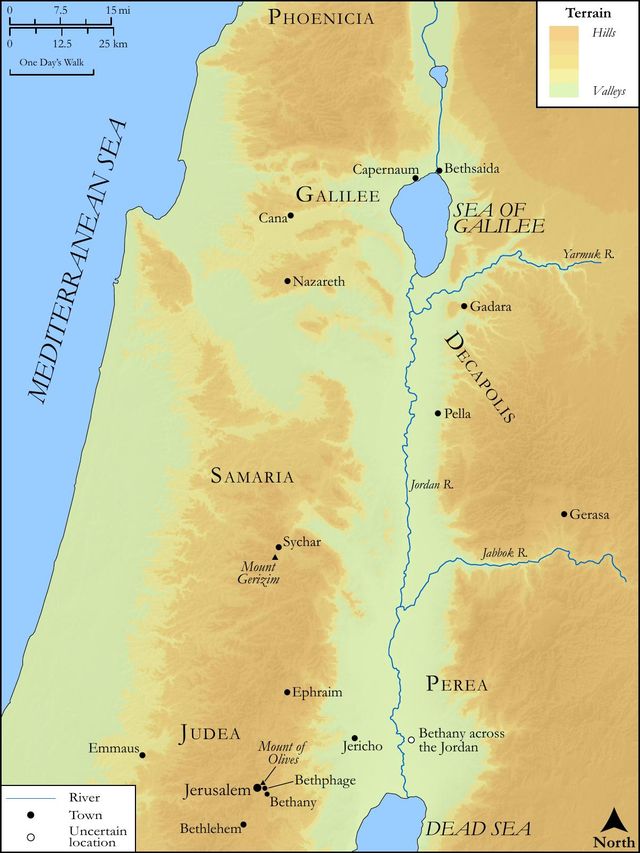
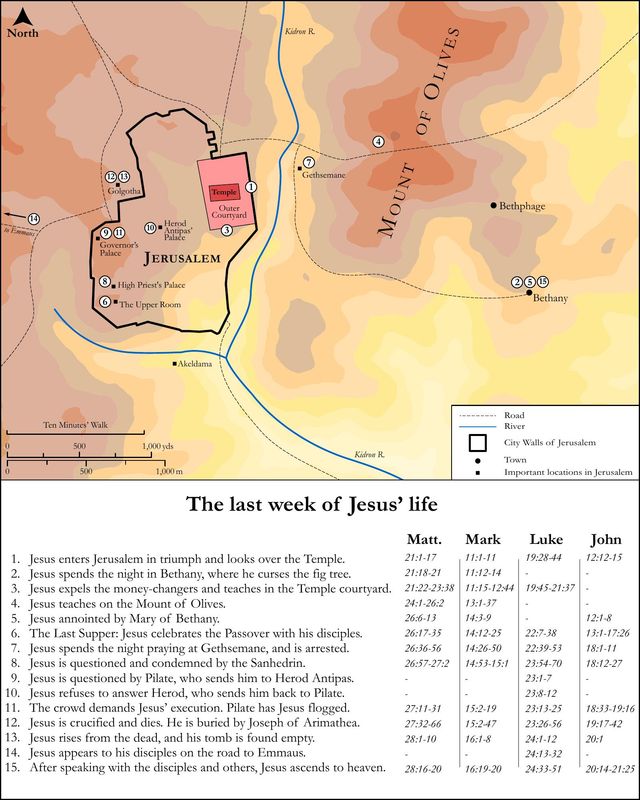
Study this verse
Public-domain commentary
Matthew Henry
From his Commentary on the Whole Bible. Henry comments on passages, not single verses — this entry covers John 15:18–25. His four-level outline is real structure in the source text, so it is rendered as structure.
Here Christ discourses concerning hatred, which is the character and genius of the devil's kingdom, as love is of the kingdom of Christ. Observe here,
I.Who they are in whom this hatred is found - the world, the children of this world, as distinguished from the children of God; those who are in the interests of the god of this world, whose image they bear, and whose power they are subject to; all those, whether Jews or Gentiles, who would not come into the church of Christ, which he audibly called, and visibly separates from this evil world. The calling of these the world intimates,
1.Their number; there were a world of people that opposed Christ and Christianity. Lord, how were they increased that troubled the Son of David! I fear, if we should put it to the vote between Christ and Satan, Satan would out-poll us quite.
2.Their confederacy and combination; these numerous hosts are embodied, and are as one, Psa 83:5. Jews and Gentiles, that could agree in nothing else, agreed to persecute Christ's minister.
3.Their spirit and disposition; they are men of the world (Psa 17:13, Psa 17:14), wholly devoted to this world and the things of it, and never thinking of another world. The people of God, though they are taught to hate the sins of sinners, yet not their persons, but to love and do good to all men. A malicious, spiteful, envious spirit, is not the spirit of Christ, but of the world.
II.Who are they against whom this hatred is levelled-against the disciples of Christ, against Christ himself, and against the Father.
1.The world hates the disciples of Christ: The world hateth you (Joh 15:19); and he speaks of it as that which they must expect and count upon, Joh 15:18, as Jo1 3:13.
(1.)Observe how this comes in here.
[1.]Christ had expressed the great kindness he had for them as friends; but, lest they should be puffed up with this, there was given them, as there was to Paul, a thorn in the flesh, that is, as it is explained there, reproaches and persecutions for Christ's sake, Co2 12:7, Co2 12:10.
[2.]He had appointed them their work, but tells them what hardships they should meet with in it, that it might not be a surprise to them, and that they might prepare accordingly.
[3.]He had charged them to love one another, and need enough they had to love one another, for the world would hate them; to be kind to one another, for they would have a great deal of unkindness and ill-will from those that were without. "Keep peace among yourselves, and this will fortify you against the world's quarrels with you." Those that are in the midst of enemies are concerned to hold together.
(2.)Observe what is here included.
[1.]The world's enmity against the followers of Christ: it hateth them. Note, Whom Christ blesseth the world curseth. The favourites and heirs of heaven have never been the darlings of this world, since the old enmity was put between the seed of the woman and of the serpent. Why did Cain hate Abel, but because his works were righteous? Esau hated Jacob because of the blessing; Joseph's brethren hated him because his father loved him; Saul hated David because the Lord was with him; Ahab hated Micaiah because of his prophecies; such are the causeless causes of the world's hatred.
[2.]The fruits of that enmity, two of which we have here, Joh 15:20. First, They will persecute you, because they hate you, for hatred is a restless passion. It is the common lot of those who will live godly in Christ Jesus to suffer persecution, Ti2 3:12. Christ foresaw what ill usage his ambassadors would meet with in the world, and yet, for the sake of those few that by their ministry were to be called out of the world, he sent them forth as sheep in the midst of wolves. Secondly, Another fruit of their enmity is implied, that they would reject their doctrine. When Christ says, If they have kept my sayings, they will keep yours, he means, They will keep yours, and regard yours, no more than they have regarded and kept mine. Note, The preachers of the gospel cannot but take the despising of their message to be the greatest injury that can be done to themselves; as it was a great affront to Jeremiah to say, Let us not give heed to any of his words, Jer 18:18.
[3.]The causes of that enmity. The world will hate them,
First, Because they do not belong to it (Joh 15:19): "If you were of the world, of its spirit, and in its interests, if you were carnal and worldly, the world would love you as its own; but, because you are called out of the world, it hates you, and ever will." Note, 1. We are not to wonder if those that are devoted to the world are caressed by it as its friends; most men bless the covetous, Psa 10:3; Psa 49:18. 2. Nor are we to wonder if those that are delivered from the world are maligned by it as its enemies; when Israel is rescued out of Egypt, the Egyptians will pursue them. Observe, The reason why Christ's disciples are not of the world is not because they have by their own wisdom and virtue distinguished themselves from the world, but because Christ hath chosen them out of it, to set them apart for himself; and this is the reason why the world hates them; for, (1.) The glory which by virtue of this choice they are designed for sets them above the world, and so makes them the objects of its envy. The saints shall judge the world, and the upright have dominion, and therefore they are hated. (2.) The grace which by virtue of this choice they are endued with sets them against the world; they swim against the stream of the world, and are not conformed to it; they witness against it, and are not conformed to it. This would support them under all the calamities which the world's hatred would bring upon them, that they were hated because they were the choice and the chosen ones of the Lord Jesus, and were not of the world. Now, [1.] This was no just cause for the world's hatred of them. If we do any thing to make ourselves hateful, we have reason to lament it; but, if men hate us for that for which they should love and value us, we have reason to pity them, but no reason to perplex ourselves. Nay, [2.] This was just cause for their own joy. He that is hated because he is rich and prospers cares not who has the vexation of it, while he has the satisfaction of it.
- Populus me sibilat, at mihi plaudo
Ipse domi -
- Let them hiss on, he cries,
While in my own opinion fully blessed.
- Timon in Hor.
Much more may those hug themselves whom the world hates, but whom Christ loves.
Secondly, "Another cause of the world's hating you will be because you do belong to Christ (Joh 15:21): For my name's sake." Here is the core of the controversy; whatever is pretended, this is the ground of the quarrel, they hate Christ's disciples because they bear his name, and bear up his name in the world. Note, 1. It is the character of Christ's disciples that they stand up for his name. The name into which they were baptized is that which they will live and die by. 2. It has commonly been the lot of those that appear for Christ's name to suffer for so doing, to suffer many things, and hard things, all these things. It is matter of comfort to the greatest sufferers if they suffer for Christ's name's sake. If you be reproached for the name of Christ, happy are you (Pe1 4:14), happy indeed, considering not only the honour that is imprinted upon those sufferings (Act 5:41), but the comfort that is infused into them, and especially the crown of glory which those sufferings lead to. If we suffer with Christ, and for Christ, we shall reign with him.
Thirdly, After all, it is the world's ignorance that is the true cause of its enmity to the disciples of Christ (Joh 15:21): Because they know not him that sent me. 1. They know not God. If men had but a due acquaintance with the very first principles of natural religion, and did but know God, though they did not embrace Christianity, yet they could not hate and persecute it. Those have no knowledge who eat up God's people, Psa 14:4. 2. They know not God as he that sent our Lord Jesus, and authorized him to be the great Mediator of the peace. We do not rightly know God if we do not know him in Christ, and those who persecute those whom he sends make it to appear that they know not that he was sent of God. See Co1 2:8.
2.The world hates Christ himself. And this is spoken of here for two ends: -
(1.)To mitigate the trouble of his followers, arising from the world's hatred, and to make it the less strange, and the less grievous (Joh 15:18): You know that it hated me before you, prōton humōn. We read it as signifying priority of time; he began in the bitter cup of suffering, and then left us to pledge him; but it may be read as expressing his superiority over them: "You know that it hated me, your first, your chief and captain, your leader and commander." [1.] If Christ, who excelled in goodness, and was perfectly innocent and universally beneficent, was hated, can we expect that any virtue or merit of ours should screen us from malice? [2.] If our Master, the founder of our religion, met with so much opposition in the planting of it, his servants and followers can look for no other in propagating and professing it. For this he refers them (Joh 15:20) to his own word, at their admission into discipleship: Remember the word that I said unto you. It would help us to understand Christ's latter sayings to compare them with his former sayings. Nor would any thing contribute more to the making of us easy than remembering the words of Christ, which will expound his providences. Now in this word there is, First, A plain truth: The servant is not greater than his Lord. This he had said to them. Mat 10:24. Christ is our Lord, and therefore we must diligently attend all his motions, and patiently acquiesce in all his disposals, for the servant is inferior to his lord. The plainest truths are sometimes the strongest arguments for the hardest duties; Elihu answers a multitude of Job's murmurings with this one self-evident truth, that God is greater than man, Job 33:12. So here is, Secondly, A proper inference drawn from it: "If they have persecuted men, as you have seen, and are likely to see much more, they will also persecute you; you may expect it and count upon it: for," 1. "You will do the same that I have done to provoke them; you will reprove them for their sins, and call them to repentance, and give them strict rules of holy living, which they will not bear." 2. "You cannot do more than I have done to oblige them; after so great an instance, let none wonder if they suffer ill for doing well." He adds, "If they have kept my sayings, they will keep yours also; as there have been a few, and but a few, that have been wrought upon by my preaching, so there will be by yours a few, and but a few." Some give another sense of this, making etērēsan to be put for parētērēsan. "If they have lain in wait for my sayings, with a design to ensnare me, they will in like manner lie in wait to entangle you in your talk."
(2.)To aggravate the wickedness of this unbelieving world, and to discover its exceeding sinfulness; to hate and persecute the apostles was bad enough, but in them to hate and persecute Christ himself was much worse. The world is generally in an ill name in scripture, and nothing can put it into a worse name than this, that it hated Jesus Christ. There is a world of people that are haters of Christ. Two things he insists upon to aggravate the wickedness of those that hated him: -
[1.]That there was the greatest reason imaginable why they should love him; men's good words and good works usually recommend them; now as to Christ,
First, His words were such as merited their love (Joh 15:22): "If I had not spoken unto them, to court their love, they had not had sin, their opposition had not amounted to a hatred of me, their sin had been comparatively no sin. But now that I have said so much to them to recommend myself to their best affections they have no pretence, no excuse for their sin." Observe here, 1. The advantage which those have that enjoy the gospel; Christ in it comes and speaks to them; he spoke in person to the men of that generation, and is still speaking to us by our Bibles and ministers, and as one that has the most unquestionable authority over us, and affection for us. Every word of his is pure, carries with it a commanding majesty, and yet a condescending tenderness, able, one would think, to charm the deafest adder. 2. The excuse which those have that enjoy not the gospel: "If I had not spoken to them, if they had ever heard of Christ and of salvation by him, they had not had sin." (1.) Not this kind of sin. They had not been chargeable with a contempt of Christ if he had not come and made a tender of his grace to them. As sin is not imputed where there is no law, so unbelief is not imputed where there is no gospel; and, where it is imputed, it is thus far the only damning sin, that, being a sin against the remedy, other sin would not damn if the guilt of them were not bound on with this. (2.) Not such a degree of sin. If they had not had the gospel among them, their other sins had not been so bad; for the times of ignorance God winked at, Luk 12:47, Luk 12:48. 3. The aggravated guilt which those lie under to whom Christ has come and spoken in vain, whom he has called and invited in vain, with whom he has reasoned and pleaded in vain; They have no cloak for their sin; they are altogether inexcusable, and in the judgment day will be speechless, and will not have a word to say for themselves. Note, The clearer and fuller the discoveries are which are made to us of the grace and truth of Jesus Christ, the more is said to us that is convincing and endearing, the greater is our sin if we do not love him and believe in him. The word of Christ strips sin of its cloak, that it may appear sin.
Secondly, His works were such as merited their love, as well as his words (Joh 15:24): "If I had not done among them, in their country, and before their eyes, such works as no other man ever did, they had not had sin; their unbelief and enmity had been excusable, and they might have had some colour to say that my word was not to be credited, if not otherwise confirmed;" but he produced satisfactory proofs of his divine mission, works which no other man did. Note, 1. As the Creator demonstrates his power and Godhead by his works (Rom 1:20), so doth the Redeemer. His miracles, his mercies, works of wonder and works of grace, prove him sent of God, and sent on a kind errand. 2. Christ's works were such as no man ever did. No common person that had not a commission from heaven, and God with him, could work miracles, Joh 3:2. And no prophet ever wrought such miracles, so many, so illustrious. Moses and Elias wrought miracles as servants, by a derived power; but Christ, as a Son, by his own power. This was it that amazed the people, that with authority he commanded diseases and devils (Mar 1:27); they owned they never saw the like, Mar 2:12. They were all good works, works of mercy; and this seems especially intended here, for he is upbraiding them with this, that they hated him. One that was so universally useful, more than ever any man was, one would think, should have been universally beloved, and yet even he is hated. 3. The works of Christ enhance the guilt of sinners' infidelity and enmity to him, to the last degree of wickedness and absurdity. If they had only heard his words, and not seen his works, - if we had only his sermons upon record, and not his miracles, unbelief might have pleaded want of proof; but now it has no excuse. Nay, the rejecting of Christ, both by them and us, has in it the sin, not only of obstinate unbelief, but of base ingratitude. They saw Christ to be most amiable, and studious to do them a kindness; yet they hated him, and studied to do him mischief. And we see in his word that great love wherewith he loved us, and yet are not wrought upon by it.
[2.]That there was no reason at all why they should hate him. Some that at one time will say and do that which is recommending, yet at another time will say and do that which is provoking and disobliging; but our Lord Jesus not only did much to merit men's esteem and good-will, but never did any thing justly to incur their displeasure; this he pleads by quoting a scripture for it (Joh 15:25): "This comes to pass, this unreasonable hatred of me, and of my disciples for my sake, that the word might be fulfilled which is written in their law" (that is, in the Old Testament, which is a law, and was received by them as a law), "They hated me without a cause;" this David speaks of himself as a type of Christ, Psa 35:19; Psa 69:4. Not, First, Those that hate Christ hate him without any just cause; enmity to Christ is unreasonable enmity. We think those deserve to be hated that are haughty and froward, but Christ is meek and lowly, compassionate and tender; those also that under colour of complaisance are malicious, envious, and revengeful, but Christ devoted himself to the service of those that used him, nay, and of those that abused him; toiled for others' ease, and impoverished himself to enrich us. Those we think hateful that are hurtful to kings and provinces, and disturbers of the public peace; but Christ, on the contrary, was the greatest blessing imaginable to his country, and yet was hated. He testified indeed that their works were evil, with a design to make them good, but to hate him for this cause was to hate him without cause. Secondly, Herein the scripture was fulfilled, and the antitype answered the type. Saul and his courtiers hated David without cause, for he had been serviceable to him with his harp, and with his sword; Absalom and his party hated him, though to him he had been an indulgent father, and to them a great benefactor. Thus was the Son of David hated, and hunted most unjustly. Those that hated Christ did not design there in to fulfil the scripture; but God, in permitting it, had that in his eye; and it confirms our faith in Christ as the Messiah that even this was foretold concerning him, and, being foretold, was accomplished in him. And we must not think it strange or hard if it have a further accomplishment in us. We are apt to justify our complaints of injuries done us with this, that they are causeless, whereas the more they are so the more they are like the sufferings of Christ, and may be the more easily borne.
3.In Christ the world hates God himself; this is twice said here (Joh 15:23): He that hateth me, though he thinks his hatred goes no further, yet really he hates my Father also. And again, Joh 15:24, They have seen and hated both me and my Father. Note,
(1.)There are those that hate God, notwithstanding the beauty of his nature and the bounty of his providence; they are enraged at his justice, as the devils that believe it and tremble, are vexed at his dominion, and would gladly break his bands asunder. Those who cannot bring themselves to deny that there is a God, and yet wish there were none, they see and hate him.
(2.)Hatred of Christ will be construed and adjudged hatred of God, for he is in his person his Father's express image, and in his office his great agent and ambassador. God will have all men to honour the Son as they honour the Father, and therefore what entertainment the Son has, that the Father has. Hence it is easy to infer that those who are enemies to the Christian religion, however they may cry up natural religion, are really enemies to all religion. Deists are in effect atheists, and those that ridicule the light of the gospel would, if they could, extinguish even natural light, and shake off all obligations of conscience and the fear of God. Let an unbelieving malignant world know that their enmity to the gospel of Christ will be looked upon in the great day as an enmity to the blessed God himself; and let all that suffer for righteousness' sake, according to the will of God, take comfort from this; if God himself be hated in them, and struck at through him, they need not be either ashamed of their cause or afraid of the issue.
Historical interpretation
Four Centuries of Reception
8 surviving comments on this verse. Each one is dated, so this reads as a timeline rather than a list.
Select a marker to jump to its quote. Markers stagger vertically where authors wrote within a few decades of each other.
This Spirit, (according to the apostle's showing, ) meant not that the service of these gifts should be in the body, nor did He place them in the human body); and on the subject of the superiority of love above all these gifts, He even taught the apostle that it was the chief commandment, just as Christ has shown it to be: "Thou shalt love the Lord with all thine heart and soul, with all thy strength, and with all thy mind, and thy neighbour as thine own self." When he mentions the fact that "it is written in the law," how that the Creator would speak with other tongues and other lips, whilst confirming indeed the gift of tongues by such a mention, he yet cannot be thought to have affirmed that the gift was that of another god by his reference to the Creator's prediction. In precisely the same manner, when enjoining on women silence in the church, that they speak not for the mere sake of learning (although that even they have the right of prophesying, he has already shown when he covers the woman that prophesies with a veil), he goes to the law for his sanction that woman should be under obedience.
And He spake not simply of "signs," but, "Which none other man did." And of this they themselves are witnesses, speaking in this way; "It was never so seen in Israel"; and, "Since the world began was it not heard that any man opened the eyes of one that was born blind"; and the matter of Lazarus was of the same kind, and all the other acts the same, and the mode of wonder-working new, and all beyond thought.
"Why then," saith one, "do they persecute both Thee and us?" "Because ye are not of the world. If ye were of the world, the world would love its own." He first remindeth them of the words which He spake also to His own brethren; but there he spake more by way of a reflection, lest He should offend them, while here, on the contrary, He revealed all. "And how is it clear that it is on this account that we are hated?" "From what was done to Me. For, tell Me, which of My words or deeds could they lay hold on, that they would not receive Me?" Then since the thing would be astounding to us, He telleth the cause; that is, their wickedness. And He stayeth not here either, but introduceth the Prophet, showing him proclaiming before of old time, and saying, that, "They hated Me without a cause."
(Hom. lxxvii. 2) Thus then they have no excuse, He says; I gave them doctrine, I added miracles, which, according to Moses' law, should convince all if the doctrine itself is good also: If I had not done among them the works that none other man did, they had not had sin.
(Hom. lxxvii. 1) And that the disciples may not say, Why then hast Thou brought us into such difficulties? Couldest not thou foresee the resistance and hatred we should meet with, He quotes the prophecy: But this cometh to pass, that the word might be fulfilled that is written in their law, They hated Me without a cause.
[Jesus says], If I was not engaged in dialogue with them in deed and in word, they would have something to say. But now, since they do not accept my words, they are clearly condemned for their enmity toward me and the Father. Through the prophecy he also shows that their hatred of him was irrational.
The works, then, are doubtless those miracles of healing in connection with their bodily complaints which He exhibited to such an extent as no one before had furnished amongst them: for these they saw, and it is in reproaching them therewith that He proceeds to say, "But now have they both seen and hated both me and my Father: but this cometh to pass that the word might be fulfilled that is written in their law, They hated me without a cause." He calls it, their law, not as invented by them, but given to them: just as we say, "Our daily bread;" which, nevertheless, we ask of God in conjoining the words "Give us." But one hates gratuitously who neither seeks advantage from the hatred nor avoids inconvenience: so do the wicked hate the Lord; and so also is He loved by the righteous, that is to say, gratuitously, inasmuch as they expect no other gifts beyond Himself, for He Himself will be all in all. But whoever would be disposed to look for something more profound in the words of Christ, "If I had not done among them the works which none other man did" (for although such were done by the Father, or the Holy Spirit, yet no one else did them, for the whole Trinity is one and the same in substance), he will find that it was He who did it even when some man of God did something similar. For in Himself He can do everything by Himself; but without Him no one can do anything. For Christ with the Father and the Holy Spirit are not three Gods, but one God, of whom it is written, "Blessed be the Lord God of Israel, who only doeth wondrous things." No one else, therefore, really himself did the works which He did amongst them; for any one else who did any such works, did them only through His doing. But He Himself did them without any doing on their part.
(xv. de Trin. c. xvii) Under the name of the Law, the whole of the Old Testament is included: and therefore our Lord says here, That is written in their law; the passage being in the Psalms.
(Tr. xci. 4) Their law, He says, not as made by them, but as given to them. A man hates without a cause, who seeks no advantage from his hatred. Thus the ungodly hate God; the righteous love Him, i. e. looking for no other good but Him: He is their all in all.
And He shows clearly that this was not unforeseen by the Law, which predicted all that was to come to pass; but we say that it. was not for this reason that the Law predicted these latter days that the Jews when they visited with hatred both the Father and the Son might be convicted of injustice, but, inasmuch as They were destined to be so hated by them, the Divine and Sacred Law presaged it, showing that the Spirit was in no way ignorant of the future. For it was written in the Book of Psalms, as spoken by the Person of Christ, as rebuking the madness of the Jews and saying, They hated Me with an unjust hatred. For surely the hatred was unjust. Certainly they were exasperated against Him without a cause, who so far from having their hatred justified, in regard at any rate to the character of the works that were done among them, ought rather to have loved Him with surpassing devotion and have delighted in a willingness to follow Him. For let any one who wishes to excuse the disobedience of the Jews come forward and tell us what ground for hatred any one could have against Him. Was any one of the works of Christ deserving of hatred or enmity? His deliverance of them from death and corruption? His emancipation of them from the tyranny of the devil, and destruction of the dominion of sin, and restoration of that which was enslaved to sonship with God? His lifting up into righteousness (by His love of mankind and forgiveness of injuries) those who were dead in sin? His allowing them to participate in the Holy Spirit an the Divine Nature, and throwing open unto us even the dwelling-place of the holy angels, and granting men an access unto heaven? How was it just, that He Who provided and ordained all this for us should incur hatred, and not rather be requited by the silence of unspoken thanksgivings and with the boon of ceaseless gratitude at our hands? Nothing, however, could I think convert the stubborn Jew to willingness to think aright. For he hated without a cause Him Whom he ought rather to have loved with his whole heart and adorned with the honour of obedience. But herein our Lord well shows that He was not unaware of the stubborn temper of the Jews, but had foretold and foreknew that it would be so with them, but still treated them with mildness and forgiveness, as became His Divine Nature. For He set before them, ill-suited as they were to receive it, the Word which called them to salvation; even to confirming the confession of their faith by miracles, if there were any men among them of a good and suitable disposition. Herein too He gives His disciples no small benefit, to the intent that in a forgiving spirit they might extend the preaching of salvation even to those who offered them insult, and might even in this be seen to walk in the track of that excellence which first was conspicuous in Him. For if there be any good thing, it is seen in Christ first, and shown to us-ward; and from Him all blessings flow.
(xxv. Moral.) It is one thing not to do good, another to hate the teacher of goodness; as there is a difference between sudden and deliberate sins. Our state generally is that we love what is good, but from infirmity cannot perform it. But to sin of set purpose, is neither to do nor to love what is good. As then it is sometimes a heavier offence to love than to do, so is it more wicked to hate justice than not to do it. There are some in the Church, who not only do not do what is good, but even persecute it, and hate in others what they neglect to do themselves. The sin of these men is not that of infirmity or ignorance, but deliberate wilful sin.
Continue studying John 15:25 across the web’s major study libraries — every link below opens this exact verse, chapter, or book on the destination site.
Read & Compare
 BibleGatewayThis verse in more than 200 translations and 70 languages.
 Bible.comThe YouVersion reader — hundreds of translations, reading plans, and highlights.
 ESV.orgCrossway's official English Standard Version reader.
 NET BibleThe NET translation with 60,000+ translators' notes on every rendering decision.
 STEP BibleTyndale House's free study tool — original text, vocabulary, and scholarly resources.
 BibliaLogos Bible Software's free web reader.
 USCCBThe New American Bible (Revised Edition) with the U.S. bishops' study notes.
Commentaries
 BibleHub CommentariesDozens of classic commentaries on this verse, gathered on one page.
 StudyLightMore than 100 commentary sets — the largest collection on the web.
 BibleRefPlain-English commentary on what this verse means, verse by verse.
 Enduring WordDavid Guzik's free commentary on this chapter, widely used by Bible teachers.
 Bible Study ToolsVerse commentary alongside Greek and Hebrew study aids.
Original Language & Research
- BibleHub InterlinearThe verse word by word — original language, transliteration, and English.
- BibleHub LexiconEvery word's original-language definition and Strong's entry.
 Blue Letter BibleDeep-study tools — Strong's numbers, concordance, and word studies.
 CNTR CollationThe earliest Greek manuscripts of this verse, collated letter by letter.
Sermons, Hymns & Audio


TrulyRandomVerse is not affiliated with these sites and doesn’t control their content. They’re linked because they’re genuinely useful.
Summary
John 15:25 serves as a profound explanation by Jesus to His disciples concerning the world's inevitable hatred towards them. He reveals that this unprovoked animosity is not an arbitrary occurrence but a direct fulfillment of ancient prophecies found within the Old Testament scriptures, specifically highlighting the theme of undeserved hostility against a righteous figure. This declaration solidifies the divine purpose behind the suffering of both Christ and His followers, framing it as a preordained aspect of God's redemptive plan rather than a sign of failure or abandonment.
Context
ShowHideLiterary Context
This verse concludes Jesus' extended discourse on the world's hatred, which began in John 15:18. Having established that the world's animosity towards His disciples stems from its prior hatred of Him, Jesus now grounds this reality in prophetic fulfillment. The preceding verses, John 15:18-24, explain why the world hates them (because it hated Him first, because they are not of the world, because it does not know the Father who sent Him). John 15:25 then shifts to how this hatred fits into God's sovereign plan, linking it directly to the Old Testament. This passage is part of Jesus' Farewell Discourse (John 13-17), where He prepares His disciples for His departure, the coming of the Holy Spirit, and the challenges they will face in the world.
Historical & Cultural Context
The phrase "their law" (τῷ νόμῳ αὐτῶν) in this verse refers not exclusively to the Pentateuch (the Law of Moses) but to the entire body of Old Testament scriptures, which Jews often referred to collectively as "the Law" or "the Law and the Prophets." This was a common Jewish idiom for the authoritative writings that contained God's revealed will and prophetic foresight. Jesus' audience, His Jewish disciples, would have immediately understood this reference. The specific prophecies Jesus alludes to are found in the Psalms (Psalm 35:19 and Psalm 69:4), which depict the suffering of a righteous individual at the hands of those who hate him without cause. This concept of "causeless hatred" (שִׂנְאַת חִנָּם, sin'at chinam) was a significant theme in Jewish tradition, particularly in later rabbinic literature, often cited as a reason for the destruction of the Second Temple. Jesus' application of this concept to Himself and His followers highlights the profound spiritual blindness and moral perversion of those who reject God's ultimate revelation.
Key Themes
ShowHideThis verse powerfully reinforces several core themes within John's Gospel and the broader biblical narrative. Firstly, it underscores the Fulfillment of Scripture, demonstrating that Jesus' life, ministry, and eventual suffering were not random events but were meticulously preordained and foretold in the sacred texts, thereby validating His messianic claims. Secondly, it highlights the Unjust Nature of the World's Hatred, emphasizing that the opposition faced by Christ and His followers is irrational, baseless, and devoid of legitimate cause, stemming from spiritual darkness rather than any fault on their part. This theme is crucial for understanding the nature of persecution. Thirdly, it speaks to the Solidarity in Suffering between Christ and His disciples, assuring them that their experience of hatred is a direct participation in His own, providing comfort and a sense of shared purpose in the face of adversity. This shared experience is a hallmark of the Christian life, as seen throughout the New Testament, for instance in Philippians 3:10.
Exposition and Analysis
ShowHideKey Word Analysis
ShowHide"something said (including the thought); by implication, a topic (subject of discourse), also reasoning (the mental faculty) or motive; by extension, a computation; specially, (with the article in John) the Divine Expression (i.e. Christ)." In this context, lógos refers to the prophetic utterance or written word of God, specifically the Old Testament scripture that foretold the Messiah's experience of causeless hatred. It emphasizes the authoritative and divine nature of the prophecy being fulfilled.
"to make replete, i.e. (literally) to cram (a net), level up (a hollow), or (figuratively) to furnish (or imbue, diffuse, influence), satisfy, execute (an office), finish (a period or task), verify (or coincide with a prediction), etc." Here, it signifies that the prophecy has been brought to its complete realization and verification in Jesus' experience. It conveys the idea of God's perfect plan unfolding precisely as foretold, leaving no aspect of the prophecy unfulfilled.
"law (through the idea of prescriptive usage), genitive case (regulation), specially, (of Moses (including the volume); also of the Gospel), or figuratively (a principle)." In this instance, nómos is used in its broader sense to refer to the entire corpus of Old Testament scriptures, encompassing not just the Mosaic Law but also the Prophets and the Writings (including the Psalms from which the quote is drawn). It signifies the authoritative divine revelation.
"accusative case of δωρεά as adverb; gratuitously (literally or figuratively):--without a cause, freely, for naught, in vain." This adverb highlights the utterly baseless, unjustified, and unprovoked nature of the hatred directed towards Jesus. It underscores the profound injustice of His suffering, as His actions and character provided no legitimate reason for such animosity.
Verse Breakdown
ShowHide"But [this cometh to pass], that the word might be fulfilled"
This introductory clause serves as a crucial transition, linking the preceding discussion of the world's hatred to a deeper theological truth. The "but" (G235 allá) introduces a contrast or a deeper explanation. Jesus is not merely stating a fact about hatred, but revealing its divine purpose: it is happening precisely "in order that" (G2443 hína) a specific prophecy might be brought to its complete and perfect realization. This emphasizes God's sovereign control even over human wickedness.
"that is written in their law"
This phrase identifies the source of the "word" (G3056 lógos) being fulfilled. "Their law" (G3551 nómos) refers to the Old Testament scriptures, which Jesus' Jewish audience would recognize as the authoritative revelation of God. By pointing to "their law," Jesus implies that the very scriptures they claim to uphold bear witness against their rejection of Him. The hatred He experiences is not unforeseen but a pre-scripted part of God's plan, recorded in the very texts they revere.
"They hated me without a cause"
This is the direct quote from the Old Testament, specifically echoing Psalm 35:19 and Psalm 69:4. The phrase "without a cause" (G1432 dōreán) is critical, emphasizing the utter lack of justification for the animosity directed towards Jesus. His life was one of perfect righteousness, love, and benevolence, yet He was met with irrational and unprovoked hatred. This highlights the world's spiritual blindness and its inherent opposition to divine light and truth.
Literary Devices
ShowHideJohn 15:25 employs several potent literary devices to convey its profound message. Primarily, it utilizes a Fulfillment Formula, a common Johannine and New Testament device where Jesus explicitly states that an event in His life or ministry is occurring "that the word might be fulfilled." This serves to underscore the divine orchestration of events, validating Jesus' messianic claims and demonstrating the continuity between the Old Testament prophecies and their New Testament realization. Secondly, the verse features a direct Quotation/Allusion to the Old Testament, specifically from the Psalms. By quoting "They hated me without a cause," Jesus directly identifies Himself with the suffering righteous servant depicted in these prophetic texts, thereby establishing His identity as the one foretold. This direct quotation lends immense authority to His words. Thirdly, there is a subtle but significant use of Contrast introduced by the opening "But" (G235 allá). This functions to shift the disciples' perspective from simply experiencing hatred to understanding it as part of a divinely ordained plan, contrasting human malice with divine purpose. Finally, the phrase "without a cause" introduces a powerful element of Irony. The world's hatred, while real and painful, is ultimately baseless and irrational when directed at the perfectly righteous Son of God, highlighting the absurdity and spiritual darkness of those who reject Him.
Theological and Thematic Connections
ShowHideJohn 15:25 profoundly reinforces the theological truth of God's sovereignty over all events, even human sin and hatred. It teaches that the suffering of Christ, and by extension His followers, is not an anomaly or a sign of divine abandonment, but rather a preordained component of God's redemptive plan. The "causeless hatred" directed at Jesus reveals the inherent spiritual rebellion of the world against divine light and truth. This rejection is not due to any flaw in Christ, but to the world's preference for darkness, making its condemnation just. The fulfillment of this prophecy demonstrates the meticulous accuracy of God's word and the unwavering nature of His purposes, assuring believers that even in persecution, they are participating in a divine narrative that is unfolding precisely as God intended. This understanding provides immense comfort and strength, reframing suffering not as a defeat, but as a confirmation of one's allegiance to Christ and a participation in His victorious journey.
Reflection and Application
ShowHideUnderstanding John 15:25 offers profound comfort and clarity for believers navigating a world often hostile to the gospel. It teaches us that opposition, far from being a sign of failure, is a confirmation of our alignment with Christ and the fulfillment of God's prophetic word. When we experience undeserved criticism, rejection, or animosity for our faith, this verse reminds us that our Lord endured the same, and indeed, far worse. It calls us to respond not with surprise or despair, but with steadfastness, knowing that our suffering is purposeful and part of a larger divine narrative. This perspective cultivates resilience, encourages forgiveness for those who hate us "without a cause," and strengthens our resolve to bear witness to Christ, even when it comes at a personal cost. It also prompts us to examine our own hearts, ensuring that any hatred we face truly stems from our allegiance to Christ, and not from our own unrighteousness or foolishness.
Questions for Reflection
ShowHideFAQ
ShowHideWhat does "their law" refer to in John 15:25?
ShowHideIn this context, "their law" (τῷ νόμῳ αὐτῶν, tō nomō autōn) refers to the entire body of the Old Testament scriptures, not just the Mosaic Law (Torah). It was a common Jewish idiom to refer to the whole of the Hebrew Bible, including the Law, the Prophets, and the Writings (which include the Psalms), as "the Law." Jesus is indicating that the prophecy He is quoting is found within the authoritative Jewish scriptures.
Which Old Testament passages are being quoted or alluded to when Jesus says, "They hated me without a cause"?
ShowHideJesus is primarily alluding to passages found in the Psalms. The most direct parallels are Psalm 35:19, which states, "Let not them that are mine enemies wrongfully rejoice over me: neither let them wink with the eye that hate me without a cause," and Psalm 69:4, which says, "They that hate me without a cause are more than the hairs of mine head: they that would destroy me, being mine enemies wrongfully, are mighty." These psalms describe the unjust suffering of a righteous individual at the hands of his adversaries, a theme that Jesus identifies with His own experience.
Why is it significant that the hatred Jesus experienced was "without a cause"?
ShowHideThe phrase "without a cause" (Greek: dōreán) is highly significant because it underscores the utter baselessness and irrationality of the world's animosity towards Jesus. It means the hatred was gratuitous, undeserved, and lacked any legitimate justification. Jesus lived a perfectly righteous life, performed good works, and spoke divine truth, yet He was met with intense hostility. This highlights the spiritual blindness and moral depravity of those who rejected Him. Their hatred stemmed not from His actions, but from their inherent opposition to God's light and truth. This concept also serves to comfort believers, assuring them that when they face similar unjust hatred for their faith, it is not due to their own wrongdoing but to the world's ongoing rebellion against Christ, just as He predicted in John 15:18-19.
Christ-Centered Fulfillment
ShowHideJohn 15:25 reveals a profound Christ-centered fulfillment, demonstrating that Jesus is the ultimate subject and embodiment of Old Testament prophecy. The "causeless hatred" He endured was not an accident but a divinely orchestrated part of His redemptive mission. As the true Suffering Servant prophesied in passages like Isaiah 53:3, Jesus perfectly fulfilled the psalmist's cries of unjust persecution. His experience of being hated "without a cause" underscores His perfect innocence and righteousness, making His subsequent sacrifice on the cross all the more potent as a substitutionary atonement for humanity's sin. This verse points directly to the cross, where the world's hatred culminated in His crucifixion, yet through which God's love and salvation were ultimately manifested. Furthermore, by identifying with the psalmist, Jesus validates His identity as the Messiah, the one through whom all scripture finds its ultimate meaning and purpose. His suffering, though rooted in human sin, was sovereignly allowed by God to accomplish the greatest good—the redemption of humanity, leading to His glorious resurrection and ascension, as celebrated in Acts 2:23-24. Thus, the hatred He faced, far from being a defeat, was a necessary step in His triumph over sin and death, establishing the foundation for His church, which would also share in His sufferings and ultimate victory, as seen in Colossians 1:24.