


Old Testament · Minor Prophets · Book 36 of 66
Zephaniah
A prophet in Josiah’s days announces the day of the LORD on Judah and the nations, and the LORD’s joy over the humble remnant he gathers.
- 3 chapters
- 53 verses
- About 7 minutes to read
- The Hebrew Prophets, c. 800–400 BC
Zephaniah begins with the undoing of everything: “I will utterly consume all things from off the land, saith the LORD” (1:2). It ends with the LORD singing over Jerusalem (3:17). Between the two stands the day of the LORD, named again and again in three short chapters: near, bitter, and wide enough to take in Judah and every nation round it. The word came in the days of Josiah, the king who purged Judah of Baal and the host of heaven (2 Kings 23:4–5), to a city that swore by the LORD and by Malcham in the same breath (1:5).
Watch the order. Judgment begins at Jerusalem, goes out to the nations west, east, south and north, and comes back to Jerusalem, which saw the nations cut off and still would not receive instruction (3:6–7). Only then does the turn come, and it comes from the LORD: a pure language for the peoples, a humble remnant left in the city, and the king of Israel in her midst. The one door the book opens before the day is the call to the meek in 2:3.
The LORD thy God in the midst of thee is mighty; he will save, he will rejoice over thee with joy; he will rest in his love, he will joy over thee with singing.
Zephaniah 3:17 KJV
How Zephaniah is laid out
7 movements · 13 passages · 53 verses
1:1–6 · 6 verses
Consumed from off the land
The word comes to Zephaniah, whose descent the title traces to Hizkiah, in the days of Josiah. The LORD will consume man and beast, fowls and fishes, from off the land. He stretches out his hand on Judah: on the remnant of Baal, the Chemarims, the worshippers of the host of heaven, those who swear by the LORD and by Malcham, and those turned back from him.
1:7–18 · 12 verses
The great day of the LORD
“Hold thy peace”: the LORD has prepared a sacrifice and bidden his guests. He will punish the princes and the king’s children, cut down the merchants of Maktesh, and search Jerusalem with candles for the men settled on their lees. The day is near, a day of wrath, darkness and trumpet against the fenced cities, and silver and gold will not deliver.
2:1–3 · 3 verses
Seek the LORD, ye meek
Before the decree bring forth and the day pass as the chaff, the nation not desired is to gather itself together. The call goes to the meek of the earth, who have wrought his judgment: seek the LORD, seek righteousness, seek meekness, for “it may be ye shall be hid in the day of the LORD'S anger.”
1 passages
2:4–15 · 12 verses
West, east, south and north
Judgment goes round Judah’s borders. Gaza, Ashkelon, Ashdod and Ekron on the coast become pasture for the remnant of Judah. Moab and Ammon, who reproached his people, shall be as Sodom and Gomorrah. The Ethiopians fall by the sword, and Nineveh, the city that said “I am, and there is none beside me,” becomes a desolation where flocks lie down.
3:1–8 · 8 verses
Woe to the oppressing city
Jerusalem would not obey, receive correction, trust the LORD or draw near. Her princes are roaring lions, her judges evening wolves, her prophets light, and her priests have polluted the sanctuary. The just LORD in her midst brings his judgment to light every morning, yet she corrupted all her doings. The LORD says “wait ye upon me” until the day he gathers the nations to pour out his indignation.
3:9–13 · 5 verses
A pure language, a humble people
Then the LORD turns to the peoples a pure language, to call on his name and serve him with one consent, and his suppliants bring an offering from beyond the rivers of Ethiopia. He takes the proud out of Jerusalem’s midst and leaves an afflicted and poor people who trust in his name, speak no lies, and lie down unafraid.
3:14–20 · 7 verses
He will rejoice over thee
Zion is called to sing, for the LORD has taken away her judgments and cast out her enemy, and the king of Israel is in her midst. “Fear thou not”: he will rejoice over her with joy and joy over her with singing. He will save her that halteth, gather her that was driven out, and make his people a name and a praise among all people.
1 passages
The words Zephaniah turns on
The day comes on all the earth. The meek seek the LORD before it, and a remnant lies down unafraid, with the LORD in the midst.
What Zephaniah teaches
yôwm · day
The day is near
“The great day of the LORD is near, it is near, and hasteth greatly” (1:14). Zephaniah calls it a sacrifice the LORD has prepared, with guests he has bidden (1:7), and Judah is the sacrifice. It falls first on Jerusalem, on the princes, the king’s children and the men “that say in their heart, The LORD will not do good, neither will he do evil” (1:12). Then it widens until “all the earth shall be devoured with the fire of my jealousy” (3:8). Under Josiah’s son Zedekiah the near day came, and Babylon “burnt the house of the LORD” (2 Kings 25:9). The last day is still ahead, and the New Testament keeps Zephaniah’s words for it: “the day of wrath” (Romans 2:5), “the great day of his wrath” (Revelation 6:17).
ʻânâv · meek
Seek the LORD, ye meek
Between the day and the oracles on the nations stands one call: “Seek ye the LORD, all ye meek of the earth, which have wrought his judgment; seek righteousness, seek meekness” (2:3). The promise is guarded: “it may be ye shall be hid.” The meek are not told they have earned a shelter, only where to seek one, as Amos said, “it may be that the LORD God of hosts will be gracious” (Amos 5:15). Pride is what the day removes; of Moab and Ammon, “This shall they have for their pride” (2:10). What the LORD leaves at the end is the meek again: “an afflicted and poor people, and they shall trust in the name of the LORD” (3:12). Jerome reports that the prophet’s own name was read by some as hidden by the Lord
.
qereb · midst
The LORD in the midst
Chapter 3 turns on one word, qereb, the midst. It begins with what is inside Jerusalem: “Her princes within her are roaring lions; her judges are evening wolves” (3:3). Yet “the just LORD is in the midst thereof; he will not do iniquity: every morning doth he bring his judgment to light” (3:5). His presence purges the city, taking the proud “out of the midst of thee” and leaving the afflicted there (3:11–12). Then the same presence is comfort: “The LORD hath taken away thy judgments, he hath cast out thine enemy: the king of Israel, even the LORD, is in the midst of thee” (3:15), and “The LORD thy God in the midst of thee is mighty; he will save” (3:17). The LORD has not moved. What he has taken away is the sin that made his presence judgment.
ʻallîyz · rejoicing
Two kinds of rejoicing
Nineveh was “the rejoicing city that dwelt carelessly” (2:15), and Jerusalem had its own, “them that rejoice in thy pride” (3:11). The word is ʻallîyz, exultant. The book silences that joy, then commands its root again: “be glad and rejoice with all the heart, O daughter of Jerusalem” (3:14). Now the LORD rejoices too: “he will rejoice over thee with joy; he will rest in his love, he will joy over thee with singing” (3:17). Christians have read these closing promises at more than one distance. Theodoret granted that they fit the return from Babylon, but found a more exact outcome after the incarnation of our Savior
. Origen looked to the remaining period, when it is that ‘all serve God under a single yoke,’
after Israel is saved (Romans 11:25–26).
Christ in Zephaniah
Zion is told that “the king of Israel, even the LORD, is in the midst of thee” (3:15). Nathanael confessed Jesus as “the Son of God … the King of Israel” (John 1:49), and the crowd cried as he came to Jerusalem, “Blessed is the King of Israel that cometh in the name of the Lord” (John 12:13). John gives the prophecy of that entry as “Fear not, daughter of Sion: behold, thy King cometh” (John 12:15), and “Fear thou not” is what Zephaniah says to Zion when her King is in her midst (3:16).
The remnant left in the city “shall not do iniquity, nor speak lies” (3:13). In Revelation the redeemed stand with the Lamb on mount Sion, and “in their mouth was found no guile” (Revelation 14:5). The pure language given so that all may “call upon the name of the LORD” (3:9) has its echo at Pentecost, where the prophecy Peter quotes ends, “whosoever shall call on the name of the Lord shall be saved” (Acts 2:21).
People
By how many verses name them
- ZephaniahA son of Cushi1
- CushiA son of Gedaliah; father of Zephaniah1
- GedaliahA son of Amariah; father of Cushi1
- AmariahA son of Hezekiah; father of Gedaliah1
- HizkiahFather of Amariah1
- JosiahA son of Amon and Jedidah; husband of Hamutal and Zebidah1
- AmonA son of Manasseh and Meshullemeth; husband of Jedidah; father of Josiah1
Places
14 named
- JerusalemThe oppressing city, searched with candles, then sung over4
- AshkelonA Philistine city; Judah’s remnant will lie down in its houses2
- MoabTo the east; it reproached his people and will become as Sodom2
- ZionCalled to sing, with the LORD her king in her midst2
- AshdodPhilistine city driven out “at the noon day”1
- AssyriaThe northern power; the LORD stretches out his hand to destroy it1
- CanaanHere the Philistine coast: “O Canaan, the land of the Philistines”1
- CushEthiopia, to the south: slain by the sword, then sending worshippers1
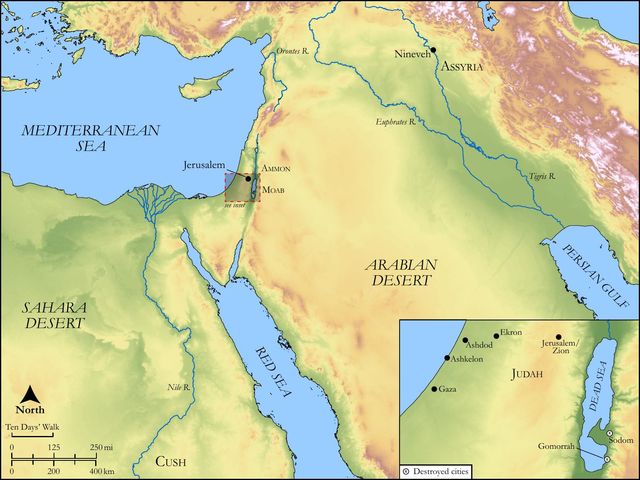
Where Zephaniah reaches
The passages it leans on, and the ones that lean on it
Man, beast and the fowls cut off: the LORD announces the day in the words he used before the flood.
The same words for the day in both prophets: darkness and gloominess, clouds and thick darkness.
Zephaniah 2:15 Isaiah 47:8 Revelation 18:7
What Nineveh “said in her heart” Isaiah’s Babylon says, and Revelation’s Babylon after it; each boast goes before a fall.
At Babel the one language was confounded; here the LORD gives the peoples a pure language to call on his name.
Zephaniah 3:14–15 Zechariah 9:9 Matthew 21:5
“Sing, O daughter of Zion,” for the King is in her midst; Zechariah says he comes, and Matthew sees him come.
Books Zephaniah links to most
The Church Fathers on Zephaniah
47 quotations from 16 writers before AD 800 · the ten most quoted, in date order
- Clement215
- Origen253
- Cyprian258
- Chrysostom407
- Jerome420
- Theodore428
- Augustine430
- Cyril444
- Theodoret458
- Gregory604
Jerome saw Christ in the temple searching Jerusalem as with Zephaniah’s candles.
He was looking for the priests; he wanted to be with them, but he could not find them. … So he surveyed all that was about him, almost as though he were searching with a lantern; so says the prophet Zephaniah: “I will explore Jerusalem with lamps.”
Gregory the Great turned the day’s fenced cities and high towers inward, to defended minds.
For what is expressed by fenced cities but minds suspected and surrounded ever with a fallacious defense; minds which, as often as their fault is attacked, suffer not the darts of truth to reach them?
Cyril of Alexandria read the Zion of 3:15 as the church, justified in Christ.
The spiritual and holy Zion—that is, the church, the holy multitude of the believers—is justified in Christ and only in him. … Thanks to him, we do not see evil anymore, for we have been delivered from the powers of evil.
Theodoret, on the promise to gather the outcast: salvation is a gift, not wages.
The salvation of human beings rests with divine lovingkindness alone: we do not earn it as the wages of righteousness; rather, it is a gift of divine goodness.
Keep studying
Articles