


Zephaniah 2:6
Bible text: King James Version (1769 Blayney text) · Public domain
Bible text: Berean Standard Bible · Public domain
Bible text: American Standard Version (1901) · Public domain
Bible text: World English Bible, Messianic edition · Public domain
Bible text: Geneva Bible (1599) · Public domain
Bible text: Young's Literal Translation · Public domain
- וְהָיְתָהve·ha·ye·Tahand it will beH1961Conj-w ¦ V-Qal-ConsecPerf-3fsVerb Qal Consecutive Perfect 3rd Singular Feminineוְandהָיְתָהit will be
- חֶבֶלChe·vel[the] region ofH2256N-cscNoun Singular common gender Construct
- הַיָּםhai·Yamthe seaH3220Art ¦ N-msNoun Singular Masculine Absoluteהַtheיָּםsea
- נְוֹתne·Votpastures ofH5116N-fpcNoun Plural Feminine Construct
- כְּרֹתke·Rotmeadows ofH3741N-fpcNoun Plural Feminine Construct
- רֹעִיםro·'ImshepherdsH7462V-Qal-Prtcpl-mpVerb Qal Participle Plural Masculine Absolute
- וְגִדְרוֹתve·gid·Rotand folds ofH1448Conj-w ¦ N-fpcNoun Plural Feminine Constructוְandגִדְרוֹתfolds of
- צֹאןTzonsheepH6629N-csNoun Singular common gender Absolute
English is a literal word-by-word gloss of the Hebrew, not the KJV's wording. Why?
This is the original text the KJV's translators worked from — each Hebrew word with its own literal English meaning in this verse, prepared by scholars at Tyndale House, Cambridge. The KJV translates whole sentences, not word by word, so its wording differs: one Hebrew word can become several English words, and the KJV may choose “the LORD” where the gloss reads “Yahweh”. Both are faithful — they answer different questions. For the KJV's own rendering, switch to the KJV text.
Details
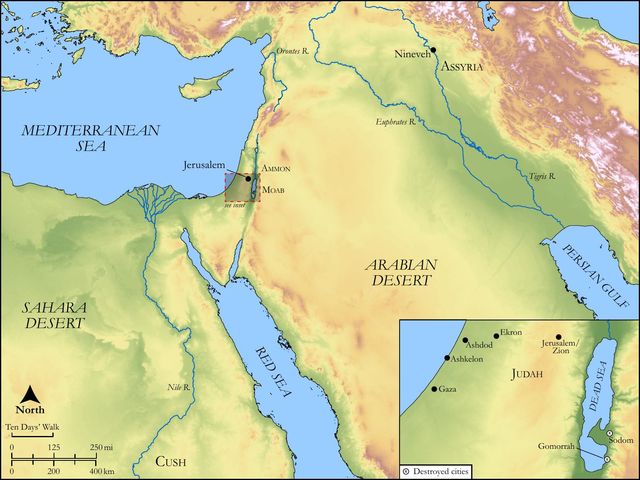
See on the biblical-era map
Study this verse
Public-domain commentary
Matthew Henry
From his Commentary on the Whole Bible. Henry comments on passages, not single verses — this entry covers Zephaniah 2:4–7.
The prophet here comes to foretel what share the neighbouring nations should have in the destruction made upon those parts of the world by Nebuchadnezzar and his victorious Chaldees, as others of the prophets did at that time, which is designed, 1. To awaken the people of the Jews, by making them sensible how strong, how deep, how large, the inundation of calamities should be, that the day of the Lord, which was near, might appear the more dreadful, and they might thereby be quickened to prepare for it as for a general deluge. 2. To comfort them with this thought, that their case, though sad, should not be singular (Solamen miseris socios habuisse doloris - The wretched find it consolatory to have companions of their woe), and much more with this, that though God had seemed to be their enemy, and to fight against them, yet he was still so far their friend, and an enemy to their enemies, that he resented, and would revenge, the indignities done them.
In these verses we have the doom of the Philistines, who were near neighbours, and old enemies, to the people of Israel. Five lordships there were in that country; only four are here named - Gaza and Ashkelon, Ashdod and Ekron; Gath, the fifth, is not named, some think because it was now subject to Judah. They were the inhabitants of the sea-coasts (Zep 2:5), for their country lay upon the Great Sea. The nation of the Cherethites is here joined with them, which bordered upon them (Sa1 30:14) and fell with them, as is foretold also, Eze 25:16. The Philistines' land is here called Canaan, for it belonged to that country which God gave to his people Israel, and was inserted in the grant made to them, Jos 13:3. This land is yet to be possessed (five lords of the Philistines), so that they wrongfully kept Israel out of the possession of it (Jdg 3:3), which is now remembered against them. For, though the rights of others may be long detained unjustly, the righteous God will at length avenge the wrong.
I.It is here foretold that the Philistines, the usurpers, shall be dispossessed and quite extirpated.
In general, here is a woe to them (Zep 2:5), which, coming from God, denotes all misery: The word of the Lord is against them - the word of the former prophets, which, though not yet accomplished, will be in its season, Isa 14:31. This word, now by this prophet, is against them. Note, Those are really in a woeful condition that have the word of the Lord against them, for no word of his shall fall to the ground. Those that rebel against the precepts of God's word shall have the threatenings of the word against them. The effect will be no less than their destruction, 1. God himself will be the author of it: "I will even destroy thee, who can make good what I say and will." 2. It shall be a universal destruction; it shall extend itself to all parts of the land, both city and country: Gaza shall be forsaken, though now a populous city. It was foretold (Jer 47:6) that baldness should come upon Gaza; Alexander the Great razed that city, and we find (Act 8:26) that Gaza was a desert. Ashkelon shall be a desolation, a pattern of desolation. Ashdod shall be driven out at noon-day; in the extremity of the scorching heat they shall have no shade, no shelter to protect them; but then, when most incommoded by the weather, they shall be forced away into captivity, which will be an aggravating circumstance of it. Ekron likewise shall be rooted up, that had been long taking root. The land of the Philistines shall be dispeopled; there shall be no inhabitant, Zep 2:5. God made the earth to be inhabited (Isa 45:18), otherwise he would have made it in vain; but, if men do not answer the end of their creation in serving God, it is just with God that the earth should not answer the end of its creation in serving them for a habitation; man's sin has sometimes subjected it to this vanity. 3. It shall be an utter destruction. The sea-coast, which used to be a harbour for ships and a habitation for merchants, shall now be deserted, and be only cottages for shepherds and folds for flocks (Zep 2:6), and then perhaps put to better use than when it was possessed by the lords of the Philistines.
II.It is here foretold that the house of Judah, the rightful owners, shall recover the possession of it, Zep 2:7.
The remnant of those that shall return out of captivity, when God visits them, shall be made to lie down in safety in the houses of Ashkelon, to lie down in the evening, when they are weary and sleepy. There they shall feed themselves and their flocks. Note, God will at length restore his people to their rights, though they may be long kept out from them.
Historical interpretation
Historical reception
1 surviving comment on this verse from the historical church.
(Verse 5-7.) Woe to those who dwell by the sea, the nation of the lost: the word of the Lord is against you, O Canaan, land of the Philistines; and I will destroy you so that there will be no inhabitant. And the sea coast shall be pastures, with shelters for shepherds and folds for flocks. And the remnant of the house of Judah shall possess it; they shall feed on it. In the houses of Ashkelon they shall lie down at evening; for the Lord their God will visit them and restore their fortunes. LXX: Woe to those who inhabit the edge of the sea, strangers from Crete! The word of the Lord is against you, O Canaan, land of the foreigners; and I will destroy you, and there will be a pasture for flocks in Crete, and a sheepfold for herds. And the edge of the sea shall belong to the remnant of the house of Judah; they shall feed their flocks in the houses of Ashkelon; in the afternoon they shall rest, for the Lord their God will visit them and turn back their captivity. As for the history, it is not difficult to interpret, because in the previous statements it was said: Gaza will be destroyed (or deserted), and Ascalon will be turned into a desert: Ashdod will be cast out to the south, and Ekron will be uprooted. With these four great cities of Palestine named, now it is evident that the Lord's discourse is directed towards the province itself, and a woe is pronounced on it: Woe to those who dwell by the sea, when the Babylonian comes; for even those who dwell near the sea will perish and be taken away. But it is doubted by no one that the land of the Palestinians is the land of Canaan. And I will destroy you, he says, so that there will be no inhabitant: and you will come to such a great devastation, that you rejoiced in the destruction of Judaea, so that all your well-fortified cities will become grazing grounds for shepherds. And after the Lord has visited his people, and has caused them to return under Zerubbabel and Joshua, and they have built the temple and rebuilt Jerusalem, you will be so uncultivated, and will be covered with thorns and nettles, that shepherds will rest from the remnants of the Jews in Ashkelon in the afternoon, and make their flocks lie down in the once noble city, and this will happen because the Lord will visit his people, and will turn away their captivity, whether it has happened or not, God will see. For our purpose now is not to weave a true history, but to communicate to our own people what we have learned from the Hebrews. However, the spiritual sense and translation of the LXX is difficult to understand, especially because there are discrepancies in interpretation. For where we have translated, nation of the lost, they said, strangers of the Cretans: and what is written in Hebrew as GoiChorethim (), they read as Goi, meaning nation, and Gar, meaning stranger: and for Chorethim, which means lost, they thought it was the name of the island of Crete. Finally, both Aquila and the fifth edition were translated, ἔθνος ὀλέθριον: And Theodotio ἔθνος ὀλεθρίας: Symmachus also ἔθνος ὀλεθρευόμενον, which all together with our interpretation make. Again, where we have said, And the cord of the sea will be the pasture of the shepherds, and all the interpreters agree with this translation, it is written in the LXX: And Crete will be the pasture of the flock, and the sheepfold. Therefore, comparing spiritual things to spiritual things, and holding onto the path once begun of the Vulgate edition, we search if we have read the name of Crete elsewhere in the Holy Scriptures. And, if I am not mistaken, it is quite clear: Cretans are always liars, evil beasts, lazy gluttons. This testimony is true. (Tit. I, 12, 13). They are unstable and easily deceived, carried away by every wind of doctrine, by human trickery, by their cunning in deceitful scheming. Instead of living in the land of confession, which is Judea, they preferred to be foreigners, those Cretans who are constantly battered by the varying waves of the sea and resonate with the sound of the Cretan lyre. According to the Apostle, they are like a tinkling cymbal. (I Cor. XIII, 1). And because the Cretans are foreigners, therefore the word of God, that is, admonition, is directed towards them: and they are called the land of Canaan, always in agitation, always in motion, and the land of the Gentiles: for they are alienated from God, they are tossed to and fro in the cable of the sea, and are situated in the region of Crete. Therefore, the word of God is directed towards them, either at the consummation and end of the world, or daily by ecclesiastical men, and those who are able to say with the apostle: Do you seek a proof of Christ speaking in me? (2 Corinthians 13:3) So that they may be driven out of Crete, and perish from their former dwellings, and that region which previously contained a lost flock, may begin to be the sheepfold of Christ; and let Judas, that is, true confession, dwell in the ropes of the sea. And when the world has now begun to be evening, and out of many who are called, few are chosen, and those who are now called the remnant of the house of Judah, may feed those who were first fed in the sea, and in Crete, and in falsehood: they will turn aside into the houses of Ashkelon, that is, where previously the fire of the devil and the blood of the slain flowed: for Ashkelon is interpreted as the murderous fire. And this will happen because the Lord will visit His people, and those who were easily captured by the sophisms of heretics, like those coming out of captivity, will overcome their adversaries and dwell in their own tabernacles. However, what is read in the Septuagint, 'From the face of the sons of Judah,' we have marked with an obelus, for it is not found in the Hebrew or in any other interpreter, and it disturbs the context and meaning of the chapter: not that it would be difficult in some way to weave in the sentence even with this included; but once we have decided on the truth of the interpretation, we choose the judgement of a more learned reader rather than the opinion of the common people.
Continue studying Zephaniah 2:6 across the web’s major study libraries — every link below opens this exact verse, chapter, or book on the destination site.
Read & Compare
 BibleGatewayThis verse in more than 200 translations and 70 languages.
 Bible.comThe YouVersion reader — hundreds of translations, reading plans, and highlights.
 ESV.orgCrossway's official English Standard Version reader.
 NET BibleThe NET translation with 60,000+ translators' notes on every rendering decision.
 STEP BibleTyndale House's free study tool — original text, vocabulary, and scholarly resources.
 BibliaLogos Bible Software's free web reader.
 USCCBThe New American Bible (Revised Edition) with the U.S. bishops' study notes.
Commentaries
 BibleHub CommentariesDozens of classic commentaries on this verse, gathered on one page.
 StudyLightMore than 100 commentary sets — the largest collection on the web.
 BibleRefPlain-English commentary on what this verse means, verse by verse.
 Enduring WordDavid Guzik's free commentary on this chapter, widely used by Bible teachers.
 Bible Study ToolsVerse commentary alongside Greek and Hebrew study aids.
Original Language & Research
- BibleHub InterlinearThe verse word by word — original language, transliteration, and English.
- BibleHub LexiconEvery word's original-language definition and Strong's entry.
 Blue Letter BibleDeep-study tools — Strong's numbers, concordance, and word studies.
 SefariaThe Hebrew text with Rashi and centuries of Jewish commentary.
Sermons, Hymns & Audio


TrulyRandomVerse is not affiliated with these sites and doesn’t control their content. They’re linked because they’re genuinely useful.
Summary
Zephaniah 2:6 prophesies the radical transformation of the Philistine coastal region, specifically the fertile and populous Shephelah, from a land of fortified cities and bustling activity into a humble pastoral landscape. This verse vividly illustrates God's sovereign judgment against the proud nations surrounding Judah, foretelling that the once-mighty Philistine strongholds will become simple dwellings and enclosures for shepherds and their flocks, a stark reversal of their former glory and a testament to divine authority over all earthly powers.
Context
ShowHideLiterary Context
Zephaniah 2:6 is part of a broader prophetic oracle against the nations surrounding Judah, following the severe pronouncements of judgment upon Judah itself in Zephaniah 1. Specifically, verses 4 and 5 initiate the prophecy against Philistia, naming its prominent cities—Gaza, Ashkelon, Ashdod, and Ekron—and declaring their impending desolation. Verse 6 continues this theme, detailing the nature of that desolation: a complete reversal of their urban, militaristic identity into a primitive, pastoral existence. This serves as a stark contrast to the Philistines' historical role as formidable enemies of Israel and underscores the comprehensive nature of God's judgment. The subsequent verse, Zephaniah 2:7, then shifts focus to the "remnant of the house of Judah," suggesting that this transformed land might eventually provide a place of rest and inheritance for God's people, highlighting a theme of divine justice that both punishes the wicked and preserves the righteous.
Historical & Cultural Context
Zephaniah prophesied during the reign of King Josiah (c. 640-609 BC), a period marked by religious reform in Judah but also by significant geopolitical shifts. The Assyrian Empire, which had long dominated the nations round about, was in decline, creating a power vacuum. This instability often led to renewed aggression among smaller nations, including the Philistines, who occupied the fertile coastal plain southwest of Judah. Historically, the Philistines were a powerful, seafaring people, known for their advanced iron technology and fortified cities, often clashing with Israel (e.g., 1 Samuel 17). Their cities were strategic trade hubs and military strongholds. The prophecy in Zephaniah 2:6, therefore, targets not just a geographical area but a symbol of pagan power and pride that had long troubled God's people. The imagery of their cities becoming "dwellings and cottages for shepherds" would have been particularly shocking, symbolizing a complete humiliation and de-urbanization of a sophisticated society.
Key Themes
ShowHideThis verse powerfully contributes to several overarching themes within Zephaniah and the broader prophetic literature. First, it emphasizes Divine Judgment and Universal Sovereignty, demonstrating that God's authority extends beyond Judah to all nations, holding them accountable for their actions and idolatry. The transformation of the Philistine coast from a place of power to a humble pasture vividly illustrates God's ability to humble the proud and reverse fortunes, a theme echoed in passages like Psalm 75:7. Second, it highlights the Reversal of Pride and Humiliation of the Arrogant. The Philistines, known for their military might and defiance, are reduced to a primitive state, underscoring the biblical principle that "pride goes before destruction, and a haughty spirit before a fall" (Proverbs 16:18). Finally, the Pastoral Imagery of shepherds and flocks, while signifying desolation for the Philistines, subtly hints at a future of peace and security for the remnant of Judah, who might inhabit this transformed land, echoing the imagery of God as a shepherd caring for His flock, as seen in Psalm 23.
Exposition and Analysis
ShowHideKey Word Analysis
ShowHideThis word (H2256) literally means "rope" or "measuring line," and by extension, "a measured portion of land," "a district," or "region." Its use here for "sea coast" emphasizes that the entire defined territory of Philistia, not just specific cities, will undergo this radical transformation. It speaks to a comprehensive redefinition of the land's purpose and inhabitants.
This term (H5116) refers to a "home," "habitation," or "pasture." While it can denote a human dwelling, it very often refers to a "fold" or "pasture" for flocks, or a "den" for wild animals. Its selection here, alongside "cottages" and "folds," strongly reinforces the idea of the land reverting to a wild, uncultivated, and primarily pastoral state, far removed from its former urban sophistication.
This word (H1448) specifically means an "enclosure" or "sheep-cote," a walled or fenced area for keeping flocks. Its inclusion alongside "dwellings" and "cottages" solidifies the imagery of the Philistine coast being entirely repurposed for animal husbandry, symbolizing a complete loss of its human population, political power, and cultural identity.
Verse Breakdown
ShowHide"And the sea coast shall be dwellings"
This clause sets the stage for the dramatic reversal. The once-populous and strategically important Philistine coastline, encompassing its major cities, is prophesied to become mere "dwellings." This immediately suggests a reduction from grand urban centers to simple, perhaps temporary, habitations, indicating a profound depopulation and de-urbanization of the region.
"[and] cottages for shepherds"
Building on the previous phrase, this specifies the nature of these humble dwellings. "Cottages" (H3741, kârâh') implies small, rudimentary shelters, reinforcing the idea of a primitive, rural existence. The explicit mention of "shepherds" paints a picture of a land suitable only for tending livestock, a stark contrast to its former status as a hub of trade, military power, and Philistine culture.
"and folds for flocks"
This final clause completes the pastoral imagery, emphasizing that the land's primary purpose will be for the housing and grazing of animals. "Folds" (H1448, gᵉdêrâh') are enclosures for sheep or goats, signifying a complete transformation of the landscape into a desolate, yet functional, pastureland. This imagery underscores the thoroughness of God's judgment, reducing a proud civilization to its most basic, agrarian elements.
Literary Devices
ShowHideZephaniah 2:6 masterfully employs several literary devices to convey its powerful message of judgment and transformation. Imagery is paramount, painting a vivid picture of a once-thriving coastal region reduced to humble "dwellings," "cottages for shepherds," and "folds for flocks." This stark visual contrast between past glory and future desolation is central to the prophecy's impact. Symbolism is also at play, as the "sea coast" symbolizes the proud, idolatrous Philistine nation, and its transformation into pastoral land symbolizes their complete humiliation and the dismantling of their power. The shepherd and flock imagery, while denoting desolation for the Philistines, also carries a broader biblical symbolism of peace, simplicity, and divine care, hinting at a future for God's remnant. Furthermore, there is a strong element of Irony in the prophecy. What was once a place of military might and urban sophistication is destined to become a humble, rural pasture, demonstrating God's ability to humble the proud and turn the world's power structures on their head. This transformation is not merely physical but symbolic of a complete reversal of fortune.
Theological and Thematic Connections
ShowHideZephaniah 2:6 stands as a profound testament to God's absolute sovereignty over all nations and His unwavering commitment to justice. It illustrates that no earthly power, no matter how fortified or proud, can ultimately withstand the divine will. The radical transformation of the Philistine coast from a center of power and idolatry to a humble pasture for flocks underscores the biblical principle that God humbles the arrogant and exalts the lowly. This judgment serves not only as punishment for Philistia's wickedness and historical opposition to Israel but also as a demonstration of God's faithfulness to His covenant people, assuring them that their enemies will not prevail indefinitely. The desolate imagery also points to the destructive consequences of rejecting God, while simultaneously hinting at a future, albeit transformed, land that might eventually serve the purposes of God's remnant.
Reflection and Application
ShowHideZephaniah 2:6 offers a powerful and enduring lesson for believers today. It serves as a stark reminder that all earthly power, wealth, and security are fleeting and ultimately subject to God's sovereign will. The prophecy against Philistia challenges us to examine where we place our trust and derive our security. Do we rely on our achievements, our possessions, our societal standing, or the stability of human institutions? This verse calls us to humility, urging us to recognize that God alone is the ultimate arbiter of destinies, capable of overturning the mightiest empires and reducing the proudest strongholds to humble pastures. It encourages us to place our hope not in the temporary structures of this world but in the eternal and unchanging purposes of God. Furthermore, it reminds us of God's justice; while judgment is severe, it is always righteous. For those who trust in Him, this provides comfort and assurance that evil will not triumph indefinitely, and God's kingdom will ultimately prevail.
Questions for Reflection
ShowHideFAQ
ShowHideWhat was the significance of the Philistine coast in Zephaniah's time?
ShowHideThe Philistine coast was a highly strategic and fertile region along the Mediterranean Sea, home to powerful city-states like Gaza, Ashkelon, Ashdod, and Ekron. These cities were important trade centers and military strongholds, and the Philistines had a long history of conflict with Israel, often serving as a formidable enemy. Their prosperity and military might made them symbols of worldly power and defiance against God's people, making their prophesied desolation a potent demonstration of divine judgment.
Does this prophecy imply a complete and permanent desolation of the Philistine land?
ShowHideThe imagery in Zephaniah 2:6 certainly describes a radical and devastating transformation, reducing the land to a primitive, pastoral state. While it signifies a profound judgment and loss of the Philistine identity and power, the subsequent verse, Zephaniah 2:7, suggests that the land might eventually become an inheritance for the "remnant of the house of Judah." This indicates that while the Philistine civilization would be utterly broken, the land itself would be repurposed by God, ultimately serving His redemptive plans for His people. This aligns with a broader prophetic pattern where judgment often precedes a new order or restoration for God's chosen.
Christ-Centered Fulfillment
ShowHideZephaniah 2:6, with its prophecy of judgment against the nations and the humbling of earthly powers, finds its ultimate fulfillment and deeper meaning in the person and work of Jesus Christ. The "day of the Lord" that Zephaniah announces, a day of universal judgment, culminates in Christ's return, when He will judge the living and the dead and establish His eternal kingdom (Matthew 25:31-32). The humbling of the proud Philistine cities foreshadows the ultimate dismantling of all human systems and strongholds that oppose God, making way for the humble, spiritual kingdom of Christ, which is "not of this world" (John 18:36). Moreover, the imagery of the land becoming "dwellings and cottages for shepherds, and folds for flocks" subtly points to Jesus as the Good Shepherd (John 10:11), who gathers His flock—His church—from all nations, transforming desolate spiritual landscapes into places of peaceful dwelling for His redeemed. The judgment on the Philistines ultimately clears the way for God's people to inherit the earth, a promise fulfilled spiritually in the church, which is Christ's body, and ultimately in the new heavens and new earth where righteousness dwells (Revelation 21:1-4).