


Acts 8:26
Bible text: King James Version (1769 Blayney text) · Public domain
Bible text: King James Version with Strong's numbers · Public domain
Bible text: Berean Standard Bible · Public domain
Bible text: American Standard Version (1901) · Public domain
Bible text: World English Bible, Messianic edition · Public domain
Bible text: Geneva Bible (1599) · Public domain
Bible text: Young's Literal Translation · Public domain
- ἌγγελοςAngelosAn angelG32N-NSMNoun Nominative Singular Masculine
- δὲdenowG1161CONJConjunction
- κυρίουkuriouof [the] LordG2962N-GSM-TNoun Genitive Singular Masculine Title
- ἐλάλησενelalēsenspokeG2980V-AAI-3SVerb Aorist Active Indicative 3rd Singular
- πρὸςprostoG4314PREPPreposition
- ΦίλιππονPhilipponPhilipG5376N-ASM-PNoun Accusative Singular Masculine Individual
- λέγων·legōnsayingG3004V-PAP-NSMVerb Present Active Participle Nominative Singular Masculine
- ἀνάστηθιanastēthido rise upG450V-2AAM-2SVerb 2nd Aorist Active Imperative 2nd Singular
- καὶkaiandG2532CONJConjunction
- πορεύουporeuoudo goG4198V-PNM-2SVerb Present Middle Or Passive Deponent Imperative 2nd Singular
- κατὰkatatowardG2596PREPPreposition
- μεσημβρίανmesēmbrian[the] southG3314N-ASFNoun Accusative Singular Feminine
- ἐπὶepitoG1909PREPPreposition
- τὴνtēntheG3588T-ASFDefinite article Accusative Singular Feminine
- ὁδὸνhodonroadG3598N-ASFNoun Accusative Singular Feminine
- τὴνtēnwhichG3588T-ASFDefinite article Accusative Singular Feminine
- καταβαίνουσανkatabainousanis going downG2597V-PAP-ASFVerb Present Active Participle Accusative Singular Feminine
- ἀπὸapofromG575PREPPreposition
- ἸερουσαλὴμIerousalēmJerusalemG2419N-GSF-LNoun Genitive Singular Feminine Location
- εἰςeistoG1519PREPPreposition
- Γάζαν·GazanGazaG1048N-ASF-LNoun Accusative Singular Feminine Location
- αὕτηhautēThisG3778D-NSFDemonstrative pronoun Nominative Singular Feminine
- ἐστὶνestinisG1510V-PAI-3SVerb Present Active Indicative 3rd Singular
- ἔρημοςerēmos[the] desert [road]G2048A-NSFAdjective Nominative Singular Feminine
English is a literal word-by-word gloss of the Greek, not the KJV's wording. Why?
This is the original text the KJV's translators worked from — each Greek word with its own literal English meaning in this verse, prepared by scholars at Tyndale House, Cambridge. The KJV translates whole sentences, not word by word, so its wording differs: one Greek word can become several English words, and the KJV may choose “charity” where the gloss reads “love”. Both are faithful — they answer different questions. For the KJV's own rendering, switch to the KJV text.
Details
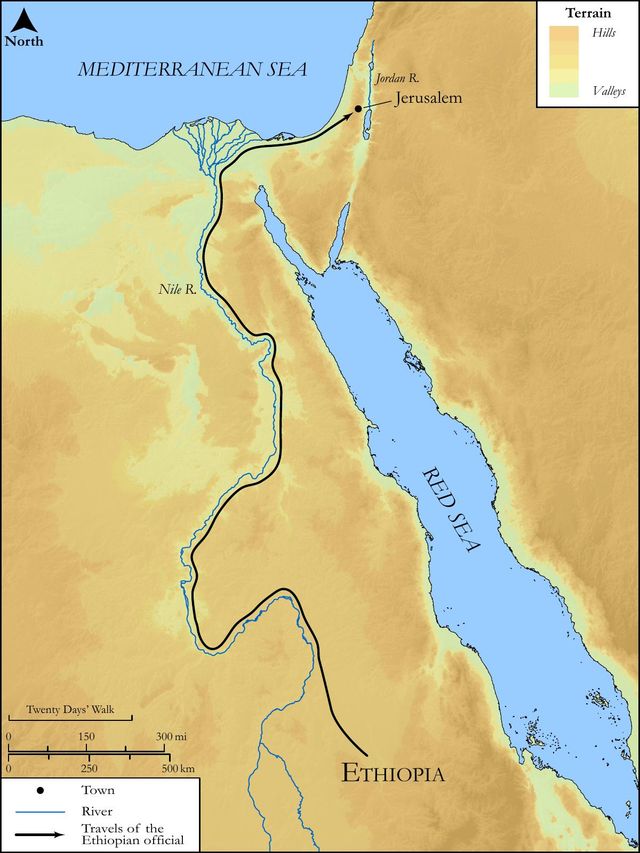
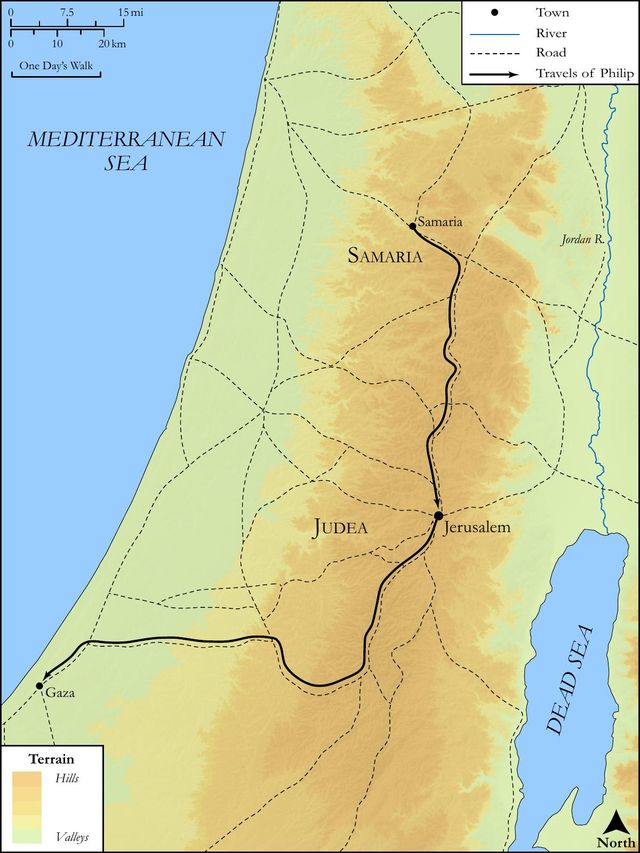
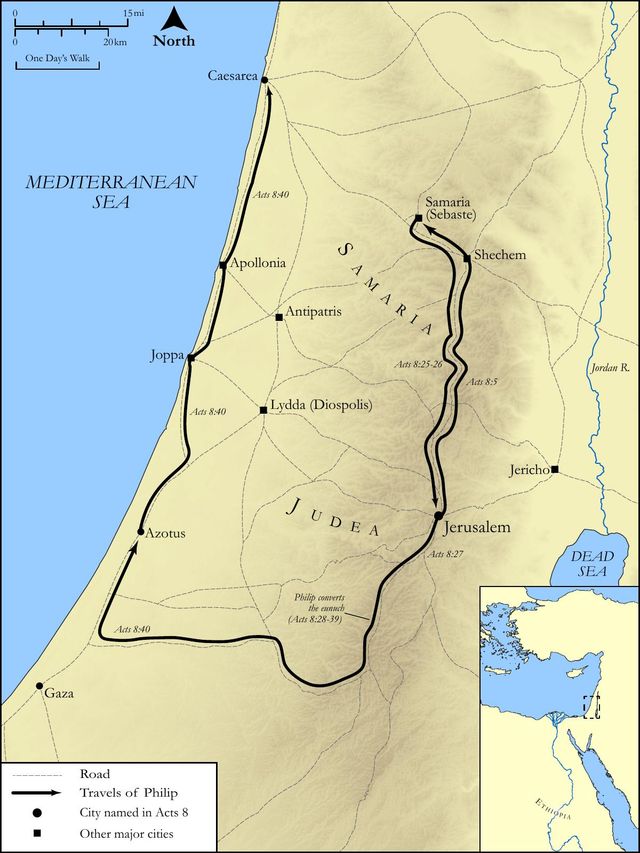
See on the biblical-era maps
Study this verse
Public-domain commentary
Matthew Henry
From his Commentary on the Whole Bible. Henry comments on passages, not single verses — this entry covers Acts 8:26–40. His three-level outline is real structure in the source text, so it is rendered as structure.
We have here the story of the conversion of an Ethiopian eunuch to the faith of Christ, by whom, we have reason to think, the knowledge of Christ was sent into that country where he lived, and that scripture fulfilled, Ethiopia shall soon stretch out her hands (one of the first of the nations) unto God, Psa 68:31.
I.Philip the evangelist is directed into the road where he would meet with this Ethiopian, Act 8:26.
When the churches in Samaria were settled, and had ministers appointed them, the apostles went back to Jerusalem; but Philip stays, expecting to be employed in breaking up fresh ground in the country. And here we have,
1.Direction given him by an angel (probably in a dream or vision of the night) what course to steer: Arise, and go towards the south. Though angels were not employed to preach the gospel, they were often employed in carrying messages to ministers for advice and encouragement, as Act 5:19. We cannot now expect such guides in our way; but doubtless there is a special providence of God conversant about the removes and settlements of ministers, and one way or other he will direct those who sincerely desire to follow him into that way in which he will own them: he will guide them with his eye. Philip must go southward, to the way that leads from Jerusalem to Gaza, through the desert or wilderness of Judah. He would never have thought of going thither, into a desert, into a common road through the desert; small probability of finding work there! Yet thither he is sent, according to our Saviour's parable, fore-telling the call of the Gentiles, Go you into the highways, and the hedges, Mat 22:9. Sometimes God opens a door of opportunity to his ministers in places very unlikely.
2.His obedience to this direction (Act 8:27): He arose and went, without objecting, or so much as asking, "What business have I there?" Or, "What likelihood is there of doing good there?" He went out, not knowing whither he went, or whom he was to meet.
II.An account is given of this eunuch (Act 8:27), who and what he was, on whom this distinguishing favour was bestowed.
1.He was a foreigner, a man of Ethiopia. There were two Ethiopias, one in Arabia, but that lay east from Canaan; it should seem this was Ethiopia in Africa, which lay south, beyond Egypt, a great way off from Jerusalem; for in Christ those that were afar off were made nigh, according to the promise, that the ends of the earth should see the great salvation. The Ethiopians were looked upon as the meanest and most despicable of the nations, blackamoors, as if nature had stigmatized them; yet the gospel is sent to them, and divine grace looks upon them, though they are black, though the sun has looked upon them.
2.He was a person of quality, a great man in his own country, a eunuch, not in body, but in office - lord chamberlain or steward of the household; and either by the dignity of his place or by his personal character, which commanded respect, he was of great authority, and bore a mighty sway under Candace queen of the Ethiopians, who probably was successor to the queen of Sheba, who is called the queen of the south, that country being governed by queens, to whom Candace was a common name, as Pharaoh to the kings of Egypt. He had the charge of all her treasure; so great a trust did she repose in him. Not many mighty, not many noble, are called; but some are.
3.He was a proselyte to the Jewish religion, for he came to Jerusalem to worship. Some think that he was a proselyte of righteousness, who was circumcised, and kept the feasts; others that he was only a proselyte of the gate, a Gentile, but who had renounced idolatry, and worshipped the God of Israel occasionally in the court of the Gentiles; but, if so, then Peter was not the first that preached the gospel to the Gentiles, as he says he was. Some think that there were remains of the knowledge of the true God in this country, ever since the queen of Sheba's time; and probably the ancestor of this eunuch was one of her attendants, who transmitted to his posterity what he learned at Jerusalem.
III.Philip and the eunuch are brought together into a close conversation; and now Philip shall know the meaning of his being sent into a desert, for there he meets with a chariot, that shall serve for a synagogue, and one man, the conversion of whom shall be in effect, for aught he knows, the conversion of a whole nation.
1.Philip is ordered to fall into company with this traveller that is going home from Jerusalem towards Gaza, thinking he has done all the business of his journey, when the great business which the overruling providence of God designed in it was yet undone. He had been at Jerusalem, where the apostles were preaching the Christian faith, and multitudes professing it, and yet there he had taken no notice of it, and made no enquiries after it - nay, it should seem, had slighted it, and turned his back upon it; yet the grace of God pursues him, overtakes him in the desert, and there overcomes him. Thus God is often found of those that sought him not, Isa 65:1. Philip has this order, not by an angel, as before, but by the Spirit whispering it in his ear (Act 8:29): "Go near, and join thyself to this chariot; go so near as that gentleman may take notice of thee." We should study to do good to those we light in company with upon the road: thus the lips of the righteous may feed many. We should not be so shy of all strangers as some affect to be. Of those of whom we know nothing else we know this, that they have souls.
2.He finds him reading in his Bible, as he sat in his chariot (Act 8:28): He ran to him, and heard him read; he read out, for the benefit of those that were with him, Act 8:30. He not only relieved the tediousness of the journey, but redeemed time by reading, not philosophy, history, nor politics, much less a romance or a play, but the scriptures, the book of Esaias; that book Christ read in (Luk 4:17) and the eunuch here, which should recommend it particularly to our reading. Perhaps the eunuch was now reading over again those portions of scripture which he had heard read and expounded at Jerusalem, that he might recollect what he had heard. Note,
(1.)It is the duty of every one of us to converse much with the holy scriptures.
(2.)Persons of quality should abound more than others in the exercises of piety, because their example will influence many, and they have their time more at command.
(3.)It is wisdom for men of business to redeem time for holy duties; time is precious, and it is the best husbandry in the world to gather up the fragments of time, that none be lost, to fill up every minute with something that will turn to a good account.
(4.)When we are returning from public worship we should use means in private for the keeping up of the good affections there kindled, and the preserving of the good impressions there made, Ch1 29:18.
(5.)Those that are diligent in searching the scriptures are in a fair way to improve in knowledge; for to him that hath shall be given.
3.He puts a fair question to him: Understandest thou what thou readest? Not by way of reproach, but with design to offer him his service. Note, What we read and hear of the word of God it highly concerns us to understand, especially what we read and hear concerning Christ; and therefore we should often ask ourselves whether we understand it or no: Have you understood all these things? Mat 13:51. And have you understood them aright? We cannot profit by the scriptures unless we do in some measure understand them, Co1 14:16, Co1 14:17. And, blessed by God, what is necessary to salvation is easy to be understood.
4.The eunuch in a sense of his need of assistance, desires Philip's company (Act 8:31): "How can I understand, says he, except some one guide me? Therefore pray come up, and sit with me." (1.) He speaks as one that had very low thoughts of himself, and his own capacity and attainments. He was so far from taking it as an affront to be asked whether he understood what he read, though Philip was a stranger, on foot, and probably looked mean (which many a less man would have done, and have called him an impertinent fellow, and bid him go about his business, what was it to him?) that he takes the question kindly, makes a very modest reply, How can I? We have reason to think he was an intelligent man, and as well acquainted with the meaning of scripture as most were, and yet he modestly confesses his weakness. Note, Those that would learn must see their need to be taught. The prophet must first own that he knows not what these are, and then the angel will tell him, Zac 4:13. (2.) He speaks as one very desirous to be taught, to have some one to guide him. Observe, He read the scripture, though there were many things in it which he did not understand. Though there are many things in the scriptures which are dark and hard to be understood, nay, which are often misunderstood, yet we must not therefore throw them by, but study them for the sake of those things that are easy, which is the likeliest way to come by degrees to the understanding of those things that are difficult: for knowledge and grace grow gradually. (3.) He invited Philip to come up and sit with him; not as Jehu took Jonadab into his chariot, to come and see his zeal for the Lord of hosts (Kg2 10:16), but rather, "Come, see my ignorance, and instruct me." He will gladly do Philip the honour to take him into the coach with him, if Philip will do him the favour to expound a portion of scripture to him. Note, In order to our right understanding of the scripture, it is requisite we should have some one to guide us; some good books, and some good men, but, above all, the Spirit of grace, to lead us into all truth.
IV.The portion of scripture which the eunuch recited, with some hints of Philip's discourse upon it.
The preachers of the gospel had a very good handle to take hold of those by who were conversant with the scriptures of the Old Testament and received them, especially when they found them actually engaged in the study of them, as the eunuch was here.
1.The chapter he was reading was the fifty-third of Isaiah, two verses of which are here quoted (Act 8:32, Act 8:33), part of the seventh and eighth verses; they are set down according to the Septuagint version, which in some things differs from the original Hebrew. Grotius thinks the eunuch read it in the Hebrew, but that Luke takes the Septuagint translation, as readier to the language in which he wrote; and he supposes that the eunuch had learned from the many Jews that were in Ethiopia both their religion and language. But, considering that the Septuagint version was made in Egypt, which was the next country adjoining to Ethiopia, and lay between it and Jerusalem, I rather think that translation was most familiar to him: it appears by Isa 20:4 that there was much communication between those two nations - Egypt and Ethiopia. The greatest variation from the Hebrew is that what in the original is, He was taken from prison and from judgment (hurried with the utmost violence and precipitation from one judgment-seat to another; or, From force and from judgment he was taken away; that is, It was from the fury of the people, and their continual clamours, and the judgment of Pilate thereupon, that he was taken away), is here read, In his humiliation his judgment was taken away. He appeared so mean and despicable in their eyes that they denied him common justice, and against all the rules of equity,. to the benefit of which every man is entitled, they declared him innocent, and yet condemned him to die; nothing criminal can be proved upon him, but he is down, and down with him. Thus in his humiliation his judgment was taken away; so, the sense is much the same with that of the Hebrew. So that these verses foretold concerning the Messiah,
(1.)That he should die, should be led to the slaughter, as sheep that were offered in sacrifice - that his life should be taken from among men, taken from the earth. With what little reason then was the death of Christ a stumbling-block to the unbelieving Jews, when it was so plainly foretold by their own prophets, and was so necessary to the accomplishment of his undertaking! Then is the offence of the cross ceased.
(2.)That he should die wrongfully, should die by violence, should be hurried out of his life, and his judgment shall be taken away - no justice done to him; for he must be cut off, but not for himself.
(3.)That he should die patiently. Like a lamb dumb before the shearer, nay, and before the butcher too, so he opened not his mouth. Never was there such an example of patience as our Lord Jesus was in his sufferings; when he was accused, when he was abused, he was silent, reviled not again, threatened not.
(4.)That yet he should live for ever, to ages which cannot be numbered; for so I understand those words, Who shall declare his generation? The Hebrew word properly signifies the duration of one life, Ecc 1:4. Now who can conceive or express how long he shall continue, notwithstanding this; for his life is taken only from the earth; in heaven he shall live to endless and innumerable ages, as it follows in Isa 53:10, He shall prolong his days.
2.The eunuch's question upon this is, Of whom speaketh the prophet this? Act 8:34. He does not desire Philip to give him some critical remarks upon the words and phrases, and the idioms of the language, but to acquaint him with the general scope and design of the prophecy, to furnish him with a key, in the use of which he might, by comparing one thing with another, be led into the meaning of the particular passage. Prophecies had usually in them something of obscurity, till they were explained by the accomplishment of them, as this now was. It is a material question he asks, and a very sensible one: "Does the prophet speak this of himself, in expectation of being used, being misused, as the other prophets were? or does he speak it of some other man, in his own age, or in some age to come?" Though the modern Jews will not allow it to be spoken of the Messiah, yet their ancient doctors did so interpret it; and perhaps the eunuch knew this, and did partly understand it so himself, only he proposed this question, to draw on discourse with Philip; for the way to improve in learning is to consult the learned. As they must enquire the law at the mouth of the priests (Mal 2:7), so they must enquire the gospel, especially that part of the treasure which is hid in the field of the Old Testament, at the mouth of the ministers of Christ. The way to receive good instructions is to ask good questions.
3.Philip takes this fair occasion given him to open to him the great mystery of the gospel concerning Jesus Christ, and him crucified. He began at this scripture, took this for his text (as Christ did another passage of the same prophecy, Luk 4:21), and preached unto him Jesus, Act 8:35. This is all the account given us of Philip's sermon, because it was the same in effect with Peter's sermons, which we have had before. The business of gospel ministers is to preach Jesus, and this is the preaching that is likely to do good. It is probable that Philip had now occasion for his gift of tongues, that he might preach Christ to this Ethiopian in the language of his own country. And here we have an instance of speaking of the things of God, and speaking of them to good purpose, not only as we sit in the house, but as we walk by the way, according to that rule, Deu 6:7.
V.The eunuch is baptized in the name of Christ, Act 8:36-38.
It is probable that the eunuch had heard at Jerusalem of the doctrine of Christ, so that it was not altogether new to him. But, if he had, what could that do towards this speedy conquest that was made of his heart for Christ. It was a powerful working of the Spirit with and by Philip's preaching that gained the point. Now here we have,
1.The modest proposal which the eunuch made of himself for baptism (Act 8:36): As they went on their way, discoursing of Christ, the eunuch asking more questions and Philip answering them to his satisfaction, they came unto a certain water, a well, river, or pond, the sight of which made the eunuch think of being baptized. Thus God, by hints of providence which seem casual, sometimes puts his people in mind of their duty, of which otherwise perhaps they would not have thought. The eunuch knew not how little a while Philip might be with him, nor where he might afterwards enquire for him. He could not expect his travelling with him to his next stage, and therefore, if Philip think fit, he will take the present convenience which offers itself of being baptized: "See, here is water, which perhaps we may not meet with a great while again; what doth hinder me to be baptized? Canst thou show any cause why I should not be admitted a disciple and follower of Christ by baptism?" Observe,
(1.)He does not demand baptism, does not say, "Here is water and here I am resolved I will be baptized;" for, if Philip have any thing to offer to the contrary, he is willing to waive it for the present. If he think him not fit to be baptized, or if there be any thing in the institution of the ordinance which will not admit such a speedy administration of it, he will not insist upon it. The most forward zeal must submit to order and rule. But,
(2.)He does desire it, and, unless Philip can show cause why not, he desires it now, and is not willing to defer it. Note, In the solemn dedicating and devoting of ourselves to God, it is good to make haste, and not to delay; for the present time is the best time, Psa 119:60. Those who have received the thing signified by baptism should not put off receiving the sign. The eunuch feared lest the good affections now working in him should cool and abate, and therefore was willing immediately to bind his soul with the baptismal bonds unto the Lord, that he might bring the matter to an issue.
2.The fair declaration which Philip made him of the terms upon which he might have the privilege of baptism (Act 8:37): "If thou believest with all thy heart, thou mayest; that is, If thou believest this doctrine which I have preached to thee concerning Jesus, if thou receivest the record God has given concerning him, and set to thy seal that it is true." He must believe with all his heart, for with the heart man believeth, not with the head only, by an assent to gospel truths in the understanding; but with the heart, by a consent of the will to gospel terms. "If thou do indeed believe with all thy heart, thou art by that united to Christ, and, if thou give proofs and evidences that thou dost so, thou mayest by baptism be joined to the church."
3.The confession of faith which the eunuch made in order to his being baptized. It is very short, but it is comprehensive and much to the purpose, and what was sufficient: I believe that Jesus Christ is the Son of God. He was before a worshipper of the true God, so that all he had to do now was to receive Christ Jesus the Lord.
(1.)He believes that Jesus is the Christ, the true Messiah promised, the anointed One.
(2.)That Christ is Jesus - a Saviour, the only Saviour of his people from their sins. And,
(3.)That this Jesus Christ is the Son of God, that he has a divine nature, as the Son is of the same nature with the Father; and that, being the Son of God, he is the heir of all things. This is the principal peculiar doctrine of Christianity, and whosoever believe this with all their hearts, and confess it, they and their seed are to be baptized.
4.The baptizing of him hereupon. The eunuch ordered his coachman to stop, commanded the chariot to stand still. It was the best baiting place he ever met with in any of his journeys. They went down both into the water, for they had no convenient vessels with them, being upon a journey, wherewith to take up water, and must therefore go down into it; not that they stripped off their clothes, and went naked into the water, but, going barefoot according to the custom, they went perhaps up to the ankles or mid-leg into the water, and Philip sprinkled water upon him, according to the prophecy which this eunuch had probably but just now read, for it was but a few verses before those which Philip found him upon, and was very apposite to his case (Isa 52:15): So shall he sprinkle many nations, kings and great men shall shut their mouths at him, shall submit to him, and acquiesce in him, for that which had not before been told them shall they see, and that which they had not heard shall they consider. Observe, Though Philip had very lately been deceived in Simon Magus, and had admitted him to baptism, though he afterwards appeared to be no true convert, yet he did not therefore scruple to baptize the eunuch upon his profession of faith immediately, without putting him upon a longer trial than usual. If some hypocrites crowd into the church, who afterwards prove a grief and scandal to us, yet we must not therefore make the door of admission any straiter than Christ has made it; they shall answer for their apostasy, and not we.
VI.Philip and the eunuch are separated presently; and this is as surprising as the other parts of the story.
One would have expected that the eunuch should either have stayed with Philip, or have taken him along with him into his own country, and, there being so many ministers in those parts, he might be spared, and it would be worth while: but God ordered otherwise. As soon as they had come up out of the water, before the eunuch went into his chariot again, the Spirit of the Lord caught away Philip (Act 8:39), and did not give him time to make an exhortation to the eunuch, as usual after baptism, which it is probable the one intended and the other expected. But his sudden departure was sufficient to make up the want of that exhortation, for it seems to have been miraculous, and that he was caught up in the air in the eunuch's sight, and so carried out of his sight; and the working of this miracle upon Philip was a confirmation of his doctrine, as much as the working of a miracle by him would have been. He was caught away, and the eunuch saw him no more, but, having lost his minister, returned to the use of his Bible again. Now here we are told,
1.How the eunuch was disposed: He went on his way rejoicing. He pursued his journey. Business called him home, and he must hasten to it; for it was no way inconsistent with his Christianity, which places no sanctity nor perfection in men's being hermits or recluses, but is a religion which men may and ought to carry about with them into the affairs of this life. But he went on rejoicing; so far was he from reflecting upon this sudden revolution and change, or advancement rather, in his religion, with any regret, that his second thoughts confirmed him abundantly in it, and he went on, rejoicing with joy unspeakable and full of glory; he was never better pleased in all his life. He rejoiced,
(1.)That he himself was joined to Christ and had an interest in him. And,
(2.)That he had these good tidings to bring to his countrymen, and a prospect of bringing them also, by virtue of his interest among them, into fellowship with Christ; for he returned, not only a Christian, but a minister. Some copies read this verse thus: And, when they were come up out of the water, the Holy Spirit fell upon the eunuch (without the ceremony of the apostle's imposition of hands), but the angel of the Lord caught away Philip.
2.How Philip was disposed of (Act 8:40): He was found at Azotus or Ashdod, formerly a city of the Philistines; there the angel or Spirit of the Lord dropped him, which was about thirty miles from Gaza, whither the eunuch was going, and where Dr. Lightfoot thinks he took ship, and went by sea into his own country. But Philip, wherever he was, would not be idle. Passing through, he preached in all the cities till he came to Cesarea, and there he settled, and, for aught that appears, had his principal residence ever after; for at Cesarea we find him in a house of his own, Act 21:8. He that had been faithful in working for Christ as an itinerant at length gains a settlement.
Historical interpretation
Five Centuries of Reception
7 surviving comments on this verse. Each one is dated, so this reads as a timeline rather than a list.
Select a marker to jump to its quote. Markers stagger vertically where authors wrote within a few decades of each other.
If Philip so "easily" baptized the chamberlain, let us reflect that a manifest and conspicuous evidence that the Lord deemed him worthy had been interposed. The Spirit had enjoined Philip to proceed to that road: the eunuch himself, too, was not found idle, nor as one who was suddenly seized with an eager desire to be baptized; but, after going up to the temple for prayer's sake, being intently engaged on the divine Scripture, was thus suitably discovered-to whom God had, unasked, sent an apostle, which one, again, the Spirit bade adjoin himself to the chamberlain's chariot.
"Not with those waters, of course, except in so far as the genus indeed is one, but the species very many. But what is an attribute to the genus reappears likewise in the species. And accordingly it makes no difference whether a man be washed in a sea or a pool, a stream or a fount, a lake or a trough; nor is there any distinction between those whom John baptized in the Jordan and those whom Peter baptized in the Tiber, unless withal the eunuch whom Philip baptized in the midst of his journeys with chance water, derived (therefrom) more or less of salvation than others. All waters, therefore, in virtue of the pristine privilege of their origin, do, after invocation of God, attain the sacramental power of sanctification; for the Spirit immediately supervenes from the heavens, and rests over the waters, sanctifying them from Himself; and being thus sanctified, they imbibe at the same time the power of sanctifying.
See Angels assisting the preaching, and not themselves preaching, but calling these to the work. But the wonderful nature of the occurrence is shown also by this: that what of old was rare, and hardly done, here takes place with ease, and see with what frequency!
It seems to me, this Philip was one of the seven; for from Jerusalem he would not have gone southwards, but to the north; but from Samaria it was towards the south. "The same is desert:" so that there is no fear of an attack from the Jews. And he did not ask, Wherefore? but arose and went.
"Now an angel of the Lord spoke to Philip, saying," etc. An angel told Philip to go to the way where queen Candace's eunuch was about to pass. The eunuch, returning from Jerusalem, where he had come to adore on account of the devotion of his mind, was sitting in his chariot, reading the passage in the prophet Isaiah where he says: "He was led as a sheep to the slaughter; and as a lamb before his shearer, he did not open his mouth", etc. Then Philip said to him: "Thinkest thou that thou understandest what thou readest?" And the eunuch made him mount the chariot and reveal to him the secrets of the Scriptures. Having received these with a faithful mind, he caught sight of some water on the way and, kindled with fervor of mind, asked to be baptized on the spot. When that was done, the Holy Ghost fell upon the eunuch, and Philip, being suddenly transported, vanished; and he was found in Azotus spreading the word of the Lord with his habitual preaching.
Arise and go toward the south. It is well to seek, find, and wash at noon, the one who, burning with the devotion of his heart, merited to be consecrated by God as a kind of first-fruits of the nations. In him that special saying of the Psalmist is fulfilled: Ethiopia will stretch out her hands to God.
To the way that goes down from Jerusalem to Gaza, this is desert. Not the road, but Gaza is called desert. For that old Gaza, which was once the boundary of the Canaanites near Egypt, was utterly destroyed, and another in its place was built elsewhere. This allegorically represents the people of the Gentiles, formerly deserted by the worship of God, nor cultivated by the preaching of any prophets. The way descending from Jerusalem to Gaza opens the spring of salvation; it is the Lord Jesus Christ, who says: "I am the way, the truth, and the life" (John XIV). He descended from the heavenly Jerusalem to our infirmities, and whitened the blackness of our guilt in the water of baptism.
Continue studying Acts 8:26 across the web’s major study libraries — every link below opens this exact verse, chapter, or book on the destination site.
Read & Compare
 BibleGatewayThis verse in more than 200 translations and 70 languages.
 Bible.comThe YouVersion reader — hundreds of translations, reading plans, and highlights.
 ESV.orgCrossway's official English Standard Version reader.
 NET BibleThe NET translation with 60,000+ translators' notes on every rendering decision.
 STEP BibleTyndale House's free study tool — original text, vocabulary, and scholarly resources.
 BibliaLogos Bible Software's free web reader.
 USCCBThe New American Bible (Revised Edition) with the U.S. bishops' study notes.
Commentaries
 BibleHub CommentariesDozens of classic commentaries on this verse, gathered on one page.
 StudyLightMore than 100 commentary sets — the largest collection on the web.
 BibleRefPlain-English commentary on what this verse means, verse by verse.
 Enduring WordDavid Guzik's free commentary on this chapter, widely used by Bible teachers.
 Bible Study ToolsVerse commentary alongside Greek and Hebrew study aids.
Original Language & Research
- BibleHub InterlinearThe verse word by word — original language, transliteration, and English.
- BibleHub LexiconEvery word's original-language definition and Strong's entry.
 Blue Letter BibleDeep-study tools — Strong's numbers, concordance, and word studies.
 CNTR CollationThe earliest Greek manuscripts of this verse, collated letter by letter.
Sermons, Hymns & Audio


TrulyRandomVerse is not affiliated with these sites and doesn’t control their content. They’re linked because they’re genuinely useful.
Summary
Acts 8:26 records a pivotal divine directive given to Philip the evangelist, immediately following his successful ministry in Samaria. An angel of the Lord commands Philip to depart from the thriving revival and journey south on a specific, geographically precise road leading from Jerusalem to Gaza, notably described as "desert." This unexpected instruction highlights God's sovereign and precise guidance in advancing His redemptive plan, setting the stage for a significant individual encounter that would further expand the reach of the Gospel.
Context
ShowHideLiterary Context
This verse marks a significant transition in the book of Acts. Prior to this, Philip had experienced a powerful and widespread revival in Samaria, characterized by many conversions, healings, and deliverances (see Acts 8:5-8). The narrative then details the visit of Peter and John to Samaria to impart the Holy Spirit (see Acts 8:14-17) and the dramatic confrontation with Simon the Sorcerer (see Acts 8:18-24). Acts 8:26, therefore, shifts the focus from a large-scale, communal outpouring of the Spirit to a highly individualized, divinely orchestrated mission. It demonstrates God's strategic direction, moving Philip from a place of established success to an isolated, seemingly barren path for a specific, vital encounter.
Historical & Cultural Context
The road "from Jerusalem unto Gaza" was an ancient and historically significant route. Gaza was one of the five major Philistine cities, located on the Mediterranean coast, and served as a crucial trade hub connecting Egypt to the Levant and Mesopotamia. While there were several routes to Gaza, the specific mention of "which is desert" (Greek: eremos) indicates a less-traveled, desolate, or wilderness path, likely the older, more direct route that bypassed populated areas. This detail is crucial, as it emphasizes the counter-intuitive nature of the divine command; Philip is directed away from the bustling centers of activity to a solitary road. This desert road was not entirely unused but would have presented a stark contrast to the vibrant urban setting of Samaria, underscoring the supernatural precision of God's guidance.
Key Themes
ShowHideActs 8:26 significantly contributes to several overarching themes in Acts. Firstly, it powerfully illustrates Divine Guidance, showcasing God's active and specific involvement in directing His servants for the spread of the Gospel. Philip is not left to his own strategic planning but receives a direct, supernatural instruction, underscoring the principle that God orchestrates the steps of His people (compare Proverbs 3:5-6). Secondly, it highlights Obedience to God's Call, as Philip immediately responds to the angel's command, demonstrating a profound readiness to follow God's instructions even when they appear illogical or lead to an isolated path. This immediate and unquestioning obedience is a hallmark of effective ministry in Acts. Thirdly, the verse subtly introduces the theme of Missional Expansion Beyond Traditional Boundaries. By directing Philip to a "desert" road, God is preparing for an encounter that will ultimately lead to the Gospel reaching an Ethiopian eunuch (see Acts 8:27-39), a significant step in fulfilling the mandate to spread the Gospel to the "ends of the earth" as outlined in Acts 1:8).
Exposition and Analysis
ShowHideKey Word Analysis
ShowHideThis word (G32) signifies a "messenger," and specifically in this context, a divine messenger. In biblical usage, "the angel of the Lord" often refers to a special manifestation of God Himself, or a direct emissary from God, indicating the supreme authority and divine origin of the message delivered to Philip. This is not a casual suggestion but a direct command from the heavenly realm.
The term (G2962), meaning "supreme in authority," "Master," or "God," emphasizes the ultimate source of the command. It underscores that the directive to Philip originates from the sovereign ruler of the universe, ensuring its absolute validity and importance. The angel acts as the mouthpiece for God Himself.
This adjective (G2048) describes something "lonesome," "waste," or a "wilderness." Applied to the road, it vividly portrays its desolate and uninhabited nature, contrasting sharply with the populated and fruitful Samaria Philip had just left. This detail is crucial as it highlights the counter-intuitive nature of God's leading, often directing His servants to seemingly unproductive or isolated places for divine appointments.
Verse Breakdown
ShowHide"And the angel of the Lord spake unto Philip, saying,"
This opening clause establishes the divine origin and authority of the subsequent command. It signifies a direct, supernatural intervention in Philip's ministry, indicating that God is actively orchestrating the next steps for the spread of the Gospel. The "angel of the Lord" serves as a direct conduit for God's will.
"Arise, and go toward the south unto the way that goeth down from Jerusalem unto Gaza,"
This is the specific command given to Philip. "Arise" implies immediate action and departure from his current location and ministry. "Go toward the south" provides a general direction, while "unto the way that goeth down from Jerusalem unto Gaza" offers precise geographical instruction, leaving no ambiguity about the intended route. This specificity underscores the meticulous nature of God's plans.
"which is desert."
This final phrase is a crucial descriptive detail about the chosen route. It highlights the desolate, unpopulated nature of this particular road, contrasting it with the bustling cities where Philip had previously ministered. This detail emphasizes that God's purposes are not limited to conventional or seemingly productive environments but can unfold in unexpected, solitary places, often for individual, divinely appointed encounters.
Literary Devices
ShowHideThe verse employs several significant literary devices. Divine Intervention is prominent, as the direct speech of "the angel of the Lord" signals God's active and personal involvement in guiding His evangelist. This supernatural element underscores the importance and authority of the command. There is a strong element of Contrast or Juxtaposition implied between Philip's recent successful ministry in the populous city of Samaria and the "desert" road to which he is now directed. This contrast highlights God's unconventional methods and His ability to work powerfully in seemingly barren environments. Furthermore, the mention of the "desert" road serves as Foreshadowing, subtly hinting that this desolate path is not without purpose but is precisely where a crucial, unexpected encounter will take place, leading to the conversion of the Ethiopian eunuch. The Geographical Specificity ("from Jerusalem unto Gaza") adds realism and emphasizes the precise and intentional nature of God's divine orchestration, demonstrating that His plans are meticulously detailed.
Theological and Thematic Connections
ShowHideActs 8:26 profoundly illustrates God's active sovereignty in the propagation of the Gospel. It demonstrates that divine guidance is often specific, sometimes counter-intuitive, and always purposeful. God is not merely observing human efforts but is intimately involved in directing the steps of His servants, ensuring that the Gospel reaches those He has prepared. This verse underscores that God's missional strategy extends beyond large-scale revivals to individual, divinely orchestrated encounters, often in unexpected places. The "desert" road signifies that God's work is not limited to fertile ground but can flourish even in barrenness, bringing life to those who seem far off.
Reflection and Application
ShowHideActs 8:26 serves as a powerful reminder for believers today to cultivate a deep sensitivity to God's voice and a spirit of unwavering obedience. In a world that often values visible success and strategic planning, this verse challenges us to consider that God's most significant work might unfold on the "desert roads" of our lives—places that seem unproductive, isolated, or contrary to our logical expectations. Philip's immediate departure from a thriving ministry in Samaria to an unknown, desolate path exemplifies radical trust in divine leading. We are called to be attentive to God's promptings, whether through the Holy Spirit, Scripture, or providential circumstances, and to be willing to step out in faith, even when the destination or purpose is not immediately clear. This passage encourages us to trust that God is always orchestrating divine appointments, preparing hearts, and opening doors for the advancement of His kingdom, even in the most unexpected places. Our role is to be available, obedient, and expectant, knowing that God's ways are higher than our ways, and His timing is perfect.
Questions for Reflection
ShowHideFAQ
ShowHideWho was Philip in Acts 8?
ShowHidePhilip, mentioned in Acts 8, is identified as one of the seven men chosen by the Jerusalem church to serve as deacons, as described in Acts 6:5. He is later referred to as "Philip the evangelist" in Acts 21:8, indicating his primary role in proclaiming the Gospel. His ministry in Acts 8 demonstrates his powerful anointing for evangelism, marked by signs, wonders, and widespread conversions.
Why was the road to Gaza called "desert"?
ShowHideThe description "which is desert" (Greek: eremos) for the road from Jerusalem to Gaza refers to a specific route that was less populated and more desolate compared to other, more commonly traveled roads. While Gaza itself was a significant city, this particular path likely traversed a wilderness or sparsely inhabited region. This detail is crucial because it highlights the counter-intuitive nature of God's command to Philip, directing him away from bustling centers of activity to a solitary place, emphasizing that God's purposes often unfold in unexpected environments.
What was the significance of Gaza in this context?
ShowHideGaza was an ancient and historically significant city, one of the five major Philistine cities, located on the southern coast of Palestine. It was a vital commercial and strategic point, serving as a gateway between Egypt and the Levant. Its mention here is significant because it represents a geographical boundary that the Gospel is now poised to cross. While Philip is directed to a "desert" road leading to Gaza, the subsequent encounter with the Ethiopian eunuch on this road ultimately facilitates the spread of the Gospel to a distant, non-Jewish region, symbolizing the expansion of God's kingdom beyond traditional Israelite boundaries.
Christ-Centered Fulfillment
ShowHideActs 8:26, with its divine directive to Philip, finds its ultimate fulfillment and deeper meaning in the person and work of Jesus Christ. The "angel of the Lord" who speaks to Philip is an emissary of the sovereign God, whose redemptive plan culminates in Christ. Just as Philip is led by divine instruction to a seemingly barren path for a specific salvific encounter, so too was Jesus led by the Spirit into the wilderness (compare Luke 4:1-2), not to be tempted, but to prepare for His public ministry of seeking and saving the lost (see Luke 19:10). The "desert" road to Gaza, which appears desolate, becomes a place of spiritual life and salvation for the Ethiopian eunuch, mirroring how Christ's crucifixion, seemingly a defeat, became the ultimate act of redemption, bringing life to a spiritually barren world (see John 12:24). Furthermore, the divine guidance given to Philip is a direct outworking of Christ's Great Commission, where He commanded His disciples to make disciples of all nations (see Matthew 28:19-20). The Holy Spirit, promised by Christ (see John 16:13), actively directs the early church's mission, ensuring that the Gospel reaches beyond Jerusalem, Judea, and Samaria, to the uttermost parts of the earth, thereby fulfilling God's eternal purpose in Christ.