


Acts 8:25
Bible text: King James Version (1769 Blayney text) · Public domain
Bible text: King James Version with Strong's numbers · Public domain
Bible text: Berean Standard Bible · Public domain
Bible text: American Standard Version (1901) · Public domain
Bible text: World English Bible, Messianic edition · Public domain
Bible text: Geneva Bible (1599) · Public domain
Bible text: Young's Literal Translation · Public domain
- οἱhoiTheyG3588T-NPMDefinite article Nominative Plural Masculine
- μὲνmenindeedG3303PRTParticle or Disjunctive
- οὖνounthereforeG3767CONJConjunction
- διαμαρτυράμενοιdiamarturamenoihaving earnestly testifiedG1263V-ADP-NPMVerb Aorist Middle Deponent Participle Nominative Plural Masculine
- καὶkaiandG2532CONJConjunction
- λαλήσαντεςlalēsanteshaving spokenG2980V-AAP-NPMVerb Aorist Active Participle Nominative Plural Masculine
- τὸνtontheG3588T-ASMDefinite article Accusative Singular Masculine
- λόγονlogonwordG3056N-ASMNoun Accusative Singular Masculine
- τοῦtouof theG3588T-GSMDefinite article Genitive Singular Masculine
- κυρίουkuriouLordG2962N-GSM-TNoun Genitive Singular Masculine Title
- ὑπέστρεφονhupestrephonwere travelling backG5290V-IAI-3PVerb Imperfect Active Indicative 3rd Plural
- εἰςeistoG1519PREPPreposition
- ἹεροσόλυμαHi'erosolumaJerusalemG2414N-APN-LNoun Accusative Plural Neuter Location
- πολλάςpollasto manyG4183A-APFAdjective Accusative Plural Feminine
- τεtethenG5037CONJConjunction
- κώμαςkōmasvillagesG2968N-APFNoun Accusative Plural Feminine
- τῶνtōnof theG3588T-GPMDefinite article Genitive Plural Masculine
- ΣαμαριτῶνSamaritōnSamaritansG4541N-GPM-LGNoun Genitive Plural Masculine Location Gentilic
- εὐηγγελίζοντοeuēngelizontothey were evangelisingG2097V-IMI-3PVerb Imperfect Middle Indicative 3rd Plural
English is a literal word-by-word gloss of the Greek, not the KJV's wording. Why?
This is the original text the KJV's translators worked from — each Greek word with its own literal English meaning in this verse, prepared by scholars at Tyndale House, Cambridge. The KJV translates whole sentences, not word by word, so its wording differs: one Greek word can become several English words, and the KJV may choose “charity” where the gloss reads “love”. Both are faithful — they answer different questions. For the KJV's own rendering, switch to the KJV text.
Details
See on the biblical-era maps
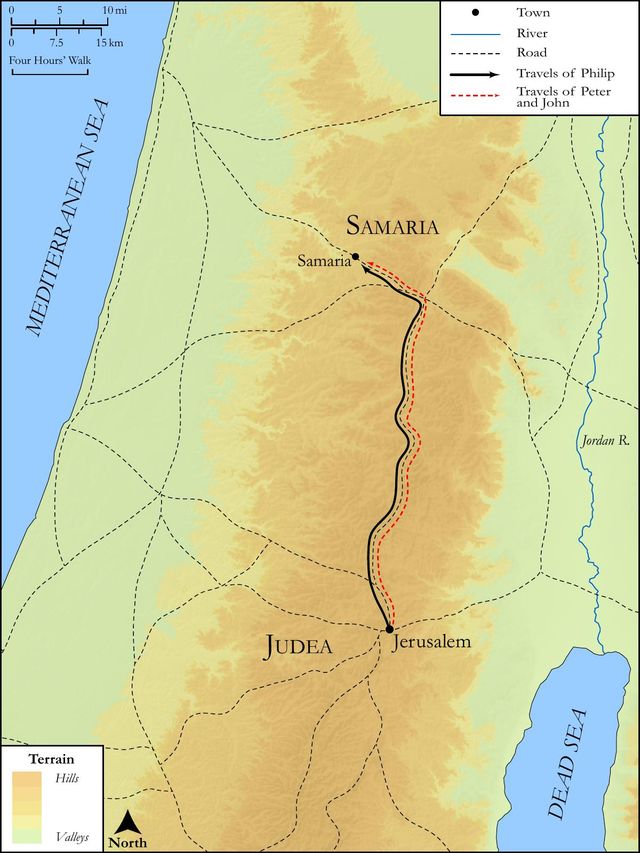
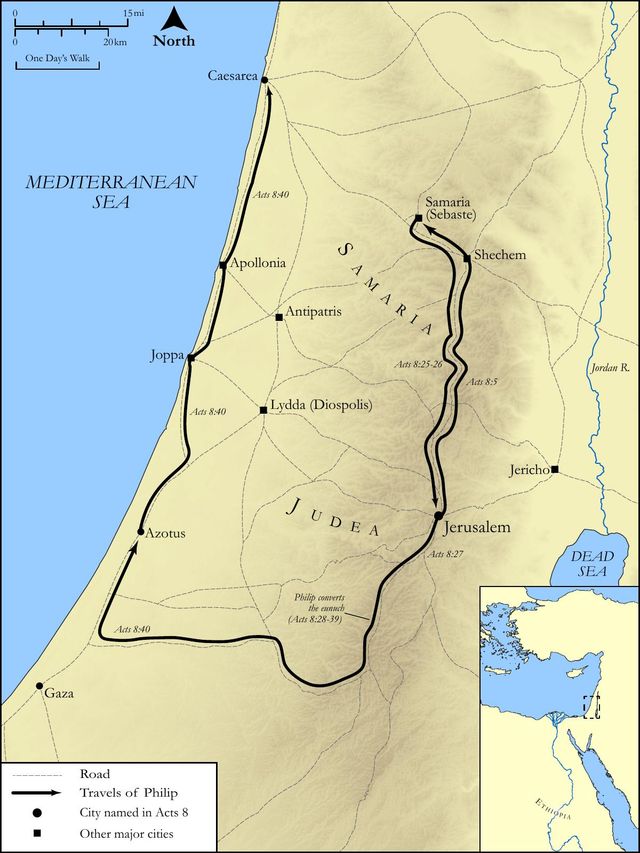
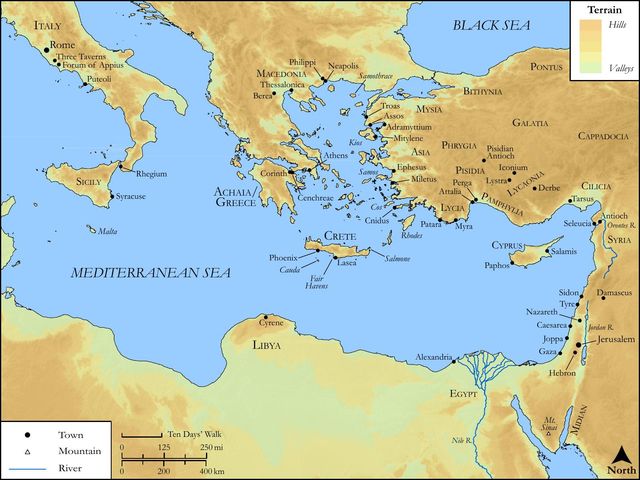
Study this verse
Public-domain commentary
Matthew Henry
From his Commentary on the Whole Bible. Henry comments on passages, not single verses — this entry covers Acts 8:14–25. His four-level outline is real structure in the source text, so it is rendered as structure.
God had wonderfully owned Philip in his work as an evangelist at Samaria, but he could do no more than an evangelist; there were some peculiar powers reserved to the apostles, for the keeping up of the dignity of their office, and here we have an account of what was done by two of them there - Peter and John. The twelve kept together at Jerusalem (Act 8:1), and thither these good tidings were brought them that Samaria had received the word of God (Act 8:14), that a great harvest of souls was gathered, and was likely to be gathered in to Christ there. The word of God was not only preached to them, but received by them; they bade it welcome, admitted the light of it, and submitted to the power of it: When they heard it, they sent unto them Peter and John. If Peter had been, as some say he was, the prince of the apostles, he would have sent some of them, or, if he had seen cause, would have gone himself of his own accord; but he was so far from this that he submitted to an order of the house, and, as a servant to the body, went whither they sent him. Two apostles were sent, the two most eminent, to Samaria, 1. To encourage Philip, to assist him, and strengthen his hands. Ministers in a higher station, and that excel in gifts and graces, should contrive how they may be helpful to those in a lower sphere, and contribute to their comfort and usefulness. 2. To carry on the good work that was begun among the people, and, with those heavenly graces that had enriched them, to confer upon them spiritual gifts. Now observe,
I.How they advanced and improved those of them that were sincere.
It is said (Act 8:16), The Holy Ghost was as yet fallen upon none of them, in those extraordinary powers which were conveyed by the descent of the Spirit upon the day of pentecost. They were none of them endued with the gift of tongues, which seems then to have been the most usual immediate effect of the pouring out of the Spirit. See Act 10:45, Act 10:46. This was both an eminent sign to those that believed not, and of excellent service to those that did. This, and other such gifts, they had not, only they were baptized in the name of the Lord Jesus, and so engaged in him and interested in him, which was necessary to salvation, and in this they had joy and satisfaction (Act 10:8), though they could not speak with tongues. Those that are indeed given up to Christ, and have experienced the sanctifying influences and operations of the Spirit of grace, have great reason to be thankful, and no reason to complain, though they have not those gifts that are for ornament, and would make them bright. But it is intended that they should go on to the perfection of the present dispensation, for the greater honour of the gospel. We have reason to think that Philip had received these gifts of the Holy Ghost himself, but had not a power to confer them; the apostles must come to do this; and they did it not upon all that were baptized, but upon some of them, and, it should seem, such as were designed for some office in the church, or at least to be eminent active members of it; and upon some of them one gift of the Holy Ghost, and upon others another. See Co1 12:4, Co1 12:8; Co1 14:26. Now in order to this,
1.The apostles prayed for them, Act 8:15. The Spirit is given, not to ourselves only (Luk 11:13), but to others also, in answer to prayer: I will put my Spirit within you (Eze 36:27), but I will for this be enquired of, Act 8:37. We may take encouragement from this example in praying to God to give the renewing graces of the Holy Ghost to those whose spiritual welfare we are concerned for - for our children, for our friends, for our ministers. We should pray, and pray earnestly, that they may receive the Holy Ghost; for this includes all blessings.
2.They laid their hands on them, to signify that their prayers were answered, and that the gift of the Holy Ghost was conferred upon them; for, upon the use of this sign, they received the Holy Ghost, and spoke with tongues. The laying on of hands was anciently used in blessing, by those who blessed with authority. Thus the apostles blessed these new converts, ordained some to be ministers, and confirmed others in their Christianity. We cannot now, nor can any, thus give the Holy Ghost by the laying on of hands; but this may intimate to us that those whom we pray for we should use our endeavours with.
II.How they discovered and discarded him that was a hypocrite among them, and this was Simon Magus; for they knew how to separate between the precious and the vile. Now observe here,
1.The wicked proposal that Simon made, by which his hypocrisy was discovered (Act 8:18, Act 8:19): When he saw that through laying on of the apostles' hands the Holy Ghost was given (which should have confirmed his faith in the doctrine of Christ, and increased his veneration for the apostles). it gave him a notion of Christianity as no other than an exalted piece of sorcery, in which he thought himself capable of being equal to the apostles, and therefore offered them money, saying, Give me also this power. He does not desire them to lay their hands on him, that he might receive the Holy Ghost himself (for he did not foresee that any thing was to be got by that), but that they would convey to him a power to bestow the gift upon others. He was ambitious to have the honour of an apostle, but not at all solicitous to have the spirit and disposition of a Christian. He was more desirous to gain honour to himself than to do good to others. Now, in making this motion, (1.) He put a great affront upon the apostles, as if they were mercenary men, would do any thing for money, and loved it as well as he did; whereas they had left what they had, for Christ, so far were they from aiming to make it more - (2.) He put a great affront upon Christianity, as if the miracles that were wrought for the proof of it were done by magic arts, only of a different nature from what he himself had practised formerly. (3.) He showed that, like Balaam, he aimed at the rewards of divination; for he would not have offered money for this power if he had not hoped to get money by it. (4.) He showed that he had a very high conceit of himself, and that he had never his heart truly humbled. Such a wretch as he had been before his baptism should have asked, like the prodigal, to be made as one of the hired servants. But, as soon as he is admitted into the family, no less a place will serve him than to be one of the stewards of the household, and to be entrusted with a power which Philip himself had not, but the apostles only.
2.The just rejection of his proposal, and the cutting reproof Peter gave him for it, Act 8:20-23.
(1.)Peter shows him his crime (Act 8:20): Thou hast thought that the gift of God may be purchased with money; and thus,
[1.]He had overvalued the wealth of this world, as if it were an equivalent for any thing, and as if, because, as Solomon saith, it answers all things, relating to the life that now is, it would answer all things relating to the other life, and would purchase the pardon of sin, the gift of the Holy Ghost, and eternal life.
[2.]He had undervalued the gift of the Holy Ghost and put it upon a level with the common gifts of nature and providence. He thought the power of an apostle might as well be had for a good fee as the advice of a physician or a lawyer, which was the greatest despite that could be done to the Spirit of grace. All the buying and selling of pardons and indulgences in the church of Rome is the product of this same wicked thought, that the gift of God may be purchased with money, when the offer of divine grace so expressly runs, without money and without price.
(2.)He shows him his character, which is inferred from his crime. From every thing that a man says or does amiss we cannot infer that he is a hypocrite in the profession he makes of religion; but this of Simon's was such a fundamental error as could by no means consist with a state of grace; his offering money (and that got by sorcery too) was an incontestable evidence that he was yet under the power of a worldly and carnal mind, and was yet that natural man which receiveth not the things of the Spirit of God, neither can he know them. And therefore Peter tells him plainly,
[1.]That his heart was not right in the sight of God, Act 8:21. "Though thou professest to believe, and art baptized, yet thou art not sincere." We are as our hearts are; if they be not right, we are wrong; and they are open in the sight of God, who knows them, judges them, and judges of us by them. Our hearts are that which they are in the sight of God, who cannot be deceived; and if they be not right in his sight, whatever our pretensions be, our religion is vain, and will stand us in no stead: our great concern is to approve ourselves to him in our integrity, for otherwise we cheat ourselves into our own ruin. Some refer this particularly to the proposal he made; what he asked is denied him, because his heart is not right in the sight of God in asking it. He does not aim at the glory of God nor the honour of Christ in it, but to make a hand of it for himself; he asks, and has not, because he asks amiss, that he may consume it upon his lusts, and be still thought some great one.
[2.]That he is in the gall of bitterness, and in the bond of iniquity: I perceive that thou art so, Act 8:23. This is plain dealing, and plain dealing is best when we are dealing about souls and eternity. Simon had got a great name among the people, and of late a good name too among God's people, and yet Peter here gives him a black character. Note, It is possible for a man to continue under the power of sin, and yet to put on a form of godliness. I perceive it, saith Peter. It was not so much by the spirit of discerning, with which Peter was endued, that he perceived this, as by Simon's discovery of it in the proposal he made. Note, The disguises of hypocrites many times are soon seen through; the nature of the wolf shows itself notwithstanding the cover of the sheep's clothing. Now the character here given of Simon is really the character of all wicked people. First, They are in the gall of bitterness - odious to God, as that which is bitter as gall is to us. Sin is an abominable thing, which the Lord hates, and sinners are by it made abominable to him; they are vicious in their own nature. Indwelling sin is a root of bitterness, that bears gall and wormwood, Deu 29:18. The faculties are corrupted, and the mind embittered against all good, Heb 12:15. It intimates likewise the pernicious consequences of sin; the end is bitter as wormwood. Secondly, They are in the bond of iniquity - bound over to the judgment of God by the guilt of sin, and bound under the dominion of Satan by the power of sin; led captive by him at his will, and it is a sore bondage, like that in Egypt, making the life bitter.
(3.)He reads him his doom in two things -
[1.]He shall sink with his worldly wealth, which he overvalued: Thy money perish with thee. First, Hereby Peter rejects his offer with the utmost disdain and indignation: "Dost thou think thou canst bribe us to betray our trust, and to put the power we are entrusted with into such unworthy hands? Away with thee and thy money too; we will have nothing to do with either. Get thee behind me, Satan." When we are tempted with money to do an evil thing, we should see what a perishing thing money is, and scorn to be biassed by it - It is the character of the upright man that he shakes his hands from holding, from touching bribes, Isa 33:15. Secondly, He warns him of his danger of utter destruction if he continued in this mind: "Thy money will perish and thou wilt lose it, and all that thou canst purchase with it. As meats for the belly and the belly for meats (Co1 6:13), so goods for money and money for goods, but God shall destroy both it and them - they perish in the using; but this is not the worst of it: thou wilt perish with it, and it with thee; and it will be an aggravation of thy ruin, and a heavy load upon thy perishing soul, that thou hadst money, which might have been made to turn to a good account (Luk 16:9), which might have been laid at the apostles' feet, as a charity, and would have been accepted, but was thrust into their hands as a bribe, and was rejected. Son, remember this."
[2.]He shall come short of the spiritual blessings which he undervalued (Act 8:21): "Thou hast neither part nor lot in this matter; thou hast nothing to do with the gifts of the Holy Ghost, thou dost not understand them, thou art excluded from them, hast put a bar in thine own door; thou canst not receive the Holy Ghost thyself, nor power to confer the Holy Ghost upon others, for thy heart is not right in the sight of God, if thou thinkest that Christianity is a trade to live by in this world, and therefore thou hast no part nor lot in the eternal life in the other world which the gospel offers." Note, First, There are many who profess the Christian religion, and yet have no part nor lot in the matter, no part in Christ (Joh 13:8), no lot in the heavenly Canaan. Secondly, They are those whose hearts are not right in the sight of God, are not animated by a right spirit, nor guided by a right rule, nor directed to the right end.
(4.)He gives him good counsel, notwithstanding, Act 8:22. Though he was angry with him, yet he did not abandon him; and, though he would have him see his case to be very bad, yet he would not have him think it desperate; yet now there is hope in Israel. Observe,
[1.]What it is that he advises him to: He must do his first works. First, He must repent, - must see his error and retract it - must change his mind and way - must be humbled and ashamed for what he has done. His repentance must be particular: "Repent of this, own thyself guilty in this, and be sorry for it." He must lay a load upon himself for it, must not extenuate it, by calling it a mistake, or misguided zeal, but must aggravate it by calling it wickedness, his wickedness, the fruit of his own corruption. Those that have said and done amiss must, as far as they can, unsay it and undo it again by repentance. Secondly, He must pray to God, must pray that God would give him repentance, and pardon upon repentance. Penitents must pray, which implies a desire towards God, and a confidence in Christ. Simon Magus, as great a man as he thinks himself, shall not be courted into the apostles' communion (how much soever some would think it a reputation to them) upon any other terms than those upon which other sinners are admitted - repentance and prayer.
[2.]What encouragement he gives him to do this: If perhaps the thought of thy heart, this wicked thought of thine, may be forgiven thee. Note, First, There may be a great deal of wickedness in the thought of the heart, its false notions, and corrupt affections, and wicked projects, which must be repented of, or we are undone. Secondly, The thought of the heart, though ever so wicked, shall be forgiven, upon our repentance, and not laid to our charge. When Peter here puts a perhaps upon it, the doubt is of the sincerity of his repentance, not of his pardon if his repentance be sincere. If indeed the thought of thy heart may be forgiven, so it may be read. Or it intimates that the greatness of his sin might justly make the pardon doubtful, though the promise of the gospel had put the matter out of doubt, in case he did truly repent: like that (Lam 3:29), If so be there may be hope.
[3.]Simon's request to them to pray for him, Act 8:24. He was startled and put into confusion by that which Peter said, finding that resented thus which he thought would have been embraced with both arms; and he cries out, Pray you to the Lord for me, that none of the things which you have spoken come upon me. Here was, First, Something well - that he was affected with the reproof given him, and terrified by the character given of him, enough to make the stoutest heart to tremble; and, this being so, he begged the prayers of the apostles for him, wishing to have an interest in them, who, he believed, had a good interest in heaven. Secondly, Something wanting. He begged of them to pray for him, but did not pray for himself, as he ought to have done; and, in desiring them to pray for him, his concern is more that the judgments he had made himself liable to might be prevented than that his corruptions might be mortified, and his heart, by divine grace, be made right in the sight of God; like Pharaoh, who would have Moses entreat the Lord for him, that he would take away this death only, not that he would take away this sin, this hardness of heart, Exo 8:8; Exo 10:17. Some think that Peter had denounced some particular judgments against him, as against Ananias and Sapphira, which, upon this submission of his, at the apostle's intercession, were prevented; or, from what is related, he might infer that some token of God's wrath would fall upon him, which he thus dreaded and deprecated.
Lastly, Here is the return of the apostles to Jerusalem, when they had finished the business they came about; for as yet they were not to disperse; but, though they came hither to do that work which was peculiar to them as apostles, yet, opportunity offering itself, they applied themselves to that which was common to all gospel ministers. 1. There, in the city of Samaria, they were preachers: They testified the word of the Lord, solemnly attested the truth of the gospel, and confirmed what the other ministers preached. They did not pretend to bring them any thing new, though they were apostles, but bore their testimony to the word of the Lord as they had received it. 2. In their road home they were itinerant preachers; as they passed through many villages of the Samaritans they preached the gospel. Though the congregations there were not so considerable as those in the cities, either for number or figure, yet their souls were as precious, and the apostles did not think it below them to preach the gospel to them. God has a regard to the inhabitants of his villages in Israel (Jdg 5:11), and so should we.
Historical interpretation
Historical reception
2 surviving comments on this verse. Each one is dated, so this reads as a timeline rather than a list.
"And preached the Gospel in many villages of the Samaritans." Observe them again, how they do not of set purpose come to Samaria, but driven by stress of persecution, just as it was in the case of Christ; and how when the Apostles go thither, it is to men now believers, no longer Samaritans. "But when the Apostles," it says, "which were at Jerusalem heard this, they sent unto them Peter and John." "Sent" them, again, to rid them of magic. And besides, the Lord had given them a pattern at the time when the Samaritans believed. "And in many villages," it says, "of the Samaritans, they preached the Gospel." Observe how actively employed even their journeys were, how they do nothing without a purpose.
"And they, when they had testified, and preached the word of the Lord, returned to Jerusalem." "Testified," probably because of him (Simon), that they may not be deceived; that thenceforth they may be safe. "Having preached," it says, "the word of the Lord, they returned to Jerusalem." Why do they go thither again where was the tyranny of the bad, where were those most bent upon killing them? Just as generals do in wars, they occupy that part of the scene of war which is most distressed.
Continue studying Acts 8:25 across the web’s major study libraries — every link below opens this exact verse, chapter, or book on the destination site.
Read & Compare
 BibleGatewayThis verse in more than 200 translations and 70 languages.
 Bible.comThe YouVersion reader — hundreds of translations, reading plans, and highlights.
 ESV.orgCrossway's official English Standard Version reader.
 NET BibleThe NET translation with 60,000+ translators' notes on every rendering decision.
 STEP BibleTyndale House's free study tool — original text, vocabulary, and scholarly resources.
 BibliaLogos Bible Software's free web reader.
 USCCBThe New American Bible (Revised Edition) with the U.S. bishops' study notes.
Commentaries
 BibleHub CommentariesDozens of classic commentaries on this verse, gathered on one page.
 StudyLightMore than 100 commentary sets — the largest collection on the web.
 BibleRefPlain-English commentary on what this verse means, verse by verse.
 Enduring WordDavid Guzik's free commentary on this chapter, widely used by Bible teachers.
 Bible Study ToolsVerse commentary alongside Greek and Hebrew study aids.
Original Language & Research
- BibleHub InterlinearThe verse word by word — original language, transliteration, and English.
- BibleHub LexiconEvery word's original-language definition and Strong's entry.
 Blue Letter BibleDeep-study tools — Strong's numbers, concordance, and word studies.
 CNTR CollationThe earliest Greek manuscripts of this verse, collated letter by letter.
Sermons, Hymns & Audio


TrulyRandomVerse is not affiliated with these sites and doesn’t control their content. They’re linked because they’re genuinely useful.
Summary
Acts 8:25 encapsulates a pivotal moment in the early Christian mission, depicting the return journey of Peter and John from Samaria to Jerusalem. This verse highlights their continued commitment to evangelism, as they actively proclaimed the gospel message not only in the Samaritan capital but also in numerous surrounding villages, thereby extending the reach of the nascent church beyond established Jewish-Samaritan divides and demonstrating the unstoppable momentum of God's word.
Context
ShowHideLiterary Context
This verse immediately follows the significant events in Samaria, where Philip's evangelistic efforts had led to many Samaritans believing and being baptized. Recognizing the need for apostolic confirmation and the impartation of the Holy Spirit, the apostles in Jerusalem dispatched Peter and John to Samaria. Their visit confirmed the authenticity of the Samaritan conversions, witnessed the outpouring of the Spirit through their laying on of hands, and included the dramatic confrontation with Simon the sorcerer, who attempted to purchase the power of the Holy Spirit. Having successfully completed their mission of consolidation and spiritual empowerment, Acts 8:25 marks their departure from Samaria, but not their cessation of ministry, as they continued to preach on their way back to the spiritual center of Jerusalem.
Historical & Cultural Context
The historical backdrop of Jewish-Samaritan relations was one of deep-seated animosity, rooted in centuries of religious and ethnic separation. Samaritans were considered a mixed race, practicing a form of Judaism centered on Mount Gerizim rather than Jerusalem, and were often despised by orthodox Jews. For Jewish apostles like Peter and John to not only minister in Samaria but to actively engage in evangelism in its "many villages" was a radical departure from conventional practice and a profound testament to the inclusive nature of the gospel. This action directly challenged entrenched prejudices and foreshadowed the broader Gentile mission, illustrating the gospel's power to transcend traditional barriers and forge a new community in Christ.
Key Themes
ShowHideActs 8:25 powerfully contributes to several overarching themes within the book of Acts. Foremost is the Expansion of the Gospel, fulfilling Jesus' commission in Acts 1:8, which mandated witness in Jerusalem, Judea, Samaria, and to the ends of the earth. This verse specifically details the "Samaria" phase of that mission, showing the gospel's deliberate spread into previously unreached or hostile territories. Another key theme is Apostolic Authority and Confirmation, as Peter and John's presence validated the Samaritan believers and ensured the unity of the church, bridging the gap between Jewish and Samaritan converts. Finally, the verse underscores the Centrality of Proclamation and Witness, highlighting that the spread of Christianity was fundamentally driven by the verbal declaration of "the word of the Lord" and "the gospel," emphasizing the active role of believers in sharing the good news.
Exposition and Analysis
ShowHideKey Word Analysis
ShowHideFrom διά ("through," "thoroughly") and μαρτυρέω ("to bear witness"), this verb signifies an earnest, solemn, and thorough declaration. It implies not just reporting facts but bearing witness with conviction, often with a sense of urgency or even warning. In this context, it underscores the apostles' profound commitment and the weighty nature of their message, delivered with divine authority.
Derived from εὖ ("good") and ἄγγελος ("messenger"), this verb literally means "to announce good news" or "to evangelize." It specifically refers to the proclamation of the good news of salvation through Jesus Christ. Its use here emphasizes that the core content of their preaching was the saving message of the gospel, contrasting with general speaking or teaching.
From λέγω ("to speak"), this term refers to something said, a message, or a discourse. In the phrase "the word of the Lord," it denotes the authoritative, divine message originating from God Himself. This highlights that the apostles were not speaking their own opinions but faithfully delivering God's revealed truth, which carried inherent power and authority.
Verse Breakdown
ShowHide"And they, when they had testified and preached the word of the Lord"
This opening clause identifies Peter and John ("they") and summarizes their completed primary mission in Samaria. The dual verbs "testified" (diamartýromai) and "preached" (laléō) emphasize the comprehensive nature of their ministry – a solemn, authoritative witness combined with verbal proclamation of God's message. This signifies their faithful execution of their apostolic duties in Samaria.
"returned to Jerusalem"
This phrase indicates their intended destination, the central hub of the early church, from which they had been sent. Their return signifies accountability to the broader apostolic leadership and the ongoing unity of the church's mission, with Jerusalem serving as a key strategic base.
"and preached the gospel in many villages of the Samaritans"
This final, crucial clause reveals that their return journey was not merely travel but a continuation of their evangelistic efforts. The mention of "many villages" underscores the extensive and intentional nature of their outreach, moving beyond the main city of Samaria into the surrounding rural areas. This demonstrates the gospel's pervasive spread and the apostles' commitment to reaching all people groups, further dismantling the historical animosity between Jews and Samaritans.
Literary Devices
ShowHideLuke employs several literary devices in Acts 8:25 to convey its significance. Narrative Progression is evident as the verse marks a transition from the specific, focused mission in Samaria (Acts 8:14-24) to a broader, ongoing evangelistic movement. It demonstrates that the work of the apostles was not confined to a single location but was dynamic and expansive. The Repetition of the concept of "preaching" ("preached the word of the Lord" and "preached the gospel") serves to emphasize the central and continuous nature of verbal proclamation in the spread of Christianity. This highlights that the core activity of the apostles was the declaration of God's message. Furthermore, Geographical Expansion is a key device, as the mention of "many villages of the Samaritans" illustrates the deliberate and strategic spread of the gospel beyond urban centers into the surrounding regions, fulfilling the missional mandate of Acts 1:8.
Theological and Thematic Connections
ShowHideActs 8:25 is a powerful testament to the unstoppable nature of God's redemptive plan and the Spirit-empowered mission of the early church. It demonstrates that the gospel is not confined by human prejudice, geographical boundaries, or cultural animosity. The apostles, having confirmed the work in Samaria, did not simply retreat but actively sought out new opportunities to share the good news, embodying the proactive and expansive heart of God for all humanity. This verse underscores the divine imperative for the gospel to permeate every segment of society, breaking down walls of division and inviting all into the family of God. It highlights the continuity of the apostolic ministry, where every journey became an opportunity for evangelism, reflecting a deep commitment to the Great Commission.
Reflection and Application
ShowHideActs 8:25 offers profound insights for contemporary believers, urging us to embrace a holistic and unceasing commitment to the gospel message. Just as Peter and John did not limit their ministry to a single location but seized every opportunity to proclaim the "word of the Lord" on their journey, so too are we called to integrate evangelism into the fabric of our daily lives. This verse challenges us to look beyond our comfort zones and cultural biases, actively seeking out "villages"—whether literal or metaphorical—where the gospel has not been fully heard or embraced. It reminds us that every interaction, every journey, every relationship can be a platform for bearing witness to the transformative power of Jesus Christ, demonstrating that the mission of God is not merely an event but a continuous lifestyle of proclamation and service.
Questions for Reflection
ShowHideFAQ
ShowHideWhat is the significance of Peter and John going to "many villages of the Samaritans" instead of just returning directly to Jerusalem?
ShowHideThe significance lies in the deliberate and expansive nature of their ministry. Instead of merely completing their primary mission in Samaria and heading straight back to Jerusalem, Peter and John intentionally continued to evangelize in the surrounding Samaritan villages. This demonstrates the early church's commitment to fulfilling Jesus' command to be witnesses in "Samaria" in its fullest sense, not just the capital city. It highlights their proactive approach to spreading the gospel, breaking down centuries of Jewish-Samaritan animosity, and showing that the good news was for all people, regardless of their ethnic or religious background. This action underscores the pervasive and uncontainable nature of the Holy Spirit's work in expanding the church's reach.
How does Acts 8:25 relate to the Great Commission?
ShowHideActs 8:25 is a direct fulfillment and vivid illustration of the Great Commission given by Jesus in Acts 1:8. Jesus commanded His disciples to be His witnesses in Jerusalem, Judea, Samaria, and to the ends of the earth. Philip's ministry initiated the gospel's spread into Samaria, and Peter and John's subsequent actions in Acts 8:25, where they "preached the gospel in many villages of the Samaritans," concretely demonstrate the church's obedience to this mandate. It shows the gospel moving beyond its Jewish origins into a historically hostile, yet divinely appointed, region, paving the way for its ultimate global expansion.
Christ-Centered Fulfillment
ShowHideActs 8:25, though focusing on the apostles' ministry, profoundly points to Christ as the ultimate subject and power of their proclamation. The "word of the Lord" they testified and preached was ultimately the message concerning Jesus Christ—His life, death, resurrection, and ascension. Their actions in Samaria, breaking down ethnic barriers and extending salvation to a traditionally despised people, perfectly embody the reconciling work of Christ, who "broke down the dividing wall of hostility" between Jew and Gentile. The "gospel" they preached in the Samaritan villages was the good news of salvation found exclusively in Jesus, the Lamb of God who takes away the sin of the world. Their willingness to endure hardship and prejudice for the sake of the gospel mirrors Christ's own self-sacrificial mission, who "came not to be served but to serve" and to seek and save the lost. Thus, Acts 8:25 is not merely a historical account of apostolic zeal, but a vibrant testament to the ongoing, transformative power of Christ's finished work, manifested through His Spirit in His church, drawing all peoples to Himself.