


Acts 8:14
Bible text: King James Version (1769 Blayney text) · Public domain
Bible text: King James Version with Strong's numbers · Public domain
Bible text: Berean Standard Bible · Public domain
Bible text: American Standard Version (1901) · Public domain
Bible text: World English Bible, Messianic edition · Public domain
Bible text: Geneva Bible (1599) · Public domain
Bible text: Young's Literal Translation · Public domain
- ἈκούσαντεςAkousantesHaving heardG191V-AAP-NPMVerb Aorist Active Participle Nominative Plural Masculine
- δὲdenowG1161CONJConjunction
- οἱhoitheG3588T-NPMDefinite article Nominative Plural Masculine
- ἐνeninG1722PREPPreposition
- ἹεροσολύμοιςHi'erosolumoisJerusalemG2414N-DPN-LNoun Dative Plural Neuter Location
- ἀπόστολοιapostoloiapostlesG652N-NPMNoun Nominative Plural Masculine
- ὅτιhotithatG3754CONJConjunction
- δέδεκταιdedektaihas receivedG1209V-RNI-3SVerb Perfect Middle Or Passive Deponent Indicative 3rd Singular
- ἡhē<the>G3588T-NSFDefinite article Nominative Singular Feminine
- ΣαμάρειαSamareiaSamariaG4540N-NSF-LNoun Nominative Singular Feminine Location
- τὸνtontheG3588T-ASMDefinite article Accusative Singular Masculine
- λόγονlogonwordG3056N-ASMNoun Accusative Singular Masculine
- τοῦtou<the>G3588T-GSMDefinite article Genitive Singular Masculine
- θεοῦtheouof GodG2316N-GSM-TNoun Genitive Singular Masculine Title
- ἀπέστειλανapesteilanthey sentG649V-AAI-3PVerb Aorist Active Indicative 3rd Plural
- πρὸςprostoG4314PREPPreposition
- αὐτοὺςautousthemG846P-APMPersonal pronoun Accusative Plural Masculine
- τὸνton<the>G3588T-ASMDefinite article Accusative Singular Masculine
- ΠέτρονPetronPeterG4074N-ASM-PNoun Accusative Singular Masculine Individual
- καὶkaiandG2532CONJConjunction
- Ἰωάννην·IōannēnJohnG2491N-ASM-PNoun Accusative Singular Masculine Individual
English is a literal word-by-word gloss of the Greek, not the KJV's wording. Why?
This is the original text the KJV's translators worked from — each Greek word with its own literal English meaning in this verse, prepared by scholars at Tyndale House, Cambridge. The KJV translates whole sentences, not word by word, so its wording differs: one Greek word can become several English words, and the KJV may choose “charity” where the gloss reads “love”. Both are faithful — they answer different questions. For the KJV's own rendering, switch to the KJV text.
Details
See on the biblical-era maps
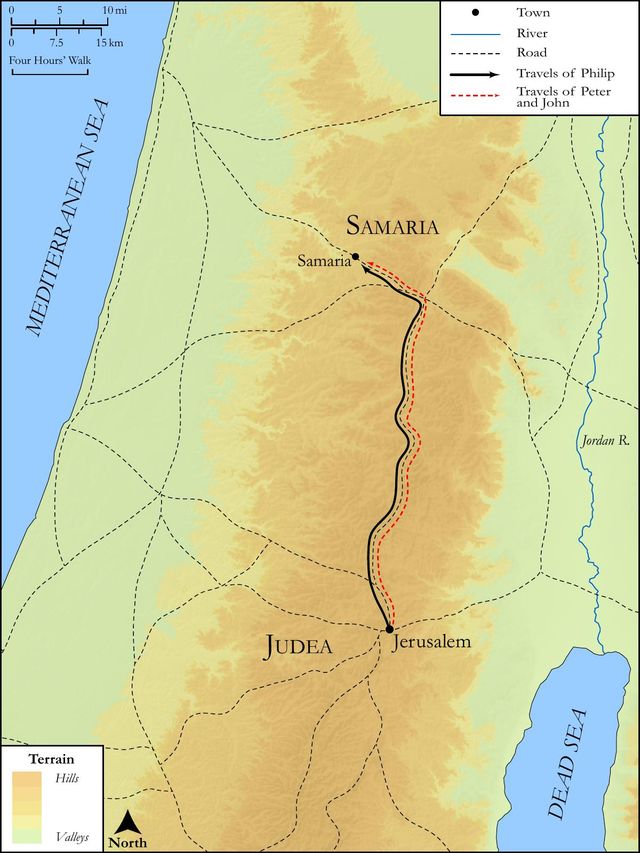
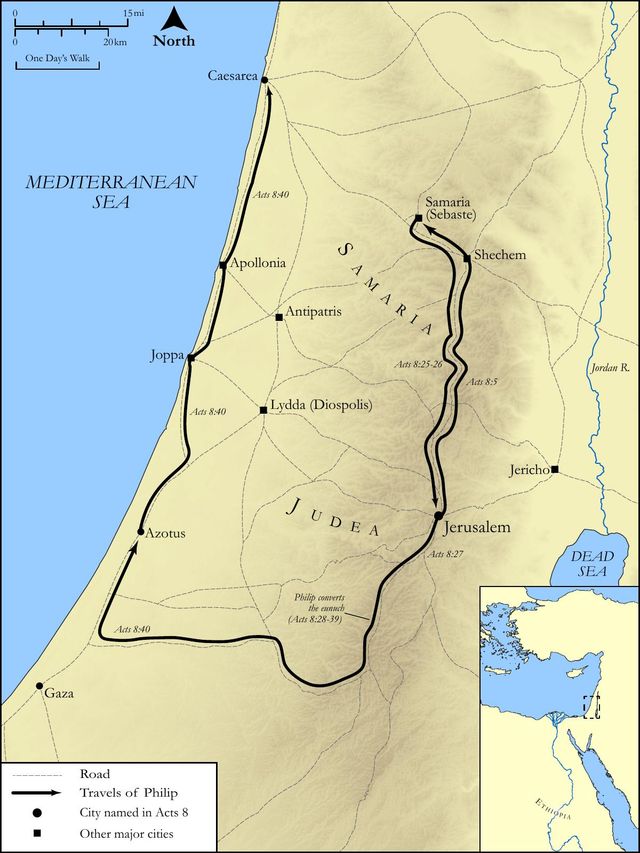
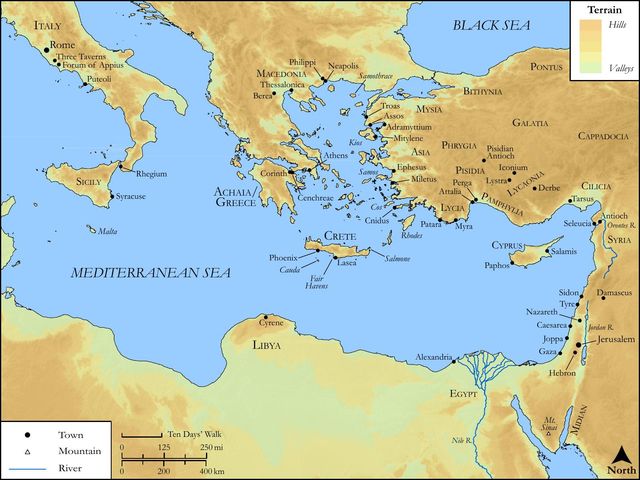
Study this verse
Public-domain commentary
Matthew Henry
From his Commentary on the Whole Bible. Henry comments on passages, not single verses — this entry covers Acts 8:14–25. His four-level outline is real structure in the source text, so it is rendered as structure.
God had wonderfully owned Philip in his work as an evangelist at Samaria, but he could do no more than an evangelist; there were some peculiar powers reserved to the apostles, for the keeping up of the dignity of their office, and here we have an account of what was done by two of them there - Peter and John. The twelve kept together at Jerusalem (Act 8:1), and thither these good tidings were brought them that Samaria had received the word of God (Act 8:14), that a great harvest of souls was gathered, and was likely to be gathered in to Christ there. The word of God was not only preached to them, but received by them; they bade it welcome, admitted the light of it, and submitted to the power of it: When they heard it, they sent unto them Peter and John. If Peter had been, as some say he was, the prince of the apostles, he would have sent some of them, or, if he had seen cause, would have gone himself of his own accord; but he was so far from this that he submitted to an order of the house, and, as a servant to the body, went whither they sent him. Two apostles were sent, the two most eminent, to Samaria, 1. To encourage Philip, to assist him, and strengthen his hands. Ministers in a higher station, and that excel in gifts and graces, should contrive how they may be helpful to those in a lower sphere, and contribute to their comfort and usefulness. 2. To carry on the good work that was begun among the people, and, with those heavenly graces that had enriched them, to confer upon them spiritual gifts. Now observe,
I.How they advanced and improved those of them that were sincere.
It is said (Act 8:16), The Holy Ghost was as yet fallen upon none of them, in those extraordinary powers which were conveyed by the descent of the Spirit upon the day of pentecost. They were none of them endued with the gift of tongues, which seems then to have been the most usual immediate effect of the pouring out of the Spirit. See Act 10:45, Act 10:46. This was both an eminent sign to those that believed not, and of excellent service to those that did. This, and other such gifts, they had not, only they were baptized in the name of the Lord Jesus, and so engaged in him and interested in him, which was necessary to salvation, and in this they had joy and satisfaction (Act 10:8), though they could not speak with tongues. Those that are indeed given up to Christ, and have experienced the sanctifying influences and operations of the Spirit of grace, have great reason to be thankful, and no reason to complain, though they have not those gifts that are for ornament, and would make them bright. But it is intended that they should go on to the perfection of the present dispensation, for the greater honour of the gospel. We have reason to think that Philip had received these gifts of the Holy Ghost himself, but had not a power to confer them; the apostles must come to do this; and they did it not upon all that were baptized, but upon some of them, and, it should seem, such as were designed for some office in the church, or at least to be eminent active members of it; and upon some of them one gift of the Holy Ghost, and upon others another. See Co1 12:4, Co1 12:8; Co1 14:26. Now in order to this,
1.The apostles prayed for them, Act 8:15. The Spirit is given, not to ourselves only (Luk 11:13), but to others also, in answer to prayer: I will put my Spirit within you (Eze 36:27), but I will for this be enquired of, Act 8:37. We may take encouragement from this example in praying to God to give the renewing graces of the Holy Ghost to those whose spiritual welfare we are concerned for - for our children, for our friends, for our ministers. We should pray, and pray earnestly, that they may receive the Holy Ghost; for this includes all blessings.
2.They laid their hands on them, to signify that their prayers were answered, and that the gift of the Holy Ghost was conferred upon them; for, upon the use of this sign, they received the Holy Ghost, and spoke with tongues. The laying on of hands was anciently used in blessing, by those who blessed with authority. Thus the apostles blessed these new converts, ordained some to be ministers, and confirmed others in their Christianity. We cannot now, nor can any, thus give the Holy Ghost by the laying on of hands; but this may intimate to us that those whom we pray for we should use our endeavours with.
II.How they discovered and discarded him that was a hypocrite among them, and this was Simon Magus; for they knew how to separate between the precious and the vile. Now observe here,
1.The wicked proposal that Simon made, by which his hypocrisy was discovered (Act 8:18, Act 8:19): When he saw that through laying on of the apostles' hands the Holy Ghost was given (which should have confirmed his faith in the doctrine of Christ, and increased his veneration for the apostles). it gave him a notion of Christianity as no other than an exalted piece of sorcery, in which he thought himself capable of being equal to the apostles, and therefore offered them money, saying, Give me also this power. He does not desire them to lay their hands on him, that he might receive the Holy Ghost himself (for he did not foresee that any thing was to be got by that), but that they would convey to him a power to bestow the gift upon others. He was ambitious to have the honour of an apostle, but not at all solicitous to have the spirit and disposition of a Christian. He was more desirous to gain honour to himself than to do good to others. Now, in making this motion, (1.) He put a great affront upon the apostles, as if they were mercenary men, would do any thing for money, and loved it as well as he did; whereas they had left what they had, for Christ, so far were they from aiming to make it more - (2.) He put a great affront upon Christianity, as if the miracles that were wrought for the proof of it were done by magic arts, only of a different nature from what he himself had practised formerly. (3.) He showed that, like Balaam, he aimed at the rewards of divination; for he would not have offered money for this power if he had not hoped to get money by it. (4.) He showed that he had a very high conceit of himself, and that he had never his heart truly humbled. Such a wretch as he had been before his baptism should have asked, like the prodigal, to be made as one of the hired servants. But, as soon as he is admitted into the family, no less a place will serve him than to be one of the stewards of the household, and to be entrusted with a power which Philip himself had not, but the apostles only.
2.The just rejection of his proposal, and the cutting reproof Peter gave him for it, Act 8:20-23.
(1.)Peter shows him his crime (Act 8:20): Thou hast thought that the gift of God may be purchased with money; and thus,
[1.]He had overvalued the wealth of this world, as if it were an equivalent for any thing, and as if, because, as Solomon saith, it answers all things, relating to the life that now is, it would answer all things relating to the other life, and would purchase the pardon of sin, the gift of the Holy Ghost, and eternal life.
[2.]He had undervalued the gift of the Holy Ghost and put it upon a level with the common gifts of nature and providence. He thought the power of an apostle might as well be had for a good fee as the advice of a physician or a lawyer, which was the greatest despite that could be done to the Spirit of grace. All the buying and selling of pardons and indulgences in the church of Rome is the product of this same wicked thought, that the gift of God may be purchased with money, when the offer of divine grace so expressly runs, without money and without price.
(2.)He shows him his character, which is inferred from his crime. From every thing that a man says or does amiss we cannot infer that he is a hypocrite in the profession he makes of religion; but this of Simon's was such a fundamental error as could by no means consist with a state of grace; his offering money (and that got by sorcery too) was an incontestable evidence that he was yet under the power of a worldly and carnal mind, and was yet that natural man which receiveth not the things of the Spirit of God, neither can he know them. And therefore Peter tells him plainly,
[1.]That his heart was not right in the sight of God, Act 8:21. "Though thou professest to believe, and art baptized, yet thou art not sincere." We are as our hearts are; if they be not right, we are wrong; and they are open in the sight of God, who knows them, judges them, and judges of us by them. Our hearts are that which they are in the sight of God, who cannot be deceived; and if they be not right in his sight, whatever our pretensions be, our religion is vain, and will stand us in no stead: our great concern is to approve ourselves to him in our integrity, for otherwise we cheat ourselves into our own ruin. Some refer this particularly to the proposal he made; what he asked is denied him, because his heart is not right in the sight of God in asking it. He does not aim at the glory of God nor the honour of Christ in it, but to make a hand of it for himself; he asks, and has not, because he asks amiss, that he may consume it upon his lusts, and be still thought some great one.
[2.]That he is in the gall of bitterness, and in the bond of iniquity: I perceive that thou art so, Act 8:23. This is plain dealing, and plain dealing is best when we are dealing about souls and eternity. Simon had got a great name among the people, and of late a good name too among God's people, and yet Peter here gives him a black character. Note, It is possible for a man to continue under the power of sin, and yet to put on a form of godliness. I perceive it, saith Peter. It was not so much by the spirit of discerning, with which Peter was endued, that he perceived this, as by Simon's discovery of it in the proposal he made. Note, The disguises of hypocrites many times are soon seen through; the nature of the wolf shows itself notwithstanding the cover of the sheep's clothing. Now the character here given of Simon is really the character of all wicked people. First, They are in the gall of bitterness - odious to God, as that which is bitter as gall is to us. Sin is an abominable thing, which the Lord hates, and sinners are by it made abominable to him; they are vicious in their own nature. Indwelling sin is a root of bitterness, that bears gall and wormwood, Deu 29:18. The faculties are corrupted, and the mind embittered against all good, Heb 12:15. It intimates likewise the pernicious consequences of sin; the end is bitter as wormwood. Secondly, They are in the bond of iniquity - bound over to the judgment of God by the guilt of sin, and bound under the dominion of Satan by the power of sin; led captive by him at his will, and it is a sore bondage, like that in Egypt, making the life bitter.
(3.)He reads him his doom in two things -
[1.]He shall sink with his worldly wealth, which he overvalued: Thy money perish with thee. First, Hereby Peter rejects his offer with the utmost disdain and indignation: "Dost thou think thou canst bribe us to betray our trust, and to put the power we are entrusted with into such unworthy hands? Away with thee and thy money too; we will have nothing to do with either. Get thee behind me, Satan." When we are tempted with money to do an evil thing, we should see what a perishing thing money is, and scorn to be biassed by it - It is the character of the upright man that he shakes his hands from holding, from touching bribes, Isa 33:15. Secondly, He warns him of his danger of utter destruction if he continued in this mind: "Thy money will perish and thou wilt lose it, and all that thou canst purchase with it. As meats for the belly and the belly for meats (Co1 6:13), so goods for money and money for goods, but God shall destroy both it and them - they perish in the using; but this is not the worst of it: thou wilt perish with it, and it with thee; and it will be an aggravation of thy ruin, and a heavy load upon thy perishing soul, that thou hadst money, which might have been made to turn to a good account (Luk 16:9), which might have been laid at the apostles' feet, as a charity, and would have been accepted, but was thrust into their hands as a bribe, and was rejected. Son, remember this."
[2.]He shall come short of the spiritual blessings which he undervalued (Act 8:21): "Thou hast neither part nor lot in this matter; thou hast nothing to do with the gifts of the Holy Ghost, thou dost not understand them, thou art excluded from them, hast put a bar in thine own door; thou canst not receive the Holy Ghost thyself, nor power to confer the Holy Ghost upon others, for thy heart is not right in the sight of God, if thou thinkest that Christianity is a trade to live by in this world, and therefore thou hast no part nor lot in the eternal life in the other world which the gospel offers." Note, First, There are many who profess the Christian religion, and yet have no part nor lot in the matter, no part in Christ (Joh 13:8), no lot in the heavenly Canaan. Secondly, They are those whose hearts are not right in the sight of God, are not animated by a right spirit, nor guided by a right rule, nor directed to the right end.
(4.)He gives him good counsel, notwithstanding, Act 8:22. Though he was angry with him, yet he did not abandon him; and, though he would have him see his case to be very bad, yet he would not have him think it desperate; yet now there is hope in Israel. Observe,
[1.]What it is that he advises him to: He must do his first works. First, He must repent, - must see his error and retract it - must change his mind and way - must be humbled and ashamed for what he has done. His repentance must be particular: "Repent of this, own thyself guilty in this, and be sorry for it." He must lay a load upon himself for it, must not extenuate it, by calling it a mistake, or misguided zeal, but must aggravate it by calling it wickedness, his wickedness, the fruit of his own corruption. Those that have said and done amiss must, as far as they can, unsay it and undo it again by repentance. Secondly, He must pray to God, must pray that God would give him repentance, and pardon upon repentance. Penitents must pray, which implies a desire towards God, and a confidence in Christ. Simon Magus, as great a man as he thinks himself, shall not be courted into the apostles' communion (how much soever some would think it a reputation to them) upon any other terms than those upon which other sinners are admitted - repentance and prayer.
[2.]What encouragement he gives him to do this: If perhaps the thought of thy heart, this wicked thought of thine, may be forgiven thee. Note, First, There may be a great deal of wickedness in the thought of the heart, its false notions, and corrupt affections, and wicked projects, which must be repented of, or we are undone. Secondly, The thought of the heart, though ever so wicked, shall be forgiven, upon our repentance, and not laid to our charge. When Peter here puts a perhaps upon it, the doubt is of the sincerity of his repentance, not of his pardon if his repentance be sincere. If indeed the thought of thy heart may be forgiven, so it may be read. Or it intimates that the greatness of his sin might justly make the pardon doubtful, though the promise of the gospel had put the matter out of doubt, in case he did truly repent: like that (Lam 3:29), If so be there may be hope.
[3.]Simon's request to them to pray for him, Act 8:24. He was startled and put into confusion by that which Peter said, finding that resented thus which he thought would have been embraced with both arms; and he cries out, Pray you to the Lord for me, that none of the things which you have spoken come upon me. Here was, First, Something well - that he was affected with the reproof given him, and terrified by the character given of him, enough to make the stoutest heart to tremble; and, this being so, he begged the prayers of the apostles for him, wishing to have an interest in them, who, he believed, had a good interest in heaven. Secondly, Something wanting. He begged of them to pray for him, but did not pray for himself, as he ought to have done; and, in desiring them to pray for him, his concern is more that the judgments he had made himself liable to might be prevented than that his corruptions might be mortified, and his heart, by divine grace, be made right in the sight of God; like Pharaoh, who would have Moses entreat the Lord for him, that he would take away this death only, not that he would take away this sin, this hardness of heart, Exo 8:8; Exo 10:17. Some think that Peter had denounced some particular judgments against him, as against Ananias and Sapphira, which, upon this submission of his, at the apostle's intercession, were prevented; or, from what is related, he might infer that some token of God's wrath would fall upon him, which he thus dreaded and deprecated.
Lastly, Here is the return of the apostles to Jerusalem, when they had finished the business they came about; for as yet they were not to disperse; but, though they came hither to do that work which was peculiar to them as apostles, yet, opportunity offering itself, they applied themselves to that which was common to all gospel ministers. 1. There, in the city of Samaria, they were preachers: They testified the word of the Lord, solemnly attested the truth of the gospel, and confirmed what the other ministers preached. They did not pretend to bring them any thing new, though they were apostles, but bore their testimony to the word of the Lord as they had received it. 2. In their road home they were itinerant preachers; as they passed through many villages of the Samaritans they preached the gospel. Though the congregations there were not so considerable as those in the cities, either for number or figure, yet their souls were as precious, and the apostles did not think it below them to preach the gospel to them. God has a regard to the inhabitants of his villages in Israel (Jdg 5:11), and so should we.
Historical interpretation
Six Centuries of Reception
11 surviving comments on this verse. Each one is dated, so this reads as a timeline rather than a list.
Select a marker to jump to its quote. Markers stagger vertically where authors wrote within a few decades of each other.
But the evil spirits were not satisfied with saying, before Christ's appearance, that those who were said to be sons of Jupiter were born of him; but after He had appeared, and been born among men, and when they learned how He had been foretold by the prophets, and knew that He should be believed on and looked for by every nation, they again, as was said above, put forward other men, the Samaritans Simon and Menander, who did many mighty works by magic, and deceived many, and still keep them deceived. For even among yourselves, as we said before, Simon was in the royal city Rome in the reign of Claudius Caesar, and so greatly astonished the sacred senate and people of the Romans, that he was considered a god, and honoured, like the others whom you honour as gods, with a statue. Wherefore we pray that the sacred senate and your people may, along with yourselves, be arbiters of this our memorial, in order that if any one be entangled by that man's doctrines, he may learn the truth, and so be able to escape error; and as for the statue, if you please, destroy it.
For I gave no thought to any of my people, that is, the Samaritans, when I had a communication in writing with Caesar, but stated that they were wrong in trusting to the magician Simon of their own nation, who, they say, is God above all power, and authority, and might.
And, thirdly, because after Christ's ascension into heaven the devils put forward certain men who said that they themselves were gods; and they were not only not persecuted by you, but even deemed worthy of honours. There was a Samaritan, Simon, a native of the village called Gitto, who in the reign of Claudius Caesar, and in your royal city of Rome, did mighty acts of magic, by virtue of the art of the devils operating in him. He was considered a god, and as a god was honoured by you with a statue, which statue was erected on the river Tiber, between the two bridges, and bore this inscription, in the language of Rome:-"Simoni Deo Sancto," "To Simon the holy God."And almost all the Samaritans, and a few even of other nations, worship him, and acknowledge him as the first god; and a woman, Helena, who went about with him at that time, and had formerly been a prostitute, they say is the first idea generated by him. And a man, Meander, also a Samaritan, of the town Capparetaea, a disciple of Simon, and inspired by devils, we know to have deceived many while he was in Antioch by his magical art. He persuaded those who adhered to him that they should never die, and even now there are some living who hold this opinion of his. And there is Marcion, a man of Pontus, who is even at this day alive, and teaching his disciples to believe in some other god greater than the Creator. And he, by the aid of the devils, has caused many of every nation to speak blasphemies, and to deny that God is the maker of this universe, and to assert that some other being, greater than He, has done greater works. All who take their opinions from these men, are, as we before said, called Christians; just as also those who do not agree with the philosophers in their doctrines, have yet in common with them the name of philosophers given to them. And whether they perpetrate those fabulous and shameful deeds-the upsetting of the lamp, and promiscuous intercourse, and eating human flesh-we know not; but we do know that they are neither persecuted nor put to death by you, at least on account of their opinions. But I have a treatise against all the heresies that have existed already composed, which, if you wish to read it, I will give you.
Now after a few days there was a great commotion in the midst of the church, for some said that they had seen wonderful works done by a certain man whose name was Simon, and that he was at Aricia, and they added further that he said he was a great power of God and without God he did nothing. Is not this the Christ? but we believe in him whom Paul preached unto us; for by him have we seen the dead raised, and men Delivered from divers infirmities: but this man seeketh contention, we know it (or, but what this contention is, we know not) for there is no small stir made among us. Perchance also he will now enter into Rome; for yesterday they besought him with great acclamations, saying unto him: Thou art God in Italy, thou art the saviour of the Romans: haste quickly unto Rome. But he spake to the people with a shrill voice, saying: Tomorrow about the seventh hour ye shall see me fly over the gate of the city in the form (habit) wherein ye now see me speaking unto you. Therefore, brethren, if it seem good unto you, let us go and await carefully the issue of the matter. They all therefore ran together and came unto the gate. And when it was the seventh hour, behold suddenly a dust was seen in the sky afar off, like a smoke shining with rays stretching far from it. And when he drew near to the gate, suddenly he was not seen: and thereafter he appeared, standing in the midst of the people; whom they all worshipped, and took knowledge that he was the same that was seen of them the day before.
And the brethren were not a little offended among themselves, seeing, moreover, that Paul was not at Rome, neither Timotheus nor Barnabas, for they had been sent into Macedonia by Paul, and that there was no man to comfort us, to speak nothing of them that had but just become catechumens. And as Simon exalted himself yet more by the works which he did, and many of them daily called Paul a sorcerer, and others a deceiver, of so great a multitude that had been stablished in the faith all fell away save Narcissus the presbyter and two women in the lodging of the Bithynians, and four that could no longer go out of their house, but were shut up (day and night): these gave themselves unto prayer (by day and night), beseeching the Lord that Paul might return quickly, or some other that should visit his servants, because the devil had made them fall by his wickedness.
And as they prayed and fasted, God was already teaching Peter at Jerusalem of that which should come to pass. For whereas the twelve years which the Lord Christ had enjoined upon him were fulfilled, he showed him a vision after this manner, saying unto him: Peter, that Simon the sorcerer whom thou didst cast out of Judaea, convicting him, hath again come before thee (prevented thee) at Rome. And that shalt thou know shortly (or, and that thou mayest know in few words): for all that did believe in me hath Satan made to fall by his craft and working: whose Power Simon approveth himself to be. But delay thee not: set forth on the morrow, and there shalt thou find a ship ready, setting sail for Italy, and within few days I will show thee my grace which hath in it no grudging. Peter then, admonished by the vision, related it unto the brethren without delay, saying: It is necessary for me to go up unto Rome to fight with the enemy and adversary of the Lord and of our brethren...
And the brethren repented and entreated Peter to fight against Simon: (who said that he was the power of God, and lodged in the house of Marcellus a senator, whom he had convinced by his charms)...
But the brethren besought Peter to join battle with Simon and not suffer him any longer to vex the people... And Peter turned unto the people that followed him and said: Ye shall now see a great and marvellous wonder. And Peter seeing a great dog bound with a strong chain, went to him and loosed him, and when he was loosed the dog received a man's voice and said unto Peter: What dost thou bid me to do, thou servant of the unspeakable and living God? Peter said unto him: Go in and say unto Simon in the midst of his company: Peter saith unto thee, Come forth abroad, for thy sake am I come to Rome, thou wicked one and deceiver of simple souls. And immediately the dog ran and entered in, and rushed into the midst of them that were with Simon, and lifted up his forefeet and in a loud voice said: Thou Simon, Peter the servant of Christ who standeth at the door saith unto thee: Come forth abroad, for thy sake am I come to Rome, thou most wicked one and deceiver of simple souls. And when Simon heard it, and beheld the incredible sight, he lost the words wherewith he was deceiving them that stood by, and all of them were amazed...
And Simon, shrewdly beaten and cast out of the house, ran unto the house where Peter lodged, even the house of Narcissus, and standing at the gate cried out: Lo, here am I, Simon: come thou down, Peter, and I will convict thee that thou hast believed on a man which is a Jew and a carpenter's son...
Now the brethren were gathered together, and all that were in Rome, and took places every one for a piece of gold: there came together also the senators and the prefects and those in authority. And Peter came and stood in the midst, and all cried out: Show us, O Peter, who is thy God and what is his greatness which hath given thee confidence. Begrudge not the Romans; they are lovers of the gods. We have had proof of Simon, let us have it of thee; convince us, both of you, whom we ought truly to believe. And as they said these things, Simon also came in, and standing in trouble of mind at Peter's side, at first he looked at him.
And after long silence Peter said: Ye men of Rome, be ye true judges unto us, for I say that I have believed on the living and true God; and I promise to give you proofs of him, which are known unto me, as many among you also can bear witness. For ye see that this man is now rebuked and silent, knowing that I drove him out of Judaea because of the deceits which he practised upon Eubula, an honourable and simple woman, by his art magic; and being driven out from thence, he is come hither, thinking to escape notice among you; and lo, he standeth face to face with me. Say now, Simon, didst thou not at Jerusalem fall at my feet and Paul's, when thou sawest the healings that were wrought by our hands, and say: I pray you take of me a payment as much as ye will, that I may be able to lay hands on men and do such mighty works? And we when we heard it cursed thee, saying: Dost thou think to tempt us as if we desired to possess money? And now, fearest thou not at all? My name is Peter, because the Lord Christ vouchsafed to call me 'prepared for all things': for I trust in the living God by whom I shall put down thy sorceries. Now let him do in your presence the wonders which he did aforetime: and what I have now said of him, will ye not believe it?
But Simon said: Thou presumest to speak of Jesus of Nazareth, the son of a carpenter, and a carpenter himself, whose birth is recorded (or whose race dwelleth) in Judaea. Hear thou, Peter: the Romans have understanding: they are no fools. And he turned to the people and said: Ye men of Rome, is God born? is he crucified? he that hath a master is no God. And when he so spake, many said: Thou sayest well, Simon...
But the prefect desired to show patience unto both, that he might not appear to do aught unjustly. And the prefect put forward one of his servants and said thus unto Simon: Take this man and deliver him to death. And to Peter he said: And do thou revive him. And unto the people the prefect said: It is now for you to judge whether of these two is acceptable unto God, he that killeth or he that maketh alive. And straightway Simon spake in the ear of the lad and made him speechless, and he died...
And Peter said: God is not tempted nor proved, O Agrippa, but if he be loved and entreated he heareth them that are worthy. But since now my God and Lord Jesus Christ is tempted among you, who hath done so great signs and wonders by my hands to turn you from your sins -now also in the sight of all do thou, Lord, at my word, by thy power raise up him whom Simon hath slain by touching him. And Peter said unto the master of the lad: Go, take hold on his right hand, and thou shalt have him alive and walking with thee. And Agrippa the prefect ran and went to the lad and took his hand and raised him up. And all the multitude seeing it cried: One is the God, one is the God of Peter...
Then every man cast stones at him [Simon] and went away home, and thenceforth believed Peter...
But Simon in his affliction found some to carry him by night on a bed from Rome unto Aricia; and he abode there a space, and was brought thence unto Terracina to one Castor that was banished from Rome upon an accusation of sorcery. And there he was sorely cut (Lat. by two physicians), and so Simon the angel of Satan came to his end.
It seems, then, expedient likewise to explain now the opinions of Simon, a native of Gitta, a village of Samaria; and we shall also prove that his successors, taking a starting-point from him, have endeavoured (to establish) similar opinions under a change of name. This Simon being an adept in sorceries, both making a mockery of many, partly according to the art of Thrasymedes, in the manner in which we have explained above, and partly also by the assistance of demons perpetrating his villany, attempted to deify himself. (But) the man was a (mere) cheat, and full of folly, and the Apostles reproved him in the Acts. [Acts 8:9-24] With much greater wisdom and moderation than Simon, did Apsethus the Libyan, inflamed with a similar wish, endeavour to have himself considered a god in Libya, And inasmuch as his legendary system does not present any wide divergence from the inordinate desire of that silly Simon, it seems expedient to furnish an explanation of it, as one worthy of the attempt made by this man.
But that very sapient fellow Simon makes his statement thus, that there is an indefinite power, and that this is the root of the universe. And this indefinite power, he says, which is fire, is in itself not anything which is simple, as the gross bulk of speculators maintain, when they assert that there are four incomposite elements, and have supposed fire, as one of these, to be uncompounded. Simon, on the other hand, alleges that the nature of fire is twofold; and one portion of this twofold (nature) he calls a something secret, and another (a something) manifest. And he asserts that the secret is concealed in the manifest parts of the fire, and that the manifest parts of the fire have been produced from the secret. And he says that all the parts of the fire, visible and invisible, have been supposed to be in possession of a capacity of perception. The world, therefore, he says, that is begotten, has been produced from the unbegotten fire. And it commenced, he says, to exist thus: The Unbegotten One took six primal roots of the principle of generation from the principle of that fire. For he maintains that these roots have been generated in pairs from the fire; and these he denominates Mind and Intelligence, Voice and Name, Ratiocination and Reflection. And he asserts that in the six roots, at the same time, resides the indefinite power, which he affirms to be Him that stood, stands, and will stand. And when this one has been formed into a figure, He will, according to this heretic, exist in the six powers substantially and potentially. And He will be in magnitude and perfection one and the same with that unbegotten and indefinite power, possessing no attribute in any respect more deficient than that unbegotten, and unalterable, and indefinite power. If, however, He who stood, stands, and will stand, continues to exist only potentially in the six powers, and has not assumed any definite figure, He becomes, says Simon, utterly evanescent, and perishes. And this takes place in the same manner as the grammatical or geometrical capacity, which, though it has been implanted in man's soul, suffers extinction when it does not obtain (the assistance of) a master of either of these arts, who would indoctrinate that soul into its principles. Now Simon affirms that he himself is He who stood, stands, and will stand, and that He is a power that is above all things. So far, then, for the opinions of Simon likewise.
"Now when the Apostles which were at Jerusalem heard that Samaria had received the word of God, they sent unto them Peter and John: who, when they were come down, prayed for them, that they might receive the Holy Ghost." And yet great signs had been done: how then had they not received the Spirit? They had received the Spirit, namely, of remission of sins: but the Spirit of miracles they had not received. "For as yet He was fallen upon none of them: only they were baptized in the name of the Lord Jesus. Then laid they their hands on them, and they received the Holy Ghost." For, to show that this was the case, and that it was the Spirit of miracles they had not received, observe how, having seen the result, Simon came and asked for this.
But how came it that in the case of the Samaritans this did not happen, but, on the contrary, neither before their baptism nor after it was there any controversy, and there they did not take it amiss, nay, as soon as they heard of it, sent the Apostles for this very purpose? True, but neither in the present case is this the thing they complain of; for they knew that it was of Divine Grace: what they say is, Why didst thou eat with them? Besides, the difference is not so great for Samaritans as it is for Gentiles.
"But they," it says, "having come down, prayed for them that they might receive the Holy Ghost: for as yet He was fallen upon none of them. Then laid they their hands upon them, and they received the Holy Ghost." Seest thou that it was not to be done in any ordinary manner, but it needed great power to give the Holy Ghost? For it is not all one, to obtain remission of sins, and to receive such a power. By degrees it is, that those receive the gift.
Why had not these received the Holy Ghost, when baptized? Either because Philip kept this honor for the Apostles; or, because he had not this gift to impart; or, he was one of the Seven: which is rather to be said. Whence, I take it, this Philip was one of the Apostles. But observe; those went not forth: it was Providentially ordered that these should go forth and those be lacking, because of the Holy Ghost: for they had received power to work miracles, but not also to impart the Spirit to others: this was the prerogative of the Apostles.
They sent Peter and John to them. Arator beautifully explains this: Peter often makes John his companion, because the Church favors the virgin.
Continue studying Acts 8:14 across the web’s major study libraries — every link below opens this exact verse, chapter, or book on the destination site.
Read & Compare
 BibleGatewayThis verse in more than 200 translations and 70 languages.
 Bible.comThe YouVersion reader — hundreds of translations, reading plans, and highlights.
 ESV.orgCrossway's official English Standard Version reader.
 NET BibleThe NET translation with 60,000+ translators' notes on every rendering decision.
 STEP BibleTyndale House's free study tool — original text, vocabulary, and scholarly resources.
 BibliaLogos Bible Software's free web reader.
 USCCBThe New American Bible (Revised Edition) with the U.S. bishops' study notes.
Commentaries
 BibleHub CommentariesDozens of classic commentaries on this verse, gathered on one page.
 StudyLightMore than 100 commentary sets — the largest collection on the web.
 BibleRefPlain-English commentary on what this verse means, verse by verse.
 Enduring WordDavid Guzik's free commentary on this chapter, widely used by Bible teachers.
 Bible Study ToolsVerse commentary alongside Greek and Hebrew study aids.
Original Language & Research
- BibleHub InterlinearThe verse word by word — original language, transliteration, and English.
- BibleHub LexiconEvery word's original-language definition and Strong's entry.
 Blue Letter BibleDeep-study tools — Strong's numbers, concordance, and word studies.
 CNTR CollationThe earliest Greek manuscripts of this verse, collated letter by letter.
Sermons, Hymns & Audio


TrulyRandomVerse is not affiliated with these sites and doesn’t control their content. They’re linked because they’re genuinely useful.
Summary
Acts 8:14 records a pivotal moment in the early church's expansion, detailing the response of the Jerusalem apostles upon hearing that the Samaritans had embraced the Gospel. This verse underscores the central authority and oversight of the apostolic leadership, as Peter and John are dispatched to Samaria to confirm the new converts' faith and integrate them fully into the burgeoning body of Christ, signifying a crucial step in the Gospel's spread beyond its initial Jewish confines.
Context
ShowHideLiterary Context
This verse immediately follows the account of Philip's powerful and successful ministry in Samaria. Following the intense persecution that erupted in Jerusalem after Stephen's martyrdom, many believers, including Philip, were scattered from Jerusalem (Acts 8:1). Philip, a deacon, went down to Samaria, where he preached Christ, performed miracles, and cast out unclean spirits, leading to widespread joy and many conversions. The Samaritans, having heard Philip's message, believed and were baptized. Acts 8:14 thus serves as a narrative pivot, shifting the focus from Philip's individual evangelistic success to the broader apostolic oversight and the subsequent impartation of the Holy Spirit, which is detailed in the verses that follow (Acts 8:15-17).
Historical & Cultural Context
The region of Samaria held a complex historical and cultural position. For centuries, Samaritans and Jews harbored deep-seated animosity, stemming from religious and ethnic differences, including disputes over the proper place of worship (Mount Gerizim versus Jerusalem). This tension is famously illustrated in John 4:9. The fact that Samaritans "received the word of God" was therefore a remarkable and unexpected development, challenging deeply ingrained prejudices. The apostles' decision to send Peter and John from Jerusalem, the spiritual and administrative center of early Christianity, highlights the significance of this breakthrough. It also reflects the early church's understanding of its mission to transcend traditional boundaries, moving beyond a purely Jewish audience.
Key Themes
ShowHideActs 8:14 contributes significantly to several overarching themes within the book of Acts. Firstly, it powerfully illustrates Apostolic Oversight and Unity. The Jerusalem apostles' immediate response to the news from Samaria demonstrates their perceived authority and responsibility to ensure the purity of the Gospel and the unity of the church as it expanded. Their sending of Peter and John was not to question the validity of Philip's work but to confirm it and to integrate these new believers into the broader Christian community, preventing any schism between Jewish and Samaritan believers. Secondly, it marks a crucial stage in the Expansion of the Gospel, directly fulfilling Christ's commission in Acts 1:8, which mandated the spread of the Gospel from "Jerusalem, and in all Judaea, and in Samaria, and unto the uttermost part of the earth." The acceptance of the Gospel in Samaria represented a significant breakthrough, challenging ethnic and cultural barriers and demonstrating God's inclusive plan for salvation. Thirdly, it subtly introduces the theme of the Holy Spirit's Impartation, as the subsequent verses reveal that Peter and John were sent specifically for the Samaritans to receive the Holy Spirit, which had not yet been given to them through Philip's ministry alone (Acts 8:17).
Exposition and Analysis
ShowHideKey Word Analysis
ShowHideDerived from apostéllō (to send out on a mission), this term refers to a delegate or ambassador, specifically commissioned by Christ with miraculous powers. In this context, it emphasizes the unique authority and foundational role of the original twelve (minus Judas, plus Matthias) in the early church's governance and doctrinal purity. Their position in Jerusalem highlights the centralized leadership structure at this nascent stage.
This primary verb signifies not merely perceiving sound, but understanding and giving audience. The apostles' "hearing" implies they received a report, likely from Philip or other believers, that communicated the significant spiritual developments in Samaria, prompting their strategic response. It suggests an active reception of information that led to action.
This verb, in the middle voice, means to accept or take in various applications, literally or figuratively. Here, it denotes the Samaritans' willing and active acceptance of "the word of God." It implies not just hearing, but believing and embracing the Gospel message preached by Philip, leading to their conversion and baptism. This reception was genuine and foundational to their new faith.
Verse Breakdown
ShowHide"Now when the apostles which were at Jerusalem heard"
This clause establishes the central authority and location of the early church's leadership. The "apostles" are the authoritative body, based in Jerusalem, the spiritual hub. Their "hearing" indicates that news of the Samaritan revival reached them, prompting their attention and subsequent action.
"that Samaria had received the word of God"
This is the crucial piece of information that reached Jerusalem. "Received the word of God" signifies the Samaritans' genuine conversion through Philip's preaching, implying faith and acceptance of the Gospel message. This was a monumental development, breaking down long-standing ethnic and religious barriers.
"they sent unto them Peter and John"
This action demonstrates the apostles' immediate and decisive response. The dispatch of two prominent apostles, Peter (the leading voice) and John (a pillar of the church), underscores the importance of the situation. Their mission was not to re-evangelize, but to confirm, validate, and integrate the new Samaritan believers, particularly regarding the reception of the Holy Spirit, as the subsequent verses reveal.
Literary Devices
ShowHideThe narrative in Acts 8:14 primarily employs Narrative Progression, moving the story forward from Philip's individual ministry to the broader apostolic oversight. This progression highlights the organized, divinely guided expansion of the church. The verse also utilizes Juxtaposition by implicitly contrasting the historical animosity between Jews and Samaritans with the unifying power of the Gospel, which leads to the Samaritans "receiving the word of God." Furthermore, the sending of Peter and John serves as an element of Foreshadowing, hinting at the significant spiritual event that is about to occur in Samaria—the impartation of the Holy Spirit through the laying on of apostolic hands, which is detailed in the subsequent verses. This strategic move emphasizes the importance of apostolic validation and the orderly reception of spiritual gifts in the early church.
Theological and Thematic Connections
ShowHideActs 8:14 powerfully illustrates God's sovereign plan for the universal spread of the Gospel, transcending all human-made divisions. The apostles' response to the Samaritan conversions demonstrates the early church's commitment to unity and the necessity of authoritative oversight in nurturing new believers and integrating diverse communities into the body of Christ. It underscores the truth that salvation is for all who believe, regardless of their background, and that the "word of God" has the power to break down the most entrenched barriers. This event confirms the divine trajectory of the church's mission, moving outward from Jerusalem as commissioned by Christ, bringing together those who were formerly alienated into one new humanity in Him.
Reflection and Application
ShowHideActs 8:14 offers profound lessons for the contemporary church, emphasizing the importance of both courageous evangelism and careful pastoral oversight. Just as Philip faithfully preached the Word, leading to genuine conversions, so too are believers today called to boldly share the Gospel, trusting in its power to transform lives and bridge divides. Yet, the apostles' response reminds us that the work of the church extends beyond initial conversion; it includes nurturing new believers, ensuring sound doctrine, and fostering unity within the global body of Christ. This passage challenges us to consider how our local churches can effectively integrate new converts from diverse backgrounds, providing spiritual nourishment and a sense of belonging. It also calls leaders to exercise wise and compassionate oversight, prioritizing the spiritual health and unity of the church over personal preferences or cultural biases.
Questions for Reflection
ShowHideFAQ
ShowHideWhy did the apostles send Peter and John if Philip had already successfully preached and baptized in Samaria?
ShowHideThe sending of Peter and John was not to validate Philip's ministry or the Samaritans' initial conversion and baptism, which were clearly genuine. Instead, it was primarily for the impartation of the Holy Spirit, as detailed in the subsequent verses (Acts 8:15-17). In this unique early church context, the Holy Spirit sometimes came upon believers subsequent to their initial faith and baptism, often through the laying on of apostolic hands. This apostolic involvement also served to confirm the legitimacy of the Samaritan conversions to the Jerusalem leadership, ensuring unity and demonstrating that this expansion was indeed part of God's plan for the church's growth beyond Jewish confines, fulfilling the commission in Acts 1:8. It underscored the central authority of the apostles in overseeing the church's expansion and maintaining doctrinal and spiritual cohesion.
Christ-Centered Fulfillment
ShowHideActs 8:14, while narrating an event of church expansion, points profoundly to Christ's ongoing work and the fulfillment of His mission. The Samaritans, historically estranged from the Jewish people, "received the word of God" because Jesus Himself had initiated the breaking down of these barriers during His earthly ministry, notably in His encounter with the Samaritan woman at the well (John 4:1-42). The sending of Peter and John from Jerusalem to Samaria directly fulfills Christ's commission for the Gospel to spread "in Jerusalem, and in all Judaea, and in Samaria, and unto the uttermost part of the earth" (Acts 1:8). This event demonstrates that Christ's redemptive work on the cross was for all humanity, effectively dismantling the "dividing wall of hostility" between Jew and Gentile, creating "one new humanity" (Ephesians 2:14-16). The subsequent impartation of the Holy Spirit by the apostles confirms that the Spirit, promised by Christ (John 14:16-17), is poured out on all who believe in Him, irrespective of their former identity, thus uniting them into the body of Christ, His church (1 Corinthians 12:13).