


Luke 12:25
Bible text: King James Version (1769 Blayney text) · Public domain
Bible text: Berean Standard Bible · Public domain
Bible text: American Standard Version (1901) · Public domain
Bible text: World English Bible, Messianic edition · Public domain
Bible text: Geneva Bible (1599) · Public domain
Bible text: Young's Literal Translation · Public domain
- τίςtisWhichG5101I-NSMInterrogative pronoun Nominative Singular Masculine
- δὲdenowG1161CONJConjunction
- ἐξexofG1537PREPPreposition
- ὑμῶνhumōnyouG4771P-2GPPersonal pronoun Genitive 2nd Plural
- μεριμνῶνmerimnōnbeing anxiousG3309V-PAP-NSMVerb Present Active Participle Nominative Singular Masculine
- δύναταιdunataiis ableG1410V-PNI-3SVerb Present Middle Or Passive Deponent Indicative 3rd Singular
- ἐπὶepitoG1909PREPPreposition
- τὴνtēntheG3588T-ASFDefinite article Accusative Singular Feminine
- ἡλικίανhēlikianlifespanG2244N-ASFNoun Accusative Singular Feminine
- αὐτοῦautouof himG846P-GSMPersonal pronoun Genitive Singular Masculine
- προσθεῖναιprostheinaito addG4369V-2AANVerb 2nd Aorist Active Infinitive
- πῆχυνpēchunhourG4083N-ASMNoun Accusative Singular Masculine
- ἕνα;henaone?G1520A-ASMAdjective Accusative Singular Masculine
English is a literal word-by-word gloss of the Greek, not the KJV's wording. Why?
This is the original text the KJV's translators worked from — each Greek word with its own literal English meaning in this verse, prepared by scholars at Tyndale House, Cambridge. The KJV translates whole sentences, not word by word, so its wording differs: one Greek word can become several English words, and the KJV may choose “charity” where the gloss reads “love”. Both are faithful — they answer different questions. For the KJV's own rendering, switch to the KJV text.
Details
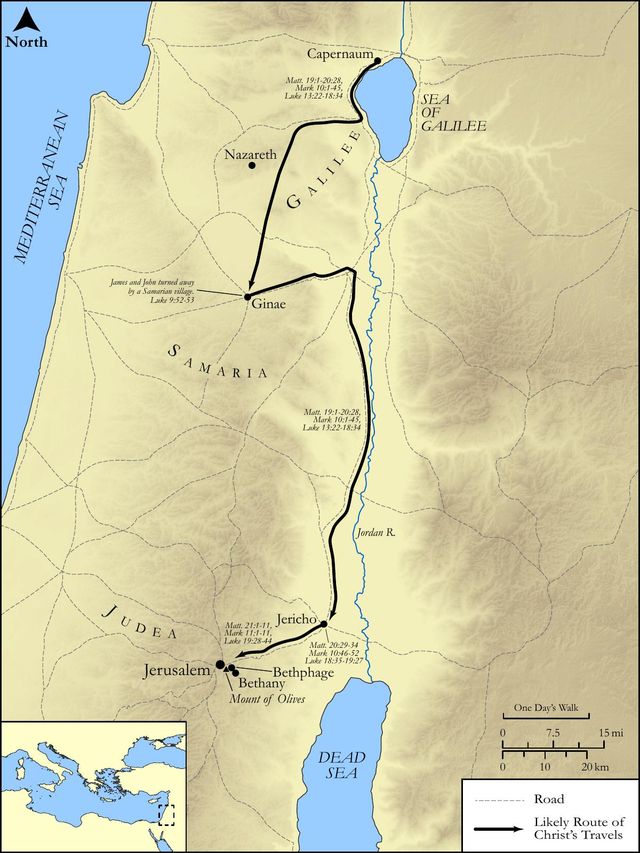
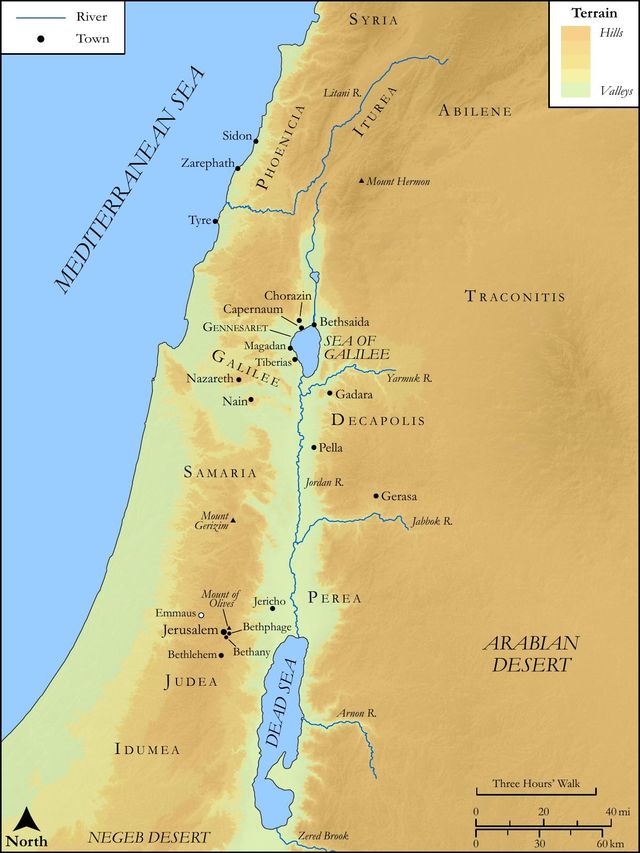
See on the biblical-era maps

Study this verse
Public-domain commentary
Matthew Henry
From his Commentary on the Whole Bible. Henry comments on passages, not single verses — this entry covers Luke 12:22–40. His four-level outline is real structure in the source text, so it is rendered as structure.
Our Lord Jesus is here inculcating some needful useful lessons upon his disciples, which he had before taught them, and had occasion afterwards to press upon them; for they need to have precept upon precept, and line upon line: "Therefore, because there are so many that are ruined by covetousness, and an inordinate affection to the wealth of this world, I say unto you, my disciples, take heed of it." Thou, O man of God, flee these things, as well as thou, O man of the world, Ti1 6:11.
I.He charges them not to afflict themselves with disquieting perplexing cares about the necessary supports of life:
Take no thought for your life, Luk 12:22. In the foregoing parable he had given us warning against that branch of covetousness of which rich people are most in danger; and that is, a sensual complacency in the abundance of this world's goods. Now his disciples might think they were in no danger of this, for they had no plenty or variety to glory in; and therefore he here warns them against another branch of covetousness, which they are most in temptation to that have but a little of this world, which was the case of the disciples at best and much more now that they had left all to follow Christ, and that was, an anxious solicitude about the necessary supports of life: "Take no thought for your life, either for the preservation of it, if it be in danger, or for the provision that is to be made for it, either of food or clothing, what ye shall eat or what ye shall put on." This is the caution he had largely insisted upon, Mat 6:25, etc.; and the arguments here used are much the same, designed for our encouragement to cast all our care upon God, which is the right way to ease ourselves of it. Consider then,
1.God, who has done the greater for us, may be depended upon to do the less. He has, without any care or forecast of our own, given us life and a body, and therefore we may cheerfully leave it to him to provide meat for the support of that life, and raiment for the defence of that body.
2.God, who provides for the inferior creatures, may be depended upon to provide for good Christians. "Trust God for meat, for he feeds the ravens (Luk 12:24); they neither sow nor reap, they take neither care nor pains beforehand to provide for themselves, and yet they are fed, and never perish for want. Now consider how much better ye are than the fowls, than the ravens. Trust God for clothing, for he clothes the lilies (Luk 12:27, Luk 12:28); they make no preparation for their own clothing, they toil not, they spin not, the root in the ground is a naked thing, and without ornament, and yet, as the flower grows up, it appears wonderfully beautified. Now, if God has so clothed the flowers, which are fading perishing things, shall he not much more clothe you with such clothing as is fit for you, and with clothing suited to your nature, as theirs is?" When God fed Israel with manna in the wilderness, he also took care for their clothing; for though he did not furnish them with new clothes, yet (which came all to one) he provided that those they had should not wax old upon them, Deu 8:4. Thus will he clothe his spiritual Israel; but then let them not be of little faith. Note, Our inordinate cares are owing to the weakness of our faith; for a powerful practical belief of the all-sufficiency of God, his covenant-relation to us as a Father, and especially his precious promises, relating both to this life and that to come, would be mighty, through God, to the pulling down of the strong holds of these disquieting perplexing imaginations.
3.Our cares are fruitless, vain, and insignificant, and therefore it is folly to indulge them. They will not gain us our wishes, and therefore ought not to hinder our repose (Luk 12:25): "Which of you by taking thought can add to his stature one cubit, or one inch, can add to his age one year or one hour? Now if ye be not able to do that which is least, if it be not in your power to alter your statures, why should you perplex yourselves about other things, which are as much out of your power, and about which it is necessary that we refer ourselves to the providence of God?" Note, As in our stature, so in our state, it is our wisdom to take it as it is, and make the best of it; for fretting and vexing, carping and caring, will not mend it.
4.An inordinate anxious pursuit of the things of this world, even necessary things, very ill becomes the disciples of Christ (Luk 12:29, Luk 12:30): "Whatever others do, seek not ye what ye shall eat, or what ye shall drink; do not you afflict yourselves with perplexing cares, nor weary yourselves with constant toils; do not hurry hither and thither with enquiries what you shall eat or drink, as David's enemies, that wandered up and down for meat (Psa 59:15), or as the eagle that seeks the prey afar off, Job 39:29. Let not the disciples of Christ thus seek their food, but ask it of God day by day; let them not be of doubtful mind; mē meteōrizesthe - Be not as meteors in the air, that are blown hither and thither with every wind; do not, like them, rise and fall, but maintain a consistency with yourselves; be even and steady, and have your hearts fixed; live not in careful suspense; let not your minds be continually perplexed between hope and fear, ever upon the rack." Let not the children of God make themselves uneasy; for,
(1.)This is to make themselves like the children of this world: "All these things do the nations of the world seek after, Luk 12:30. They that take care for the body only, and not for the soul, for this world only, and not for the other, look no further than what they shall eat and drink; and, having no all-sufficient God to seek to and confide in, they burden themselves with anxious cares about those things. But it ill becomes you to do so. You, who are called out of the world, ought not to be thus conformed to the world, and to walk in the way of this people," Isa 8:11, Isa 8:12. When inordinate cares prevail over us, we should think, "What am I, a Christian or a heathen? Baptized or not baptized? If a Christian, if baptized, shall I rank myself with Gentiles, and join with them in their pursuits?"
(2.)It is needless for them to disquiet themselves with care about the necessary supports of life; for they have a Father in heaven who does and will take care for them: "Your Father knows that you have need of these things, and considers it, and will supply your needs according to his riches in glory; for he is your Father, who made you subject to these necessities, and therefore will suit his compassions to them: your Father, who maintains you, educates you, and designs an inheritance for you, and therefore will take care that you want no good thing."
(3.)They have better things to mind and pursue (Luk 12:31): "But rather seek ye the kingdom of God, and mind this, you, my disciples, who are to preach the kingdom of God; let your hearts be upon your work, and your great care how to do that well, and this will effectually divert your thoughts from inordinate care about things of the world. And let all that have souls to save seek the kingdom of God, in which only they can be safe. Seek admission into it, seek advancement in it; seek the kingdom of grace, to be subjects in that; the kingdom of glory, to be princes in that; and then all these things shall be added to you. Mind the affairs of your souls with diligence and care, and then trust God with all your other affairs."
(4.)They have better things to expect and hope for: Fear not, little flock, Luk 12:32. For the banishing of inordinate cares, it is necessary that fears should be suppressed. When we frighten ourselves with an apprehension of evil to come, we put ourselves upon the stretch of care how to avoid it, when after all perhaps it is but the creature of our own imagination. Therefore fear not, little flock, but hope to the end; for it is your Father's good pleasure to give you the kingdom. This comfortable word we had not in Matthew. Note,
[1.]Christ's flock in this world is a little flock; his sheep are but few and feeble. The church is a vineyard, a garden, a small spot, compared with the wilderness of this world; as Israel (Kg1 20:27), who were like two little flocks of kids, when the Syrians filled the country.
[2.]Though it be a little flock, quite over-numbered, and therefore in danger of being overpowered, by its enemies, yet it is the will of Christ that they should not be afraid: "Fear not, little flock, but see yourselves safe under the protection and conduct of the great and good Shepherd, and lie easy." [3.] God has a kingdom in store for all that belong to Christ's little flock, a crown of glory (Pe1 5:4), a throne of power (Rev 3:21), unsearchable riches, far exceeding the peculiar treasures of kings and provinces. The sheep on the right hand are called to come and inherit the kingdom; it is theirs for ever; a kingdom for each. [4.] The kingdom is given according to the good pleasure of the Father; It is your Father's good pleasure; it is given not of debt, but of grace, free grace, sovereign grace; even so, Father, because it seemed good unto thee. The kingdom is his; and may he not do what he will with his own? [5.] The believing hopes and prospects of the kingdom should silence and suppress the fears of Christ's little flock in this world. "Fear no trouble; for, though it should come, it shall not come between you and the kingdom, that is sure, it is near." (That is not an evil worth trembling at the thought of which cannot separate us from the love of God). "Fear not the want of any thing that is good for you; for, if it be your Father's good pleasure to give you the kingdom, you need not question but he will bear your charges thither."
II.He charged them to make sure work for their souls, by laying up their treasure in heaven, Luk 12:33, Luk 12:34. Those who have done this may be very easy as to all the events of time.
1."Sit loose to this world, and to all your possessions in it: Sell that ye have, and give alms," that is, "rather than want wherewith to relieve those that are truly necessitous, sell what you have that is superfluous, all that you can spare from the support of yourselves and families, and give it to the poor. Sell what you have, if you find it a hindrance fRom. or incumbrance in, the service of Christ. Do not think yourselves undone, if by being fined, imprisoned, or banished, for the testimony of Jesus, you be forced to sell your estates, thought they be the inheritance of your fathers. Do not sell to hoard up the money, or because you can make more of it by usury, but sell and give alms; what is given in alms, in a right manner, is put out to the best interest, upon the best security."
2."Set your hearts upon the other world, and your expectations from that world. Provide yourselves bags that wax not old, that wax not empty, not of gold, but of grace in the heart and good works in the life; these are the bags that will last." Grace will go with us into another world, for it is woven in the soul; and our good works will follow us, for God is not unrighteous to forget them. These will be treasures in heaven, that will enrich us to eternity.
(1.)It is treasure that will not be exhausted; we may spend upon it to eternity, and it will not be at all the less; there is no danger of seeing the bottom of it.
(2.)It is treasure that we are in no danger of being robbed of, for no thief approaches near it; what is laid up in heaven is out of reach of enemies.
(3.)It is treasure that will not spoil with keeping, any more than it will waste with spending; the moth does not corrupt it, as it does our garments which we now wear. Now by this it appears that we have laid up our treasure in heaven if our hearts be there while we are here (Luk 12:34), if we think much of heaven and keep our eye upon it, if we quicken ourselves with the hopes of it and keep ourselves in awe with the fear of falling short of it. But, if your hearts be set upon the earth and the things of it, it is to be feared that you have your treasure and portion in it, and are undone when you leave it.
III.He charges them to get ready, and to keep in a readiness for Christ's coming, when all those who have laid up their treasure in heaven shall enter upon the enjoyment of it, Luk 12:35, etc.
1.Christ is our Master, and we are his servants, not only working servants, but waiting servants, servants that are to do him honour, in waiting on him, and attending his motions: If any man serve me, let him follow me. Follow the Lamb whithersoever he goes. But that is not all: they must do him honour in waiting for him, and expecting his return. We must be as men that wait for their Lord, that sit up late while he stays out late, to be ready to receive him.
2.Christ our Master, though now gone from us, will return again, return from the wedding, from solemnizing the nuptials abroad, to complete them at home. Christ's servants are now in a state of expectation, looking for their Master's glorious appearing, and doing every thing with an eye to that, and in order to that. He will come to take cognizance of his servants, and, that being a critical day, they shall either stay with him or be turned out of doors, according as they are found in that day.
3.The time of our Master's return is uncertain; it will be in the night, it will be far in the night, when he has long deferred his coming, and when many have done looking for him; in the second watch, just before midnight, or in the third watch, next after midnight, Luk 12:38. His coming to us, at our death, is uncertain, and to many it will be a great surprise; for the Son of Man cometh at an hour that ye think not (Luk 12:40), without giving notice beforehand. This bespeaks not only the uncertainty of the time of his coming, but the prevailing security of the greatest part of men, who are unthinking, and altogether regardless of the notices given them, so that, whenever he comes, it is in an hour that they think not.
4.That which he expects and requires from his servants is that they be ready to open to him immediately, whenever he comes (Luk 12:36), that is, that they be in a frame fit to receive him, or rather to be received by him; that they be found as his servants, in the posture that becomes them, with their loins girded about, alluding to the servants that are ready to go whither their master sends them, and do what their master bids them, having their long garments tucked up (which otherwise would hang about them, and hinder them), and their lights burning, with which to light their master into the house, and up to his chamber.
5.Those servants will be happy who shall be found ready, and in a good frame, when their Lord shall come (Luk 12:37): Blessed are those servants who, after having waited long, continue in a waiting frame, until the hour that their Lord comes, and are then found awake and aware of his first approach, of his first knock; and again (Luk 12:38): Blessed are those servants, for then will be the time of their preferment. Here is such an instance of honour done them as is scarcely to be found among men: He will make them sit down to meat, and will serve them. For the bridegroom to wait upon his bride at table is not uncommon, but to wait upon his servants is not the manner of men; yet Jesus Christ was among his disciples as one that served, and did once, to show his condescension, gird himself, and serve them, when he washed their feet (Joh 13:4, Joh 13:5); it signified the joy with which they shall be received into the other world by the Lord Jesus, who is gone before, to prepare for them, and has told them that his Father will honour them, Joh 12:26.
6.We are therefore kept at uncertainty concerning the precise time of his coming that we may be always ready; for it is no thanks to a man to be ready for an attack, if he know beforehand just the time when it will be made: The good man of the house, if he had known what hour the thief would have come, though he were ever so careless a man, would yet have watched, and have frightened away the thieves, Luk 12:39. But we do not know at what hour the alarm will be given us, and therefore are concerned to watch at all tines, and never to be off our guard. Or this may intimate the miserable case of those who are careless and unbelieving in this great matter. If the good man of the house had had notice of his danger of being robbed such a night, he would have sat up, and saved his house; but we have notice of the day of the Lord's coming, as a thief in the night, to the confusion and ruin of all secure sinners, and yet do not thus watch. If men will take such care of their houses, O let us be thus wise for our souls: Be ye therefore ready also, as ready as the good man of the house would be if he knew what hour the thief would come.
Historical interpretation
Eight Centuries of Reception
10 surviving comments on this verse. Each one is dated, so this reads as a timeline rather than a list.
Select a marker to jump to its quote. Markers stagger vertically where authors wrote within a few decades of each other.
By the ravens also he signifies something else, for the birds which pick up seeds have a ready source of food, but those that feed on flesh as the ravens do have more difficulty in getting it. Yet birds of this kind suffer from no lack of food, because the providence of God extends every where; but he brings to the same purpose also a third argument, saying, And which of you by taking thought can add to his stature?
If no one has by his own skill contrived a bodily stature for himself, but can not add even the shortest delay to the prefixed limit of his time of life, why should we be vainly anxious about the necessaries of life?
It must also be noted that lilies are not generated in the roughness of mountains and in the untamedness of forests, but in the pleasantness of gardens. For there are certain gardens of various fruitful virtues, according to what is written: A closed garden, my sister, my bride, a closed garden, a sealed fountain; because where there is integrity, where there is chastity, where there is piety, where there is faithful secrecy of secrets, where there is the brightness of angels, there the violets of confessors, the lilies of virgins, the roses of martyrs are. And it is not incongruous for anyone to compare angels to lilies, since Christ himself has mentioned the lily, saying: I am the flower of the field and the lily of the valley. And it is fitting that Christ is compared to a lily; for where there is the blood of martyrs, there is Christ, who is a sublime, immaculate, harmless flower; in him, the roughness of thorns does not offend, but the surrounding grace shines forth. For the thorns are like the roses, because they are the torments of the martyrs. Unoffended divinity has no thorns, which it has not felt the torments.
Therefore, if lilies or angels are clothed with glory surpassing that of humans, we must not despair of God's mercy in us, to whom the Lord promises a similar appearance of angels through the grace of resurrection. In this passage, it also seems to address that question, which even the Apostle did not overlook; for the peoples of this world inquire how the dead rise again and with what kind of body they come.
For when he says, Seek the kingdom of God: and all these things shall be added unto you; he shows that grace will not be lacking to the faithful, neither in the present nor in the future, if only those who desire divine things do not seek after earthly things. For it is inappropriate for men to be concerned with food, who are soldiers for the kingdom. The king knows how to provide for, nourish, and clothe his household; and therefore he said: Cast your care upon God, and he himself will nourish you.
Indeed, it is a bonus and moral discourse, which contributes to the faith of divine mercy, either literally, because it relates to the stature of our body, or spiritually, because without God's favor, we can add nothing beyond the measure of our stature. The discourse of the Lord, using the comparison of flowers and grass, is especially persuasive. For what could be more moral for persuasion than to see that even irrational things are adorned by God's providence, so that they have no need for usefulness or ornamentation? Much more so, you should believe that a rational person, if he puts all his use in God and never desires to change his faith, will never be in need; precisely because he presumes on divine favor.
But it is a great thing to follow up this example in faith. For to the birds of the air who have no labour of tilling, no produce from the fruitfulness of crops, Divine Providence grants an unfailing sustenance. It is true then that the cause of our poverty seems to be covetousness. For they have for this reason a toilless and abundant use of food, because they think not of claiming to themselves by any special right fruits given for common food. We have lost what things were common by claiming them as our own. For neither is any thing a man's own, where nothing is perpetual, nor is supply certain when the end is uncertain.
(Hom. 21. in Matt.) Observe, that when God has once given a soul, it abides the same, but the body is taking growth daily. Passing over then the soul as not receiving increase, he makes mention only of the body, giving us to understand that it is not increased by food alone, but by the Divine Providence, from the fact that no one by receiving nourishment can add any thing to his stature. It is therefore concluded, If ye then be not able to do that thing which is least, take no thought for the rest.
(de Qu. Ev. l. ii. qu. 28.) But in speaking concerning increasing the stature of the body, He refers to that which is least, that is, to God, to make bodies.
But perhaps you will reply to this, "Who then will give us the necessities of life?" Our answer to this is as follows: The Lord is worthy to be trusted, and he clearly promises it to you and through little things gives you full assurance that he will be true also in that which is great. "Consider," he says, "the ravens: they neither sow nor reap, they have neither storehouse nor barn, and yet God feeds them." … Through the birds and the flowers of the field, he produces in you a firm and unwavering faith. Nor does he permit us at all to doubt, but rather he gives us the certainty that he will grant us his mercy and stretch out his comforting hand, that we may have sufficiency in all things. It is, moreover, a very wicked thing that while those who are placed under the yoke of bodily slavery depend on their masters as sufficient to supply them with food and clothing, we will not consent to put our trust in almighty God, when he promises us the necessities of life.
That is, ye are more precious, because a rational animal like man is of a higher order in the nature of things than irrational things, as the birds are.
To Him then leave the care of directing the body, by whose aid you see it to come to pass that you have a body of such a stature.
Which of you by worrying can add one cubit to his stature? If you then cannot do even that which is least, why are you anxious about the rest? That is, by whose power and dominion was it done that your body was brought to this stature, by his providence also can it be clothed. It can be understood that it was not done by your own care that your body came to this stature from this: if you try and wish to add one cubit to this stature, you cannot. Therefore, also entrust the care of clothing the body to him, by whose care you see it was done that you have a body of such stature. Therefore, he says, if you then cannot do even that which is least, for this is minimal, but to God it is to make bodies. Moreover, an example had to be given also for clothing, just as it was given for nourishment. Hence, it follows, and he says:
Now the reason that he omits mention of the other birds, and speaks only of the ravens, is, that the young of the ravens are by an especial providence fed by God. For the ravens produce indeed, but do not feed, but neglect their young, to whom in a marvellous manner from the air their food comes, brought as it were by the wind, which they receive having their mouths open, and so are nourished. Perhaps also such things were spoken by synecdoche, i. e. the whole signified by a part. Hence in Matthew our Lord refers to the birds of the air, (Matt. 6:26.) but here more particularly to the ravens, as being more greedy and ravenous than others.
Continue studying Luke 12:25 across the web’s major study libraries — every link below opens this exact verse, chapter, or book on the destination site.
Read & Compare
 BibleGatewayThis verse in more than 200 translations and 70 languages.
 Bible.comThe YouVersion reader — hundreds of translations, reading plans, and highlights.
 ESV.orgCrossway's official English Standard Version reader.
 NET BibleThe NET translation with 60,000+ translators' notes on every rendering decision.
 STEP BibleTyndale House's free study tool — original text, vocabulary, and scholarly resources.
 BibliaLogos Bible Software's free web reader.
 USCCBThe New American Bible (Revised Edition) with the U.S. bishops' study notes.
Commentaries
 BibleHub CommentariesDozens of classic commentaries on this verse, gathered on one page.
 StudyLightMore than 100 commentary sets — the largest collection on the web.
 BibleRefPlain-English commentary on what this verse means, verse by verse.
 Enduring WordDavid Guzik's free commentary on this chapter, widely used by Bible teachers.
 Bible Study ToolsVerse commentary alongside Greek and Hebrew study aids.
Original Language & Research
- BibleHub InterlinearThe verse word by word — original language, transliteration, and English.
- BibleHub LexiconEvery word's original-language definition and Strong's entry.
 Blue Letter BibleDeep-study tools — Strong's numbers, concordance, and word studies.
 CNTR CollationThe earliest Greek manuscripts of this verse, collated letter by letter.
Sermons, Hymns & Audio


TrulyRandomVerse is not affiliated with these sites and doesn’t control their content. They’re linked because they’re genuinely useful.
Summary
Luke 12:25 serves as a poignant rhetorical question within Jesus' broader discourse on anxiety, challenging the inherent futility of human worry. It underscores the profound limitation of human agency in controlling fundamental aspects of life, such as physical growth or lifespan, thereby implicitly contrasting this powerlessness with God's sovereign provision and care. The verse powerfully redirects the listener from a posture of anxious self-reliance to one of trusting dependence on divine providence.
Context
ShowHideLiterary Context
This verse is an integral part of Jesus' extended teaching on worry and material possessions, delivered to His disciples and a large crowd. It immediately follows the parable of the Rich Fool in Luke 12:16-21, which sternly warns against covetousness and the misguided pursuit of earthly wealth without regard for eternal realities. Jesus then transitions directly into a discourse on worry, beginning in Luke 12:22, urging His followers not to be anxious about their lives, food, or clothing. He illustrates God's meticulous care by pointing to the ravens and lilies (Luke 12:24 and Luke 12:27-28), which neither toil nor spin, yet are provided for by God. Verse 25, therefore, functions as a decisive rhetorical question that aims to dismantle the very logic of anxiety by exposing its utter ineffectiveness in altering one's physical state or destiny.
Historical & Cultural Context
In ancient agrarian societies, life was often precarious, marked by vulnerability to famine, disease, and political instability. Daily sustenance was a constant concern, making anxiety about food, drink, and clothing a common reality. People lived much more closely to the cycles of nature and the direct impact of weather on crops. The concept of "stature" (Greek hēlikía) could refer to both physical height and age/lifespan, a common ambiguity in ancient thought. The "cubit" (Greek pēchys) was a standard unit of measurement, roughly equivalent to the length of a forearm (approximately 18 inches or 45 cm). Jesus' audience would have understood the impossibility of adding such a measure to one's physical height, and by extension, the absurdity of adding even a small increment to one's life through worry. This highlights a fundamental human limitation in a world where control over one's fate was far less assumed than in modern times.
Key Themes
ShowHideLuke 12:25 contributes significantly to several overarching themes in Luke's Gospel and Jesus' teaching. Firstly, it powerfully reinforces the futility of worry, demonstrating that anxiety is not only emotionally draining but also entirely unproductive in altering one's circumstances, particularly those beyond human control. Secondly, the verse highlights the stark contrast between human limitation and divine sovereignty. Humans are shown to be utterly powerless over their own physical development or the duration of their lives, implicitly pointing to God as the ultimate orchestrator of all creation and life. This theme is echoed throughout the Gospels, emphasizing that true security lies not in self-effort but in God's providential care, as also seen in Matthew 6:25-34. Finally, by exposing the uselessness of anxiety, Jesus subtly redirects His listeners towards the theme of trust in God's provision. If worry cannot change anything, then the only logical and faithful response is to surrender control and trust in the benevolent Father who knows and provides for the needs of His children (Luke 12:30).
Exposition and Analysis
ShowHideKey Word Analysis
ShowHideThis word signifies to be anxious, to be troubled with cares, or to worry. It describes a state of restless preoccupation and distracting concern, often about earthly matters or future uncertainties. The verb implies a mental and emotional burden that is both unproductive and spiritually depleting.
This term carries a dual meaning, referring to either physical height or age/lifespan. Given the context of adding a "cubit," which is a measure of length, the primary interpretation leans towards physical height. However, the broader discourse on life's duration and the futility of anxiety often leads scholars to also consider the meaning of "lifespan," implying that worry cannot add even a short period to one's life. Both interpretations underscore the same point: human inability to control fundamental aspects of existence.
This is a unit of linear measure, typically from the elbow to the tip of the middle finger, approximately 18 inches or 45 centimeters. Its inclusion here emphasizes the smallness of the increment being discussed. Whether referring to a small increase in height or a brief extension of life, the point is that even the most minimal alteration is beyond human power through worry.
Verse Breakdown
ShowHide"And which of you"
This opening phrase immediately sets up a rhetorical question, directly addressing the listeners and inviting them to consider their own experience and limitations. It implies that the answer is self-evident and universally applicable.
"with taking thought"
This specifies the method being critiqued: anxiety, worry, or restless preoccupation. Jesus challenges the very premise that such a mental state could produce any tangible, positive outcome in a person's physical existence.
"can add to his stature"
This clause presents the impossible action. "Stature" (as discussed above) refers to either physical height or lifespan. The implication is that neither worrying nor any amount of human effort can alter these fundamental aspects of one's being, which are ultimately in God's hands.
"one cubit?"
This final phrase highlights the utter futility of the effort. A cubit is a relatively small measure. Jesus emphasizes that if one cannot even add this minimal amount to their physical dimension or lifespan through worry, then the entire exercise of anxiety is pointless. The question mark underscores the rhetorical nature, expecting a resounding "none."
Literary Devices
ShowHideJesus employs a powerful Rhetorical Question in Luke 12:25, which is a question posed for effect rather than for an answer. By asking "And which of you with taking thought can add to his stature one cubit?", Jesus compels His audience to acknowledge their own powerlessness in the face of life's fundamental realities. The expected answer, "no one," underscores the utter futility of anxiety. This rhetorical device is highly persuasive, as it allows the listeners to arrive at the conclusion themselves, making the truth more impactful. Additionally, there is an element of Hyperbole or Understatement depending on the interpretation of "stature." If "stature" refers to physical height, then adding a full cubit would be a significant, almost miraculous, increase, making the impossibility clear. If it refers to lifespan, then adding even a "cubit" (a small measure of time) is equally impossible through worry. In either case, the imagery exaggerates the point to emphasize the absolute lack of control humans have over these aspects of their lives, thereby highlighting the irrationality of worry.
Theological and Thematic Connections
ShowHideLuke 12:25 is a profound statement on divine providence and human trust. It challenges the deeply ingrained human tendency to control circumstances, particularly those beyond our grasp, and redirects our focus to God's ultimate sovereignty. Theologically, it asserts that life's fundamental dimensions—our very being and the span of our days—are not subject to our anxious manipulations but are under the benevolent hand of a God who cares for His creation. This verse implicitly calls believers to a radical dependence on God, reminding us that worry is not only unproductive but also a subtle form of distrust in God's character and His promises. It serves as a foundational truth for cultivating peace amidst uncertainty, urging us to surrender our anxieties to the One who holds all things together.
Reflection and Application
ShowHideIn a world increasingly marked by rapid change, economic uncertainty, and global challenges, the temptation to worry is ever-present. Luke 12:25 stands as a timeless beacon, reminding us that much of our anxiety is expended on things utterly beyond our control. We often fret over our health, our future, the well-being of loved ones, or external circumstances, yet Jesus' words invite us to a liberating truth: worry accomplishes nothing. It cannot add a single day to our lives, nor can it alter our physical makeup. Instead, it saps our energy, diminishes our joy, and distracts us from the present moment and the opportunities for faithfulness that God has placed before us. The practical application is to consciously choose trust over torment, to release our grip on what we cannot control, and to place our confidence in the God who orchestrates all things. This does not mean abandoning responsibility or planning, but rather approaching life with a spirit of peaceful reliance, knowing that our ultimate well-being is secured in His hands.
Questions for Reflection
ShowHideFAQ
ShowHideDoes Jesus' teaching in Luke 12:25 mean that we should not plan for the future or take preventative measures?
ShowHideNo, Jesus' teaching here is not a call to irresponsibility or a rejection of wise planning. Rather, it is a condemnation of anxious thought—the kind of worry that is unproductive, consuming, and ultimately rooted in a lack of trust in God's providence. Planning, saving, and taking preventative measures are acts of wisdom and good stewardship, often encouraged elsewhere in Scripture (e.g., Proverbs 6:6-8). The distinction lies in the heart attitude: are we planning with a spirit of trust and reliance on God, or are we consumed by a restless, fearful preoccupation that assumes all outcomes depend solely on our efforts? Jesus is addressing the latter, emphasizing that even our most intense worry cannot alter the fundamental realities of life and death, which remain in God's hands. His instruction is to seek God's Kingdom first (Luke 12:31), trusting that all necessary things will be provided.
Christ-Centered Fulfillment
ShowHideLuke 12:25, with its stark declaration of the futility of worry, finds its ultimate fulfillment and resolution in the person and work of Jesus Christ. While the verse highlights humanity's powerlessness to add a cubit to one's stature or lifespan, Christ Himself is the one who, through His incarnation, death, and resurrection, has conquered the ultimate sources of human anxiety: sin and death. He is the one who truly "adds" to our lives, not a mere cubit of physical dimension or time, but eternal life and a new spiritual stature in Him (Colossians 2:10). Jesus, the Son of God, perfectly modeled a life of complete trust in the Father, even in the face of immense suffering and the cross (Luke 22:42). His teaching on worry, therefore, is not a detached philosophical observation but an invitation to share in His peace, a peace that surpasses all understanding because it is grounded in His finished work (John 14:27). Through His atoning sacrifice, Christ has addressed the root cause of our insecurity, freeing us from the bondage of anxious striving and enabling us to live lives of confident faith, knowing that our heavenly Father knows our needs and has provided for them supremely in His Son (Romans 8:32). In Christ, our true "stature" is not measured by earthly dimensions but by our adoption as children of God, secured by grace, and our "lifespan" is transformed into an eternal inheritance.