


Zechariah 12:7
- וְהוֹשִׁיעַve·ho·Shi·a'and he will saveH3467Conj-w ¦ V-Hiphil-ConsecPerf-3msVerb Hiphil Consecutive Perfect 3rd Singular Masculineוְandהוֹשִׁיעַhe will save
- יְהוָהYah·wehYahwehH3068N-properNoun Proper Title
- אֶת'et<obj.>H853DirObjMParticle Object Indicator
- אָהֳלֵי'o·ho·Lei[the] tents ofH168N-mpcNoun Plural Masculine Construct
- יְהוּדָהye·hu·DahJudahH3063N-properNoun Proper Location
- בָּרִאשֹׁנָהba·ri·sho·Nahat the firstH7223Prep-b ¦ Adj-fsAdjective Numerical Position Singular Feminine Absoluteבָּat theרִאשֹׁנָהfirst
- לְמַעַןle·Ma·'anso thatH4616PrtParticle Conditional
- לֹאlo'notH3808NegParticle Negative
- תִגְדַּלtig·Dalit will be greatH1431V-Qal-Imperf-3fsVerb Qal Imperfect 3rd Singular Feminine
- תִּפְאֶרֶתtif·'E·ret[the] splendor ofH8597N-fscNoun Singular Feminine Construct
- בֵּיתbeit[the] house ofH1004N-mscNoun Singular Masculine Construct
- דָּוִידda·VidDavidH1732N-proper-mNoun Proper Masculine
- וְתִפְאֶרֶתve·tif·'E·retand [the] splendor ofH8597Conj-w ¦ N-fscNoun Singular Feminine Constructוְandתִפְאֶרֶת[the] splendor of
- יֹשֵׁבyo·Shev[the] inhabitant[s] ofH3427V-Qal-Prtcpl-msVerb Qal Participle Singular Masculine Construct
- יְרוּשָׁלִַםye·ru·sha·LimJerusalemH3389N-properNoun Proper Location
- עַל'alaboveH5921PrepPreposition
- יְהוּדָהye·hu·DahJudahH3063N-properNoun Proper Location
English is a literal word-by-word gloss of the Hebrew, not the KJV's wording. Why?
This is the original text the KJV's translators worked from — each Hebrew word with its own literal English meaning in this verse, prepared by scholars at Tyndale House, Cambridge. The KJV translates whole sentences, not word by word, so its wording differs: one Hebrew word can become several English words, and the KJV may choose “the LORD” where the gloss reads “Yahweh”. Both are faithful — they answer different questions. For the KJV's own rendering, switch to the KJV text.
Details
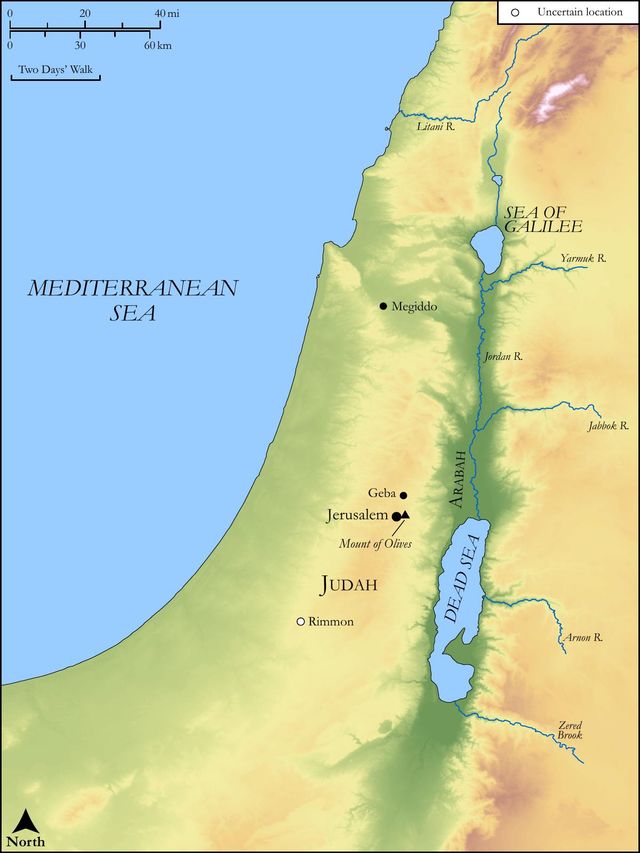
See on the biblical-era map
Study this verse
Public-domain commentary
Matthew Henry
From his Commentary on the Whole Bible. Henry comments on passages, not single verses — this entry covers Zechariah 12:1–8. His four-level outline is real structure in the source text, so it is rendered as structure.
Here is, I. The title of this charter of promises made to God's Israel; it is the burden of the word of the Lord, a divine prediction; it is of weight in the delivery of it; it is to be pressed upon people, and will be very pressing in the accomplishment of it; it is a burden, a heavy burden, to all the church's enemies, like that talent of lead, Zac 5:7, Zac 5:8. But it is for Israel; it is for their comfort and benefit. As even the fiery law (Deu 33:2), so the fiery prophecies and fiery providences that come from God's right hand, come for them; the word that speaks terror to their enemies speaks peace to them, as the pillar of cloud and fire, which turned a bright side towards the Israelites, to direct and encourage them, but a black side towards the Egyptians, to terrify and dispirit them. Happy are those that have even the burdens of God's word for them, as well as the blessings of it.
II.The title of him that grants this charter, which is prefixed to it to show that he has both authority to make these promises and ability to make them good, for he is the Creator of the world and our Creator, and therefore has an incontestable irresistible dominion.
1.He stretches out the heavens; not only he did so at the first, when he said, Let there be a firmament, and he made the firmament, but he does so still; he keeps them stretched out like a curtain, keeps them from running in, and will do so till the end come, when the heavens shall be rolled together as a scroll. No bounds can be set to his power who stretches out the heavens, nor can any thing be too hard for him.
2.He lays the foundation of the earth, and keeps it firm and fixed on its own basis, or rather on its own axis, though it is founded on the seas (Psa 24:1, Psa 24:2), nay, though it is hung upon nothing, Job 26:7. The founder of this earth is no doubt the ruler of it, and judges in it, and those deceive themselves who say, The Lord has forsaken the earth, for, if he had, it would have sunk, since it is he that not only did lay its foundations at first, but does still lay them, still uphold them.
3.He forms the spirit of man within him. He made us these souls, Jer 38:16. He not only breathed into the first man, but still breathes into every man the breath of life; the body is derived from the fathers of our flesh, but the soul is infused by the Father of spirits, Heb 12:9. He fashions men's hearts; they are in his hand, and he turns them as the rivers of water, and casts them into what mould he pleases, so as to serve his own purposes with them; and he can therefore save his church by inspiriting his friends and dispiriting his enemies, and will eternally save all his chosen by forming their spirits anew.
III.The promises themselves that are here made them, by which the church shall be secured, and in which all its friends may enjoy a holy security.
1.It is promised that, whatever attacks the enemies of the church may make upon her purity or peace, they will certainly issue in their own confusion. The enemies of God and of his kingdom bear a great deal of malice and ill-will to Jerusalem, and form designs for its destruction; but it will prove, at last, that they are but preparing ruin for themselves; Jerusalem is in safety, and those are in all the danger who fight against it. This is here illustrated by three comparisons: -
(1.)Jerusalem shall be a cup of trembling to all that lay siege to it, Zac 12:2. They promise themselves that it shall be to them a cup of wine, which they shall easily and with pleasure drink off, and they thirst for its spoils, nay, they thirst for its blood, as for such a cup; but it shall prove a cup of slumber, nay, a cup of poison, to them, which, when they take it into their hands, and think it is all their own, they shall not be able to drink off: the fumes of it shall give them enough. When the kings were assembled against her, and saw how God was known in her palaces for a refuge, they trembled and hasted away; fear took hold upon them, as we find, Psa 48:3-6. Thus Alexander the Great was struck with amazement when he met Jaddus the high priest, and was deterred thereby from offering any violence to Jerusalem. When Sennacherib laid siege against Judah and Jerusalem he found them such a cup of stupifying wine as laid all his mighty men asleep, Psa 76:5, Psa 76:6. Some read it, I will make Jerusalem a post of contrition or breaking. Those that make any attempts upon Jerusalem do but run their heads against a post, which they cannot move, but are sure to hurt themselves. The blast of the terrible ones is as a storm against the wall (Isa 25:4), broken by it, but not shaking it. God's church is a cup of consolation to all her friends (Isa 66:11), but a cup of trembling to all that would either debauch her by errors and corruptions or destroy her by wars and persecutions. See Isa 51:22, Isa 51:23.
(2.)Jerusalem shall be a burdensome stone to all that attempt to remove it or carry it away, Zac 12:3. All the people of the earth are here supposed to be gathered together against it, some one time and some another; there has been a succession of enemies, from age to age, making war upon the church. But though they were all at once in a confederacy against it, and had formed a resolution to cut off the name of Israel, that it should be no more in remembrance (Psa 83:4), they will find it a task too hard for them. Those that are for keeping up and advancing the kingdom of sin in the world look upon Jerusalem, even the church of God, as the great obstacle to their designs, and they must have it out of the way; but they will find it heavier than they think it is; so that,
[1.]They cannot remove it. God will have a church in the world, in spite of them; it is built upon a rock, and is as Mount Zion, that abides for ever, Psa 125:1. This stone, cut out of the mountain without hands, will not only keep its ground, but fill the earth, Dan 2:35. Nay,
[2.]It will break in pieces all that burden themselves with it, as that stone smote the image, Dan 2:45. All that think themselves a match for it shall be cut in pieces by it. Some think it is an allusion to a sport which Jerome, upon this place, says was in use among the Jews, as among us: young men tried their strength, and strove for mastery, by heaving up great stones, which, if they proved too heavy for them, fell upon them, and bruised them. Those that make a jest of religion, and banter sacred things, will find them a burdensome stone, that it is ill-jesting with edged-tools, and though they make light of it (saying, Am not I in sport?) they bring upon themselves an insupportable sinking load of guilt. Our Saviour seems to allude to these words when he speaks of himself as a burdensome stone to those that will not have him for their foundation-stone, which shall fall upon them and grind them to powder, Mat 21:44.
(3.)The governors of Judah shall be among their enemies like a hearth of fire among the wood, and a torch of fire in a sheaf, Zac 12:6. Not that their own passions shall make them incendiaries and firebrands to all about them; no; Zion's King is meek and lowly, and all subordinate governors must be like him; but God's justice will make them avengers of his cause, and theirs, upon their enemies. Those that contend with them will find it is like an opposition given by briers and thorns to a consuming fire, Isa 27:4. It will go through them, and burn them together. It is God's wrath, and not theirs, that is the fire which devours the adversaries. God's fire is said to be in Zion, and his furnace in Jerusalem. Isa 31:9. The enemies thought to be as water to this fire, to extinguish it and put it quite out; but God will make them as wood, nay, as a sheaf of corn (which is more combustible), to this fire, not only to be consumed by it, but to be made thereby to burn the more strongly. When God would make Abimelech and the men of Shechem one another's destroyers fire is said to come out from the one to devour the other, Jdg 9:20. So here, Fire shall come out from the governors of Judah to devour all the people round about, as from the mouth of God's witnesses to consume those who offer to hurt them, Rev 11:5. The persecutors of the primitive church found this fulfilled in it, witness Lactantius's history of God's judgments upon the primitive persecutors, and the confession of Julian the apostate at last. Thou hast overcome me, O thou Galilean! The church's motto may be, Nemo me impune lacesset - He that assails me does it at his peril. If you are weary of your life, persecute the Christians, was once a proverb.
2.It is promised that God will infatuate the counsels and enfeeble the courage of the church's enemies (Zac 12:4): "In that day, when the people of the earth are gathered together against Jerusalem, I will smite every horse with astonishment, and his rider with madness;" and again, "I will smite every horse of the people with blindness, so that they shall be no way serviceable to them; blinding the horses will be as bad as houghing them." The horses and their horsemen shall both forget the military exercise to which they were trained, and, instead of keeping ranks and observing the rules of their discipline, they shall both grow mad, and ruin themselves. The church's infantry shall be too hard for the enemy's cavalry; and those who were upbraided with trusting in horses shall be baffled by those who were forbidden to multiply horses.
3.It is promised that Jerusalem shall be re-peopled and replenished (Zac 12:6): Jerusalem shall be inhabited again in her own place, even in Jerusalem. The natives of Jerusalem shall not incorporate in a colony in some other country, and build a city there, and call that Jerusalem, and see the promises fulfilled in that, as those in New England called their towns by the names of towns in Old England. No; they shall have a new Jerusalem upon the same foundation, the same spot of ground, with the old one. They had so after their return out of captivity, but this was to have its full accomplishment in the gospel-church, which is a Jerusalem inhabited in its own place; for, the gospel being to be preached to all the world, it may call every place its own.
4.It is promised that the inhabitants of Jerusalem shall be enabled to defend themselves, and yet shall be taken under the divine protection, Zac 12:8. See here in what method God preserves his church, and those that are his, from the gates of hell to and through the gates of heaven.
(1.)He does himself secure them: In that day shall the Lord defend the inhabitants of Jerusalem, not only Jerusalem itself from being taken and destroyed, but every inhabitant of it from being any way damaged. God will not only be a wall of fire about the city, to fortify that, but he will encompass particular persons with his favour as with a shield, so that no dart of the besiegers shall touch them.
(2.)He does it by giving them strength and courage to help themselves. What God works in his people by his grace contributes more to their preservation and defence than what he works for them by his providence. The God of Israel gives strength and power to his people, that they may do their part, and then he will not be wanting to do his. it is the glory of God to strengthen the weak, that most need his help, that see and own their need of it, and will be the most thankful for it.
[1.]In that day the feeblest of the inhabitants of Jerusalem shall be as David, shall be men of war, as bold and brave, as skilful and strong, as David himself, shall attempt and accomplish great things, as David did, and become as serviceable to Jerusalem in guarding it as David himself was in founding it, and as formidable as he was to the enemies of it. See what divine grace does; it makes children not only men, but champions, makes weak saints to be not only good soldiers, but great soldiers, like David. And see how God often does his own work as easily and effectually, and more to his own glory, by weak and obscure instruments than by the most illustrious.
[2.]The house of David shall be as God, that is, as the angel of the Lord, before them. Zerubbabel was now the top-branch of the house of David; he shall be endued with wisdom and grace for the service to which he is called, and shall go before the people as an angel, as that angel (so some think) which went before the people of Israel through the wilderness, which was God himself, Exo 23:20. God will increase the gifts and abilities both of the people and princes, in proportion to the respective services for which they are designed. It was said of David that he was as an angel of God, to discern good and bad, Sa2 14:17. Such shall the house of David now be. The inhabitants of Jerusalem shall be as strong and fit for action as nature made David, and their magistrates as wise and fit for counsel as grace made him. But this was to have its full accomplishment in Christ; now the house of David looked little and mean, and its glory was eclipsed, but in Christ the house of David shone more brightly than ever, and its countenance was as that of an angel; in him it became more blessed, and more a blessing, than ever it had been.
5.It is promised that there shall be a very good understanding between the city and the country, and that the balance shall be kept even between them; there shall be no mutual envies or jealousies between them; they shall not keep up any separate interests, but shall heartily unite in their counsels, and act in concert for the common good; and this happy agreement between the city and the country, the head and the body, is very necessary to the health, welfare, and safety of any nation.
(1.)The governors of Judah, the magistrates and gentry of the country, shall think honourably of the citizens, the inhabitants of Jerusalem, the merchants and tradesmen; they shall not run them down, and contrive how to keep them under, but they shall say in their hearts, not in compliment but in sincerity, The inhabitants of Jerusalem shall be my strength, the strength of my country, of my family, in the Lord of hosts their God, Zac 12:5. They will therefore, upon all occasions, pay respect and deference to Jerusalem, as the mother-city, the ruling-city, and the city that is to be first served, because they look upon it to be the bulwark of the nation and its strongest fortification in times of public danger and distress, which therefore they would all come in to the assistance of and come under the protection of, and this not so much because it was a rich city, and money is the sinews of war, nor because it was a populous city and could bring the greatest numbers into the field, nor because its inhabitants were generally the most ingenious active men, the best soldiers and the best commanders (of Zion it shall be said, This and that brave man were born there), but because it was a holy city, where God's house and household, the temple and the priests, were, where his worship was kept up and his feasts were observed, and because it should now be more than ever a praying city, for upon the inhabitants of Jerusalem God will pour a spirit of supplication (Zac 12:10); therefore the governors of Judah shall say, These are my strength; they are so upon the account of their relation to, their interest in, and their communion with, the Lord of hosts, their God. Because the Lord of hosts is in a particular manner their God (for in Salem is his tabernacle and his dwelling-place in Zion), therefore they shall be my strength. Note, It is well with a kingdom when its great men know how to value its good men, when its governors look upon religion and religious people to be their strength, and consider it their interest to support them, and learn to call godly praying people, and skilful faithful ministers, the chariots and horsemen of Israel, as Joash called Elisha, and not the troublers of the land, as Ahab called Elijah.
(2.)The court and the city shall not despise, nor look with contempt upon, the inhabitants of the country; no, not the meanest of them, much less upon the governors of Judah; for God will put signal honour upon Judah, and so save them from the contempt of their brethren. As Jerusalem was dignified by special ordinances, so Judah shall be dignified with special providences. God says (Zac 12:4), I will open my eyes upon the house of Judah, upon the poor country people. Proud men scornfully overlook them, but the great God will graciously look upon them and look after them. Nay, (Zac 12:7), the Lord shall save the tents of Judah first. Those that dwell in tents lie most exposed; but God will remarkably protect and deliver them before those that dwell in Jerusalem. He will appear glorious in what he does for the inhabitants of his villages in Israel, Jdg 5:11. Thus, in the mystical body, God gives more abundant honour to that part which lacked, that there may be no schism in the body (see Co1 12:22-25), which is the reason here given why the glory of the house of David, which has great power, and the glory of the inhabitants of Jerusalem, who have great wealth, and both which live in great pomp and pleasure, may not magnify themselves against Judah and the tents of Judah, the dwellers in which work hard, and fare hard, and perhaps are not so well bred. Note, Courtiers and citizens ought not to despise country people, nor look with disdain upon those whom God opens his eyes upon and who are first saved, while it is so hard for the rich and great to enter the kingdom of God. If God by his grace has magnified the dwellers in the tents of Judah, having chosen the weak and foolish things of the world and chosen to employ them, we affront him if we vilify them, or magnify ourselves against them, Jam 2:5, Jam 2:6. This promise has a further reference to the gospel-church, in which no difference shall be made between high and low, rich and poor, bond and free, circumcision and uncircumcision, but all shall be alike welcome to Christ, and partake of his benefits, Col 3:11. Jerusalem shall not then be thought, as it had been, more holy than other parts of the land of Israel.
Historical interpretation
Historical reception
1 surviving comment on this verse from the historical church.
(Vers. 6, 7.) On that day, I will make the leaders of Judah like a fiery furnace among wood, and like a burning torch among hay. They will consume all the surrounding peoples to the right and to the left, and Jerusalem will be inhabited again in its own place, in Jerusalem. And the Lord will save the dwellings of Judah, just as in the beginning, so that the glory of the house of David and the pride of the inhabitants of Jerusalem may not be exalted over Judah. LXX: On that day, I will make the commanders of Judah like a flaming firepot among wood, and like a burning torch among straw, and they will devour all the peoples of the Lord around them, to the right and to the left, and Jerusalem will still be inhabited in its own place, and the Lord will save the dwellings of Judah, just as at the beginning, so that the glory of the house of David may not be magnified, and the pride of the inhabitants of Jerusalem may not be lifted up over Judah. When the leaders of Judah said in their hearts: Strengthen me, Lord, those who were oppressed in Jerusalem, so that those who were overcome by their own weakness may overcome with your help. Then I, the Lord Almighty their God, will make the leaders of Judah like a fiery furnace in wood, and like a torch in straw, to devour the adversaries with whom they were joined through feigned friendship. Let them devour from the right and from the left, and let them kill all the peoples around, so that Jerusalem may once again be inhabited in its place, and may not fear hostile attacks. Let the cities, towns, villages, and hamlets of the three tribes of Judaea, which were plundered and devastated, be restored as they were before being ravaged. And let not the royal house, and the distinguished and magnificent tribe of Judah, and the inhabitants of Jerusalem boast against the tribe of Judah, for it is ruled by its own authority, governed by its own counsel; but let them know that victory belongs to the Lord in both. Whether these things are according to history or they are future events, leaving the faith of the affairs to the judgment of the Lord, and to those who have received the sacred spirit of wisdom and truth from him. We say that during the time of the Church's persecution, the leaders and officers bearing the name of Christians, about whom we have spoken above, when the Lord brings peace to Jerusalem and destroys the adversary by the breath of His mouth, will be like a blazing furnace in the wood, devouring fruitless trees, and like torches in the straw, consuming whatever grain it does not have, and carried by every wind of doctrine, they will be handed over to the fire. And the princes of Judah and the officers at their right and left will devour those who refuse to walk in the middle of the road and do not know. To be excessive in wickedness, from which the people of God refrain, we will not turn to the right or to the left, but we will walk the straight path (Numbers 20). The right path is called frugality, which the Greeks call φειδολία (sparcity); the left path is luxury; the middle path is rectitude and frugality. Therefore, all those on the right path, to whom it is said: Do not be overly righteous (Ecclesiastes 7:17): and on the left, those who hear: The ways that turn to the left are perverse (Proverbs 4:27), the devouring flame will consume, and with the enemies defeated and removed, Jerusalem, that is the Church, will regain its former glory and be in its proper state, and the tents of Judah will be saved, while the gatherings of Christians scattered throughout the world, which we desire to leave like tents and tabernacles for the house that is not made by human hands, and for the heavenly Jerusalem. Therefore, the dwellings of the common people and everyone who is called by the name Christian, and who are considered in the public eye, received the old peace when the princes of the Churches were besieged and turned to flight, so that the masters and teachers do not think that it was due to their own teaching and wisdom, but that peace was restored to the Churches by the help of the Lord.
Continue studying Zechariah 12:7 across the web’s major study libraries — every link below opens this exact verse, chapter, or book on the destination site.
Read & Compare
 BibleGatewayThis verse in more than 200 translations and 70 languages.
 Bible.comThe YouVersion reader — hundreds of translations, reading plans, and highlights.
 ESV.orgCrossway's official English Standard Version reader.
 NET BibleThe NET translation with 60,000+ translators' notes on every rendering decision.
 STEP BibleTyndale House's free study tool — original text, vocabulary, and scholarly resources.
 BibliaLogos Bible Software's free web reader.
 USCCBThe New American Bible (Revised Edition) with the U.S. bishops' study notes.
Commentaries
 BibleHub CommentariesDozens of classic commentaries on this verse, gathered on one page.
 StudyLightMore than 100 commentary sets — the largest collection on the web.
 BibleRefPlain-English commentary on what this verse means, verse by verse.
 Enduring WordDavid Guzik's free commentary on this chapter, widely used by Bible teachers.
 Bible Study ToolsVerse commentary alongside Greek and Hebrew study aids.
Original Language & Research
- BibleHub InterlinearThe verse word by word — original language, transliteration, and English.
- BibleHub LexiconEvery word's original-language definition and Strong's entry.
 Blue Letter BibleDeep-study tools — Strong's numbers, concordance, and word studies.
 SefariaThe Hebrew text with Rashi and centuries of Jewish commentary.
Sermons, Hymns & Audio


TrulyRandomVerse is not affiliated with these sites and doesn’t control their content. They’re linked because they’re genuinely useful.
Summary
Zechariah 12:7 declares God's strategic intervention to save "the tents of Judah" first, referring to the rural, less prominent inhabitants, before fully delivering Jerusalem and the house of David. This divine prioritization serves a crucial purpose: to prevent the more renowned and powerful segments of society from boasting or exalting themselves over the common people, thereby fostering unity and humility within the nation as God brings about their comprehensive salvation.
Context
ShowHideLiterary Context
Zechariah 12 initiates a new prophetic oracle, shifting focus to the climactic future deliverance of Jerusalem and Judah from all surrounding nations. The preceding chapters (Zechariah 9-11) prophesied about the coming King, the rejection of the good shepherd, and the breaking of covenants. Chapter 12 opens with a powerful declaration of God's sovereignty over creation and His intent to make Jerusalem "a cup of trembling" and "a burdensome stone" to all nations that attack it (Zechariah 12:2-3). Amidst this intense conflict, God promises to protect Judah and Jerusalem, empowering them against their foes. Verse 7 specifically details the order and rationale of God's saving act within this broader eschatological framework, ensuring that the deliverance is holistic and prevents internal strife or pride.
Historical & Cultural Context
The prophecy in Zechariah 12:7 speaks to the socio-political realities of post-exilic Judah. "The tents of Judah" (H168, H3063) refers to the rural population, the common people living in unfortified settlements or the countryside, often viewed as less significant than the urban elite. In contrast, "the house of David" (H1004, H1732) represents the royal lineage and political leadership, while "the inhabitants of Jerusalem" (H3427, H3389) signify the city dwellers, who often held more prestige, wealth, and military security due to Jerusalem's status as the capital and fortified center. The cultural context implies a potential for social stratification and pride, where those in positions of power or living in the prominent city might look down upon or boast against their rural counterparts. God's declaration directly addresses this potential for division, emphasizing His impartial care for all His people.
Key Themes
ShowHideThis verse contributes significantly to several key themes within Zechariah and the broader prophetic literature. It highlights Divine Sovereignty and Protection, as the Lord Himself is the one who "shall save" Judah. It underscores God's consistent concern for Humility and the Exaltation of the Lowly, a theme echoed throughout Scripture, where God often chooses the weak to confound the strong (1 Corinthians 1:27). The explicit purpose clause "that the glory... do not magnify themselves" emphasizes God's active opposition to Pride and Self-Exaltation, particularly among those in positions of authority or prominence. Furthermore, the verse subtly promotes National Unity, ensuring that God's salvation benefits all segments of Judah, preventing internal strife and fostering a collective sense of gratitude and dependence on God rather than human achievement or status. This divine strategy ensures that the ultimate glory belongs to God alone.
Exposition and Analysis
ShowHideKey Word Analysis
ShowHideThis word (H168) literally refers to a tent, often used to denote a dwelling place or tabernacle. In this context, "tents of Judah" is an idiom for the rural, less fortified, and often more vulnerable population of Judah, as opposed to the well-established, fortified city of Jerusalem and its prominent "house of David." It emphasizes their humble and perhaps exposed status.
The verb (H3467) means to be open, wide, or free, and by implication, to be safe, to deliver, or to bring salvation. It implies a rescue from distress or danger, leading to a state of security and freedom. Here, it denotes God's active intervention to bring deliverance and protection to Judah.
This primitive root (H1431) means to be or make large, great, or exalted. In this specific context, with the reflexive implication of "themselves" in the KJV, it carries the negative connotation of self-exaltation, boasting, or acting superior. God's action prevents the more prominent elements from becoming arrogant or prideful in their perceived status or blessings.
Verse Breakdown
ShowHide"The LORD also shall save the tents of Judah first,"
This clause establishes the divine agent (the LORD, YHWH) and the initial recipients of His salvation (the rural, common people of Judah). The adverb "first" (H7223, riʼshôwn') is crucial, indicating a deliberate order of divine intervention. It highlights God's particular concern for the humble and less prominent, ensuring they are not overlooked or disadvantaged in the broader deliverance.
"that the glory of the house of David and the glory of the inhabitants of Jerusalem do not magnify [themselves] against Judah."
This is a purpose clause, explaining why God saves the "tents of Judah" first. "The glory of the house of David" refers to the prestige, power, and honor associated with the royal lineage, while "the glory of the inhabitants of Jerusalem" speaks to the prominence and status of the capital city's residents. The phrase "do not magnify [themselves] against Judah" indicates God's intention to prevent arrogance, boasting, or a sense of superiority from these more prominent groups toward the rest of the nation. It underscores God's desire for unity and humility among His people.
Literary Devices
ShowHideZechariah 12:7 employs several powerful literary devices. Metonymy is evident in "the tents of Judah," where "tents" stands in for the rural, less prominent population, contrasting with the "house of David" and "inhabitants of Jerusalem" which represent the royal and urban elite. This creates a clear Antithesis or Contrast between the humble and the exalted, highlighting God's specific care for the former. The verse also functions as a Purpose Clause, explicitly stating the divine rationale for God's actions ("that the glory... do not magnify themselves"). This reveals God's character as one who opposes Pride and seeks Humility and unity among His people. The use of "glory" (H8597, tiphʼârâh') twice in quick succession emphasizes the potential for self-exaltation, making the divine preventative measure all the more significant.
Theological and Thematic Connections
ShowHideZechariah 12:7 profoundly illustrates God's consistent character as one who exalts the humble and resists the proud. This divine principle is woven throughout the biblical narrative, demonstrating that God's favor is not based on human status, power, or prominence, but often flows towards the lowly and the meek. By prioritizing the "tents of Judah," God subverts human expectations and societal hierarchies, ensuring that His salvation is seen as a gift that fosters unity rather than division or self-aggrandizement. This act prevents any segment of His people from taking undue credit or developing a sense of superiority, ensuring that all glory redounds to Him alone. It is a powerful reminder that true spiritual strength and honor come from dependence on God, not from earthly prestige.
Reflection and Application
ShowHideZechariah 12:7 offers profound insights for believers and communities today. It challenges our natural inclination to value status, prominence, or outward success above humility and service. God's deliberate act of saving the "tents of Judah" first serves as a powerful reminder that His kingdom operates on an inverted scale compared to worldly values. Those who are often overlooked, despised, or considered less significant in human eyes are often precisely the ones God chooses to highlight and bless, precisely to humble the proud and prevent boasting. This calls for a radical re-evaluation of how we perceive and treat others within the body of Christ and in society. It encourages leaders to serve with humility, recognizing that their position is for the benefit of all, especially the most vulnerable. It also calls every believer to guard against spiritual pride, understanding that all blessings and achievements are gifts from God, intended to foster unity and mutual honor, not to create divisions or elevate one group over another. Our ultimate goal should be to magnify God, not ourselves or our accomplishments.
Questions for Reflection
ShowHideFAQ
ShowHideWhy does the Lord save "the tents of Judah" first?
ShowHideThe phrase "the tents of Judah" refers to the rural, less fortified, and often more vulnerable population of Judah, distinct from the urban elite of Jerusalem and the royal "house of David." The Lord saves them first as a deliberate act of divine prioritization. This serves two primary purposes: first, it demonstrates God's impartial care and concern for all His people, especially the humble and overlooked. Second, and explicitly stated in the verse, it prevents the more prominent and powerful elements—the house of David and the inhabitants of Jerusalem—from becoming prideful or boasting against the common people, ensuring that the salvation is seen as a unifying act of God's grace, not a cause for human self-exaltation. This aligns with God's consistent character of exalting the humble and resisting the proud (James 4:6).
What does it mean for "the glory... to not magnify themselves against Judah"?
ShowHideThis phrase highlights God's opposition to pride and self-exaltation. "The glory of the house of David" refers to the prestige and honor associated with the royal lineage, and "the glory of the inhabitants of Jerusalem" refers to the prominence and status of the capital city's residents. To "magnify themselves" (from the Hebrew gâdal, H1431) in this context means to become arrogant, boastful, or to act superior. By saving the rural "tents of Judah" first, God ensures that the more prominent groups cannot claim undue credit for the deliverance or look down upon their less influential countrymen. It emphasizes that salvation comes from God alone and is intended to foster humility and unity across all segments of society, preventing internal divisions fueled by pride.
Christ-Centered Fulfillment
ShowHideZechariah 12:7, with its emphasis on God's saving the tents of Judah first and His opposition to pride, finds profound fulfillment in the person and work of Jesus Christ. Jesus, the Son of David, did not come in the earthly glory of a king to be magnified by the powerful, but rather as one who emptied Himself, taking the form of a servant (Philippians 2:7). His ministry was consistently directed towards the "tents of Judah" of His day—the poor, the sick, the lowly, and the outcasts, demonstrating God's heart for the humble and overlooked (Luke 4:18). Furthermore, Christ's sacrificial death on the cross utterly demolishes any basis for human boasting or self-magnification. Through Him, salvation is by grace alone, through faith alone, "so that no one may boast" (Ephesians 2:8-9). He unites all believers—Jew and Gentile, rich and poor, prominent and humble—into one body, preventing any group from exalting themselves against another (Galatians 3:28). Thus, the divine principle of humility and unity, initiated by God's saving act in Zechariah, is perfectly embodied and eternally secured in Christ, the ultimate deliverer who ensures that all glory belongs to God alone.