


Zechariah 12:1
Bible text: King James Version (1769 Blayney text) · Public domain
Bible text: King James Version with Strong's numbers · Public domain
Bible text: Berean Standard Bible · Public domain
Bible text: American Standard Version (1901) · Public domain
Bible text: World English Bible, Messianic edition · Public domain
Bible text: Geneva Bible (1599) · Public domain
Bible text: Young's Literal Translation · Public domain
- מַשָּׂאma·Sa'[the] oracle ofH4853N-mscNoun Singular Masculine Construct
- דְבַרde·var[the] word ofH1697N-mscNoun Singular Masculine Construct
- יְהוָהYah·wehYahwehH3068N-properNoun Proper Title
- עַל'alonH5921PrepPreposition
- יִשְׂרָאֵלYis·ra·'ElIsraelH3478N-properNoun Proper Location
- נְאֻםne·'um[the] utterance ofH5002N-mscNoun Singular Masculine Construct
- יְהוָהYah·wehYahwehH3068N-properNoun Proper Title
- נֹטֶהno·Teh[who] stretched outH5186V-Qal-Prtcpl-msVerb Qal Participle Singular Masculine Absolute
- שָׁמַיִםsha·Ma·yimheavenH8064N-mpNoun Plural Masculine Absolute
- וְיֹסֵדve·yo·Sedand [who] foundedH3245Conj-w ¦ V-Qal-Prtcpl-msVerb Qal Participle Singular Masculine Absoluteוְandיֹסֵד[who] founded
- אָרֶץ'A·retzearthH776N-fsNoun Singular Feminine Absolute
- וְיֹצֵרve·yo·Tzerand [who] formedH3335Conj-w ¦ V-Qal-Prtcpl-msVerb Qal Participle Singular Masculine Absoluteוְandיֹצֵר[who] formed
- רוּחַRu·ach[the] spirit ofH7307N-fscNoun Singular Feminine Construct
- אָדָם'a·Dama humanH120N-msNoun Singular Masculine Absolute
- בְּקִרְבּוֹbe·kir·Boin his inner beingH7130Prep-b ¦ N-msc ¦ 3msNoun Singular Masculine Constructבְּinקִרְבּinner beingוֹhis
English is a literal word-by-word gloss of the Hebrew, not the KJV's wording. Why?
This is the original text the KJV's translators worked from — each Hebrew word with its own literal English meaning in this verse, prepared by scholars at Tyndale House, Cambridge. The KJV translates whole sentences, not word by word, so its wording differs: one Hebrew word can become several English words, and the KJV may choose “the LORD” where the gloss reads “Yahweh”. Both are faithful — they answer different questions. For the KJV's own rendering, switch to the KJV text.
Details
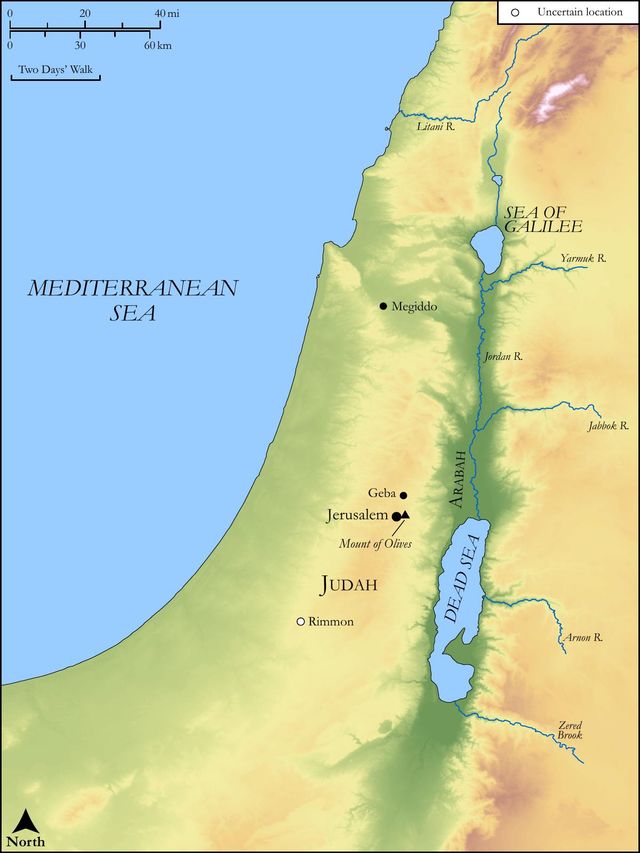
See on the biblical-era map
Study this verse
Public-domain commentary
Matthew Henry
From his Commentary on the Whole Bible. Henry comments on passages, not single verses — this entry covers Zechariah 12:1–8. His four-level outline is real structure in the source text, so it is rendered as structure.
Here is, I. The title of this charter of promises made to God's Israel; it is the burden of the word of the Lord, a divine prediction; it is of weight in the delivery of it; it is to be pressed upon people, and will be very pressing in the accomplishment of it; it is a burden, a heavy burden, to all the church's enemies, like that talent of lead, Zac 5:7, Zac 5:8. But it is for Israel; it is for their comfort and benefit. As even the fiery law (Deu 33:2), so the fiery prophecies and fiery providences that come from God's right hand, come for them; the word that speaks terror to their enemies speaks peace to them, as the pillar of cloud and fire, which turned a bright side towards the Israelites, to direct and encourage them, but a black side towards the Egyptians, to terrify and dispirit them. Happy are those that have even the burdens of God's word for them, as well as the blessings of it.
II.The title of him that grants this charter, which is prefixed to it to show that he has both authority to make these promises and ability to make them good, for he is the Creator of the world and our Creator, and therefore has an incontestable irresistible dominion.
1.He stretches out the heavens; not only he did so at the first, when he said, Let there be a firmament, and he made the firmament, but he does so still; he keeps them stretched out like a curtain, keeps them from running in, and will do so till the end come, when the heavens shall be rolled together as a scroll. No bounds can be set to his power who stretches out the heavens, nor can any thing be too hard for him.
2.He lays the foundation of the earth, and keeps it firm and fixed on its own basis, or rather on its own axis, though it is founded on the seas (Psa 24:1, Psa 24:2), nay, though it is hung upon nothing, Job 26:7. The founder of this earth is no doubt the ruler of it, and judges in it, and those deceive themselves who say, The Lord has forsaken the earth, for, if he had, it would have sunk, since it is he that not only did lay its foundations at first, but does still lay them, still uphold them.
3.He forms the spirit of man within him. He made us these souls, Jer 38:16. He not only breathed into the first man, but still breathes into every man the breath of life; the body is derived from the fathers of our flesh, but the soul is infused by the Father of spirits, Heb 12:9. He fashions men's hearts; they are in his hand, and he turns them as the rivers of water, and casts them into what mould he pleases, so as to serve his own purposes with them; and he can therefore save his church by inspiriting his friends and dispiriting his enemies, and will eternally save all his chosen by forming their spirits anew.
III.The promises themselves that are here made them, by which the church shall be secured, and in which all its friends may enjoy a holy security.
1.It is promised that, whatever attacks the enemies of the church may make upon her purity or peace, they will certainly issue in their own confusion. The enemies of God and of his kingdom bear a great deal of malice and ill-will to Jerusalem, and form designs for its destruction; but it will prove, at last, that they are but preparing ruin for themselves; Jerusalem is in safety, and those are in all the danger who fight against it. This is here illustrated by three comparisons: -
(1.)Jerusalem shall be a cup of trembling to all that lay siege to it, Zac 12:2. They promise themselves that it shall be to them a cup of wine, which they shall easily and with pleasure drink off, and they thirst for its spoils, nay, they thirst for its blood, as for such a cup; but it shall prove a cup of slumber, nay, a cup of poison, to them, which, when they take it into their hands, and think it is all their own, they shall not be able to drink off: the fumes of it shall give them enough. When the kings were assembled against her, and saw how God was known in her palaces for a refuge, they trembled and hasted away; fear took hold upon them, as we find, Psa 48:3-6. Thus Alexander the Great was struck with amazement when he met Jaddus the high priest, and was deterred thereby from offering any violence to Jerusalem. When Sennacherib laid siege against Judah and Jerusalem he found them such a cup of stupifying wine as laid all his mighty men asleep, Psa 76:5, Psa 76:6. Some read it, I will make Jerusalem a post of contrition or breaking. Those that make any attempts upon Jerusalem do but run their heads against a post, which they cannot move, but are sure to hurt themselves. The blast of the terrible ones is as a storm against the wall (Isa 25:4), broken by it, but not shaking it. God's church is a cup of consolation to all her friends (Isa 66:11), but a cup of trembling to all that would either debauch her by errors and corruptions or destroy her by wars and persecutions. See Isa 51:22, Isa 51:23.
(2.)Jerusalem shall be a burdensome stone to all that attempt to remove it or carry it away, Zac 12:3. All the people of the earth are here supposed to be gathered together against it, some one time and some another; there has been a succession of enemies, from age to age, making war upon the church. But though they were all at once in a confederacy against it, and had formed a resolution to cut off the name of Israel, that it should be no more in remembrance (Psa 83:4), they will find it a task too hard for them. Those that are for keeping up and advancing the kingdom of sin in the world look upon Jerusalem, even the church of God, as the great obstacle to their designs, and they must have it out of the way; but they will find it heavier than they think it is; so that,
[1.]They cannot remove it. God will have a church in the world, in spite of them; it is built upon a rock, and is as Mount Zion, that abides for ever, Psa 125:1. This stone, cut out of the mountain without hands, will not only keep its ground, but fill the earth, Dan 2:35. Nay,
[2.]It will break in pieces all that burden themselves with it, as that stone smote the image, Dan 2:45. All that think themselves a match for it shall be cut in pieces by it. Some think it is an allusion to a sport which Jerome, upon this place, says was in use among the Jews, as among us: young men tried their strength, and strove for mastery, by heaving up great stones, which, if they proved too heavy for them, fell upon them, and bruised them. Those that make a jest of religion, and banter sacred things, will find them a burdensome stone, that it is ill-jesting with edged-tools, and though they make light of it (saying, Am not I in sport?) they bring upon themselves an insupportable sinking load of guilt. Our Saviour seems to allude to these words when he speaks of himself as a burdensome stone to those that will not have him for their foundation-stone, which shall fall upon them and grind them to powder, Mat 21:44.
(3.)The governors of Judah shall be among their enemies like a hearth of fire among the wood, and a torch of fire in a sheaf, Zac 12:6. Not that their own passions shall make them incendiaries and firebrands to all about them; no; Zion's King is meek and lowly, and all subordinate governors must be like him; but God's justice will make them avengers of his cause, and theirs, upon their enemies. Those that contend with them will find it is like an opposition given by briers and thorns to a consuming fire, Isa 27:4. It will go through them, and burn them together. It is God's wrath, and not theirs, that is the fire which devours the adversaries. God's fire is said to be in Zion, and his furnace in Jerusalem. Isa 31:9. The enemies thought to be as water to this fire, to extinguish it and put it quite out; but God will make them as wood, nay, as a sheaf of corn (which is more combustible), to this fire, not only to be consumed by it, but to be made thereby to burn the more strongly. When God would make Abimelech and the men of Shechem one another's destroyers fire is said to come out from the one to devour the other, Jdg 9:20. So here, Fire shall come out from the governors of Judah to devour all the people round about, as from the mouth of God's witnesses to consume those who offer to hurt them, Rev 11:5. The persecutors of the primitive church found this fulfilled in it, witness Lactantius's history of God's judgments upon the primitive persecutors, and the confession of Julian the apostate at last. Thou hast overcome me, O thou Galilean! The church's motto may be, Nemo me impune lacesset - He that assails me does it at his peril. If you are weary of your life, persecute the Christians, was once a proverb.
2.It is promised that God will infatuate the counsels and enfeeble the courage of the church's enemies (Zac 12:4): "In that day, when the people of the earth are gathered together against Jerusalem, I will smite every horse with astonishment, and his rider with madness;" and again, "I will smite every horse of the people with blindness, so that they shall be no way serviceable to them; blinding the horses will be as bad as houghing them." The horses and their horsemen shall both forget the military exercise to which they were trained, and, instead of keeping ranks and observing the rules of their discipline, they shall both grow mad, and ruin themselves. The church's infantry shall be too hard for the enemy's cavalry; and those who were upbraided with trusting in horses shall be baffled by those who were forbidden to multiply horses.
3.It is promised that Jerusalem shall be re-peopled and replenished (Zac 12:6): Jerusalem shall be inhabited again in her own place, even in Jerusalem. The natives of Jerusalem shall not incorporate in a colony in some other country, and build a city there, and call that Jerusalem, and see the promises fulfilled in that, as those in New England called their towns by the names of towns in Old England. No; they shall have a new Jerusalem upon the same foundation, the same spot of ground, with the old one. They had so after their return out of captivity, but this was to have its full accomplishment in the gospel-church, which is a Jerusalem inhabited in its own place; for, the gospel being to be preached to all the world, it may call every place its own.
4.It is promised that the inhabitants of Jerusalem shall be enabled to defend themselves, and yet shall be taken under the divine protection, Zac 12:8. See here in what method God preserves his church, and those that are his, from the gates of hell to and through the gates of heaven.
(1.)He does himself secure them: In that day shall the Lord defend the inhabitants of Jerusalem, not only Jerusalem itself from being taken and destroyed, but every inhabitant of it from being any way damaged. God will not only be a wall of fire about the city, to fortify that, but he will encompass particular persons with his favour as with a shield, so that no dart of the besiegers shall touch them.
(2.)He does it by giving them strength and courage to help themselves. What God works in his people by his grace contributes more to their preservation and defence than what he works for them by his providence. The God of Israel gives strength and power to his people, that they may do their part, and then he will not be wanting to do his. it is the glory of God to strengthen the weak, that most need his help, that see and own their need of it, and will be the most thankful for it.
[1.]In that day the feeblest of the inhabitants of Jerusalem shall be as David, shall be men of war, as bold and brave, as skilful and strong, as David himself, shall attempt and accomplish great things, as David did, and become as serviceable to Jerusalem in guarding it as David himself was in founding it, and as formidable as he was to the enemies of it. See what divine grace does; it makes children not only men, but champions, makes weak saints to be not only good soldiers, but great soldiers, like David. And see how God often does his own work as easily and effectually, and more to his own glory, by weak and obscure instruments than by the most illustrious.
[2.]The house of David shall be as God, that is, as the angel of the Lord, before them. Zerubbabel was now the top-branch of the house of David; he shall be endued with wisdom and grace for the service to which he is called, and shall go before the people as an angel, as that angel (so some think) which went before the people of Israel through the wilderness, which was God himself, Exo 23:20. God will increase the gifts and abilities both of the people and princes, in proportion to the respective services for which they are designed. It was said of David that he was as an angel of God, to discern good and bad, Sa2 14:17. Such shall the house of David now be. The inhabitants of Jerusalem shall be as strong and fit for action as nature made David, and their magistrates as wise and fit for counsel as grace made him. But this was to have its full accomplishment in Christ; now the house of David looked little and mean, and its glory was eclipsed, but in Christ the house of David shone more brightly than ever, and its countenance was as that of an angel; in him it became more blessed, and more a blessing, than ever it had been.
5.It is promised that there shall be a very good understanding between the city and the country, and that the balance shall be kept even between them; there shall be no mutual envies or jealousies between them; they shall not keep up any separate interests, but shall heartily unite in their counsels, and act in concert for the common good; and this happy agreement between the city and the country, the head and the body, is very necessary to the health, welfare, and safety of any nation.
(1.)The governors of Judah, the magistrates and gentry of the country, shall think honourably of the citizens, the inhabitants of Jerusalem, the merchants and tradesmen; they shall not run them down, and contrive how to keep them under, but they shall say in their hearts, not in compliment but in sincerity, The inhabitants of Jerusalem shall be my strength, the strength of my country, of my family, in the Lord of hosts their God, Zac 12:5. They will therefore, upon all occasions, pay respect and deference to Jerusalem, as the mother-city, the ruling-city, and the city that is to be first served, because they look upon it to be the bulwark of the nation and its strongest fortification in times of public danger and distress, which therefore they would all come in to the assistance of and come under the protection of, and this not so much because it was a rich city, and money is the sinews of war, nor because it was a populous city and could bring the greatest numbers into the field, nor because its inhabitants were generally the most ingenious active men, the best soldiers and the best commanders (of Zion it shall be said, This and that brave man were born there), but because it was a holy city, where God's house and household, the temple and the priests, were, where his worship was kept up and his feasts were observed, and because it should now be more than ever a praying city, for upon the inhabitants of Jerusalem God will pour a spirit of supplication (Zac 12:10); therefore the governors of Judah shall say, These are my strength; they are so upon the account of their relation to, their interest in, and their communion with, the Lord of hosts, their God. Because the Lord of hosts is in a particular manner their God (for in Salem is his tabernacle and his dwelling-place in Zion), therefore they shall be my strength. Note, It is well with a kingdom when its great men know how to value its good men, when its governors look upon religion and religious people to be their strength, and consider it their interest to support them, and learn to call godly praying people, and skilful faithful ministers, the chariots and horsemen of Israel, as Joash called Elisha, and not the troublers of the land, as Ahab called Elijah.
(2.)The court and the city shall not despise, nor look with contempt upon, the inhabitants of the country; no, not the meanest of them, much less upon the governors of Judah; for God will put signal honour upon Judah, and so save them from the contempt of their brethren. As Jerusalem was dignified by special ordinances, so Judah shall be dignified with special providences. God says (Zac 12:4), I will open my eyes upon the house of Judah, upon the poor country people. Proud men scornfully overlook them, but the great God will graciously look upon them and look after them. Nay, (Zac 12:7), the Lord shall save the tents of Judah first. Those that dwell in tents lie most exposed; but God will remarkably protect and deliver them before those that dwell in Jerusalem. He will appear glorious in what he does for the inhabitants of his villages in Israel, Jdg 5:11. Thus, in the mystical body, God gives more abundant honour to that part which lacked, that there may be no schism in the body (see Co1 12:22-25), which is the reason here given why the glory of the house of David, which has great power, and the glory of the inhabitants of Jerusalem, who have great wealth, and both which live in great pomp and pleasure, may not magnify themselves against Judah and the tents of Judah, the dwellers in which work hard, and fare hard, and perhaps are not so well bred. Note, Courtiers and citizens ought not to despise country people, nor look with disdain upon those whom God opens his eyes upon and who are first saved, while it is so hard for the rich and great to enter the kingdom of God. If God by his grace has magnified the dwellers in the tents of Judah, having chosen the weak and foolish things of the world and chosen to employ them, we affront him if we vilify them, or magnify ourselves against them, Jam 2:5, Jam 2:6. This promise has a further reference to the gospel-church, in which no difference shall be made between high and low, rich and poor, bond and free, circumcision and uncircumcision, but all shall be alike welcome to Christ, and partake of his benefits, Col 3:11. Jerusalem shall not then be thought, as it had been, more holy than other parts of the land of Israel.
Historical interpretation
Historical reception
5 surviving comments on this verse. Each one is dated, so this reads as a timeline rather than a list.
Select a marker to jump to its quote. Markers stagger vertically where authors wrote within a few decades of each other.
There are many statements of spirit in general in the sacred Scriptures, and a person could easily become confused from ignorance, if he did not know to what sort of spirit the particular text refers; therefore we must be sure of the nature of the Holy Spirit according to Scripture. For example, Aaron is called Christ (anointed), and David also, and Saul and others are called christs, yet there is only one true Christ; similarly, since the name of spirit has been given to many things, we must determine what in particular is called the Holy Spirit. Many things are called spirits; our soul is called spirit; this wind, which is blowing, is called spirit; great valor is called spirit; impure action is called spirit; and a hostile devil is called spirit. Take care, therefore, when you hear such things, not to mistake one for another because of the similarity of the name. Scripture says of the soul, “When his spirit departs, he returns to the earth”; and again of the soul: “Who forms the spirit of man within him.”
Therefore he referred the thunders to the words of the Lord, the sound of which went out into all the earth. And we understand the word spirit in this place of the soul, which he took endowed with potential reason and perfection. For the Scripture often designates the soul of humankind by the word spirit, as you read: “Who creates the spirit of man within him.” So too the Lord signified his soul by the word spirit, when he said, “Into your hands I commend my spirit.”
(Chapter 12, Verse 1) The burden of the word of the Lord over Israel: says the Lord, who stretches out the heavens, and lays the foundation of the earth, and forms the spirit of man within him: Behold, I will make Jerusalem a cup of trembling unto all the people round about, and Judah shall be in siege against Jerusalem. And in that day will I make Jerusalem a burdensome stone for all people: all that burden themselves with it shall be cut in pieces, though all the people of the earth be gathered together against it. LXX: The Assumption of the word of the Lord upon Israel, says the Lord, stretching out the heavens and founding the earth, and forming the spirit of man within it: Behold, I will bring Jerusalem to be a threshold that is moved in a circuit by all peoples, in Judah and around Jerusalem. And there will be a siege around Jerusalem, and it will be in that day, I will make Jerusalem a stone to be trampled upon by all nations: whoever tramples upon it will mock it, and I will gather all the nations of the earth against it. There are three interpretations of this passage, from the place where we read: Behold, I will place Jerusalem as a cup of intoxication to all the peoples around, until the place where it is written (Ch. XIII, v. 7): Stir up the sword against my shepherd, and against the man who stands beside me, says the Lord of hosts: Strike the shepherd, and the sheep will be scattered. Others among the Jews believe that this has already been partially fulfilled by Zerubbabel, up to C. Pompey, who was the first of the Romans to capture Judea and the temple, as Josephus writes. But others maintain that when Jerusalem has been rebuilt, it will be at the end of the world: which promise is made to the wretched Jewish people, along with their blinded shepherd, whom we read about above. But others, that is, we who are called by the name of Christ, in the Church until the end of the world, remember daily to be fulfilled and to fulfill. And lest we extend the length of the volume with details, we present it in the following way: These say this, others suspect this, we feel this way, and we have presented three opinions so that the diligent reader can understand what should be fittingly attributed to whom, based on the diversity of interpretation. Therefore, the Lord who stretched out the heavens like a skin, and solidified the earth with a high mass, and formed the spirit of man within it, is the same Creator of all souls, so that he might form one living being from two substances, the soul and the body. For the spirit is often understood as the soul, as it is said: Father, into your hands I commend my spirit (Luke 23:46). And: You will take away their spirit, and they will die and return to their dust (Psalm 104:29). Therefore, this Creator of the universe and Lord testifies that He will set Jerusalem as a threshold of stumbling for all the surrounding peoples, so that whoever touches its threshold will be intoxicated and fall, or if the threshold itself falls upon him from whom it is touched. But even Judas, besieged Jerusalem, is captured by the Gentiles, and in passing into their fellowship, he will be compelled to besiege his own metropolis. Moreover, not only will the Lord make Jerusalem a threshold of stumbling for all peoples, but He will also make it a stone of burden for all peoples, and whoever wants to lift it will be torn apart by laceration. For all the kingdoms of the earth will gather against Jerusalem. It is a custom in the cities of Palestine, and even to this day throughout all Judaea, that in villages, towns, and fortresses, large stones of great weight are placed, for young men to exercise themselves and lift them according to their strength. Some lift them up to their knees, some up to their waist, some up to their shoulders and head, and some even above their heads, demonstrating the magnitude of their strength with straight and joined hands. In the citadel of the Athenians, near the statue of Minerva, I saw a bronze sphere of immense weight, which I could hardly move due to my own weakness. When I asked what it was for, I was told by the city's inhabitants that it was used to test the strength of athletes, and no one was allowed to participate in the games until their ability to lift the weight was determined. Therefore, the meaning is this: I will set Jerusalem as a heavy stone for all nations to lift. Indeed, they will lift it up, and, according to the variety of their strength, they will devastate it; but it is necessary that, while it is being lifted up, in the very exertion and elevation of the weight, the heaviest stone leaves some crack or scrape on the bodies that are lifting it. The Church can be interpreted in this way, that all persecutors who have fought against the house of the Lord will be intoxicated by the same cup with which Jeremiah offers to drink to all nations, so that they may drink, and be intoxicated, and fall, and vomit, and go mad (Jer. XXV). I know that in a time of persecution many of our people are being forced to fight against the Church; but whoever desires to lift this burden, will indeed lift it, and with his own hands will support it, for he will not go unpunished, with the sword of the Lord fighting against him. The stone of burden, which we have interpreted as best we could, the Seventy have translated as a stone trampled on by all nations. Whoever tramples on it (that is, Jerusalem) will be mocked. The meaning is clear, that Jerusalem is to be trampled upon and mocked by both enemy nations and persecutors as they please. But the higher meaning is better and truer. We will briefly explain each point, so that we may finally come to the conclusion, lest if we have written at length, the mind of the Reader be confused by the obscurity of events and the length of the discourse.
Hence we ought to understand this passage so that we do not take the words “he breathed into him the breath of life, and he became a living soul” to mean that a part, as it were, of the nature of God was turned into the soul of man. Thus we are not forced to say that the nature of God is mutable. It is especially in this error that the truth weighs down upon these Manichaeans. For as pride is the mother of all the heretics, they dared to say that the soul is the nature of God. And thus they are under pressure from us when we say to them, “Then the nature of God errs and is unhappy and is corrupted by the stain of vices and sins, or is, as you say, soiled by the filth of the opposing nature,” and other such things that it is wicked to believe about the nature of God. For in another passage Scripture clearly says that the soul was made by almighty God and that it is therefore not a part of God or the nature of God. There the prophet says, “He who formed the spirit for all men made all things,” and in another place it says, “He who formed the spirit of man is in him.” These testimonies clearly prove that the spirit of man was made. In Scripture the rational part of man’s soul by which he differs from the beasts and rules over them by the law of nature is called the spirit of man. On this the apostle says, “No one knows what pertains to man except the spirit of man which is within him.” If these testimonies were not clear proof that the soul of man was made, there would be no lack of those who would say that the spirit of man was not made and who would think that it is the nature of God and say that part of God was changed into it, when there took place that breathing forth by God. Healthy doctrine likewise rejects this, because the spirit of man itself is at times in error and at times thinks wisely; thus it proclaims that it is mutable, and it is in no way permissible to believe this of the nature of God. But there cannot be a greater sign of pride than that the human soul says that it is what God is, while it still groans under such great burdens of vice and unhappiness.
I do not want anyone to tell me that this view [that God condemns innocent souls] should be supported by the passage “who formed the spirit of man in him” and “who made the heart of every one of them.” Something supremely strong and invincible is needed to force me to believe that God condemns any souls without any guilt of theirs. It is either as great a thing, or it is, perhaps greater, to create as to form, yet it is written, “Create a clean heart in me, O God.” This is no argument for thinking that the soul in this passage prays to be made before it had any being. As, therefore, while now existing, it is created by renewal of its justice, so, while now existing, it is formed by the shaping force of doctrine.
Continue studying Zechariah 12:1 across the web’s major study libraries — every link below opens this exact verse, chapter, or book on the destination site.
Read & Compare
 BibleGatewayThis verse in more than 200 translations and 70 languages.
 Bible.comThe YouVersion reader — hundreds of translations, reading plans, and highlights.
 ESV.orgCrossway's official English Standard Version reader.
 NET BibleThe NET translation with 60,000+ translators' notes on every rendering decision.
 STEP BibleTyndale House's free study tool — original text, vocabulary, and scholarly resources.
 BibliaLogos Bible Software's free web reader.
 USCCBThe New American Bible (Revised Edition) with the U.S. bishops' study notes.
Commentaries
 BibleHub CommentariesDozens of classic commentaries on this verse, gathered on one page.
 StudyLightMore than 100 commentary sets — the largest collection on the web.
 BibleRefPlain-English commentary on what this verse means, verse by verse.
 Enduring WordDavid Guzik's free commentary on this chapter, widely used by Bible teachers.
 Bible Study ToolsVerse commentary alongside Greek and Hebrew study aids.
Original Language & Research
- BibleHub InterlinearThe verse word by word — original language, transliteration, and English.
- BibleHub LexiconEvery word's original-language definition and Strong's entry.
 Blue Letter BibleDeep-study tools — Strong's numbers, concordance, and word studies.
 SefariaThe Hebrew text with Rashi and centuries of Jewish commentary.
Sermons, Hymns & Audio


TrulyRandomVerse is not affiliated with these sites and doesn’t control their content. They’re linked because they’re genuinely useful.
Summary
Zechariah 12:1 introduces the final major prophetic oracle of the book, a "burden" from the LORD concerning Israel's future. This verse establishes the absolute authority and power of the divine speaker by majestically declaring His role as the sovereign Creator of all things, who stretches forth the heavens, lays the foundation of the earth, and intimately forms the spirit of humanity. It sets a profound theological foundation for the dramatic eschatological events that follow, affirming that the God who speaks these weighty prophecies is fully capable of bringing them to pass.
Context
ShowHideLiterary Context
Zechariah 12:1 marks a distinct shift in the book, initiating the second major prophetic oracle (chapters 12-14) which focuses specifically on the eschatological destiny of Jerusalem and the nation of Israel. While chapters 9-11 also contain prophetic burdens concerning Israel's future and the coming Messiah, chapters 12-14 delve into a climactic period of conflict, divine intervention, and spiritual restoration. This opening verse serves as a grand, authoritative preamble, underscoring the omnipotence of the God who is about to reveal profound truths concerning the end times. The use of "burden" (Hebrew: massâʼ) signals a weighty, divinely authoritative pronouncement, often associated with judgment or a significant divine act, setting a serious tone for the revelations to come.
Historical & Cultural Context
The Book of Zechariah was written during the post-exilic period (c. 520-518 BC), when the Jewish exiles had returned to Judah under Persian rule and were engaged in rebuilding the Second Temple. This era was marked by both hope and hardship, as the people faced internal struggles and external pressures. The prophecies in Zechariah often address the immediate concerns of the community (like temple rebuilding and leadership) but also extend far into the future, offering messianic hope and eschatological visions. The cultural understanding of God as Creator was foundational to Israelite theology, rooted in the creation narratives of Genesis. By invoking God's creative power, Zechariah reminds his audience—and subsequent readers—that the God who controls the very fabric of existence is the same God orchestrating the future of His people, regardless of their current circumstances.
Key Themes
ShowHideThis verse powerfully introduces several pivotal themes that resonate throughout Zechariah and the broader biblical narrative. Firstly, it emphasizes Divine Sovereignty and Omnipotence, portraying God as the ultimate Creator and sustainer of all things, from the vast heavens to the intricate human spirit. This assertion of God's absolute power provides the bedrock for the credibility of the dramatic prophecies that follow concerning Israel's future, reinforcing that the God who initiates these events is fully capable of bringing them to fruition (compare Isaiah 40:28). Secondly, the term "burden" highlights the Weight and Authority of Prophecy, indicating that the message is not merely human insight but a solemn, divinely inspired declaration with profound implications for Israel and the world. This concept of a prophetic "burden" is also seen in other prophetic books, such as Malachi 1:1. Thirdly, the explicit declaration that this oracle is "for Israel" underscores God's Enduring Covenant Faithfulness to His chosen people, despite their historical failures. It sets the stage for the dramatic events and spiritual transformation described in the subsequent chapters, demonstrating God's unwavering commitment to His ultimate plan for their redemption and restoration (see Jeremiah 31:3).
Exposition and Analysis
ShowHideKey Word Analysis
ShowHideMeaning a burden; specifically, tribute, or (abstractly) porterage; figuratively, an utterance, chiefly a doom, especially singing; mental, desire. In this context, it signifies a weighty, authoritative, and divinely inspired prophetic oracle, often carrying a sense of solemnity, warning, or significant pronouncement. It implies a message that is heavy with divine import and certainty.
Meaning to mould into a form; especially as a potter; figuratively, to determine (i.e., form a resolution). This word emphasizes God's active, intentional, and artistic involvement in creation, much like a potter shapes clay. It speaks to His deliberate design and sovereign control over the formation of both the physical and non-physical aspects of existence.
Meaning wind; by resemblance breath, i.e., a sensible (or even violent) exhalation; figuratively, life, anger, unsubstantiality; by extension, a region of the sky; by resemblance spirit, but only of a rational being (including its expression and functions). Here, it refers to the non-physical, animating essence of human beings—the inner life, mind, and consciousness that God uniquely imparts.
Verse Breakdown
ShowHide"The burden of the word of the LORD for Israel, saith the LORD,"
This opening clause establishes the nature and source of the prophecy. "The burden" (Hebrew: massâʼ) indicates a weighty, solemn, and authoritative prophetic utterance, not merely a message but a divine pronouncement that carries significant implications. It is explicitly "of the word of the LORD," emphasizing its divine origin and absolute truthfulness. The phrase "for Israel" clearly identifies the primary recipient and subject of this oracle, highlighting God's specific and enduring concern for His covenant people. The repetition "saith the LORD" reinforces the divine authority and certainty of the message.
"which stretcheth forth the heavens,"
This phrase begins a series of three majestic participles describing God's creative power. "Stretcheth forth" (Hebrew: nâṭâh) implies an expansive, deliberate act of creation, portraying God as the architect who unfurls the vast expanse of the heavens. This speaks to His immense power and control over the celestial realm.
"and layeth the foundation of the earth,"
Complementing the creation of the heavens, this clause describes God's establishment of the terrestrial realm. "Layeth the foundation" (Hebrew: yâçad) emphasizes God's role as the master builder, establishing the earth with stability and order. This highlights His sovereignty over the physical world and its very existence.
"and formeth the spirit of man within him."
This final creative act shifts focus from the heavens and the earth to the intimate. "Formeth" (Hebrew: yâtsar) suggests the careful, deliberate work of a potter, emphasizing God's personal involvement in shaping human life. The creation of "the spirit of man within him" points to God's unique act of imparting the non-physical, animating essence to humanity, distinguishing humans from all other created beings and demonstrating His profound sovereignty over every individual's inner being and life force.
Literary Devices
ShowHideZechariah 12:1 is rich in literary devices that amplify its theological weight. The opening phrase, "The burden of the word of the LORD," is a powerful example of a Prophetic Oracle formula, immediately signaling a divinely authoritative and significant message. The triple declaration of God's creative acts—stretching forth the heavens, laying the foundation of the earth, and forming the spirit of man—is a form of Merism, where two contrasting or extreme elements (heavens and earth) are used to encompass the totality of creation, with the added detail of the human spirit emphasizing God's comprehensive sovereignty over all realms, both vast and intimate. This tripartite structure also functions as a Climax, moving from the vastness of the heavens to the intricate, personal creation of the human spirit, underscoring the depth and breadth of God's power. The descriptions of God as the one who "stretcheth forth," "layeth the foundation," and "formeth" use Divine Epithets and Anthropomorphic Language (attributing human actions like stretching or laying foundations to God) to convey His active, personal, and intentional involvement in creation, making His power relatable and awe-inspiring.
Theological and Thematic Connections
ShowHideZechariah 12:1 profoundly establishes God's absolute sovereignty as Creator as the bedrock for His future redemptive and judgmental actions concerning Israel. The God who is about to intervene dramatically in human history is the same God who brought all existence into being, from the vast heavens to the innermost spirit of man. This foundational truth assures the reader that His prophetic word is not merely a prediction but a declaration of what He, in His infinite power, will certainly accomplish. It underscores that God's covenant faithfulness to Israel, even in the face of their failures, is rooted in His unchanging character as the omnipotent Creator, capable of bringing about their ultimate restoration and the establishment of His kingdom.
Reflection and Application
ShowHideZechariah 12:1 serves as a profound anchor for faith, reminding us that the God who speaks is the all-powerful, all-knowing Creator of everything. His words, whether promises of salvation or warnings of judgment, are not empty pronouncements but are backed by His infinite power and authority over all creation. This verse calls us to profound awe and worship, recognizing that the very being who sustains the heavens and the earth also intimately formed our individual spirits. In a world often filled with uncertainty and fear, understanding God's comprehensive sovereignty, as declared in this verse, should instill deep confidence in the reliability of His Word and His unwavering ability to bring about His purposes, both globally and personally. It encourages us to trust His plans for our lives and for the world, knowing that the Creator of all things is meticulously at work.
Questions for Reflection
ShowHideFAQ
ShowHideWhat does "The burden of the word of the LORD" mean in Zechariah 12:1?
ShowHideThe phrase "The burden of the word of the LORD" (Hebrew: massâʼ dâbâr Yᵉhôvâh) signifies a weighty, solemn, and authoritative prophetic oracle. The Hebrew word massâʼ (burden) implies something that is "lifted up" or "carried," often referring to a heavy pronouncement, a divine utterance that carries significant implications, whether of judgment, warning, or a momentous revelation. It is not merely a message but a divinely inspired declaration that demands serious attention and carries the full weight of God's authority. This phrase is used in other prophetic books to introduce major oracles, such as in Isaiah 13:1 or Nahum 1:1, indicating a message of profound importance and certain fulfillment from the sovereign God.
Christ-Centered Fulfillment
ShowHideZechariah 12:1, with its majestic declaration of God as the Creator of the heavens and the earth and the former of the human spirit, finds profound Christ-centered fulfillment. The New Testament reveals that Jesus Christ is not merely an agent of creation but is Himself the divine Creator, through whom and for whom all things were made. Colossians 1:16 explicitly states, "For by him were all things created, that are in heaven, and that are in earth, visible and invisible... all things were created by him, and for him." Similarly, John 1:3 affirms, "All things were made by him; and without him was not any thing made that was made." Thus, the "LORD" who "stretcheth forth the heavens, and layeth the foundation of the earth" is none other than the pre-incarnate Christ, the eternal Son. Furthermore, the intimate act of "forming the spirit of man within him" points to Christ's ongoing work, not only in physical creation but in the spiritual re-creation of humanity. Through His atoning sacrifice and resurrection, Christ offers new life, forming a new spirit within believers, as described in 2 Corinthians 5:17, where "if any man be in Christ, he is a new creature: old things are passed away; behold, all things are become new." The God who sovereignly created all things is the same God who, in Christ, sovereignly redeems and transforms the human spirit, fulfilling the ultimate "burden" of salvation and the establishment of His eternal kingdom.