


Zechariah 11:17
Bible text: King James Version (1769 Blayney text) · Public domain
Bible text: King James Version with Strong's numbers · Public domain
Bible text: Berean Standard Bible · Public domain
Bible text: American Standard Version (1901) · Public domain
Bible text: World English Bible, Messianic edition · Public domain
Bible text: Geneva Bible (1599) · Public domain
Bible text: Young's Literal Translation · Public domain
- הוֹיHowoe to!H1945PrtParticle Interjection
- רֹעִיro·'Imy shepherd ofH7462V-Qal-Prtcpl-ms ¦ 1csVerb Qal Participle Singular Masculine Constructרֹעִshepherd ofיmy
- הָאֱלִילha·'e·Lil<the> worthlessnessH457Art ¦ N-msNoun Singular Masculine Absoluteהָ<the>אֱלִילworthlessness
- עֹזְבִי'o·ze·Vi[who] abandonsH5800V-Qal-Prtcpl-msVerb Qal Participle Singular Masculine Construct
- הַצֹּאןha·Tzon<of> the flockH6629Art ¦ N-csNoun Singular common gender Absoluteהַ<of> theצֹּאןflock
- חֶרֶבChe·reva swordH2719N-fsNoun Singular Feminine Absolute
- עַל'al[will be] onH5921PrepPreposition
- זְרוֹעוֹze·ro·'Ohis armH2220N-fsc ¦ 3msNoun Singular Feminine Constructזְרוֹעarmוֹhis
- וְעַלve·'aland onH5921Conj-w ¦ PrepPrepositionוְandעַלon
- עֵין'ein[the] eye ofH5869N-fscNoun Singular Feminine Construct
- יְמִינוֹye·mi·Nohis right [side]H3225N-fsc ¦ 3msNoun Singular Feminine Constructיְמִינright [side]וֹhis
- זְרֹעוֹze·ro·'Ohis armH2220N-fsc ¦ 3msNoun Singular Feminine Constructזְרֹעarmוֹhis
- יָבוֹשׁya·Vo·oshtotally <wither>H3001V-Qal-InfAbsVerb Qal Infinitive Absolute
- תִּיבָשׁti·Vashit will witherH3001V-Qal-Imperf-3fsVerb Qal Imperfect 3rd Singular Feminine
- וְעֵיןve·'Einand [the] eye ofH5869Conj-w ¦ N-fscNoun Singular Feminine Constructוְandעֵין[the] eye of
- יְמִינוֹye·mi·Nohis right [side]H3225N-fsc ¦ 3msNoun Singular Feminine Constructיְמִינright [side]וֹhis
- כָּהֹהka·Hohcertainly <to dim>H3543V-Qal-InfAbsVerb Qal Infinitive Absolute
- תִכְהֶהtikh·Hehit will grow dimH3543V-Qal-Imperf-3fsVerb Qal Imperfect 3rd Singular Feminine
English is a literal word-by-word gloss of the Hebrew, not the KJV's wording. Why?
This is the original text the KJV's translators worked from — each Hebrew word with its own literal English meaning in this verse, prepared by scholars at Tyndale House, Cambridge. The KJV translates whole sentences, not word by word, so its wording differs: one Hebrew word can become several English words, and the KJV may choose “the LORD” where the gloss reads “Yahweh”. Both are faithful — they answer different questions. For the KJV's own rendering, switch to the KJV text.
Details
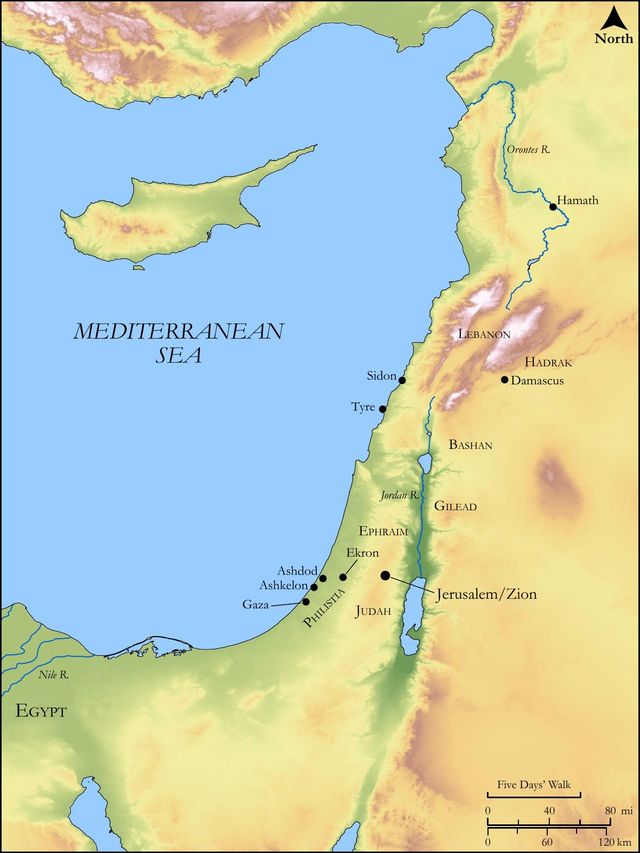
See on the biblical-era map
Study this verse
Public-domain commentary
Matthew Henry
From his Commentary on the Whole Bible. Henry comments on passages, not single verses — this entry covers Zechariah 11:15–17. His two-level outline is real structure in the source text, so it is rendered as structure.
God, having shown the misery of this people in their being justly abandoned by the good Shepherd, here shows their further misery in being shamefully abused by a foolish shepherd. The prophet is himself to personate and represent this pretended shepherd (Zac 11:15): Take unto thee the instruments or accoutrements of a foolish shepherd, that are no way fit for the business, such a shepherd's coat, and bag, and staff, as a foolish shepherd would appear in; for such a shepherd shall be set over them (Zac 11:16), who, instead of protecting them, shall oppress them and do them mischief. 1. They shall be under the inspection of unfaithful ministers. Their scribes, and priests, and doctors of their law, shall bind heavy burdens upon them, and grievous to be borne, and, with their traditions imposed, shall make the ceremonial law much more a yoke than God had made it. The description here given of the foolish shepherd suits very well with the character Christ gives of the scribes and Pharisees, Mat 23:2. They shall be under the tyranny of unmerciful princes, that shall rule them with rigour, and make their own land as much a house of bondage to them as ever Egypt or Babylon was. When they had rejected him by whom princes decree justice it was just that they should be turned over to those who decree unrighteous decrees. 3. They shall be imposed upon and deluded by false Christs and false prophets, as our Saviour foretold, Mat 24:5. Many such there were, who by their seditious practices provoked the Romans, and hastened the ruin of the Jewish nation; but it is observable that they were never cheated by a counterfeit Messiah till they had refused and rejected the true Messiah. Now observe,
I.What a curse this foolish shepherd should be to the people, Zac 11:16.
God will, for their punishment, raise up a foolish shepherd, who will not do the duty of a shepherd; he will not visit those that are cut off, nor go after those that go astray, nor seek those that are missing, to find them out and bring them home, as the good shepherd does, Mat 18:12, Mat 18:13. Their shepherds take no care of the young ones, that need their care and are well worthy of it, as Christ does, Isa 40:11. They do not heal that which was broken, which was worried and torn, but let it die of its bruises, when a little thing, in time, would have saved it. They do not feed those who, through weakness, stand still, and are ready to faint, and cannot get forward, but leave them behind, let who will take them up; they do not carry that which stands still (so some read it); they never do any thing to support the weak and comfort the feeble-minded; but, on the contrary,
1.They are luxurious themselves: They eat of the flesh of the fat; they will have of the best for themselves; and, like that wicked servant that said, My lord delays his coming, they eat and drink with the drunken, and serve their own bellies.
2.They are barbarous to the flock. Their passions are as ill-governed as their appetites, for, when they are in a rage against any of the flock, they tear their very claws in pieces by over-driving them; they beat their hoofs; they smite their fellow servants. Woe unto thee, O land! when thy king is such a child!
II.What a curse this foolish shepherd should bring upon himself (Zac 11:17):
Woe to the idol-shepherd, who, like an idol, has eyes and sees not, who, like an idol, receives abundance of respect and homage from the people and the chief of their offerings, but neither can nor will do them any kindness. He leaves the flock when they most need his care, leaves them destitute, and flees, because he is a hireling; his doom is that the sword of God's justice shall be upon his arm and his right eye, so that he shall quite lose the use of both. His arm shall wither and be dried up, so that he who would not help his friends when it was required shall not know how to help himself; his right eye shall be utterly darkened, that he shall not discern the danger that his flock is in, nor know which way to look for relief. This was fulfilled when Christ said to the Pharisees, I have come that those who see may be made blind, Joh 9:39. Those that have gifts which qualify them to do good, if they do not do good with them, shall be deprived of them; those that should have been workmen, but were slothful and would do nothing, will justly have their arm dried up; and those that should have been watchmen, but were sleepy and would never look about them, will justly have their eye blinded.
Historical interpretation
Historical reception
1 surviving comment on this verse from the historical church.
(vv. 15 seqq.) And the Lord said to me: Take for yourself the vessels of a foolish shepherd. For behold, I will raise up a shepherd in the land who will not visit those who are abandoned, he will not seek the scattered, and he will not heal the broken. And what stands, he will not nourish, and he will eat the flesh of the fat ones, and he will dissolve their hoofs. O shepherd, forsaking the flock and the idol: a sword will be upon his arm and upon his right eye, his arm will be dried up with dryness, and his right eye will be darkened with darkness. LXX: And the Lord said to me: Take yet the instruments of a foolish shepherd. For behold I will raise up a shepherd in the land, who shall not visit what is forsaken, nor seek what is scattered, nor heal what is broken, nor nourish that which standeth, and he shall eat the flesh of the fat ones, and break their hoofs. O shepherd, that feedest the sheep, woe to the idle shepherd that forsaketh the flock: the sword upon his arm and upon his right eye: his arm shall quite wither away, and his right eye shall be utterly darkened. When he says, 'Take for yourself the vessels of a foolish shepherd,' it signifies that he had taken for himself two staffs, one called Favor, and the other called Union. And because he had thrown them away due to his own fault and sin, and the unity between Judah and Israel had been broken, we have been grafted into the root of the good olive tree, and blindness has come upon the house of Israel in part, until the fullness of the Gentiles comes in (Rom. 11). Now it is said to the prophet, as a most weighty foolish shepherd, or unwise, to assume the prophecy. The foolish and ignorant shepherd is undoubtedly the Antichrist; who is said to come at the end of the world, and the manner in which he will come is indicated. So we must take the shepherd's vessels, his symbols and attire, a purse, a staff, a flute, and a whistle. Just as Isaiah, in order to demonstrate the captivity of the people, enters naked (Isa. 20); and Jeremiah goes to the house of the potter, to show the destruction of the vessel which was spinning on the wheel, and to demonstrate the destruction of Israel and the power of God (Jer. 18); and Ezekiel, in order to demonstrate the overthrow of Jerusalem and the escape of Zedekiah, and the burdens of the captives, not only speaks but also demonstrates through his attire, by digging through the wall and carrying it on his shoulders (Ezek. 12); so does Zechariah take on the attire of the foolish and ignorant shepherd, to proclaim the one who is to come (Zech. 11). This shepherd will rise in Israel, for the true shepherd had said: I will no longer feed you. He is also called by another name in the prophet Daniel (Ch. IX), and in the Gospel (Mark XIII), and in the letter of Paul to the Thessalonians (II Thess. II), the abomination of desolation, who will sit in the temple of the Lord and will make himself out to be God, the one who is also referred to as the great sense through Isaiah (Isa. XXXII). And he has come for this purpose, not to heal, but to destroy the flock of Israel. For the good shepherd visits the sick sheep, seeks out the scattered ones, brings back the ones that have been left behind, and sustains the tired ones. On the other hand, the bad shepherd acts against everything, devours the flesh of the fat ones, dissolves the hooves of the rams and sheep, and perverts them so that they do not enter with a straight foot. The Jews received this shepherd, whom the Lord Jesus will kill with the breath of his mouth and render useless by the brightness of his coming, so that those who did not believe the truth may not be saved but believe in falsehood and be judged because they consented to wickedness. But describing the worst, foolish, and inexperienced shepherd, the prophetic discourse is directed to him, saying: O shepherd, and idol. So wicked is the shepherd that he is not called a worshiper of idols, but he himself is named an idol, while he calls himself God, and desires to be worshiped by all. He has abandoned the flock to be devoured by beasts, which the Lord had kept for so long. A sword is upon his arm, and strength, and upon his right eye, with which he proudly claimed to see the sacraments of God sharply, and to see more than all the prophets who came before, to the extent that he called himself the Son of God. But that sword, of which we have spoken above, and of which we will now speak in part, is the one about which Isaiah also speaks: My sword has become intoxicated in the heavens (Isa. XXXIV, 5). Therefore, the sword of the Lord will be upon his arm and upon his right eye, so that its strength and all the boasting of his power may be dried up by aridity, and the knowledge which he falsely promised to himself may be obscured by eternal darkness.
Continue studying Zechariah 11:17 across the web’s major study libraries — every link below opens this exact verse, chapter, or book on the destination site.
Read & Compare
 BibleGatewayThis verse in more than 200 translations and 70 languages.
 Bible.comThe YouVersion reader — hundreds of translations, reading plans, and highlights.
 ESV.orgCrossway's official English Standard Version reader.
 NET BibleThe NET translation with 60,000+ translators' notes on every rendering decision.
 STEP BibleTyndale House's free study tool — original text, vocabulary, and scholarly resources.
 BibliaLogos Bible Software's free web reader.
 USCCBThe New American Bible (Revised Edition) with the U.S. bishops' study notes.
Commentaries
 BibleHub CommentariesDozens of classic commentaries on this verse, gathered on one page.
 StudyLightMore than 100 commentary sets — the largest collection on the web.
 BibleRefPlain-English commentary on what this verse means, verse by verse.
 Enduring WordDavid Guzik's free commentary on this chapter, widely used by Bible teachers.
 Bible Study ToolsVerse commentary alongside Greek and Hebrew study aids.
Original Language & Research
- BibleHub InterlinearThe verse word by word — original language, transliteration, and English.
- BibleHub LexiconEvery word's original-language definition and Strong's entry.
 Blue Letter BibleDeep-study tools — Strong's numbers, concordance, and word studies.
 SefariaThe Hebrew text with Rashi and centuries of Jewish commentary.
Sermons, Hymns & Audio


TrulyRandomVerse is not affiliated with these sites and doesn’t control their content. They’re linked because they’re genuinely useful.
Summary
Zechariah 11:17 delivers a severe prophetic "woe" against a negligent and self-serving leader, metaphorically described as an "idol shepherd" who abandons his flock. This pronouncement details divine judgment, specifically targeting the shepherd's arm and right eye, symbolizing the incapacitation of his ability to act, protect, and discern, thereby rendering him utterly useless and blind to his responsibilities. The verse serves as a climactic condemnation within Zechariah's allegorical portrayal of Israel's corrupt leadership and God's righteous retribution.
Context
ShowHideLiterary Context
Zechariah 11 is a profound and somber prophetic allegory that depicts God's relationship with His people, particularly through the lens of their leadership. The chapter begins with a lament over the destruction of the land, followed by Zechariah's symbolic role as a shepherd of a flock "doomed to slaughter" (Zechariah 11:4). He carries two staffs, "Beauty" (or "Favor"), representing God's covenant with Israel, and "Bands" (or "Union"), symbolizing the unity between Judah and Israel (Zechariah 11:7). The breaking of "Beauty" signifies God's breaking of His covenant due to the people's rejection of Him and His true shepherd. The true shepherd, often understood as a prefigurement of the Messiah, is then rejected and valued at the price of a slave—thirty pieces of silver (Zechariah 11:12-13). Following this rejection, a "foolish" or "worthless" shepherd is appointed, who exploits and neglects the flock, failing to care for the perishing, lost, or injured (Zechariah 11:15-16). Zechariah 11:17 is the climactic pronouncement of divine judgment, the "woe," upon this worthless leader, summarizing God's righteous anger and the severe consequences of such abandonment.
Historical & Cultural Context
The book of Zechariah is set in the post-exilic period, around 520-518 BC, as the Jewish exiles had returned from Babylon and were engaged in rebuilding the temple in Jerusalem. This era was marked by spiritual and national challenges, with the people struggling to maintain their identity and faith under Persian rule. The concept of a "shepherd" was a common metaphor for leadership in Israel, applying to kings, priests, and prophets, who were expected to guide, protect, and provide for their people. Israel's history was replete with examples of both faithful and unfaithful leaders, from David, the shepherd-king, to numerous corrupt kings and prophets who led the people astray. The prophecy in Zechariah 11 reflects this historical reality, lamenting the failure of past and contemporary leaders who, instead of nurturing the flock, exploited it for personal gain. The divine judgment pronounced in this verse resonates with earlier prophetic condemnations of negligent leadership found throughout the Old Testament, such as in Ezekiel 34 and Jeremiah 23.
Key Themes
ShowHideZechariah 11:17 contributes significantly to several major themes within the book and broader biblical theology. A primary theme is Divine Judgment on Worthless Leadership. The "woe" pronounced is God's direct condemnation of leaders who abandon or exploit their spiritual and societal responsibilities, emphasizing that such negligence will not go unpunished. Another key theme is the Consequences of Negligence. The severe physical judgments—a withered arm and a darkened eye—are not merely literal punishments but powerful symbols of the loss of the very faculties essential for effective leadership: the ability to act decisively and protect (arm) and the capacity to discern, guide, and envision (eye). These punishments perfectly fit the crime of a shepherd who "leaveth the flock." Finally, the verse highlights the Contrast with the True Shepherd. By depicting the utter failure and judgment of the "idol shepherd," the prophecy implicitly, and later explicitly in the New Testament, sets the stage for the coming of the Good Shepherd who lays down His life for the sheep, in stark opposition to the self-serving and destructive nature of the worthless leader.
Exposition and Analysis
ShowHideKey Word Analysis
ShowHideThis word, often translated as "worthless," "insignificant," or "of no value," is derived from a root meaning "nothing." When applied to a shepherd, it describes a leader who is empty, useless, or brings no benefit to the flock. It signifies not necessarily a literal idol worshiper, but a leader whose actions are akin to worshiping a false god—their own self-interest—rather than genuinely caring for the flock. Such a leader is "good for nothing" in the eyes of God, failing to fulfill the divine mandate of true shepherding.
This primitive root means "to loosen, i.e., relinquish, permit, forsake, leave (destitute, off)." In the context of a shepherd, it denotes the deliberate abandonment of responsibility. This is not merely neglect but an active turning away from the flock, leaving them vulnerable to predators and distress. It highlights the shepherd's profound dereliction of duty, which is the core offense leading to the "woe."
The arm, as the limb stretched out for action, symbolizes strength, power, and the ability to act, protect, and provide. For a shepherd, the arm is crucial for wielding a staff, defending against threats, and guiding the sheep. The judgment that the arm "shall be clean dried up" signifies the complete incapacitation of the shepherd's strength and capacity for effective action.
The eye represents vision, discernment, guidance, and the ability to see and understand. For a shepherd, the eye is essential for watching over the flock, identifying dangers, finding pasture, and leading the sheep. The judgment that the right eye "shall be utterly darkened" symbolizes the complete loss of the shepherd's spiritual and practical insight, rendering him blind to the needs of the flock and incapable of providing proper guidance. The "right eye" specifically, often associated with strength and precision, emphasizes the complete removal of his most vital faculty for discernment.
Verse Breakdown
ShowHide"Woe to the idol shepherd that leaveth the flock!"
This opening pronouncement is a divine curse or lament, signaling a severe judgment. The "idol shepherd" (or "worthless shepherd") is identified as the recipient of this woe, specifically condemned for his egregious act of "leav[ing] the flock." This highlights the fundamental failure of his leadership: abandonment and negligence, rather than care and protection.
"the sword [shall be] upon his arm, and upon his right eye:"
This clause introduces the nature of the divine retribution. The "sword" here is not necessarily a literal weapon but a symbol of divine judgment and punitive action. It is directed specifically at the shepherd's "arm" and "right eye," indicating that the punishment will target the very faculties that a shepherd needs to perform his duties effectively.
"his arm shall be clean dried up,"
This describes the first consequence of the divine judgment. The "drying up" of the arm signifies the complete loss of strength, power, and the ability to act or provide. A shepherd with a withered arm is incapable of wielding his staff, defending his sheep, or leading them. This is a direct and fitting punishment for a leader who failed to use his strength for the flock's benefit.
"and his right eye shall be utterly darkened."
This describes the second, equally severe consequence. The "utterly darkened" right eye signifies the complete loss of vision, discernment, and guidance. A shepherd who is blind cannot see dangers, find pasture, or lead his flock. This judgment incapacitates his ability to perceive and guide, reflecting his failure to provide spiritual or practical insight for those under his care.
Literary Devices
ShowHideZechariah 11:17 employs several potent literary devices to convey its message of divine judgment. The most prominent is Symbolism, where the "shepherd" represents the leader, and the "flock" symbolizes the people or nation. The "arm" symbolizes strength, action, and provision, while the "right eye" symbolizes discernment, vision, and guidance. The "sword" is a symbol of divine judgment and punitive action. The entire verse functions as an extended Metaphor, comparing corrupt leadership to a "worthless shepherd" who abandons his sheep, thereby illustrating the devastating consequences of such neglect. The opening "Woe" is a classic prophetic Woe Oracle, a common literary form in the Old Testament used to pronounce judgment and lament over sin or impending disaster. The descriptions of the arm being "clean dried up" and the eye "utterly darkened" utilize Hyperbole and Figurative Language to emphasize the completeness and severity of the incapacitation, underscoring that the punishment precisely fits the crime by removing the very capacities that the shepherd failed to use righteously.
Theological and Thematic Connections
ShowHideZechariah 11:17 powerfully underscores God's unwavering justice and His profound concern for His people, particularly regarding the quality of their leadership. The "woe" pronounced upon the "idol shepherd" reveals that God holds those in positions of authority to a high standard of accountability. True leadership, whether spiritual or secular, is characterized by selfless care, protection, and guidance, not exploitation or abandonment. This verse stands as a stark reminder that negligence and self-interest in leadership are an affront to God and will incur severe divine retribution. It also highlights the theme of divine sovereignty over human affairs, demonstrating that God will ultimately intervene to address injustice and protect His flock, even if it means removing unworthy leaders. The judgment on the arm and eye signifies a divinely ordained incapacitation, ensuring that those who fail to use their strength and discernment for good will lose those very capacities.
Reflection and Application
ShowHideZechariah 11:17 offers timeless and profound lessons for all who hold positions of influence, whether in the church, in civil society, in the workplace, or within families. It serves as a sobering reminder that leadership is a sacred trust, not an opportunity for personal gain or neglect. For those in authority, the verse calls for a deep introspection: Am I truly caring for those entrusted to me, or am I "leaving the flock" through indifference, self-interest, or a lack of engagement? Am I using my "arm" (strength, resources, influence) to protect and provide, and my "eye" (discernment, vision, wisdom) to guide and lead rightly? The severe consequences described should motivate all leaders to cultivate genuine compassion, diligence, and integrity. For those who are part of the "flock," this passage encourages discernment. It calls us to recognize the characteristics of true, sacrificial leadership versus that which is worthless or self-serving, and to pray for and support leaders who genuinely embody the spirit of a good shepherd. Ultimately, this prophecy points to God's unwavering justice and His ultimate sovereignty over all forms of leadership, ensuring that those who abandon their sacred trust will face the consequences.
Questions for Reflection
ShowHideFAQ
ShowHideWho is the "idol shepherd" or "worthless shepherd" in Zechariah 11:17?
ShowHideThe "idol shepherd" (KJV) or "worthless shepherd" (as translated in many modern versions like ESV, NIV) is not identified as a specific historical individual. Instead, he represents a type of corrupt, negligent, and self-serving leader who exploits rather than cares for the flock (the people of Israel). This figure stands in stark contrast to the true shepherd (often seen as a prefigurement of the Messiah) who was rejected earlier in Zechariah 11. The "idol" aspect refers to his worthlessness or emptiness, implying that he is good for nothing and brings no benefit to the flock, effectively serving himself rather than God or the people.
What do the judgments on the "arm" and "right eye" symbolize?
ShowHideThe judgments on the "arm" and "right eye" are highly symbolic, representing the incapacitation of the very faculties essential for a shepherd's role. The "arm" symbolizes strength, power, and the ability to act, protect, and provide for the flock. A "dried up" arm means the loss of this capacity. The "right eye" symbolizes vision, discernment, and the ability to guide and lead with wisdom. An "utterly darkened" right eye signifies the complete loss of insight and the inability to see or guide the flock effectively. These punishments are fitting, as they directly remove the capabilities that the worthless shepherd failed to use righteously for the well-being of his flock.
How does this prophecy apply to leaders today?
ShowHideZechariah 11:17 serves as a timeless warning for all who hold positions of leadership and influence, whether in spiritual, governmental, corporate, or familial contexts. It underscores God's demand for accountability and integrity from those entrusted with authority. Leaders today are called to be true shepherds, demonstrating selfless care, protection, and wise guidance for those under their charge, rather than exploiting them for personal gain or abandoning them through negligence. The "woe" reminds us that God holds leaders to a high standard, and failure to meet this standard will ultimately incur divine judgment, manifesting as the loss of effectiveness or influence in their areas of responsibility.
Christ-Centered Fulfillment
ShowHideZechariah 11:17, with its pronouncement of woe against the "idol shepherd," finds its ultimate Christ-centered fulfillment in the stark contrast between the worthless leaders of Israel and the perfect, self-sacrificial ministry of Jesus, the True Shepherd. The chapter itself foreshadows the rejection of the Messiah, valued at the price of a slave (Zechariah 11:12-13), a prophecy directly fulfilled in Judas's betrayal of Jesus for thirty pieces of silver (Matthew 26:14-15 and Matthew 27:3-10). While the "idol shepherd" abandons the flock, Jesus declares, "I am the good shepherd; the good shepherd lays down His life for the sheep" (John 10:11). Unlike the worthless shepherd whose arm is dried up and eye darkened, Jesus possessed all power and perfect discernment, using His strength to heal (Matthew 8:1-3) and His divine vision to guide His disciples and expose hypocrisy (Matthew 23:13-36). The judgment on the "idol shepherd" serves as a powerful backdrop, highlighting the unparalleled grace and faithfulness of Christ, who did not abandon His flock but pursued them even unto death, gathering those who were scattered and lost (Matthew 9:36). He is the one Shepherd who perfectly fulfills all the righteous demands of God, offering true protection, provision, and eternal life to His sheep (John 10:27-28).