


Luke 17:15
Bible text: King James Version (1769 Blayney text) · Public domain
Bible text: Berean Standard Bible · Public domain
Bible text: American Standard Version (1901) · Public domain
Bible text: World English Bible, Messianic edition · Public domain
Bible text: Geneva Bible (1599) · Public domain
Bible text: Young's Literal Translation · Public domain
- εἷςheisoneG1520A-NSMAdjective Nominative Singular Masculine
- δὲdethenG1161CONJConjunction
- ἐξexofG1537PREPPreposition
- αὐτῶνautōnthemG846P-GPMPersonal pronoun Genitive Plural Masculine
- ἰδὼνidōnhaving seenG1492V-2AAP-NSMVerb 2nd Aorist Active Participle Nominative Singular Masculine
- ὅτιhotithatG3754CONJConjunction
- ἰάθηiathēhe was healedG2390V-API-3SVerb Aorist Passive Indicative 3rd Singular
- ὑπέστρεψενhupestrepsenturned backG5290V-AAI-3SVerb Aorist Active Indicative 3rd Singular
- μετὰmetawithG3326PREPPreposition
- φωνῆςphōnēsa voiceG5456N-GSFNoun Genitive Singular Feminine
- μεγάληςmegalēsloudG3173A-GSFAdjective Genitive Singular Feminine
- δοξάζωνdoxazōnglorifyingG1392V-PAP-NSMVerb Present Active Participle Nominative Singular Masculine
- τὸνton<the>G3588T-ASMDefinite article Accusative Singular Masculine
- θεόνtheonGodG2316N-ASM-TNoun Accusative Singular Masculine Title
English is a literal word-by-word gloss of the Greek, not the KJV's wording. Why?
This is the original text the KJV's translators worked from — each Greek word with its own literal English meaning in this verse, prepared by scholars at Tyndale House, Cambridge. The KJV translates whole sentences, not word by word, so its wording differs: one Greek word can become several English words, and the KJV may choose “charity” where the gloss reads “love”. Both are faithful — they answer different questions. For the KJV's own rendering, switch to the KJV text.
Details
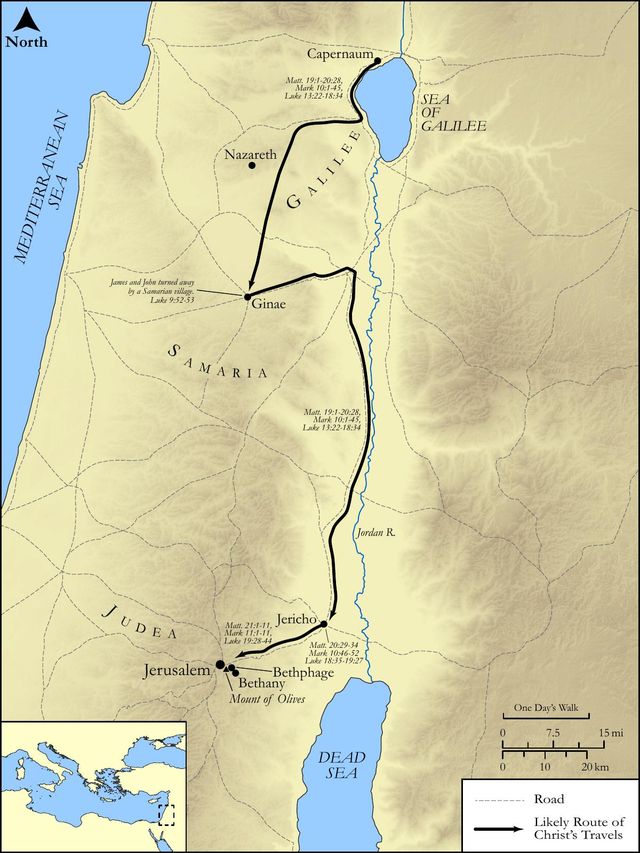
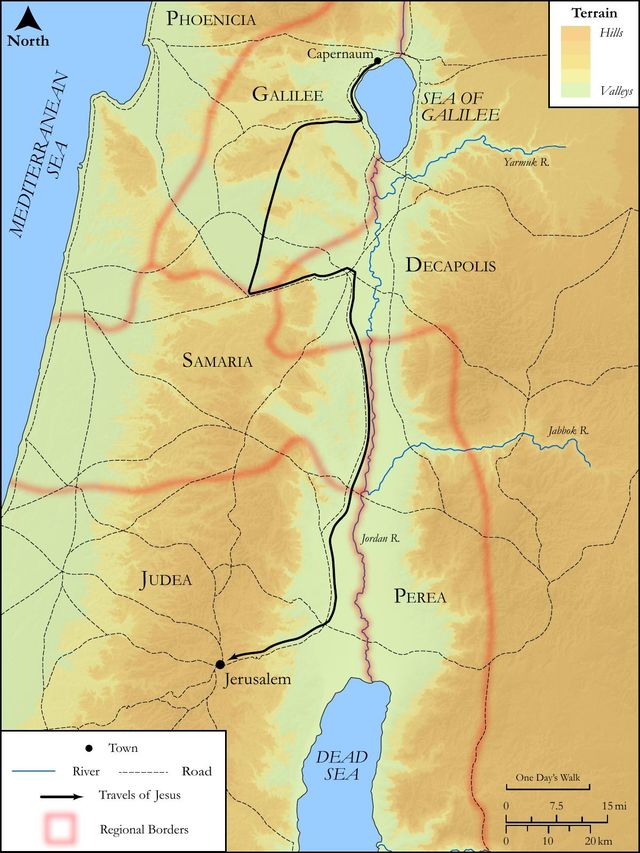
See on the biblical-era maps

Study this verse
Public-domain commentary
Matthew Henry
From his Commentary on the Whole Bible. Henry comments on passages, not single verses — this entry covers Luke 17:11–19. His three-level outline is real structure in the source text, so it is rendered as structure.
We have here an account of the cure of ten lepers, which we had not in any other of the evangelists. The leprosy was a disease which the Jews supposed to be inflicted for the punishment of some particular sin, and to be, more than other diseases, a mark of God's displeasure; and therefore Christ, who came to take away sin, and turn away wrath, took particular care to cleanse the lepers that fell in his way. Christ was now in his way to Jerusalem, about the mid-way, where he had little acquaintance in comparison with what he had either at Jerusalem or in Galilee. He was now in the frontier-country, the marches that lay between Samaria and Galilee. He went that road to find out these lepers, and to cure them; for he is found of them that sought him not. Observe,
I.The address of these lepers to Christ.
They were ten in a company; for, though they were shut out from society with others, yet those that were infected were at liberty to converse with one another, which would be some comfort to them, as giving them an opportunity to compare notes, and to condole with one another. Now observe,
1.They met Christ as he entered into a certain village. They did not stay till he had refreshed himself for some time after the fatigue of his journey, but met him as he entered the town, weary as he was; and yet he did not put them off, nor adjourn their cause.
2.They stood afar off, knowing that by the law their disease obliged them to keep their distance. A sense of our spiritual leprosy should make us very humble in all our approaches to Christ. Who are we, that we should draw near to him that is infinitely pure? We are impure.
3.Their request was unanimous, and very importunate (Luk 17:13): They lifted up their voices, being at a distance, and cried, Jesus, Master, have mercy on us. those that expect help from Christ must take him for their Master, and be at his command. If he be Master, he will be Jesus, a Saviour, and not otherwise. They ask not in particular to be cured of their leprosy, but, Have mercy on us; and it is enough to refer ourselves to the compassions of Christ, for they fail not. They heard the fame of this Jesus (though he had not been much conversant in that country), and that was such as encouraged them to make application to him; and, if but one of them began in so cheap and easy an address, they would all join.
II.Christ sent them to the priest, to be inspected by him, who was the judge of the leprosy.
He did not tell them positively that they should be cured, but bade them go show themselves to the priests, Luk 17:14. This was a trial of their obedience, and it was fit that it should be so tried, as Naaman's in a like case: Go wash in Jordan. Note, Those that expect Christ's favours must take them in his way and method. Some of these lepers perhaps would be ready to quarrel with the prescription: "Let him either cure or say that he will not, and not send us to the priests on a fool's errand;" but, over-ruled by the rest, they all went to the priest. As the ceremonial law was yet in force, Christ took care that it should be observed, and the reputation of it kept up, and due honour paid to the priests in things pertaining to their function; but, probably, he had here a further design, which was to have the priest's judgment of, and testimony to, the perfectness of the cure; and that the priest might be awakened, and others by him, to enquire after one that had such a commanding power over bodily diseases.
III.As they went, they were cleansed, and so became fit to be looked upon by the priest, and to have a certificate from him that they were clean. Observe, Then we may expect God to meet us with mercy when we are found in the way of duty. If we do what we can, God will not be wanting to do that for us which we cannot. Go, attend upon instituted ordinances; go and pray, and read the scriptures: Go show thyself to the priests; go and open thy case to a faithful minister, and, though the means will not heal thee of themselves, God will heal thee in the diligent use of those means.
IV.One of them, and but one, returned, to give thanks, Luk 17:15.
When he saw that he was healed, instead of going forward to the priest, to be by him declared clean, and so discharged from his confinement, which was all that the rest aimed at, he turned back towards him who was the Author of his cure, whom he wished to have the glory of it, before he received the benefit of it. He appears to have been very hearty and affectionate in his thanksgivings: With a loud voice he glorified God, acknowledging it to come originally from him; and he lifted up his voice in his praises, as he had done in his prayers, Luk 17:13. Those that have received mercy from God should publish it to others, that they may praise God too, and may be encouraged by their experiences to trust in him. But he also made a particular address of thanks to Christ (Luk 17:16): He fell down at his feet, put himself into the most humble reverent posture he could, and gave him thanks. Note, We ought to give thanks for the favours Christ bestows upon us, and particularly for recoveries from sickness; and we ought to be speedy in our returns of praise, and not defer them, lest time wear out the sense of the mercy. It becomes us also to be very humble in our thanksgivings, as well as in our prayers. It becomes the seed of Jacob, like him, to own themselves less than the least of God's mercies, when they have received them, as well as when they are in pursuit of them.
V.Christ took notice of this one that had thus distinguished himself; for, it seems, he was a Samaritan, whereas the rest were Jews, Luk 17:16. The Samaritans were separatists from the Jewish church, and had not the pure knowledge and worship of God among them that the Jews had, and yet it was one of them that glorified God, when the Jews forgot, or, when it was moved to them, refused, to do it. Now observe here,
1.The particular notice Christ took of him, of the grateful return he made, and the ingratitude of those that were sharers with him in the mercy - that he who was a stranger to the commonwealth of Israel was the only one that returned to give glory to God, Luk 17:17, Luk 17:18. See here,
(1.)How rich Christ is in doing good: Were there not ten cleansed? Here was a cure by wholesale, a whole hospital healed with one word's speaking. Note, There is an abundance of healing cleansing virtue in the blood of Christ, sufficient for all his patients, though ever so many. Here are ten at a time cleansed; we shall have never the less grace for others sharing it.
(2.)How poor we are in our returns: "Where are the nine? Why did not they return to give thanks?" This intimates that ingratitude is a very common sin. Of the many that receive mercy from God, there are but few, very few, that return to give thanks in a right manner (scarcely one in ten), that render according to the benefit done to them.
(3.)How those often prove most grateful from whom it was least expected. A Samaritan gives thanks, and a Jew does not. Thus many who profess revealed religion are out-done, and quite shamed, by some that are governed only by natural religion, not only in moral value, but in piety and devotion. This serves here to aggravate the ingratitude of those Jews of whom Christ speaks, as taking it very ill that his kindness was so slighted. And it intimates how justly he resents the ingratitude of the world of mankind, for whom he had done so much, and from whom he has received so little.
2.The great encouragement Christ gave him, Luk 17:19. The rest had their cure, and had it not revoked, as justly it might have been, for their ingratitude, though they had such a good example of gratitude set before them; but he had his cure confirmed particularly with an encomium: Thy faith hath made thee whole. The rest were made whole by the power of Christ, in compassion to their distress, and in answer to their prayer; but he was made whole by his faith, by which Christ saw him distinguished from the rest. Note, Temporal mercies are then doubled and sweetened to us when they are fetched in by the prayers of faith, and returned by the praises of faith.
Historical interpretation
Nine Centuries of Reception
11 surviving comments on this verse. Each one is dated, so this reads as a timeline rather than a list.
Select a marker to jump to its quote. Markers stagger vertically where authors wrote within a few decades of each other.
Whence also, astonished that one only out of the ten was thankful for his release to the divine grace, He does not command him to offer a gift according to the law, because he had already paid his tribute of gratitude when "he glorified God; for thus did the Lord will that the law's requirement should be interpreted.
Today, the Lord rebukes those who keep the Passover the way the Jews did, just as he rebuked certain lepers he had cleansed. You recall that he loved the one who was thankful, but he was angry with the ungrateful ones, because they did not acknowledge their Deliverer. They thought more highly of their cure from leprosy than of him who had healed them.… Actually, this one was given much more than the rest. Besides being healed of his leprosy, he was told by the Lord, “Stand up and go on your way. Your faith has saved you.”You see, those who give thanks and those who glorify have the same kind of feelings. They bless their helper for the benefits they have received. That is why Paul urged everybody to “glorify God with your body.” Isaiah also commanded, “Give glory to God.”
saying, And it came to pass, showing that the Samaritans were indeed well disposed towards the mercies above mentioned, but the Jews not so. For there was enmity between the Jews and the Samaritans, and He to allay this, passed into the midst of both nations, that he might cement both into one new man.
They associated together from the sympathy they felt as partakers of the same calamity, and were waiting till Jesus passed, anxiously looking out to see Him approach. As it is said, Which stood afar off, for the Jewish law esteems leprosy unclean, whereas the law of the Gospel calls unclean not the outward, but the inward leprosy.
They pronounce the name of Jesus, and gain to themselves the reality. For Jesus is by interpretation Saviour. They say, Have mercy upon us, because they were sensible of His power, and sought neither for gold and silver, but that their bodies might put on again a healthful appearance.
When he found that he was cleansed, he had boldness to draw near, as it follows, And fell down on his face at his feet giving him thanks. Thus by his prostration and prayers showing at once both his faith and his gratitude.
It follows, And he was a Samaritan.
Wherein it is shown, that strangers were more ready to receive the faith, but Israel was slow to believe; and so it follows, And he said unto him, Arise, go thy way, thy faith has made thee whole.
After speaking the foregoing parable, our Lord censures the ungrateful;
(de Quæst. Ev. l. ii. qu. 40.) The lepers may be taken mystically for those who, having no knowledge of the true faith, profess various erroneous doctrines. For they do not conceal their ignorance, but blazen it forth as the highest wisdom, making a vain show of it with boasting words. But since leprosy is a blemish in colour, when true things appear clumsily mixed up with false in a single discourse or narration, as in the colour of a single body, they represent a leprosy streaking and disfiguring as it were with true and false dyes the colour of the human form. Now these lepers must be so put away from the Church, that being as far removed as possible, they may with loud shouts call upon Christ. But by their calling Him Teacher, I think it is plainly implied that leprosy is truly the false doctrine which the good teacher may wash away. Now we find that of those upon whom our Lord bestowed bodily mercies, not one did He send to the priests, save the lepers, for the Jewish priesthood was a figure of that priesthood which is in the Church. All vices our Lord corrects and heals by His own power working inwardly in the conscience, but the teaching of infusion by means of the Sacrament, or of catechizing by word of mouth, was assigned to the Church. And as they went, they were cleansed; just as the Gentiles to whom Peter came, having not yet received the sacrament of Baptism, whereby we come spiritually to the priests, are declared cleansed by the infusion of the Holy Spirit. Whoever then follows true and sound doctrine in the fellowship of the Church, proclaiming himself to be free from the confusion of lies, as it were a leprosy, yet still ungrateful to his Cleanser does not prostrate himself with pious humility of thanksgiving, is like to those of whom the Apostle says, that when they knew God, they glorified him not as God, nor were thankful. (Rom. 1:21.) Such then will remain in the ninth number as imperfect. For the nine need one, that by a certain form of unity they may be cemented together, in order to become ten. But he who gave thanks was approved of as a type of the one only Church. And since these were Jews, they are declared to have lost through pride the kingdom of heaven, wherein most of all unity is preserved. But the man who was a Samaritan, which is by interpretation "guardian," giving back to Him who gave it that which he had received, according to the Psalm, My strength will I preserve for thee, (Ps. 59:9.) has kept the unity of the kingdom with humble devotion.
Why did he not say, “I will, be cleansed,” as he did in the case of another leper, instead of commanding them to show themselves to the priests? It was because the law gave directions to this effect to those who were delivered from leprosy. It commanded them to show themselves to the priests and to offer a sacrifice for their cleansing. He commanded them to go as being already healed so that they might bear witness to the priests, the rulers of the Jews and always envious of his glory. They testified that wonderfully and beyond their hope, they had been delivered from their misfortune by Christ’s willing that they should be healed. He did not heal them first but sent them to the priests, because the priests knew the marks of leprosy and of its healing.
The Saviour next manifests His glory by drawing over Israel to the faith. As it follows, And as he entered into a certain village, there met him ten men that were lepers, men who were banished from the towns and cities, and counted unclean, according to the rites of the Mosaic law.
The law also ordered, that those who were cleansed from leprosy should offer sacrifice for the sake of their purification.
Whereby the Jewish priests who were jealous of His glory might know that it was by Christ granting them health that they were suddenly and miraculously healed.
Falling into a thankless forgetfulness, the nine lepers that were Jews did not return to give glory to God. By this, he shows that Israel was hard of heart and utterly unthankful. The stranger, a Samaritan, was of foreign race brought from Assyria. The phrase “in the middle of Samaria and Galilee” has meaning. “He returned with a loud voice to glorify God.” It shows that the Samaritans were grateful but that the Jews, even when they benefited, were ungrateful.
One of them, etc. This one, who returned glorifying God, signifies the devoted humility of the one Church to Christ. Who, well falling at the feet of the Lord, gave thanks. For he truly gives thanks to God, who, by repressing the thoughts of his own presumption, humbly sees how weak he is in himself, who attributes no virtue to himself, who acknowledges that the good deeds he performs come from the mercy of the Creator. Hence it is rightly added:
He fell upon his face, because he blushes with shame when he remembers the evils he had committed. And he is commanded to rise and walk, because he who, knowing his own weakness, lies lowly on the ground, is led to advance by the consolation of the divine word to mighty deeds. But if faith made him whole, who hurried himself back to give thanks, therefore does unbelief destroy those who have neglected to give glory to God for mercies received. Wherefore that we ought to increase our faith by humility, as it is declared in the former parable, so in this is it exemplified in the actions themselves.
They therefore stand afar off as if ashamed of the uncleanness which was imputed to them, thinking that Christ would loathe them as others did. Thus they stood afar off, but were made nigh unto Him by their prayers. For the Lord is nigh unto all them that call upon him in truth. (Ps. 145:18.) Therefore it follows, And they lifted up their voices, and said, Jesus, Master, have mercy upon us.
They do not merely supplicate or entreat Him as if He were a man, but they call Him Master or Lord, as if almost they looked upon Him as God. But He bids them show themselves to the priests, as it follows, And when he saw them, he said, Go, show yourselves unto the priests. For they were examined whether they were cleansed from their leprosy or not.
Therefore in bidding them go to the priests, he meant nothing more than that they were just about to be healed; and so it follows, And it came to pass that as they went they were healed.
But out of the ten, the nine Israelites were ungrateful, whereas the Samaritan stranger returned and lifted up his voice in thanksgiving, as it follows, And one of them turned back, and with a loud voice glorified God.
We may gather from this that a man is not one whit hindered from pleasing God because he comes from a cursed race, only let him bear in his heart an honest purpose. Further, let not him that is born of saints boast himself, for the nine who were Israelites were ungrateful; and hence it follows, And Jesus answering him said, Were there not ten cleansed?
Continue studying Luke 17:15 across the web’s major study libraries — every link below opens this exact verse, chapter, or book on the destination site.
Read & Compare
 BibleGatewayThis verse in more than 200 translations and 70 languages.
 Bible.comThe YouVersion reader — hundreds of translations, reading plans, and highlights.
 ESV.orgCrossway's official English Standard Version reader.
 NET BibleThe NET translation with 60,000+ translators' notes on every rendering decision.
 STEP BibleTyndale House's free study tool — original text, vocabulary, and scholarly resources.
 BibliaLogos Bible Software's free web reader.
 USCCBThe New American Bible (Revised Edition) with the U.S. bishops' study notes.
Commentaries
 BibleHub CommentariesDozens of classic commentaries on this verse, gathered on one page.
 StudyLightMore than 100 commentary sets — the largest collection on the web.
 BibleRefPlain-English commentary on what this verse means, verse by verse.
 Enduring WordDavid Guzik's free commentary on this chapter, widely used by Bible teachers.
 Bible Study ToolsVerse commentary alongside Greek and Hebrew study aids.
Original Language & Research
- BibleHub InterlinearThe verse word by word — original language, transliteration, and English.
- BibleHub LexiconEvery word's original-language definition and Strong's entry.
 Blue Letter BibleDeep-study tools — Strong's numbers, concordance, and word studies.
 CNTR CollationThe earliest Greek manuscripts of this verse, collated letter by letter.
Sermons, Hymns & Audio


TrulyRandomVerse is not affiliated with these sites and doesn’t control their content. They’re linked because they’re genuinely useful.
Summary
Luke 17:15 captures a pivotal moment in the narrative of the ten lepers, highlighting the profound and immediate response of one individual who, upon recognizing his miraculous healing by Jesus, spontaneously returned to offer fervent praise and adoration to God. This verse sets the stage for a deeper exploration of genuine gratitude and true worship, contrasting sharply with the silent departure of the other nine.
Context
ShowHideLiterary Context
This verse is an integral part of the pericope found in Luke 17:11-19, which recounts Jesus' encounter with ten men afflicted with leprosy as He journeys towards Jerusalem. The narrative begins with their collective plea for mercy, followed by Jesus' instruction for them to go show themselves to the priests, a command rooted in the Mosaic Law for verifying cleansing and allowing reintegration into society (as detailed in Leviticus 14:2). The healing occurs "as they went," emphasizing the link between their obedience and the miraculous outcome. Luke 17:15 then shifts focus to the singular, exceptional response of one of these healed men, setting up the poignant contrast with the other nine who continued on their way. The subsequent verse, Luke 17:16, reveals the identity of this grateful individual as a Samaritan, adding a crucial layer of theological and social significance to the narrative.
Historical & Cultural Context
Leprosy, or tzara'at in Hebrew, was a devastating and highly stigmatized condition in biblical times. Beyond its physical debilitation, it rendered individuals ritually unclean and socially ostracized, forcing them into isolation from family, community, and temple worship, as prescribed in Leviticus 13. Healing from leprosy was considered a miracle of divine intervention, often seen as a power belonging solely to God (2 Kings 5:7). The instruction to show oneself to the priests was not for healing, but for official verification of cleansing and subsequent re-entry into communal life. Furthermore, the revelation that the grateful leper was a Samaritan is highly significant. Deep-seated animosity and cultural-religious division existed between Jews and Samaritans (John 4:9), making the Samaritan's exemplary gratitude a powerful subversion of societal expectations and a testament to God's inclusive grace.
Key Themes
ShowHideThis verse contributes significantly to several overarching themes within Luke's Gospel and biblical theology. The most prominent is Profound Gratitude and Thanksgiving, highlighting that true appreciation extends beyond merely receiving a blessing to actively acknowledging and honoring the Giver. The leper's immediate return and "loud voice glorified God" exemplify True Worship and Glorifying God, demonstrating a spontaneous, heartfelt act of praise that contrasts sharply with the silent departure of the others. This underscores that genuine faith often manifests in outward expressions of devotion and attributing divine power to the source of one's blessings. The narrative also subtly touches upon Faith and Obedience, as the healing occurred "as they went," emphasizing that their obedience to Jesus' command was intertwined with their faith. Finally, the identity of the grateful leper as a Samaritan underscores Luke's consistent theme of the Inclusion of Outsiders and the Overlooked, showing that God's grace and the capacity for genuine faith are not limited by ethnic or social boundaries, a motif seen throughout Luke's Gospel.
Exposition and Analysis
ShowHideKey Word Analysis
ShowHide"to cure (literally or figuratively):--heal, make whole." This word emphasizes the complete restoration, not merely a remission of symptoms, but a profound act of divine intervention that made the leper "whole." It signifies a comprehensive recovery from a debilitating condition, pointing to the miraculous nature of Jesus' power.
"to turn under (behind), i.e. to return (literally or figuratively):--come again, return (again, back again), turn back (again)." This verb denotes a deliberate, conscious reversal of direction. While the other nine continued their journey, this individual made an intentional choice to interrupt his path and return to the source of his blessing, signifying a profound shift in priority and focus.
"to render (or esteem) glorious (in a wide application):--(make) glorify(-ious), full of (have) glory, honour, magnify." This is a powerful term indicating an act of worship, praise, and public recognition of God's majesty and power. It means to give honor, praise, or esteem, attributing the miracle directly to divine power and acknowledging God's supreme authority and goodness.
Verse Breakdown
ShowHide"And one of them,"
This opening phrase immediately highlights the singular, exceptional response among the group of ten, drawing the reader's attention to the stark contrast that will unfold. It sets apart this individual's actions from the collective.
"when he saw that he was healed,"
This clause indicates the moment of realization and perception. The healing was not just experienced passively, but consciously acknowledged and understood as a completed, miraculous fact. The verb "saw" (eídō) implies not just physical sight but also a profound comprehension of the divine nature of his restoration.
"turned back,"
This signifies a deliberate and immediate change of direction. While the others continued their journey to fulfill the requirements of the Law, this individual chose to interrupt his path to fulfill a higher calling of gratitude and worship, prioritizing the Giver over the gift.
"and with a loud voice glorified God,"
This describes the fervent and public nature of his worship. The "loud voice" (φωνῇ μεγάλῃ - phōnē megalē) emphasizes an uninhibited, passionate outburst of praise and thanksgiving, openly declaring God's power and goodness as the ultimate source of his healing. This act of glorification is the supreme expression of his gratitude and recognition of divine agency.
Literary Devices
ShowHideThe narrative of Luke 17:15 effectively employs several literary devices to convey its profound message. Contrast is the most prominent, immediately established by highlighting "one of them" against the implied nine who did not return. This juxtaposition powerfully emphasizes the rarity and significance of genuine gratitude. Irony is also at play, as the one who demonstrates exemplary thanksgiving is later revealed to be a Samaritan, an outsider typically despised by the Jewish audience. This subverts expectations and underscores God's grace extending beyond traditional boundaries, simultaneously serving as a subtle rebuke to the presumed Jewish lepers who failed to return. The healing of leprosy itself carries Symbolism, representing not only physical restoration but also spiritual cleansing and deliverance from the defilement of sin. The leper's return and glorification of God thus symbolize the proper response of a soul redeemed and made whole by divine grace. Finally, the phrase "with a loud voice" serves as a device of Emphasis, highlighting the fervent, public, and unashamed nature of the leper's praise, making his act of worship all the more striking and memorable.
Theological and Thematic Connections
ShowHideThis verse profoundly illustrates the theological principle that true gratitude is more than a fleeting emotion; it is an active, worshipful response that acknowledges God as the ultimate source of all blessings. The leper's immediate return to glorify God reveals a heart transformed by divine grace, recognizing that the miracle was not merely a physical cure but an encounter with the divine. This act of glorification aligns with the biblical mandate to offer thanks in all circumstances, understanding that our blessings are not accidental but purposeful gifts from a benevolent God. It challenges us to move beyond mere reception of gifts to a posture of profound appreciation and worship towards the Giver, recognizing His sovereignty and goodness in every aspect of our lives.
Reflection and Application
ShowHideLuke 17:15 serves as a timeless mirror, inviting us to examine the posture of our own hearts in response to God's abundant grace. In a world prone to entitlement and forgetfulness, the Samaritan leper's immediate and public act of thanksgiving stands as a powerful counter-narrative. It prompts us to cultivate a deliberate practice of recognizing God's hand in every facet of our lives – from the miraculous to the mundane – and to articulate our gratitude not just privately, but also through our words, actions, and communal worship. This verse reminds us that genuine faith is often expressed through a grateful heart that consistently turns back to the Giver, acknowledging His sovereignty and goodness. Our response to divine blessing is not merely an optional addition to our faith, but a vital component that deepens our spiritual journey, enriches our relationship with God, and testifies to His glory before others.
Questions for Reflection
ShowHideFAQ
ShowHideWhy did only one of the ten lepers return to give thanks?
ShowHideThe text does not explicitly state why the other nine did not return, but it highlights a common human tendency to receive blessings without acknowledging the Giver. While all ten obeyed Jesus' command to show themselves to the priests (a necessary step for reintegration into society according to Leviticus 14), only one recognized the deeper spiritual significance of the healing and felt compelled to offer personal, heartfelt gratitude to Jesus, and by extension, to God. This contrast emphasizes that true faith involves not just obedience to commands, but also a responsive heart of worship that prioritizes the Giver over merely receiving the gift.
What is the significance of the one who returned being a Samaritan?
ShowHideThe fact that the grateful leper was a Samaritan (revealed in Luke 17:16) is highly significant. Samaritans were typically despised by Jews, and there was deep-seated animosity and cultural-religious division between the two groups (John 4:9). Luke's Gospel frequently highlights Jesus' ministry extending to overlooked groups and outsiders, demonstrating that God's grace is not confined to traditional boundaries. This detail underscores the idea that genuine faith and gratitude can be found in unexpected places, challenging the prejudices of the time and demonstrating God's inclusive love. It also serves as a subtle rebuke to the Jewish lepers who, despite being part of the chosen people, failed to show the same level of gratitude as the "outsider."
Christ-Centered Fulfillment
ShowHideLuke 17:15, while focusing on the leper's response, ultimately points to Christ as the divine source of all healing and the worthy recipient of all glory. Jesus, as the Son of God, not only possessed the power to cure physical ailments like leprosy, a power previously reserved for God alone (2 Kings 5:7), but He also came to offer a deeper, spiritual healing from the defilement of sin. The leper's act of "glorifying God" through Jesus foreshadows the ultimate worship due to Christ, who is God incarnate. Just as this man was made physically whole, Christ offers spiritual wholeness and reconciliation with God through His atoning sacrifice on the cross (Colossians 1:19-20). The grateful leper's immediate return anticipates the proper response of all who are redeemed by Christ – a life of continuous thanksgiving and glorification of God, made possible through the Lamb of God who takes away the sin of the world (John 1:29). His example calls us to recognize Jesus not merely as a miracle worker, but as the divine Healer and Lord, to whom all praise and honor are due (Philippians 2:9-11).