


Luke 17:12
Bible text: King James Version (1769 Blayney text) · Public domain
Bible text: Berean Standard Bible · Public domain
Bible text: American Standard Version (1901) · Public domain
Bible text: World English Bible, Messianic edition · Public domain
Bible text: Geneva Bible (1599) · Public domain
Bible text: Young's Literal Translation · Public domain
- καὶkaiAndG2532CONJConjunction
- εἰσερχομένουeiserchomenouwhen is enteringG1525V-PNP-GSMVerb Present Middle Or Passive Deponent Participle Genitive Singular Masculine
- αὐτοῦautouHeG846P-GSMPersonal pronoun Genitive Singular Masculine
- εἴςeisintoG1519PREPPreposition
- τιναtinaa certainG5100X-ASFIndefinite pronoun Accusative Singular Feminine
- κώμηνkōmēnvillageG2968N-ASFNoun Accusative Singular Feminine
- ἀπήντησανapēntēsanmetG528V-AAI-3PVerb Aorist Active Indicative 3rd Plural
- αὐτῷautōwith HimG846P-DSMPersonal pronoun Dative Singular Masculine
- δέκαdekatenG1176A-NUIAdjective
- λεπροὶleproileprousG3015A-NPMAdjective Nominative Plural Masculine
- ἄνδρεςandresmenG435N-NPMNoun Nominative Plural Masculine
- οἳhoiwhoG3739R-NPMRelative pronoun Nominative Plural Masculine
- ἔστησανestēsanstoodG2476V-2AAI-3PVerb 2nd Aorist Active Indicative 3rd Plural
- πόρρωθενporrōthenafar offG4207ADV-CAdverb Comparative
English is a literal word-by-word gloss of the Greek, not the KJV's wording. Why?
This is the original text the KJV's translators worked from — each Greek word with its own literal English meaning in this verse, prepared by scholars at Tyndale House, Cambridge. The KJV translates whole sentences, not word by word, so its wording differs: one Greek word can become several English words, and the KJV may choose “charity” where the gloss reads “love”. Both are faithful — they answer different questions. For the KJV's own rendering, switch to the KJV text.
Details
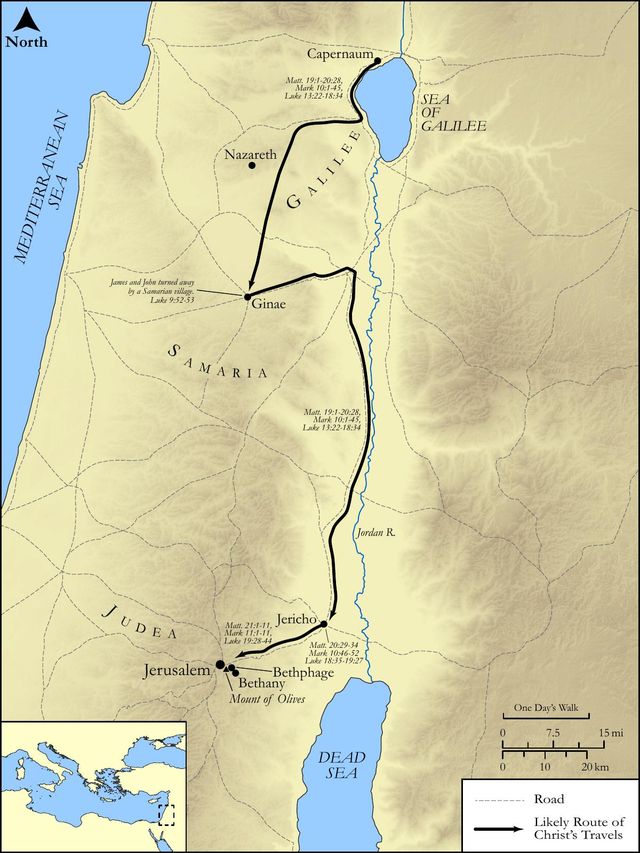
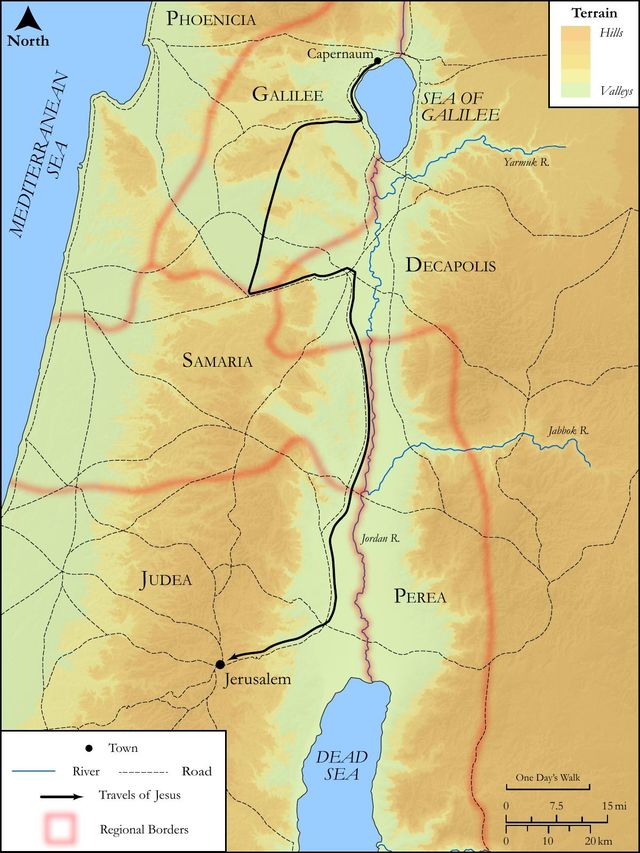
See on the biblical-era maps

Study this verse
Public-domain commentary
Matthew Henry
From his Commentary on the Whole Bible. Henry comments on passages, not single verses — this entry covers Luke 17:11–19. His three-level outline is real structure in the source text, so it is rendered as structure.
We have here an account of the cure of ten lepers, which we had not in any other of the evangelists. The leprosy was a disease which the Jews supposed to be inflicted for the punishment of some particular sin, and to be, more than other diseases, a mark of God's displeasure; and therefore Christ, who came to take away sin, and turn away wrath, took particular care to cleanse the lepers that fell in his way. Christ was now in his way to Jerusalem, about the mid-way, where he had little acquaintance in comparison with what he had either at Jerusalem or in Galilee. He was now in the frontier-country, the marches that lay between Samaria and Galilee. He went that road to find out these lepers, and to cure them; for he is found of them that sought him not. Observe,
I.The address of these lepers to Christ.
They were ten in a company; for, though they were shut out from society with others, yet those that were infected were at liberty to converse with one another, which would be some comfort to them, as giving them an opportunity to compare notes, and to condole with one another. Now observe,
1.They met Christ as he entered into a certain village. They did not stay till he had refreshed himself for some time after the fatigue of his journey, but met him as he entered the town, weary as he was; and yet he did not put them off, nor adjourn their cause.
2.They stood afar off, knowing that by the law their disease obliged them to keep their distance. A sense of our spiritual leprosy should make us very humble in all our approaches to Christ. Who are we, that we should draw near to him that is infinitely pure? We are impure.
3.Their request was unanimous, and very importunate (Luk 17:13): They lifted up their voices, being at a distance, and cried, Jesus, Master, have mercy on us. those that expect help from Christ must take him for their Master, and be at his command. If he be Master, he will be Jesus, a Saviour, and not otherwise. They ask not in particular to be cured of their leprosy, but, Have mercy on us; and it is enough to refer ourselves to the compassions of Christ, for they fail not. They heard the fame of this Jesus (though he had not been much conversant in that country), and that was such as encouraged them to make application to him; and, if but one of them began in so cheap and easy an address, they would all join.
II.Christ sent them to the priest, to be inspected by him, who was the judge of the leprosy.
He did not tell them positively that they should be cured, but bade them go show themselves to the priests, Luk 17:14. This was a trial of their obedience, and it was fit that it should be so tried, as Naaman's in a like case: Go wash in Jordan. Note, Those that expect Christ's favours must take them in his way and method. Some of these lepers perhaps would be ready to quarrel with the prescription: "Let him either cure or say that he will not, and not send us to the priests on a fool's errand;" but, over-ruled by the rest, they all went to the priest. As the ceremonial law was yet in force, Christ took care that it should be observed, and the reputation of it kept up, and due honour paid to the priests in things pertaining to their function; but, probably, he had here a further design, which was to have the priest's judgment of, and testimony to, the perfectness of the cure; and that the priest might be awakened, and others by him, to enquire after one that had such a commanding power over bodily diseases.
III.As they went, they were cleansed, and so became fit to be looked upon by the priest, and to have a certificate from him that they were clean. Observe, Then we may expect God to meet us with mercy when we are found in the way of duty. If we do what we can, God will not be wanting to do that for us which we cannot. Go, attend upon instituted ordinances; go and pray, and read the scriptures: Go show thyself to the priests; go and open thy case to a faithful minister, and, though the means will not heal thee of themselves, God will heal thee in the diligent use of those means.
IV.One of them, and but one, returned, to give thanks, Luk 17:15.
When he saw that he was healed, instead of going forward to the priest, to be by him declared clean, and so discharged from his confinement, which was all that the rest aimed at, he turned back towards him who was the Author of his cure, whom he wished to have the glory of it, before he received the benefit of it. He appears to have been very hearty and affectionate in his thanksgivings: With a loud voice he glorified God, acknowledging it to come originally from him; and he lifted up his voice in his praises, as he had done in his prayers, Luk 17:13. Those that have received mercy from God should publish it to others, that they may praise God too, and may be encouraged by their experiences to trust in him. But he also made a particular address of thanks to Christ (Luk 17:16): He fell down at his feet, put himself into the most humble reverent posture he could, and gave him thanks. Note, We ought to give thanks for the favours Christ bestows upon us, and particularly for recoveries from sickness; and we ought to be speedy in our returns of praise, and not defer them, lest time wear out the sense of the mercy. It becomes us also to be very humble in our thanksgivings, as well as in our prayers. It becomes the seed of Jacob, like him, to own themselves less than the least of God's mercies, when they have received them, as well as when they are in pursuit of them.
V.Christ took notice of this one that had thus distinguished himself; for, it seems, he was a Samaritan, whereas the rest were Jews, Luk 17:16. The Samaritans were separatists from the Jewish church, and had not the pure knowledge and worship of God among them that the Jews had, and yet it was one of them that glorified God, when the Jews forgot, or, when it was moved to them, refused, to do it. Now observe here,
1.The particular notice Christ took of him, of the grateful return he made, and the ingratitude of those that were sharers with him in the mercy - that he who was a stranger to the commonwealth of Israel was the only one that returned to give glory to God, Luk 17:17, Luk 17:18. See here,
(1.)How rich Christ is in doing good: Were there not ten cleansed? Here was a cure by wholesale, a whole hospital healed with one word's speaking. Note, There is an abundance of healing cleansing virtue in the blood of Christ, sufficient for all his patients, though ever so many. Here are ten at a time cleansed; we shall have never the less grace for others sharing it.
(2.)How poor we are in our returns: "Where are the nine? Why did not they return to give thanks?" This intimates that ingratitude is a very common sin. Of the many that receive mercy from God, there are but few, very few, that return to give thanks in a right manner (scarcely one in ten), that render according to the benefit done to them.
(3.)How those often prove most grateful from whom it was least expected. A Samaritan gives thanks, and a Jew does not. Thus many who profess revealed religion are out-done, and quite shamed, by some that are governed only by natural religion, not only in moral value, but in piety and devotion. This serves here to aggravate the ingratitude of those Jews of whom Christ speaks, as taking it very ill that his kindness was so slighted. And it intimates how justly he resents the ingratitude of the world of mankind, for whom he had done so much, and from whom he has received so little.
2.The great encouragement Christ gave him, Luk 17:19. The rest had their cure, and had it not revoked, as justly it might have been, for their ingratitude, though they had such a good example of gratitude set before them; but he had his cure confirmed particularly with an encomium: Thy faith hath made thee whole. The rest were made whole by the power of Christ, in compassion to their distress, and in answer to their prayer; but he was made whole by his faith, by which Christ saw him distinguished from the rest. Note, Temporal mercies are then doubled and sweetened to us when they are fetched in by the prayers of faith, and returned by the praises of faith.
Historical interpretation
Seven Centuries of Reception
11 surviving comments on this verse. Each one is dated, so this reads as a timeline rather than a list.
Select a marker to jump to its quote. Markers stagger vertically where authors wrote within a few decades of each other.
Today, the Lord rebukes those who keep the Passover the way the Jews did, just as he rebuked certain lepers he had cleansed. You recall that he loved the one who was thankful, but he was angry with the ungrateful ones, because they did not acknowledge their Deliverer. They thought more highly of their cure from leprosy than of him who had healed them.… Actually, this one was given much more than the rest. Besides being healed of his leprosy, he was told by the Lord, “Stand up and go on your way. Your faith has saved you.”You see, those who give thanks and those who glorify have the same kind of feelings. They bless their helper for the benefits they have received. That is why Paul urged everybody to “glorify God with your body.” Isaiah also commanded, “Give glory to God.”
saying, And it came to pass, showing that the Samaritans were indeed well disposed towards the mercies above mentioned, but the Jews not so. For there was enmity between the Jews and the Samaritans, and He to allay this, passed into the midst of both nations, that he might cement both into one new man.
They associated together from the sympathy they felt as partakers of the same calamity, and were waiting till Jesus passed, anxiously looking out to see Him approach. As it is said, Which stood afar off, for the Jewish law esteems leprosy unclean, whereas the law of the Gospel calls unclean not the outward, but the inward leprosy.
They pronounce the name of Jesus, and gain to themselves the reality. For Jesus is by interpretation Saviour. They say, Have mercy upon us, because they were sensible of His power, and sought neither for gold and silver, but that their bodies might put on again a healthful appearance.
When he found that he was cleansed, he had boldness to draw near, as it follows, And fell down on his face at his feet giving him thanks. Thus by his prostration and prayers showing at once both his faith and his gratitude.
It follows, And he was a Samaritan.
Wherein it is shown, that strangers were more ready to receive the faith, but Israel was slow to believe; and so it follows, And he said unto him, Arise, go thy way, thy faith has made thee whole.
After speaking the foregoing parable, our Lord censures the ungrateful;
(de Quæst. Ev. l. ii. qu. 40.) The lepers may be taken mystically for those who, having no knowledge of the true faith, profess various erroneous doctrines. For they do not conceal their ignorance, but blazen it forth as the highest wisdom, making a vain show of it with boasting words. But since leprosy is a blemish in colour, when true things appear clumsily mixed up with false in a single discourse or narration, as in the colour of a single body, they represent a leprosy streaking and disfiguring as it were with true and false dyes the colour of the human form. Now these lepers must be so put away from the Church, that being as far removed as possible, they may with loud shouts call upon Christ. But by their calling Him Teacher, I think it is plainly implied that leprosy is truly the false doctrine which the good teacher may wash away. Now we find that of those upon whom our Lord bestowed bodily mercies, not one did He send to the priests, save the lepers, for the Jewish priesthood was a figure of that priesthood which is in the Church. All vices our Lord corrects and heals by His own power working inwardly in the conscience, but the teaching of infusion by means of the Sacrament, or of catechizing by word of mouth, was assigned to the Church. And as they went, they were cleansed; just as the Gentiles to whom Peter came, having not yet received the sacrament of Baptism, whereby we come spiritually to the priests, are declared cleansed by the infusion of the Holy Spirit. Whoever then follows true and sound doctrine in the fellowship of the Church, proclaiming himself to be free from the confusion of lies, as it were a leprosy, yet still ungrateful to his Cleanser does not prostrate himself with pious humility of thanksgiving, is like to those of whom the Apostle says, that when they knew God, they glorified him not as God, nor were thankful. (Rom. 1:21.) Such then will remain in the ninth number as imperfect. For the nine need one, that by a certain form of unity they may be cemented together, in order to become ten. But he who gave thanks was approved of as a type of the one only Church. And since these were Jews, they are declared to have lost through pride the kingdom of heaven, wherein most of all unity is preserved. But the man who was a Samaritan, which is by interpretation "guardian," giving back to Him who gave it that which he had received, according to the Psalm, My strength will I preserve for thee, (Ps. 59:9.) has kept the unity of the kingdom with humble devotion.
Why did he not say, “I will, be cleansed,” as he did in the case of another leper, instead of commanding them to show themselves to the priests? It was because the law gave directions to this effect to those who were delivered from leprosy. It commanded them to show themselves to the priests and to offer a sacrifice for their cleansing. He commanded them to go as being already healed so that they might bear witness to the priests, the rulers of the Jews and always envious of his glory. They testified that wonderfully and beyond their hope, they had been delivered from their misfortune by Christ’s willing that they should be healed. He did not heal them first but sent them to the priests, because the priests knew the marks of leprosy and of its healing.
The Saviour next manifests His glory by drawing over Israel to the faith. As it follows, And as he entered into a certain village, there met him ten men that were lepers, men who were banished from the towns and cities, and counted unclean, according to the rites of the Mosaic law.
The law also ordered, that those who were cleansed from leprosy should offer sacrifice for the sake of their purification.
Whereby the Jewish priests who were jealous of His glory might know that it was by Christ granting them health that they were suddenly and miraculously healed.
Falling into a thankless forgetfulness, the nine lepers that were Jews did not return to give glory to God. By this, he shows that Israel was hard of heart and utterly unthankful. The stranger, a Samaritan, was of foreign race brought from Assyria. The phrase “in the middle of Samaria and Galilee” has meaning. “He returned with a loud voice to glorify God.” It shows that the Samaritans were grateful but that the Jews, even when they benefited, were ungrateful.
And it came to be, etc., ten leprous men met him. Leprous men can not unreasonably be understood as those who, not having the knowledge of true faith, profess various doctrines of error. For they do not hide their ignorance, but present it as supreme expertise to the light and display the boasting of their speech. And indeed there is no false doctrine which does not mix some truths among the false things. Hence true things mixed irregularly with false ones, appearing in one argument or narration of a man, as in the color of one body, signify leprosy, diversifying and staining human bodies with places of true and false colors. These therefore are to be avoided by the Church, so that if possible, being far removed, they may invoke Christ with a loud voice. Wherefore it is aptly added:
He fell upon his face, because he blushes with shame when he remembers the evils he had committed. And he is commanded to rise and walk, because he who, knowing his own weakness, lies lowly on the ground, is led to advance by the consolation of the divine word to mighty deeds. But if faith made him whole, who hurried himself back to give thanks, therefore does unbelief destroy those who have neglected to give glory to God for mercies received. Wherefore that we ought to increase our faith by humility, as it is declared in the former parable, so in this is it exemplified in the actions themselves.
From this one may learn that nothing prevents a man from living in a manner pleasing to God, not even if he belongs to a despised race, if only he has a good will and disposition. For behold, ten lepers met Jesus as He was about to enter a certain city. They met Him outside the city, for those who were considered unclean were not permitted to go into the city. They stood afar off, as if ashamed of their supposed uncleanness, and did not dare to draw near, thinking that Jesus abhorred them as did the others. They lifted up their voices and made supplication. By physical location they were standing afar off, but in their supplication they were near. For the Lord is nigh unto all that call upon Him in truth (Ps. 144:19). And they did not make supplication to Him as to a mere man, but as to One greater than a man. For they called Him Master, meaning Lord, Protector, and Guardian, which is not far from thinking of Him as God.
The Lord instructs them to show themselves to the priests. Initially the priests would examine men such as these to determine whether they were lepers or not. For there were certain signs by which the priests could recognize incurable leprosy. But in addition to this, if it should happen that someone who had been suffering from leprosy was healed, the priests would again examine him to verify the cure, in which event the gift commanded by the law would be offered (Lev. 14). In this case, since these men were already confirmed lepers, why should they show themselves to the priests, unless indeed they were about to be cleansed? To command them to go the priests indicated nothing less than that they would be healed. This is why the Evangelist says that as they went, they were cleansed. Of the ten lepers, the nine who were Israelites showed themselves to be ungrateful, while it was the Samaritan, an accursed foreigner, as we said earlier, who returned to voice his gratitude. The Samaritans were Assyrians; therefore, let no Gentile despair, and let no one descended from holy forebears boast. This miracle also signifies the common salvation that came to the whole human race. For the ten lepers represent all of human nature—it was leprous with wickedness, carrying about with it the ugliness of sin, passing its life outside the heavenly city on account of its uncleanness, and standing afar off from God. But this very distance from God is itself a supplication. For when the Lover of mankind, Who wills that all should be saved and receive good things, sees someone who is not sharing in His goodness, then He is most quick to show mercy and to heal those who are so miserably afflicted. But He also healed the whole leprous nature of man, when, for every mans sake, He took flesh and tasted of death. Although the Jews had been cleansed of the uncleanness of their leprous sin, as far as it was the Lords part to do, they showed themselves ungrateful and did not return from the path of their vain foolishness to give glory to God Who saved them, that is, to believe in Him Who is God and Who endured the extremes of suffering. For this is the glory of God: His Flesh and His Cross. These Jews, then, did not confess the incarnate and crucified Lord of glory. But the foreign and accursed people of the Gentiles recognized the One Who makes clean, and they glorified Him by believing in Him. They believed that God loves man so much and is so powerful that He accepted the very depth of dishonor for our sake—this is His love of man; and having accepted it, He suffered no harm to His own nature—this is His power.
They therefore stand afar off as if ashamed of the uncleanness which was imputed to them, thinking that Christ would loathe them as others did. Thus they stood afar off, but were made nigh unto Him by their prayers. For the Lord is nigh unto all them that call upon him in truth. (Ps. 145:18.) Therefore it follows, And they lifted up their voices, and said, Jesus, Master, have mercy upon us.
They do not merely supplicate or entreat Him as if He were a man, but they call Him Master or Lord, as if almost they looked upon Him as God. But He bids them show themselves to the priests, as it follows, And when he saw them, he said, Go, show yourselves unto the priests. For they were examined whether they were cleansed from their leprosy or not.
Therefore in bidding them go to the priests, he meant nothing more than that they were just about to be healed; and so it follows, And it came to pass that as they went they were healed.
But out of the ten, the nine Israelites were ungrateful, whereas the Samaritan stranger returned and lifted up his voice in thanksgiving, as it follows, And one of them turned back, and with a loud voice glorified God.
We may gather from this that a man is not one whit hindered from pleasing God because he comes from a cursed race, only let him bear in his heart an honest purpose. Further, let not him that is born of saints boast himself, for the nine who were Israelites were ungrateful; and hence it follows, And Jesus answering him said, Were there not ten cleansed?
Continue studying Luke 17:12 across the web’s major study libraries — every link below opens this exact verse, chapter, or book on the destination site.
Read & Compare
 BibleGatewayThis verse in more than 200 translations and 70 languages.
 Bible.comThe YouVersion reader — hundreds of translations, reading plans, and highlights.
 ESV.orgCrossway's official English Standard Version reader.
 NET BibleThe NET translation with 60,000+ translators' notes on every rendering decision.
 STEP BibleTyndale House's free study tool — original text, vocabulary, and scholarly resources.
 BibliaLogos Bible Software's free web reader.
 USCCBThe New American Bible (Revised Edition) with the U.S. bishops' study notes.
Commentaries
 BibleHub CommentariesDozens of classic commentaries on this verse, gathered on one page.
 StudyLightMore than 100 commentary sets — the largest collection on the web.
 BibleRefPlain-English commentary on what this verse means, verse by verse.
 Enduring WordDavid Guzik's free commentary on this chapter, widely used by Bible teachers.
 Bible Study ToolsVerse commentary alongside Greek and Hebrew study aids.
Original Language & Research
- BibleHub InterlinearThe verse word by word — original language, transliteration, and English.
- BibleHub LexiconEvery word's original-language definition and Strong's entry.
 Blue Letter BibleDeep-study tools — Strong's numbers, concordance, and word studies.
 CNTR CollationThe earliest Greek manuscripts of this verse, collated letter by letter.
Sermons, Hymns & Audio


TrulyRandomVerse is not affiliated with these sites and doesn’t control their content. They’re linked because they’re genuinely useful.
Summary
Luke 17:12 introduces the poignant encounter between Jesus and ten men afflicted with leprosy as He enters a village on His journey. This verse immediately establishes the profound social and religious isolation of these individuals, who, by law and custom, were compelled to keep a significant distance from others. Despite their ostracization, their collective presence and their positioning "afar off" set the stage for a remarkable display of faith, divine compassion, and transformative healing that transcends societal and ritual barriers.
Context
ShowHideLiterary Context
This verse advances a distinct narrative unit within Luke's Gospel, which opens at Luke 17:11 and follows Jesus' teachings on forgiveness, faith, and service (Luke 17:1-10). It immediately precedes the healing of the ten lepers (Luke 17:13-19), a miracle unique to Luke's account. The preceding verse, Luke 17:11, specifies Jesus' route "through the midst of Samaria and Galilee," indicating His itinerant ministry and His willingness to engage with diverse populations, including those often overlooked. The story culminates not just in physical healing but in a theological lesson about gratitude and faith, particularly highlighted by the Samaritan leper's return.
Historical & Cultural Context
In ancient Israel, "leprosy" (Hebrew: tzara'at) was a broad term encompassing various severe, chronic skin conditions, not solely modern Hansen's disease. According to Mosaic Law, particularly detailed in Leviticus 13, individuals afflicted with leprosy were declared ritually unclean and were subject to strict regulations. They were forced to live in isolation outside of towns and villages, to wear torn clothes, and to cry out "Unclean! Unclean!" to warn others of their presence. This condition led to complete social ostracism, spiritual defilement, and exclusion from communal life and temple worship. The phrase "stood afar off" in Luke 17:12 precisely reflects this enforced distance, emphasizing their profound physical, social, and religious separation.
Key Themes
ShowHideThis verse introduces several significant themes that resonate throughout the broader narrative and Luke's Gospel. The profound isolation of the lepers, underscored by their "standing afar off," powerfully illustrates the devastating social and religious consequences of their condition. Despite this isolation, their collective presence and their act of "meeting" Jesus convey their desperate hope and implicit faith that Jesus possessed the power to heal them, transcending all societal and ritual barriers. This encounter also immediately sets the stage for Jesus' accessibility and compassion, demonstrating His consistent willingness to engage with and minister to the most lowly and ritually unclean members of society, a hallmark of His ministry as depicted by Luke. Furthermore, the very fact that these ten lepers awaited Jesus highlights His burgeoning reputation as a healer and implicitly demonstrates the divine authority He wielded over sickness and impurity.
Exposition and Analysis
ShowHideKey Word Analysis
ShowHideThis term refers to individuals suffering from leprosy, a condition that rendered them ritually unclean and socially ostracized under Mosaic Law. The emphasis is on their societal status as outcasts due to their affliction, rather than a precise medical diagnosis.
This verb signifies "to meet away," or "to encounter." It suggests a deliberate movement on the part of the lepers to intercept Jesus, indicating their intentionality and desperate desire for an encounter, despite the restrictions placed upon them.
This adverb means "from far" or "at a distance." It precisely describes the mandatory physical separation maintained by lepers according to the law, underscoring their profound isolation and the social stigma attached to their condition.
Verse Breakdown
ShowHide"And as he entered into a certain village"
This clause establishes the setting for the encounter, emphasizing Jesus' active, itinerant ministry. His entry into a "certain village" (Greek: kṓmē, a hamlet or town) highlights His presence among ordinary people, even in less prominent locales.
"there met him ten men that were lepers"
This introduces the subjects of the narrative—a group of ten men afflicted with leprosy. The number "ten" signifies a significant group, suggesting a shared predicament and perhaps a communal support system in their isolation. Their act of "meeting" Jesus indicates their proactive pursuit of Him, driven by hope for healing.
"which stood afar off"
This crucial detail underscores the profound social and ritual isolation of the lepers. According to Levitical law, lepers were required to maintain a significant distance from ritually clean individuals to prevent contamination. This phrase visually depicts their lowly status and the barrier that separated them from society, making their appeal to Jesus all the more poignant.
Literary Devices
ShowHideLuke employs several literary devices in this verse to establish the scene and foreshadow the narrative's significance. The Contrast between Jesus' active "entering" into the village and the lepers' static position "afar off" immediately highlights their respective states of inclusion and exclusion. The phrase "stood afar off" functions as powerful Symbolism for the lepers' complete social, religious, and physical isolation, representing the ultimate human condition of being separated from community and God due to sin and impurity. The very presence of ten lepers, a significant number, creates a sense of Anticipation, setting the stage for a remarkable intervention by Jesus, whose reputation for healing precedes Him. This verse also serves as Foreshadowing, hinting at Jesus' radical compassion and willingness to cross social and religious boundaries to minister to the lowly, a recurring theme in Luke's Gospel.
Theological and Thematic Connections
ShowHideThis verse powerfully introduces the theme of divine compassion extended to the utterly overlooked. The lepers, by their very condition, were considered the lowest of the low, living symbols of impurity and separation from God's people. Their desperate act of meeting Jesus, even from a distance, signifies a profound act of faith—a belief that He possessed the power to transcend their ritual uncleanness and restore them. This encounter highlights Jesus' unique authority over sickness and defilement, demonstrating that His kingdom breaks down barriers of exclusion and offers radical inclusion. It underscores the truth that no human condition, no matter how dire or ritually polluting, is beyond the reach of God's redemptive power.
Reflection and Application
ShowHideLuke 17:12 serves as a profound reminder of the human condition of isolation and the desperate need for divine intervention. Just as these ten lepers, despite their forced distance, sought out Jesus, we are called to bring our deepest needs, our "unclean" parts, and our feelings of separation—whether from God or from others—to Christ. This verse prompts us to consider who the "lepers" are in our own communities today: those overlooked by poverty, illness, social stigma, or spiritual brokenness. Jesus' willingness to encounter these men, even from a distance, challenges us to cultivate a posture of empathy and active compassion, recognizing that true ministry often involves reaching out to those on the fringes. It encourages us to dismantle the invisible walls we might erect between ourselves and others, remembering that Christ's love extends to all, regardless of their past or present condition, inviting them into a community of healing and acceptance.
Questions for Reflection
ShowHideFAQ
ShowHideWhy were the lepers "afar off"?
ShowHideThe lepers were "afar off" due to strict Old Testament laws outlined primarily in Leviticus 13. These laws declared individuals with certain skin diseases, broadly termed "leprosy," as ritually unclean. To prevent the spread of the disease and ritual impurity, they were commanded to live outside the camps or villages and to warn others of their presence by crying "Unclean! Unclean!" This enforced distance was a legal, social, and religious requirement, underscoring their complete isolation from community life and worship.
Why is it significant that there were "ten" lepers?
ShowHideThe number "ten" is significant for several reasons. First, it indicates a communal experience of suffering and isolation, suggesting that lepers often congregated together for mutual support, as they were excluded from mainstream society. Second, it sets up the powerful contrast later in the narrative when only one of the ten returns to give thanks (Luke 17:15-19), highlighting the theme of gratitude and true faith. While the law required isolation, it didn't forbid lepers from associating with each other.
Christ-Centered Fulfillment
ShowHideLuke 17:12, with its depiction of ten isolated lepers, powerfully foreshadows and illuminates the Christ-centered fulfillment of God's redemptive plan. In the Old Covenant, leprosy was the quintessential symbol of sin's defiling power, rendering individuals unclean and separated from God's presence and His people, as detailed in Leviticus 13. Jesus, by encountering and healing these lepers, demonstrates His divine authority not merely over physical illness but over the very spiritual impurity that sin represents. He is the ultimate High Priest who, unlike the Levitical priests who could only declare a leper clean, possesses the power to make the unclean clean, touching them and restoring them to full fellowship (Matthew 8:3). This act of radical inclusion anticipates the new covenant reality where, through Christ's atoning sacrifice, all who were once "afar off" due to sin are brought near by His blood (Ephesians 2:13). The lepers' desperate cry for mercy mirrors humanity's spiritual need for a Savior, and Jesus' compassionate response reveals Him as the Lamb of God who truly takes away the sin of the world, cleansing and reconciling those who were utterly ostracized (John 1:29). His ministry to these outcasts prefigures the expansive reach of the Gospel, which breaks down every wall of hostility and invites all, regardless of their past defilement, into the family of God (Galatians 3:28).