


John 20:27
Bible text: King James Version (1769 Blayney text) · Public domain
Bible text: King James Version with Strong's numbers · Public domain
Bible text: Berean Standard Bible · Public domain
Bible text: American Standard Version (1901) · Public domain
Bible text: World English Bible, Messianic edition · Public domain
Bible text: Geneva Bible (1599) · Public domain
Bible text: Young's Literal Translation · Public domain
- εἶταeitaThenG1534ADVAdverb
- λέγειlegeiHe saysG3004V-PAI-3SVerb Present Active Indicative 3rd Singular
- τῷtō<the>G3588T-DSMDefinite article Dative Singular Masculine
- Θωμᾷ·Thōmato ThomasG2381N-DSM-PNoun Dative Singular Masculine Individual
- φέρεpheredo bringG5342V-PAM-2SVerb Present Active Imperative 2nd Singular
- τὸνtontheG3588T-ASMDefinite article Accusative Singular Masculine
- δάκτυλόνdaktulonfingerG1147N-ASMNoun Accusative Singular Masculine
- σουsouof youG4771P-2GSPersonal pronoun Genitive 2nd Singular
- ὧδεhōdehereG5602ADVAdverb
- καὶkaiandG2532CONJConjunction
- ἴδεidedo seeG1492V-2AAM-2SVerb 2nd Aorist Active Imperative 2nd Singular
- τὰςtastheG3588T-APFDefinite article Accusative Plural Feminine
- χεῖράςcheirashandsG5495N-APFNoun Accusative Plural Feminine
- μουmouof MeG3165P-1GSPersonal pronoun Genitive 1st Singular
- καὶkaiandG2532CONJConjunction
- φέρεpheredo bringG5342V-PAM-2SVerb Present Active Imperative 2nd Singular
- τὴνtēntheG3588T-ASFDefinite article Accusative Singular Feminine
- χεῖράcheirahandG5495N-ASFNoun Accusative Singular Feminine
- σουsouof youG4771P-2GSPersonal pronoun Genitive 2nd Singular
- καὶkaiandG2532CONJConjunction
- βάλεbaledo put [it]G906V-2AAM-2SVerb 2nd Aorist Active Imperative 2nd Singular
- εἰςeisintoG1519PREPPreposition
- τὴνtēntheG3588T-ASFDefinite article Accusative Singular Feminine
- πλευράνpleuransideG4125N-ASFNoun Accusative Singular Feminine
- μουmouof MeG3165P-1GSPersonal pronoun Genitive 1st Singular
- καὶkaiandG2532CONJConjunction
- μὴmēnotG3361PRT-NNegative Particle Negative
- γίνουginoudo beG1096V-PNM-2SVerb Present Middle Or Passive Deponent Imperative 2nd Singular
- ἄπιστοςapistosunbelievingG571A-NSMAdjective Nominative Singular Masculine
- ἀλλὰallabutG235CONJConjunction
- πιστόςpistosbelievingG4103A-NSMAdjective Nominative Singular Masculine
English is a literal word-by-word gloss of the Greek, not the KJV's wording. Why?
This is the original text the KJV's translators worked from — each Greek word with its own literal English meaning in this verse, prepared by scholars at Tyndale House, Cambridge. The KJV translates whole sentences, not word by word, so its wording differs: one Greek word can become several English words, and the KJV may choose “charity” where the gloss reads “love”. Both are faithful — they answer different questions. For the KJV's own rendering, switch to the KJV text.
Details
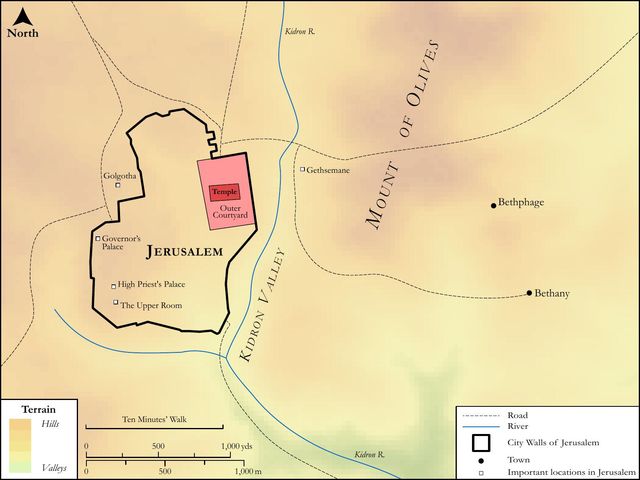
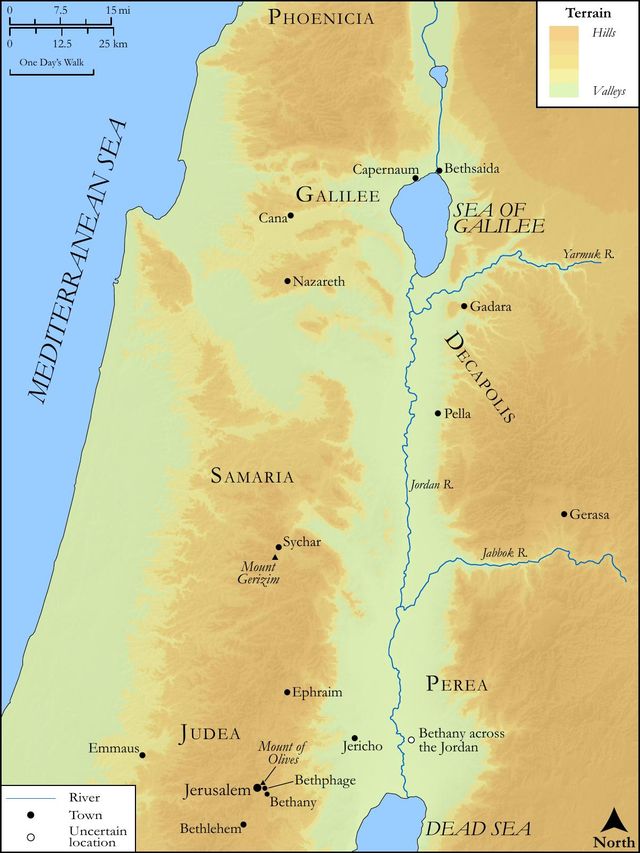
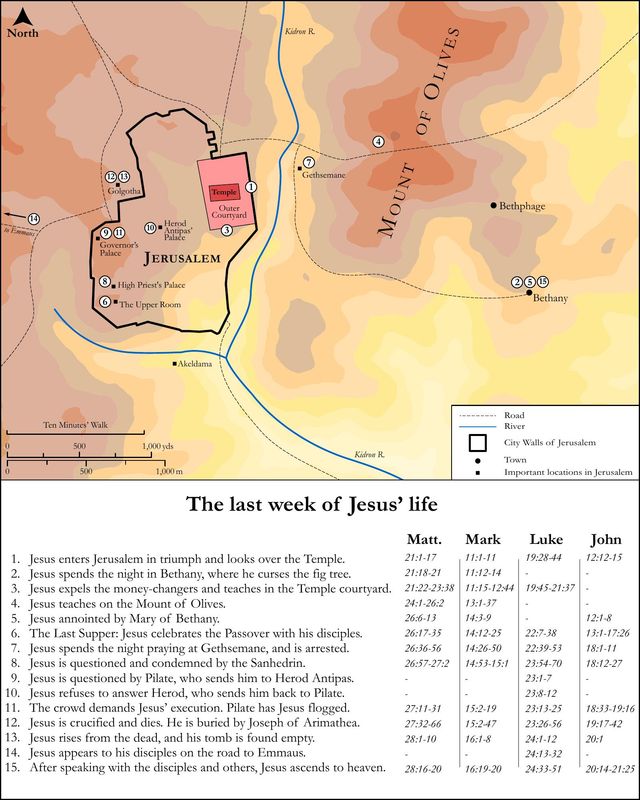
See on the biblical-era maps
Study this verse
Public-domain commentary
Matthew Henry
From his Commentary on the Whole Bible. Henry comments on passages, not single verses — this entry covers John 20:26–31. His four-level outline is real structure in the source text, so it is rendered as structure.
We have here an account of another appearance of Christ to his disciples, after his resurrection, when Thomas was now with them. And concerning this we may observe,
I.When it was that Christ repeated his visit to his disciples:
After eight days, that day seven-night after he rose, which must therefore be, as that was, the first day of the week.
1.He deferred his next appearance for some time, to show his disciples that he was not risen to such a life as he had formerly lived, to converse constantly with them but was as one that belonged to another world, and visited this only as angels do, now and then, when there was occasion. Where Christ was during these eight days, and the rest of the time of his abode on earth, it is folly to enquire, and presumption to determine. Wherever he was, no doubt angels ministered unto him. In the beginning of his ministry he had been forty days unseen, tempted by the evil spirit, Mat 4:1, Mat 4:2. And now in the beginning of his glory he was forty days, for the most part unseen, attended by good spirits.
2.He deferred it so long as seven days. And why so?
(1.)That he might put a rebuke upon Thomas for his incredulity. He had neglected the former meeting of the disciples; and, to teach him to prize those seasons of grace better for the future, he cannot have such another opportunity for several days. He that slips one tide must stay a good while for another. A very melancholy week, we have reason to think Thomas had of it, drooping, and in suspense, while the other disciples were full of joy; and it was owing to himself and his own folly.
(2.)That he might try the faith and patience of the rest of the disciples. They had gained a great point when they were satisfied that they had seen the Lord. Then were the disciples glad; but he would try whether they could keep the ground they had got, when they saw no more of him for some days. And thus he would gradually wean them from his bodily presence, which they had doted and depended too much upon.
(3.)That he might put an honour upon the first day of the week, and give a plain intimation of his will, that it should be observed in his church as the Christian sabbath, the weekly day of holy rest and holy convocations. That one day in seven should be religiously observed was an appointment from the beginning, as old as innocency; and that in the kingdom of the Messiah the first day of the week should be that solemn day this was indication enough, that Christ on that day once and again met his disciples in a religious assembly. It is highly probable that in his former appearance to them he appointed them that day seven-night to be together again, and promised to meet them; and also that he appeared to them every first day of the week, besides other times, during the forty days. The religious observance of that day has been thence transmitted down to us through every age of the church. This therefore is the day which the Lord has made.
II.Where, and how, Christ made them this visit.
It was at Jerusalem, for the doors were shut now, as before, for fear of the Jews. There they staid, to keep the feast of unleavened bread seven days, which expired the day before this; yet they would not set out on their journey to Galilee on the first day of the week, because it was the Christian sabbath, but staid till the day after. Now observe,
1.That Thomas was with them; though he had withdrawn himself once, yet not a second time. When we have lost one opportunity, we should give the more earnest heed to lay hold on the next, that we may recover our losses. It is a good sign if such a loss whet our desires, and a bad sign if it cool them. The disciples admitted him among them, and did not insist upon his believing the resurrection of Christ, as they did, because as yet it was but darkly revealed; they did not receive him to doubtful disputation, but bade him welcome to come and see. But observe, Christ did not appear to Thomas, for his satisfaction, till he found him in society with the rest of his disciples, because he would countenance the meetings of Christians and ministers, for there will he be in the midst of them. And, besides, he would have all the disciples witnesses of the rebuke he gave to Thomas, and yet withal of the tender care he had of him.
2.That Christ came in among them, and stood in the midst, and they all knew him, for he showed himself now, just as he had shown himself before (Joh 20:19), still the same, and no changeling. See the condescension of our Lord Jesus. The gates of heaven were ready to be opened to him, and there he might have been in the midst of the adorations of a world of angels; yet, for the benefit of his church, he lingered on earth, and visited the little private meetings of his poor disciples, and is in the midst of them.
3.He saluted them all in a friendly manner, as he had done before; he said, Peace be unto you. This was no vain repetition, but significant of the abundant and assured peace which Christ gives, and of the continuance of his blessings upon his people, for they fail not, but are new every morning, new every meeting.
III.What passed between Christ and Thomas at this meeting; and that only is recorded, though we may suppose he said a great deal to the rest of them. Here is,
1.Christ's gracious condescension to Thomas, Joh 20:27. He singled him out from the rest, and applied himself particularly to him: "Reach hither thy finger, and, since thou wilt have it so, behold my hands, and satisfy thy curiosity to the utmost about the print of the nails; reach hither thy hand, and, if nothing less will convince thee, thrust it into my side." Here we have,
(1.)An implicit rebuke of Thomas's incredulity, in the plain reference which is here had to what Thomas had said, answering it word for word, for he had heard it, though unseen; and one would think that his telling him of it should put him to the blush. Note, There is not an unbelieving word on our tongues, no, nor thought in our minds, at any time, but it is known to the Lord Jesus. Psa 78:21.
(2.)An express condescension to this weakness, which appears in two things: - [1.] That he suffers his wisdom to be prescribed to. Great spirits will not be dictated to by their inferiors, especially in their acts of grace; yet Christ is pleased here to accommodate himself even to Thomas's fancy in a needless thing, rather than break with him, and leave him in his unbelief. He will not break the bruised reed, but, as a good shepherd, gathers that which was driven away, Eze 34:16. We ought thus to bear the infirmities of the weak, Rom 15:1, Rom 15:2. [2.] He suffers his wounds to be raked into, allows Thomas even to thrust his hand into his side, if then at last he would believe. Thus, for the confirmation of our faith, he has instituted an ordinance on purpose to keep his death in remembrance, though it was an ignominious, shameful death, and one would think should rather have been forgotten, and no more said of it; yet, because it was such an evidence of his love as would be an encouragement to our faith, he appoints the memorial of it to be celebrated. And in that ordinance where in we show the Lord's death we are called, as it were, to put our finger into the print of the nails. Reach hither thy hand to him, who reacheth forth his helping, inviting, giving hand to thee.
It is an affecting word with which Christ closes up what he had to say to Thomas: Be not faithless but believing; mē ginou apistos - do not thou become an unbeliever; as if he would have been sealed up under unbelief, had he not yielded now. This warning is given to us all: Be not faithless; for, if we are faithless, we are Christless and graceless, hopeless and joyless; let us therefore say, Lord, I believe, help thou my unbelief.
2.Thomas's believing consent to Jesus Christ. He is now ashamed of his incredulity, and cries out, My Lord and my God, Joh 20:28. We are not told whether he did put his finger into the print of the nails; it should seem, he did not, for Christ says (Joh 20:29), Thou hast seem, and believed; seeing sufficed. And now faith comes off a conqueror, after a struggle with unbelief.
(1.)Thomas is now fully satisfied of the truth of Christ's resurrection - that the same Jesus that was crucified is now alive, and this is he. His slowness and backwardness to believe may help to strengthen our faith; for hereby it appears that the witnesses of Christ's resurrection, who attested it to the world, and pawned their lives upon it, were not easy credulous men, but cautious enough, and suspended their belief of it till they saw the utmost evidence of it they could desire. Thus out of the eater came forth meat.
(2.)He therefore believed him to be Lord and God, and we are to believe him so.
[1.]We must believe his deity - that he is God; not a man made God, but God made man, as this evangelist had laid down his thesis at first, Joh 1:1. The author and head of our holy religion has the wisdom, power, sovereignty, and unchangeableness of God, which was necessary, because he was to be not only the founder of it, but the foundation of it for its constant support, and the fountain of life for its supply.
[2.]His mediation - that he is Lord, the one Lord, Co1 8:6; Ti1 2:5. He is sufficiently authorized, as pleni-potentiary, to settle the great concerns that lie between God and man, to take up the controversy which would inevitably have been our ruin, and to establish the correspondence that was necessary to our happiness; see Act 2:36; Rom 14:9.
(3.)He consented to him as his Lord and his God. In faith there must be the consent of the will to gospel terms, as well as the assent of the understanding to gospel truths. We must accept of Christ to be that to us which the Father hath appointed him. My Lord refers to Adonai - my foundation and stay; my God to Elohim - my prince and judge. God having constituted him the umpire and referee, we must approve the choice, and entirely refer ourselves to him. This is the vital act of faith, He is mine, Sol 2:16.
(4.)He made an open profession of this, before those that had been the witnesses of his unbelieving doubts. He says it to Christ, and, to complete the sense, we must read it, Thou art my Lord and my God; or, speaking to his brethren, This is my Lord and my God. Do we accept of Christ as our Lord God? We must go to him, and tell him so, as David (Psa 16:2), deliver the surrender to him as our act and deed, tell others so, as those that triumph in our relation to Christ: This is my beloved. Thomas speaks with an ardency of affection, as one that took hold of Christ with all his might, My Lord and my God.
3.The judgment of Christ upon the whole (Joh 20:29): "Thomas because thou hast seen me, thou hast believed, and it is well thou art brought to it at last upon any terms; but blessed are those that have not seen, and yet have believed." Here,
(1.)Christ owns Thomas a believer. Sound and sincere believers, though they be slow and weak, shall be graciously accepted of the Lord Jesus. Those who have long stood it out, if at last they yield, shall find him ready to forgive. No sooner did Thomas consent to Christ than Christ gives him the comfort of it, and lets him know that he believes.
(2.)He upbraids him with his former incredulity. He might well be ashamed to think,
[1.]That he had been so backward to believe, and came so slowly to his own comforts. Those that in sincerity have closed with Christ see a great deal of reason to lament that they did not do it sooner.
[2.]That it was not without much ado that he was brought to believe at last: "If thou hadst not seen me alive, thou wouldst not have believed;" but if no evidence must be admitted but that of our own senses, and we must believe nothing but what we ourselves are eye-witnesses of, farewell all commerce and conversation. If this must be the only method of proof, how must the world be converted to the faith of Christ? He is therefore justly blamed for laying so much stress upon this.
(3.)He commends the faith of those who believe upon easier terms. Thomas, as a believer, was truly blessed; but rather blessed are those that have not seen. It is not meant of not seeing the objects of faith (for these are invisible, Heb 11:1; Co2 4:18), but the motives of faith - Christ's miracles, and especially his resurrection; blessed are those that see not these, and yet believe in Christ. This may look, either backward, upon the Old Testament saints, who had not seen the things which they saw, and yet believed the promise made unto the father, and lived by that faith; or forward, upon those who should afterwards believe, the Gentiles, who had never seen Christ in the flesh, as the Jews had. This faith is more laudable and praise-worthy than theirs who saw and believed; for,
[1.]It evidences a better temper of mind in those that do believe. Not to see and yet to believe argues greater industry in searching after truth, and greater ingenuousness of mind in embracing it. He that believes upon that sight has his resistance conquered by a sort of violence; but he that believes without it, like the Bereans, is more noble.
[2.]It is a greater instance of the power of divine grace. The less sensible the evidence is the more does the work of faith appear to be the Lord's doing. Peter is blessed in his faith, because flesh and blood have not revealed it to him, Mat 16:17. Flesh and blood contribute more to their faith that see and believe, than to theirs who see not and yet believe. Dr. Lightfoot quotes a saying of one of the rabbin, "That one proselyte is more acceptable to God than all the thousands of Israel that stood before mount Sinai; for they saw and received the law, but a proselyte sees not, and yet receives it."
IV.The remark which the evangelist makes upon his narrative, like an historian drawing towards a conclusion, Joh 20:30, Joh 20:31. And here,
1.He assures us that many other things occurred, which were all worthy to be recorded, but are not written in the book: many signs. Some refer this to all the signs that Jesus did during his whole life, all the wondrous words he spoke, and all the wondrous works he did. But it seems rather to be confined to the signs he did after his resurrection, for these were in the presence of the disciples only, who are here spoken of, Act 10:41. Divers of his appearances are not recorded, as appears, Co1 15:5-7. See Act 1:3. Now,
(1.)We may here improve this general attestation, that there were other signs, many others, for the confirmation of our faith; and, being added to the particular narratives, they very much strengthen the evidence. Those that recorded the resurrection of Christ were not put to fish for evidence, to take up such short and scanty proofs as they could find, and make up the rest with conjecture. No, they had evidence enough and to spare, and more witnesses to produce than they had occasion for. The disciples, in whose presence these other signs were done, were to be preachers of Christ's resurrection to others, and therefore it was requisite they should have proofs of it ex abundanti - in abundance, that they might have a strong consolation, who ventured life and all upon it.
(2.)We need not ask why they were not all written, or why not more than these, or others than these; for it is enough for us that so it seemed good to the Holy Spirit, by whose inspiration this was given. Had this history been a mere human composition, it had been swelled with a multitude of depositions and affidavits, to prove the contested truth of Christ's resurrection and long argument drawn up for the demonstration of it; but, being a divine history, the penmen write with a noble security, relating what amounted to a competent proof, sufficient to convince those that were willing to be taught and to condemn those that were obstinate in their unbelief; and, if this satisfy not, more would not. Men produce all they have to say, that they may gain credit; but God does not, for he can give faith. Had this history been written for the entertainment of the curious, it would have been more copious, or every circumstance would have brightened and embellished the story; but it was written to bring men to believe, and enough is said to answer that intention, whether men will hear or whether they will forbear.
2.He instructs us in the design of recording what we do find here (Joh 20:31): "These accounts are given in this and the following chapter, that you might believe upon these evidences; that you might believe that Jesus is the Christ, the Son of God, declared with power to be so by his resurrection."
(1.)Here is the design of those that wrote the gospel. Some write books for their diversion, and publish them for their profit or applause, others to oblige the Athenian humour, others to instruct the world in arts and sciences for their secular advantage; but the evangelists wrote without any view of temporal benefit to themselves or others, but to bring men to Christ and heaven, and, in order to this, to persuade men to believe; and for this they took the most fitting methods, they brought to the world a divine revelation, supported with its due evidences.
(2.)The duty of those that read and hear the gospel. It is their duty to believe, to embrace, the doctrine of Christ, and that record given concerning him Jo1 5:11.
[1.]We are here told what the great gospel truth is which we are to believe - that Jesus is that Christ, that Son of God. First, That he is the Christ, the person who, under the title of the Messiah, was promised to, and expected by, the Old Testament saints, and who, according to the signification of the name, is anointed of God to be a prince and a Saviour. Secondly, That he is the Son of God; not only as Mediator (for then he had not been greater than Moses, who was a prophet, intercessor, and lawgiver), but antecedent to his being the Mediator; for if he had not been a divine person, endued with the power of God and entitled to the glory of God, he had not been qualified for the undertaking - not fit either to do the Redeemer's work or to wear the Redeemer's crown.
[2.]What the great gospel blessedness is which we are to hope for - That believing we shall have life through his name. This is, First, To direct our faith; it must have an eye to the life, the crown of life, the tree of life set before us. Life through Christ's name, the life proposed in the covenant which is made with us in Christ, is what we must propose to ourselves as the fulness of our joy and the abundant recompence of all our services and sufferings. Secondly, To encourage our faith, and invite us to believe. Upon the prospect of some great advantage, men will venture far; and greater advantage there cannot be than that which is offered by the words of this life, as the gospel is called, Act 5:20. It includes both spiritual life, in conformity to God and communion with him, and eternal life, in the vision and fruition of him. Both are through Christ's name, by his merit and power, and both indefeasibly sure to all true believers.
Historical interpretation
Five Centuries of Reception
19 surviving comments on this verse. Each one is dated, so this reads as a timeline rather than a list.
Select a marker to jump to its quote. Markers stagger vertically where authors wrote within a few decades of each other.
And I know that He was possessed of a body not only in His being born and crucified, but I also know that He was so after His resurrection, and believe that He is so now. When, for instance, He came to those who were with Peter, He said to them, "Lay hold, handle Me, and see that I am not an incorporeal spirit." "For a spirit hath not flesh and bones, as ye see Me have." And He says to Thomas, "Reach hither thy finger into the print of the nails, and reach hither thy hand, and thrust it into My side; " and immediately they believed that He was Christ. Wherefore Thomas also says to Him, "My Lord, and my God." And on this account also did they despise death, for it were too little to say, indignities and stripes. Nor was this all; but also after He had shown Himself to them, that He had risen indeed, and not in appearance only, He both ate and drank with them during forty entire days. And thus was He, with the flesh, received up in their sight unto Him that sent Him, being with that same flesh to come again, accompanied by glory and power. For, say the [holy] oracles, "This same Jesus, who is taken up from you into heaven, shall so come, in like manner as ye have seen Him go unto heaven." But if they say that He will come at the end of the world without a body, how shall those "see Him that pierced Him," and when they recognise Him, "mourn for themselves? " For incorporeal beings have neither form nor figure, nor the aspect of an animal possessed of shape, because their nature is in itself simple.
Marcion chose to believe that Jesus was a phantom, denying to him the reality of a perfect body. Now, not even to his apostles was his nature ever a matter of deception. He was truly both seen and heard on the mount. True and real was the draught of wine at the marriage of [Cana in] Galilee. True and real also was the touch of the then believing Thomas. Read the testimony of John: “That which we have seen, which we have heard, which we have looked on with our eyes and our hands have handled, of the Word of life.” False, of course, and deceptive must have been that testimony, if the witness of our eyes and ears and hands by nature is a lie.
He calls Him, then, "the first-fruits of them that sleep," as the "first-begotten of the dead." For He, having risen, and being desirous to show that that same (body) had been raised which had also died, when His disciples were in doubt, called Thomas to Him, and said, "Reach hither; handle me, and see: for a spirit hath not bone and flesh, as ye see me have."
In calling Him the first-fruits, he testified to that which we have said, viz., that the Saviour, taking to Himself the flesh out of the same lump, raised this same flesh, and made it the first-fruits of the flesh of the righteous, in order that all we who have believed in the hope of the Risen One may have the resurrection in expectation.
That Christ is God. In Genesis: "And God said unto Jacob, Arise, and go up to the place of Bethel, and dwell there; and make there an altar to that God who appeared unto thee when thou reddest from the face of thy brother Esau." Also in Isaiah: "Thus saith the Lord, the God of Sabaoth, Egypt is wearied; and the merchandise of the Ethiopians, and the tall men of the Sabeans, shall pass over unto Thee, and shall be Thy servants; and shall walk after Thee bound with chains; and shall worship Thee, and shall pray to Thee, because God is in Thee, and there is no other God beside Thee. For Thou art God, and we knew it not, O God of Israel, our Saviour. They shall all be confounded and fear who oppose Thee, and shall fall into confusion." Likewise in the same: "The voice of one crying in the wilderness, Prepare ye the way of the Lord, make straight the paths of our God. Every channel shall be filled up, and every mountain and bill shall be made low, and all crooked places shall be made straight, and rough places plain; and the glory of the Lord shall be seen, and all flesh shall see the salvation of God, because the Lord hath spoken it." Moreover, in Jeremiah: This is our God, and no other shall be esteemed beside Him, who hath found all the way of knowledge, and hath given it to Jacob His son, and to Israel His beloved. After this He was seen upon earth, and He conversed with men." Also in Zechariah God says: "And they shall cross over through the narrow sea, and they shall smite the waves in the sea, and they shall dry up all the depths of the rivers; and all the haughtiness of the Assyrians shall be confounded, and the sceptre of Egypt shall be taken away. And I will strengthen them in the Lord their God, and in His name shall they glory, saith the Lord." Moreover, in Hosea the Lord saith: "I will not do according to the anger of mine indignation, I will not allow Ephraim to be destroyed: for I am God, and there is not a holy man in thee: and I will not enter into the city; I will go after God." Also in the forty-fourth Psalm: "Thy throne, O God, is for ever and ever: the sceptre of righteousness is the sceptre of Thy kingdom. Thou hast loved righteousness, and hated iniquity: wherefore God, Thy God, hath anointed Thee with the oil of gladness above Thy fellows." So, too, in the forty-fifth Psalm: "Be still, and know that I am God. I will be exalted among the nations, and I will be exalted in the earth." Also in the eighty-first Psalm: "They have not known, neither have they understood: they will walk on in darkness." Also in the sixty-seventh Psalm: "Sing unto God, sing praises unto His name: make a way for Him who goeth up into the west: God is His name." Also in the Gospel according to John: "In the beginning was the Word, and the Word was with God, and God was the Word." Also in the same: "The Lord said to Thomas, Reach hither thy finger, and behold my hands: and be not faithless, but believing. Thomas answered and said unto Him, My Lord and my God. Jesus saith unto him, Because thou hast seen me, thou hast believed: blessed are they who have not seen, and yet have believed." Also Paul to the Romans: "I could wish that I myself were accursed from Christ for my brethren and my kindred according to the flesh: who are Israel-ires: whose are the adoption, and the glory, and the covenant, and the appointment of the law, and the service (of God), and the promises; whose are the fathers, of whom, according to the flesh, Christ came, who is God over all, blessed for evermore." Also in the Apocalypse: "I am Alpha and Omega, the beginning and the end I will give to him that is athirst, of the fountain of living water freely. He that overcometh shall possess these things, and their inheritance; and I will be his God, and he shall be my son." Also in the eighty-first Psalm: "God stood in the congregation of gods, and judging gods in the midst." And again in the same place: "I have said, Ye are gods; and ye are all the children of the Highest: but ye shall die like men." But if they who have been righteous, and have obeyed the divine precepts, may be called gods, how much more is Christ, the Son of God, God! Thus He Himself says in the Gospel according to John: "Is it not written in the law, that I said, Ye are gods? If He called them gods to whom the word of God was given, and the Scripture cannot be relaxed, do ye say to Him whom the Father hath sanctified and sent into the world, that thou blasphemest, because I said, I am the Son of God? But if I do not the works of my Father, believe me not; but if I do, and ye will not believe me, believe the works, and know that the Father is in me, and I in Him." Also in the Gospel according to Matthew: "And ye shall call His name Emmanuel, which is, being interpreted, God with us."
If, like a Thomas, you were left out when the disciples were assembled to whom Christ shows himself, when you do see him do not be faithless. And if you do not believe, then believe those who tell you. And if you cannot believe them either, then have confidence in the print of the nails.
Once he had accustomed people to seeing the miracle of resurrection in other bodies, he confirmed his word in his own humanity. You already received a glimpse of that word working in others—those who were about to die, the child who had just ceased to live, the young man at the edge of the grave, the putrefying corpse, all alike restored by one command to life.… Now look at him whose hands were pierced with nails, look at him whose side was transfixed with a spear. Pass your fingers through the print of the nails, thrust your hand into the spear wound. You could surely guess how far within your hand would reach by the breadth of the external scar since the wound that gives admission to the hand shows to what depth the iron entered. If he then has been raised, well may we utter the apostle’s exclamation, “How do some say that there is no resurrection of the dead?” Since, then, every prediction of the Lord is shown to be true by the testimony of events—in fact, we not only learned this from his words but also received the proof in his deeds from the very same people who returned to life by resurrection—what other occasion is left for those who do not believe? Let us rather bid farewell to those who pervert our simple faith by “philosophy and vain deceit.” Let us instead hold on to our confession [of the resurrection] in its purity, a confession that we have learned through the gracious words of the prophet, “You shall take away their breath, and they shall fail and turn to dust. You shall then send forth your Spirit, and they shall be created, and you shall renew the face of the earth.”
And not in this way only did Jesus rebuke him, but also by what follows; for when he, being fully satisfied, breathed again, and cried aloud, "My Lord, and my God," He saith, "Because thou hast seen Me, thou hast believed; blessed are they who have not seen, and yet have believed."
For this is of faith, to receive things not seen; since, "Faith is the substance of things hoped for, the evidence of things not seen." And here He pronounceth blessed not the disciples only, but those also who after them should believe. "Yet," saith some one, "the disciples saw and believed." Yes, but they sought nothing of the kind, but from the proof of the napkins, they straightway received the word concerning the Resurrection, and before they saw the body, exhibited all faith. When therefore any one in the present day say, "I would that I had lived in those times, and had seen Christ working miracles," let them reflect, that, "Blessed are they who have not seen, and yet have believed."
(Hom. lxxxvii) Consider the mercy of the Lord, how for the sake of one soul, He exhibits His wounds. And yet the disciples deserved credit, and He had Himself foretold the event. Notwithstanding, because one person, Thomas, would examine Him, Christ allowed him. But He did not appear to him immediately, but waited till the eighth day, in order that the admonition being given in the presence of the disciples, might kindle in him greater desire, and strengthen his faith for the future. And after eight days again His disciples were within, and Thomas with them: then came Jesus, the doors being shut, and stood in the midst, and said, Peace be unto you.
(Hom. lxxxvii. 1) Jesus then comes Himself, and does not wait till Thomas interrogates Him. But to show that He heard what Thomas said to the disciples, He uses the same words. And first He rebukes him; Then saith He to Thomas, Reach hither thy finger, and behold My hands; and reach hither thy hand, and thrust it into My side: secondly, He admonishes him; And be not faithless, but believing. Note how that before they receive the Holy Ghost faith wavers, but afterward is firm. We may wonder how an incorruptible body could retain the marks of the nails. But it was done in condescension; in order that they might be sure that it was the very person Who was crucified.
(Hom. lxxxvii) If any one then says, Would that I had lived in those times, and seen Christ doing miracles! let him reflect, Blessed are they that have not seen, and yet have believed.
And why doth He not appear to him straightway, instead of "after eight days"? In order that being in the mean time continually instructed by the disciples, and hearing the same thing, he might be inflamed to more eager desire, and be more ready to believe for the future. But whence knew he that His side had been opened? From having heard it from the disciples. How then did he believe partly, and partly not believe? Because this thing was very strange and wonderful. But observe, I pray you, the truthfulness of the disciples, how they hide no faults, either their own or others', but record them with great veracity.
Jesus again presenteth himself to them, and waiteth not to be requested by Thomas, nor to hear any such thing, but before he had spoken, Himself prevented him, and fulfilled his desire; showing that even when he spake those words to the disciples, He was present. For He used the same words, and in a manner conveying a sharp rebuke, and instruction for the future. For having said, "Reach hither thy finger, and behold My hands; and reach hither thy hand, and thrust it into My side"; He added, "And be not faithless, but believing."
Seest thou that his doubt proceeded from unbelief? But it was before he had received the Spirit; after that, it was no longer so, but, for the future, they were perfected.
It is worth enquiring, how an incorruptible body showed the prints of the nails, and was tangible by a mortal hand. But be not thou disturbed; what took place was a matter of condescension. For that which was so subtle and light as to enter in when the doors were shut, was free from all density; but this marvel was shown, that the Resurrection might be believed, and that men might know that it was the Crucified One Himself, and that another rose not in His stead. On this account He arose bearing the signs of the Cross, and on this account He eateth. At least the Apostles everywhere made this a sign of the Resurrection, saying, "We, who did eat and drink with Him." As therefore when we see Him walking on the waves before the Crucifixion, we do not say, that that body is of a different nature, but of our own; so after the Resurrection, when we see Him with the prints of the nails, we will no more say, that he is therefore corruptible. For He exhibited these appearances on account of the disciple.
After the resurrection we shall have the same members that we now use, the same flesh and blood and bones, for it is not the nature of these that is condemned in Holy Scripture but their works.… The true confession of the resurrection declares that the flesh will be glorious, but without destroying its reality. And so, when the apostle says, “This [flesh] is corruptible and mortal,” his words denote this very body, in other words, the flesh that was then seen. But when he further adds that it “puts on incorruption and immortality,” he is not saying that what was put on [i.e., the clothing] does away with the body that it adorns in glory. Rather, it makes that body glorious that previously lacked glory. When the more worthless robe of mortality and weakness is laid aside, then we can be clothed with the gold of immortality and the blessedness of strength as well as virtue.
The love we bear for the blessed martyrs causes us—how, I do not know—to desire to see in the heavenly kingdom the marks that they received for the name of Christ. And possibly we shall see them. For this will not be a deformity but a mark of honor and will add luster to their appearance as well as a spiritual (if not a bodily) beauty.… For even though the blemishes of the body will not be found in any resurrected body, the evidences of virtue can hardly be called blemishes.
"But Thomas, one of the twelve, who is called Didymus, was not with them when Jesus came. The other disciples therefore said unto him, We have seen the Lord. But he said unto them, Except I shall see in His hands the print of the nails, and put my finger into the place of the nails, and put my hand into His side, I will not believe. And after eight days, again His disciples were within, and Thomas with them. Then came Jesus, the doors being shut, and stood in the midst, and said, Peace be unto you. Then saith He to Thomas, Reach hither thy finger, and behold my hands; and reach hither thy hand, and put it into my side: and be not faithless, but believing. Thomas answered and said unto Him, My Lord and my God." He saw and touched the man, and acknowledged the God whom he neither saw nor touched; but by the means of what he saw and touched, he now put far away from him every doubt, and believed the other. "Jesus saith unto him, Because thou hast seen me, thou hast believed." He saith not, Thou hast touched me, but, "Thou hast seen me," because sight is a kind of general sense. For sight is also habitually named in connection with the other four senses: as when we say, Listen, and see how well it sounds; smell it, and see how well it smells; taste it, and see how well it savors; touch it, and see how hot it is. Everywhere has the word, See, made itself heard, although sight, properly speaking, is allowed to belong only to the eyes. Hence here also the Lord Himself says, "Reach hither thy finger, and behold my hands:" and what else does He mean but, Touch and see? And yet he had no eyes in his finger. Whether therefore it was by looking, or also by touching, "Because thou hast seen me," He says, "thou hast believed." Although it may be affirmed that the disciple dared not so to touch, when He offered Himself for the purpose; for it is not written, And Thomas touched Him. But whether it was by gazing only, or also by touching that he saw and believed, what follows rather proclaims and commends the faith of the Gentiles: "Blessed are they that have not seen, and yet have believed." He made use of words in the past tense, as One who, in His predestinating purpose, knew what was future, as if it had already taken place.
(de Symb. ad Cat. ii. 8) He might, had He pleased, have wiped all spot and trace of wound from His glorified body; but He had reasons for retaining them. He showed them to Thomas, who would not believe except he saw and touched; and He will show them to His enemies, not to say, as He did to Thomas, Because thou hast seen, thou hast believed, but to convict them: Behold the Man whom ye crucified, see the wounds which ye inflicted, recognise the side which ye pierced, that it was by you, and for you, that it was opened, and yet ye cannot enter there.
(xxii. Civ. Dei, xix) We are, as I know not how, afflicted with such love for the blessed martyrs, that we would wish in that kingdom to see on their bodies the marks of those wounds which they have borne for Christ's sake. And perhaps we shall see them; for they will not have deformity, but dignity, and, though on the body, shine forth not with bodily, but with spiritual beauty (virtutis). Nor yet, if any of the limbs of martyrs have been cut off, shall they therefore appear without them in the resurrection of the dead; for it is said, There shall not an hair of your head perish. But if it be fit that in that new world, the traces of glorious wounds should still be preserved on the immortal flesh, in the places where the limbs were cut off there, though those same limbs withal be not lost but restored, shall the wounds appear. For though all the blemishes of the body shall then be no more, yet the evidences of virtue are not to be called blemishes.
Let the attentive reader call to mind that our Lord repulsed Mary Magdalene from touching Him, saying plainly: Touch Me not, for I am not yet ascended unto the Father. Yet He allows Thomas to touch His Side, and to feel with his fingers the print of the nails. We have already explained why our Lord did this, but none the less will we call back to mind the reason, briefly recapitulating what we said. For not yet had the time arrived for Mary to touch Him, because she had not yet been sanctified by the grace of the Holy Spirit; for while Christ was yet in our midst, and had not yet ascended to the Father in heaven, it was impossible to see the descent of the Comforter fully accomplished among men. It was meet, however, for Thomas to touch Him, as he, as well as the rest, had been enriched with the Spirit. For, as we said before, he was not on account of his absence without his share in the Spirit. For the munificence of the Giver reached unto him also, when the boon was granted to the entire company of the holy disciples.
I think we ought also to investigate the following question. Thomas felt our Saviour's Side, and found the wounds made by the soldier's spear, and saw the print of the nails. Then how was it, someone may inquire, that the marks of corruption were apparent in an incorruptible Body? For the abiding trace of the holes bored through the Hands and Side, and the marks of wounds and punctures made by steel, affords proof of physical corruption, though the true and incontrovertible fact that Christ's Body was transformed into incorrup-tion points to a necessary discarding of all the results of corruption, together with corruption itself. For will any man who is lame, at the Resurrection have a maimed foot or limb? And if any man have lost the sight of his eyes in this life, will he be raised again blind? How then, someone may say, can we have shaken off the yoke of corruption, if its results still remain and rule over our members? It is essential, I think, to inquire into this question; and this we say, with reference to the difficulties raised by the passage. We are as far as possible anxious to assent to the contention that at the time of the resurrection there will be no remnant of adventitious corruption left in us, but, as the wise Paul said concerning this body of ours, that which is sown in weakness is raised in power, and that which is sown in dishonour is raised in glory. And what can we expect the resurrection of this body in power and glory to be, if it does not imply that it will cast off all the weakness and dishonour of corruption and disease, and return to its original purity? For the human body was not made for death and corruption. But, inasmuch as Thomas required this proof for his perfect satisfaction, our Lord Jesus Christ, of necessity, therefore, in order to leave no excuse for our want of faith, appears even as he sought to see Him; for even when He ascended into heaven itself, and made known the meaning of the mystery concerning Himself to the rulers, principalities, and powers above, and to those who commanded the legions of angels, He appeared also unto them in this same guise that they might believe that in very truth the Word That was of the Father, and in the Father, became Man for our sake, and that they might know that such was His care for His creatures that He died for our salvation. And, in order to make the meaning of my explanation clearer to my hearers, I will add the very words spoken by the mouth of Isaiah on this subject. He saith: Who is This That cometh from Edom, with dyed garments from Bosra? They who raise this shout, I mean the cry: Who is This That cometh from Edom? that is, from the earth, are angels and rational powers, for they are marvelling at the Lord ascending into heaven. And, seeing Him almost, as it were, dyed in His own Blood, they say unto Him, not yet apprehending the mystery: Why is Thy apparel red, and why are Thy garments like him that treadeth in the wine-vats? For they compare the colour of the blood to new wine, lately trodden in the press. And what saith Christ unto them? First, in order that He may be known to be the living God, He saith: I speak righteousness; using the word speak, instead of "teach." And most assuredly. He that teacheth righteousness must be a Lawgiver, and if a Lawgiver, surely also God. Then say the angels unto Him, as Christ showeth them the marks of the nails: What are these wounds in Thy Hands? and the Lord answereth: Those with which I was wounded in the house of My beloved. For Israel was the house that the Lord loved, and Israel smote Him with nails and spear. For the outrages of the soldiers may justly be ascribed unto the Jews, for they brought the Lord to His death. Therefore, when He wished to satisfy the holy angels that He was, in fact, a Man, and that He had undergone the Cross for us, and that He was risen again to life from the dead, Christ was not content with mere words, but showed unto them the marks of His suffering. What is there to astonish us in the fact, that when He desired to rid the blessed Thomas of his unbelief He showed the print of the nails, appearing unto him, contrary to expectation, for the advantage of all men, and to the intent that we might believe without question that the mystery of the Resurrection was actually accomplished, no other body being raised but that which suffered death?
Before the passion he predicted his bodily death each time, saying that he would be handed over to the high priest’s followers and proclaiming the trophy of the cross. But after the passion, when he rose from the dead on the third day and, since the disciples doubted that he had been raised, he appeared to them in his actual body. [He] declares that he has real flesh with bones, presents his wounded side to their eyes and shows them the marks of the nails.
Who protected the hand of the disciple, then,
That was not melted when he approached
The fiery side of the Lord?
Who gave it daring and strength to probe
The flaming bone?
Certainly the side was examined.
For unless the side had supplied abundant power,
How could a right hand of clay have touched
The sufferings which had shaken
What is above and what is below?
It was grace itself that was given to Thomas
By Christ to touch his side and to cry out,
“You are our Lord and God.”
Truly the bramble bush which endured fire
Was burned but not consumed.
Because of the hand of Thomas
I believe the story of Moses.
For, though his hand was perishable and thorny,
It was not burned
When it touched the side that was like burning flame.
Then fire came upon the bramble bush,
But now, the thorny one raced to the fire;
And God himself looked on,
Guarding both. And so I believe.
And so I will praise the one who is both God and man, as I cry,
“You are our Lord and God.”
For truly the boundary line of faith
Was circumscribed for me
By the hand of Thomas.
For when he touched Christ
He became like the pen
Of a rapid-writing scribe
That writes for the faithful.
Faith gushes forth from it.
The robber drank and became sober again from it.
The disciples watered their hearts from it.
Thomas drained the knowledge that he sought from it,
For he drank first and then offered a draught
To many who have a little doubt. He persuades them to say,
“You are our Lord and God.”
(Hom. xxvi.) Our Lord gave that flesh to be touched which He had introduced through shut doors: wherein two wonderful, and, according to human reason, contradictory things appear, viz. that after the resurrection He had a body incorruptible, and yet palpable. For that which is palpable must be corruptible, and that which is incorruptible must be impalpable. But He showed Himself incorruptible and yet palpable, to prove that His body after His resurrection was the same in nature as before, but different in glory.
(Mor. xii. 31) Our body also in that resurrection to glory will be subtle by means of the action of the Spirit, but palpable by its true nature, not, as Eutychius says, impalpable, and subtler than the winds and the air.
The Lord came again, and offered his side to the unbelieving disciple to touch, showed his hands, and by displaying the scar of his wounds, healed the wound of that man's unbelief. What, dearest brothers, what do you observe in these things? Do you think it happened by chance that this chosen disciple was absent then, but coming later heard, hearing doubted, doubting touched, touching believed? This did not happen by chance, but by divine dispensation. For heavenly mercy acted in a wondrous way so that the doubting disciple, while he touched the wounds of flesh in his master, might heal in us the wounds of unbelief. For the unbelief of Thomas profited us more for faith than the faith of the believing disciples, because while he is brought back to faith by touching, our mind, all doubt set aside, is strengthened in faith. For thus the Lord permitted his disciple to doubt after his resurrection, yet did not abandon him in his doubt, just as before his birth he willed Mary to have a spouse, who nevertheless did not attain to marriage with her. For thus the doubting and touching disciple became a witness of the true resurrection, just as the spouse had been the guardian of the mother's perfect virginity.
Continue studying John 20:27 across the web’s major study libraries — every link below opens this exact verse, chapter, or book on the destination site.
Read & Compare
 BibleGatewayThis verse in more than 200 translations and 70 languages.
 Bible.comThe YouVersion reader — hundreds of translations, reading plans, and highlights.
 ESV.orgCrossway's official English Standard Version reader.
 NET BibleThe NET translation with 60,000+ translators' notes on every rendering decision.
 STEP BibleTyndale House's free study tool — original text, vocabulary, and scholarly resources.
 BibliaLogos Bible Software's free web reader.
 USCCBThe New American Bible (Revised Edition) with the U.S. bishops' study notes.
Commentaries
 BibleHub CommentariesDozens of classic commentaries on this verse, gathered on one page.
 StudyLightMore than 100 commentary sets — the largest collection on the web.
 BibleRefPlain-English commentary on what this verse means, verse by verse.
 Enduring WordDavid Guzik's free commentary on this chapter, widely used by Bible teachers.
 Bible Study ToolsVerse commentary alongside Greek and Hebrew study aids.
Original Language & Research
- BibleHub InterlinearThe verse word by word — original language, transliteration, and English.
- BibleHub LexiconEvery word's original-language definition and Strong's entry.
 Blue Letter BibleDeep-study tools — Strong's numbers, concordance, and word studies.
 CNTR CollationThe earliest Greek manuscripts of this verse, collated letter by letter.
Sermons, Hymns & Audio


TrulyRandomVerse is not affiliated with these sites and doesn’t control their content. They’re linked because they’re genuinely useful.
Summary
Jesus confronts Thomas's expressed doubt regarding His resurrection by offering the very physical proof Thomas demanded. This pivotal moment underscores the tangible reality of Christ's post-resurrection body while simultaneously issuing a profound call to move beyond empirical evidence to a faith rooted in trust and belief, setting the stage for a deeper understanding of discipleship that transcends mere sight.
Context
ShowHideLiterary Context
This verse is situated within the immediate aftermath of Jesus' resurrection, specifically during His second appearance to the disciples in the upper room. Eight days prior, Jesus had appeared to the disciples, but Thomas was notably absent (John 20:24). Upon hearing the disciples' testimony, Thomas famously declared his refusal to believe unless he could physically touch Jesus' nail prints and thrust his hand into His side (John 20:25). Jesus' appearance in John 20:26 directly addresses Thomas's specific demand, demonstrating Jesus' omniscience and compassionate engagement with individual struggles of faith, culminating in the direct address of John 20:27. This scene serves as a narrative climax for Thomas's journey from skepticism to confession, leading directly into Jesus' blessing on those who believe without seeing (John 20:29).
Historical & Cultural Context
The historical setting is Jerusalem shortly after the Passover and the crucifixion of Jesus, a period of immense confusion and fear among Jesus' followers. The disciples were hiding behind locked doors "for fear of the Jews" (John 20:19), indicating the volatile political and religious climate. In Jewish culture, eyewitness testimony was paramount for validating claims, particularly those as extraordinary as resurrection. Thomas's demand for physical proof was not entirely unreasonable within this framework, as it sought concrete evidence to substantiate an otherwise unbelievable claim. The concept of a physical resurrection was also a point of contention among Jewish sects, with the Sadducees denying it entirely while the Pharisees affirmed it. Jesus' physical appearance, bearing the marks of His crucifixion, provided irrefutable evidence against any notion of a mere spiritual apparition, grounding the resurrection firmly in historical reality.
Key Themes
ShowHideJohn 20:27 powerfully contributes to several overarching themes in John's Gospel. Firstly, it solidifies the tangible reality of the resurrection, proving that Jesus' body was not a phantom but truly resurrected, albeit glorified, bearing the marks of His suffering. This physical proof is crucial for the Gospel's assertion of Jesus' victory over death, a central tenet echoed in 1 Corinthians 15:20. Secondly, it highlights Jesus' profound compassion and patience with doubters. Jesus does not rebuke Thomas for his skepticism but meets him precisely at his point of need, offering the very evidence he sought. This demonstrates Jesus' deep understanding of human frailty and His desire to lead individuals to genuine faith. Finally, the verse introduces the critical theme of the nature of faith, moving beyond a reliance on empirical evidence to a higher call for belief without seeing. While evidence can facilitate belief, Jesus' concluding command to Thomas, "be not faithless, but believing," emphasizes that true faith is ultimately a matter of trust and conviction, a theme further developed in John 20:29.
Exposition and Analysis
ShowHideKey Word Analysis
ShowHideMeaning "to lay forth" or "relate in words," often implying systematic or set discourse. Here, it indicates Jesus' deliberate and authoritative address to Thomas, not a casual remark, but a purposeful statement designed to confront and transform Thomas's unbelief.
Meaning "to see" (literally or figuratively); by implication, "to know." Jesus invites Thomas not just to visually perceive His hands but to truly "know" the reality of His resurrected body through direct observation, leading to a deeper understanding and conviction.
Meaning "disbelieving," "without Christian faith," or "untrustworthy." This word precisely describes Thomas's state of doubt, indicating a lack of trust or conviction in the testimony of others and the reality of the resurrection. Jesus' command challenges Thomas to move away from this state of unbelief.
Meaning "trustworthy" (objectively) or "trustful" (subjectively). In this context, it refers to being "trustful" or "faithful." It stands in direct contrast to "faithless," representing the desired state of profound trust and conviction in Jesus and the truth of His resurrection.
Verse Breakdown
ShowHide"Then saith he to Thomas,"
This opening phrase immediately establishes the direct and personal nature of Jesus' address. The word "Then" (G1534, eîta) indicates a sequence of events, highlighting that Jesus' appearance and words to Thomas are a specific, targeted response to Thomas's previous declaration of doubt, emphasizing Jesus' intentionality and knowledge of Thomas's heart.
"Reach hither thy finger, and behold my hands;"
Jesus directly echoes Thomas's earlier demand (John 20:25), inviting him to inspect the wounds in His hands. The imperative "Reach hither" (G5342, phérō G5602, hōde) combined with "behold" (G1492, eídō) emphasizes a call to physical engagement and careful observation, providing the empirical evidence Thomas sought. This demonstrates Jesus' willingness to meet Thomas at his point of skepticism.
"and reach hither thy hand, and thrust [it] into my side:"
This second part of the invitation further addresses Thomas's specific, almost audacious, demand to probe the wound in Jesus' side. The verb "thrust" (G906, bállō) implies a forceful insertion, which, while perhaps shocking, underscores the undeniable reality of the wound and, by extension, the physical resurrection. This invitation leaves no room for doubt about the tangibility of Jesus' body.
"and be not faithless, but believing."
This is the climactic command and the theological heart of the verse. After offering the physical proof, Jesus transcends the need for empirical evidence by calling Thomas to a higher form of faith. The Greek words ápistos ("faithless," G571) and pistós ("believing," G4103) form a stark contrast, urging Thomas to move from a state of unbelief and distrust to one of active trust and conviction. This statement serves as a transition from evidence-based belief to a faith that trusts even without seeing, anticipating the beatitude in John 20:29.
Literary Devices
ShowHideThe passage employs several significant literary devices. Direct Address is prominent, as Jesus speaks directly and personally to Thomas, highlighting the individual nature of faith and doubt. The use of Repetition in Jesus' echoing of Thomas's own words ("Reach hither thy finger... reach hither thy hand") serves to underscore Jesus' omniscience and His direct engagement with Thomas's specific challenge. This also functions as a form of Irony, as Jesus provides the very proof Thomas demanded, yet immediately follows it with a call to a faith that transcends such demands. The concluding phrase, "be not faithless, but believing," is a powerful example of Antithesis, juxtaposing two opposing states (unbelief vs. belief) to emphasize the desired transformation in Thomas. This rhetorical contrast powerfully conveys the spiritual choice Thomas, and indeed all believers, are called to make.
Theological and Thematic Connections
ShowHideJohn 20:27 stands as a profound theological statement on the nature of the resurrection and the essence of faith. It affirms the physical reality of Jesus' resurrection, demonstrating that His glorified body retained the marks of His crucifixion, which serves as irrefutable proof of His victory over death and sin. This encounter also highlights God's compassionate patience with human doubt, showing Jesus' willingness to meet individuals where they are, even in their skepticism, to lead them to truth. Ultimately, the verse pivots from physical evidence to a higher call for faith, suggesting that while evidence can be a catalyst, true belief is a trust in the unseen, a conviction grounded in the person of Christ rather than solely on empirical data. This sets a precedent for future generations of believers who would not have the privilege of direct physical encounter with the resurrected Lord.
Reflection and Application
ShowHideThe encounter between Jesus and Thomas in John 20:27 offers profound encouragement and challenge for contemporary believers. It validates that doubt is a natural part of the human experience and even the spiritual journey; Jesus did not condemn Thomas but graciously engaged with his skepticism. This teaches us that God is not afraid of our questions or our need for assurance. However, the verse also provides a clear trajectory: from skepticism to a robust, trusting faith. While we do not have the privilege of physically touching Jesus' wounds, we have the overwhelming historical testimony of the apostles, the transforming power of the Holy Spirit, and the living Word of God. Our call, like Thomas's, is to move beyond the need for empirical proof to embrace a faith that trusts in the unseen realities of God's promises and the truth of Christ's resurrection. This kind of faith is not blind but is grounded in the historical facts and the ongoing work of God in the world and in our lives, leading to a deeper, more resilient relationship with Him.
Questions for Reflection
ShowHideFAQ
ShowHideWas Thomas's doubt a sin, or was it a natural human response?
ShowHideThomas's doubt, while perhaps a natural human response to an extraordinary claim, was a lack of belief in the testimony of his trusted companions and, implicitly, a lack of trust in Jesus' power to overcome death. While Jesus did not condemn him, His gentle rebuke ("be not faithless, but believing") indicates that persistent unbelief, especially in the face of credible witness, is not the ideal state. It was an opportunity for Jesus to demonstrate His compassion and to lead Thomas to a deeper, more mature faith that would eventually confess Him as "My Lord and my God!" (John 20:28). The narrative suggests that while the doubt itself might be understandable, remaining in a state of unbelief when truth is presented is not what God desires for His followers.
Christ-Centered Fulfillment
ShowHideThe encounter in John 20:27 is a profound Christ-centered moment, revealing not only the physical reality of Jesus' resurrection but also the very heart of His redemptive mission. Jesus, the resurrected Lord, bears the indelible marks of His crucifixion, demonstrating that His victory over sin and death was achieved through real suffering and a real, physical death. These wounds, which Thomas was invited to touch, are not signs of weakness but eternal emblems of Christ's perfect sacrifice on the cross, a sacrifice foreshadowed throughout the Old Testament and fulfilled in His passion (Isaiah 53:5). By offering His wounded hands and side, Jesus confirms that He is indeed the Lamb of God who takes away the sin of the world (John 1:29), the one whose body was broken for us (1 Corinthians 11:24). Furthermore, Jesus' compassionate response to Thomas's doubt showcases His role as the Good Shepherd who seeks out and cares for every one of His sheep, even the straying or skeptical ones (John 10:11). His call to "be not faithless, but believing" is ultimately a call to place one's full trust in Him, the author and perfecter of our faith (Hebrews 12:2), whose resurrection guarantees our own hope of eternal life (Romans 8:11). Thus, this passage not only affirms the historical truth of the resurrection but also deeply reveals the character and saving work of Christ, inviting all to believe in Him and receive life in His name (John 20:31).