


John 13:25
Bible text: King James Version (1769 Blayney text) · Public domain
Bible text: Berean Standard Bible · Public domain
Bible text: American Standard Version (1901) · Public domain
Bible text: World English Bible, Messianic edition · Public domain
Bible text: Geneva Bible (1599) · Public domain
Bible text: Young's Literal Translation · Public domain
- ἀναπεσὼνanapesōnHaving leanedG377V-2AAP-NSMVerb 2nd Aorist Active Participle Nominative Singular Masculine
- οὖνounthenG3767CONJConjunction
- ἐκεῖνοςekeinosheG1565D-NSMDemonstrative pronoun Nominative Singular Masculine
- ἐπὶepionG1909PREPPreposition
- τὸtotheG3588T-ASNDefinite article Accusative Singular Neuter
- στῆθοςstēthosbreastG4738N-ASNNoun Accusative Singular Neuter
- τοῦtou<the>G3588T-GSMDefinite article Genitive Singular Masculine
- ἸησοῦIēsouof JesusG2424N-GSM-PNoun Genitive Singular Masculine Individual
- λέγειlegeihe saysG3004V-PAI-3SVerb Present Active Indicative 3rd Singular
- αὐτῷ·autōto HimG846P-DSMPersonal pronoun Dative Singular Masculine
- κύριεkurieLordG2962N-VSM-TNoun Vocative Singular Masculine Person Gentilic
- τίςtiswhoG5101I-NSMInterrogative pronoun Nominative Singular Masculine
- ἐστιν;estinis it?G1510V-PAI-3SVerb Present Active Indicative 3rd Singular
English is a literal word-by-word gloss of the Greek, not the KJV's wording. Why?
This is the original text the KJV's translators worked from — each Greek word with its own literal English meaning in this verse, prepared by scholars at Tyndale House, Cambridge. The KJV translates whole sentences, not word by word, so its wording differs: one Greek word can become several English words, and the KJV may choose “charity” where the gloss reads “love”. Both are faithful — they answer different questions. For the KJV's own rendering, switch to the KJV text.
Details
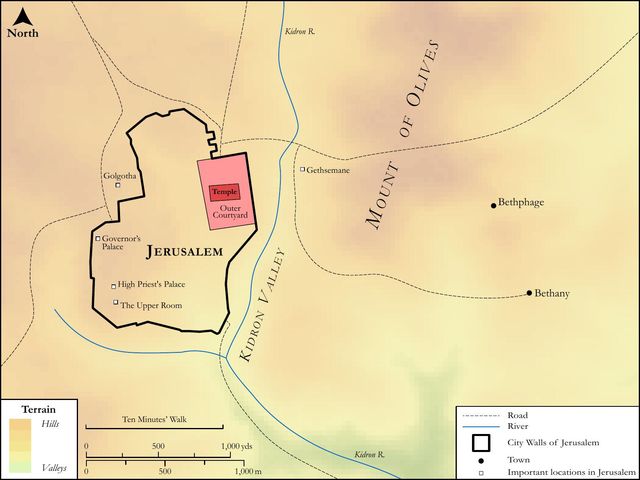
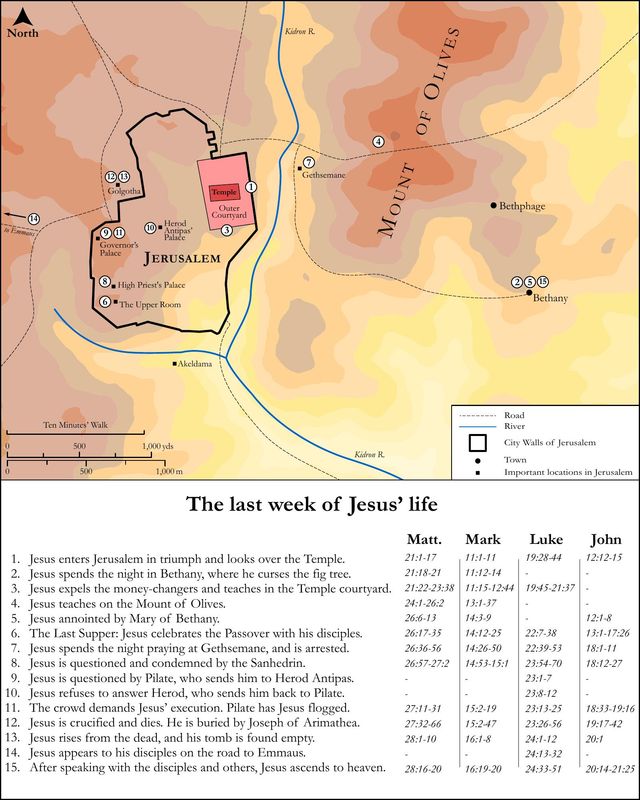
See on the biblical-era maps

Study this verse
Public-domain commentary
Matthew Henry
From his Commentary on the Whole Bible. Henry comments on passages, not single verses — this entry covers John 13:18–30. His four-level outline is real structure in the source text, so it is rendered as structure.
We have here the discovery of Judas's plot to betray his Master. Christ knew it from the beginning; but now first he discovered it to his disciples, who did not expect Christ should be betrayed, though he had often told them so, much less did they suspect that one of them should do it. Now here,
I.Christ gives them a general intimation of it (Joh 13:18):
I speak not of you all, I cannot expect you will all do these things, for I know whom I have chosen, and whom I have passed by; but the scripture will be fulfilled (Psa 41:9), He that eateth bread with me hath lifted up his heel against me. He does not yet speak out, either of the crime or the criminal, but raises their expectations of a further discovery.
1.He intimates to them that they were not all right. He had said (Joh 13:10), You are clean, but not all. So here, I speak not of you all. Note, What is said of the excellencies of Christ's disciples cannot be said of all that are called so. The word of Christ is a distinguishing word, which separates between cattle and cattle, and will distinguish thousands into hell who flattered themselves with hopes that they were going to heaven. I speak not of you all; you my disciples and followers. Note, There is a mixture of bad with good in the best societies, a Judas among the apostles; it will be so till we come to the blessed society into which shall enter nothing unclean or disguised.
2.That he himself knew who were right, and who were not: I know whom I have chosen, who the few are that are chosen among the many that are called with the common call. Note,
(1.)Those that are chosen, Christ himself had the choosing of them; he nominated the persons he undertook for.
(2.)Those that are chosen are known to Christ, for he never forgets any whom he has once had in his thoughts of love, Ti2 2:19.
3.That in the treachery of him that proved false to him the scripture was fulfilled, which takes off very much both the surprise and offence of the thing. Christ took one into his family whom he foresaw to be a traitor, and did not by effectual grace prevent his being so, that the scripture might be fulfilled. Let it not therefore be a stumbling-block to any; for, though it do not at all lessen Judas's offence, it may lessen our offence at it. The scripture referred to is David's complaint of the treachery of some of his enemies; the Jewish expositors, and ours from them generally understand it of Ahithophel: Grotius thinks it intimates that the death of Judas would be like that of Ahithophel. But because that psalm speaks of David's sickness, of which we read nothing at the time of Ahithophel's deserting him, it may better be understood of some other friend of his, that proved false to him. This our Saviour applies to Judas.
(1.)Judas, as an apostle, was admitted to the highest privilege: he did eat bread with Christ. He was familiar with him, and favoured by him, was one of his family, one of those with whom he was intimately conversant. David saith of his treacherous friend, He did eat of my bread; but Christ, being poor, had no bread he could properly call his own. He saith, He did eat bread with me; such as he had by the kindness of his friends, that ministered to him, his disciples had their share of, Judas among the rest. Wherever he went, Judas was welcome with him, did not dine among servants, but sat at table with his Master, ate of the same dish, drank of the same cup, and in all respects fared as he fared. He ate miraculous bread with him, when the loaves were multiplied, ate the passover with him. Note, All that eat bread with Christ are not his disciples indeed. See Co1 10:3-5.
(2.)Judas, as an apostate, was guilty of the basest treachery: he lifted up the heel against Christ.
[1.]He forsook him, turned his back upon him, went out from the society of his disciples, Joh 13:30.
[2.]He despised him, shook off the dust of his feet against him, in contempt of him and his gospel. Nay,
[3.]He became an enemy to him; spurned at him, as wrestlers do at their adversaries, whom they would overthrow. Note, It is no new thing for those that were Christ's seeming friends to prove his real enemies. Those who pretended to magnify him magnify themselves against him, and thereby prove themselves guilty, not only of the basest ingratitude, but the basest treachery and perfidiousness.
II.He gives them a reason why he told them beforehand of the treachery of Judas (Joh 13:19):
"Now I tell you before it come, before Judas has begun to put his wicked plot in execution, that when it is come to pass you may, instead of stumbling at it, be confirmed in your belief that I am he, he that should come." 1. By his clear and certain foresight of things to come, of which in this, as in other instances, he gave incontestable proof, he proved himself to be the true God, before whom all things are naked and open. Christ foretold that Judas would betray him when there was no ground to suspect such a thing, and so proved himself the eternal Word, which is a discerner of the thoughts and intents of the heart. The prophecies of the New Testament concerning the apostasy of the latter times (which we have, 2 Th. 2; 1 Tim. 4, and in the Apocalypse) being evidently accomplished is a proof that those writings were divinely inspired, and confirms our faith in the whole canon of scripture. 2. By this application of the types and prophecies of the Old Testament to himself, he proved himself to be the true Messiah, to whom all the prophets bore witness. Thus it was written, and thus it behoved Christ to suffer, and he suffered just as it was written, Luk 24:25, Luk 24:26; Joh 8:28.
III.He gives a word of encouragement to his apostles, and all his ministers whom he employs in his service (Joh 13:20):
He that receiveth whomsoever I send receiveth me. The purport of these words is the same with what we have in other scriptures, but it is not easy to make out their coherence here. Christ had told his disciples that they must humble and abase themselves. "Now," saith he, "though there may be those that will despise you for your condescension, yet there will be those that will do you honour, and shall be honoured for so doing." Those who know themselves dignified by Christ's commission may be content to be vilified in the world's opinion. Or, he intended to silence the scruples of those who, because there was a traitor among the apostles, would be shy of receiving any of them; for, if one of them was false to his Master, to whom would any of them be true? Ex uno disce omnes - They are all alike. No, as Christ will think never the worse of them for Judas's crime, so he will stand by them, and own them, and will raise up such as shall receive them. Those that had received Judas when he was a preacher, and perhaps were converted and edified by his preaching, were never the worse, nor should reflect upon it with any regret, though he afterwards proved a traitor; for he was one whom Christ sent. We cannot know what men are, much less what they will be, but those who appear to be sent of Christ we must receive, till the contrary appear. Though some, by entertaining strangers, have entertained robbers unawares, yet we must still be hospitable, for thereby some have entertained angels. The abuses put upon our charity, though ordered with ever so much discretion, will neither justify our uncharitableness, nor lose us the reward of our charity.
1.We are here encouraged to receive ministers as sent of Christ: "He that receiveth whomsoever I send, though weak and poor, and subject to like passions as others (for as the law, so the gospel, makes men priests that have infirmity), yet if he deliver my message, and be regularly called and appointed to do so, and as an officer give himself to the word and prayer, he that entertains him shall be owned as a friend of mine." Christ was now leaving the world, but he would leave an order of men to be his agents, to deliver his word, and those who receive this, in the light and love of it, receive him. To believe the doctrine of Christ, and obey his law, and accept the salvation offered upon the terms proposed; this is receiving those whom Christ sends, and it is receiving Christ Jesus the Lord himself.
2.We are here encouraged to receive Christ as sent of God: He that thus receiveth me, that receiveth Christ in his ministers, receiveth the Father also, for they come upon his errand likewise, baptizing in the name of the Father, as well as of the Son. Or, in general, He that receiveth me as his prince and Saviour receiveth him that sent me as his portion and felicity. Christ was sent of God, and in embracing his religion we embrace the only true religion.
IV.Christ more particularly notifies to them the plot which one of their number was now hatching against him (Joh 13:21):
When Jesus had thus said in general, to prepare them for a more particular discovery, he was troubled in spirit, and showed it by some gesture or sign, and he testified, he solemnly declared it (cum animo testandi - with the solemnity of a witness on oath), "One of you shall betray me; one of you my apostles and constant followers." None indeed could be said to betray him but those in whom he reposed a confidence, and who were the witnesses of his retirements. This did not determine Judas to the sin by any fatal necessity; for, though the event did follow according to the prediction, yet not from the prediction. Christ is not the author of sin; yet as to this heinous sin of Judas,
1.Christ foresaw it; for even that which is secret and future, and hidden from the eyes of all living, naked and open before the eyes of Christ. He knows what is in men better than they do themselves (Kg2 8:12), and therefore sees what will be done by them. I knew that thou wouldest deal very treacherously, Isa 48:8.
2.He foretold it, not only for the sake of the rest of the disciples, but for the sake of Judas himself, that he might take warning, and recover himself out of the snare of the devil. Traitors proceed not in their plots when they find they are discovered; surely Judas, when he finds that his Master knows his design, will retreat in time; if not, it will aggravate his condemnation.
3.He spoke of it with a manifest concern; he was troubled in spirit when he mentioned it. He had often spoken of his own sufferings and death, without any such trouble of spirit as he here manifested when he spoke of the ingratitude and treachery of Judas. This touched him in a tender part. Note, The falls and miscarriages of the disciples of Christ are a great trouble of spirit to their Master; the sins of Christians are the grief of Christ. "What! One of you betray me? You that have received from me such distinguishing favours; you that I had reason to think would be firm to me, that have professed such a respect for me; what iniquity have you found in me that one of you should betray me?" This went to his heart, as the undutifulness of children grieves those who have nourished and brought them up, Isa 1:2. See Psa 95:10; Isa 63:10.
V.The disciples quickly take the alarm.
They knew their Master would neither deceive them nor jest with them; and therefore looked one upon another, with a manifest concern, doubting of whom he spake.
1.By looking one upon another they evinced the trouble they were in upon this notice given them; it struck such a horror upon them that they knew not well which way to look, nor what to say. They saw their Master troubled, and therefore they were troubled. This was at a feast where they were cheerfully entertained; but hence we must be taught to rejoice with trembling, and as though we rejoiced not. When David wept for his son's rebellion, all his followers wept with him (Sa2 15:30); so Christ's disciples here. Note, That which grieves Christ is, and should be, a grief to all that are his, particularly the scandalous miscarriages of those that are called by his name: Who is offended, and I burn not?
2.Hereby they endeavoured to discover the traitor. They looked wistfully in one another's face, to see who blushed, or, by some disorder in the countenance, manifested guilt in the heart, upon this notice; but, while those who were faithful had their consciences so clear that they could lift up their faces without spot, he that was false had his conscience so seared that he was not ashamed, neither could he blush, and so no discovery could be made in this way. Christ thus perplexed his disciples for a time, and put them into confusion, that he might humble them, and prove them, might excite in them a jealousy of themselves, and an indignation at the baseness of Judas. It is good for us sometimes to be put to a gaze, to be put to a pause.
VI.The disciples were solicitous to get their Master to explain himself, and to tell them particularly whom he meant; for nothing but this can put them out of their present pain, for each of them thought he had as much reason to suspect himself as any of his brethren; now,
1.Of all the disciples John was most fit to ask, because he was the favourite, and sat next his Master (Joh 13:23): There was leaning on Jesus's bosom one of the disciples whom Jesus loved. It appears that this was John, by comparing Joh 21:20, Joh 21:24. Observe,
(1.)The particular kindness which Jesus had for him; he was known by this periphrasis, that he was the disciple whom Jesus loved. He loved them all (Joh 13:1), but John was particularly dear to him. His name signifies gracious. Daniel, who was honoured with the revelations of the Old Testament, as John of the New, was a man greatly beloved, Dan 9:23. Note, Among the disciples of Christ some are dearer to him than others.
(2.)His place and posture at this time: He was leaning on Jesus's bosom. Some say that it was the fashion in those countries to sit at meat in a leaning posture, so that the second lay in the bosom of the first, and so on, which does not seem probable to me, for in such a posture as this they could neither eat nor drink conveniently; but, whether this was the case or not, John now leaned on Christ's bosom, and it seems to be an extraordinary expression of endearment used at this time. Note, There are some of Christ's disciples whom he lays in his bosom, who have more free and intimate communion with him than others. The Father loved the Son, and laid him in his bosom (Joh 1:18), and believers are in like manner one with Christ, Joh 17:21. This honour all the saints shall have shortly in the bosom of Abraham. Those who lay themselves at Christ's feet, he will lay in his bosom.
(3.)Yet he conceals his name, because he himself was the penman of the story. He put this instead of his name, to show that he was pleased with it; it is his title of honour, that he was the disciple whom Jesus loved, as in David's and Solomon's court there was one that was the king's friend; yet he does not put his name down, to show that he was not proud of it, nor would seem to boast of it. Paul in a like case saith, I knew a man in Christ.
2.Of all the disciples Peter was most forward to know, Joh 13:24. Peter, sitting at some distance, beckoned to John, by some sign or other, to ask. Peter was generally the leading man, most apt to put himself forth; and, where men's natural tempers lead them to be thus bold in answering and asking, if kept under the laws of humility and wisdom, they make men very serviceable. God gives his gifts variously; but that the forward men in the church may not think too well of themselves, nor the modest be discouraged, it must be noted that it was not Peter, but John, that was the beloved disciple. Peter was desirous to know, not only that he might be sure it was not he, but that, knowing who it was, they might withdraw from him, and guard against him, and, if possible, prevent his design. It were a desirable thing, we should think, to know who in the church will deceive us; yet let this suffice - Christ knows, though we do not. The reason why Peter did not himself ask was because John had a much fairer opportunity, by the advantage of his seat at table, to whisper the question into the ear of Christ, and to receive a like private answer. It is good to improve our interest in those that are near to Christ, and to engage their prayers for us. Do we know any that we have reason to think lie in Christ's bosom? Let us beg of them to speak a good word for us.
3.The question was asked accordingly (Joh 13:25): He then, lying at the breast of Jesus, and so having the convenience of whispering with him, saith unto him, Lord, who is it? Now here John shows,
(1.)A regard to his fellow-disciple, and to the motion he made. Though Peter had not the honour he had at this time, yet he did not therefore disdain to take the hint and intimation he gave him. Note, Those who lie in Christ's bosom may often learn from those who lie at his feet something that will be profitable for them, and be reminded of that which they did not of themselves think of. John was willing to gratify Peter herein, having so fair an opportunity for it. As every one hath received the gift, so let him minister the same for a common good, Rom 12:6.
(2.)A reverence of his Master. Though he whispered this in Christ's ear, yet he called him Lord; the familiarity he was admitted to did not at all lessen his respect for his Master. It becomes us to use a reverence in expression, and to observe a decorum even in our secret devotions, which no eye is a witness to, as well as in public assemblies. The more intimate communion gracious souls have with Christ, the more sensible they are of his worthiness and their own unworthiness, as Gen 18:27.
4.Christ gave a speedy answer to this question, but whispered it in John's ear; for it appears (Joh 13:29) that the rest were still ignorant of the matter. He it is to whom I shall give a sop, psōmion - a morsel, a crust, when I have dipped it in the sauce. And when he had dipped the sop, John strictly observing his motion, he gave it to Judas; and Judas took it readily enough, not suspecting the design of it, but glad of a savoury bit, to make up his mouth with.
(1.)Christ notified the traitor by a sign. He could have told John by name who he was (The adversary and enemy is that wicked Judas, he is the traitor, and none but he); but thus he would exercise the observation of John, and intimate what need his ministers have of a spirit of discerning; for the false brethren we are to stand upon our guard against are not made known to us by words, but by signs; they are to be known to us by their fruits, by their spirits; it requires great diligence and care to form a right judgment upon them.
(2.)That sign was a sop which Christ gave him, a very proper sign, because it was the fulfilling of the scripture (Joh 13:18) that the traitor should be one that ate bread with him, that was at this time a fellow-commoner with him. It had likewise a significancy in it, and teaches us,
[1.]That Christ sometimes gives sops to traitors; worldly riches, honours, and pleasures are sops (if I may so speak), which Providence sometimes gives into the hands of wicked men. Judas perhaps thought himself a favourite because he had the sop, like Benjamin at Joseph's table, a mess by himself; thus the prosperity of fools, like a stupifying sop, helps to destroy them.
[2.]That we must not be outrageous against those whom we know to be very malicious against us. Christ carved to Judas as kindly as to any at the table, though he knew he was then plotting his death. If thine enemy hunger, feed him; this is to do as Christ does.
VII.Judas himself, instead of being convinced hereby of his wickedness, was the more confirmed in it, and the warning given him was to him a savour of death unto death; for it follows,
1.The devil hereupon took possession of him (Joh 13:27): After the sop, Satan entered into him: not to make him melancholy, nor drive him distracted, which was the effect of his possessing some; not to hurry him into the fire, nor into the water; happy had it been for him if that had been the worst of it, or if with the swine he had been choked in the sea; but Satan entered into him to possess him with a prevailing prejudice against Christ and his doctrine, and a contempt of him, as one whose life was of small value, to excite in him a covetous desire of the wages of unrighteousness and a resolution to stick at nothing for the obtaining of them. But,
(1.)Was not Satan in him before? How then is it said that now Satan entered into him? Judas was all along a devil (Joh 6:70), a son of perdition, but now Satan gained a more full possession of him, had a more abundant entrance into him. His purpose to betray his Master was now ripened into a fixed resolution; now he returned with seven other spirits more wicked than himself, Luk 11:26. Note,
[1.]Though the devil is in every wicked man that does his works (Eph 2:2), yet sometimes he enters more manifestly and more powerfully than at other times, when he puts them upon some enormous wickedness, which humanity and natural conscience startle at.
[2.]Betrayers of Christ have much of the devil in them. Christ speaks of the sin of Judas as greater than that of any of his persecutors.
(2.)How came Satan to enter into him after the sop? Perhaps he was presently aware that it was the discovery of him, and it made him desperate in his resolutions. Many are made worse by the gifts of Christ's bounty, and are confirmed in their impenitency by that which should have led them to repentance. The coals of fire heaped upon their heads, instead of melting them, harden them.
2.Christ hereupon dismissed him, and delivered him up to his own heart's lusts: Then said Jesus unto him, What thou doest, do quickly. This is not to be understood as either advising him to his wickedness or warranting him in it; but either,
(1.)As abandoning him to the conduct and power of Satan. Christ knew that Satan had entered into him, and had peaceable possession; and now he gives him up as hopeless. The various methods Christ had used for his conviction were ineffectual; and therefore, "What thou doest thou wilt do quickly; if thou art resolved to ruin thyself, go on, and take what comes." Note, When the evil spirit is willingly admitted, the good Spirit justly withdraws. Or,
(2.)As challenging him to do his worst: "Thou art plotting against me, put thy plot in execution and welcome, the sooner the better, I do not fear thee, I am ready for thee." Note, our Lord Jesus was very forward to suffer and die for us, and was impatient of delay in the perfecting of his undertaking. Christ speaks of Judas's betraying him as a thing he was now doing, though he was only purposing it. Those who are contriving and designing mischief are, in God's account, doing mischief.
3.Those that were at table understood not what he meant, because they did not hear what he whispered to John (Joh 13:28, Joh 13:29): No man at table, neither the disciples nor any other of the guests, except John, knew for what intent he spoke this to him.
(1.)They did not suspect that Christ said it to Judas as a traitor, because it did not enter into their heads that Judas was such a one, or would prove so. Note, It is an excusable dulness in the disciples of Christ not to be quick-sighted in their censures. Most are ready enough to say, when they hear harsh things spoken in general, Now such a one is meant, and now such a one; but Christ's disciples were so well taught to love one another that they could not easily learn to suspect one another; charity thinks no evil.
(2.)They therefore took it for granted that he said it to him as a trustee, or treasurer of the household, giving him order for the laying out of some money. Their surmises in this case discover to us for what uses and purposes our Lord Jesus commonly directed payments out of that little stock he had, and so teach us how to honour the Lord with our substance. They concluded something was to be laid out, either,
[1.]In works of piety: Buy those things that we have need of against the feast. Though he borrowed a room to eat the passover in, yet he bought in provision for it. That is to be reckoned well bestowed which is laid out upon those things we have need of for the maintenance of God's ordinances among us; and we have the less reason to grudge that expense now because our gospel-worship is far from being so chargeable as the legal worship was.
[2.]Or in works of charity: That he should give something to the poor. By this it appears, First, That our Lord Jesus, though he lived upon alms himself (Luk 8:3), yet gave alms to the poor, a little out of a little. Though he might very well be excused, not only because he was poor himself, but because he did so much good in other ways, curing so many gratis; yet, to set us an example, he gave, for the relief of the poor, out of that which he had for the subsistence of his family; see Eph 4:28. Secondly, That the time of a religious feast was thought a proper time for works of charity. When he celebrated the passover he ordered something for the poor. When we experience God's bounty to us, this should make us bountiful to the poor.
4.Judas hereupon sets himself vigorously to pursue his design against him: He went away. Notice is taken,
(1.)Of his speedy departure: He went out presently, and quitted the house,
[1.]For fear of being more plainly discovered to the company, for, if he were, he expected they would all fall upon him, and be the death of him, or at least of his project.
[2.]He went out as one weary of Christ's company and the society of his apostles. Christ needed not to expel him, he expelled himself. Note, Withdrawing from the communion of the faithful is commonly the first overt-act of a backslider, and the beginning of an apostasy.
[3.]He went out to prosecute his design, to look for those with whom he was to make his bargain, and to settle the agreement with them. Now that Satan had got into him he hurried him on with precipitation, lest he should see his error and repent of it.
(2.)Of the time of his departure: It was night.
[1.]Though it was night, an unseasonable time for business, yet, Satan having entered into him, he made no difficulty of the coldness and darkness of the night. This should shame us out of our slothfulness and cowardice in the service of Christ, that the devil's servants are so earnest and venturous in his service.
[2.]Because it was night, and this gave him advantage of privacy and concealment. He was not willing to be seen treating with the chief priests, and therefore chose the dark night as the fittest time for such works of darkness. Those whose deeds are evil love darkness rather than light. See Job 24:13, etc.
Historical interpretation
Two Centuries of Reception
7 surviving comments on this verse. Each one is dated, so this reads as a timeline rather than a list.
Select a marker to jump to its quote. Markers stagger vertically where authors wrote within a few decades of each other.
What man, then, of sound mind can possibly suppose that they were ignorant of anything, whom the Lord ordained to be masters (or teachers), keeping them, as He did, inseparable (from Himself) in their attendance, in their discipleship, in their society, to whom, "when they were alone, He used to expound" all things which were obscure, telling them that "to them it was given to know those mysteries," which it was not permitted the people to understand? Was anything withheld from the knowledge of Peter, who is called "the rock on which the church should be built," who also obtained "the keys of the kingdom of heaven," with the power of "loosing and binding in heaven and on earth? " Was anything, again, concealed from John, the Lord's most beloved disciple, who used to lean on His breast to whom alone the Lord pointed Judas out as the traitor, whom He commended to Mary as a son in His own stead? Of what could He have meant those to be ignorant, to whom He even exhibited His own glory with Moses and Elias, and the Father's voice moreover, from heaven? Not as if He thus disapproved of all the rest, but because "by three witnesses must every word be established.
(t. xxxii. 13.) He then lying on Jesus' breast, saith unto Him, Lord, who is it?
John, by reclining on the Word and resting on more mystical things, was reclining in the bosom of the Word, analogous also to the Word being in the bosom of the Father, according to the statement, “The only-begotten God who is in the bosom of the Father, he has declared him.”
(Hom. lxii. 1) Our Lord after His twofold promise of assistance to the Apostles in their future labours, remembers that the traitor is cut off from both, and is troubled at the thought: When Jesus had thus said, He was troubled in spirit, and testified, and said, Verily, verily, I say unto you, that one of you shall betray Me.
(Hom. lxxii. 1) As He did not mention Him by name, all began to fear: Then the disciples looked one on another, doubting of whom He spake; not conscious of any evil in themselves, and yet trusting to Christ's words, more than to their own thoughts.
While all were trembling, and not excepting even Peter, their head, John, as the beloved disciple, lay upon Jesus' breast. He then lying on Jesus' breast saith unto Him, Lord, who is it?
(Hom. lxxii. 1) If thou want to know the cause of this familiarity, it is love: Whom Jesus loved. Others were loved, but he was loved more than any.
(Hom. lxxii. 1) Whom Jesus loved. This John says to show his own innocence, and also why it was that Peter beckoned to him, inasmuch as he was not Peter's superior: Simon Peter therefore beckoned to him, that he should ask who it should be of whom he spake. Peter had been just reproved, and therefore, checking the customary vehemence of his love, he did not speak himself now, but made John speak for him. He always appears in Scripture as zealous, and an intimate friend of John's.
"When Jesus had thus said, He was troubled in spirit, and testified, and said, Verily, verily, I say unto you, that one of you shall betray Me."
Again He bringeth fear on all by not mentioning the traitor by name. "But they are in doubt"; although conscious to themselves of nothing evil; but they deemed the declaration of Christ more to be believed than their own thoughts. Wherefore they "looked one on another." By laying the whole upon one, Jesus would have cut short their fear, but by adding, "one of you," He troubled all. What then? The rest looked upon one another; but the ever fervent Peter "beckoneth" to John. Since he had been before rebuked, and when Christ desired to wash him would have hindered Him, and since he is everywhere found moved indeed by love, yet blamed; being on this account afraid, he neither kept quiet, nor did he speak, but wished to gain information by means of John. But it is a question worth asking, why when all were distressed, and trembling, when their leader was afraid, John like one at ease leans on Jesus' bosom, and not only leans, but even lies on His breast? Nor is this the only thing worthy of enquiry, but that also which follows. What is that? What he saith of himself, "Whom Jesus loved." Why did no one else say this of himself? Yet the others were loved too. But he more than any. And if no other hath said this about him, but he about himself, it is nothing wonderful. Paul too does the same when occasion calls, saying thus, "I knew a man fourteen years ago"; yet in fact he has gone through other no trifling praises of himself.
(Tr. lx. 4) On Jesus' breast; the same as in Jesus' bosom. Or, he lay first in Jesus' bosom, and then ascended higher, and lay upon His breast; as if, had he remained lying in His bosom, and not ascended to lie on His breast, our Lord would not have told him what Peter wanted to know. By his lying at last on Jesus' breast, is expressed that greater and more abundant grace, which made him Jesus' special disciple.
Notice again how effectually the very wise Evangelist spurs us on to a desire to live, as far as possible, in the manner most accordant with reason, and to train up the keenness of our intellectual powers so as to be able, and that with perfect ease, to act in obedience to the Divine intentions, and to endeavour, as far as in us lies, to thoroughly fulfil the conditions of the vision of God. He tells us that he was himself the object of special honour and love on the part of Christ our Saviour, so as even to recline next Him, actually in the very bosom of the Lord, deeming this circumstance a token of His surpassing affection towards him. Nearest therefore to God, and as it were in the highest place in His honour, will most especially be those whose heart is pure: and to them also the Saviour Himself assigns conspicuous honour when He says that the pure in heart shall be blessed, for they shall see God. And we shall bring forward, as evidence of the truth of this saying, even this very wise Evangelist himself. For he has seen the glory of Christ, according to his own words, for he says: I beheld His glory, the glory as of the Only-begotten of the Father, full of grace and truth. For surely not with bodily eyes could any one gaze at the nature of Him Who to every creature is absolutely invisible. For, according to the Saviour's words: No man hath seen the Father, save He Which is from God, that is, the Son; He hath seen the Father. To those however who keep their mind untainted by worldly stain, and freed from vain imagination whose only concern is with this life, it seems that Christ reveals His own peculiar glory by a subtle and perhaps incomprehensible process, thereby showing forth also the glory of the Father. For it must have been with this meaning that He said: He that hath seen Me hath seen the Father.
Continue studying John 13:25 across the web’s major study libraries — every link below opens this exact verse, chapter, or book on the destination site.
Read & Compare
 BibleGatewayThis verse in more than 200 translations and 70 languages.
 Bible.comThe YouVersion reader — hundreds of translations, reading plans, and highlights.
 ESV.orgCrossway's official English Standard Version reader.
 NET BibleThe NET translation with 60,000+ translators' notes on every rendering decision.
 STEP BibleTyndale House's free study tool — original text, vocabulary, and scholarly resources.
 BibliaLogos Bible Software's free web reader.
 USCCBThe New American Bible (Revised Edition) with the U.S. bishops' study notes.
Commentaries
 BibleHub CommentariesDozens of classic commentaries on this verse, gathered on one page.
 StudyLightMore than 100 commentary sets — the largest collection on the web.
 BibleRefPlain-English commentary on what this verse means, verse by verse.
 Enduring WordDavid Guzik's free commentary on this chapter, widely used by Bible teachers.
 Bible Study ToolsVerse commentary alongside Greek and Hebrew study aids.
Original Language & Research
- BibleHub InterlinearThe verse word by word — original language, transliteration, and English.
- BibleHub LexiconEvery word's original-language definition and Strong's entry.
 Blue Letter BibleDeep-study tools — Strong's numbers, concordance, and word studies.
 CNTR CollationThe earliest Greek manuscripts of this verse, collated letter by letter.
Sermons, Hymns & Audio


TrulyRandomVerse is not affiliated with these sites and doesn’t control their content. They’re linked because they’re genuinely useful.
Summary
A profoundly intimate moment during the Last Supper is captured, where the Beloved Disciple, traditionally identified as John, leans back against Jesus and, at Peter's prompting, asks the Lord to identify the betrayer. This verse highlights the unique closeness between Jesus and John, allowing for a private and confidential exchange amidst the disciples' collective confusion and distress over Jesus' announcement of betrayal. It sets the stage for the revelation of Judas Iscariot as the one who would hand Jesus over.
Context
ShowHideLiterary Context
This verse is situated immediately after Jesus' troubling declaration that one of His own disciples would betray Him, a pronouncement that deeply disturbed the group (John 13:21). The disciples, bewildered and anxious, began to look at one another, uncertain of whom Jesus spoke (John 13:22). Simon Peter, known for his directness and eagerness, signals to "the disciple whom Jesus loved" (John 13:23), who was reclining in a position of honor closest to Jesus, to inquire about the betrayer's identity (John 13:24). John's unique physical proximity to Jesus allows him to fulfill Peter's request, leading directly to Jesus' subtle identification of Judas in the subsequent verse (John 13:26).
Historical & Cultural Context
The scene unfolds during the Passover meal, which in Jesus' time was typically eaten while reclining on low couches around a U-shaped table, known as a triclinium. Guests would recline on their left elbow, leaving their right hand free to eat. The head of one guest would naturally be near the chest or bosom of the guest to their left. This arrangement meant that the "disciple whom Jesus loved" was in the most intimate and privileged position relative to Jesus, allowing for private conversation. This physical closeness was not merely accidental but reflective of a deep bond of trust and affection, characteristic of a host-guest relationship where the most honored guest would be seated closest to the host.
Key Themes
ShowHideThe passage powerfully underscores themes of intimacy and privileged access through John's physical position, symbolizing a deeper spiritual closeness. It highlights the humanity and distress of the disciples, who are thrown into confusion and anxiety by Jesus' revelation of betrayal, prompting their desperate search for answers. Furthermore, the scene emphasizes Jesus' foreknowledge and sovereignty over the unfolding events, even as He allows the betrayal to proceed. Finally, the unique role of the Beloved Disciple is prominently featured, as he serves as the conduit for the disciples' collective question, uniquely positioned to receive a direct, albeit veiled, answer from Jesus. This moment contributes to the broader Johannine theme of light exposing darkness, as Jesus prepares to reveal the true nature of the betrayer.
Exposition and Analysis
ShowHideKey Word Analysis
ShowHideThis verb (G1968) means "to fall upon," "to embrace," or "to press upon." In this context, combined with the preposition epí (G1909, "upon" or "on"), it describes a posture of reclining or leaning back against someone. It conveys a sense of close contact and physical intimacy, suggesting a relaxed and trusted position rather than a sudden or violent action. This posture was common for guests at a banquet, but its specific mention here emphasizes John's unique proximity to Jesus.
The term (G4738) refers to the chest or bosom. In the cultural context of reclining at a meal, resting one's head near the "breast" or "bosom" of the person to their left indicated a position of honor, deep trust, and intimate fellowship. It implies a closeness that allows for private conversation and a sense of security.
This title (G2962) signifies "supreme in authority," "controller," or "Master." John's use of "Lord" in his question to Jesus acknowledges Jesus' divine authority and sovereignty, even in a moment of profound human confusion and distress. It reflects the disciples' continued reverence and submission to Jesus despite their bewilderment about the impending betrayal.
Verse Breakdown
ShowHide"He then lying on Jesus' breast"
This phrase identifies "He" as the Beloved Disciple (John), whose physical position at the table placed him in intimate proximity to Jesus. "Lying on Jesus' breast" describes the common custom of reclining at a meal, where one's head would be near the chest of the person to their left. This posture signifies a place of honor, trust, and deep personal connection, making it natural for a private exchange.
"saith unto him"
This indicates that the Beloved Disciple initiated a direct, verbal communication with Jesus. The context implies a hushed, confidential tone, given the sensitive nature of the inquiry and the general confusion among the other disciples.
"Lord, who is it?"
This is the direct question posed by the Beloved Disciple, prompted by Peter. It reflects the collective anxiety and bewilderment of the disciples regarding Jesus' earlier announcement of betrayal. The use of "Lord" underscores their continued reverence for Jesus, even as they seek clarity on such a disturbing matter. The question itself is born out of a desire to understand and identify the source of such a profound betrayal.
Literary Devices
ShowHideThe verse effectively employs Symbolism through John's physical posture. His "lying on Jesus' breast" is not just a literal description of dining custom but powerfully symbolizes the deep spiritual intimacy and trust shared between Jesus and the Beloved Disciple. This physical closeness mirrors a profound spiritual bond, allowing for the confidential revelation that follows. There is also an element of Dramatic Irony, as the disciples are desperate to know the betrayer's identity, yet the answer is about to be revealed to the one closest to Jesus, highlighting their collective ignorance versus Jesus' complete foreknowledge. Furthermore, the scene serves as Characterization, particularly for John, solidifying his identity as the "disciple whom Jesus loved" and emphasizing his unique access to Jesus' heart and mind.
Theological and Thematic Connections
ShowHideThe intimate posture of the Beloved Disciple, "lying on Jesus' breast," serves as a profound theological statement about the nature of fellowship with Christ. Just as John enjoyed a position of unparalleled closeness and trust, believers are invited into a deep, personal, and confidential relationship with Jesus. This intimacy is not merely physical proximity but a spiritual reality where we can bring our deepest questions, anxieties, and uncertainties to the Lord, trusting in His wisdom and revelation. It underscores that true understanding and peace often come not from public pronouncements, but from drawing near to the heart of God in private communion, where sensitive truths can be shared and burdens laid bare. This privileged access is a gift of grace, available to all who seek to abide in Him.
Reflection and Application
ShowHideThe scene in John 13:25 offers a powerful invitation for every believer to cultivate a profound and intimate relationship with Jesus Christ. Just as John was physically close enough to Jesus to whisper a question and receive a direct, albeit nuanced, answer, we too are called to draw near to our Savior with our deepest concerns, our most perplexing questions, and our heaviest burdens. In a world full of confusion and uncertainty, this verse reminds us that true clarity and peace are found not in frantic searching, but in quiet, trusting communion with the One who knows all things. It encourages us to lean into His presence, to listen for His voice, and to trust that He will reveal what we need to know in His perfect timing. Our spiritual posture, like John's physical one, should be one of humble dependence and affectionate trust, allowing us to rest securely in His love and wisdom.
Questions for Reflection
ShowHideFAQ
ShowHideWho was "the disciple whom Jesus loved" mentioned in this passage?
ShowHideWhile the Gospel of John never explicitly names "the disciple whom Jesus loved," consistent early church tradition, supported by internal textual evidence, identifies this figure as John, the son of Zebedee and author of the Gospel. This identification is further strengthened by the fact that John is never named directly in the Gospel, a common authorial convention for self-reference in ancient literature. His unique position at the Last Supper and his presence at crucial moments like the crucifixion (John 19:26-27) and the empty tomb (John 20:2-9) further solidify this traditional understanding.
What does "lying on Jesus' breast" mean in the cultural context of the time?
ShowHideThe phrase "lying on Jesus' breast" refers to the common dining custom of that day, particularly among the Romans and the Greeks, where guests would recline on low couches (triclinia) while eating. They would typically lean on their left elbow, allowing their head to be near the chest or "bosom" of the person seated to their left. This position was one of intimacy and honor. The guest to the right of the host would have their head near the host's breast, indicating a privileged and trusted relationship. Thus, John's position signifies not only physical closeness but also a deep bond of affection and trust with Jesus.
Why did Simon Peter ask John to inquire of Jesus, rather than asking Jesus directly himself?
ShowHideSimon Peter's request to John in John 13:24 likely stemmed from a combination of factors. Firstly, Peter's physical position at the table might have been such that he was not close enough to Jesus for a private, hushed conversation, whereas John was in the most intimate spot. Secondly, Peter, despite his boldness, may have felt that John's unique and beloved relationship with Jesus granted him a more appropriate or effective channel for such a sensitive inquiry. It highlights Peter's eagerness to know the truth and his recognition of John's special access to Jesus' heart.
Christ-Centered Fulfillment
ShowHideThe profound intimacy depicted in John 13:25 finds its ultimate Christ-centered fulfillment in Jesus Himself. Just as the Beloved Disciple rested on Jesus' breast, Jesus, the "only begotten Son, which is in the bosom of the Father," perfectly embodies this divine intimacy (John 1:18). He is the one who perfectly knows the Father and reveals Him to humanity. Through His atoning work, Jesus, the Lamb of God (John 1:29), has opened the way for all believers to enter into this same kind of intimate fellowship with God. No longer are we kept at a distance, but through Christ, we have "boldness and access with confidence through our faith in him" (Ephesians 3:12). The New Covenant, inaugurated by Jesus' sacrifice, invites us to draw near to God's throne of grace (Hebrews 4:16) not merely as servants, but as beloved children, sharing in the very life and love that flows from the heart of the Father, revealed and made accessible through the Son. Thus, John's unique position foreshadows the universal privilege of intimacy with God that Christ secured for all who believe.