


Daniel 11:31
Bible text: King James Version (1769 Blayney text) · Public domain
Bible text: King James Version with Strong's numbers · Public domain
Bible text: Berean Standard Bible · Public domain
Bible text: American Standard Version (1901) · Public domain
Bible text: World English Bible, Messianic edition · Public domain
Bible text: Geneva Bible (1599) · Public domain
Bible text: Young's Literal Translation · Public domain
- וּזְרֹעִיםu·ze·ro·'Imand forcesH2220Conj-w ¦ N-mpNoun Plural Masculine Absoluteוּandזְרֹעִיםforces
- מִמֶּנּוּmi·Me·nufrom himH4480Prep ¦ 3msPrepositionמִמֶּfromנּוּhim
- יַעֲמֹדוּya·'a·Mo·duthey will ariseH5975V-Qal-Imperf-3mpVerb Qal Imperfect 3rd Plural Masculine
- וְחִלְּלוּve·chi·le·Luand they will profaneH2490Conj-w ¦ V-Piel-ConsecPerf-3cpVerb Piel Consecutive Perfect 3rd Plural common genderוְandחִלְּלוּthey will profane
- הַמִּקְדָּשׁha·mik·Dashthe sanctuaryH4720Art ¦ N-msNoun Singular Masculine Absoluteהַtheמִּקְדָּשׁsanctuary
- הַמָּעוֹזha·ma·'Ozthe strongholdH4581Art ¦ N-msNoun Singular Masculine Absoluteהַtheמָּעוֹזstronghold
- וְהֵסִירוּve·he·Si·ruand they will abolishH5493Conj-w ¦ V-Hiphil-ConsecPerf-3cpVerb Hiphil Consecutive Perfect 3rd Plural common genderוְandהֵסִירוּthey will abolish
- הַתָּמִידha·ta·Midthe perpetual [offering]H8548Art ¦ N-msNoun Singular Masculine Absoluteהַtheתָּמִידperpetual [offering]
- וְנָתְנוּve·na·te·Nuand they will set upH5414Conj-w ¦ V-Qal-ConsecPerf-3cpVerb Qal Consecutive Perfect 3rd Plural common genderוְandנָתְנוּthey will set up
- הַשִּׁקּוּץha·shi·Kutzthe abominationH8251Art ¦ N-msNoun Singular Masculine Absoluteהַtheשִּׁקּוּץabomination
- מְשׁוֹמֵםme·sho·MemdesolatingH8074V-Piel-Prtcpl-msVerb Piel Participle Singular Masculine Absolute
English is a literal word-by-word gloss of the Hebrew, not the KJV's wording. Why?
This is the original text the KJV's translators worked from — each Hebrew word with its own literal English meaning in this verse, prepared by scholars at Tyndale House, Cambridge. The KJV translates whole sentences, not word by word, so its wording differs: one Hebrew word can become several English words, and the KJV may choose “the LORD” where the gloss reads “Yahweh”. Both are faithful — they answer different questions. For the KJV's own rendering, switch to the KJV text.
Words in [ ] are added by the English.
Details
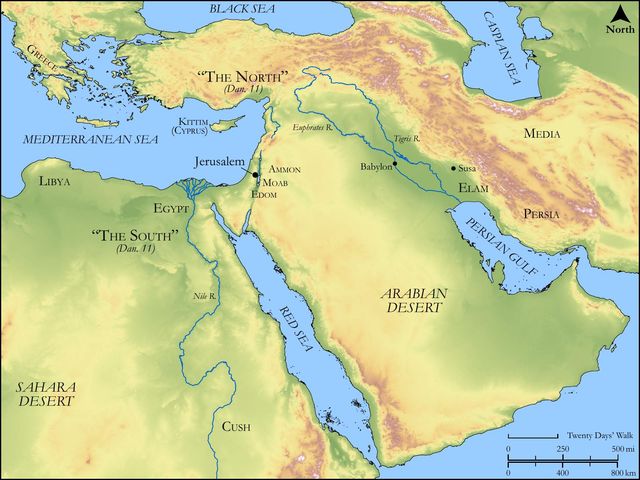
See on the biblical-era map
Study this verse
Public-domain commentary
Matthew Henry
From his Commentary on the Whole Bible. Henry wrote on whole passages, and this entry covers Daniel 11:21–45. He set out his notes in a three-level outline, kept here as he numbered it.
All this is a prophecy of the reign of Antiochus Epiphanes, the little horn spoken of before (Daniel 8:9) a sworn enemy to the Jewish religion, and a bitter persecutor of those that adhered to it. What troubles the Jews met with in the reigns of the Persian kings were not so particularly foretold to Daniel as these, because then they had living prophets with them, Haggai and Zechariah, to encourage them; but these troubles in the days of Antiochus were foretold, because, before that time, prophecy would cease, and they would find it necessary to have recourse to the written word. Some things in this prediction concerning Antiochus are alluded to in the New Testament predictions of the antichrist, especially Daniel 11:36, Daniel 11:37. And as it is usual with the prophets, when they foretel the prosperity of the Jewish church, to make use of such expressions as were applicable to the kingdom of Christ, and insensibly to slide into a prophecy of that, so, when they foretel the troubles of the church, they make use of such expressions as have a further reference to the kingdom of the antichrist, the rise and ruin of that. Now concerning Antiochus, the angel foretels here,
I.His character:
He shall be a vile person. He called himself Epiphanes - the illustrious, but his character was the reverse of his surname. The heathen writers describe him to be an odd-humoured man, rude and boisterous, base and sordid. He would sometimes steal out of the court into the city, and herd with any infamous company incognito - in disguise he made himself a companion of the common sort, and of the basest strangers that came to town. He had the most unaccountable whims, so that some took him to be silly, others to be mad. Hence he was called Epimanes - the madman. He is called a vile person, for he had been a long time a hostage at Rome for the fidelity of his father when the Romans had subdued him; and it was agreed that, when the other hostages were exchanged, he should continue a prisoner at large.
II.His accession to the crown.
By a trick he got his elder brother's son, Demetrius, to be sent a hostage to Rome, in exchange for him, contrary to the cartel; and, his elder brother being made away with by Heliodorus (Daniel 11:20), he took the kingdom. The states of Syria did not give it to him (Daniel 11:21), because they knew it belonged to his elder brother's son, nor did he get it by the sword, but came in peaceably, pretending to reign for his brother's son, Demetrius, then a hostage at Rome. But with the help of Eumenes and Attalus, neighbouring princes, he gained an interest in the people, and by flatteries obtained the kingdom, established himself in it, and crushed Heliodorus, who made head against him with the arms of a flood; those that opposed him were overflown and broken before him, even the prince of the covenant, his nephew, the rightful heir, whom he pretended to covenant with that he would resign to him whenever he should return, Daniel 11:22. But (Daniel 11:23) after the league made with him he shall work deceitfully, as one whose avowed maxim it is that princes ought not to be bound by their word any longer than it is for their interest. And with a small people, that at first cleave to him, he shall become strong, and (Daniel 11:24) he shall enter peaceably upon the fattest places of the kingdom of Syria, and, very unlike his predecessors, shall scatter among the people the prey, and the spoil, and riches, to insinuate himself into their affections; but, at the same time, he shall forecast his devices against the strong-holds, to make himself master of them, so that his generosity shall last but for a time; when he has got the garrisons into his hands he will scatter his spoil no more, but rule by force, as those commonly do that come in by fraud. He that comes in like a fox reigns like a lion. Some understand these verses of his first expedition into Egypt, when he came not as an enemy, but as a friend and guardian to the young king Ptolemaeus Philometer, and therefore brought with him but few followers, yet those stout men, and faithful to his interest, whom he placed in divers of the strong-holds in Egypt, thereby making himself master of them.
III.His war with Egypt, which was his second expedition thither.
This is described, Daniel 11:25, Daniel 11:27. Antiochus shall stir up his power and courage against Ptolemaeus Philometer king of Egypt. Ptolemy, thereupon, shall be stirred up to battle against him, shall come against him with a very great and mighty army; but Ptolemy, though he has such a vast army, shall not be able to stand before him; for Antiochus's army shall overthrow his, and overpower it, and great multitudes of the Egyptian army shall fall down slain. And no marvel, for the king of Egypt shall be betrayed by his own counsellors; those that feed of the portion of his meat, that eat of his bread and live upon him, being bribed by Antiochus, shall forecast devices against him, and even they shall destroy him; and what fence is there against such treachery? After the battle, a treaty of peace shall be set on foot, and these two kings shall meet at one council-board, to adjust the articles of peace between them; but they shall neither of them be sincere in it, for they shall, in their pretences and promises of amity and friendship, lie to one another, for their hearts shall be at the same time to do one another all the mischief they can. And then no marvel that it shall not prosper. The peace shall not last; but the end of it shall be at the time appointed in the divine Providence, and then the war shall break out again, as a sore that is only skinned over.
IV.Another expedition against Egypt.
From the former he returned with great riches (Daniel 11:28), and therefore took the first occasion to invade Egypt again, at the time appointed by the divine Providence, two years after, in the eighth year of his reign, Daniel 11:29. He shall come towards the south. But this attempt shall not succeed, as the two former did, nor shall he gain his point, as he had done before once and again; for (Daniel 11:30) the ships of Chittim shall come against him, that is, the navy of the Romans, or only ambassadors from the Roman senate, who came in ships. Ptolemaeus Philometer, king of Egypt, being now in a strict alliance with the Romans, craved their aid against Antiochus, who had besieged him and his mother Cleopatra in the city of Alexandria. The Roman senate thereupon sent an embassy to Antiochus, to command him to raise the siege, and, when he desired some time to consider of it and consult with his friends about it, Popilius, one of the ambassadors, with his staff drew a circle about him, and told him, as one having authority, he should give a positive answer before he came out of that circle; whereupon, fearing the Roman power, he was forced immediately to give orders for the raising of the siege and the retreat of his army out of Egypt. So Livy and others relate the story which this prophecy refers to. He shall be grieved, and return; for it was a great vexation to him to be forced to yield thus.
V.His rage and cruel practices against the Jews.
This is that part of his government, or mis-government rather, which is most enlarged upon in this prediction. In his return from his expedition into Egypt (which is prophesied of, Daniel 11:28) he did exploits against the Jews, in the sixth year of his reign; then he spoiled the city and temple. But the most terrible storm was in his return from Egypt, two years after, prophesied of Daniel 11:30. Then he took Judea in his way home; and, because he could not gain his point in Egypt by reason of the Romans interposing, he wreaked his revenge upon the poor Jews, who gave him no provocation, but had greatly provoked God to permit him to do it, Daniel 8:23.
1.He had a rooted antipathy to the Jews' religion: His heart was against the holy covenant, Daniel 11:28. And (Daniel 11:30) he had indignation against the holy covenant, that covenant of peculiarity by which the Jews were incorporated a people distinct from all other nations, and dignified above them. He hated the law of Moses and the worship of the true God, and was vexed at the privileges of the Jewish nation and the promises made to them. Note, That which is the hope and joy of the people of God is the envy of their neighbours, and that is the holy covenant. Esau hated Jacob because he had got the blessing. Those that are strangers to the covenant are often enemies to it.
2.He carried on his malicious designs against the Jews by the assistance of some perfidious apostate Jews. He kept up intelligence with those that forsook the holy covenant (Daniel 11:30), some of the Jews that were false to their religion, and introduced the customs of the heathen, with whom they made a covenant. See the fulfilling of this, 1 Macc. 1:11-15, where it is expressly said, concerning those renegado Jews, that they made themselves uncircumcised and forsook the holy covenant. We read (2 Macc. 4:9) of Jason, the brother of Onias the high priest, who by the appointment of Antiochus set up a school at Jerusalem, for the training up of youth in the fashions of the heathen; and (2 Macc. 4:23, etc.) of Menelaus, who fell in with the interests of Antiochus, and was the man that helped him into Jerusalem, now in his last return from Egypt. We read much in the book of the Maccabees of the mischief done to the Jews by these treacherous men of their own nation, Jason and Menelaus, and their party. These upon all occasions he made use of. "Such as do wickedly against the covenant, such as throw up their religion, and comply with the heathen, he shall corrupt with flatteries, to harden them in their apostasy, and to make use of them as decoys to draw in others," Daniel 11:32. Note, It is not strange if those who do not live up to their religion, but in their conversations do wickedly against the covenant, are easily corrupted by flatteries to quit their religion. Those that make shipwreck of a good conscience will soon make shipwreck of the faith.
3.He profaned the temple. Arms stand on his part (Daniel 11:31), not only his own army which he now brought from Egypt, but a great party of deserters from the Jewish religion that joined with them; and they polluted the sanctuary of strength, not only the holy city, but the temple. The story of this we have, 1 Macc. 1:21, etc. He entered proudly into the sanctuary, took away the golden altar, and the candlestick, etc. And therefore (v. 25) there was a great mourning in Israel; the princes and elders mourned, etc. And (2 Macc. 5:15, etc.) Antiochus went into the most holy temple, Menelaus, that traitor to the laws and to his own country, being his guide. Antiochus, having resolved to bring all about him to be of his religion, took away the daily sacrifice, Daniel 11:31. Some observe that the word Tammidh, which signifies no more than daily, is only here, and in the parallel place, used for the daily sacrifice, as if there were a designed liberty left to supply it either with sacrifice, which was suppressed by Antiochus, or with gospel-worship, which was suppressed by the Antichrist. Then he set up the abomination of desolation upon the altar (1 Macc. 1:54), even an idol altar (v. 59), and called the temple the temple of Jupiter Olympius, 2 Macc. 6:2.
4.He persecuted those who retained their integrity. Though there are many who forsake the covenant and do wickedly against it, yet there is a people who do know their God and retain the knowledge of him, and they shall be strong and do exploits, Daniel 11:32. When others yield to the tyrant's demands, and surrender their consciences to his impositions, they bravely keep their ground, resist the temptation, and make the tyrant himself ashamed of his attempt upon them. Good old Eleazar, one of the principal scribes, when he had swine's flesh thrust into his mouth, did bravely spit it out again, though he knew he must be tormented to death for so doing, and was so, 2 Macc. 6:19. The mother and her seven sons were put to death for adhering to their religion, 2 Macc. 7. This might well be called doing exploits; for to choose suffering rather than sin is a great exploit. And it was by faith, by being strong in faith, that they did those exploits, that they were tortured, not accepting deliverance, as the apostle speaks, probably with reference to that story, Hebrews 11:35. Or it may refer to the military courage and achievements of Judas Maccabaeus and others in opposition to Antiochus. Note, The right knowledge of God is, and will be, the strength of the soul, and, in the strength of that, gracious souls do exploits. Those that know his name will put their trust in him, and by that trust will do great things. Now, concerning this people that knew their God, we are here told,
(1.)That they shall instruct many, Daniel 11:33. They shall make it their business to show others what they have learned themselves of the difference between truth and falsehood, good and evil. Note, Those that have the knowledge of God themselves should communicate their knowledge to those about them, and this spiritual charity must be extensive: they must instruct many. Some understand this of a society newly erected for the propagating of divine knowledge, called Assideans, godly men, pietists (so the name signifies), that were both knowing and zealous in the law; these instructed many. Note, In times of persecution and apostasy, which are trying times, those that have knowledge ought to make use of it for the strengthening and establishing of others. Those that understand aright themselves ought to do what they can to bring others to understand; for knowledge is a talent that must be traded with. Or, They shall instruct many by their perseverance in their duty and their patient suffering for it. Good examples instruct many, and with many are the most powerful instructions.
(2.)They shall fall by the cruelty of Antiochus, shall be put to the torture, and put to death, by his rage. Though they are so excellent and intelligent themselves, and so useful and serviceable to others, yet Antiochus shall show them no mercy, but they shall fall for some days; so it may be read, Revelation 2:10, Thou shalt have tribulation ten days. We read much, in the books of the Maccabees, of Antiochus's barbarous usage of the pious Jews, how many he slew in wars and how many he murdered in cold blood. Women were put to death for having their children circumcised, and their infants were hanged about their necks, 1 Macc. 1:60, 61. But why did God suffer this? How can this be reconciled with the justice and goodness of God? I answer, Very well, if we consider what it was that God aimed at in this (Daniel 11:35): Some of those of understanding shall fall, but it shall be for the good of the church and for their own spiritual benefit. It shall be to try them, and to purge, and to make them white. They needed these afflictions themselves. The best have their spots, which must be washed off, their dross, which must be purged out; and their troubles, particularly their share in the public troubles, help to do this; being sanctified to them by the grace of God, they are means of mortifying their corruptions, weaning them from the world, and awakening them to greater seriousness and diligence in religion. They try them, as silver in the furnace is refined from its dross; they purge them, as wheat in the barn is winnowed from the chaff; and they make them white, as cloth by the fuller is cleared from its spots. See 1 Peter 1:7. Their sufferings for righteousness' sake would try and purge the nation of the Jews, would convince them of the truth, excellency, and power of that holy religion which these understanding men died for their adherence to. The blood of the martyrs is the seed of the church; it is precious blood, and not a drop of it should be shed but upon such a valuable consideration.
(3.)The cause of religion, though it be thus run upon, shall not be run down. When they shall fall they shall not be utterly cast down, but they shall be holpen with a little help, Daniel 11:34. Judas Maccabaeus, and his brethren, and a few with them, shall make head against the tyrant, and assert the injured cause of their religion; they pulled down the idolatrous altars, circumcised the children that they found uncircumcised, recovered the law out of the hand of the Gentiles, and the work prospered in their hands, 1 Macc. 2:45, etc. Note, Those that stand by the cause of religion when it is threatened and struck at, though they may not immediately be delivered and made victorious, shall yet have present help. And a little help must not be despised; but, when times are very bad, we must be thankful for some reviving. It is likewise foretold that many shall cleave to them with flatteries; when they see the Maccabees prosper some Jews shall join with them that are no true friends to religion, but will only pretend friendship either with design to betray them or in hope to rise with them; but the fiery trial (Daniel 11:35) will separate between the precious and the vile, and by it those that are perfect will be made manifest and those that are not.
(4.)Though these troubles may continue long, yet they will have an end. They are for a time appointed, a limited time, fixed in the divine counsels. This warfare shall be accomplished. Hitherto the power of the enemy shall come, and no further; here shall its proud waves be stayed.
5.He grew very proud, insolent, and profane, and, being puffed up with his conquests, bade defiance to Heaven, and trampled upon every thing that was sacred, Daniel 11:36, etc. And here some think begins a prophecy of the antichrist, the papal kingdom. It is plain that St. Paul, in his prophecy of the rise and reign of the man of sin, alludes to this (2 Thessalonians 2:4), which shows that Antiochus was a type and figure of that enemy, as Babylon also was; but, this being joined in a continued discourse with the foregoing prophecies concerning Antiochus, to me it seems probably that it principally refers to him, and in him had its primary accomplishment, and has reference to the other only by way of accommodation.
(1.)He shall impiously dishonour the God of Israel, the only living and true God, called here the God of gods. He shall, in defiance of him and his authority, do according to his will against his people and his holy religion; he shall exalt himself above him, as Sennacherib did, and shall speak marvellous things against him and against his laws and institutions. This was fulfilled when Antiochus forbade sacrifices to be offered in God's temple, and ordered the sabbaths to be profaned, the sanctuary and the holy people to be polluted, etc., to the end that they might forget the law and change all the ordinances, and this upon pain of death, 1 Macc. 1:45.
(2.)He shall proudly put contempt upon all other gods, shall magnify himself above every god, even the gods of the nations. Antiochus wrote to his own kingdom that every one should leave the gods he had worshipped, and worship such as he ordered, contrary to the practice of all the conquerors that went before him, 1 Macc. 1:41, 42. And all the heathen agreed according to the commandment of the king; fond as they were of their gods, they did not think them worth suffering for, but, their gods being idols, it was all alike to them what gods they worshipped. Antiochus did not regard any god, but magnified himself above all, Daniel 11:37. He was so proud that he thought himself above the condition of a mortal man, that he could command the waves of the sea, and reach to the stars of heaven, as his insolence and haughtiness are expressed, 2 Macc. 9:8, 10. Thus he carried all before him, till the indignation was accomplished (Daniel 11:36), till he had run his length, and filled up the measure of his iniquity; for that which is determined shall be done, and nothing more, nothing short.
(3.)He shall, contrary to the way of the heathen, disregard the god of his fathers, Daniel 11:37. Though an affection to the religion of their ancestors was, among the heathen, almost as natural to them as the desire of women (for, if you search through the isles of Chittim, you will not find an instance of a nation that has changed its gods, Jeremiah 2:10, Jeremiah 2:11), yet Antiochus shall not regard the god of his fathers; he made laws to abolish the religion of his country, and to bring in the idols of the Greeks. And though his predecessors had honoured the God of Israel, and given great gifts to the temple at Jerusalem (2 Macc. 3:2, 3), he offered the greatest indignities to God and his temple. His not regarding the desire of women may denote his barbarous cruelty (he shall spare no age or sex, no, not the tender ones) or his unnatural lusts, or, in general, his contempt of every thing which men of honour have a concern for, or it might be accomplished in something we meet not with in history. Its being joined to his not regarding the god of his fathers intimates that the idolatries of his country had in them more of the gratifications of the flesh than those of other countries (Lucian has written of the Syrian goddesses), and yet that would not prevail to keep him to them.
(4.)He shall set up an unknown god, a new god, Daniel 11:38. In his estate, in the room of the god of his fathers (Apollo and Diana, deities of pleasure), he shall honour the god of forces, a supposed deity of power, a god whom his fathers knew not, nor worshipped; because he will be thought in wisdom and strength to excel his fathers, he shall honour this god with gold, and silver, and precious stones, thinking nothing too good for the god he has taken a fancy to. This seems to be Jupiter Olympius, known among the Phoenicians by the name of Baal-Semen, the lord of heaven, but never introduced among the Syrians till Antiochus introduced it. Thus shall he do in the most strong holds, in the temple of Jerusalem, which is called the sanctuary of strength (Daniel 11:31), and here the fortresses of munitions; there he shall set up the image of this strange god. Some read it, He shall commit the munitions of strength, or of the most strong God (that is, the city Jerusalem), to a strange god; he put it under the protection and government of Jupiter Olympius. This god he shall not only acknowledge, but shall increase with glory, by setting his image even upon God's altar. And he shall cause those that minister to this idol to rule over many, shall put them into places of power and trust, and they shall divide the land for gain, shall be maintained richly out of the profits of the country. Some by the Mahuzzim, or god of forces, that Antiochus shall worship, understand money, which is said to answer all things, and which is the great idol of worldly people.
Now here is very much that is applicable to the man of sin; he exalts himself above all that is called god or that is worshipped; magnifies himself above all; his flatterers call him our lord god the pope. By forbidding marriage, and magnifying the single life, he pretends not to regard the desire of women; and honours the god of forces, the god Mahuzzim, or strong holds, saints and angels, whom his followers take for their protectors, as the heathen did of old their demons; these they make presidents of several countries, etc. These they honour with vast treasures dedicated to them, and therein the learned Mr. Mede thinks that this prophecy was fulfilled, and that it is referred to 1 Timothy 4:1, 1 Timothy 4:2.
VI.Here seems to be another expedition into Egypt, or, at least, a struggle with Egypt.
The Romans had tied him up from invading Ptolemy, but now that king of the south pushes at him (Daniel 11:40), makes an attempt upon some of his territories, whereupon Antiochus, the king of the north, comes against him like a whirlwind, with incredible swiftness and fury, with chariots, and horses, and many ships, a great force. He shall come trough countries, and shall overflow and pass over. In this flying march many countries shall be overthrown by him; and he shall enter into the glorious land, the land of Israel; it is the same word that is translated the pleasant land, Daniel 8:9. He shall make dreadful work among the nations thereabout; yet some shall escape his fury, particularly Edom and Moab, and the chief of the children of Ammon, Daniel 11:41. He did not put these countries under contribution, because they had joined with him against the Jews. But especially the land of Egypt shall not escape, but he will quite beggar that, so bare will he strip it. This some reckon his fourth and last expedition against Egypt, in the tenth or eleventh year of his reign, under pretence of assisting the younger brother of Ptolemaeus Philometer against him. We read not of any great slaughter made in this expedition, but great plunder; for, it should seem, that was what he came for: He shall have power over the treasures of gold and silver, and all the precious things of Egypt, Daniel 11:43. Polybius, in Athenaeus, relates that Antiochus, having got together abundance of wealth, by spoiling young Philometer, and breaking league with him, and by the contributions of his friends, bestowed a vast deal upon a triumph, in imitation of Paulus Aemilius, and describes the extravagance of it; here we are told how he got that money which he spent so profusely. Notice is here taken likewise of the use he made of the Lybians and Ethiopians, who bordered upon Egypt; they were at his steps; he had them at his foot, had them at his beck, and they made inroads upon Egypt to serve him.
VII.Here is a prediction of the fall and ruin of Antiochus, as before (Daniel 8:25), when he is in the height of his honour, flushed with victory, and laden with spoils, tidings out of the east and out of the north (out of the north-east) shall trouble him, Daniel 11:44. Or, He shall have intelligence, both from the eastern and northern parts, that the king of Parthia is invading his kingdom. This obliged him to drop the enterprises he had in hand, and to go against the Persians and Parthians that were revolting from him; and this vexed him, for now he thought utterly to ruin and extirpate the Jewish nation, when that expedition called him off, in which he perished. This is explained by a passage in Tacitus (though an impious one) where he commends Antiochus for his attempt to take away the superstition of the Jews, and bring in the manners of the Greeks, among them (ut teterrimam gentem in melius mutaret - to meliorate an odious nation), and laments that he was hindered from accomplishing it by the Parthian war. Now here is,
1.The last effort of his rage against the Jews. When he finds himself perplexed and embarrassed in his affairs he shall go forth with great fury to destroy and utterly to make away many, Daniel 11:44. The story of this we have 1 Macc. 3:27, etc., what a rage Antiochus was in when he heard of the successes of Judas Maccabaeus, and the orders he gave to Lysias to destroy Jerusalem. Then he planted the tabernacles of his palace, or tents of his court, between the seas, between the Great Sea and the Dead Sea. He set up his royal pavilion at Emmaus near Jerusalem, in token that, though he could not be present himself, yet he gave full power to his captains to prosecute the war against the Jews with the utmost rigour. He placed his tent there, as if he had taken possession of the glorious holy mountain and called it his own. Note, When impiety grows very impudent we may see its ruin near.
2.His exit: He shall come to his end and none shall help him; God shall cut him off in the midst of his days and none shall be able to prevent his fall. This is the same with that which was foretold Daniel 8:25 (He shall be broken without hand), where we took a view of his miserable end. Note, When God's time shall come to bring proud oppressors to their end none shall be able to help them, nor perhaps inclined to help them; for those that covet to be feared by all when they are in their grandeur, when they come to be in distress will find themselves loved by none; none will lend them so much as a hand or a prayer to help them; and, if the Lord do not help, who shall?
Of the kings that came after Antiochus nothing is here prophesied, for that was the most malicious mischievous enemy to the church, that was a type of the son of perdition, whom the Lord shall consume with the breath of his mouth and destroy with the brightness of his coming, and none shall help him.
Historical interpretation
Historical reception
4 surviving comments on this verse. Each one is dated, so this reads as a timeline rather than a list.
Select a marker to jump to its quote. Markers stagger vertically where authors wrote within a few decades of each other.
“[Jesus] breathed on the disciples and said to them, ‘Receive the Holy Spirit.’ ” As soon as these things were done, everything was finished. The altar was broken, and the veil of the temple was torn from top to bottom. And although the city was not yet sacked and destroyed, the abomination of desolation was soon to rest on the temple and the city. The consummation of the ancient ceremonies was at hand.
Daniel then went on to show that Antiochus destroyed the Jewish commonwealth and way of life when he said, And through him the sacrifice was disordered by transgression.
Verse 31. "And arms shall stand on his part, and they shall defile (Vulgate: that (?) they may defile) the sanctuary of strength, and they shall take away the continual sacrifice, and shall place there the abomination unto desolation." Instead of "arms," another writer has rendered it as "seed," so as to imply descendants and progeny. But those of the other viewpoint claim that the persons mentioned are those who were sent by Antiochus two years after he had plundered the Temple in order to exact tribute from the Jews, and also to eliminate the worship of God, setting up an image of Jupiter Olympius in the Temple at Jerusalem, and also statues of Antiochus himself. These are described as the abomination of desolation, having been set up when the burnt offering and continual sacrifice were taken away. But we on our side contend that all these things took place in a preliminary way as a mere type of the Antichrist, who is destined to seat himself in the Temple of God, and make himself out to be as God. The Jews, however, would have us understand these things as referring, not to Antiochus Epiphanes or the Antichrist, but to the Romans, of whom it was earlier stated, "And war galleys shall come," whether Italian or Roman, "and he shall be humbled." Considerably later, says the text, a king, Vespasian, shall emerge from the Romans themselves, who had come to Ptolemy's assistance and threatened Antiochus. It is his arms or descendants who would rise up, namely his son Titus, who with his army would defile the sanctuary and remove the continual sacrifice and devote the temple to permanent desolation. By the terms siim (Siyyim) and chethim (Kittiym), which we have rendered as "galleys" and "Romans," the Jews would have us understand "Italians" and "Romans."
He calls the generals who assist him his “arms,” since after the manner of arms they fulfill the commands of the king. Therefore, he will send some to profane the sanctuary of the kingdom, that is, the temple dedicated to almighty God. He will erect an altar to an idol inside of it; he refers to it as the “desolating abomination.” The second book of the Maccabees teaches us this when it says, “And about this time Antiochus sent a second expedition to Egypt.” … Then he relates how the slaughter proceeded against all his comrades. The dead were numbered at eighty thousand. Shortly thereafter he says again, “Since Antiochus had a hostile disposition against the Jews, he sent the most loathsome Apollonius with an army of twenty thousand against two thousand and ordered them to slaughter everyone in every company they met.” And a little later he says again, “Soon thereafter the king sent an Athenian senator to compel the Jews to depart from their ancestral laws and not to conduct themselves any longer by the laws of God but to defile the temple in Jerusalem and to swear by Olympian Zeus.”
Continue studying Daniel 11:31 across the web’s major study libraries — every link below opens this exact verse, chapter, or book on the destination site.
Read & Compare
 BibleGatewayThis verse in more than 200 translations and 70 languages.
 Bible.comThe YouVersion reader — hundreds of translations, reading plans, and highlights.
 ESV.orgCrossway's official English Standard Version reader.
 NET BibleThe NET translation with 60,000+ translators' notes on every rendering decision.
 STEP BibleTyndale House's free study tool — original text, vocabulary, and scholarly resources.
 BibliaLogos Bible Software's free web reader.
 USCCBThe New American Bible (Revised Edition) with the U.S. bishops' study notes.
Commentaries
 BibleHub CommentariesDozens of classic commentaries on this verse, gathered on one page.
 StudyLightMore than 100 commentary sets — the largest collection on the web.
 BibleRefPlain-English commentary on what this verse means, verse by verse.
 Enduring WordDavid Guzik's free commentary on this chapter, widely used by Bible teachers.
 Bible Study ToolsVerse commentary alongside Greek and Hebrew study aids.
Original Language & Research
- BibleHub InterlinearThe verse word by word — original language, transliteration, and English.
- BibleHub LexiconEvery word's original-language definition and Strong's entry.
 Blue Letter BibleDeep-study tools — Strong's numbers, concordance, and word studies.
 SefariaThe Hebrew text with Rashi and centuries of Jewish commentary.
Sermons, Hymns & Audio


TrulyRandomVerse is not affiliated with these sites and doesn’t control their content. They’re linked because they’re genuinely useful.
Written with AI assistance. Always check it against Scripture.
This verse
The king’s forces defile God’s sanctuary, stop the daily sacrifice and set up a detestable idol that brings desolation, as Antiochus Epiphanes did in 167 BC and as Jesus said would happen again.
“And arms shall stand on his part,”
The “arms” (zᵉrôwaʻ) are the king’s military forces, who stand on his side and carry out his will.
“and they shall pollute the sanctuary of strength,”
The temple in Jerusalem, called a sanctuary of strength because it stood for the security and presence of God. To pollute (châlal) is to profane, to make the holy common.
“and shall take away the daily sacrifice,”
The tamid, the continual burnt offering of morning and evening. The word “sacrifice” is supplied by the KJV. Daniel 8 had foretold the same loss (Daniel 8:11–13).
“and they shall place the abomination that maketh desolate.”
A detestable idol (shiqqûwts) that brings desolation (shâmêm). Antiochus set up an altar to Zeus in the temple in 167 BC, and Jesus spoke of the abomination as still to come (Matthew 24:15).
The Abomination of Desolation
Daniel 11:31–35
Summary
These five verses describe the darkest hour of the king Daniel 11 has been following. His forces defile the sanctuary, stop the daily sacrifice and set up “the abomination that maketh desolate”. God’s people then divide. Those who already do wickedly against the covenant are won over by flattery, while “the people that do know their God shall be strong”. The wise among them teach many, and many of them die or lose everything. They receive a little help, false friends attach themselves to them, and God uses the whole ordeal to try, purge and make his people white until the time he has appointed.
The prophecy was fulfilled in the reign of Antiochus IV Epiphanes, and Jesus took up its words for a desolation still to come (Matthew 24:15). God foresees even the worst days of his people. Knowing him is their strength, and their suffering has a purpose and an end that he has fixed.
What is the abomination that maketh desolate?
Verse 31 comes at the climax of a long prophecy about the wars between “the king of the north” and “the king of the south”. These are generally understood as the Seleucid kings of Syria and the Ptolemaic kings of Egypt, who ruled parts of Alexander the Great’s empire after his death in 323 BC. From verse 21 the chapter follows one especially wicked king of the north, widely identified as Antiochus IV Epiphanes, who reigned from 175 to 164 BC. The verse before turns him in anger against the holy covenant (Daniel 11:30), and this verse tells what he does to God’s house.
“Arms shall stand on his part” means his military forces. The word zᵉrôwaʻ is the arm, and Scripture uses it for strength and power, so here it stands for the troops and agents who carry out the king’s will. They “pollute the sanctuary of strength”, which is the temple in Jerusalem, the Second Temple. It was the heart of Israel’s worship and its life as a nation, and the sign of God’s presence among his people. To pollute, châlal, is to profane, to treat what is holy as common and so make it unfit for the purpose God gave it.
They also “take away the daily sacrifice”. The Hebrew is tamid, “continual”, and the KJV supplies the word “sacrifice” to make the sense plain. It means the burnt offering made every morning and every evening under the law of Moses, the steady rhythm of Israel’s worship. Stopping it struck at the covenant itself and at the worship God had commanded.
Last of all they “place the abomination that maketh desolate”. The noun shiqqûwts means something disgusting or detestable, and Scripture uses it especially of idols. The words “that maketh desolate” translate a second word, shâmêm, which speaks of ruin and desolation and of the horror such a thing brings on those who see it. Together, shiqqûwts shâmêm names an idolatrous thing set up in the holy place, so offensive to God that desolation follows it. Daniel had already seen a vision of a power by whom “the daily sacrifice was taken away, and the place of his sanctuary was cast down” (Daniel 8:11–13).
What Antiochus did to the temple
Antiochus set out to force Greek culture and religion on the Jews of Judea and to suppress their worship. In 167 BC he desecrated the temple, setting up an altar to Zeus there and sacrificing swine on the altar, and he persecuted those who resisted. These events are recorded in 1 Maccabees and other historical sources. The verses that follow describe the same years from the side of God’s people.
The abomination Jesus said was still to come
Long after Antiochus, Jesus told his disciples that they would yet see “the abomination of desolation, spoken of by Daniel the prophet” (Matthew 24:15, Mark 13:14). So the prophecy reaches further than the second century BC. What Antiochus did became a pattern, a type of a greater desecration at the end. Paul describes “that man of sin”, who “as God sitteth in the temple of God, shewing himself that he is God” (2 Thessalonians 2:3–4), and many believers identify this final figure as the Antichrist, who will defile a future temple and demand worship. In this way a real event in history foreshadows a greater one, and God’s foreknowledge covers both.
Christ, the true temple and the one sacrifice
Against this picture of a defiled house and a stopped sacrifice, the New Testament sets Jesus. He spoke of his own body as the temple: “Destroy this temple, and in three days I will raise it up” (John 2:19–21). His one offering of himself takes away sin once for all, “For by one offering he hath perfected for ever them that are sanctified” (Hebrews 10:10–14). Where the king’s forces polluted, Christ purifies, and where they brought desolation, he reconciles.
Through him, believers themselves are the temple of the Holy Spirit (1 Corinthians 3:16, 6:19), and in the holy city to come “the Lord God Almighty and the Lamb are the temple of it” (Revelation 21:22). The worship of God through Christ will never be taken away, and God will dwell among his people for ever.
Flattery for the faithless, strength for those who know God
Verse 32 shows God’s people dividing under pressure. “Such as do wickedly against the covenant” are those already inclined to abandon it. The covenant, bᵉrîyth, is a compact, alliance or treaty, and here it is God’s bond with Israel, given in the law of Moses and marking them as his people. The king “corrupts” them. The verb chânêph means to soil, especially in a moral sense, and so to draw someone further into godlessness. His tool is “flatteries”, chălaqqâh, a word from a root meaning “smooth”: smooth, slippery words used to persuade and entice. Under Antiochus these were the promises of favour, gain and acceptance that won over the Jewish Hellenizers and those who sought political or economic advantage by leaving their faith.
“But the people that do know their God shall be strong.” To know, yâdaʻ, is a broad word that covers seeing, recognising, caring for and knowing someone closely. Here it means a deep, personal and loyal relationship with God himself, and that knowledge is the source of their strength. To be strong, châzaq, is to hold fast and be firm, and it includes courage to stand and resolve to act.
Jesus said, “And this is life eternal, that they might know thee the only true God, and Jesus Christ, whom thou hast sent” (John 17:3). We know the Father through the Son, who has declared him (John 1:18) and who is the only way to him (John 14:6). The strength comes from Christ as well, as Paul says: “I can do all things through Christ which strengtheneth me” (Philippians 4:13). The covenant his people keep today is the new covenant the LORD promised through Jeremiah (Jeremiah 31:31–34). Christ “is the mediator of a better covenant, which was established upon better promises” (Hebrews 8:6), sealed in his blood and secured by his faithfulness.
What does “do exploits” mean?
The word “exploits” is the KJV’s addition, and the Hebrew says only “and shall do” (v’asu). In this setting the doing means bold and costly deeds of faithfulness and resistance against the oppressor. They were seen in history in the Maccabean revolt, when a faithful remnant rose against Antiochus. Hebrews remembers believers of this kind, “Who through faith subdued kingdoms, wrought righteousness”, and who “out of weakness were made strong” (Hebrews 11:33–38).
The same division between the faithless and the faithful runs through the history of God’s people and will mark the last days. John writes of some who left the church, “They went out from us, but they were not of us” (1 John 2:19), and in every age the people who know their God hold firm against both pressure and flattery.
The wise who instruct many and suffer for it
Verse 33 names “they that understand among the people”. The verb sâkal means to be wise and have understanding, to consider, to make wise and instruct, and to prosper. These are believers with practical, spiritual wisdom, who understand God’s covenant and his purposes and so stay faithful when others compromise. Their understanding reaches outward, for they “instruct many”, teaching, guiding and warning those who waver. Daniel 12 promises them a reward: “And they that be wise shall shine as the brightness of the firmament; and they that turn many to righteousness as the stars for ever and ever” (Daniel 12:3).
“Yet they shall fall.” The verb kâshal means to totter, stumble or fall, and here it means suffering and death under persecution. The verse names four forms of it. The sword is execution. Flame may be burning as execution or torture, or the burning of homes and goods. Captivity is prison or exile, and spoil is the plunder of their possessions. Together they cover the loss of life, freedom and property.
The last word, “days”, is yôwm, the ordinary word for a day or a span of time. The KJV supplies “many” to bring out that the persecution would last a long while, so the faithful would need endurance over a long stretch. Daniel 12 speaks to exactly this: “Blessed is he that waiteth” (Daniel 12:12).
Why faithfulness brings suffering
Wisdom and faithful teaching often bring opposition from those hostile to God, and Scripture says so plainly. Jesus said, “Blessed are they which are persecuted for righteousness’ sake: for theirs is the kingdom of heaven” (Matthew 5:10–12), and “fear not them which kill the body, but are not able to kill the soul” (Matthew 10:28). Paul wrote, “Yea, and all that will live godly in Christ Jesus shall suffer persecution” (2 Timothy 3:12). Hebrews tells of believers who “were slain with the sword” and wandered “being destitute, afflicted, tormented; (Of whom the world was not worthy:)” (Hebrews 11:35–38).
Jesus walked this road first. He made God known perfectly, and “for the joy that was set before him endured the cross, despising the shame” (Hebrews 12:2). He told his disciples, “If they have persecuted me, they will also persecute you” (John 15:20), and to the church at Smyrna he said, “be thou faithful unto death, and I will give thee a crown of life” (Revelation 2:10). The pattern of Daniel’s wise ones belongs to every age, and it comes to its height in the great tribulation Jesus foretold (Matthew 24:21), out of which John saw a great multitude come (Revelation 7:14).
A little help, and friends who flatter
Verse 34 says that “when they shall fall, they shall be holpen with a little help”. “Holpen” is old English for “helped”. The verb ʻâzar means to help, aid or succour, with the sense of surrounding someone to protect them. The help is mᵉʻaṭ, little: real help, and limited.
In history this little help is usually taken to be the Maccabean revolt (about 167 to 160 BC), led by Mattathias and his sons. It brought a reprieve, the rededication of the temple that is remembered at Hanukkah, and a time of Jewish self-rule. Much suffering remained, and the promised kingdom was still to come. So God’s help here carries his people through the trial while the trial goes on, as the Lord told Paul, “My grace is sufficient for thee: for my strength is made perfect in weakness” (2 Corinthians 12:9). The full deliverance belongs to the kingdom God will set up, which “shall never be destroyed” (Daniel 2:44).
“But many shall cleave to them with flatteries.” To cleave, lâvâh, is to join or unite with someone. These people join with chălaqlaqqâh, a word for something very smooth and slippery, a treacherous place to stand, and so for flattery. As the faithful gain ground, many attach themselves to them for protection, gain or influence, with smooth words and divided hearts. This danger comes from alongside the faithful, and the New Testament warns of it often. Jesus said, “Beware of false prophets, which come to you in sheep’s clothing” (Matthew 7:15), and he will say to some who called him “Lord, Lord”, “I never knew you” (Matthew 7:21–23). Paul faced “false brethren unawares brought in” (Galatians 2:4), and Peter warns of false teachers who “with feigned words make merchandise of you” (2 Peter 2:1–3).
The same falling and help mark the story of Christ and his church. Jesus was “despised and rejected of men” (Isaiah 53:3–5) and looked utterly defeated on the cross, and God raised him as “the firstfruits of them that slept” (1 Corinthians 15:20–22). Until he returns, his church passes through times of falling, as Smyrna did (Revelation 2:8–10), upheld by the Comforter he promised would “abide with you for ever” (John 14:16–18). Then “God shall wipe away all tears from their eyes” (Revelation 21:4).
Why does God let the wise fall?
Verse 35 answers this directly: “some of them of understanding shall fall, to try them, and to purge, and to make them white”. The words for understanding and falling are sâkal and kâshal again, as in verse 33. Their suffering has a purpose that God has given it. To try is to refine, as metal is refined in the fire. To purge is to cleanse away what is impure. To make white, lâban, is to whiten, a picture of purity and holiness. The fall here is suffering and death under persecution, and it is no sign that these wise ones failed God. It is his refining work in them.
Scripture uses the same picture elsewhere. Malachi says of the Lord, “he shall sit as a refiner and purifier of silver” (Malachi 3:2–3). Peter writes of “the trial of your faith, being much more precious than of gold that perisheth, though it be tried with fire” (1 Peter 1:6–7), and Paul says “that tribulation worketh patience” (Romans 5:3–5). Daniel 12 gathers the same three words: “Many shall be purified, and made white, and tried” (Daniel 12:10).
All this rests on Christ, “who of God is made unto us wisdom” (1 Corinthians 1:30). He “by himself purged our sins” (Hebrews 1:3), and his people “have washed their robes, and made them white in the blood of the Lamb” (Revelation 7:14). The cleansing that saves us is his work on the cross. The trials we go through are a share in “the fellowship of his sufferings” (Philippians 3:10), by which God makes us more like him.
Until the time appointed
The refining lasts “even to the time of the end: because it is yet for a time appointed.” In Daniel the time of the end is the closing period of God’s plan for history, leading to the full coming of his kingdom and the final judgment (Daniel 12:4). Here the verse widens from the persecution under Antiochus to that last period, and so it leads into the final prophecies of Daniel 12. Believers who read the trials of verses 31 to 35 as a pattern see in this verse the bridge from the one to the other.
“A time appointed” means that God has fixed the length of the suffering as surely as its purpose. Habakkuk was told the same about the vision God gave him: “For the vision is yet for an appointed time”, and “it will surely come” (Habakkuk 2:3). The trial has a boundary God has set, and his purposes will be fully done at the moment he has chosen, when Christ returns and the work of purifying his people is complete.
Faith that holds when it costs something
Daniel’s prophecy was written before these things happened, so that God’s people would recognise them when they came and know that none of it had taken their God by surprise. That is still true for us. Whatever pressure comes on the church, by force or by flattery, God has seen it, set its limits and fixed its end.
The passage shows where strength comes from in such a time. It belongs to “the people that do know their God”. Knowing God through Christ, in his word and in prayer, is what keeps us steady when smooth words invite us to let go of the covenant. It also gives us something to pass on, as the wise in verse 33 taught many. The flatterers of verses 32 and 34 are a call to discernment, about others and about our own motives in following Christ.
And the passage is honest that faithfulness can be costly. The wise fell by the sword and the flame, and the help they received was little. Yet their falling was in God’s hands, to try, purge and make them white, and those who turn many to righteousness will shine as the stars for ever and ever (Daniel 12:3). When following Christ costs you something, you are walking where his people have always walked, and the God who appointed the time will bring it to its end.
Daniel 11:31 This verse
“And arms shall stand on his part,”
The “arms” (zᵉrôwaʻ) are the king’s military forces, who stand on his side and carry out his will.
“and they shall pollute the sanctuary of strength,”
The temple in Jerusalem, called a sanctuary of strength because it stood for the security and presence of God. To pollute (châlal) is to profane, to make the holy common.
“and shall take away the daily sacrifice,”
The tamid, the continual burnt offering of morning and evening. The word “sacrifice” is supplied by the KJV. Daniel 8 had foretold the same loss (Daniel 8:11–13).
“and they shall place the abomination that maketh desolate.”
A detestable idol (shiqqûwts) that brings desolation (shâmêm). Antiochus set up an altar to Zeus in the temple in 167 BC, and Jesus spoke of the abomination as still to come (Matthew 24:15).
Daniel 11:32
“And such as do wickedly against the covenant”
Those already inclined to abandon God’s covenant (bᵉrîyth) with Israel.
“shall he corrupt by flatteries:”
The king soils them morally (chânêph) with smooth, enticing words (chălaqqâh), the promises of favour and gain that won over the Hellenizers.
“but the people that do know their God”
Their mark is a close, loyal knowledge (yâdaʻ) of God himself.
“shall be strong, and do exploits.”
They hold fast (châzaq) and act boldly. “Exploits” is supplied by the KJV, and the Hebrew says simply “and shall do”.
Daniel 11:33
“And they that understand among the people”
The wise (sâkal), whose understanding of God’s ways keeps them faithful when others compromise.
“shall instruct many:”
Their wisdom is shared. They teach and guide others, and Daniel 12 promises that those who turn many to righteousness shall shine as the stars (Daniel 12:3).
“yet they shall fall by the sword, and by flame,”
Faithful teaching brings violent death. The verb kâshal means to stumble or fall, and here it means suffering and death.
“by captivity, and by spoil,”
Prison or exile, and the plunder of their goods.
“many days.”
The Hebrew has “days” (yôwm), and the KJV supplies “many” to show that the persecution would be long.
Daniel 11:34
“Now when they shall fall,”
The faithful of verse 33 in their suffering.
“they shall be holpen with a little help:”
“Holpen” means helped (ʻâzar), and the help is little (mᵉʻaṭ), usually taken to be the Maccabean revolt, which brought a reprieve and the rededication of the temple.
“but many shall cleave to them with flatteries.”
Many join (lâvâh) the faithful with smooth and slippery words (chălaqlaqqâh), for their own advantage and with false hearts.
Daniel 11:35
“And some of them of understanding shall fall,”
Some of the wise (sâkal) fall (kâshal), and the next words give the reason.
“to try them, and to purge, and to make them white,”
God’s purpose in the suffering is to refine, cleanse and whiten (lâban) his people, words gathered again in Daniel 12:10.
“even to the time of the end:”
The refining runs on to the closing period of God’s plan for history, which Daniel 12 goes on to describe.
“because it is yet for a time appointed.”
God has fixed when the end will come, so the trial has a limit he has set.
Last revised