


Mark 14:54
- καὶkaiAndG2532CONJConjunction
- ὁho<the>G3588T-NSMDefinite article Nominative Singular Masculine
- ΠέτροςPetrosPeterG4074N-NSM-PNoun Nominative Singular Masculine Individual
- ἀπὸapofromG575PREPPreposition
- μακρόθενmakrothenafar offG3113ADVAdverb
- ἠκολούθησενēkolouthēsenfollowedG190V-AAI-3SVerb Aorist Active Indicative 3rd Singular
- αὐτῷautōHimG846P-DSMPersonal pronoun Dative Singular Masculine
- ἕωςhe'ōsuntilG2193PREPPreposition
- ἔσωesōwithinG2080ADVAdverb
- εἰςeistoG1519PREPPreposition
- τὴνtēntheG3588T-ASFDefinite article Accusative Singular Feminine
- αὐλὴνaulēncourtG833N-ASFNoun Accusative Singular Feminine
- τοῦtouof theG3588T-GSMDefinite article Genitive Singular Masculine
- ἀρχιερέωςarchiereōshigh priestG749N-GSMNoun Genitive Singular Masculine
- καὶkaiandG2532CONJConjunction
- ἦνēnhe wasG1510V-IAI-3SVerb Imperfect Active Indicative 3rd Singular
- συγκαθήμενοςsugkathēmenossittingG4775V-PNP-NSMVerb Present Middle Or Passive Deponent Participle Nominative Singular Masculine
- μετὰmetawithG3326PREPPreposition
- τῶνtōntheG3588T-GPMDefinite article Genitive Plural Masculine
- ὑπηρετῶνhupēretōnofficersG5257N-GPMNoun Genitive Plural Masculine
- καὶkaiandG2532CONJConjunction
- θερμαινόμενοςthermainomenoswarming himselfG2328V-PMP-NSMVerb Present Middle Participle Nominative Singular Masculine
- πρὸςprosatG4314PREPPreposition
- τὸtotheG3588T-ASNDefinite article Accusative Singular Neuter
- φῶςphōsfireG5457N-ASNNoun Accusative Singular Neuter
English is a literal word-by-word gloss of the Greek, not the KJV's wording. Why?
This is the original text the KJV's translators worked from — each Greek word with its own literal English meaning in this verse, prepared by scholars at Tyndale House, Cambridge. The KJV translates whole sentences, not word by word, so its wording differs: one Greek word can become several English words, and the KJV may choose “charity” where the gloss reads “love”. Both are faithful — they answer different questions. For the KJV's own rendering, switch to the KJV text.
Details
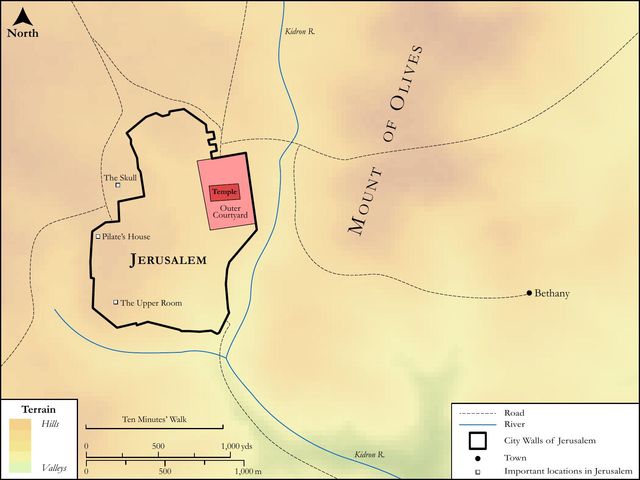
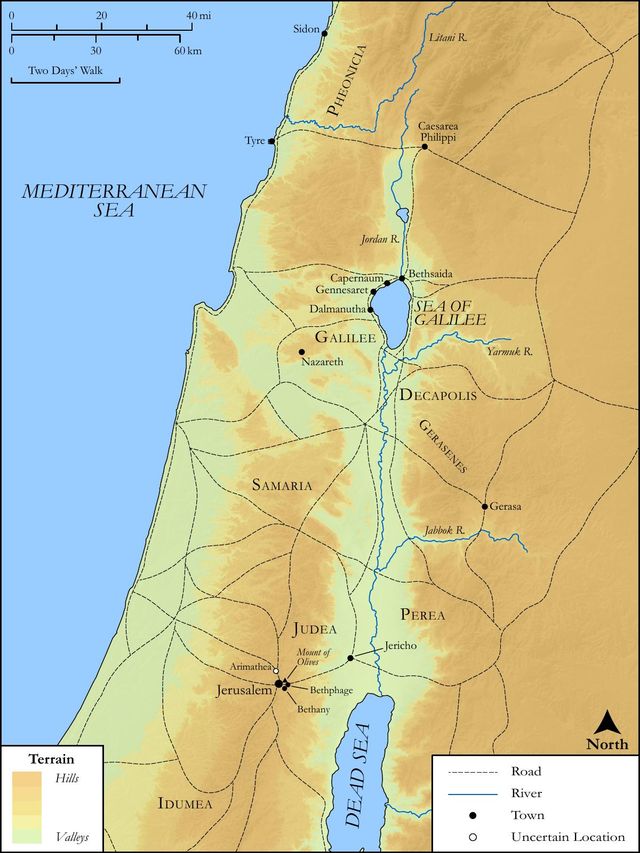
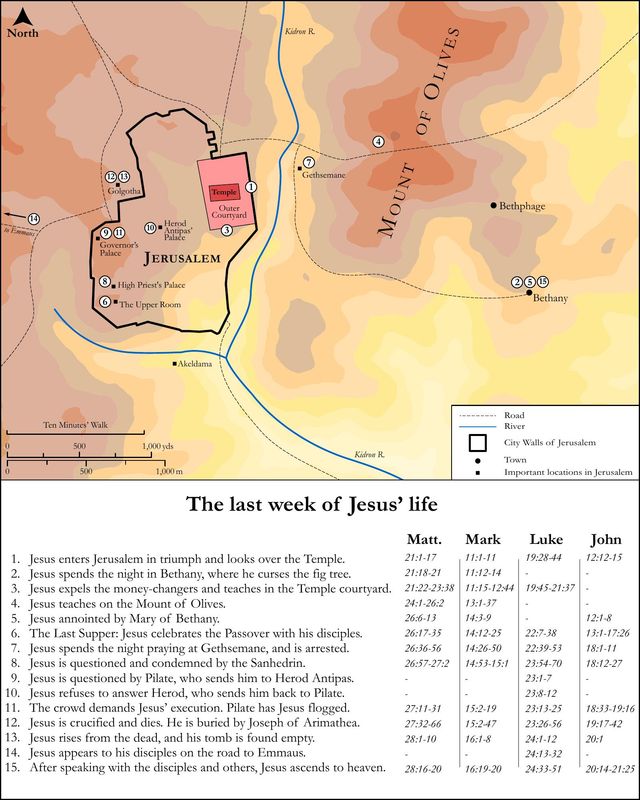
See on the biblical-era map
Study this verse
Public-domain commentary
Matthew Henry
From his Commentary on the Whole Bible. Henry comments on passages, not single verses — this entry covers Mark 14:53–65. His two-level outline is real structure in the source text, so it is rendered as structure.
We have here Christ's arraignment, trial, conviction, and condemnation, in the ecclesiastical court, before the great sanhedrim, of which the high priest was president, or judge of the court; the same Caiaphas that had lately adjudged it expedient he should be put to death, guilty or not guilty (Joh 11:50), and who therefore might justly be excepted against as partial.
I.Christ is hurried away to his house, his palace it is called, such state did he live in.
And there, though, in the dead of the night, all the chief priests, and elders, and scribes, that were in the secret, were assembled, ready to receive the prey; so sure were they of it.
II.Peter followed at a distance, such a degree of cowardice was his late courage dwindled into, Mar 14:54.
But when he came to the high priest's palace, he sneakingly went, and sat with the servants, that he might not be suspected to belong to Christ. The high priest's fire side was no proper place, nor his servants proper company, for Peter, but it was his entrance into a temptation.
III.Great diligence was used to procure, for love or money, false witnesses against Christ.
They had seized him as a malefactor, and now they had him they had no indictment to prefer against him, no crime to lay to his charge, but they sought for witnesses against him; pumped some with ensnaring questions, offered bribes to others, if they would accuse him, and endeavored to frighten others, if they would not, Mar 14:55, Mar 14:56. The chief priests and elders were by the law entrusted with the prosecuting and punishing of false witnesses (Deu 19:16, Deu 19:17); yet those were now ringleaders in a crime that tends to overthrow of all justice. It is time to cry, Help, Lord, when the physicians of a land are its troublers, and those that should be the conservators of peace and equity, are the corrupters of both.
IV.He was at length charged with words spoken some years ago, which, as they were represented, seemed to threaten the temple, which they had made no better than an idol of (Mar 14:57, Mar 14:58); but the witnesses to this matter did not agree (Mar 14:59), for one swore that he said, I am able to destroy the temple of God, and to build it in three days (so it is in Matthew); the other swore that he said, I will destroy this temple, that is made with hands, and within three days, I will build not it, but another made without hands; now these two differ much from each other; oude isē ēn hē marturia - their testimony was not sufficient, nor equal to the charge of a capital crime; so Dr. Hammond: they did not accuse him of that upon which a sentence of death might be founded, no not by the utmost stretch of their law.
V.He was urged to be his own accuser (Mar 14:60); The high priest stood up in a heat, and said, Answerest thou nothing? This he said under pretence of justice and fair dealing, but really with a design to ensnare him, that they might accuse him, Luk 11:53, Luk 11:54; Luk 20:20. We may well imagine with what an air of haughtiness and disdain this proud high priest brought our Lord Jesus to this question; "Come you, the prisoner at the bar, you hear what is sworn against you; what have you now to say for yourself?" Pleased to think that he seemed silent, who had so often silenced those that picked quarrels with him. Still Christ answered nothing, that he might set us an example,
1.Of patience under calumnies and false accusations; when we are reviled, let us not revile again, Pe1 2:23. And,
2.Of prudence, when a man shall be made an offender for a word (Isa 29:21), and our defence made our offence; it is an evil time indeed when the prudent shall keep silence (lest they make bad worse), and commit their cause to him that judgeth righteously. But,
VI.When he was asked whether he was the Christ, he confessed, and denied not, that he was, Mar 14:61, Mar 14:62.
He asked, Art thou the Son of the Blessed? that is the Son of God? for, as Dr. Hammond observes, the Jews, when they named God, generally added, blessed for ever; and thence the Blessed is the title of God, a peculiar title, and applied to Christ, Rom 9:5. And for the proof of his being the Son of God, he binds them over to his second coming; "Ye shall see the Son of man sitting on the right hand of power; that Son of man that now appears so mean and despicable, whom ye see and trample upon (Isa 53:2, Isa 53:3), you shall shortly see and tremble before." Now, one would think that such a word as this which our Lord Jesus seems to have spoken with a grandeur and majesty not agreeable to his present appearance (for through the thickest cloud of his humiliation some rays of glory were still darted forth), should have startled the court, and at least, in the opinion of some of them, should have amounted to a demurrer, or arrest of judgment, and that they should have stayed process till they had considered further of it; when Paul at the bar reasoned of the judgment to come, the judge trembled, and adjourned the trial, Act 24:25. But these chief priests were so miserably blinded with malice and rage, that, like the horse rushing into the battle, they mocked at fear, and were not affrighted, neither believed they that it was the sound of the trumpet, Job 39:22, Job 39:24. And see Job 15:25, Job 15:26.
VII.The high priest, upon this confession of his, convicted him as a blasphemer (Mar 14:63); He rent his clothes - chitōnas autou.
Some think the word signifies his pontifical vestments, which, for the greater state, he had put on, though in the night, upon this occasion. As before, in his enmity to Christ, he said he knew not what (Joh 11:51, Joh 11:52), so now he did he knew not what. If Saul's rending Samuel's mantle was made to signify the rending of the kingdom from him (Sa1 15:27, Sa1 15:28), much more did Caiaphas's rending his own clothes signify the rending of the priesthood from him, as the rending of the veil, at Christ's death, signified the throwing of all open. Christ's clothes, even when he was crucified, were kept entire, and not rent: for when the Levitical priesthood was rent in pieces and done away, This Man, because he continues ever, has an unchangeable priesthood.
VIII.They agreed that he was a blasphemer, and, as such, was guilty of a capital crime, Mar 14:64.
The question seemed to be put fairly, What think ye? But it was really prejudged, for the high priest had said, Ye have heard the blasphemy; he gave judgment first, who, as president of the court, ought to have voted last. So they all condemned him to be guilty of death; what friends he had in the great sanhedrim, did not appear, it is probable that they had not notice.
IX.They set themselves to abuse him, and, as the Philistines with Samson, to make sport with him, Mar 14:65.
It should seem that some of the priests themselves that had condemned him, so far forgot the dignity, as well as duty, of their place, and the gravity which became them, that they helped their servants in playing the fool with a condemned prisoner. This they made their diversion, while they waited for the morning, to complete their villany. That night of observations (as the passover-night was called) they made a merry night of. If they did not think it below them to abuse Christ, shall we think any thing below us, by which we may do him honour?
Historical interpretation
Five Centuries of Reception
6 surviving comments on this verse. Each one is dated, so this reads as a timeline rather than a list.
Select a marker to jump to its quote. Markers stagger vertically where authors wrote within a few decades of each other.
Then took place the gathering together of the bulls among the heifers of the people. (Ps. 67:31, Vulg.) It goes on: And Peter followed him afar off, even into the palace of the High Priest. For though fear holds him back, love draws him on.
He warms himself at the fire in the hall, with the servants. The hall of the High-Priest is the enclosure of the world, the servants are the devils, with whom whosoever remains cannot weep for his sins; the fire is the desire of the flesh.
But iniquity lied as the queen did against Joseph, and the priests against Susannah, but a flame goes out, if it has no fuel; wherefore it goes on, And found none. For many bare false witness against him, but their witness agreed not together. For whatever is not consistent is held to be doubtful. There follows, And there arose certain, and bare false witness against him, saying, We heard him say, I will destroy this temple that is made with hands, and within three days I will build another made without hands. It is usual with heretics out of the truth to extract the shadow; He did not say what they said, but something like it, of the temple of His body, which He raised again after two days.
And he was sitting with the attendants and warming himself at the fire. There is the fire of love, and there is also the fire of desire. Of this it is said: I came to cast fire upon the earth, and what will I if it be already kindled (Luke 12)? But of that: They are all adulterers, like an oven heated by the baker (Hosea 7). This fire, descending upon the believers in the upper room of Zion, taught them to praise God in various languages. That fire kindled by the evil spirit in the courtyard of Caiaphas armed the harmful tongues of the faithless to deny and blaspheme the Lord. For what the malignant council was plotting inside the house of the high priest, this fire materially lit outside in the courtyard amidst the cold of the night, symbolically prefigured. Therefore, whoever extinguishes the evil and harmful fire in themselves can say with the prophet to the Lord: For I am become like a bottle in the frost; yet do I not forget thy statutes (Psalm 119). But those in whom the flame of love has been overwhelmed by the turbulent waters of vices hear from the Lord: Because iniquity shall abound, the love of many shall wax cold (Matthew 24). At that cold moment, the Apostle Peter, numb from the cold, wished to warm himself by the coals of Caiaphas' attendants, because he sought the comfort of temporal ease by the company of the faithless. But soon, remembered by the Lord, he left behind both the physical fire of the wicked and the infidelity within his heart. And after the resurrection of the Lord, revived by the holy fire, he completely purged the sin of his threefold denial by the threefold confession of love. Then, upon that memorable catch of fish, when he came to the Lord with his fellow disciples, soon seeing the coals laid, and the fish laid on it and the bread, he was inflamed with the fire of love in the hidden chambers of his heart.
But Peter followed from a distance, etc. Deservedly he followed from a distance, who was soon to deny him. For he could not have denied if he had clung closely to Christ. Yet in this, he is most greatly venerable to us with admiration because he did not leave the Lord even when he was afraid. For what he fears is due to nature; what he follows is due to devotion; what he denies is due to deception; what he repents of is due to faith. Another interpretation: Peter following the same Lord from a distance to the passion signified that the Church would indeed follow, that is, imitate the passion of the Lord, but from a far distance. For the Church suffers for itself, but He for the Church.
(ubi sup.) He means by the High Priest Caiaphas, who (as John writes) was High Priest that year, of whom Josephus relates that he bought his priesthood of the Roman Emperor. There follows: And with him were assembled all the Chief Priests and the elders and the scribes.
(ubi sup.) But rightly does he follow afar off, who is just about to betray Him; for he could not have denied Christ, if he had remained close to Him. There follows, And he sat with the servants, and warmed himself at the fire.
(ubi sup.) For charity is the fire of which it is said, I am come to send fire on the earth, (Luke 12:49) which flame coming down on the believers, taught them to speak with various tongues the praise of the Lord. There is also a fire of covetousness, of which it is said, They are all adulterers as an oven; (Hosea 7:4) this fire, raised up in the hall of Caiaphas by the suggestion of an evil spirit, was arming the tongues of the traitors to deny and blaspheme the Lord. For the fire lit up in the hall amidst the cold of the night was a figure of what the wicked assembly was doing within; for because of the abounding of iniquity the love of many waxes cold. Peter, who for a time was benumbed by this cold, wished as it were to be warmed by the coals of the servants of Caiaphas, because He sought in the society of traitors the consolation of worldly comfort. It goes on, And the Chief Priests and all the council sought for witness against Jesus to put him to death. (Matt. 24:12)
(ubi sup.) He had said also, I will raise up, meaning a thing with life and soul, and a breathing temple. He is a false witness, who understands words in a sense, in which they are not spoken.
Though the law commanded that there should be but one High Priest, there were then many put into the office, and stripped of it, year by year, by the Roman emperor. He therefore calls chief priests those who had finished the time allotted to them, and had been stripped of their priesthood. But their actions are a sign of their judgment, which they earned on as they had prejudged, for they sought for a witness, that they might seem to condemn and destroy Jesus with justice.
For the Lord had not said, I will destroy, but, Destroy, nor did He say, made with hands, but, this temple.
(non occ.) The Evangelist had related above how our Lord had been taken by the servants of the Priests, now he begins to relate how He was condemned to death in the house of the High Priest: wherefore it is said, And they led Jesus away to the High Priest.
Continue studying Mark 14:54 across the web’s major study libraries — every link below opens this exact verse, chapter, or book on the destination site.
Read & Compare
 BibleGatewayThis verse in more than 200 translations and 70 languages.
 Bible.comThe YouVersion reader — hundreds of translations, reading plans, and highlights.
 ESV.orgCrossway's official English Standard Version reader.
 NET BibleThe NET translation with 60,000+ translators' notes on every rendering decision.
 STEP BibleTyndale House's free study tool — original text, vocabulary, and scholarly resources.
 BibliaLogos Bible Software's free web reader.
 USCCBThe New American Bible (Revised Edition) with the U.S. bishops' study notes.
Commentaries
 BibleHub CommentariesDozens of classic commentaries on this verse, gathered on one page.
 StudyLightMore than 100 commentary sets — the largest collection on the web.
 BibleRefPlain-English commentary on what this verse means, verse by verse.
 Enduring WordDavid Guzik's free commentary on this chapter, widely used by Bible teachers.
 Bible Study ToolsVerse commentary alongside Greek and Hebrew study aids.
Original Language & Research
- BibleHub InterlinearThe verse word by word — original language, transliteration, and English.
- BibleHub LexiconEvery word's original-language definition and Strong's entry.
 Blue Letter BibleDeep-study tools — Strong's numbers, concordance, and word studies.
 CNTR CollationThe earliest Greek manuscripts of this verse, collated letter by letter.
Sermons, Hymns & Audio


TrulyRandomVerse is not affiliated with these sites and doesn’t control their content. They’re linked because they’re genuinely useful.
Summary
Mark 14:54 vividly portrays Peter's conflicted state immediately following Jesus' arrest in Gethsemane. While the other disciples fled, Peter, driven by a mixture of loyalty and fear, followed Jesus at a cautious distance. This path led him into the very courtyard of the high priest's palace, where he sought to blend in with the servants, warming himself by their fire—a seemingly innocuous act that tragically positioned him for the imminent and painful test of his faith.
Context
ShowHideLiterary Context
This verse immediately follows the traumatic events in the Garden of Gethsemane, where Jesus was betrayed by Judas and arrested by a large crowd. Mark 14:50 explicitly states that "they all forsook him, and fled," highlighting the profound abandonment Jesus experienced. Peter's action in Mark 14:54 is therefore presented as a notable, albeit flawed, exception to the general flight of the disciples. It sets the geographical and emotional stage for the high priest's interrogation of Jesus and, more significantly for Peter, the series of denials that will unfold in the very same location, as detailed in Mark 14:66-72. This verse acts as a crucial transition, moving the narrative from the arrest to the trials, with Peter's personal drama unfolding in parallel.
Historical & Cultural Context
The scene takes place in Jerusalem during the Passover week, a time of heightened religious and political tension. The "palace of the high priest" (Greek aulē, G833) refers to the large, inner courtyard of the high priest's residence, likely a substantial complex where officials, guards, and servants would gather, especially during a significant nighttime event like an arrest and preliminary hearing. Warming oneself by a fire was a common practice in Jerusalem's cool spring nights, providing a natural excuse for Peter to be present without drawing undue attention. The presence of "servants" (hypērétēs, G5257) and "officers" (implied by the context of an arrest party) indicates a bustling, semi-public space, making Peter's attempt to blend in both understandable and strategically dangerous.
Key Themes
ShowHideMark 14:54 contributes significantly to several overarching themes in Mark's Gospel. Firstly, it underscores the theme of human frailty and fear in the face of immense pressure, even among Jesus' closest disciples. Peter's earlier bold declarations of loyalty, such as his vow in Mark 14:31 that he would never deny Jesus, stand in stark contrast to his cautious distance here. Secondly, the verse introduces the theme of discipleship's cost and challenge, illustrating that true following requires more than physical proximity; it demands unwavering commitment, especially in adversity. Peter's "following afar off" foreshadows his spiritual and emotional distance, which will lead to his spectacular failure. Finally, this scene is integral to the narrative of Peter's denial and subsequent restoration, serving as the immediate prelude to his threefold denial of Jesus, a pivotal moment in the Passion narrative found in Mark 14:66-72.
Exposition and Analysis
ShowHideKey Word Analysis
ShowHideThis word, G190, means "to be in the same way with, i.e., to accompany (specially, as a disciple)." While Peter physically followed Jesus, the qualification "afar off" immediately subverts the full implication of discipleship. It suggests a partial, hesitant adherence rather than the complete, self-denying following Jesus called for (e.g., Mark 8:34).
An adverb, means "from a distance or afar." This emphasizes Peter's physical separation from Jesus, which is indicative of his emotional and spiritual struggle. It highlights his desire to observe without fully committing himself to the dangerous proximity of his arrested Master, revealing a profound internal conflict between loyalty and self-preservation.
Means "to seat oneself in company with." This act signifies Peter's attempt to integrate himself into the environment of the high priest's servants and guards. By sitting with them, Peter sought anonymity and safety, but in doing so, he placed himself in a compromising position, aligning himself with those who were either indifferent or hostile to Jesus, rather than standing in solidarity with his Lord.
Verse Breakdown
ShowHide"And Peter followed him afar off,"
This clause immediately establishes Peter's unique, yet compromised, position among the disciples. Unlike the others who "fled," Peter maintained a connection, however tenuous. The phrase "afar off" is crucial, indicating a physical distance that mirrors an emerging spiritual and emotional detachment, driven by fear and self-preservation rather than unwavering commitment.
"even into the palace of the high priest:"
This specifies Peter's destination, the very heart of Jesus' immediate trial and condemnation. The term "palace" (aulḗ) refers to the courtyard, an open, semi-public space. Peter's entry into this hostile environment, despite his distance, demonstrates a certain courage or perhaps a compelling curiosity, but it also places him directly in the crucible of temptation.
"and he sat with the servants,"
This action reveals Peter's strategy for remaining unnoticed and safe. By joining the servants, who were likely lower-status individuals not directly involved in the religious proceedings, Peter hoped to blend in. This act of "sitting with" those outside Jesus' immediate circle foreshadows his later denial, as he attempts to disassociate himself from Jesus to avoid suspicion.
"and warmed himself at the fire."
This seemingly innocuous detail serves multiple purposes. Physically, it explains Peter's presence in the cold night. Symbolically, the fire represents a place of comfort and community, but in this context, it is the comfort of those who are not aligned with Jesus. This act of seeking warmth from a "worldly" source in a moment of spiritual crisis highlights Peter's human need for security and comfort over courageous solidarity, setting the stage for his imminent moral failure.
Literary Devices
ShowHideMark 14:54 employs several powerful literary devices. Foreshadowing is prominent, as Peter's physical distance and his act of warming himself by the fire with the servants directly precede and set the stage for his three denials of Jesus (Mark 14:66-72). His attempt to blend in and seek comfort among those hostile to Jesus creates the perfect environment for his faith to be tested and found wanting. There is also a strong element of Irony: Peter, who had so vehemently declared his loyalty and willingness to die with Jesus, is now found "following afar off" and seeking comfort among the very people who might expose him. This contrasts sharply with his earlier boasts, highlighting the gap between intention and action under pressure. Finally, the "fire" itself can be seen as Symbolism. While literally a source of warmth, it also represents the heat of the impending trial and the intense pressure Peter is about to experience. It is around this fire that his faith will be tested and, for a time, extinguished.
Theological and Thematic Connections
ShowHideMark 14:54 serves as a poignant theological commentary on the nature of discipleship, particularly in times of crisis. It exposes the inherent human tendency towards self-preservation and fear, even in those who have walked most closely with Christ. Peter's actions highlight that genuine following of Jesus is not merely about physical proximity or outward declarations of loyalty, but about an unwavering commitment that transcends personal comfort and safety. His "following afar off" is a stark reminder that a compromised or distant discipleship inevitably leads to vulnerability and potential failure, contrasting sharply with Jesus' own steadfast and sacrificial obedience to the Father's will, even unto death. This scene powerfully illustrates the spiritual danger of seeking comfort and acceptance from the world when one should be standing in solidarity with Christ.
Reflection and Application
ShowHidePeter's actions in Mark 14:54 offer a profound challenge to contemporary discipleship. His "following afar off" is a powerful metaphor for our own tendencies to keep Christ at a safe distance when the demands of discipleship become too costly, uncomfortable, or socially inconvenient. Are we willing to stand close to Jesus, even when it means facing ridicule, persecution, or the loss of worldly comfort and acceptance? The scene by the fire reminds us that seeking warmth and belonging in environments that are indifferent or hostile to Christ can subtly erode our commitment and make us susceptible to compromise. True discipleship calls for a radical solidarity with Jesus, regardless of the circumstances, trusting that His presence is our ultimate security and comfort. This verse compels us to examine our own hearts: where are we "following afar off," and what "fires" are we warming ourselves by that might lead us away from steadfast devotion to Christ?
Questions for Reflection
ShowHideFAQ
ShowHideWhy did Peter follow Jesus "afar off"?
ShowHidePeter's decision to follow "afar off" (Greek makróthen, G3113) was likely a complex mix of loyalty, fear, and curiosity. On one hand, he was distinct from the other disciples who "all forsook him, and fled" (Mark 14:50). This shows a lingering attachment and perhaps a desire to see what would happen to Jesus. On the other hand, the "afar off" indicates a profound fear for his own safety. He had just witnessed Jesus' violent arrest and was aware of the danger. His earlier boast of unwavering loyalty (Mark 14:31) was now being tested, and his human weakness led him to prioritize self-preservation while still wanting to remain connected to the unfolding events.
What is the significance of Peter warming himself by the fire?
ShowHideThe act of warming himself by the fire (Greek thermaínō, G2328, and phōs, G5457 for fire) is significant both literally and symbolically. Literally, it was a cold night in Jerusalem, and seeking warmth was a natural human need. Symbolically, however, this act places Peter in a precarious position. He is seeking comfort and blending in with the "servants" (hypērétēs, G5257) and guards—people who were either indifferent or hostile to Jesus. This physical alignment with the world, rather than standing in solidarity with his suffering Lord, sets the stage for his subsequent denials. The fire becomes the very locus of his spiritual trial, where his identity as a follower of Jesus is questioned and, for a time, disavowed (Mark 14:66-72).
Christ-Centered Fulfillment
ShowHideMark 14:54, with Peter's hesitant and fearful following, starkly contrasts with the unwavering and purposeful journey of Jesus towards the cross. While Peter seeks comfort and safety, Jesus resolutely walks the path of suffering, fulfilling the Father's will. Peter's weakness highlights the profound need for a perfect High Priest, one who does not "follow afar off" but fully embraces the cup of suffering for humanity's sake. Jesus, unlike Peter, does not warm himself by the world's fire but endures the fire of God's wrath against sin, becoming the ultimate sacrifice. His steadfastness in the face of betrayal and abandonment underscores His divine strength and perfect obedience, which alone can atone for the frailty and failures of humanity, including Peter's. The subsequent restoration of Peter, as seen in John 21:15-19, is entirely a work of Christ's grace, demonstrating that even profound human failure cannot thwart God's redemptive plan when met with the atoning power of the Lamb of God. Jesus' perfect obedience, even unto death on the cross, is the true "following" that secures salvation, covering all instances where we, like Peter, fall short.