


Mark 14:65
Bible text: King James Version (1769 Blayney text) · Public domain
Bible text: King James Version with Strong's numbers · Public domain
Bible text: Berean Standard Bible · Public domain
Bible text: American Standard Version (1901) · Public domain
Bible text: World English Bible, Messianic edition · Public domain
Bible text: Geneva Bible (1599) · Public domain
Bible text: Young's Literal Translation · Public domain
- καὶkaiAndG2532CONJConjunction
- ἤρξαντόērxantobeganG757V-ADI-3PVerb Aorist Middle Deponent Indicative 3rd Plural
- τινεςtinessomeG5100X-NPMIndefinite pronoun Nominative Plural Masculine
- ἐμπτύεινemptueinto spitG1716V-PANVerb Present Active Infinitive
- αὐτῷautōupon HimG846P-DSMPersonal pronoun Dative Singular Masculine
- καὶkaiandG2532CONJConjunction
- περικαλύπτεινperikalupteinto cover upG4028V-PANVerb Present Active Infinitive
- αὐτοῦautouof HimG846P-GSMPersonal pronoun Genitive Singular Masculine
- τὸtotheG3588T-ASNDefinite article Accusative Singular Neuter
- πρόσωπονprosōponfaceG4383N-ASNNoun Accusative Singular Neuter
- καὶkaiandG2532CONJConjunction
- κολαφίζεινkolaphizeinto strikeG2852V-PANVerb Present Active Infinitive
- αὐτὸνautonHimG846P-ASMPersonal pronoun Accusative Singular Masculine
- καὶkaiandG2532CONJConjunction
- λέγεινlegeinto sayG3004V-PANVerb Present Active Infinitive
- αὐτῷ·autōto HimG846P-DSMPersonal pronoun Dative Singular Masculine
- προφήτευσονprophēteusondo prophesyG4395V-AAM-2SVerb Aorist Active Imperative 2nd Singular
- καὶkaiAndG2532CONJConjunction
- οἱhoitheG3588T-NPMDefinite article Nominative Plural Masculine
- ὑπηρέταιhupēretaiofficersG5257N-NPMNoun Nominative Plural Masculine
- ῥαπίσμασινrhapismasinwith the palmsG4475N-DPNNoun Dative Plural Neuter
- αὐτὸνautonHimG846P-ASMPersonal pronoun Accusative Singular Masculine
- ἔλαβονelabonreceivedG2983V-2AAI-3PVerb 2nd Aorist Active Indicative 3rd Plural
English is a literal word-by-word gloss of the Greek, not the KJV's wording. Why?
This is the original text the KJV's translators worked from — each Greek word with its own literal English meaning in this verse, prepared by scholars at Tyndale House, Cambridge. The KJV translates whole sentences, not word by word, so its wording differs: one Greek word can become several English words, and the KJV may choose “charity” where the gloss reads “love”. Both are faithful — they answer different questions. For the KJV's own rendering, switch to the KJV text.
Details
See on the biblical-era maps
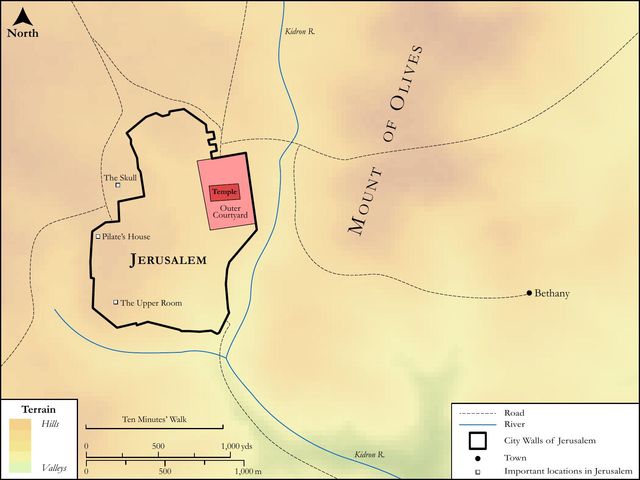
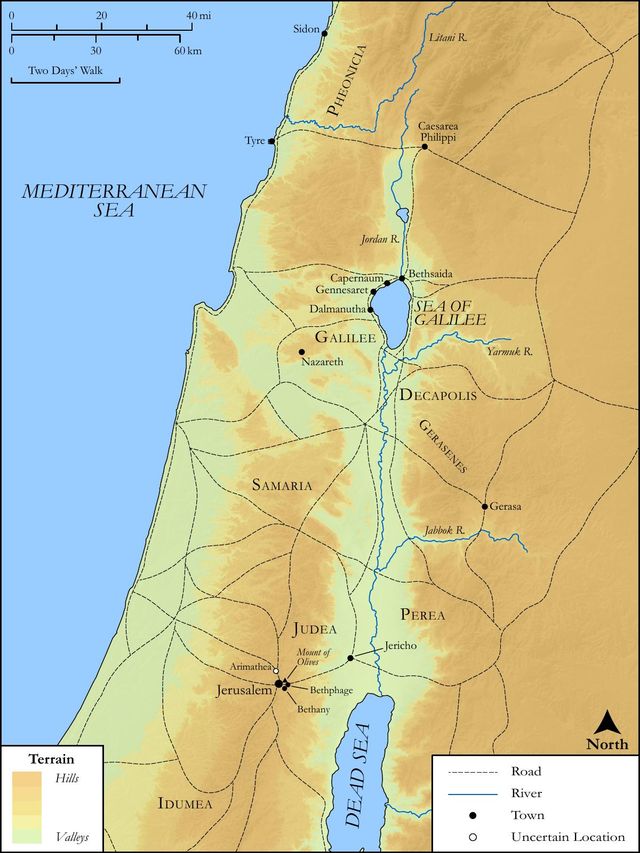
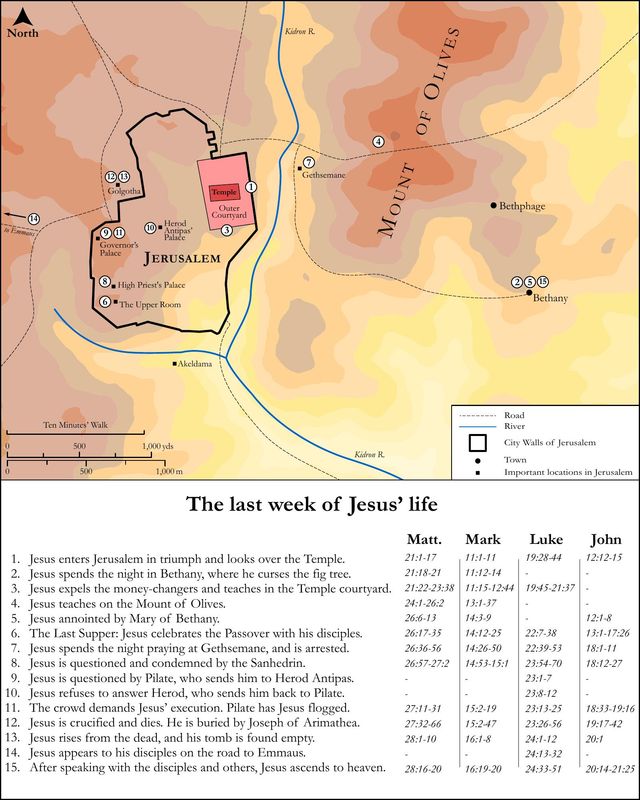
Study this verse
Public-domain commentary
Matthew Henry
From his Commentary on the Whole Bible. Henry comments on passages, not single verses — this entry covers Mark 14:53–65. His two-level outline is real structure in the source text, so it is rendered as structure.
We have here Christ's arraignment, trial, conviction, and condemnation, in the ecclesiastical court, before the great sanhedrim, of which the high priest was president, or judge of the court; the same Caiaphas that had lately adjudged it expedient he should be put to death, guilty or not guilty (Joh 11:50), and who therefore might justly be excepted against as partial.
I.Christ is hurried away to his house, his palace it is called, such state did he live in.
And there, though, in the dead of the night, all the chief priests, and elders, and scribes, that were in the secret, were assembled, ready to receive the prey; so sure were they of it.
II.Peter followed at a distance, such a degree of cowardice was his late courage dwindled into, Mar 14:54.
But when he came to the high priest's palace, he sneakingly went, and sat with the servants, that he might not be suspected to belong to Christ. The high priest's fire side was no proper place, nor his servants proper company, for Peter, but it was his entrance into a temptation.
III.Great diligence was used to procure, for love or money, false witnesses against Christ.
They had seized him as a malefactor, and now they had him they had no indictment to prefer against him, no crime to lay to his charge, but they sought for witnesses against him; pumped some with ensnaring questions, offered bribes to others, if they would accuse him, and endeavored to frighten others, if they would not, Mar 14:55, Mar 14:56. The chief priests and elders were by the law entrusted with the prosecuting and punishing of false witnesses (Deu 19:16, Deu 19:17); yet those were now ringleaders in a crime that tends to overthrow of all justice. It is time to cry, Help, Lord, when the physicians of a land are its troublers, and those that should be the conservators of peace and equity, are the corrupters of both.
IV.He was at length charged with words spoken some years ago, which, as they were represented, seemed to threaten the temple, which they had made no better than an idol of (Mar 14:57, Mar 14:58); but the witnesses to this matter did not agree (Mar 14:59), for one swore that he said, I am able to destroy the temple of God, and to build it in three days (so it is in Matthew); the other swore that he said, I will destroy this temple, that is made with hands, and within three days, I will build not it, but another made without hands; now these two differ much from each other; oude isē ēn hē marturia - their testimony was not sufficient, nor equal to the charge of a capital crime; so Dr. Hammond: they did not accuse him of that upon which a sentence of death might be founded, no not by the utmost stretch of their law.
V.He was urged to be his own accuser (Mar 14:60); The high priest stood up in a heat, and said, Answerest thou nothing? This he said under pretence of justice and fair dealing, but really with a design to ensnare him, that they might accuse him, Luk 11:53, Luk 11:54; Luk 20:20. We may well imagine with what an air of haughtiness and disdain this proud high priest brought our Lord Jesus to this question; "Come you, the prisoner at the bar, you hear what is sworn against you; what have you now to say for yourself?" Pleased to think that he seemed silent, who had so often silenced those that picked quarrels with him. Still Christ answered nothing, that he might set us an example,
1.Of patience under calumnies and false accusations; when we are reviled, let us not revile again, Pe1 2:23. And,
2.Of prudence, when a man shall be made an offender for a word (Isa 29:21), and our defence made our offence; it is an evil time indeed when the prudent shall keep silence (lest they make bad worse), and commit their cause to him that judgeth righteously. But,
VI.When he was asked whether he was the Christ, he confessed, and denied not, that he was, Mar 14:61, Mar 14:62.
He asked, Art thou the Son of the Blessed? that is the Son of God? for, as Dr. Hammond observes, the Jews, when they named God, generally added, blessed for ever; and thence the Blessed is the title of God, a peculiar title, and applied to Christ, Rom 9:5. And for the proof of his being the Son of God, he binds them over to his second coming; "Ye shall see the Son of man sitting on the right hand of power; that Son of man that now appears so mean and despicable, whom ye see and trample upon (Isa 53:2, Isa 53:3), you shall shortly see and tremble before." Now, one would think that such a word as this which our Lord Jesus seems to have spoken with a grandeur and majesty not agreeable to his present appearance (for through the thickest cloud of his humiliation some rays of glory were still darted forth), should have startled the court, and at least, in the opinion of some of them, should have amounted to a demurrer, or arrest of judgment, and that they should have stayed process till they had considered further of it; when Paul at the bar reasoned of the judgment to come, the judge trembled, and adjourned the trial, Act 24:25. But these chief priests were so miserably blinded with malice and rage, that, like the horse rushing into the battle, they mocked at fear, and were not affrighted, neither believed they that it was the sound of the trumpet, Job 39:22, Job 39:24. And see Job 15:25, Job 15:26.
VII.The high priest, upon this confession of his, convicted him as a blasphemer (Mar 14:63); He rent his clothes - chitōnas autou.
Some think the word signifies his pontifical vestments, which, for the greater state, he had put on, though in the night, upon this occasion. As before, in his enmity to Christ, he said he knew not what (Joh 11:51, Joh 11:52), so now he did he knew not what. If Saul's rending Samuel's mantle was made to signify the rending of the kingdom from him (Sa1 15:27, Sa1 15:28), much more did Caiaphas's rending his own clothes signify the rending of the priesthood from him, as the rending of the veil, at Christ's death, signified the throwing of all open. Christ's clothes, even when he was crucified, were kept entire, and not rent: for when the Levitical priesthood was rent in pieces and done away, This Man, because he continues ever, has an unchangeable priesthood.
VIII.They agreed that he was a blasphemer, and, as such, was guilty of a capital crime, Mar 14:64.
The question seemed to be put fairly, What think ye? But it was really prejudged, for the high priest had said, Ye have heard the blasphemy; he gave judgment first, who, as president of the court, ought to have voted last. So they all condemned him to be guilty of death; what friends he had in the great sanhedrim, did not appear, it is probable that they had not notice.
IX.They set themselves to abuse him, and, as the Philistines with Samson, to make sport with him, Mar 14:65.
It should seem that some of the priests themselves that had condemned him, so far forgot the dignity, as well as duty, of their place, and the gravity which became them, that they helped their servants in playing the fool with a condemned prisoner. This they made their diversion, while they waited for the morning, to complete their villany. That night of observations (as the passover-night was called) they made a merry night of. If they did not think it below them to abuse Christ, shall we think any thing below us, by which we may do him honour?
Historical interpretation
Eight Centuries of Reception
7 surviving comments on this verse. Each one is dated, so this reads as a timeline rather than a list.
Select a marker to jump to its quote. Markers stagger vertically where authors wrote within a few decades of each other.
But our God and Saviour Himself, Who brought salvation to the world, and assisted mankind by His love, is led as a sheep to the slaughter, without crying, and remained mute and kept silence yea even from good words. (Ps. 39:3) Wherefore it goes on, But he field his peace, and answered nothing. The silence of Christ is the pardon for the defence or excuse of Adam. (Gen. 3:10.)
But they looked from afar off for Him, whom though near they cannot see, as Isaac from the blindness of his eyes does not know Jacob who was under his hands, but prophesies long before things which were to come to him. It goes on, Jesus said, I am; namely, that they might be inexcusable.
The High Priest indeed asks the Son of God, but Jesus in His answer speaks of the Son of Man, that we may by this understand that the Son of God is also the Son of Man; and let us not make a quaternityx in the Trinity, but let man be in God and God in man. And He said, Sitting on the right hand of power, that is, reigning in life everlasting, and in the Divine power. He says, And coming with the clouds of heaven. He ascended in a cloud, He will come with a cloud; that is, He ascended in that body alone, which He took of the Virgin, and He will come to judgment with the whole Church, which is His body and His fulness.
They condemned Him to be guilty of death, that by His guiltiness He might absolve our guilt. It goes on: And some began to spit on him, and to cover his face, and to buffet him, and to say unto him, Prophesy: and the servants did strike him with the palms of their hands; that is, that by being spit upon He might wash the face of our soul, and by the covering of His face, might take away the veil from our hearts, and by the buffets, which were dealt upon His head, might heal the head of mankind, that is, Adam, and by the blows, by which He was smitten with the hands, His great praise might be testified by the clapping of our hands and by our lips, as it is said, O clap your hands together, all ye people. (Ps. 47:1)
Who is this strange one who says that he had been silent before, but would not always be silent? Who is he who was led as a sheep to the slaughter and who, like a lamb without making a sound before its shearer, did not open his mouth? Who is he who did not cry out and whose voice was not heard in the streets? Surely it was he who was not stubborn and who did not murmur when he offered his back to the scourges and his cheeks to blows. He did not turn his face away from their filthy spittle. When accused by the priests and elders, he answered nothing and, to the amazement of Pilate, kept a most patient silence.
(ubi sup.) We must understand by this, that the Lord suffered these things till morning, in the house of the High Priest, whither He had first been brought.
(Serm. 5. de Pass.) But Caiaphas, to increase the odiousness of what they had heard rent his clothes, and without knowing what his frantic action meant, by his madness, deprived himself of the honour of the priesthood, forgetting that command, by which it is said of the High Priest, He shall not uncover his head or rend his clothes. For there follows: Then the High Priest rent his clothes, and saith, What need we any further witnesses? Ye have heard the blasphemy: what think ye?
And some began to spit on him, and to cover his face, and to buffet him, and to say to him: Prophesy. And the officers struck him with the palms of their hands. The prophecy was fulfilled here which says: I gave my cheeks to the smiters, and I did not hide my face from confusion and spitting (Isaiah 50:6). But he who was struck then with buffetings from the Jews is now also struck by the blasphemies of false Christians. He who was then spat upon with the saliva of the unbelievers is now even to this day dishonored and provoked with insults by the frenzied only in name faithful. They covered his face, not so that he would not see their crimes, but so that they themselves, as they once did to Moses, might hide from themselves the grace of his knowledge. For if they believed Moses, they might perhaps also believe in the Lord. That veil remains until this day upon their hearts not revealed. But it has been taken away for us who believe in Christ. For it was not in vain that the veil of the temple was torn in two at the moment he died, and the things that had been hidden throughout the whole time of the law, and had been concealed from the carnal Israel, were made manifest to the worshippers of the New Testament in the sanctum sanctorum secrets. But what they say to him: Prophesy, and according to other evangelists: Prophesy who is the one who struck you; they do this as if in scorn of him who wished to be considered a prophet by the people. But he himself arranging what he suffers, everything is done for us, as Peter exhorts: Since Christ suffered in the flesh, let us arm ourselves with the same thought, and be prepared to endure the mocking insults for his name.
(ubi sup.) The more Jesus remained silent before the false witnesses who were unworthy of His answer, and the impious priests, the more the High Priest, overcome with anger, endeavoured to provoke Him to answer, that he might find room for accusing Him, from any thing whatever which He might say. Wherefore it is said, And the High Priest stood up in the midst, and asked Jesus, saying, Answerest thou nothing? what is it which these witness against thee? The High Priest, angry and impatient at finding no room for accusation against Him, rises from his seat, thus showing by the motion of his body the madness of his mind.
(ubi sup.) If therefore to thee, O Jew, O Pagan, and heretic, the contempt, weakness, and cross in Christ are a subject of scorn, see how by this the Son of Man is to sit at the right hand of the Father, and to come in His majesty on the clouds of heaven.
(ubi sup.) But it was also with a higher mystery, that in the Passion of our Lord the Jewish priest rent his own clothes, that is, his ephod, whilst the garment of the Lord could not be rent, even by the soldiers, who crucified Him. For it was a figure that the Jewish priesthood was to be rent on account of the wickedness of the priests themselves. But the solid strength of the Church, which is often called the garment of her Redeemer, can never be torn asunder.
(ubi sup.) By saying, Prophesy, who is he that smote thee, they mean to insult Him, because He wished to be looked upon as a prophet by the people.
But He remained silent because He knew that they would not attend to his words; wherefore He answered according to Luke, If I tell you, ye will not believe. (Luke 22:67) Wherefore there follows, Again the High Priest asked him, and said unto him, Art thou the Christ, the Son of the Blessed? The High Priest indeed puts this question, not that he might learn of Him and believe, but in order to seek occasion against Him. But he asks, Art thou the Christ, the Son of the Blessed, because there were many Christs, that is, anointed persons, as Kings and High Priests, but none of these was called the Son of the Blessed God, that is, the Ever-praised.
For He knew that they would not believe, nevertheless He answered them, lest they should afterwards say, If we had heard any thing from Him, we would have believed on Him; but this is their condemnation, that they heard and did not believe.
As if He had said, Ye shall see Me as the Son of Man sitting on the right hand of the Father, for He here calls the Father power. He will not however come without a body, but as He appeared to those who crucified Him, so will He appear in the judgment.
The High Priest does after the manner of the Jews; for whenever any thing intolerable or sad occurred to them, they used to rend their clothes. In order then to show that Christ had spoken great and intolerable blasphemy, he rent his clothes.
The Jewish priesthood was to be rent from the time that they condemned Christ as guilty of death; wherefore there follows, And they all condemned him to be guilty of death.
Continue studying Mark 14:65 across the web’s major study libraries — every link below opens this exact verse, chapter, or book on the destination site.
Read & Compare
 BibleGatewayThis verse in more than 200 translations and 70 languages.
 Bible.comThe YouVersion reader — hundreds of translations, reading plans, and highlights.
 ESV.orgCrossway's official English Standard Version reader.
 NET BibleThe NET translation with 60,000+ translators' notes on every rendering decision.
 STEP BibleTyndale House's free study tool — original text, vocabulary, and scholarly resources.
 BibliaLogos Bible Software's free web reader.
 USCCBThe New American Bible (Revised Edition) with the U.S. bishops' study notes.
Commentaries
 BibleHub CommentariesDozens of classic commentaries on this verse, gathered on one page.
 StudyLightMore than 100 commentary sets — the largest collection on the web.
 BibleRefPlain-English commentary on what this verse means, verse by verse.
 Enduring WordDavid Guzik's free commentary on this chapter, widely used by Bible teachers.
 Bible Study ToolsVerse commentary alongside Greek and Hebrew study aids.
Original Language & Research
- BibleHub InterlinearThe verse word by word — original language, transliteration, and English.
- BibleHub LexiconEvery word's original-language definition and Strong's entry.
 Blue Letter BibleDeep-study tools — Strong's numbers, concordance, and word studies.
 CNTR CollationThe earliest Greek manuscripts of this verse, collated letter by letter.
Sermons, Hymns & Audio


TrulyRandomVerse is not affiliated with these sites and doesn’t control their content. They’re linked because they’re genuinely useful.
Summary
Mark 14:65 powerfully depicts the immediate aftermath of Jesus' condemnation by the Jewish Sanhedrin, revealing a scene of intense physical abuse and profound humiliation. This verse captures the raw cruelty inflicted upon Jesus, as He is subjected to spitting, blindfolding, striking, and mocking challenges to His prophetic claims, underscoring the depths of human depravity and the beginning of His ultimate suffering.
Context
ShowHideLiterary Context
This verse is situated at a pivotal moment in Mark's Gospel, immediately following Jesus' arrest in the Garden of Gethsemane and His clandestine trial before the full Sanhedrin in the high priest's palace. Just moments prior, Jesus had unequivocally affirmed His divine identity as "the Christ, the Son of the Blessed" and prophesied His future return "sitting at the right hand of Power, and coming with the clouds of heaven" (Mark 14:62). This declaration, perceived as blasphemy by the council, led to their unanimous condemnation to death. The actions described in Mark 14:65 are not part of a formal legal punishment but rather an outburst of contempt, rage, and mockery from the religious leaders and their attendants, a visceral expression of their rejection of His claims.
Historical & Cultural Context
The trial of Jesus before the Sanhedrin was fraught with legal irregularities, including being held at night, on a feast day, and without proper witnesses or defense. Culturally, spitting on someone was an act of extreme contempt and dishonor, a public display of utter disdain. Covering someone's face, especially in this context, could serve multiple purposes: to prevent the victim from identifying their assailants, to symbolize a criminal's impending execution (as a condemned man), or to intensify the mockery by challenging their supposed divine knowledge while visually impaired. The "buffeting" and "striking with the palms of their hands" were not mere slaps but forceful blows, designed to inflict pain and further degrade the accused. These actions were a stark violation of any semblance of justice or human dignity, reflecting the intense hatred Jesus provoked among His accusers.
Key Themes
ShowHideMark 14:65 contributes significantly to several overarching themes in Mark's Gospel. Foremost is the theme of Profound Suffering and Humiliation of the Messiah, which is central to Mark's portrayal of Jesus. The physical and emotional abuse highlights the depths to which the Son of God descended for humanity's sake. Another key theme is the Mockery of Jesus' Messianic and Prophetic Claims. The command "Prophesy!" after His face was covered directly challenges His divine knowledge and authority, ironically confirming His true identity even as they scorned it. This scene also underscores the Fulfillment of Old Testament Prophecy, particularly the Suffering Servant passages in Isaiah, where the Messiah is depicted as enduring shame and spitting (Isaiah 50:6). Finally, the verse vividly illustrates Human Depravity and Injustice, revealing the capacity for extreme cruelty and the perversion of justice when religious and political power are wielded by those blinded by prejudice and fear.
Exposition and Analysis
ShowHideKey Word Analysis
ShowHideDerived from "en" (in) and "ptýō" (to spit), this word signifies an act of spitting at or upon someone. In ancient Near Eastern cultures, spitting was a profound gesture of contempt, disgust, and utter humiliation, designed to publicly shame and dishonor an individual. Its use here emphasizes the extreme degradation Jesus endured.
This term, from a root meaning "to chastise" or "to punish," specifically means "to strike with the fist," often implying blows to the head or face. It conveys forceful, repeated, and violent physical abuse. The word highlights the brutal, intentional infliction of pain by Jesus' captors.
Meaning "to foretell events, divine, speak under inspiration, or exercise the prophetic office," this word is used here in a deeply sarcastic and mocking sense. By covering Jesus' face and then demanding He prophesy who struck Him, His tormentors were cruelly challenging His claims to divine insight and His identity as the Messiah, who was expected to be a great prophet.
This noun refers to a "slap" or a "blow with the open hand," or even with a rod. While it might seem less severe than "buffet," it still denotes a painful and humiliating strike. The phrase "did strike him with the palms of their hands" indicates a continuous, demeaning assault, further emphasizing the physical abuse and the complete lack of respect shown to Jesus.
Verse Breakdown
ShowHide"And some began to spit on him,"
This clause initiates the physical abuse, highlighting the profound disrespect and contempt shown to Jesus. Spitting was a public act of extreme dishonor, intended to defile and degrade the recipient. The use of "began" suggests this was the start of a prolonged period of abuse.
"and to cover his face,"
This action, often referred to as blindfolding, served multiple purposes. It prevented Jesus from seeing His attackers, adding to His vulnerability and psychological torment. It also allowed His tormentors to strike Him with impunity, and symbolically, it could signify a condemned man, whose face would be covered before execution.
"and to buffet him,"
Following the spitting and blindfolding, this describes the direct physical assault. "Buffeting" implies striking with fists, particularly to the head or face, indicating a violent and painful beating. This was not merely a slap but a forceful, repeated assault.
"and to say unto him, Prophesy:"
This is the verbal component of the mockery. With His face covered, Jesus was challenged to use His supposed prophetic powers to identify who had just struck Him. This was a cruel taunt, directly ridiculing His claims to divine knowledge and His identity as the Messiah, who was expected to be a prophet and king.
"and the servants did strike him with the palms of their hands."
This final clause indicates that the abuse was not limited to the Sanhedrin members but extended to their attendants. The "servants" joined in the physical assault, using open-handed blows. This detail underscores the widespread contempt and the complete breakdown of any decorum or justice, as even those in subservient roles felt emboldened to participate in the humiliation of Jesus.
Literary Devices
ShowHideMark 14:65 is rich with literary devices that amplify its impact. Irony is profoundly present in the command "Prophesy!" The very individuals who reject Jesus' prophetic claims and divine identity mockingly challenge Him to demonstrate those powers. This verbal taunt, coupled with the physical abuse, serves as a dark mirror to His true nature. The scene also employs Pathos, evoking deep pity and sorrow for Jesus' suffering. The graphic descriptions of spitting, blindfolding, and striking are designed to elicit an emotional response from the reader, emphasizing the immense pain and humiliation He endured. Furthermore, the verse uses Symbolism: the covering of Jesus' face can symbolize the spiritual blindness of His accusers, who fail to recognize the Son of God standing before them. The entire scene serves as a powerful Foreshadowing of the greater suffering and ultimate crucifixion that awaits Jesus, establishing the theme of the Suffering Servant who cures profound injustice for the sake of humanity.
Theological and Thematic Connections
ShowHideMark 14:65 is a profound theological statement on the nature of Christ's suffering and the depth of human sin. It reveals that Jesus' path to redemption was not merely through a legal condemnation but through a gauntlet of personal humiliation and physical abuse, willingly endured. This suffering, far from being an accidental byproduct of His trial, was an integral part of God's sovereign plan for atonement, demonstrating the immense cost of sin and the boundless love of God. The scene underscores the reality of human depravity, where religious zealotry and fear can lead to the most heinous acts of injustice against the innocent. It also highlights Jesus' perfect obedience and submission to the Father's will, even in the face of unimaginable cruelty, setting the stage for His ultimate sacrifice.
Reflection and Application
ShowHideMark 14:65 confronts us with the stark reality of Jesus' suffering, inviting us to move beyond a mere intellectual understanding to a profound appreciation of His sacrifice. This verse reminds us that our salvation was purchased not just by His death, but by every indignity, every blow, and every mocking word He willingly endured. It calls us to reflect on the immense love that motivated Him to submit to such degradation for our sake, despite His divine power to stop it. For believers, this passage offers a powerful example of enduring injustice with grace and humility, knowing that Christ Himself suffered unjustly. It also serves as a sobering mirror, revealing the human capacity for cruelty and the urgent need for divine transformation in our own hearts and in the world. As we contemplate this scene, our gratitude for Christ's atoning work should deepen, compelling us to live lives worthy of such a costly redemption.
Questions for Reflection
ShowHideFAQ
ShowHideWhy did they cover Jesus' face before striking Him?
ShowHideCovering Jesus' face, often referred to as blindfolding, served multiple cruel purposes. Firstly, it prevented Him from seeing His attackers, thereby intensifying His vulnerability and psychological torment. It also allowed His tormentors to strike Him with impunity, knowing they could not be identified. Symbolically, it could represent the spiritual blindness of His accusers who failed to recognize the Son of God, or it could be a demeaning act, as a condemned criminal's face might be covered. The act of covering His face amplified the humiliation and mockery, especially when coupled with the demand to "Prophesy!" (Mark 14:65).
What was the significance of the command "Prophesy!"?
ShowHideThe command "Prophesy!" was a direct and cruel taunt, loaded with bitter irony. After covering Jesus' face, His tormentors challenged Him to use His divine knowledge to identify who had just struck Him. This was a direct mockery of His claims to be the Messiah, who was expected to be a great prophet, and the Son of God with divine insight. They were daring Him to prove His claims in a demeaning game, ridiculing the very power they denied He possessed. This act highlights the profound spiritual blindness and hardened hearts of those who condemned Him (Mark 14:62).
Who were the "servants" mentioned in the verse?
ShowHideThe "servants" (Greek, hypērétēs) mentioned in Mark 14:65 were likely attendants, guards, or officers associated with the high priest's household or the Sanhedrin. These were not Roman soldiers but Jewish temple guards or household staff. Their participation in the abuse underscores the widespread contempt and the complete breakdown of any semblance of justice or decorum. It shows that the humiliation of Jesus was not limited to the religious leaders themselves but extended to those under their authority, indicating a pervasive atmosphere of hostility and malice.
Christ-Centered Fulfillment
ShowHideMark 14:65, with its stark depiction of Jesus' humiliation and suffering, is a poignant fulfillment of Old Testament prophecy and a profound revelation of Christ's identity and mission. This scene vividly portrays the Suffering Servant described by Isaiah, who "gave my back to the smiters, and my cheeks to them that plucked off the hair: I hid not my face from shame and spitting" (Isaiah 50:6). Jesus, the innocent Lamb of God, willingly submitted to this degradation, not as a victim of circumstance, but as the sovereign Son of God fulfilling His redemptive purpose. His endurance of spitting, blindfolding, and blows foreshadows the ultimate sacrifice on the cross, where He would bear the full weight of humanity's sin and shame (2 Corinthians 5:21). The mockery of "Prophesy!" ironically confirms His true prophetic and kingly office, as He is indeed the one who knows all things and will return in glory (Matthew 26:64). Thus, this verse is not merely a historical account of abuse, but a powerful testament to the self-emptying love of Christ, who humbled Himself to the point of death, even death on a cross, so that through His suffering, we might find salvation and eternal life (Philippians 2:8).