


Job 39:22
Bible text: King James Version (1769 Blayney text) · Public domain
Bible text: Berean Standard Bible · Public domain
Bible text: American Standard Version (1901) · Public domain
Bible text: World English Bible, Messianic edition · Public domain
Bible text: Geneva Bible (1599) · Public domain
Bible text: Young's Literal Translation · Public domain
- יִשְׂחַקyis·Chakit laughsH7832V-Qal-Imperf-3msVerb Qal Imperfect 3rd Singular Masculine
- לְפַחַדLe·fa·chadto fearH6343Prep-l ¦ N-msNoun Singular Masculine Absoluteלְtoפַחַדfear
- וְלֹאve·Lo'and notH3808Conj-w ¦ NegParticle Negativeוְandלֹאnot
- יֵחָתye·Chatit is dismayedH2865V-Niphal-Imperf-3msVerb Niphal Imperfect 3rd Singular Masculine
- וְלֹאve·lo'and notH3808Conj-w ¦ NegParticle Negativeוְandלֹאnot
- יָשׁוּבya·Shuvit turns backH7725V-Qal-Imperf-3msVerb Qal Imperfect 3rd Singular Masculine
- מִפְּנֵיmi·pe·neifrom beforeH6440Prep-m ¦ N-mpcNoun Plural Masculine Constructמִfromפְּנֵיbefore
- חָרֶבCha·reva swordH2719N-fsNoun Singular Feminine Absolute
English is a literal word-by-word gloss of the Hebrew, not the KJV's wording. Why?
This is the original text the KJV's translators worked from — each Hebrew word with its own literal English meaning in this verse, prepared by scholars at Tyndale House, Cambridge. The KJV translates whole sentences, not word by word, so its wording differs: one Hebrew word can become several English words, and the KJV may choose “the LORD” where the gloss reads “Yahweh”. Both are faithful — they answer different questions. For the KJV's own rendering, switch to the KJV text.
Details
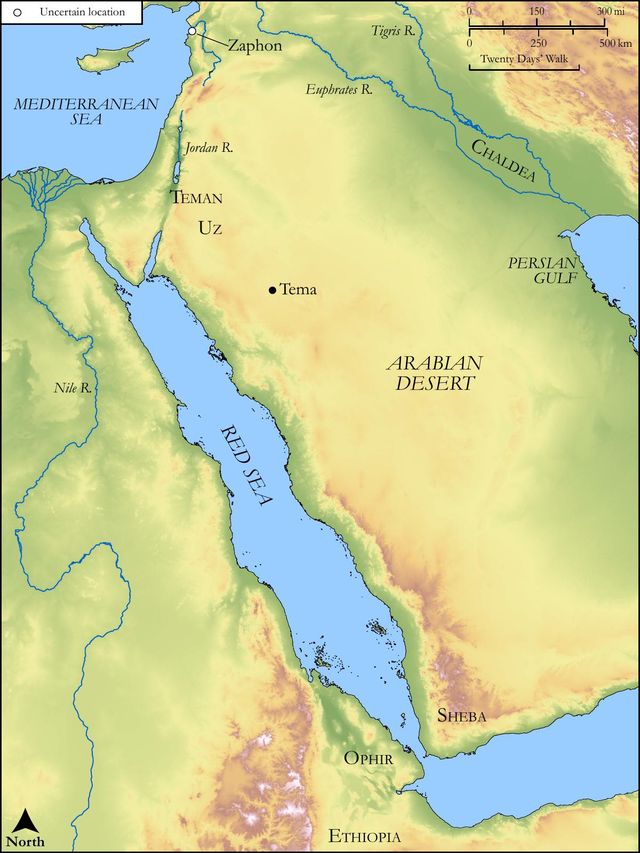
See on the biblical-era map
Study this verse
Public-domain commentary
Matthew Henry
From his Commentary on the Whole Bible. Henry comments on passages, not single verses — this entry covers Job 39:19–25.
God, having displayed his own power in those creatures that are strong and despise man, here shows it in one scarcely inferior to any of them in strength, and yet very tame and serviceable to man, and that is the horse, especially the horse that is prepared against the day of battle and is serviceable to man at a time when he has more than ordinary occasion for his service. It seems, there was, in Job's country, a noble generous breed of horses. Job, it is probable, kept many, though they are not mentioned among his possessions, cattle for use in husbandry being there valued more than those for state and war, which alone horses were then reserved for, and they were not then put to such mean services as with us they are commonly put to. Concerning the great horse, that stately beast, it is here observed, 1. That he has a great deal of strength and spirit (v. 19): Hast thou given the horse strength? He uses his strength for man, but has it not from him: God gave it to him, who is the fountain of all the powers of nature, and yet he himself delights not in the strength of the horse (Psa 147:10), but has told us that a horse is a vain thing for safety, Psa 33:17. For running, drawing, and carrying, no creature that is ordinarily in the service of man has so much strength as the horse has, nor is of so stout and bold a spirit, not to be made afraid as a grasshopper, but daring and forward to face danger. It is a mercy to man to have such a servant, which, though very strong, submits to the management of a child, and rebels not against his owner. But let not the strength of a horse be trusted to, Hos 14:3; Psa 20:7; Isa 31:1, Isa 31:3. 2. That his neck and nostrils look great. His neck is clothed with thunder, with a large and flowing mane, which makes him formidable and is an ornament to him. The glory of his nostrils, when he snorts, flings up his head, and throws foam about, is terrible, Job 39:20. Perhaps there might be at that time, and in that country, a more stately breed of horses than any we have now. 3. That he is very fierce and furious in battle, and charges with an undaunted courage, though he pushes on in imminent danger of his life. (1.) See how frolicsome he is (Job 39:21): He paws in the valley, scarcely knowing what ground he stands upon. He is proud of his strength, and he has much more reason to be so as using his strength in the service of man, and under his direction, than the wild ass that uses it in contempt of man, and in a revolt from him Job 39:8. (2.) See how forward he is to engage: He goes on to meet the armed men, animated, not by the goodness of the cause, or the prospect of honour, but only by the sound of the trumpet, the thunder of the captains, and the shouting of the soldiers, which are as bellows to the fire of his innate courage, and make him spring forward with the utmost eagerness, as if he cried, Ha! ha! Job 39:25. How wonderfully are the brute-creatures fitted for and inclined to the services for which they were designed. (3.) See how fearless he is, how he despises death and the most threatening dangers, (Job 39:22): He mocks at fear, and makes a jest of it; slash at him with a sword, rattle the quiver, brandish the spear, to drive him back, he will not retreat, but press forward, and even inspires courage into his rider. (4.) See how furious he is. He curvets and prances, and runs on with so much violence and heat against the enemy that one would think he even swallowed the ground with fierceness and rage, Job 39:24. High mettle is the praise of a horse rather than of a man, whom fierceness and rage ill become. This description of the war-horse will help to explain that character which is given of presumptuous sinners, Jer 8:6. Every one turneth to his course, as the horse rusheth into the battle. When a man's heart is fully set in him to do evil, and he is carried on in a wicked way by the violence of inordinate appetites and passions, there is no making him afraid of the wrath of God and the fatal consequences of sin. Let his own conscience set before him the curse of the law, the death that is the wages of sin, and all the terrors of the Almighty in battle-array; he mocks at this fear, and is not affrighted, neither turns he back from the flaming sword of the cherubim. Let ministers lift up their voice like a trumpet, to proclaim the wrath of God against him, he believes not that it is the sound of the trumpet, nor that God and his heralds are in earnest with him; but what will be in the end hereof it is easy to foresee.
Historical interpretation
Historical reception
3 surviving comments on this verse. Each one is dated, so this reads as a timeline rather than a list.
61. Let us see how he mocks at fear, who, as he counts, tramples under foot the swords of the adversaries. For he says, Who shall separate us from the love of Christ? shall tribulation, or distress, or famine, or persecution? [Rom. 8, 35] In fear, coming punishment is dreaded; but in the sword, pain is felt already from a present blow. Because therefore a holy man dreads not coming evils, he despises fear: but because he is not overcome even by a blow as it comes upon him, he yields not at all to the sword. Against this horse then there are as many swords of enemies as there are kinds of persecutions, all which he meets and overcomes, because from the love of life, he prepares himself for destruction. But since we have heard how so very sturdy a breast exposes itself to the shafts, let us now hear what is done by the adversaries.
Concerning “the exhortation of the captains and the howling of the army,” the tempting vices that fight against us in invisible contest in behalf of the pride that reigns over them, some of them go first, like captains, others follow, after the manner of an army. For all faults do not occupy the heart with equal access. But while the greater and the few surprise a neglected mind, the smaller and the numberless pour themselves upon it in a whole body. For when pride, the queen of sins, has fully possessed a conquered heart, she surrenders it immediately to the seven principal sins, as if to some of her generals, to lay it waste. And an army in truth follows these generals, because doubtless there spring up from them importunate hosts of sins.
80. He mocketh at fear, because he is not so far alarmed by fear of any temptation, as to keep silence. And he yieldeth not to the sword; because though violent temptation assails him, it yet drives him not away from the care of his neighbour. Whence also Paul, teaching us an example of resolute conversation, both states what swords he endures from the enemy, and shows how he yields not to these same swords. For he had endured from the enemy the sword of carnal temptation, after every contest with the works of the flesh had been already overcome, who said; I see another law in my members, warring against the law of my mind, and leading me captive to the law of sin, which is in my members. [Rom. 7, 23] But to that sword, which he had overcome in himself, he yielded not in others also, when saying in truth, to those about him; Let not sin reign in your mortal body, to obey the desires thereof. [Rom. 6, 12] And again; Mortify your members, which are upon the earth, fornication, uncleanness, lust, evil concupiscence. [Col. 3, 5] There smote him more heavily the sword of those temptations, of which he himself says, In more numerous labours, in prisons more abundantly, in stripes above measure, in deaths oft. Of the Jews five times received I forty stripes save one, thrice was I beaten with rods, once was I stoned, thrice I suffered shipwreck, by night and by day I have been in the deep of the sea. [2 Cor. 11, 23-25] And other sufferings, which he was able to endure, and we are weary of enumerating. But how, from love to his neighbour, he yields not to this sword, after stating many things, he himself subjoins; Besides those things that are without, that which cometh upon me daily, the care of all the Churches. [ib. 28] The horse of God is therefore smitten with the sword, and yet is not, by this blow, kept from his course, whilst the bold soldier in the spiritual contest both receives himself wounds from the enemy, and yet binds [or ‘smites.’ (strength)] others, for their salvation. But, against this so hard breast of the heavenly soldier, the ancient enemy seeks the more for sharper weapons, as he beholds himself more resolutely despised.
Continue studying Job 39:22 across the web’s major study libraries — every link below opens this exact verse, chapter, or book on the destination site.
Read & Compare
 BibleGatewayThis verse in more than 200 translations and 70 languages.
 Bible.comThe YouVersion reader — hundreds of translations, reading plans, and highlights.
 ESV.orgCrossway's official English Standard Version reader.
 NET BibleThe NET translation with 60,000+ translators' notes on every rendering decision.
 STEP BibleTyndale House's free study tool — original text, vocabulary, and scholarly resources.
 BibliaLogos Bible Software's free web reader.
 USCCBThe New American Bible (Revised Edition) with the U.S. bishops' study notes.
Commentaries
 BibleHub CommentariesDozens of classic commentaries on this verse, gathered on one page.
 StudyLightMore than 100 commentary sets — the largest collection on the web.
 BibleRefPlain-English commentary on what this verse means, verse by verse.
 Enduring WordDavid Guzik's free commentary on this chapter, widely used by Bible teachers.
 Bible Study ToolsVerse commentary alongside Greek and Hebrew study aids.
Original Language & Research
- BibleHub InterlinearThe verse word by word — original language, transliteration, and English.
- BibleHub LexiconEvery word's original-language definition and Strong's entry.
 Blue Letter BibleDeep-study tools — Strong's numbers, concordance, and word studies.
 SefariaThe Hebrew text with Rashi and centuries of Jewish commentary.
Sermons, Hymns & Audio


TrulyRandomVerse is not affiliated with these sites and doesn’t control their content. They’re linked because they’re genuinely useful.
Summary
Job 39:22 vividly portrays the warhorse, a magnificent creature endowed by God with an extraordinary, almost defiant, courage. This verse, part of the Lord's sweeping discourse to Job, highlights the horse's utter disdain for danger and its unwavering resolve in the face of battle. It serves as a powerful testament to God's boundless wisdom, sovereign power, and intricate design evident throughout His creation, challenging Job's limited human perspective on divine governance.
Context
ShowHideLiterary Context
This verse is embedded within God's second major speech to Job, spanning Job 38-41. Following Job's lament and implicit challenge to God's justice, the Lord responds not with direct answers to Job's suffering, but with a series of rhetorical questions and majestic descriptions of His creation, demonstrating His incomprehensible wisdom and power. The specific section on the warhorse (Job 39:19-25) is a pinnacle of this divine display, showcasing a creature uniquely equipped for the chaos of battle. Job 39:22 focuses on the horse's remarkable fearlessness, illustrating how God has instilled in this animal an instinctual bravery that far surpasses human courage, thereby underscoring His absolute sovereignty over all living things. The preceding verses set the stage by describing the horse's strength and eagerness for battle, making its subsequent indifference to danger even more striking.
Historical & Cultural Context
Among the kings of that day, the warhorse was a prized and formidable asset, central to military might and often symbolizing power and prestige. These horses were meticulously bred and trained for the rigors of battle, yet their innate courage, as described in Job, was considered a divine endowment. Unlike human warriors who might be driven by duty or fear of shame, the warhorse's fearlessness was presented as an intrinsic quality, a direct gift from its Creator. This passage would have resonated deeply with an audience familiar with the terror and chaos of ancient warfare, making the horse's "mocking at fear" an even more striking and awe-inspiring attribute. The setting of the book of Job, likely in the patriarchal era and possibly in the land of Uz (a region known for its strong, wild animals), further enhances the naturalistic descriptions of God's creation, emphasizing His dominion over all aspects of the natural world.
Key Themes
ShowHideThe description of the warhorse in Job 39 powerfully contributes to several overarching themes in the book of Job. Foremost is the theme of Divine Sovereignty and Power, as the horse's incredible attributes are presented as direct evidence of God's creative might and His absolute control over the natural world. God alone is the source of such strength and courage, even in the animal kingdom, serving to humble Job and remind him of the Creator's incomprehensible ways. Another key theme is The Majesty of Creation, where God uses His diverse and awe-inspiring creatures—from the wild ass to the ostrich and the warhorse—to demonstrate His wisdom and the intricate beauty of His design. The warhorse, with its noble spirit and indifference to danger, stands as a prime example of how God displays His glory throughout the world, emphasizing that His wisdom extends far beyond human comprehension or questioning, as seen throughout Job 38-41.
Exposition and Analysis
ShowHideKey Word Analysis
ShowHideThe Hebrew verb שָׂחַק (sâchaq) means "to laugh (in pleasure or detraction)," "to play," or "to deride." In this context, it conveys more than just an absence of fear; it suggests an active, almost contemptuous dismissal of fear. The warhorse doesn't merely lack fear; it treats fear as something insignificant, something to be scoffed at or trifled with, highlighting an extraordinary, almost defiant, courage.
The Hebrew verb חָתַת (châthath) means "to prostrate," "to break down," or "to be (make) afraid," "to dismay," or "to terrify." Its negation, "is not affrighted," strongly reinforces the preceding phrase. It emphasizes the horse's complete immunity to terror, even when faced with the most alarming and life-threatening stimuli. This is not mere bravery but an intrinsic, profound lack of panic or dread, indicating an unshakeable composure.
The Hebrew noun חֶרֶב (chereb) refers to a cutting instrument like a knife, dagger, or sword, often from its destructive effect. Here it stands as a metonym for the instruments and ultimate dangers of battle, representing the direct means of death in ancient warfare. The horse's refusal to "turn back from the sword" signifies its unwavering resolve and its willingness to charge directly into the most perilous situations without hesitation or retreat.
Verse Breakdown
ShowHide"He mocketh at fear"
This clause introduces the warhorse's extraordinary characteristic: an inherent, almost playful, disdain for fear itself. It's not just a lack of fear, but an active rejection or scoffing at the very concept of dread, indicating a profound, divinely endowed courage that sets it apart from other creatures and even human reactions.
"and is not affrighted"
This phrase serves as a powerful parallel and reinforcement to the first, emphasizing the horse's complete immunity to terror or dismay. Even in the most chaotic and terrifying circumstances of battle, the warhorse remains utterly unperturbed, demonstrating a steadfastness and composure that is truly remarkable and divinely instilled.
"neither turneth he back from the sword"
This final clause provides the ultimate demonstration of the warhorse's courage. The "sword" represents the direct and imminent threat of death in warfare. The horse's refusal to retreat or turn away signifies its unwavering resolve, its direct engagement with danger, and its forward charge into the heart of conflict, embodying absolute fearlessness and an unyielding spirit in the face of mortal peril.
Literary Devices
ShowHideThe verse employs several potent Literary Devices to convey the warhorse's exceptional nature. Personification is evident in the phrase "He mocketh at fear," attributing a human-like capacity for scorn or defiance to an animal, thereby elevating its courage beyond mere instinct. This personification imbues the horse with a conscious, almost intellectual, rejection of dread. Hyperbole is also at play, as the description of a creature utterly devoid of fear in the face of a sword exaggerates its bravery to emphasize its extraordinary, divinely-imparted quality. The vivid Imagery of a warhorse charging into battle, unyielding and unconcerned by the instruments of death, paints a powerful picture in the reader's mind, making the creature a compelling symbol of God's mighty creative power and His ability to imbue His creation with unique attributes.
Theological and Thematic Connections
ShowHideThe warhorse's divinely instilled fearlessness in Job 39:22 serves as a profound theological statement about God's power and wisdom. It illustrates that courage, even in its most instinctual forms, originates from the Creator. This animal, designed for war, embodies a resolve that far surpasses human capacity, highlighting the vastness of God's design and His ability to equip His creation with attributes beyond our comprehension. For humanity, often plagued by fear and anxiety, the warhorse stands as a testament to a divine source of strength. It implicitly challenges Job's limited understanding of God's governance, demonstrating that the same God who endows an animal with such unwavering bravery is fully capable of sustaining and empowering His human servants through any trial. This passage underscores that true courage is ultimately a gift from God, flowing from His sovereign will and power, and that His ways are beyond human questioning.
Reflection and Application
ShowHideWhile the warhorse is not a moral agent, its divinely endowed fearlessness in the face of overwhelming odds serves as a powerful metaphor and inspiration for believers. This passage calls us to consider the source of true courage and how God's incredible power, evident in His creation, can be manifested in our own lives. Just as God instills such unwavering resolve in a horse, He is also able to grant His people a spirit of power, love, and a sound mind, enabling them to face their own "swords"—the challenges, fears, and adversities of life—without being "affrighted." We are reminded that our strength does not come from within ourselves, but from the sovereign God who equips us for every battle. The warhorse's refusal to turn back from danger encourages us to stand firm in faith, trusting in the One who is sovereign over all circumstances, knowing that through Christ, we can face anything. Our call is to "mock at fear" by placing our confidence entirely in God's unfailing might and presence, recognizing that He has overcome the world.
Questions for Reflection
ShowHideFAQ
ShowHideIs the warhorse in Job 39:22 a symbol for something else, or is it a literal animal?
ShowHideWhile the warhorse's attributes are certainly symbolic of God's power and design, the primary intent of the passage in Job 39 is to describe a literal animal. God is using concrete examples from His creation to illustrate His vast, incomprehensible wisdom and sovereign control. The warhorse, along with other creatures like the wild ass and the ostrich, serves as a powerful, tangible demonstration of God's creative genius, intended to humble Job and expand his understanding of divine governance beyond his limited human perspective. It's a real creature displaying divinely-endowed, extraordinary qualities.
How does the warhorse's fearlessness relate to human courage or faith?
ShowHideThe warhorse's fearlessness, as a divinely-endowed instinct, highlights that God is the ultimate source of all courage. While humans experience fear and must choose to act in faith despite it, the warhorse's intrinsic bravery points to a Creator who can instill such qualities. For believers, this implies that the same God who equips a horse with such resolve can also empower us with spiritual courage to face life's challenges. 2 Timothy 1:7 speaks of God giving us "a spirit not of fear but of power and love and self-control." This connection suggests that our ability to overcome fear is not merely a human trait but a divine enablement, allowing us to stand firm, just as the warhorse does not turn back from the sword, through the strength of Christ as mentioned in Philippians 4:13.
Why does God use examples from the animal kingdom to respond to Job's questions?
ShowHideGod uses examples from the animal kingdom, including the warhorse, to demonstrate His vast, unsearchable wisdom and power that far transcend human understanding. Job had questioned God's justice and governance from a limited human viewpoint. By showcasing His intricate design and sovereign control over creatures like the warhorse, which possess attributes beyond human capacity or comprehension, God humbles Job. It's a rhetorical strategy to show that if Job cannot even comprehend the complexities of the natural world, how can he presume to understand or challenge the Creator's moral governance of the universe? This approach redirects Job's focus from his suffering to God's unparalleled majesty and sovereignty, as seen throughout Job 38-41.
Christ-Centered Fulfillment
ShowHideWhile Job 39:22 directly describes the warhorse, its underlying theological truth—that God is the source of all extraordinary power and fearlessness—finds its ultimate and most profound fulfillment in Jesus Christ. The warhorse "mocketh at fear" and "is not affrighted," charging directly into the "sword." This foreshadows Christ, who, though fully human, faced the ultimate "sword" of sin, death, and the wrath of God with unwavering resolve. Jesus did not "turn back" from the cross, but willingly embraced His mission, demonstrating a divine courage that transcends mere bravery (Philippians 2:8). He faced the spiritual forces of darkness and the physical agony of crucifixion without fear, ultimately triumphing over them (Hebrews 2:14-15). In Christ, believers find the true source of courage to face life's battles; He has overcome the world (John 16:33), and through Him, we are "more than conquerors" (Romans 8:37). The warhorse's divinely-imparted courage points to the perfect, resolute, and ultimately victorious courage of the Lamb of God, who laid down His life and took it up again, conquering fear and death for all who believe, offering His own unwavering steadfastness as our ultimate example and strength.