


Job 39:23
Bible text: King James Version (1769 Blayney text) · Public domain
Bible text: Berean Standard Bible · Public domain
Bible text: American Standard Version (1901) · Public domain
Bible text: World English Bible, Messianic edition · Public domain
Bible text: Geneva Bible (1599) · Public domain
Bible text: Young's Literal Translation · Public domain
- עָלָיו'A·lavon itH5921Prep ¦ 3msPrepositionעָלָיonוit
- תִּרְנֶהtir·Nehit rattlesH7439V-Qal-Imperf-3fsVerb Qal Imperfect 3rd Singular Feminine
- אַשְׁפָּה'ash·Paha quiverH827N-fsNoun Singular Feminine Absolute
- לַהַבLa·hav[the] blade ofH3851N-mscNoun Singular Masculine Construct
- חֲנִיתcha·Nita spearH2595N-fsNoun Singular Feminine Absolute
- וְכִידוֹןve·khi·Donand a javelinH3591Conj-w ¦ N-msNoun Singular Masculine Absoluteוְandכִידוֹןa javelin
English is a literal word-by-word gloss of the Hebrew, not the KJV's wording. Why?
This is the original text the KJV's translators worked from — each Hebrew word with its own literal English meaning in this verse, prepared by scholars at Tyndale House, Cambridge. The KJV translates whole sentences, not word by word, so its wording differs: one Hebrew word can become several English words, and the KJV may choose “the LORD” where the gloss reads “Yahweh”. Both are faithful — they answer different questions. For the KJV's own rendering, switch to the KJV text.
Details
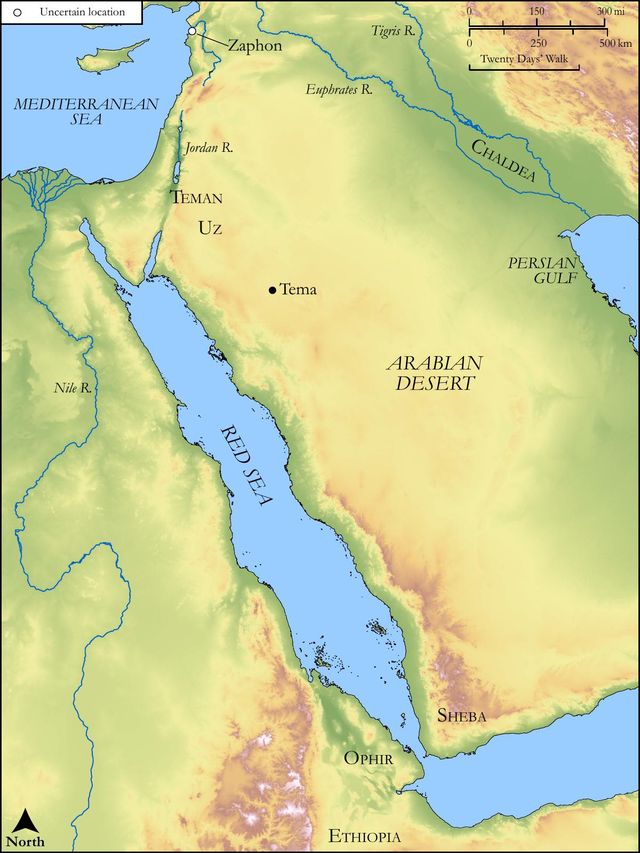
See on the biblical-era map
Study this verse
Public-domain commentary
Matthew Henry
From his Commentary on the Whole Bible. Henry comments on passages, not single verses — this entry covers Job 39:19–25.
God, having displayed his own power in those creatures that are strong and despise man, here shows it in one scarcely inferior to any of them in strength, and yet very tame and serviceable to man, and that is the horse, especially the horse that is prepared against the day of battle and is serviceable to man at a time when he has more than ordinary occasion for his service. It seems, there was, in Job's country, a noble generous breed of horses. Job, it is probable, kept many, though they are not mentioned among his possessions, cattle for use in husbandry being there valued more than those for state and war, which alone horses were then reserved for, and they were not then put to such mean services as with us they are commonly put to. Concerning the great horse, that stately beast, it is here observed, 1. That he has a great deal of strength and spirit (v. 19): Hast thou given the horse strength? He uses his strength for man, but has it not from him: God gave it to him, who is the fountain of all the powers of nature, and yet he himself delights not in the strength of the horse (Psa 147:10), but has told us that a horse is a vain thing for safety, Psa 33:17. For running, drawing, and carrying, no creature that is ordinarily in the service of man has so much strength as the horse has, nor is of so stout and bold a spirit, not to be made afraid as a grasshopper, but daring and forward to face danger. It is a mercy to man to have such a servant, which, though very strong, submits to the management of a child, and rebels not against his owner. But let not the strength of a horse be trusted to, Hos 14:3; Psa 20:7; Isa 31:1, Isa 31:3. 2. That his neck and nostrils look great. His neck is clothed with thunder, with a large and flowing mane, which makes him formidable and is an ornament to him. The glory of his nostrils, when he snorts, flings up his head, and throws foam about, is terrible, Job 39:20. Perhaps there might be at that time, and in that country, a more stately breed of horses than any we have now. 3. That he is very fierce and furious in battle, and charges with an undaunted courage, though he pushes on in imminent danger of his life. (1.) See how frolicsome he is (Job 39:21): He paws in the valley, scarcely knowing what ground he stands upon. He is proud of his strength, and he has much more reason to be so as using his strength in the service of man, and under his direction, than the wild ass that uses it in contempt of man, and in a revolt from him Job 39:8. (2.) See how forward he is to engage: He goes on to meet the armed men, animated, not by the goodness of the cause, or the prospect of honour, but only by the sound of the trumpet, the thunder of the captains, and the shouting of the soldiers, which are as bellows to the fire of his innate courage, and make him spring forward with the utmost eagerness, as if he cried, Ha! ha! Job 39:25. How wonderfully are the brute-creatures fitted for and inclined to the services for which they were designed. (3.) See how fearless he is, how he despises death and the most threatening dangers, (Job 39:22): He mocks at fear, and makes a jest of it; slash at him with a sword, rattle the quiver, brandish the spear, to drive him back, he will not retreat, but press forward, and even inspires courage into his rider. (4.) See how furious he is. He curvets and prances, and runs on with so much violence and heat against the enemy that one would think he even swallowed the ground with fierceness and rage, Job 39:24. High mettle is the praise of a horse rather than of a man, whom fierceness and rage ill become. This description of the war-horse will help to explain that character which is given of presumptuous sinners, Jer 8:6. Every one turneth to his course, as the horse rusheth into the battle. When a man's heart is fully set in him to do evil, and he is carried on in a wicked way by the violence of inordinate appetites and passions, there is no making him afraid of the wrath of God and the fatal consequences of sin. Let his own conscience set before him the curse of the law, the death that is the wages of sin, and all the terrors of the Almighty in battle-array; he mocks at this fear, and is not affrighted, neither turns he back from the flaming sword of the cherubim. Let ministers lift up their voice like a trumpet, to proclaim the wrath of God against him, he believes not that it is the sound of the trumpet, nor that God and his heralds are in earnest with him; but what will be in the end hereof it is easy to foresee.
Historical interpretation
Historical reception
3 surviving comments on this verse. Each one is dated, so this reads as a timeline rather than a list.
62. In Holy Scripture by the word ‘quiver’ is designated, sometimes the just and hidden counsel of God; but sometimes the clandestine machination of the wicked. By ‘quiver’ is expressed the just and hidden counsel of God, as this same blessed Job in a former part bears witness, saying, Because He hath opened His quiver, and afflicted me. [Job 30, 11] That is, He has disclosed His hidden counsel, and has wounded me with an open blow. For as arrows lie hid in the quiver, so do sentences lie hid in the secret counsel of God: and an arrow is drawn, as it were, from the quiver, when God launches forth an open sentence from His secret counsel. The machination of the wicked is also designated by the word ‘quiver,’ as is said by the Prophet, They have made their arrows in the quiver, that they may shoot in darkness at the upright in heart. For when the wicked conceal by secret machinations the schemes, which they plan against the good, they prepare, as it were, arrows in the quiver, and in this gloom of the present life, as if in darkness, they strike the upright in heart; because their malicious shafts can both be felt by their wound, and yet cannot be discovered as they are coming. Because therefore the horse of God is alarmed by no adversity, and the more he is opposed, the more ardently is he led against the armed enemies by the power of his intention; his persecutors, who perceive that they are defeated even when striking him, being confounded, have recourse to skill, prepare stratagems, and conceal, as it were, their wounds by launching them from a distance; whence it is now rightly said, Over him will rattle the quiver; that they may strike him from a distance, by secret machination, whom they approach in vain with open onset. This quiver had rattled over the horse of God, when forty men who had conspired for his death, were seeking for Paul to be brought out of prison; that they might kill him, with the blows of their designs, as though secretly, by the craft of arrows, whom they could not at all overcome by the attack of public persecution. The quiver therefore rattled; because the cause of secret machination came to Paul.
63. Although if we attentively enquire, we find a still deeper meaning in the sound of the quiver. For adversaries frequently enter into designs against the good, rely on wicked inventions, betake themselves to devise schemes; but yet themselves engage, themselves send persons, who should disclose these same schemes to the good; in order that, while the preparation of punishment is secretly, as it were, made known to the credulous, it may be the more dreaded; and that wounds suspected may the more disturb the mind of the bearer, than if inflicted. For, while arrows are concealed, and rattle in the quiver, they threaten death even though unseen. The quiver, therefore, rattles against the horse, when the hidden machination of the wicked against a holy preacher discloses, even more fraudulently, the design which it fraudulently conceals; in order that, by launching its threats beforehand, it may frighten, as if by the sound of the quiver, when the preacher of God fears not open insults, as weapons which strike him close at hand. But when he is not alarmed by these same threats, the cruelty of persecutors soon proceeds to open punishments. Whence, after it is said, Over him will rattle the quiver, it is immediately rightly added;
The spear will shake.
64. The spear is shaken against the preacher of God, after the rattling of the quiver, when, after terrors have been displayed, open punishment is now brought forward, striking near at hand. But holy preachers, when they are undergoing punishments in defence of the faith, cease not, even in the midst of blows, to seize those, whom they are able, to the same faith. And when they patiently receive wounds, they skilfully return the arrows of preaching against the hearts of unbelievers. Whence it is sometimes the case, that the very persons who are raging in persecution, grieve not so much, because they do not soften the heart of the preacher, as because, by his words, they lose others also. Because then they do not overcome him by striking him, lest others who hear him should forsake them, they soon prepare, against the words of the speaker, the shield of reply. Whence when He was saying, The spear will shake, He rightly subjoins;
And the shield.
65. For, after the raging persecutor smites with punishment the body of the preacher, he protects the heart of his hearers with the words of his disputation, as if with a shield. The spear, then, is shaken, that the holy man may be smitten; but the shield is placed in the way, that he may not be heard. For the defenders of God have their own arrows in the battle, which they launch more speedily into the hearts of their hearers, as they draw them from the bow of the spirit, that is, from the inmost tension of the heart. For Paul had armed himself with these, in the contest of faith, when saying, I suffer, even to bonds, as an evil doer; but the word of God is not bound. [2 Tim. 2, 9] As if he were saying; I am struck indeed with the spear of punishments, but yet cease not to launch forth the arrows of my words. I receive the wounds of cruelty, but I transfix the hearts of the unbelievers, by speaking the truth. Let it be said therefore; Over him will rattle the quiver, the spear will shake, and the shield. For the quiver rattles against the horse of God, because the counsels of the wicked resound about him; because open punishment is sought for, the spear is shaken; but because he is opposed by disputation also, the shield is wielded before him. But is he at all restrained from his warmth by these means? For with the greater persecution a holy man is oppressed, the more eagerly is he urged on to preach the truth; and, while he submits patiently to his persecutors, he eagerly hastens to attract his hearers to himself.
81. For since he sees that the zeal of a holy mind helps others also against him, he labours to wound it with multiplied temptation. Whence it frequently happens, that they who rule over others under them, endure severer struggles with temptations; in order, that when the leader himself is put to flight, after the manner of bodily contests, the associated unanimity of the resisting host may be dispersed without an effort. Therefore the crafty enemy, devising divers wounds of blows against the heavenly soldier, wounds him at one time by stratagem, by an arrow from the quiver, at another brandishes a spear before his face; because, namely, he both conceals some vices under the guise of virtues, and presents others to his sight openly as they are. For where he perceives the soldier of God to be weakened, he there requires not the veil of deceit. But where he observes that he firmly opposes him, he there doubtless contrives stratagems against his strength. For when he sees any one weak in an allurement of the flesh, he openly sets before his sight the appearance of a body capable of being desired. But if perchance he sees that he is mighty against avarice, he importunately suggests to his thoughts the want of those of his family; in order that, while the mind is directed, with seeming piety, to the care of providing for them, it may be secretly seduced and hurried into sin by seeking after wealth. The arrow then insidiously assails the horse of God, when the crafty enemy conceals for him a vice beneath a virtue. But the spear wounds in close combat, when open wickedness tempts him, even aware of it.
82. But the heavenly soldier is often opposed by the enemy in both ways, at one and the same time; in order that he may be destroyed by some one blow. For the crafty adversary endeavours to strike at the same time, both raging openly, and lurking in ambush; in order that while the arrow is dreaded from a secret spot, the spear may be less feared before his face; or that, while he withstands the spear before his face, the arrow may not be observed when coming from a secret place. For he often puts forward the temptation of lust, and suddenly desisting, more craftily suggests pride at chastity having been preserved. And there are some, who when they observe that many have fallen, from the stronghold of chastity, into the pit of pride, neglecting to watch over their life, are plunged into the filthiness of lust. But there are some, on the other hand, who, while they avoid the uncleanness of lust, plunge, through the height of chastity, into the gulph of pride. A fault therefore, which springs from a vice, is, as it were, a spear striking openly; and a fault which springs from a virtue, is, as it were, an arrow from the quiver wounding in secret. But the horse of God both overcomes the spear before his face, when he tramples down lust; and looks round at the arrow on the side, when, in the cleanness of chastity, he keeps himself from pride. Whence also it is well said by Solomon to one engaged in both contests; The Lord shall be on thy side, and will keep thy foot, that thou be not taken. [Prov. 3, 26] For the foot stretches out to things in front. But he, who beholds those things which are on the side, sees not those things which are before him. And again, he, who from looking forward to guard his foot, beholds what are before, gives up keeping watch at his side. But whilst we perform any act of virtue before our face, we look forward, as it were, where our foot ought to be placed; but when a fault secretly rises up from this virtue, whilst we look forward, as it were, our side is laid open to the arrow. But frequently, when we are afraid of a rising fault, we decline the virtue, which ought to be put in act; and when the side is, as it were, looked round upon, we see not how the foot is to be placed in front. It is, therefore, well said, The Lord shall be on thy side, and will keep thy foot that thou be not taken; because the soldier of God, protected by the shield of Divine grace, both observes, by looking round, what dangers can come forth on the side, and, by advancing forwards, ceases not to place his footsteps before his face. And the crafty enemy who envies him, because he sees that he prevails not at all by quiver and spear, opposes to him his shield; in order that, if he pierces not the breast of his opponent by striking it, he may at least obstruct his onward course by some obstacles. For to his efforts he opposes certain difficulties; and when he is unable to overcome, he however resists him.
Concerning “the exhortation of the captains and the howling of the army,” the tempting vices that fight against us in invisible contest in behalf of the pride that reigns over them, some of them go first, like captains, others follow, after the manner of an army. For all faults do not occupy the heart with equal access. But while the greater and the few surprise a neglected mind, the smaller and the numberless pour themselves upon it in a whole body. For when pride, the queen of sins, has fully possessed a conquered heart, she surrenders it immediately to the seven principal sins, as if to some of her generals, to lay it waste. And an army in truth follows these generals, because doubtless there spring up from them importunate hosts of sins.
Continue studying Job 39:23 across the web’s major study libraries — every link below opens this exact verse, chapter, or book on the destination site.
Read & Compare
 BibleGatewayThis verse in more than 200 translations and 70 languages.
 Bible.comThe YouVersion reader — hundreds of translations, reading plans, and highlights.
 ESV.orgCrossway's official English Standard Version reader.
 NET BibleThe NET translation with 60,000+ translators' notes on every rendering decision.
 STEP BibleTyndale House's free study tool — original text, vocabulary, and scholarly resources.
 BibliaLogos Bible Software's free web reader.
 USCCBThe New American Bible (Revised Edition) with the U.S. bishops' study notes.
Commentaries
 BibleHub CommentariesDozens of classic commentaries on this verse, gathered on one page.
 StudyLightMore than 100 commentary sets — the largest collection on the web.
 BibleRefPlain-English commentary on what this verse means, verse by verse.
 Enduring WordDavid Guzik's free commentary on this chapter, widely used by Bible teachers.
 Bible Study ToolsVerse commentary alongside Greek and Hebrew study aids.
Original Language & Research
- BibleHub InterlinearThe verse word by word — original language, transliteration, and English.
- BibleHub LexiconEvery word's original-language definition and Strong's entry.
 Blue Letter BibleDeep-study tools — Strong's numbers, concordance, and word studies.
 SefariaThe Hebrew text with Rashi and centuries of Jewish commentary.
Sermons, Hymns & Audio


TrulyRandomVerse is not affiliated with these sites and doesn’t control their content. They’re linked because they’re genuinely useful.
Summary
Job 39:23, nestled within God's profound discourse to Job, powerfully illustrates the Creator's majestic design and sovereign power through the vivid portrayal of the warhorse. This verse specifically captures the animal's astonishing courage and unwavering composure amidst the chaos of battle, detailing the sensory assault of "the quiver rattleth against him, the glittering spear and the shield." It underscores a creature divinely equipped with an inherent, almost defiant, fearlessness in the face of instruments of death, serving as a testament to God's incomprehensible wisdom and purposeful creation.
Context
ShowHideLiterary Context
Job 39:23 is an integral part of God's second and culminating speech to Job, encompassing Job chapters 38-41. This divine monologue follows Job's initial, humbled response in Job 40:3-5, where he admits his inability to contend with God's wisdom. God continues to challenge Job's limited perspective by unveiling a grand tapestry of His creation, from the order of the heavens to the untamed wild animals. The section from Job 39:19-25 specifically focuses on the magnificent warhorse, celebrating its strength, speed, and, most notably, its fearless disposition in combat. Verse 23, with its precise sensory details of warfare, serves to amplify the horse's extraordinary courage and readiness for the fray, demonstrating its unflappable nature even as the instruments of war clash and gleam around it, thereby reinforcing God's unassailable wisdom and power.
Historical & Cultural Context
Among the kings of that day, the horse, particularly the warhorse, was not merely an animal but a potent symbol of military power, national prestige, and wealth. Unlike other domesticated animals, the warhorse was meticulously bred and rigorously trained for the terrifying and chaotic environment of battle. Its capacity to remain calm, or even to exhibit eagerness, amidst the deafening noise, blinding dust, and mortal danger of combat was an exceptionally prized attribute. This detailed description in Job would have resonated deeply with an audience intimately familiar with the realities of ancient warfare and the pivotal role of cavalry. The "quiver," "spear," and "shield" were ubiquitous armaments of ancient warriors, representing the immediate and lethal threats encountered on the battlefield. The depiction of the warhorse's fearlessness in the face of these implements highlights not only its physical prowess but also a divinely instilled spirit that transcended natural instinct, making it a powerful example of God's unique and purposeful design in creation.
Key Themes
ShowHideThe meticulous description of the warhorse in Job 39, and specifically in verse 23, significantly contributes to several overarching theological themes woven throughout the book of Job. Firstly, it serves as a powerful illustration of Divine Power and Design, showcasing God's unparalleled ability to create creatures of immense strength and specific, often counter-intuitive, purpose. The warhorse's inherent fearlessness in the face of lethal implements is not solely a product of human training but rather a divinely instilled characteristic. Secondly, the passage profoundly emphasizes God's Sovereignty Over Creation, highlighting His complete control and intimate knowledge over all His works, from the minutiae of the wild ass to the grand display of power in the warhorse. This serves to humble Job, reminding him that human understanding pales in comparison to the Creator's infinite wisdom. Finally, the warhorse's Fearlessness in Adversity emerges as a vivid metaphor for courage, demonstrating a creature designed to embrace the very chaos that would naturally terrify others, a trait ultimately sourced in God's creative will, as consistently demonstrated throughout the wild animal descriptions in Job 38-41.
Exposition and Analysis
ShowHideKey Word Analysis
ShowHideFrom the lemma H7439, this primitive root means "to whiz" or "rattle." In the context of the quiver, it vividly conveys a sharp, percussive, and chaotic sound, like arrows shifting violently within their case. This auditory detail immediately plunges the listener into the disorienting environment of battle, emphasizing the immediate and unceasing din that the warhorse endures without flinching. The choice of this word intensifies the sensory experience of the battlefield and underscores the horse's remarkable composure amidst such a clamor.
From the lemma H3851, this word derives from an unused root meaning "to gleam," signifying a flash or, figuratively, a sharply polished blade or point of a weapon. When applied to the spear, it evokes the image of light reflecting off a honed, metallic surface, creating a dazzling and potentially terrifying visual. This "glittering" effect makes the spear a highly visible and immediate threat, adding a striking visual dimension to the auditory chaos described by "rattleth." It powerfully underscores the horse's fearlessness, as it remains undaunted by both the sounds and sights of imminent danger.
From the lemma H2595, this term refers to a lance or javelin, typically used for thrusting, akin to "pitching a tent" (from its root). It denotes a primary offensive weapon in ancient warfare. The mention of the spear, especially in conjunction with "glittering," highlights the direct and lethal threats the warhorse faces. Its presence confirms the proximity of close-quarters combat and the horse's willingness to charge directly into the face of such deadly instruments.
Verse Breakdown
ShowHide"The quiver rattleth against him"
This opening clause immediately establishes an intense auditory dimension of battle. The "quiver" (אֲשְׁפָּה, ʼashpâh') is a container for arrows, and its "rattling" (רָנָה, rânâh') implies the rapid, jarring movement of an archer or the general tumultuous commotion of active warfare. The phrase "against him" is crucial, emphasizing that these sounds are not distant background noise but directly impinging upon the horse, yet it remains remarkably unfazed, indicating an extraordinary level of battle-readiness and courage.
"the glittering spear and the shield"
This second part of the verse shifts to powerful visual elements, completing the sensory immersion in the battlefield. The "glittering spear" (חֲנִית לַהַב, _chănîyth lahab'_) refers to a sharp, reflective weapon that catches the light, signaling a direct, piercing threat. The "shield" (כִּידוֹן, kîydôwn'), a defensive implement often used in close combat, further indicates the proximity of intense fighting and the readiness for direct engagement. Together, these images paint a comprehensive picture of a horse standing resolute and fearless amidst the full sensory assault of a battlefield, ready to charge into the very heart of the conflict, demonstrating a divinely instilled courage that defies natural instinct.
Literary Devices
ShowHideJob 39:23 is exceptionally rich in Imagery, painting a vivid sensory tableau of the battlefield. The potent auditory imagery of the "quiver rattleth" (enhanced by the evocative Onomatopoeia inherent in the Hebrew rânâh) combines seamlessly with the striking visual imagery of the "glittering spear" and "shield" to fully immerse the reader in the chaotic and perilous environment. This powerful combination of sound and sight serves to highlight the extraordinary courage of the warhorse, which remains serene yet eager amidst such a terrifying din and display. The verse also employs Synecdoche, where the "quiver," "spear," and "shield" function as metonymic representations of the entirety of warfare and its myriad dangers, rather than merely individual objects. This technique amplifies the perceived threat against which the horse remains utterly undeterred. Ultimately, the detailed description of the warhorse's unyielding bravery serves as a form of Personification of courage, attributing to the animal a human-like quality of deliberate, unyielding fortitude in the face of death, a profound characteristic clearly presented as divinely bestowed.
Theological and Thematic Connections
ShowHideJob 39:23, in its detailed portrayal of the warhorse's divinely instilled courage, serves as a profound theological statement about God's intricate and purposeful design in creation. It reminds us that God is not merely a distant architect but an intimate sculptor of every creature, imbuing them with specific characteristics that fulfill His grand purposes. The warhorse's fearlessness in the face of overwhelming odds points to a Creator who orchestrates power and purpose even in the most formidable and dangerous aspects of His world. This passage challenges human presumption and invites awe, reminding us that God's wisdom far surpasses our own, and His ways are often beyond our comprehension, yet always perfect in their execution. It reinforces the theme that true strength and courage ultimately originate from the Creator.
Reflection and Application
ShowHideThe vivid image of the warhorse, standing unperturbed and even eager amidst the clatter and gleam of battle, offers a powerful spiritual metaphor for believers navigating the complexities of life. Just as God imbues this magnificent creature with a supernatural courage to face physical warfare, He likewise equips His children with strength and fearlessness to confront the spiritual battles and adversities that inevitably arise. This verse calls us to profound trust in God's sovereign design, recognizing that He is intimately involved in shaping our character and equipping us for the specific challenges we face. When we feel overwhelmed by the "rattling quivers" and "glittering spears" of our circumstances—be they trials, temptations, opposition, or personal struggles—we can draw immense confidence from the God who orchestrates such power and purpose in His creation. Our courage in the face of adversity is not self-generated but divinely supplied, enabling us to stand firm, press forward, and even "scoff at fear," knowing that the Creator of the universe is our ultimate source of strength, resilience, and ultimate victory.
Questions for Reflection
ShowHideFAQ
ShowHideWhy does God describe a warhorse in such detail to Job, especially focusing on its fearlessness?
ShowHideGod's detailed description of the warhorse, particularly its fearlessness in Job 39:19-25, serves multiple profound purposes within His discourse to Job. Primarily, it functions as a powerful demonstration of God's incomprehensible power, infinite wisdom, and absolute sovereign control over all creation. By highlighting a creature that instinctively defies its own preservation to rush eagerly into battle, God showcases His ability to instill unique and counter-intuitive traits for specific, often grand, purposes. This challenges Job's limited human understanding and perspective, reminding him that God's ways and His intricate designs are far beyond human comprehension. The warhorse's courage is not merely a product of human training but a divinely ordained characteristic, illustrating that God's design extends to every detail, even the very spirit of a creature facing death. It underscores the overarching theme that God is the ultimate source of all strength, purpose, and order in creation, a stark contrast to Job's earlier attempts to comprehend divine justice based on his finite human reasoning.
Christ-Centered Fulfillment
ShowHideThe awe-inspiring fearlessness of the warhorse in Job 39:23, a creature divinely designed for the chaos of battle, finds its ultimate fulfillment and spiritual parallel in the unwavering resolve and triumphant courage of Jesus Christ. Just as the warhorse "scoffs at fear" (Job 39:22), Christ faced the ultimate spiritual battle—the cross and the power of sin and death—with absolute courage, divine determination, and perfect obedience. He was the Lamb of God who willingly went to the slaughter, yet simultaneously the conquering Lion of Judah who decisively triumphed over sin, death, and the grave. His steadfast resolve in the face of unimaginable suffering, betrayal, and the "glittering spear" of Roman executioners (John 19:34) was not born of human strength but of His inherent divine nature and boundless love for humanity. Through His sacrificial death and glorious resurrection, Christ disarmed the principalities and powers (Colossians 2:15), leading captivity captive and securing eternal victory. Believers, through their union with Christ, are now empowered by His indwelling Spirit to face their own spiritual battles, clothed in the full armor of God, drawing courage from the One who has already secured the ultimate victory, enabling them to stand firm and fearless even when the "quiver rattleth" around them.