


Job 41:26
Bible text: King James Version (1769 Blayney text) · Public domain
Bible text: Berean Standard Bible · Public domain
Bible text: American Standard Version (1901) · Public domain
Bible text: World English Bible, Messianic edition · Public domain
Bible text: Geneva Bible (1599) · Public domain
Bible text: Young's Literal Translation · Public domain
- מַשִּׂיגֵהוּma·si·Ge·hu[one who] reaches itH5381V-Hiphil-Prtcpl-ms ¦ 3msVerb Hiphil Participle Singular Masculine Constructמַשִּׂיגֵ[one who] reachesהוּit
- חֶרֶבChe·reva swordH2719N-fsNoun Singular Feminine Absolute
- בְּלִיbe·LinotH1097N-msNoun Singular Masculine Absolute
- תָקוּםta·Kumit is establishedH6965V-Qal-Imperf-3fsVerb Qal Imperfect 3rd Singular Feminine
- חֲנִיתcha·Nita spearH2595N-fsNoun Singular Feminine Absolute
- מַסָּעma·Sa'a dartH4551N-msNoun Singular Masculine Absolute
- וְשִׁרְיָהve·shir·Yahand a javelinH8302Conj-w ¦ N-fsNoun Singular Feminine Absoluteוְandשִׁרְיָהa javelin
English is a literal word-by-word gloss of the Hebrew, not the KJV's wording. Why?
This is the original text the KJV's translators worked from — each Hebrew word with its own literal English meaning in this verse, prepared by scholars at Tyndale House, Cambridge. The KJV translates whole sentences, not word by word, so its wording differs: one Hebrew word can become several English words, and the KJV may choose “the LORD” where the gloss reads “Yahweh”. Both are faithful — they answer different questions. For the KJV's own rendering, switch to the KJV text.
Details
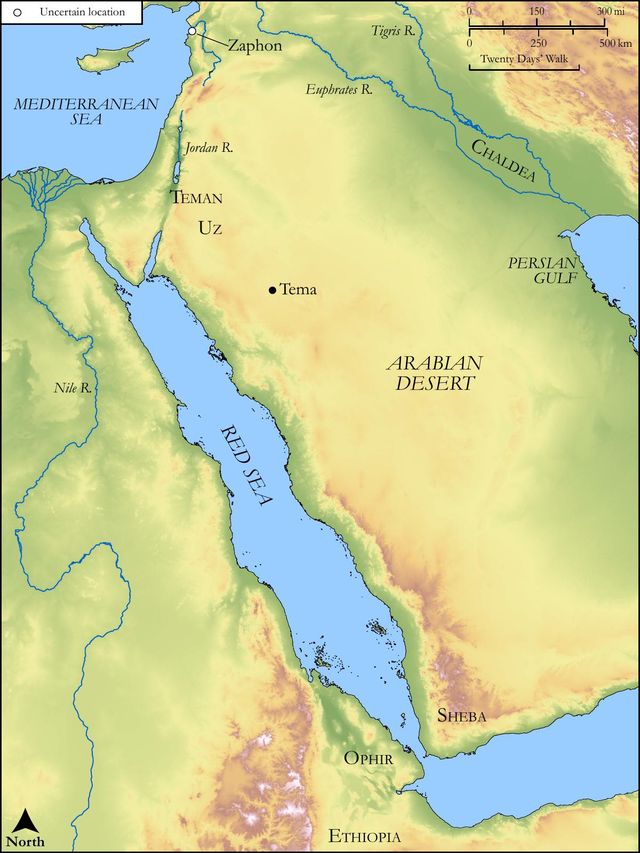
See on the biblical-era map
Study this verse
Public-domain commentary
Matthew Henry
From his Commentary on the Whole Bible. Henry comments on passages, not single verses — this entry covers Job 41:11–34. His three-level outline is real structure in the source text, so it is rendered as structure.
God, having in the foregoing verses shown Job how unable he was to deal with the leviathan, here sets forth his own power in that massy mighty creature. Here is,
I.God's sovereign dominion and independency laid down, Job 41:11.
1.That he is indebted to none of his creatures. If any pretend he is indebted to them, let them make their demand and prove their debt, and they shall receive it in full and not by composition: "Who has prevented me?" that is, "who has laid any obligations upon me by any services he has done me? Who can pretend to be before-hand with me? If any were, I would not long be behind-hand with them; I would soon repay them." The apostle quotes this for the silencing of all flesh in God's presence, Rom 11:35. Who hath first given to him, and it shall be recompensed to him again? As God does not inflict upon us the evils we have deserved, so he does bestow upon us the favours we have not deserved.
2.That he is the rightful Lord and owner of all the creatures: "Whatsoever is under the whole heaven, animate or inanimate, is mine (and particularly this leviathan), at my command and disposal, what I have an incontestable property in and dominion over." All is his; we are his, all we have and do; and therefore we cannot make God our debtor; but of thy own, Lord, have we given thee. All is his, and therefore, if he were indebted to any, he has wherewithal to repay them; the debt is in good hands. All is his, and therefore he needs not our services, nor can he be benefited by them. If I were hungry I would not tell thee, for the world is mind and the fulness thereof, Psa 50:12.
II.The proof and illustration of it, from the wonderful structure of the leviathan, Job 41:12.
1.The parts of his body, the power he exerts, especially when he is set upon, and the comely proportion of the whole of him, are what God will not conceal, and therefore what we must observe and acknowledge the power of God in. Though he is a creature of monstrous bulk, yet there is in him a comely proportion. In our eye beauty lies in that which is small (inest sua gratia parvis - little things have a gracefulness all their own) because we ourselves are so; but in God's eye even the leviathan is comely; and, if he pronounce even the whale, event he crocodile, so, it is not for us to say of any of the works of his hands that they are ugly of ill-favoured; it is enough to say so, as we have cause, of our own works. God here goes about to give us an anatomical view (as it were) of the leviathan; for his works appear most beautiful and excellent, and his wisdom and power appear most in them, when they are taken in pieces and viewed in their several parts and proportions.
(1.)The leviathan, even prima facie - at first sight, appears formidable and inaccessible, Job 41:13, Job 41:14. Who dares come so near him while he is alive as to discover or take a distinct view of the face of the garment, the skin with which he is clothed as with a garment, so near him as to bridle him like a horse and so lead him away, so near him as to be within reach of his jaws, which are like a double bridle? Who will venture to look into his mouth, as we do into a horse's mouth? He that opens the doors of his face will see his teeth terrible round about, strong and sharp, and fitted to devour; it would make a man tremble to think of having a leg or an arm between them.
(2.)His scales are his beauty and strength, and therefore his pride, Job 41:15-17. The crocodile is indeed remarkable for his scales; if we understand it of the whale, we must understand by these shields (for so the word is) the several coats of his skin; or there might be whales in that country with scales. That which is remarkable concerning the scales is that they stick so close together, by which he is not only kept warm, for no air can pierce him, but kept safe, for no sword can pierce him through those scales. Fishes, that live in the water, are fortified accordingly by the wisdom of Providence, which gives clothes as it gives cold.
(3.)He scatters terror with his very breath and looks; if he sneeze or spout up water, it is like a light shining, either with the froth or the light of the sun shining through it, Job 41:18. The eyes of the whale are reported to shine in the night-time like a flame, or, as here, like the eye-lids of the morning; the same they say of the crocodile. The breath of this creature is so hot and fiery, from the great natural heat within, that burning lamps and sparks of fire, smoke and a flame, are said to go out of his mouth, even such as one would think sufficient to set coals on fire, Job 41:19-21. Probably these hyperbolical expressions are used concerning the leviathan to intimate the terror of the wrath of God, for that is it which all this is designed to convince us of. Fire out of his mouth devours, Psa 18:7, Psa 18:8. The breath of the Almighty, like a stream of brimstone, kindles Tophet, and will for ever keep it burning, Isa 30:33. The wicked one shall be consumed with the breath of his mouth, Th2 2:8.
(4.)He is of invincible strength and most terrible fierceness, so that he frightens all that come in his way, but is not himself frightened by any. Take a view of his neck, and there remains strength, Job 41:22. his head and his body are well set together. Sorrow rejoices (or rides in triumph) before him, for he makes terrible work wherever he comes. Or, Those storms which are the sorrow of others are his joys; what is tossing to others is dancing to him. His flesh is well knit, Job 41:23. The flakes of it are joined so closely together, and are so firm, that it is hard to pierce it; he is as if he were all bone. His flesh is of brass, which Job had complained his was not, Job 6:12. His heart is as firm as a stone, Job 41:24. He has spirit equal to his bodily strength, and, though he is bulky, he is sprightly, and not unwieldy. As his flesh and skin cannot be pierced, so his courage cannot be daunted; but, on the contrary, he daunts all he meets and puts them into a consternation (Job 41:25): When he raises up himself like a moving mountain in the great waters even the mighty are afraid lest he should overturn their ships or do them some other mischief. By reason of the breakings he makes in the water, which threaten death, they purify themselves, confess their sins, betake themselves to their prayers, and get ready for death. We read (Job 3:8) of those who, when they raise up a leviathan, are in such a fright that they curse the day. It was a fear which, it seems, used to drive some to their curses and others to their prayers; for, as now, so then there were seafaring men of different characters and on whom the terrors of the sea have contrary effects; but all agree there is a great fright among them when the leviathan raises up himself.
(5.)All the instruments of slaughter that are used against him do him no hurt and therefore are not error to him, Job 41:26-29. The sword and the spear, which wound nigh at hand, are nothing to him; the darts, arrows, and sling-stones, which wound at a distance, do him no damage; nature has so well armed him cap-a-pie - at all points, against them all. The defensive weapons which men use when they engage with the leviathan, as the habergeon, or breast-plate, often serve men no more than their offensive weapons; iron and brass are to him as straw and rotten wood, and he laughs at them. It is the picture of a hard-hearted sinner, that despises the terrors of the Almighty and laughs at all the threatenings of his word. The leviathan so little dreads the weapons that are used against him that, to show how hardy he is, he chooses to lie on the sharp stones, the sharp-pointed things (Job 41:30), and lies as easy there as if he lay on the soft mire. Those that would endure hardness must inure themselves to it.
(6.)His very motion in the water troubles it and puts it into a ferment, Job 41:31, Job 41:32. When he rolls, and tosses, and makes a stir in the water, or is in pursuit of his prey, he makes the deep to boil like a pot, he raises a great froth and foam upon the water, such as is upon a boiling pot, especially a pot of boiling ointment; and he makes a path to shine after him, which even a ship in the midst of the sea does not, Pro 30:19. One may trace the leviathan under water by the bubbles on the surface; and yet who can take that advantage against him in pursuing him? Men track hares in the snow and kill them, but he that tracks the leviathan dares not come near him.
2.Having given this particular account of his parts, and his power, and his comely proportion, he concludes with four things in general concerning this animal: - (1.) That he is a non-such among the inferior creatures: Upon earth there is not his like, Job 41:33. No creature in this world is comparable to him for strength and terror. Or the earth is here distinguished from the sea: His dominion is not upon the earth (so some), but in the waters. None of all the savage creatures upon earth come near him for bulk and strength, and it is well for man that he is confined to the waters and there has a watch set upon him (Job 7:12) by the divine Providence, for, if such a terrible creature were allowed to roam and ravage upon this earth, it would be an unsafe and uncomfortable habitation for the children of men, for whom it is intended. (2.) That he is more bold and daring than any other creature whatsoever: He is made without fear. The creatures are as they are made; the leviathan has courage in his constitution, nothing can frighten him; other creatures, quite contrary, seem as much designed for flying as this for fighting. So, among men, some are in their natural temper bold, others are timorous. (3.) That he is himself very proud; though lodged in the deep, yet he beholds all high things, Job 41:34. The rolling waves, the impending rocks, the hovering clouds, and the ships under sail with top and top-gallant, this mighty animal beholds with contempt, for he does not think they either lessen him or threaten him. Those that are great are apt to be scornful. (4.) That he is a king over all the children of pride, that is, he is the proudest of all proud ones. He has more to be proud of (so Mr. Caryl expounds it) than the proudest people in the world have; and so it is a mortification to the haughtiness and lofty looks of men. Whatever bodily accomplishments men are proud of, and puffed up with, the leviathan excels them and is a king over them. Some read it so as to understand it of God: He that beholds all high things, even he, is King over all the children of pride; he can tame the behemoth (Job 40:19) and the leviathan, big as they are, and stout-hearted as they are. This discourse concerning those two animals was brought in to prove that it is God only who can look upon proud men and abase them, bring them low and tread them down, and hide them in the dust (Job 40:11-13), and so it concludes with a quod erat demonstrandum - which was to be demonstrated; there is one that beholds all high things, and, wherein men deal proudly, is above them; he is King over all the children of pride, whether brutal or rational, and can make them all either bend or break before him, Isa 2:11. The lofty looks of man shall be humbled, and the haughtiness of men shall be bowed down, and thus the Lord alone shall be exalted.
Historical interpretation
Historical reception
1 surviving comment on this verse from the historical church.
17. In Holy Scripture by a ‘sword’ is sometimes designated holy preaching, sometimes eternal damnation, sometimes temporal tribulation, sometimes the wrath or persuasion of the ancient enemy. For a ‘sword’ is put for holy preaching, as Paul says, And the sword of the Spirit, which is the word of God. [Eph. 6, 17] By the word ‘sword’ is designated eternal damnation, as is written of an heretical preacher; If his children be multiplied, they will be in the sword; [Job 27, 14] because in whatever great number they here shoot forth, they are consumed with eternal damnation. A ‘sword’ is taken for temporal tribulation, as is said to Mary concerning tribulations which are about to follow; And a sword shall pass through thine own soul. [Luke 2, 35] Again, by ‘sword’ is expressed the wrath or persuasion of the malignant enemy, as the Psalmist says; Who hast delivered David Thy servant from the malicious sword. [Ps. 144, 10] For kind is the sword of holy preaching, with which we are struck that we may die from sin. But the sword of diabolical persuasion is malicious, with which a man is fatally wounded, that he may he deprived of rectitude of life. The sword then of the ancient enemy is, at that time, that accursed man, assumed for the purpose of his service. For he sharpens him through the malice of cunning, and pierces the hearts of the feeble. The sword therefore of this man reaches Leviathan, when his own accursed man has taken him up. But if by the word ‘sword’ his wrath is designated, he is rightly described, not as seizing the sword, but as seized by the sword. For he is then turned into such madness, that, seeking to rule over all, he is unable to control his own anger. For we, when we assume wrath in the exercise of justice, hold a sword; because we control it by keeping it under the moderation of judgment. But he, because he is hurried on through the precipices of fury, is said not to seize his sword, but to be seized by his sword. For he does not keep and control his anger, but, in his fury, is possessed by his anger.
18. But it is plain to all, that we strike our adversary with a spear, but are protected from our adversary by a breastplate. By a spear we inflict wounds, by a breastplate we are protected from wounds. What therefore is designated by a ‘spear’ but the shaft of preaching; what by a breastplate but the strength of patience? This Leviathan then, because by taking that reprobate man to himself, he is let loose in the wrath of every kind of cruelty, is said to be ‘seized by a sword.’ For by the display of his immense strength, he then exhibits whatever power of wickedness he possesses. And neither the spear nor the breastplate will be able to stand, because entering into Antichrist, he will seem to be of such great strength, as (if heavenly assistance were wanting) to blunt the keenness of preachers, and to overthrow the long-suffering of the patient. For unless heavenly grace strengthens the life of the righteous, the spear does not stand, because the strength of preachers is broken; the breastplate does not resist, because the patience of the constant is burst through and penetrated.
Continue studying Job 41:26 across the web’s major study libraries — every link below opens this exact verse, chapter, or book on the destination site.
Read & Compare
 BibleGatewayThis verse in more than 200 translations and 70 languages.
 Bible.comThe YouVersion reader — hundreds of translations, reading plans, and highlights.
 ESV.orgCrossway's official English Standard Version reader.
 NET BibleThe NET translation with 60,000+ translators' notes on every rendering decision.
 STEP BibleTyndale House's free study tool — original text, vocabulary, and scholarly resources.
 BibliaLogos Bible Software's free web reader.
 USCCBThe New American Bible (Revised Edition) with the U.S. bishops' study notes.
Commentaries
 BibleHub CommentariesDozens of classic commentaries on this verse, gathered on one page.
 StudyLightMore than 100 commentary sets — the largest collection on the web.
 BibleRefPlain-English commentary on what this verse means, verse by verse.
 Enduring WordDavid Guzik's free commentary on this chapter, widely used by Bible teachers.
 Bible Study ToolsVerse commentary alongside Greek and Hebrew study aids.
Original Language & Research
- BibleHub InterlinearThe verse word by word — original language, transliteration, and English.
- BibleHub LexiconEvery word's original-language definition and Strong's entry.
 Blue Letter BibleDeep-study tools — Strong's numbers, concordance, and word studies.
 SefariaThe Hebrew text with Rashi and centuries of Jewish commentary.
Sermons, Hymns & Audio


TrulyRandomVerse is not affiliated with these sites and doesn’t control their content. They’re linked because they’re genuinely useful.
Summary
Job 41:26, embedded within God's climactic discourse to Job, powerfully depicts the unassailable might and terrifying invulnerability of Leviathan. This verse emphatically declares the utter futility of all human weaponry—be it swords, spears, darts, or even protective armor like the habergeon—against this formidable creature. Through this vivid portrayal, God not only underscores Leviathan's impenetrable nature but, more profoundly, magnifies His own unparalleled sovereignty and omnipotence, thereby humbling Job by demonstrating that if humanity cannot contend with one of God's creatures, it certainly cannot challenge the Creator Himself.
Context
ShowHideLiterary Context
Job 41:26 is strategically placed within God's second and final speech to Job, which commences in Job 38 and concludes with Job 41. Following Job's persistent laments and his bold challenges to divine justice, God responds not with direct explanations for Job's suffering, but with an awe-inspiring revelation of His power and inscrutable wisdom, primarily conveyed through a series of rhetorical questions about the natural world. After vividly describing the untamable Behemoth in Job 40, God dedicates the entirety of Job 41 to the magnificent and terrifying Leviathan. This extended poetic description emphasizes Leviathan's immense strength, fearsome appearance, and, most crucially, its absolute invulnerability to human assault, a point powerfully culminated in Job 41:26. The verse serves as a dramatic climax to the depiction of Leviathan's physical imperviousness, reinforcing the creature's unassailable nature and, by extension, God's absolute dominion over even the most fearsome and chaotic aspects of creation.
Historical & Cultural Context
The Book of Job is set in the ancient land of Uz, a region likely east of Israel, and its narrative echoes themes prevalent in the patriarchal period, though its precise dating remains a subject of scholarly debate. The imagery of Leviathan stands in contrast to the myths of the nations, in which colossal, chaotic sea creatures—such as the Babylonian Tiamat or the Canaanite Yam—were said to be subdued by their gods to establish order. While Job's Leviathan is distinctly presented as a creature of God's own making, its description deliberately evokes the profound awe, terror, and sense of untamable power associated with such primeval beings. The weaponry enumerated in the verse—sword, spear, dart, and habergeon—were standard instruments of warfare and defense among the nations of that day. This familiarity with their effectiveness against human or animal adversaries would have made Leviathan's complete resistance to them all the more striking and impactful to the original audience, powerfully conveying the creature's extraordinary nature and God's unparalleled might.
Key Themes
ShowHideThe meticulous description of Leviathan, culminating in the declaration of its invulnerability in Job 41:26, powerfully reinforces several core theological themes central to the Book of Job. Foremost among these is God's Omnipotence and Sovereignty, demonstrating that His power extends even to the most formidable and seemingly untamable forces within creation. The implicit rhetorical question posed to Job, and indeed to all humanity, is profound: if humanity cannot conquer one of God's creatures, how can it possibly challenge the Creator Himself? This leads directly to the theme of Human Limitation and Humility, as Job is confronted with the vast, unbridgeable chasm between his finite understanding and God's infinite wisdom and power. The ultimate purpose of this divine revelation is to humble Job, leading him to a posture of repentance and a deeper, more profound trust in God's inscrutable ways, a transformation vividly captured in Job 42:1-6. Furthermore, Leviathan, often interpreted as a potent symbol of primeval chaos or untamed evil, underscores God's absolute Control Over Chaos. God's ability to not only create but also to effortlessly control such a creature signifies His ultimate authority over all forces, both natural and spiritual, providing a profound assurance of His providential governance over the world, even amidst suffering and apparent disorder, a theme echoed in passages like Psalm 74:14.
Exposition and Analysis
ShowHideKey Word Analysis
ShowHideDerived from the root meaning "to be dry" or "to lay waste," this term refers to a cutting instrument, specifically a knife, sword, or other sharp implement, emphasizing its destructive effect. In the context of Job 41:26, the "sword" represents the primary offensive weapon of ancient warfare, highlighting humanity's most direct and potent means of attack. Its inability to "hold" against Leviathan underscores the creature's impenetrable hide and the utter futility of human might.
A primitive root meaning "to rise," "to stand," "to endure," or "to be established." In the phrase "cannot hold" (לֹא יָקוּם, lo yaqum), it signifies an utter inability to stand firm, to penetrate, or to inflict any lasting effect. It conveys that the weapons simply fail to "take hold" or "stick" to Leviathan, bouncing off or breaking without causing injury. This emphasizes the creature's overwhelming resilience and imperviousness to any assault.
This term refers to a corslet or coat of mail, a piece of protective armor typically made of interlocking metal rings or scales. Its inclusion alongside offensive weapons is highly significant: it implies that not only are human attacks futile, but even human defensive technology is rendered irrelevant in the face of Leviathan's power. It underscores the creature's complete imperviousness to any human-made contrivance, whether for offense or defense, symbolizing the comprehensive inadequacy of human military might.
Verse Breakdown
ShowHide"The sword of him that layeth at him cannot hold:"
This initial clause establishes the core assertion of the verse: any attempt by a human to attack Leviathan with a sword is utterly ineffective. The phrase "layeth at him" (from H5381 nâsag, "to reach" or "to lay at") implies a direct, forceful, and intentional assault. The declaration "cannot hold" (from H6965 qûwm, "to stand" or "to endure") signifies that the sword, a quintessential offensive weapon, fails to penetrate, grip, or even leave a lasting mark on the creature's hide, demonstrating its extraordinary toughness and invulnerability.
"the spear, the dart, nor the habergeon."
This second clause expands upon the first, enumerating additional weaponry to emphasize the comprehensive nature of Leviathan's resistance. The "spear" (H2595 chănîyth) and "dart" (H4551 maççâʻ) represent other common projectile and thrusting weapons, reinforcing the idea that no form of direct, pointed assault will succeed. The inclusion of the "habergeon" (H8302 shiryôwn), a type of armor, is particularly striking. While seemingly out of place among offensive weapons, its presence here functions as a metonymy for human military might, indicating that no aspect of human warfare—neither offensive weapons nor defensive armor—can prevail against Leviathan. The cumulative effect of listing these diverse implements underscores the creature's absolute imperviousness to all human efforts and ingenuity.
Literary Devices
ShowHideThe language of Job 41:26 employs several powerful literary devices to convey Leviathan's formidable nature and, by extension, God's supreme power. Hyperbole is vividly evident in the exaggerated description of the creature's invulnerability, suggesting an absolute imperviousness to any human weapon, which serves to magnify its terrifying power beyond natural limits. This exaggeration is further amplified by Enumeration, a specific form of Parallelism, where a comprehensive list of diverse weapons (sword, spear, dart, habergeon) is presented. This cumulative listing creates a powerful sense of comprehensive futility, emphasizing that no human implement, regardless of type or purpose, can harm Leviathan. Finally, Symbolism is profoundly at play. Leviathan itself functions as a potent symbol, not merely of a large animal, but of untamable primeval chaos, the forces of evil, or even the limits of human understanding and control. By depicting this symbolic creature as utterly unconquerable by human means, the text powerfully symbolizes God's absolute sovereignty over all chaotic forces and His unmatched dominion over creation, a dominion that far surpasses human capacity and human weaponry.
Theological and Thematic Connections
ShowHideJob 41:26 serves as a profound theological statement on the vast disparity between divine power and human limitation. By presenting Leviathan as a creature utterly beyond human control or harm, God is not merely describing an animal; He is illustrating His own unchallengeable authority and omnipotence. This verse forces Job, and by extension all humanity, to confront the reality that if a mere creature of God's hand is so formidable, how infinitely more powerful and incomprehensible is the Creator Himself. It underscores the futility of questioning God's ways from a position of finite understanding and limited strength, calling for a posture of humility and trust in His sovereign wisdom, even amidst suffering and unanswered questions. The invulnerability of Leviathan thus becomes a vivid metaphor for the unassailable nature of God's dominion over all things, visible and invisible, chaotic and orderly, reminding us that true security and understanding are found only in Him.
Reflection and Application
ShowHideJob 41:26, while describing an ancient creature of immense power, holds timeless spiritual truths profoundly relevant for contemporary believers. In a world that frequently champions self-reliance, human ingenuity, and technological advancement as the ultimate solutions, this verse serves as a powerful and humbling reminder of our inherent limitations in contrast to God's boundless power. When we encounter "Leviathans" in our own lives—whether they manifest as overwhelming challenges, seemingly insurmountable obstacles, persistent temptations, or spiritual battles that feel utterly beyond our strength—this passage calls us to shift our gaze from our own insufficient resources to the infinite might of God. It cultivates a posture of profound humility, recognizing that true victory, enduring peace, and ultimate deliverance are found not in our ability to conquer every foe through our own efforts, but in resting securely in the assurance that God, who created and effortlessly controls even the most fearsome aspects of His creation, is ultimately in sovereign control of our lives and circumstances. This perspective liberates us from the crushing burden of self-sufficiency and invites us into a deeper, more profound, and liberating trust in His providential care and unfathomable wisdom.
Questions for Reflection
ShowHideFAQ
ShowHideIs Leviathan a literal animal or a symbolic creature?
ShowHideWhile the description of Leviathan in Job 41 employs incredibly vivid, animalistic imagery, the consensus among most biblical scholars is that it functions primarily as a symbolic or mythical creature within the theological framework of the book. Its characteristics—such as breathing fire, having impenetrable scales, and being completely resistant to all human weaponry as described in Job 41:26—transcend the capabilities of any known real-world animal. Among the nations, such colossal creatures often symbolized primeval chaos, untamable forces of nature, or even evil beyond human power. In the context of Job, Leviathan serves as a powerful metaphor for the limits of human power and understanding, starkly contrasting with God's absolute, unchallengeable sovereignty over all creation, including the most fearsome and chaotic elements. Thus, its purpose is less about zoological classification and more about profound theological revelation, illustrating God's boundless dominion over everything.
What is the significance of the "habergeon" in this verse?
ShowHideThe "habergeon" (Hebrew: shiryôwn, H8302) refers to a type of protective armor, specifically a coat of mail or breastplate. Its inclusion in Job 41:26 is highly significant because it is a defensive item listed alongside offensive weapons (sword, spear, dart). This comprehensive enumeration emphasizes that no human-made implement, whether designed for attack or for protection, can inflict harm upon Leviathan or withstand its power. It underscores the creature's complete and utter imperviousness to human military might in its entirety. By including both offensive and defensive weaponry, the text powerfully conveys that humanity's entire arsenal and all its strategic efforts are rendered useless against this creature, thereby magnifying God's power as the one who created and effortlessly controls such an unassailable being.
How does Job 41:26 fit into the broader message of the Book of Job?
ShowHideJob 41:26 is a crucial and climactic component of God's response to Job's persistent questioning and lamentations. Throughout the book, Job has grappled profoundly with his inexplicable suffering and has, at times, challenged God's justice and wisdom. In God's magnificent speeches in Job 38-41, He responds not by directly explaining Job's suffering, but by showcasing His infinite wisdom, power, and sovereignty through His creation. The detailed description of Leviathan's unconquerable nature in Job 41, particularly its invulnerability highlighted in Job 41:26, serves to profoundly humble Job. The implicit question God poses is clear: if Job cannot even contend with one of God's creatures, a mere part of His creation, how can he possibly contend with the Creator Himself, the source of all power and wisdom? This overwhelming realization leads Job to a posture of deep repentance and a renewed, profound trust in God's sovereignty, as beautifully depicted in Job 42:1-6, thereby reinforcing the book's central message about human humility before divine majesty and the unfathomable nature of God's ways.
Christ-Centered Fulfillment
ShowHideWhile Job 41:26 describes a creature from the Old Testament, its underlying theological message of insurmountable power and human futility finds profound Christ-centered fulfillment in the New Testament. Leviathan, often understood as a potent symbol of untamable chaos, the forces of evil, or even the very dominion of sin and death that humanity is utterly powerless to overcome, points forward to the ultimate "Leviathan" that truly held humanity captive: the spiritual realm of sin, death, and the devil. Humanity, with all its "swords, spears, darts, and habergeons"—representing its accumulated wisdom, inherent strength, technological prowess, and moral efforts—is utterly powerless against these spiritual forces. However, the New Testament gloriously reveals Jesus Christ as the one who definitively conquers this ultimate "Leviathan." He is the true Lord over all creation, whose power far surpasses even the most formidable of God's creatures. Through His sacrificial death on the cross and His triumphant resurrection, Christ "disarmed the powers and authorities, he made a public spectacle of them, triumphing over them by the cross" (as declared in Colossians 2:15). He is the one who, by His own death, has "destroyed him who has the power of death, that is, the devil" (Hebrews 2:14). Just as God alone could create and subdue Leviathan, so too only God incarnate, Jesus Christ, could overcome the spiritual forces that enslave humanity. His victory means that believers are no longer subject to the "unconquerable" power of sin and death, but are set free by the one who holds "the keys of Death and Hades" (Revelation 1:18). Thus, Job 41:26, in its depiction of insurmountable power, ultimately foreshadows the absolute, unchallengeable dominion of Christ over all things, offering hope and liberation where human effort is utterly futile.