


Job 41:25
- מִשֵּׂתוֹmi·se·tofrom its uprisingH7613Prep-m ¦ N-fsc ¦ 3msNoun Singular Feminine Constructמִfromשֵּׂתuprisingוֹits
- יָגוּרוּya·Gu·ruthey are afraidH1481V-Qal-Imperf-3mpVerb Qal Imperfect 3rd Plural Masculine
- אֵלִים'e·Limmighty onesH410N-mpNoun Plural Masculine Absolute
- מִשְּׁבָרִיםmi·she·va·Rimfrom crashing<s>H7667Prep-m ¦ N-mpNoun Plural Masculine Absoluteמִfromשְּׁבָרִיםcrashing<s>
- יִתְחַטָּאוּyit·cha·Ta·'uthey are bewilderedH2398V-Hithpael-Imperf-3mpVerb Hithpael Imperfect 3rd Plural Masculine
English is a literal word-by-word gloss of the Hebrew, not the KJV's wording. Why?
This is the original text the KJV's translators worked from — each Hebrew word with its own literal English meaning in this verse, prepared by scholars at Tyndale House, Cambridge. The KJV translates whole sentences, not word by word, so its wording differs: one Hebrew word can become several English words, and the KJV may choose “the LORD” where the gloss reads “Yahweh”. Both are faithful — they answer different questions. For the KJV's own rendering, switch to the KJV text.
Details
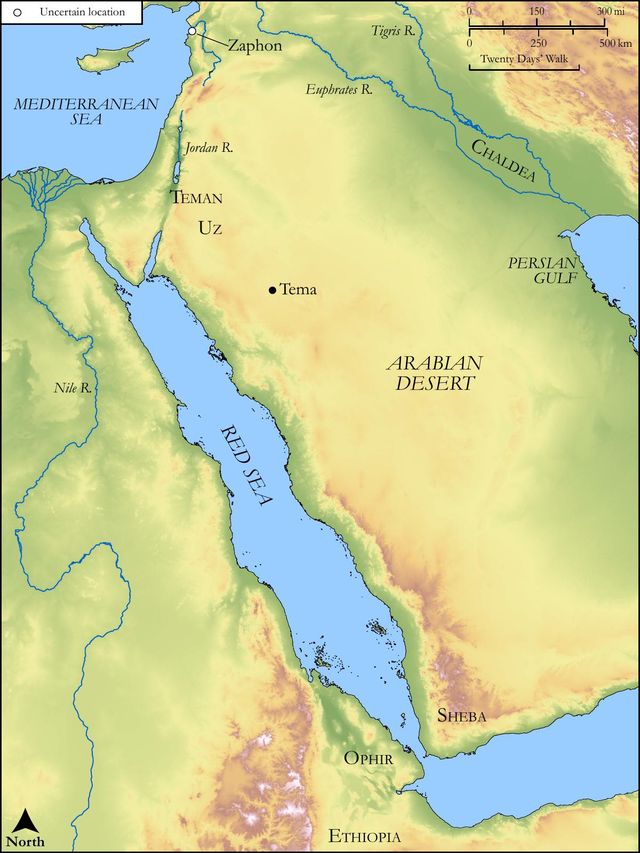
See on the biblical-era map
Study this verse
Public-domain commentary
Matthew Henry
From his Commentary on the Whole Bible. Henry comments on passages, not single verses — this entry covers Job 41:11–34. His three-level outline is real structure in the source text, so it is rendered as structure.
God, having in the foregoing verses shown Job how unable he was to deal with the leviathan, here sets forth his own power in that massy mighty creature. Here is,
I.God's sovereign dominion and independency laid down, Job 41:11.
1.That he is indebted to none of his creatures. If any pretend he is indebted to them, let them make their demand and prove their debt, and they shall receive it in full and not by composition: "Who has prevented me?" that is, "who has laid any obligations upon me by any services he has done me? Who can pretend to be before-hand with me? If any were, I would not long be behind-hand with them; I would soon repay them." The apostle quotes this for the silencing of all flesh in God's presence, Rom 11:35. Who hath first given to him, and it shall be recompensed to him again? As God does not inflict upon us the evils we have deserved, so he does bestow upon us the favours we have not deserved.
2.That he is the rightful Lord and owner of all the creatures: "Whatsoever is under the whole heaven, animate or inanimate, is mine (and particularly this leviathan), at my command and disposal, what I have an incontestable property in and dominion over." All is his; we are his, all we have and do; and therefore we cannot make God our debtor; but of thy own, Lord, have we given thee. All is his, and therefore, if he were indebted to any, he has wherewithal to repay them; the debt is in good hands. All is his, and therefore he needs not our services, nor can he be benefited by them. If I were hungry I would not tell thee, for the world is mind and the fulness thereof, Psa 50:12.
II.The proof and illustration of it, from the wonderful structure of the leviathan, Job 41:12.
1.The parts of his body, the power he exerts, especially when he is set upon, and the comely proportion of the whole of him, are what God will not conceal, and therefore what we must observe and acknowledge the power of God in. Though he is a creature of monstrous bulk, yet there is in him a comely proportion. In our eye beauty lies in that which is small (inest sua gratia parvis - little things have a gracefulness all their own) because we ourselves are so; but in God's eye even the leviathan is comely; and, if he pronounce even the whale, event he crocodile, so, it is not for us to say of any of the works of his hands that they are ugly of ill-favoured; it is enough to say so, as we have cause, of our own works. God here goes about to give us an anatomical view (as it were) of the leviathan; for his works appear most beautiful and excellent, and his wisdom and power appear most in them, when they are taken in pieces and viewed in their several parts and proportions.
(1.)The leviathan, even prima facie - at first sight, appears formidable and inaccessible, Job 41:13, Job 41:14. Who dares come so near him while he is alive as to discover or take a distinct view of the face of the garment, the skin with which he is clothed as with a garment, so near him as to bridle him like a horse and so lead him away, so near him as to be within reach of his jaws, which are like a double bridle? Who will venture to look into his mouth, as we do into a horse's mouth? He that opens the doors of his face will see his teeth terrible round about, strong and sharp, and fitted to devour; it would make a man tremble to think of having a leg or an arm between them.
(2.)His scales are his beauty and strength, and therefore his pride, Job 41:15-17. The crocodile is indeed remarkable for his scales; if we understand it of the whale, we must understand by these shields (for so the word is) the several coats of his skin; or there might be whales in that country with scales. That which is remarkable concerning the scales is that they stick so close together, by which he is not only kept warm, for no air can pierce him, but kept safe, for no sword can pierce him through those scales. Fishes, that live in the water, are fortified accordingly by the wisdom of Providence, which gives clothes as it gives cold.
(3.)He scatters terror with his very breath and looks; if he sneeze or spout up water, it is like a light shining, either with the froth or the light of the sun shining through it, Job 41:18. The eyes of the whale are reported to shine in the night-time like a flame, or, as here, like the eye-lids of the morning; the same they say of the crocodile. The breath of this creature is so hot and fiery, from the great natural heat within, that burning lamps and sparks of fire, smoke and a flame, are said to go out of his mouth, even such as one would think sufficient to set coals on fire, Job 41:19-21. Probably these hyperbolical expressions are used concerning the leviathan to intimate the terror of the wrath of God, for that is it which all this is designed to convince us of. Fire out of his mouth devours, Psa 18:7, Psa 18:8. The breath of the Almighty, like a stream of brimstone, kindles Tophet, and will for ever keep it burning, Isa 30:33. The wicked one shall be consumed with the breath of his mouth, Th2 2:8.
(4.)He is of invincible strength and most terrible fierceness, so that he frightens all that come in his way, but is not himself frightened by any. Take a view of his neck, and there remains strength, Job 41:22. his head and his body are well set together. Sorrow rejoices (or rides in triumph) before him, for he makes terrible work wherever he comes. Or, Those storms which are the sorrow of others are his joys; what is tossing to others is dancing to him. His flesh is well knit, Job 41:23. The flakes of it are joined so closely together, and are so firm, that it is hard to pierce it; he is as if he were all bone. His flesh is of brass, which Job had complained his was not, Job 6:12. His heart is as firm as a stone, Job 41:24. He has spirit equal to his bodily strength, and, though he is bulky, he is sprightly, and not unwieldy. As his flesh and skin cannot be pierced, so his courage cannot be daunted; but, on the contrary, he daunts all he meets and puts them into a consternation (Job 41:25): When he raises up himself like a moving mountain in the great waters even the mighty are afraid lest he should overturn their ships or do them some other mischief. By reason of the breakings he makes in the water, which threaten death, they purify themselves, confess their sins, betake themselves to their prayers, and get ready for death. We read (Job 3:8) of those who, when they raise up a leviathan, are in such a fright that they curse the day. It was a fear which, it seems, used to drive some to their curses and others to their prayers; for, as now, so then there were seafaring men of different characters and on whom the terrors of the sea have contrary effects; but all agree there is a great fright among them when the leviathan raises up himself.
(5.)All the instruments of slaughter that are used against him do him no hurt and therefore are not error to him, Job 41:26-29. The sword and the spear, which wound nigh at hand, are nothing to him; the darts, arrows, and sling-stones, which wound at a distance, do him no damage; nature has so well armed him cap-a-pie - at all points, against them all. The defensive weapons which men use when they engage with the leviathan, as the habergeon, or breast-plate, often serve men no more than their offensive weapons; iron and brass are to him as straw and rotten wood, and he laughs at them. It is the picture of a hard-hearted sinner, that despises the terrors of the Almighty and laughs at all the threatenings of his word. The leviathan so little dreads the weapons that are used against him that, to show how hardy he is, he chooses to lie on the sharp stones, the sharp-pointed things (Job 41:30), and lies as easy there as if he lay on the soft mire. Those that would endure hardness must inure themselves to it.
(6.)His very motion in the water troubles it and puts it into a ferment, Job 41:31, Job 41:32. When he rolls, and tosses, and makes a stir in the water, or is in pursuit of his prey, he makes the deep to boil like a pot, he raises a great froth and foam upon the water, such as is upon a boiling pot, especially a pot of boiling ointment; and he makes a path to shine after him, which even a ship in the midst of the sea does not, Pro 30:19. One may trace the leviathan under water by the bubbles on the surface; and yet who can take that advantage against him in pursuing him? Men track hares in the snow and kill them, but he that tracks the leviathan dares not come near him.
2.Having given this particular account of his parts, and his power, and his comely proportion, he concludes with four things in general concerning this animal: - (1.) That he is a non-such among the inferior creatures: Upon earth there is not his like, Job 41:33. No creature in this world is comparable to him for strength and terror. Or the earth is here distinguished from the sea: His dominion is not upon the earth (so some), but in the waters. None of all the savage creatures upon earth come near him for bulk and strength, and it is well for man that he is confined to the waters and there has a watch set upon him (Job 7:12) by the divine Providence, for, if such a terrible creature were allowed to roam and ravage upon this earth, it would be an unsafe and uncomfortable habitation for the children of men, for whom it is intended. (2.) That he is more bold and daring than any other creature whatsoever: He is made without fear. The creatures are as they are made; the leviathan has courage in his constitution, nothing can frighten him; other creatures, quite contrary, seem as much designed for flying as this for fighting. So, among men, some are in their natural temper bold, others are timorous. (3.) That he is himself very proud; though lodged in the deep, yet he beholds all high things, Job 41:34. The rolling waves, the impending rocks, the hovering clouds, and the ships under sail with top and top-gallant, this mighty animal beholds with contempt, for he does not think they either lessen him or threaten him. Those that are great are apt to be scornful. (4.) That he is a king over all the children of pride, that is, he is the proudest of all proud ones. He has more to be proud of (so Mr. Caryl expounds it) than the proudest people in the world have; and so it is a mortification to the haughtiness and lofty looks of men. Whatever bodily accomplishments men are proud of, and puffed up with, the leviathan excels them and is a king over them. Some read it so as to understand it of God: He that beholds all high things, even he, is King over all the children of pride; he can tame the behemoth (Job 40:19) and the leviathan, big as they are, and stout-hearted as they are. This discourse concerning those two animals was brought in to prove that it is God only who can look upon proud men and abase them, bring them low and tread them down, and hide them in the dust (Job 40:11-13), and so it concludes with a quod erat demonstrandum - which was to be demonstrated; there is one that beholds all high things, and, wherein men deal proudly, is above them; he is King over all the children of pride, whether brutal or rational, and can make them all either bend or break before him, Isa 2:11. The lofty looks of man shall be humbled, and the haughtiness of men shall be bowed down, and thus the Lord alone shall be exalted.
Historical interpretation
Historical reception
1 surviving comment on this verse from the historical church.
12. Holy Scripture often so mixes up past and future times, as sometimes to use the future for the past, sometimes the past for the future. For it uses the future for the past, when there is pointed out to John a woman, who is about to bring forth a male child, to rule the Gentiles with a rod of iron. [Rev. 12, 5] For since this had already taken place by the coming of the Lord in the flesh, an event which had occurred was being announced. Again, it was the past for the future, as the Lord speaks by the Psalmist, saying; They have dug My hands, and My feet, they have numbered all My bones. [Ps. 22, 16. 17.] For by these words in truth, the nature of the Lord’s Passion is described as already past, but yet it is announced as still far future. In this place then in which it is said; When he shall he taken away, the angels shall fear, nothing prevents its being understood, that past events are described under the form of the future tense. Nor do we give up the sense of its true meaning, if we believe that when this Leviathan was falling from the height of blessedness, the Elect Angels also were greatly terrified at his fall, in order that, as the fall of pride was casting him out from their number, their very fear might give them strength to stand more firmly. Whence it also follows;
And being affrighted shall be purified.
13. But they are purified; doubtless because, when he went forth with his reprobate hosts, they alone, who were to live in happiness for ever, remained in the abodes of heaven. His fall then alarmed and purified them; it alarmed them, in order that they might not proudly despise their Creator. But it purified them, because it was so ordered, that when the reprobate went forth, the Elect alone remained. And because God, the Maker of all things, knows how to apply even the evil doings of the reprobate to the protection of the good, He converted the lapse of those who fell to the benefit of those who remain; and the fault of the proud is punished, by the same means by which the increased merits of the humble Angels were discovered and confirmed. For on the fall of these, it was granted as a special gift to those that they should never in any wise fall. For while the holy Angels behold in them the ruin of their own nature, they stand with greater caution and firmness in their own persons. Hence it is ordered, by the Lord the Maker of all, marvellously arranging all things, that even the losses of its ruin are of service to that abode of Elect spirits, when it is more firmly built up, in consequence of its having been partially destroyed.
14. But because Holy Scripture is frequently accustomed to designate the preachers of the Church, by the name of ‘Angels,’ because they announce the glory of the heavenly country, we can in this place understand ‘Angels’ to mean holy preachers. For this cause it is that John, in the Apocalypse, writing to the seven Churches, speaks to the Angels of the Churches, that is, to the preachers of the peoples. [Rev. 2, and 3] Hence the Prophet says; And the angels of peace shall weep bitterly. [Is. 33, 7] Hence again the Prophet Malachi says; The priest’s lips keep knowledge, and they seek the law at his mouth, for he is the angel of the Lord of hosts. [Mal. 2, 7] Hence Paul says; Great is the mystery of godliness, which was manifested in the flesh, was justified in the spirit, appeared unto angels, hath been preached unto the Gentiles, is believed on in this world, is received up into glory. [1 Tim. 3, 16] He therefore, who, after he had said that the mystery of the dispensation appeared to Angels, added also that it had been preached unto the Gentiles, certainly by the name ‘Angels’ designated holy preachers, that is, the messengers of truth.
15. If therefore the expression, When he shall be taken away, the angels shall fear, and being affrighted shall be purified, is referred to future time, there is here pointed out the last damnation of this Leviathan, in this world, on the coming of the strict Judge. Because he, who is now tolerated by the wonderful longsuffering of gentleness, is taken out of this world by the wrath of judgment. But he is cast out from thence with so great a weight of terror, that even the strength of holy preachers is disturbed; For when he shall he taken away, the angels shall fear. Because when he is swept away with the whirlwind of judgment, even those messengers of the heavenly country, who shall be found in their bodies, are staggered with unbounded fear, and tremble. For though they now are strong and perfect, yet, as still living in the flesh, they cannot fail of being agitated with fear, at the whirlwind of such great terror. But when this Leviathan is swept away, and when all the elements are shaken at his destruction, the hope of the approach of the kingdom fills those holy preachers with joy, whom, as I have said, that time of judgment shall find still in their bodies, and the infirmity of their flesh alarms them at the display of wrath. There will therefore be in them, in a certain way, a joyful trembling, and a fearless fear; because they are sure of being rewarded in the heavenly kingdom, and through fear of so great a whirlwind they tremble from the infirmity of the flesh.
16. Let us consider therefore how greatly the conscience of the wicked is then agitated, when the life even of the just is disturbed. What will they do, who hate the coming of the Judge, if even they who love tremble at the terror of so great a judgment? And because, whatever rust of slight sins could possibly exist in holy preachers, is burnt out by this dread, after He had said, When he shall be taken away, the angels shall fear, He fitly subjoined immediately; And being affrighted shall be purified. But because we have learnt these things concerning the end of this Leviathan, let us hear what he does meanwhile, before he perishes.
Continue studying Job 41:25 across the web’s major study libraries — every link below opens this exact verse, chapter, or book on the destination site.
Read & Compare
 BibleGatewayThis verse in more than 200 translations and 70 languages.
 Bible.comThe YouVersion reader — hundreds of translations, reading plans, and highlights.
 ESV.orgCrossway's official English Standard Version reader.
 NET BibleThe NET translation with 60,000+ translators' notes on every rendering decision.
 STEP BibleTyndale House's free study tool — original text, vocabulary, and scholarly resources.
 BibliaLogos Bible Software's free web reader.
 USCCBThe New American Bible (Revised Edition) with the U.S. bishops' study notes.
Commentaries
 BibleHub CommentariesDozens of classic commentaries on this verse, gathered on one page.
 StudyLightMore than 100 commentary sets — the largest collection on the web.
 BibleRefPlain-English commentary on what this verse means, verse by verse.
 Enduring WordDavid Guzik's free commentary on this chapter, widely used by Bible teachers.
 Bible Study ToolsVerse commentary alongside Greek and Hebrew study aids.
Original Language & Research
- BibleHub InterlinearThe verse word by word — original language, transliteration, and English.
- BibleHub LexiconEvery word's original-language definition and Strong's entry.
 Blue Letter BibleDeep-study tools — Strong's numbers, concordance, and word studies.
 SefariaThe Hebrew text with Rashi and centuries of Jewish commentary.
Sermons, Hymns & Audio


TrulyRandomVerse is not affiliated with these sites and doesn’t control their content. They’re linked because they’re genuinely useful.
Summary
Job 41:25, situated within God's magnificent discourse to Job from the whirlwind, vividly portrays the overwhelming power and terrifying presence of Leviathan, a creature so formidable that even "the mighty" are struck with fear. This fear is so profound it compels them to engage in an act of purification, highlighting the creature's immense destructive potential and, by extension, the unparalleled sovereignty and majesty of its Creator, God Himself. The verse underscores humanity's inherent weakness and vulnerability when confronted with truly untamable forces, ultimately pointing to the absolute power of the Divine.
Context
ShowHideLiterary Context
Job 41:25 is a climactic statement in God's extended challenge to Job, which began in Job 38. After Job's persistent questioning of divine justice and wisdom, God responds by unveiling His boundless power through the description of two magnificent creatures: Behemoth in Job 40:15-24 and Leviathan in Job 41. The detailed portrayal of Leviathan, from its impenetrable scales (Job 41:15-17) to its fiery breath (Job 41:18-21), serves to demonstrate God's absolute control over creation, even over beings that are utterly beyond human mastery. Verse 25 specifically emphasizes the creature's psychological and spiritual impact, showing that its mere "raising up" is enough to paralyze the most powerful of men, setting the stage for Job's ultimate submission and repentance in Job 42:1-6.
Historical & Cultural Context
The concept of powerful, often chaotic, sea monsters was prevalent in ancient Near Eastern (ANE) mythologies, where such creatures frequently symbolized primordial chaos and the forces that opposed divine order. While Leviathan may have been inspired by real creatures like the crocodile, its description in Job transcends mere naturalism, taking on symbolic dimensions. In ANE cosmogonies, deities often proved their supremacy by subduing or slaying such chaos monsters. By presenting Leviathan as a creature that even "the mighty" cannot contend with, God implicitly asserts His unique power as the only One capable of controlling it, thereby demonstrating His unrivaled sovereignty over all creation and chaos. The idea of "purifying themselves" in the face of overwhelming power or a manifestation of the divine (or its creation) reflects a common cultural practice where ritual cleansing or atonement was sought to avert divine wrath, appease powerful entities, or restore purity after encountering something awe-inspiring or defiling.
Key Themes
ShowHideThis verse powerfully contributes to several overarching themes in the book of Job and the broader biblical narrative. The primary theme is Divine Sovereignty and Omnipotence, showcasing that God's power is so vast that even His creation, Leviathan, can instill terror in the strongest of humans, reinforcing the message that if humanity cannot contend with this creature, it certainly cannot contend with God. This leads to the theme of Human Insignificance and Humility, as "the mighty are afraid" underscores the fragility and limitations of human strength and pride in the face of truly overwhelming, untamable power. It speaks to the universal human experience of terror when confronted with forces beyond control or comprehension, prompting a recognition of one's own finite nature as seen in the psalmist's reflection on humanity's place. Finally, the phrase "by reason of breakings they purify themselves" introduces the theme of a Spiritual Response to Awe and Terror. When faced with such immense, destructive power (the "breakings" or shattering effect of Leviathan), even the most powerful individuals are driven to seek spiritual cleansing or atonement, implying a recognition of their own vulnerability and perhaps sinfulness before a greater power, leading them to humble themselves or seek divine mercy, echoing the call in James 4:10.
Exposition and Analysis
ShowHideKey Word Analysis
ShowHideThis word (אֵלִים) is the plural of H352 ʾayil, properly meaning "strength" or "anything strong," and can refer to a chief or a powerful man. In this context, it refers to powerful rulers, chieftains, or even "gods" in a metaphorical sense, implying that even those who consider themselves powerful, god-like, or divinely appointed are utterly terrified by Leviathan. It suggests that no human power, no matter how great, can stand against this creature, let alone against its Creator.
The Hebrew word שֶׁבֶר (H7667, sheber') literally means "fracture," "ruin," "breach," or "calamity." Here, it describes the devastating impact and overwhelming force of Leviathan's presence. It's not just a physical breaking, but a psychological or spiritual "shattering" of resolve and confidence in those who witness it. The terror is so profound it breaks their spirit and self-reliance, leading to a state of utter collapse.
This verb (יִתְחַטָּאוּ) is from the root H2398 châṭâʼ, meaning "to miss," "to sin," or "to cleanse/de-sin." The Hithpael stem, used here, is reflexive, meaning "to cleanse oneself from sin," "to make atonement," or "to purify oneself ritually." This indicates a deliberate act of spiritual or ritual cleansing, prompted by the overwhelming fear and the realization of one's own impurity or inadequacy in the face of such a formidable creature, which ultimately points to God's majesty and holiness.
Verse Breakdown
ShowHide"When he raiseth up himself"
This clause depicts Leviathan in an active, imposing posture, signifying a moment when the creature fully reveals its immense size, power, and terrifying presence. This "raising up" is not merely physical but signifies the full manifestation of its overwhelming might, asserting its dominance and challenging any who might dare to confront it.
"the mighty are afraid"
This highlights the immediate and universal response to Leviathan's display of power. "The mighty" refers to those who are typically fearless, powerful, or influential—leaders, warriors, or even those considered divinely strong. Their fear underscores Leviathan's unparalleled terror, demonstrating that no human strength, courage, or status can withstand its intimidating presence.
"by reason of breakings"
This phrase explains the profound cause of the fear and the subsequent action. The "breakings" refer to the shattering, devastating effect Leviathan has on those who encounter it. It's the overwhelming sense of ruin, calamity, or psychological collapse that its presence inspires, driving "the mighty" to a desperate and instinctual response.
"they purify themselves"
This describes the profound, almost instinctual, reaction to the terror. Driven by the "breakings," these powerful individuals seek ritual or spiritual cleansing. This implies a recognition of their own vulnerability, inadequacy, or even sinfulness in the face of such overwhelming power, leading them to seek atonement or a restoration of purity before what they perceive as a greater, potentially divine, force.
Literary Devices
ShowHideJob 41:25 employs several powerful literary devices to convey its message. Hyperbole is evident in the description of Leviathan's power, exaggerating its effects to underscore God's ultimate sovereignty. While Leviathan may have been inspired by real creatures like the crocodile, its portrayal here transcends naturalistic description to become a creature of mythical proportions, so terrifying that even "the mighty" are shattered. This exaggeration serves a theological purpose, demonstrating that if such a creature is beyond human control, how much more is its Creator. Symbolism is central, with Leviathan standing as a potent symbol of untamable chaos, raw power, and the forces of evil or disorder that are beyond human mastery. God's ability to describe and control Leviathan thus symbolizes His absolute dominion over all chaos and evil in the cosmos. Furthermore, there's a subtle use of Anthropomorphism in attributing human-like fear and a ritualistic response ("purify themselves") to "the mighty" when confronted with a beast, emphasizing the creature's profound psychological impact. The verse also functions as a form of A fortiori argument (from the lesser to the greater): if Leviathan is so terrifying, how much more awesome and powerful must God be, who created and controls it?
Theological and Thematic Connections
ShowHideJob 41:25 serves as a profound theological statement, reinforcing the absolute sovereignty and unparalleled power of God over all creation, including the most fearsome and untamable forces. Leviathan, whether a literal creature or a symbolic representation of chaos and evil, is ultimately subject to God's command. The terror it inspires in "the mighty" underscores the futility of human strength and pride when confronted with divine power, or even a creature of God's making. This leads to a humbling realization that true security and wisdom lie not in self-reliance but in acknowledging God's supremacy and seeking His grace. The act of "purifying themselves" speaks to a deep-seated human instinct to seek spiritual cleansing or atonement when confronted with overwhelming power or a sense of one's own inadequacy and sinfulness before the divine. It highlights that the proper response to divine revelation, even through the terrifying aspects of creation, is humility and a turning towards righteousness.
Reflection and Application
ShowHideJob 41:25 offers profound insights for contemporary life, inviting us to reflect on our own "Leviathans"—those overwhelming challenges, fears, or societal evils that seem beyond our control and instill a sense of powerlessness. Whether it's a personal crisis, a global pandemic, economic instability, or pervasive injustice, these "Leviathans" can shatter our sense of security and self-sufficiency. The verse reminds us that even "the mighty" are rendered afraid and compelled to seek purification, suggesting that our natural and proper response to such overwhelming forces should be one of profound humility and a turning towards God. Instead of relying solely on our own strength, intellect, or worldly power, true wisdom lies in acknowledging our limitations and seeking spiritual cleansing and reliance on the ultimate power of God. This can manifest as repentance, fervent prayer, a renewed commitment to living righteously, or actively seeking God's will, recognizing that all earthly might pales in comparison to divine sovereignty. Just as the ancients might have sought ritual purification, we are called to seek spiritual renewal and trust in the One who commands all creation and holds all things in His hand.
Questions for Reflection
ShowHideFAQ
ShowHideIs Leviathan a literal creature or symbolic?
ShowHideThe interpretation of Leviathan in Job 41:25, and throughout Scripture, often involves a blend of literal and symbolic understanding. While Leviathan's description shares characteristics with real powerful creatures like the Nile crocodile, its portrayal in Job goes beyond mere naturalism, imbuing it with mythical and theological significance. In ancient Near Eastern contexts, such creatures often symbolized primordial chaos and forces hostile to divine order. Therefore, while it may have a basis in a real animal, its primary function in Job is symbolic: it represents the untamable, fearsome aspects of creation that are utterly beyond human control, serving as a powerful testament to God's absolute sovereignty. Other biblical passages like Psalm 74:14 and Isaiah 27:1 further emphasize its symbolic role as a cosmic monster representing evil and chaos, which God ultimately defeats.
What does "by reason of breakings they purify themselves" truly mean?
ShowHideThis phrase describes a profound and desperate response to overwhelming terror. "Breakings" (Hebrew sheber) signifies the shattering or ruinous impact of Leviathan's presence—not just physical destruction, but a psychological and spiritual collapse of resolve in those who witness it. In the face of such an unstoppable, terrifying force, "the mighty" realize their utter inadequacy and vulnerability. The response, "they purify themselves" (Hebrew yitḥaṭṭaʾu), indicates a ritual or spiritual act of cleansing. This is not necessarily an act of moral repentance for specific sins, but rather a desperate attempt to restore purity, seek atonement, or appease a perceived divine power in the face of an existential threat. It suggests that overwhelming fear, when confronted with a manifestation of immense power that dwarfs human capabilities, can drive individuals to acknowledge their own impurity or weakness and seek a form of cleansing or reconciliation, ultimately pointing to the need for divine mercy and intervention.
Christ-Centered Fulfillment
ShowHideJob 41:25, with its depiction of Leviathan as an unconquerable force that terrifies even "the mighty," finds its ultimate Christ-centered fulfillment in the person and work of Jesus Christ. While Leviathan symbolizes the untamable forces of chaos and evil that humanity cannot overcome, Christ is revealed as the true "Mighty One" who not only confronts but utterly conquers these spiritual Leviathans—sin, death, and the devil. Unlike the "mighty" who are afraid and purify themselves in the face of Leviathan, Jesus, through His crucifixion and resurrection, triumphed over all spiritual powers and authorities, disarming them and making a public spectacle of them (Colossians 2:15). He came to destroy the works of the devil (1 John 3:8) and, through His death, rendered powerless the one who had the power of death, that is, the devil (Hebrews 2:14-15). Furthermore, the "purification" sought by the terrified "mighty" in Job 41:25 is fully and perfectly realized in Christ. His shed blood is the ultimate means by which humanity is truly cleansed from sin and impurity (1 John 1:7), making atonement once for all (Hebrews 9:26). Thus, the terror of Leviathan foreshadows the profound and necessary awe before God's power, which is ultimately channeled through Christ's victory and His gracious provision of true purification and peace for all who believe.