


Job 40:19
Bible text: King James Version (1769 Blayney text) · Public domain
Bible text: Berean Standard Bible · Public domain
Bible text: American Standard Version (1901) · Public domain
Bible text: World English Bible, Messianic edition · Public domain
Bible text: Geneva Bible (1599) · Public domain
Bible text: Young's Literal Translation · Public domain
- הוּאhu'itH1931Pro-3msPronoun Personal 3rd Singular Masculine
- רֵאשִׁיתre·Shit[is] [the] first ofH7225N-fscNoun Singular Feminine Construct
- דַּרְכֵיdar·khei[the] ways ofH1870N-cpcNoun Plural common gender Construct
- אֵל'ElGodH410N-msNoun Singular Masculine Absolute
- הָעֹשׂוֹha·'o·sothe [one who] made itH6213Art ¦ V-Qal-Prtcpl-ms ¦ 3msVerb Qal Participle Singular Masculine Constructהָtheעֹשׂ[one who] madeוֹit
- יַגֵּשׁya·Geshlet him bring nearH5066V-Hiphil-Imperf-3msVerb Hiphil Imperfect 3rd Singular Masculine
- חַרְבּוֹchar·Bohis swordH2719N-fsc ¦ 3msNoun Singular Feminine Constructחַרְבּswordוֹhis
English is a literal word-by-word gloss of the Hebrew, not the KJV's wording. Why?
This is the original text the KJV's translators worked from — each Hebrew word with its own literal English meaning in this verse, prepared by scholars at Tyndale House, Cambridge. The KJV translates whole sentences, not word by word, so its wording differs: one Hebrew word can become several English words, and the KJV may choose “the LORD” where the gloss reads “Yahweh”. Both are faithful — they answer different questions. For the KJV's own rendering, switch to the KJV text.
Details
See on the biblical-era map
Study this verse
Public-domain commentary
Matthew Henry
From his Commentary on the Whole Bible. Henry comments on passages, not single verses — this entry covers Job 40:15–24. His three-level outline is real structure in the source text, so it is rendered as structure.
God, for the further proving of his own power and disproving of Job's pretensions, concludes his discourse with the description of two vast and mighty animals, far exceeding man in bulk and strength, one he calls behemoth, the other leviathan. In these verses we have the former described. "Behold now behemoth, and consider whether thou art able to contend with him who made that beast and gave him all the power he has, and whether it is not thy wisdom rather to submit to him and make thy peace with him." Behemoth signifies beasts in general, but must here be meant of some one particular species. Some understand it of the bull; others of an amphibious animal, well known (they say) in Egypt, called the river-horse (hippopotamus), living among the fish in the river Nile, but coming out to feed upon the earth. But I confess I see no reason to depart from the ancient and most generally received opinion, that it is the elephant that is here described, which is a very strong stately creature, of very large stature above any other, of wonderful sagacity, and of so great a reputation in the animal kingdom that among so many four-footed beasts as we have had the natural history of (ch. 38 and 39) we can scarcely suppose this should be omitted. Observe,
I.The description here given of the behemoth.
1.His body is very strong and well built. His strength is in his loins, Job 40:16. His bones, compared with those of other creatures, are like bars of iron, Job 40:18. His back-bone is so strong that, though his tail be not large, yet he moves it like a cedar, with a commanding force, Job 40:17. Some understand it of the trunk of the elephant, for the word signifies any extreme part, and in that there is indeed a wonderful strength. So strong is the elephant in his back and loins, and the sinews of his thighs, that he will carry a large wooden tower, and a great number of fighting men in it. No animal whatsoever comes near the elephant for strength of body, which is the main thing insisted on in this description.
2.He feeds on the productions of the earth and does not prey upon other animals: He eats grass as an ox (Job 40:15), the mountains bring him forth food (Job 40:20), and the beasts of the field do not tremble before him nor flee from him, as from a lion, but they play about him, knowing they are in no danger from him. This may give us occasion,
(1.)To acknowledge the goodness of God in ordering it so that a creature of such bulk, which requires so much food, should not feed upon flesh (for then multitudes must die to keep him alive), but should be content with the grass of the field, to prevent such destruction of lives as otherwise must have ensued.
(2.)To commend living upon herbs and fruits without flesh, according to the original appointment of man's food, Gen 1:29. Even the strength of an elephant, as of a horse and an ox, may be supported without flesh; and why not that of a man? Though therefore we use the liberty God has allowed us, yet be not among riotous eaters of flesh, Pro 23:20.
(3.)To commend a quiet and peaceable life. Who would not rather, like the elephant, have his neighbours easy and pleasant about him, than, like the lion, have them all afraid of him?
3.He lodges under the shady trees (Job 40:21), which cover him with their shadow (Job 40:22), where he has a free and open air to breathe in, while lions, which live by prey, when they would repose themselves, are obliged to retire into a close and dark den, to live therein, and to abide in the covert of that, Job 38:40. Those who are a terror to others cannot but be sometimes a terror to themselves too; but those will be easy who will let others be easy about them; and the reed and fens, and the willows of the brook, though a very weak and slender fortification, yet are sufficient for the defence and security of those who therefore dread no harm, because they design none.
4.That he is a very great and greedy drinker, not of wine or strong drink (to be greedy of that is peculiar to man, who by his drunkenness makes a beast of himself), but of fair water.
(1.)His size is prodigious, and therefore he must have supply accordingly, Job 40:23. He drinks so much that one would think he could drink up a river, if you would give him time, and not hasten him. Or, when he drinks, he hasteth not, as those do that drink in fear; he is confident of his own strength and safety, and therefore makes no haste when he drinks, no more haste than good speed.
(2.)His eye anticipates more than he can take; for, when he is very thirsty, having been long kept without water, he trusts that he can drink up Jordan in his mouth, and even takes it with his eyes, Job 40:24. As a covetous man causes his eyes to fly upon the wealth of this world, which he is greedy of, so this great beast is said to snatch, or draw up, even a river with his eyes.
(3.)His nose has in it strength enough for both; for, when he goes greedily to drink with it, he pierces through snares or nets, which perhaps are laid in the waters to catch fish. He makes nothing of the difficulties that lie in his way, so great is his strength and so eager his appetite.
II.The use that is to be made of this description.
We have taken a view of this mountain of a beast, this over-grown animal, which is here set before us, not merely as a show (as sometimes it is in our country) to satisfy our curiosity and to amuse us, but as an argument with us to humble ourselves before the great God; for,
1.He made this vast animal, which is so fearfully and wonderfully made; it is the work of his hands, the contrivance of his wisdom, the production of his power; it is behemoth which I made, Job 40:15. Whatever strength this, or any other creature, has, it is derived from God, who therefore must be acknowledged to have all power originally and infinitely in himself, and such an arm as it is not for us to contest with. This beast is here called the chief, in its kind, of the ways of God (Job 40:19), an eminent instance of the Creator's power and wisdom. Those that will peruse the accounts given by historians of the elephant will find that his capacities approach nearer to those of reason than the capacities of any other brute-creature whatsoever, and therefore he is fitly called the chief of the ways of God, in the inferior part of the creation, no creature below man being preferable to him.
2.He made him with man, as he made other four-footed beasts, on the same day with man (Gen 1:25, Gen 1:26), whereas the fish and fowl were made the day before; he made him to live and move on the same earth, in the same element, and therefore man and beast are said to be jointly preserved by divine Providence as fellow-commoners, Psa 36:6. "It is behemoth, which I made with thee; I made that beast as well as thee, and he does not quarrel with me; why then dost thou? Why shouldst thou demand peculiar favours because I made thee (Job 10:9), when I made the behemoth likewise with thee? I made thee as well as that beast, and therefore can as easily manage thee at pleasure as that beast, and will do it whether thou refuse or whether thou choose. I made him with thee, that thou mayest look upon him and receive instruction." We need not go far for proofs and instances of God's almighty power and sovereign dominion; they are near us, they are with us, they are under our eye wherever we are.
3.He that made him can make his sword to approach to him (Job 40:19), that is, the same hand that made him, notwithstanding his great bulk and strength, can unmake him again at pleasure and kill an elephant as easily as a worm or a fly, without any difficulty, and without the imputation either of waste or wrong. God that gave to all the creatures their being may take away the being he gave; for may he not do what he will with his own? And he can do it; he that has power to create with a word no doubt has power to destroy with a word, and can as easily speak the creature into nothing as at first he spoke it out of nothing. The behemoth perhaps is here intended (as well as the leviathan afterwards) to represent those proud tyrants and oppressors whom God had just now challenged Job to abase and bring down. They think themselves as well fortified against the judgments of God as the elephant with his bones of brass and iron; but he that made the soul of man knows all the avenues to it, and can make the sword of justice, his wrath, to approach to it, and touch it in the most tender and sensible part. He that framed the engine, and put the parts of it together, knows how to take it in pieces. Woe to him therefore that strives with his Maker, for he that made him has therefore power to make him miserable, and will not make him happy unless he will be ruled by him.
Historical interpretation
Two Centuries of Reception
3 surviving comments on this verse. Each one is dated, so this reads as a timeline rather than a list.
Select a marker to jump to its quote. Markers stagger vertically where authors wrote within a few decades of each other.
47. As if He were plainly saying, He has strength sufficient for so many purposes, because in the nature of things the Creator made him first, when creating him in his substance. For what do we understand by the ‘ways’ of God, but His doings? Of which He says by the Prophet; For My ways are not as your ways. [Is. 55, 8] And Behemoth is said to be the chief of the ways of God, because doubtless when He was performing all the work of creation, He created him first, whom He made more eminent than the other Angels. The Prophet is looking at the eminence of this superiority [‘primatus.’], when he says, The cedars in the paradise of God were not higher, the fir trees equalled not his summit, the plane trees were not equal to his branches, nor any tree in the paradise of God was like him and his beauty, since He made him beautiful with his many and thick branches. [Ez. 31, 8. 9.] For who can be understood by cedars, fir trees, and planes, unless those bands of heavenly virtues of lofty height, planted in the verdure of eternal joy? But these, though created lofty, were yet neither preferred nor equalled to him. And he is said to have been made beautiful with his many and thick branches, because when set above the other legions, a comeliness, as great as the subject multitude of Angels which adorned him, rendered him the more beautiful. This tree in the paradise of God had, as it were, as many crowded branches, as were the legions of heavenly spirits, it beheld placed beneath it. And therefore, when sinning, he was condemned without pardon, because he had been created great beyond comparison. Hence it is again said to him by the same Prophet, Thou wast a seal of the likeness of God, full of wisdom, and perfect in beauty in the delights of the paradise of God. [Ez. 28, 12. 13.] For having many things to say of his greatness, he comprehended all in the first word. For what good had he not, if he was the seal of the similitude of God? For from the seal of a ring such a likeness is impressed in image, as exists in essence in the seal itself. And though man was created after the likeness of God, yet as if ascribing something greater to an Angel, he says not that he was made after the likeness of God, but that he was the very seal of the likeness of God; in order that, as he is more subtle in nature, the likeness of God may be believed to have been more fully impressed on him.
48. Hence it is that the same Prophet, still speaking of the power of his superiority, subjoins; Every precious stone was thy covering, the sardius, and topaz, and jasper, the chrysolite, the onyx, and the beryl, the sapphire, the carbuncle, and the emerald. [Ez. 28, 13] He mentioned nine kinds of stones, doubtless because there are nine; orders of angels. For when in the very words of Scripture, Angels, Archangels, Thrones, Dominations, Virtues, Princedoms, Powers, Cherubim, and Seraphim, are plainly spoken of and mentioned, it is shown how great are the distinctions of the citizens of heaven. And yet this Behemoth is described as being covered by them, because he had those as a vesture for his adornment, by comparison with whom he was more brilliant, when he transcended their brightness. Of whose description he further adds in that passage, Gold the work of thy beauty, and thy holes [read ‘foramina.’] were prepared in the day that thou wast created. [Ez. 28, 13] Gold existed as the work of his beauty, because he shone forth with the brightness of the wisdom, which he received when created aright. But holes are made in stones in order that when bound together by gold, they may be united in the composition of an ornament, and that they may not be separated from each other, which the gold binds together by being poured between and filling the holes. The holes of this stone were prepared then in the day of its creation, because, namely, he was created capable of love. And had he wished to be filled therewith, he would have been able to cling firm to the Angels who stand, as to stones placed in the ornament of a king. For had he given himself up to be penetrated by the gold of charity, when associated with the holy Angels, he would still be remaining, as we said, a stone firmly fixed in the ornament of a king. This stone then had holes, but, through the sin of pride, they were not filled with the gold of charity. For since they are fastened with gold, so as not to fall, he therefore fell, because, even though perforated with the hand of the artificer, he scorned to be bound with the bands of love. But now, the other stones, which had been perforated similarly with him, were bound together by charity mutually penetrating them, and obtained, on his fall, this, as a gift, that they should now be never loosened by falling from the ornament of the King. The same Prophet, still gazing on the loftiness of his superiority [‘principatus.’], subjoins, Thou, the outspread and covering Cherub in the holy mountain of God, hast walked perfect in the midst of the stones of fire. [Ez. 28, 14] For Cherub is interpreted, ‘Plenitude of knowledge,’ and he is therefore called a Cherub, because he is not doubted to have surpassed all in his knowledge. And he walked in perfection in the midst of the stones of fire, because he dwelt amid the hearts of Angels, which were kindled with the fire of love, bright with the glory of his creation. And he rightly speaks of him as outspread and covering. For we overshadow every thing which we protect when stretched out. And because he is believed to have overshadowed the brightness of the others, through comparison with his brightness, he is said to have been himself outspread and covering. For he who transcends the greatness of others by his great excellence, has covered them, as it were, by overshadowing. That then which is said in one place to be beautiful with branches, in another a seal of similitude, in another a Cherub, and in another covering, is in this place declared by the voice of the Lord to be this Behemoth, the chief of the ways of God.
49. But He mentions these wondrous things of him, in what he had, and in what he lost, expressly to show to awestruck man, what, if guilty himself of pride, he is likely to suffer from the sin of his haughtiness; if He would not abstain from smiting him, whom He exalted at his creation to the glory of such great brightness. Let man then consider what he deserves for his pride on earth, if even an Angel, placed above other Angels, is cast down in heaven. Whence it is also well said by the Prophet, My sword is made drunk in heaven. [Is. 34, 5] As if He were plainly saying, Consider with what wrath I shall smite the haughty of the earth, if I have not forborne to smite for the sin of pride, those even, whom I have created next to Myself in heaven. Having heard then these many powers of the ancient enemy, having known the greatness of the state in which he was made; who would not fall down with unbounded fear, who would not sink under the blow of desperation? But because the display of our enemy’s power keeps down our pride, the Lord comforts our infirmity also by disclosing the dispensation of His grace. Hence when calling him ‘the chief of His ways,’ He immediately added;
He that made him, hath bended up his sword.
50. For the ‘sword’ of this Behemoth is his malice in doing hurt. But his sword is bended by Him, by Whom he was created naturally good. Because his malice is so restrained by Divine dispensation, as not to be permitted to strike the minds of men, as much as he wishes. Because, therefore, our enemy both has great power, and strikes a less blow, the kindness of our Creator restrains his sword, so that it is bent back, and lies hid in his own conscience, and that his malice does not extend itself further for the death of men, than it is righteously ordered from above. The great strength therefore which he has for many things, he possesses from the original [‘principio’] of his mighty creation; but so far as he is defeated by some, his sword is doubtless bent back by his Creator. For when this Behemoth, who is the chief of the ways of God, received permission to practise temptation against the holy man, he roused the nations, he took away the flocks, he cast down fire from heaven, he agitated the air and roused the winds, he shook and overthrew the house, he killed his sons, when feasting together, [Job 1, 19] he employed the mind of the wife in the craft of evil persuasion, he pierced the flesh of the husband with the wounds he inflicted. [ib. 2, 9. 10.] But his sword is bent back by his Creator, when it is said, Save his life. [ib. 6.] And how great is his weakness, when his sword has been bent back, is described by the witness of the Evangelist, that he was not able to continue in the man he had possessed, and again that he presumed not, unbidden, to assail the brute animals, saying, If Thou cast us out, send us into the herd of swine. [Matt. 8, 31] For it is shown how much his sword of malice is bent back, since he would not be able to assail even the herd of swine, unless the supreme Power gave him permission. When then can he venture of his own accord to injure men who are made after the likeness of God, of whom is it doubtless quite plain, that he cannot presume to touch the swine, without permission? [‘non jussus.’]
51. We must observe also, that when Behemoth is called the chief [‘principium’] of the ways of God, the insane doctrine of Arius is overthrown by plain reason. For he confesses that the Son of God is a creature, and behold Behemoth is set forth as the first created in the creation of things. It remains therefore for Arius either to assert that the Son is not made, or to believe in his folly that he was created after Behemoth. But since every thing which is folded [‘applicatur.’] is turned back on itself, Behemoth is rightly said to be a sword bent back. For his malice is steeped in itself, when, on being forbidden, it does not exert itself according to its wish, against the life of the Elect. But it is permitted to strike many, as their merits deserve, in order that when they forsake God they may serve His cursed enemy. But he is defeated the more powerfully by the Elect, the more they bow themselves with greater humility before the sole Author of all things. Since therefore from being called the chief of the ways of God, from being proved to be very insupportable, when the Lord permits it, we know plainly with how strong an enemy we are fighting; it remains therefore for each of us, to subject himself more entirely to his Maker, the more truly he considers the mighty power of his adversary against him. For what are we but dust? But what is he, but one of the heavenly spirits, and what is still greater, their chief? What then can he venture on his own strength, when he contends, though dust, against the chief of angels? But because the Creator of heavenly spirits has assumed an earthly body, lowly dust now rightly overcomes the haughty angel. For by adhering to True Strength he gains powers, which the apostate spirit lost by following himself. And it is meet for him, who believed that he was strong, when he had forsaken his Creator, to be conquered by dust, in order that he may learn on defeat, that he has failed through pride. But he pants with furious rage, because when sufferings torture him below, man ascends to the highest happiness; because flesh is exalted to, and abides in, that loftiness, from which he, that great spirit, lies cast forth for ever. But their relative deserts changed the positions of their minds. Thus, thus did pride deserve to be cast down, thus humility to be exalted, so as that a heavenly spirit might endure hell, by exalting himself, and earth, through humility, reign for ever above the heavens.
“This is the beginning of the ways of God. He who made him provided him with his sword.” The sword of this Behemoth is his own malice in inflicting harm. But he who made him good in his nature provided him with his sword, because, according to divine will, his malice is limited, so that he is not allowed to strike human beings as much as he would like to. Now, if our enemy can do much but strikes less, this is due to the fact that the mercy of our Creator sets a limit to his sword. Therefore, [the devil] hides inside his conscience, and his malice, through which he makes people die, does not exceed the proper limits set by God.
The words “its strength is in its cover” [mean] its strength and vigor are precisely in the animal itself. Animals usually take shelter in different places, but [the author] says this animal does not need a shelter at all.
Continue studying Job 40:19 across the web’s major study libraries — every link below opens this exact verse, chapter, or book on the destination site.
Read & Compare
 BibleGatewayThis verse in more than 200 translations and 70 languages.
 Bible.comThe YouVersion reader — hundreds of translations, reading plans, and highlights.
 ESV.orgCrossway's official English Standard Version reader.
 NET BibleThe NET translation with 60,000+ translators' notes on every rendering decision.
 STEP BibleTyndale House's free study tool — original text, vocabulary, and scholarly resources.
 BibliaLogos Bible Software's free web reader.
 USCCBThe New American Bible (Revised Edition) with the U.S. bishops' study notes.
Commentaries
 BibleHub CommentariesDozens of classic commentaries on this verse, gathered on one page.
 StudyLightMore than 100 commentary sets — the largest collection on the web.
 BibleRefPlain-English commentary on what this verse means, verse by verse.
 Enduring WordDavid Guzik's free commentary on this chapter, widely used by Bible teachers.
 Bible Study ToolsVerse commentary alongside Greek and Hebrew study aids.
Original Language & Research
- BibleHub InterlinearThe verse word by word — original language, transliteration, and English.
- BibleHub LexiconEvery word's original-language definition and Strong's entry.
 Blue Letter BibleDeep-study tools — Strong's numbers, concordance, and word studies.
 SefariaThe Hebrew text with Rashi and centuries of Jewish commentary.
Sermons, Hymns & Audio


TrulyRandomVerse is not affiliated with these sites and doesn’t control their content. They’re linked because they’re genuinely useful.
Summary
Job 40:19, situated within God's awe-inspiring discourse to Job, describes Behemoth as "the chief of the ways of God," highlighting its unparalleled majesty and strength among earthly creatures. This verse powerfully asserts God's absolute sovereignty, declaring that the Creator, who fashioned such a formidable being, retains ultimate control and can easily subdue or judge it, thereby emphasizing divine omnipotence and humbling human understanding in the face of God's magnificent power and unchallengeable authority over all creation.
Context
ShowHideLiterary Context
Job 40:19 is situated within the climactic section of the book of Job, specifically God's direct address to Job from a whirlwind, spanning Job 38 through Job 41. After Job's persistent questioning of divine justice and wisdom, God responds not with a direct explanation of Job's suffering, but with a series of rhetorical questions and vivid descriptions of His creation. This divine monologue is designed to demonstrate His infinite power, wisdom, and sovereign control over all creation. Behemoth is introduced in Job 40:15 and described through Job 40:24. Following Behemoth, God describes Leviathan in Job 41. These two creatures, often interpreted as real, albeit exceptionally powerful, animals (like a hippopotamus or crocodile, or perhaps symbolic beasts representing chaos), serve as irrefutable evidence of God's creative might, far surpassing human ability to comprehend or control. Verse 19 specifically elevates Behemoth to a preeminent status among God's terrestrial works, setting the stage for the declaration of God's unassailable authority over even His most formidable creations.
Historical & Cultural Context
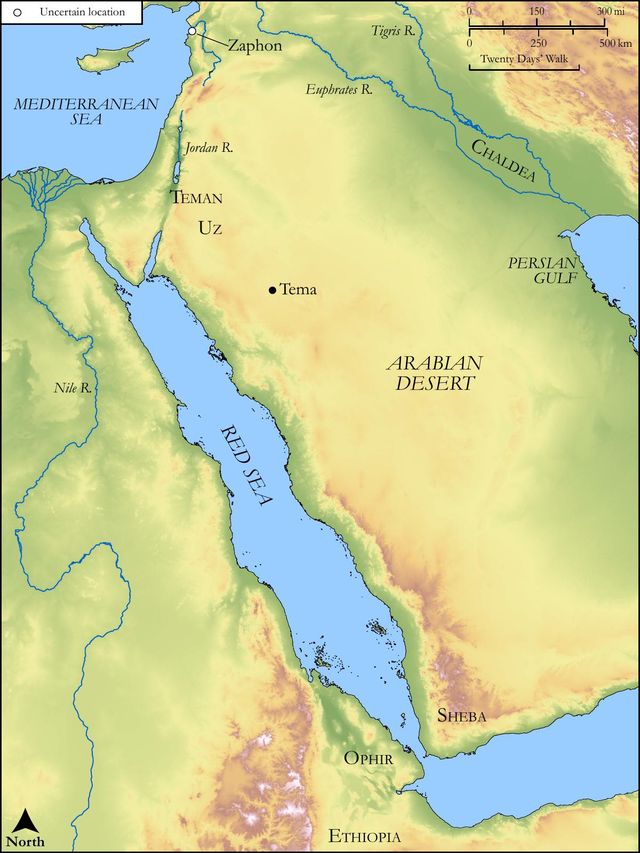
The book of Job is set in the land of Uz, a region likely east of Palestine, and reflects a wisdom tradition that grapples with profound questions of suffering, justice, and divine sovereignty. While the exact identity of Behemoth and Leviathan has been debated by scholars, Scripture presents Leviathan as one "whom thou hast made to play therein," and Behemoth as made with Job, symbolizing untamed power that God alone commands. However, the biblical text presents Behemoth and Leviathan not as independent deities or chaotic forces, but as creatures created by God, firmly under His dominion. This directly contrasts with pagan mythologies where gods might struggle against such primordial forces. The KJV's "chief of the ways of God" (ראשית דרכי אל) suggests a creature of unparalleled grandeur, a "first-fruits" or "masterpiece" of God's creative work, reflecting an ancient understanding of a hierarchical creation where certain animals embodied immense power and mystery. The "sword" as a metaphor for divine judgment or decisive action is a common motif in the Old Testament, signifying the ultimate authority of a king or deity.
Key Themes
ShowHideJob 40:19 contributes significantly to several overarching themes in the book of Job. Firstly, it powerfully underscores God's Supreme Creative Power and Wisdom. Behemoth's description as "the chief of the ways of God" emphasizes the incredible might and artistry of the Creator, showcasing a creature so immense and powerful that it stands as a testament to God's unparalleled genius in creation. This resonates with the broader biblical declaration that creation itself proclaims God's glory, as seen in Psalm 19:1. Secondly, the verse highlights Divine Sovereignty and Absolute Authority. The assertion that "he that made him can make his sword to approach unto him" is a potent declaration that despite Behemoth's formidable nature, its Creator holds ultimate control over it. No creature, however mighty, operates outside God's sovereign will or beyond His reach, reinforcing the truth that God's dominion extends over all creation, as affirmed in Daniel 4:35. Finally, the description of Behemoth serves to instill Human Humility in the Face of God's Majesty. By presenting such an overwhelming creature, God demonstrates to Job the vast chasm between human understanding and divine wisdom. If Job cannot even contend with or comprehend the full scope of God's creation, how can he presume to question the justice or wisdom of the Almighty? This theme runs throughout God's discourse from the whirlwind, challenging Job's limited perspective and calling him to a posture of awe and submission.
Exposition and Analysis
ShowHideKey Word Analysis
ShowHideThis word typically means "beginning," "first," or "first-fruits." In the context of Job 40:19, when applied to Behemoth, it signifies preeminence in terms of power, size, or magnificence rather than chronological priority. Behemoth is presented as the "foremost," "principal," or "masterpiece" among God's created works, particularly among terrestrial creatures. It serves as a prime example, a crowning achievement of God's creative power, demonstrating the Creator's unlimited capacity to bring forth beings of immense strength and scale.
This word literally means "a road" or "path," but figuratively denotes a "course of life," "mode of action," or "works." In this verse, "ways of God" refers to God's creative acts or His works in creation. Thus, Behemoth is the "chief" or "masterpiece" among God's creative works, highlighting its extraordinary nature as a testament to divine craftsmanship and power.
This word literally means "sword" or "cutting instrument." In biblical contexts, a sword is a common symbol for divine judgment, power, decisive action, or the instrument of God's wrath and destruction. Here, it is a powerful metaphor for God's ultimate authority and ability to subdue or destroy even the mightiest of His creations. Despite Behemoth's formidable nature, the "sword" of God can "approach unto him," meaning God can effortlessly bring His power or judgment to bear upon this creature, emphasizing His absolute sovereignty and control over all things, including the most powerful elements of His creation.
Verse Breakdown
ShowHide"He [is] the chief of the ways of God:"
This clause establishes Behemoth's unique status in creation. It signifies that Behemoth is not merely one animal among many, but a preeminent example of God's creative power and design. It is a "masterpiece" or "first-fruits" of God's works, showcasing His ability to create beings of immense strength, size, and resilience. This declaration elevates Behemoth to a position of unparalleled grandeur within the terrestrial realm, serving as a powerful testament to the Creator's boundless might and wisdom.
"he that made him can make his sword to approach [unto him]."
This second clause directly asserts God's absolute sovereignty over Behemoth. Despite the creature's formidable nature, the God who created it retains full control. The "sword" is a metaphor for divine power, judgment, or decisive action, indicating that God can effortlessly subdue, judge, or even destroy Behemoth if He chooses. This statement serves to humble Job and any human observer, demonstrating that no creature, however mighty, can stand against the Creator's will or escape His ultimate authority. It underscores that God's power is not merely displayed in creation, but also in His sovereign control over all that He has made.
Literary Devices
ShowHideJob 40:19 employs several potent literary devices to convey its profound theological message. The preceding description of Behemoth (Job 40:15-18) itself is a form of Hyperbole, exaggerating its immense power and invincibility (e.g., "bones are like bars of iron," "tail sways like a cedar") to emphasize God's even greater power. The phrase "chief of the ways of God" uses Metonymy or Synecdoche, where "ways" (referring to God's creative acts) stands for the creatures themselves, and "chief" denotes Behemoth's preeminence among them. Most significantly, the "sword" in "can make his sword to approach unto him" is a powerful Metaphor. It is not a literal sword, but a symbolic representation of God's divine power, judgment, and ultimate authority. This metaphor vividly communicates that God, the Creator, possesses the ultimate means to subdue or destroy even His mightiest creation, reinforcing His unchallengeable sovereignty. The entire passage, as part of God's direct address, is also an example of Theophany, where God reveals Himself and His attributes through His creation, challenging human perception and fostering awe.
Theological and Thematic Connections
ShowHideJob 40:19 profoundly articulates God's absolute sovereignty and His unparalleled creative power. It demonstrates that even the most formidable and awe-inspiring elements of creation are utterly subject to the will of their Maker. This truth serves to humble humanity, reminding us that if we cannot contend with or fully comprehend God's creatures, how much less can we question or grasp the infinite wisdom and power of the Creator Himself. The verse asserts that God's power is not merely manifested in creation, but also in His ongoing, unchallenged dominion over all He has made, assuring us that nothing is beyond His control or purpose.
Reflection and Application
ShowHideJob 40:19 calls us to a profound posture of humility and awe before the Creator. In a world that often seeks to assert human control or questions divine justice in the face of suffering, this verse serves as a powerful reminder of God's unassailable omnipotence and wisdom. It encourages us to trust in a God who not only brought forth the most magnificent and powerful creatures but also holds absolute sway over them. When faced with overwhelming circumstances or seemingly insurmountable challenges, we can find comfort and strength in the knowledge that the God who effortlessly controls Behemoth also orchestrates the details of our lives. This understanding should lead us to surrender our anxieties, submit our limited understanding to His infinite wisdom, and rest in His sovereign care, knowing that His power is far greater than any problem we might encounter and that His purposes will ultimately prevail.
Questions for Reflection
ShowHideFAQ
ShowHideWhat is Behemoth, and why is it called "the chief of the ways of God"?
ShowHideBehemoth, described in Job 40:15-24, is a creature of immense size and power, often identified by scholars as a hippopotamus or a large, powerful land animal, though some interpret it as a mythical or symbolic beast representing primeval forces. The phrase "chief of the ways of God" (ראשית דרכי אל, reshith darkey El) means it is the "foremost," "principal," or "masterpiece" among God's created works, particularly among terrestrial creatures. It signifies that Behemoth is a preeminent example of God's creative might and artistry, not necessarily the first creature created chronologically, but one that supremely demonstrates the Creator's boundless power and wisdom in bringing forth such a formidable being.
Christ-Centered Fulfillment
ShowHideWhile Job 40:19 directly speaks of God the Father's sovereignty over creation, its profound declaration of divine power and ultimate control finds its ultimate fulfillment and clearest expression in the person and work of Jesus Christ. He is not merely a creature, but the eternal Son of God, through whom "all things were created, in heaven and on earth, visible and invisible, whether thrones or dominions or rulers or authorities—all things were created through him and for him" (Colossians 1:16). Just as God the Father can make His "sword" approach Behemoth, so too does Christ, as the pre-existent Word of God (John 1:1-3), possess absolute authority over all creation, including the forces of chaos and evil that Behemoth might symbolize. He demonstrated this sovereignty by calming storms (Mark 4:39), casting out demons (Luke 8:29-33), and ultimately conquering death itself through His resurrection (1 Corinthians 15:54-57). The power of God displayed in creating and controlling Behemoth is fully embodied in Christ, who holds "all authority in heaven and on earth" (Matthew 28:18), and who will ultimately bring all things into submission to Himself (Philippians 3:21). Thus, the awe inspired by Behemoth's Creator points us to the even greater awe due to Christ, the sovereign Lord and Redeemer, who upholds the universe by the word of His power (Hebrews 1:3).