


Job 40:24
Bible text: King James Version (1769 Blayney text) · Public domain
Bible text: Berean Standard Bible · Public domain
Bible text: American Standard Version (1901) · Public domain
Bible text: World English Bible, Messianic edition · Public domain
Bible text: Geneva Bible (1599) · Public domain
Bible text: Young's Literal Translation · Public domain
- בְּעֵינָיוbe·'ei·Navby its eyesH5869Prep-b ¦ N-fdc ¦ 3msNoun Dual Feminine Constructבְּbyעֵינָיeyesוits
- יִקָּחֶנּוּyi·ka·Che·nuwill anyone take? itH3947V-Qal-Imperf-3ms ¦ 3msVerb Qal Imperfect 3rd Singular Masculineיִקָּחֶwill anyone take?נּוּit
- בְּמוֹקְשִׁיםbe·mok·Shimwith snaresH4170Prep-b ¦ N-mpNoun Plural Masculine Absoluteבְּwithמוֹקְשִׁיםsnares
- יִנְקָבyin·kovwill anyone pierce?H5344V-Qal-Imperf-3msVerb Qal Imperfect 3rd Singular Masculine
- אָף'Afa noseH639N-msNoun Singular Masculine Absolute
English is a literal word-by-word gloss of the Hebrew, not the KJV's wording. Why?
This is the original text the KJV's translators worked from — each Hebrew word with its own literal English meaning in this verse, prepared by scholars at Tyndale House, Cambridge. The KJV translates whole sentences, not word by word, so its wording differs: one Hebrew word can become several English words, and the KJV may choose “the LORD” where the gloss reads “Yahweh”. Both are faithful — they answer different questions. For the KJV's own rendering, switch to the KJV text.
Details
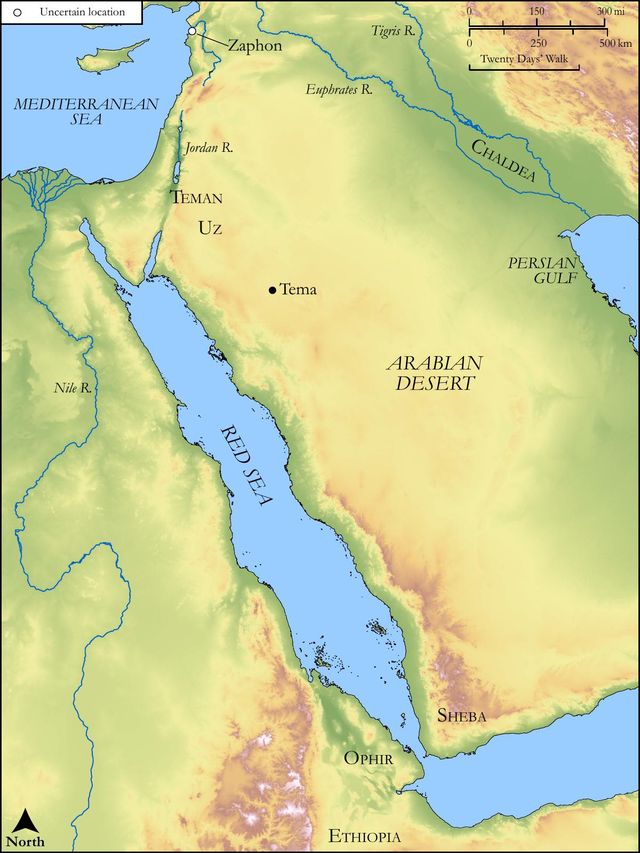
See on the biblical-era map
Study this verse
Public-domain commentary
Matthew Henry
From his Commentary on the Whole Bible. Henry comments on passages, not single verses — this entry covers Job 40:15–24. His three-level outline is real structure in the source text, so it is rendered as structure.
God, for the further proving of his own power and disproving of Job's pretensions, concludes his discourse with the description of two vast and mighty animals, far exceeding man in bulk and strength, one he calls behemoth, the other leviathan. In these verses we have the former described. "Behold now behemoth, and consider whether thou art able to contend with him who made that beast and gave him all the power he has, and whether it is not thy wisdom rather to submit to him and make thy peace with him." Behemoth signifies beasts in general, but must here be meant of some one particular species. Some understand it of the bull; others of an amphibious animal, well known (they say) in Egypt, called the river-horse (hippopotamus), living among the fish in the river Nile, but coming out to feed upon the earth. But I confess I see no reason to depart from the ancient and most generally received opinion, that it is the elephant that is here described, which is a very strong stately creature, of very large stature above any other, of wonderful sagacity, and of so great a reputation in the animal kingdom that among so many four-footed beasts as we have had the natural history of (ch. 38 and 39) we can scarcely suppose this should be omitted. Observe,
I.The description here given of the behemoth.
1.His body is very strong and well built. His strength is in his loins, Job 40:16. His bones, compared with those of other creatures, are like bars of iron, Job 40:18. His back-bone is so strong that, though his tail be not large, yet he moves it like a cedar, with a commanding force, Job 40:17. Some understand it of the trunk of the elephant, for the word signifies any extreme part, and in that there is indeed a wonderful strength. So strong is the elephant in his back and loins, and the sinews of his thighs, that he will carry a large wooden tower, and a great number of fighting men in it. No animal whatsoever comes near the elephant for strength of body, which is the main thing insisted on in this description.
2.He feeds on the productions of the earth and does not prey upon other animals: He eats grass as an ox (Job 40:15), the mountains bring him forth food (Job 40:20), and the beasts of the field do not tremble before him nor flee from him, as from a lion, but they play about him, knowing they are in no danger from him. This may give us occasion,
(1.)To acknowledge the goodness of God in ordering it so that a creature of such bulk, which requires so much food, should not feed upon flesh (for then multitudes must die to keep him alive), but should be content with the grass of the field, to prevent such destruction of lives as otherwise must have ensued.
(2.)To commend living upon herbs and fruits without flesh, according to the original appointment of man's food, Gen 1:29. Even the strength of an elephant, as of a horse and an ox, may be supported without flesh; and why not that of a man? Though therefore we use the liberty God has allowed us, yet be not among riotous eaters of flesh, Pro 23:20.
(3.)To commend a quiet and peaceable life. Who would not rather, like the elephant, have his neighbours easy and pleasant about him, than, like the lion, have them all afraid of him?
3.He lodges under the shady trees (Job 40:21), which cover him with their shadow (Job 40:22), where he has a free and open air to breathe in, while lions, which live by prey, when they would repose themselves, are obliged to retire into a close and dark den, to live therein, and to abide in the covert of that, Job 38:40. Those who are a terror to others cannot but be sometimes a terror to themselves too; but those will be easy who will let others be easy about them; and the reed and fens, and the willows of the brook, though a very weak and slender fortification, yet are sufficient for the defence and security of those who therefore dread no harm, because they design none.
4.That he is a very great and greedy drinker, not of wine or strong drink (to be greedy of that is peculiar to man, who by his drunkenness makes a beast of himself), but of fair water.
(1.)His size is prodigious, and therefore he must have supply accordingly, Job 40:23. He drinks so much that one would think he could drink up a river, if you would give him time, and not hasten him. Or, when he drinks, he hasteth not, as those do that drink in fear; he is confident of his own strength and safety, and therefore makes no haste when he drinks, no more haste than good speed.
(2.)His eye anticipates more than he can take; for, when he is very thirsty, having been long kept without water, he trusts that he can drink up Jordan in his mouth, and even takes it with his eyes, Job 40:24. As a covetous man causes his eyes to fly upon the wealth of this world, which he is greedy of, so this great beast is said to snatch, or draw up, even a river with his eyes.
(3.)His nose has in it strength enough for both; for, when he goes greedily to drink with it, he pierces through snares or nets, which perhaps are laid in the waters to catch fish. He makes nothing of the difficulties that lie in his way, so great is his strength and so eager his appetite.
II.The use that is to be made of this description.
We have taken a view of this mountain of a beast, this over-grown animal, which is here set before us, not merely as a show (as sometimes it is in our country) to satisfy our curiosity and to amuse us, but as an argument with us to humble ourselves before the great God; for,
1.He made this vast animal, which is so fearfully and wonderfully made; it is the work of his hands, the contrivance of his wisdom, the production of his power; it is behemoth which I made, Job 40:15. Whatever strength this, or any other creature, has, it is derived from God, who therefore must be acknowledged to have all power originally and infinitely in himself, and such an arm as it is not for us to contest with. This beast is here called the chief, in its kind, of the ways of God (Job 40:19), an eminent instance of the Creator's power and wisdom. Those that will peruse the accounts given by historians of the elephant will find that his capacities approach nearer to those of reason than the capacities of any other brute-creature whatsoever, and therefore he is fitly called the chief of the ways of God, in the inferior part of the creation, no creature below man being preferable to him.
2.He made him with man, as he made other four-footed beasts, on the same day with man (Gen 1:25, Gen 1:26), whereas the fish and fowl were made the day before; he made him to live and move on the same earth, in the same element, and therefore man and beast are said to be jointly preserved by divine Providence as fellow-commoners, Psa 36:6. "It is behemoth, which I made with thee; I made that beast as well as thee, and he does not quarrel with me; why then dost thou? Why shouldst thou demand peculiar favours because I made thee (Job 10:9), when I made the behemoth likewise with thee? I made thee as well as that beast, and therefore can as easily manage thee at pleasure as that beast, and will do it whether thou refuse or whether thou choose. I made him with thee, that thou mayest look upon him and receive instruction." We need not go far for proofs and instances of God's almighty power and sovereign dominion; they are near us, they are with us, they are under our eye wherever we are.
3.He that made him can make his sword to approach to him (Job 40:19), that is, the same hand that made him, notwithstanding his great bulk and strength, can unmake him again at pleasure and kill an elephant as easily as a worm or a fly, without any difficulty, and without the imputation either of waste or wrong. God that gave to all the creatures their being may take away the being he gave; for may he not do what he will with his own? And he can do it; he that has power to create with a word no doubt has power to destroy with a word, and can as easily speak the creature into nothing as at first he spoke it out of nothing. The behemoth perhaps is here intended (as well as the leviathan afterwards) to represent those proud tyrants and oppressors whom God had just now challenged Job to abase and bring down. They think themselves as well fortified against the judgments of God as the elephant with his bones of brass and iron; but he that made the soul of man knows all the avenues to it, and can make the sword of justice, his wrath, to approach to it, and touch it in the most tender and sensible part. He that framed the engine, and put the parts of it together, knows how to take it in pieces. Woe to him therefore that strives with his Maker, for he that made him has therefore power to make him miserable, and will not make him happy unless he will be ruled by him.
Historical interpretation
Four Centuries of Reception
3 surviving comments on this verse. Each one is dated, so this reads as a timeline rather than a list.
Select a marker to jump to its quote. Markers stagger vertically where authors wrote within a few decades of each other.
“And when he has gone up to a steep mountain, he causes joy to the quadrupeds in the deep.” This means the wild animals have raised their heads only when this animal has withdrawn to the mountains. If [God] has created these two enormous beasts, he did so in order that you might know that he may create all of them according to their own type. But God does not do so because his creation is oriented to provide what is useful to you. Notice how these beasts observe their proper laws: they haunt that part of the sea which is not navigable. But one may ask, What is their use? We ignore what is the mysterious utility of these monsters, but, if we want to take the risk of an explanation, we may say that they lead toward the knowledge of God.
14. It is much to be observed, that the Lord, tempering in His mercy the words of His Scripture, alarms us at one time with sharp excitements, comforts us at another with gentle consolations, and blends terror with comforts, and comforts with terror; in order that, while they are both tempered towards us with wonderful skill of management, we may be found neither to despair through fear, nor yet incautiously secure. For when He had pointed out in manifold expressions the cunning crafts, and the unrestrained strength of Behemoth, He immediately sets forth the coming of His Only-begotten Son our Redeemer, and teaches in what way this Behemoth is to be destroyed; in order that, having oppressed our heart by recounting his might, He might speedily alleviate our sorrow by pointing out his destruction. Therefore, after He had said, He will drink up a river, and will not wonder, and trusteth that Jordan can flow into his mouth, He immediately announces the coming of the Lord’s Incarnation, saying, In his eyes He will take him as with a hook. Who can be ignorant that in a ‘hook’ a bait is shown, a point is concealed? For the bait tempts, that the point may wound. Our Lord therefore, when coming for the redemption of mankind, made, as it were, a kind of hook of Himself for the death of the devil; for He assumed a body, in order that this Behemoth might seek therein the death of the flesh, as if it were his bait. But while he is unjustly aiming at that death in His person, he lost us, whom he was, as it were, justly holding. He was caught, therefore, in the ‘hook’ of His Incarnation, because while he sought in Him the bait of His Body, he was pierced with the sharp point of His Divinity. For there was within Him His Humanity, to attract to Him the devourer, there was there His Divinity to wound; there was there His open infirmity to excite, His hidden virtue to pierce through the jaw of the spoiler. He was, therefore, taken by a hook, because he perished by means of that which he swallowed. And this Behemoth knew indeed the Incarnate Son of God, but knew not the plan of our redemption. For he knew that the Son of God had been incarnate for our redemption, but he was quite ignorant that this our Redeemer was piercing him by His own death. Whence it is well said, In his eyes He will take him as with a hook. For we are said to have in our eyes that which we see placed before us. But the ancient enemy of mankind saw placed before him the Redeemer, Whom he confessed in knowing, feared in confessing, saying, What have we to do with Thee, Thou Son of God? Hast Thou come to torment us before the time? [Matt. 8, 29] He was taken therefore with a hook in his eyes, because he both knew, and seized it; and he first knew Whom to fear, and yet afterwards feared Him not, when hungering in Him for the death of the Flesh, as if it were his proper bait. Because then we have heard what our Head has done by Himself, let us now hear what He is doing by His own members. It follows;
And bore through his nostrils with stakes.
15. What else do we understand by stakes [‘sudes’], that is, poles [‘palos’], (which are sharpened indeed in order to be fixed in the ground,) but the sharp counsels of the Saints? And these perforate the nostrils of this Behemoth, while they both watchfully behold on every side his most ingenious stratagems, and pierce, by overcoming them. But a scent is drawn through the nostrils, and by drawing our breath deep, an object is detected even when placed at some distance. By the nostrils of Behemoth are, therefore, designated his cunning stratagems, by which he most ingeniously endeavours both to learn the secret good qualities of our heart, and to scatter them by his most fatal persuasion. The Lord, therefore, perforates his nostrils with stakes, because, penetrating his crafty stratagems by the acute senses of the Saints, He takes from them their power. But he often hovers about the paths of the righteous with such insidious art, as to seek to approach them for their hurt, even by means of the good qualities which he knows to exist in them. For from observing the liberality of one person, he inflames another with the fire of discord; and when he sees one person compassionate, he persuades another to be angry, in order that, by suggesting that a good deed has not been done in common, he may cut off accordant minds from the benefit of a common favour. For since he is not able to break down the resolutions of the just by persuading them to sin, he is busy in sowing evils therein by means of their good deeds. But holy men overcome these his stratagems the more speedily, the more acutely they detect them. A point which we set forth the better, if we bring forward Paul, one of many maintainers of the truth in evidence. For when a certain Corinthian under his care had committed the sin of incest, the illustrious teacher delivered him up to Satan for the destruction of the flesh, for the satisfaction of penance, and reserved his spirit to be saved to the day of the Lord Jesus. [1 Cor. 5, 5] For by great skill in discipline he was forcibly delivered for punishment to the very person, to whom he had in his sin voluntarily submitted; in order that he who had been the author of the sin of wickedness, might himself become the scourge of discipline. But when this penance had been well gone through, on learning that the Corinthians had been already moved with compassion towards him, he says, To whom ye forgive any thing, I also; for I forgave any thing, for your sakes I forgave it in the person of Christ. [2 Cor. 2, 10] As thinking of the blessing of communion, he says, To whom ye forgive any thing, I also. As if he were saying, I agree with your good doings; may whatever you have done be counted as mine. And he immediately added, And if I forgave any thing, for your sakes I forgave it. As if he were saying, Whatever I have done compassionately, has added further good to your doings. My goodness is, therefore, your profit, your goodness is my profit. And he immediately added and subjoined that binding of hearts [‘compagem cordium’], in which he is thus held, In the person of Christ. For as if we were presuming to say to him, Why dost thou so carefully couple thyself with thy disciples? why dost thou so anxiously conform either thyself to them, or them to thyself in thy doings? he immediately subjoined, That we may not be circumvented by Satan. [ib. 11] And with what acuteness he penetrates his crafty stratagems, he teaches, adding, For we are not ignorant of his devices. As if he said in other words, We are sharp stakes of the Lord’s making, and we penetrate the nostrils of this Behemoth by subtle circumspection, lest he should pervert to an evil end that which the mind enters on aright.
16. By ‘stakes’ can be signified the acute words of Wisdom Himself manifested in the flesh, so that by the nostrils of Behemoth may be typified (since scent is drawn in by the nostrils) that prying search of the ancient enemy. For when he doubted whether God were incarnate, he wished to ascertain this by tempting and asking of Him miracles, saying, If Thou be the Son of God, command that these stones be made bread. [Matt. 4, 3] Because then he wished to learn the scent of His Divinity from the evidence of miracles, he drew in the breath, as it were, by his nostrils. But when it is immediately said to him in answer, Man liveth not by bread alone, and, Thou shall not tempt the Lord thy God, [ib. 4, 7] because the Truth repelled the searching enquiry of the ancient enemy by the sharpness of his sayings, he pierced his nostrils, as it were, with stakes. But because this Behemoth spreads forth with various arguments of deceit, he is marked still further by the addition of another name.
The words “the shadows surround it.” Because of the size of the animal, [the author says], anywhere it goes, it casts shadows around it. The words “the crows like a torrent surround it.” [This is said] because the habit of these birds is to approach and croak anytime they see something terrifying.
Continue studying Job 40:24 across the web’s major study libraries — every link below opens this exact verse, chapter, or book on the destination site.
Read & Compare
 BibleGatewayThis verse in more than 200 translations and 70 languages.
 Bible.comThe YouVersion reader — hundreds of translations, reading plans, and highlights.
 ESV.orgCrossway's official English Standard Version reader.
 NET BibleThe NET translation with 60,000+ translators' notes on every rendering decision.
 STEP BibleTyndale House's free study tool — original text, vocabulary, and scholarly resources.
 BibliaLogos Bible Software's free web reader.
 USCCBThe New American Bible (Revised Edition) with the U.S. bishops' study notes.
Commentaries
 BibleHub CommentariesDozens of classic commentaries on this verse, gathered on one page.
 StudyLightMore than 100 commentary sets — the largest collection on the web.
 BibleRefPlain-English commentary on what this verse means, verse by verse.
 Enduring WordDavid Guzik's free commentary on this chapter, widely used by Bible teachers.
 Bible Study ToolsVerse commentary alongside Greek and Hebrew study aids.
Original Language & Research
- BibleHub InterlinearThe verse word by word — original language, transliteration, and English.
- BibleHub LexiconEvery word's original-language definition and Strong's entry.
 Blue Letter BibleDeep-study tools — Strong's numbers, concordance, and word studies.
 SefariaThe Hebrew text with Rashi and centuries of Jewish commentary.
Sermons, Hymns & Audio


TrulyRandomVerse is not affiliated with these sites and doesn’t control their content. They’re linked because they’re genuinely useful.
Summary
Job 40:24 concludes God's profound description of Behemoth, a creature of staggering power and untameable nature, presented within the divine discourse to Job from the whirlwind. This verse, widely interpreted as a series of rhetorical questions, underscores Behemoth's invulnerability to human capture or control, thereby serving to magnify the Creator's own immeasurable power, wisdom, and sovereign authority, which vastly surpass any human capacity or understanding.
Context
ShowHideLiterary Context
Job 40:24 is positioned at the climax of God's second major speech to Job (chapters 38-41), delivered directly from a whirlwind. This divine monologue is not an explanation for Job's suffering but a majestic revelation of God's omnipotence and absolute control over all creation. Following an initial challenge to Job's wisdom and power (Job 38-39), God introduces Behemoth (Job 40:15-24) and subsequently Leviathan (Job 41:1-34) as preeminent examples of His creative might. The detailed portrayal of Behemoth, culminating in this verse, functions as a powerful rhetorical challenge to Job: if he cannot even contend with or control such a formidable creature, how much less can he challenge or comprehend the ways of its infinitely more powerful Creator? The verse thus serves as a climactic statement of Behemoth's formidable nature, directly confronting Job's perceived capacity and understanding.
Historical & Cultural Context
Among the nations of that day, the ability to tame and control large, wild animals was a significant marker of power, dominion, and even divine favor, often associated with kings, heroes, and deities. Descriptions of fearsome beasts, whether real or mythical, were common in ancient literature to illustrate the might of gods or human rulers. The imagery of hooks, snares, and nose-rings for controlling powerful animals like oxen or camels was a familiar and practical method of subjugation. Therefore, God's rhetorical questions about capturing Behemoth would have resonated deeply with Job and his contemporaries, highlighting the creature's exceptional untameability. The ongoing scholarly debate over Behemoth's precise zoological identity (often identified as a hippopotamus or elephant, or a mythical creature) underscores its symbolic role as the epitome of untameable strength, emphasizing a theological message about God's power rather than a literal zoological identification.
Key Themes
ShowHideThis verse, situated within the broader context of God's speeches, powerfully contributes to several overarching themes in the Book of Job. Primarily, it underscores God's Unchallengeable Power and Sovereignty. The detailed, awe-inspiring portrayal of Behemoth, a creature utterly beyond human control, serves as a tangible demonstration of the limitless might of its Creator, echoing the declarations of God's power over creation found in Psalm 104. Secondly, it highlights Human Limitations and Humility. By presenting a creature that Job cannot subdue, God illustrates the vast chasm between finite human weakness and infinite divine omnipotence, inviting Job to acknowledge his own limited understanding and power, a theme that culminates in Job's confession of God's omnipotence in Job 42:2. Finally, it evokes Awe for Creation, encouraging a deep sense of wonder and reverence for the diversity and power of God's creative work, reflecting His boundless wisdom and power, as seen throughout the creation account in Genesis 1.
Exposition and Analysis
ShowHideKey Word Analysis
ShowHideA primitive root meaning "to take" (in the widest variety of applications), "to seize," "to accept," or "to capture." In Job 40:24, the verb יִקָּחֶנּוּ (yiqqāḥennû), derived from this root, is often translated as "he takes it" or, more commonly in modern scholarship, as a rhetorical question: "Can one take it?" This emphasizes the impossibility of seizing Behemoth, highlighting its formidable nature and vigilance.
This noun refers to a "noose" (for catching animals), a "snare," or a "trap." By implication, it can also mean a "hook" (for the nose). In the context of Job 40:24, the plural form בְּמוֹקְשִׁים (bəmuqāšîm) means "with snares" or "by means of traps." Its use here underscores the futility of human attempts to control Behemoth through conventional trapping or restraining devices, reinforcing the creature's untameable nature.
A primitive root meaning "to puncture," "to pierce," "to bore through," or figuratively "to specify" or "designate." In the keeping of animals in that day, piercing the nose of a large animal with a ring or hook was a common method of subjugation. The verb יִנָּקֵב (yinnāqēḇ) in this verse is understood as a rhetorical question: "Can its nose be pierced?" or "Can one put a hook through its nose?" The implied negative answer emphasizes Behemoth's imperviousness to such methods, highlighting its immense strength and invulnerability to human control.
Verse Breakdown
ShowHide"He taketh it with his eyes"
While the King James Version renders this as a declarative statement, the most widely accepted interpretation among modern scholars is that this is a rhetorical question posed by God to Job: "Can one capture it in its presence?" or "Can one take it while it watches?" This reading emphasizes Behemoth's acute awareness and the sheer difficulty, if not impossibility, of subduing such a vigilant and powerful creature through direct confrontation or stealth. The implied answer is a resounding "No," underscoring the creature's formidable nature and the limits of human power.
"[his] nose pierceth through snares"
Similar to the first clause, the KJV presents this as a statement of Behemoth's action. However, the Hebrew is best understood as another rhetorical question: "Can its nose be pierced by snares?" or "Can one put a hook through its nose for control?" This alludes to the ancient practice of inserting rings or hooks into the noses of large, powerful animals (like oxen or bears) to lead or control them. The question highlights Behemoth's immense strength and thick hide, implying that no human-made snare or piercing device could effectively control it. The creature is too powerful to be tamed or led by conventional means, further emphasizing God's unique power over such a creation.
Literary Devices
ShowHideJob 40:24, along with the broader description of Behemoth, employs several potent literary devices to convey its profound theological message. The most prominent is the Rhetorical Question, as the verse is widely interpreted as two challenging questions posed by God to Job, rather than declarative statements. These questions ("Can one capture it...?" "Can its nose be pierced...?") are designed not to elicit an answer from Job, but to emphasize the sheer impossibility of human control over such a creature, thereby magnifying God's own power as its Creator. This technique forces Job to confront his own limitations and God's unchallengeable might. Hyperbole is also at play, as the description of Behemoth's untameable nature and invulnerability might be exaggerated to underscore its formidable character and, by extension, God's supreme power. Behemoth functions as Symbolism, representing the untamed, immense power of creation that lies utterly beyond human dominion. It is a tangible metaphor for the vastness of God's power and the limits of human understanding and control. The entire divine discourse, including this verse, serves as a powerful demonstration of Divine Revelation, where God reveals His character not through explanation of suffering, but through the overwhelming display of His creative and sovereign power.
Theological and Thematic Connections
ShowHideJob 40:24 profoundly contributes to the biblical understanding of divine sovereignty and human humility. By presenting Behemoth as an untameable force, God emphatically demonstrates that His power extends far beyond human comprehension or control, even over the most formidable aspects of His creation. This challenges any notion of human autonomy or self-sufficiency, compelling Job, and by extension all humanity, to recognize their finite nature in the face of an infinite God. The verse invites a posture of awe and reverence, reminding us that God's wisdom in creation is as boundless as His power, and His ways are often inscrutable to human reason. It teaches us to trust in a God who can manage the most powerful creatures, and therefore, can surely manage the complexities and mysteries of our lives, even when we do not understand His methods or purposes.
Reflection and Application
ShowHideJob 40:24 serves as a powerful mirror, reflecting our own limitations and the boundless majesty of God. In a world that often prizes human ingenuity, control, and understanding, this verse calls us to a profound humility. It challenges our tendency to seek exhaustive explanations for every trial or to believe we can master every circumstance. Just as Job could not contend with Behemoth, we cannot fully grasp or control the vastness of God's creation, let alone His intricate plans for our lives. This passage encourages us to release our grip on the need for exhaustive understanding and instead cultivate a deep trust in the all-wise, all-powerful Creator. It invites us to marvel at the sheer wonder of God's creative work, recognizing that if His power is evident in a creature like Behemoth, how much more is it at work in sustaining creation and orchestrating our individual paths. Our response should be one of humble adoration and confident surrender to the God who holds all things in His hands.
Questions for Reflection
ShowHideFAQ
ShowHideWhat is Behemoth, and why is it described in such detail?
ShowHideBehemoth, described in Job 40:15-24, is a creature of immense power and size, often identified by scholars as a hippopotamus or elephant, or sometimes as a mythical primeval beast. Its exact zoological identity is less important than its theological purpose. God describes Behemoth in such detail to demonstrate His unparalleled creative power and sovereignty. By presenting a creature that is untameable and overwhelmingly strong, God rhetorically asks Job if he can contend with it. The implied answer is "no," thereby humbling Job and illustrating that if he cannot even control this creature, he certainly cannot challenge or fully comprehend the ways of its Creator. It serves as a tangible example of God's power over creation, far exceeding human capacity.
Why is Job 40:24 considered a difficult verse to translate, and what is its most common interpretation?
ShowHideJob 40:24 is notoriously difficult to translate from the Hebrew due to its concise and ambiguous syntax, leading to various renderings in different Bible versions. The King James Version's "He taketh it with his eyes: [his] nose pierceth through snares" presents it as a declarative statement. However, the most common and widely accepted interpretation among modern scholars is that the verse contains two rhetorical questions. The first part, "He taketh it with his eyes," is understood as "Can one capture it in its presence?" or "Can one take it while it watches?" The second part, "[his] nose pierceth through snares," is interpreted as "Can its nose be pierced by snares?" or "Can one put a hook through its nose?" This interpretation emphasizes the impossibility of capturing or controlling Behemoth by human means, thereby magnifying God's power as the one who created and controls such a creature.
What is the main point God is making to Job by describing Behemoth and Leviathan?
ShowHideThe main point God makes to Job through the detailed descriptions of Behemoth (Job 40:15-24) and Leviathan (Job 41:1-34) is not to explain the reasons for Job's suffering, but to reveal His own absolute sovereignty, wisdom, and power over all creation. God challenges Job to recognize his own finite understanding and limited power in comparison to the Creator of such formidable beasts. If Job cannot even contend with these creatures, how can he question or understand the ways of their Maker? The descriptions serve to humble Job, leading him to a place of profound reverence and trust in God's unsearchable wisdom, ultimately culminating in Job's confession of God's omnipotence in Job 42:2.
Christ-Centered Fulfillment
ShowHideWhile Job 40:24, with its focus on Behemoth, highlights God's immense power in creation, its ultimate fulfillment and deepest meaning are found in Jesus Christ. The untameable power and sovereignty of God, so vividly displayed in His control over Behemoth, are fully embodied and revealed in the Son. Christ is not merely a powerful creature's Creator but the very Word through whom all things were made, and by whom all things hold together, including every "behemoth" of creation (Colossians 1:16-17). The power that could not be challenged by Job is the power that Jesus demonstrated in calming storms, casting out demons, and ultimately, conquering sin and death. He is the one who "upholds the universe by the word of his power" (Hebrews 1:3). The rhetorical questions posed to Job about controlling Behemoth find their ultimate answer in Christ, who possesses "all authority in heaven and on earth" (Matthew 28:18). He is the supreme demonstration of God's wisdom and power, not just over physical creation, but over the spiritual forces of evil, effectively "destroying the works of the devil" (1 John 3:8), thereby taming the true "behemoths" that seek to ensnare humanity. In Christ, we see the very God who spoke from the whirlwind, now made flesh, inviting us not to fear His power, but to trust in His redemptive and sovereign love.