


Job 40:23
Bible text: King James Version (1769 Blayney text) · Public domain
Bible text: Berean Standard Bible · Public domain
Bible text: American Standard Version (1901) · Public domain
Bible text: World English Bible, Messianic edition · Public domain
Bible text: Geneva Bible (1599) · Public domain
Bible text: Young's Literal Translation · Public domain
- הֵןhenthere!H2005PrtParticle Interjection
- יַעֲשֹׁקya·'a·Shokit is violentH6231V-Qal-Imperf-3msVerb Qal Imperfect 3rd Singular Masculine
- נָהָרNa·hor[the] riverH5104N-msNoun Singular Masculine Absolute
- לֹאlo'notH3808NegParticle Negative
- יַחְפּוֹזyach·Pozit is alarmedH2648V-Qal-Imperf-3msVerb Qal Imperfect 3rd Singular Masculine
- יִבְטַחyiv·Tachit is confidentH982V-Qal-Imperf-3msVerb Qal Imperfect 3rd Singular Masculine
- כִּיkiforH3588PrtParticle Conditional
- יָגִיחַya·Gi·achit bursts forthH1518V-Qal-Imperf-3msVerb Qal Imperfect 3rd Singular Masculine
- יַרְדֵּןyar·Den[the] JordanH3383N-properNoun Proper Location
- אֶל'eltoH413PrepPreposition
- פִּיהוּPi·huits mouthH6310N-msc ¦ 3msNoun Singular Masculine Constructפִּיmouthהוּits
English is a literal word-by-word gloss of the Hebrew, not the KJV's wording. Why?
This is the original text the KJV's translators worked from — each Hebrew word with its own literal English meaning in this verse, prepared by scholars at Tyndale House, Cambridge. The KJV translates whole sentences, not word by word, so its wording differs: one Hebrew word can become several English words, and the KJV may choose “the LORD” where the gloss reads “Yahweh”. Both are faithful — they answer different questions. For the KJV's own rendering, switch to the KJV text.
Details
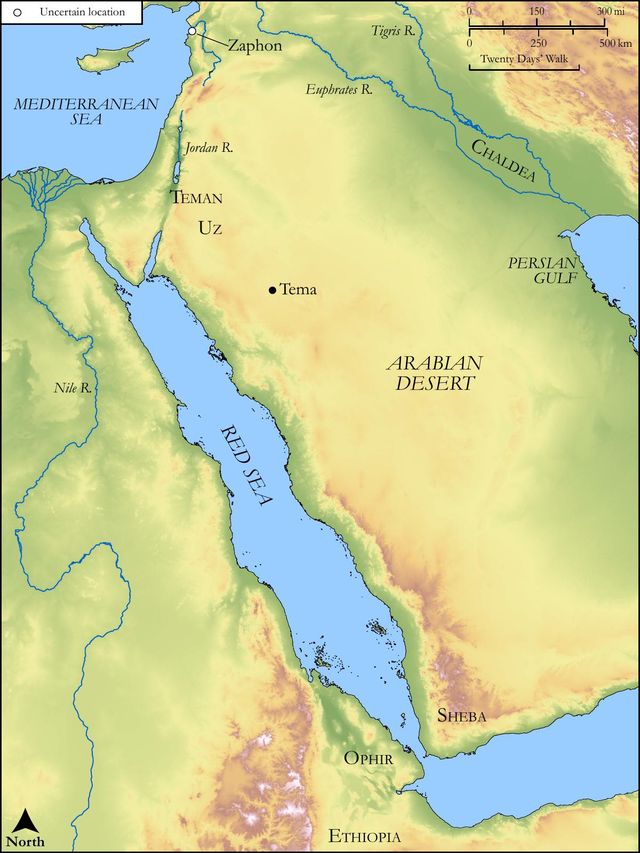
See on the biblical-era map
Study this verse
Public-domain commentary
Matthew Henry
From his Commentary on the Whole Bible. Henry comments on passages, not single verses — this entry covers Job 40:15–24. His three-level outline is real structure in the source text, so it is rendered as structure.
God, for the further proving of his own power and disproving of Job's pretensions, concludes his discourse with the description of two vast and mighty animals, far exceeding man in bulk and strength, one he calls behemoth, the other leviathan. In these verses we have the former described. "Behold now behemoth, and consider whether thou art able to contend with him who made that beast and gave him all the power he has, and whether it is not thy wisdom rather to submit to him and make thy peace with him." Behemoth signifies beasts in general, but must here be meant of some one particular species. Some understand it of the bull; others of an amphibious animal, well known (they say) in Egypt, called the river-horse (hippopotamus), living among the fish in the river Nile, but coming out to feed upon the earth. But I confess I see no reason to depart from the ancient and most generally received opinion, that it is the elephant that is here described, which is a very strong stately creature, of very large stature above any other, of wonderful sagacity, and of so great a reputation in the animal kingdom that among so many four-footed beasts as we have had the natural history of (ch. 38 and 39) we can scarcely suppose this should be omitted. Observe,
I.The description here given of the behemoth.
1.His body is very strong and well built. His strength is in his loins, Job 40:16. His bones, compared with those of other creatures, are like bars of iron, Job 40:18. His back-bone is so strong that, though his tail be not large, yet he moves it like a cedar, with a commanding force, Job 40:17. Some understand it of the trunk of the elephant, for the word signifies any extreme part, and in that there is indeed a wonderful strength. So strong is the elephant in his back and loins, and the sinews of his thighs, that he will carry a large wooden tower, and a great number of fighting men in it. No animal whatsoever comes near the elephant for strength of body, which is the main thing insisted on in this description.
2.He feeds on the productions of the earth and does not prey upon other animals: He eats grass as an ox (Job 40:15), the mountains bring him forth food (Job 40:20), and the beasts of the field do not tremble before him nor flee from him, as from a lion, but they play about him, knowing they are in no danger from him. This may give us occasion,
(1.)To acknowledge the goodness of God in ordering it so that a creature of such bulk, which requires so much food, should not feed upon flesh (for then multitudes must die to keep him alive), but should be content with the grass of the field, to prevent such destruction of lives as otherwise must have ensued.
(2.)To commend living upon herbs and fruits without flesh, according to the original appointment of man's food, Gen 1:29. Even the strength of an elephant, as of a horse and an ox, may be supported without flesh; and why not that of a man? Though therefore we use the liberty God has allowed us, yet be not among riotous eaters of flesh, Pro 23:20.
(3.)To commend a quiet and peaceable life. Who would not rather, like the elephant, have his neighbours easy and pleasant about him, than, like the lion, have them all afraid of him?
3.He lodges under the shady trees (Job 40:21), which cover him with their shadow (Job 40:22), where he has a free and open air to breathe in, while lions, which live by prey, when they would repose themselves, are obliged to retire into a close and dark den, to live therein, and to abide in the covert of that, Job 38:40. Those who are a terror to others cannot but be sometimes a terror to themselves too; but those will be easy who will let others be easy about them; and the reed and fens, and the willows of the brook, though a very weak and slender fortification, yet are sufficient for the defence and security of those who therefore dread no harm, because they design none.
4.That he is a very great and greedy drinker, not of wine or strong drink (to be greedy of that is peculiar to man, who by his drunkenness makes a beast of himself), but of fair water.
(1.)His size is prodigious, and therefore he must have supply accordingly, Job 40:23. He drinks so much that one would think he could drink up a river, if you would give him time, and not hasten him. Or, when he drinks, he hasteth not, as those do that drink in fear; he is confident of his own strength and safety, and therefore makes no haste when he drinks, no more haste than good speed.
(2.)His eye anticipates more than he can take; for, when he is very thirsty, having been long kept without water, he trusts that he can drink up Jordan in his mouth, and even takes it with his eyes, Job 40:24. As a covetous man causes his eyes to fly upon the wealth of this world, which he is greedy of, so this great beast is said to snatch, or draw up, even a river with his eyes.
(3.)His nose has in it strength enough for both; for, when he goes greedily to drink with it, he pierces through snares or nets, which perhaps are laid in the waters to catch fish. He makes nothing of the difficulties that lie in his way, so great is his strength and so eager his appetite.
II.The use that is to be made of this description.
We have taken a view of this mountain of a beast, this over-grown animal, which is here set before us, not merely as a show (as sometimes it is in our country) to satisfy our curiosity and to amuse us, but as an argument with us to humble ourselves before the great God; for,
1.He made this vast animal, which is so fearfully and wonderfully made; it is the work of his hands, the contrivance of his wisdom, the production of his power; it is behemoth which I made, Job 40:15. Whatever strength this, or any other creature, has, it is derived from God, who therefore must be acknowledged to have all power originally and infinitely in himself, and such an arm as it is not for us to contest with. This beast is here called the chief, in its kind, of the ways of God (Job 40:19), an eminent instance of the Creator's power and wisdom. Those that will peruse the accounts given by historians of the elephant will find that his capacities approach nearer to those of reason than the capacities of any other brute-creature whatsoever, and therefore he is fitly called the chief of the ways of God, in the inferior part of the creation, no creature below man being preferable to him.
2.He made him with man, as he made other four-footed beasts, on the same day with man (Gen 1:25, Gen 1:26), whereas the fish and fowl were made the day before; he made him to live and move on the same earth, in the same element, and therefore man and beast are said to be jointly preserved by divine Providence as fellow-commoners, Psa 36:6. "It is behemoth, which I made with thee; I made that beast as well as thee, and he does not quarrel with me; why then dost thou? Why shouldst thou demand peculiar favours because I made thee (Job 10:9), when I made the behemoth likewise with thee? I made thee as well as that beast, and therefore can as easily manage thee at pleasure as that beast, and will do it whether thou refuse or whether thou choose. I made him with thee, that thou mayest look upon him and receive instruction." We need not go far for proofs and instances of God's almighty power and sovereign dominion; they are near us, they are with us, they are under our eye wherever we are.
3.He that made him can make his sword to approach to him (Job 40:19), that is, the same hand that made him, notwithstanding his great bulk and strength, can unmake him again at pleasure and kill an elephant as easily as a worm or a fly, without any difficulty, and without the imputation either of waste or wrong. God that gave to all the creatures their being may take away the being he gave; for may he not do what he will with his own? And he can do it; he that has power to create with a word no doubt has power to destroy with a word, and can as easily speak the creature into nothing as at first he spoke it out of nothing. The behemoth perhaps is here intended (as well as the leviathan afterwards) to represent those proud tyrants and oppressors whom God had just now challenged Job to abase and bring down. They think themselves as well fortified against the judgments of God as the elephant with his bones of brass and iron; but he that made the soul of man knows all the avenues to it, and can make the sword of justice, his wrath, to approach to it, and touch it in the most tender and sensible part. He that framed the engine, and put the parts of it together, knows how to take it in pieces. Woe to him therefore that strives with his Maker, for he that made him has therefore power to make him miserable, and will not make him happy unless he will be ruled by him.
Historical interpretation
Five Centuries of Reception
5 surviving comments on this verse. Each one is dated, so this reads as a timeline rather than a list.
Select a marker to jump to its quote. Markers stagger vertically where authors wrote within a few decades of each other.
For since the children are partakers of flesh and blood, He also Himself likewise partook of the same (Heb 2.14), that having been made partakers of His presence in the flesh we might be made partakers also of His Divine grace: thus Jesus was baptized, that thereby we again by our participation might receive both salvation and honour. According to Job, there was in the waters the dragon that draws up the Jordan into his mouth [Job 40.23]. Since,
Therefore, it was necessary to break the heads of the dragon in pieces (Ps 74.14), He went down and bound the strong one in the waters, that we might receive power to tread upon serpents and scorpions (Luke 10.19). The beast was great and terrible. No fishing- vessel was able to carry one scale of his tail (Job 40.26): destruction ran before him (Job 41.13), ravaging all that met him. The Life encountered him, that the mouth of Death might henceforth be stopped, and all we that are saved might say, O death, where is thy sting? O grave, where is thy victory (1 Cor 15.55)? The sting of death is drowned by Baptism. - "Catechetical Lectures 3, Chapter 11."
“And when he has gone up to a steep mountain, he causes joy to the quadrupeds in the deep.” This means the wild animals have raised their heads only when this animal has withdrawn to the mountains. If [God] has created these two enormous beasts, he did so in order that you might know that he may create all of them according to their own type. But God does not do so because his creation is oriented to provide what is useful to you. Notice how these beasts observe their proper laws: they haunt that part of the sea which is not navigable. But one may ask, What is their use? We ignore what is the mysterious utility of these monsters, but, if we want to take the risk of an explanation, we may say that they lead toward the knowledge of God.
12. For what is in this place designated by the name of ‘river,’ except the downward course of the human race, which rises at its birth, as if from the source of its fountain, but passes down, as if flowing to its lowest level at its death? But who are signified by the expression ‘Jordan,’ except those who have been already imbued with the sacrament of Baptism? For since our Redeemer deigned to be baptized in this river, all who have been baptized must needs be expressed by the name of that stream, in which this very sacrament of Baptism happened to be begun. Because, therefore, this Behemoth has drawn to himself like a river the human race flowing downward from the beginning of the world, even to the times of redemption, but a few Elect ones escaping him, it is now well said; He will drink up a river, and will not wonder. But since even after the coming of the Mediator he seizes some even of the faithful, who neglect to live righteously, it is rightly subjoined; And trusteth that Jordan can flow into his mouth. As if it were plainly said, Before the coming of the Redeemer of the world, he drank up the world without wondering, but, which is far worse, even after the coming of the Redeemer, he trusts that he is able to swallow up some, who have been sealed with the sacrament of Baptism. For he devours some who have been placed in the profession of Christians, because he supplants them by causing error in their faith itself. But others he does not turn aside from the uprightness of the faith, but inclines to the practice of wicked works. Others he is unable to bend as much as he wishes in deeds of impurity, but he inwardly turns them aside from the zeal of their intention; so that, when they sever their minds from charity, whatever they may do outwardly may not be right. And they retain the faith, but they retain not the life of faith; because they either openly do those things which are unlawful, or else from their perverted heart, their doings are wicked, even though they seem to be holy. For since some persons are faithful in their professions, but not in their lives, it is said by the voice of the Truth, Not every one that saith unto Me, Lord, Lord, shall enter into the kingdom of heaven. [Matt 7, 21] Hence He says again; But why call ye Me, Lord, Lord, and do not the things which I say? [Luke 6, 46] Hence Paul says, They profess that they know God, but in works they deny Him. [Tit. 1, 16] Hence John says, He that saith that he knoweth God, and keepeth not His commandments, is a liar. [1 John 2, 4] Hence it is that the Lord complains of His own ancient people; This people honoureth Me with their lips, but their heart is far from Me. [Mark 7, 6; Is. 29, 13] Hence also the Psalmist says, They loved Him with their mouth, and they lied unto Him with their tongue. [Ps. 78, 36] But it was no wonder that this Behemoth before the water of the laver, before the heavenly sacraments, before the corporeal presence of the Redeemer, drank up, with the yawning gulph of his deep persuasion, the river of the human race. But it is very wonderful, it is very terrible, that even after the knowledge of the Redeemer, he seizes many with his open mouth, that he pollutes them after the water of the laver, that after heavenly sacraments he hurries them away to the depth of hell. Let it be said then, let it be said fearfully by the voice of the Truth; He will drink up a river, and will not wonder, and trusteth that Jordan can flow into his mouth. For the devil counted it not a great thing that he seized unbelievers, but he now rouses himself with all his efforts to destroy those, whom he pines at seeing regenerated against him. Let no one then trust that faith without works can be sufficient for him, when we know that it is written; Faith without works is dead. [James 2, 20] Let no one think that he has entirely escaped the bite of Behemoth by a mere confession of faith. Because he has already drunk up a river, but still thirsts after Jordan. And Jordan flows into his mouth as often as any Christian sinks down into iniquity. We have now escaped his mouth, by the aid of faith, but we must take earnest heed, not to fall therein by slippery doings. If care in walking is neglected, it is in vain that we keep the straight road by faith. Because the way of faith leads indeed to the heavenly country, but it does not carry to the close those who stumble therein.
13. We have another point to consider more minutely on this head. For those who we said were expressed by ‘Jordan,’ can also be designated by the ‘river.’ For they who have already confessed their belief in the truth, but neglect to live faithfully, can rightly be called a ‘river:’ namely, because they flow downwards. But ‘Jordan’ in the Hebrew word means ‘the descent of them.’ And there are some who in seeking the way of truth cast away their own selves, and come down from the pride of their former life. And when they desire eternal things, they entirely estrange themselves from this world, by not only seeking after the goods of others, but even abandoning their own. And so far from seeking glory therein, they despise it even when it offers itself. For hence is that which is said by the voice of the Truth, If any man will come after Me, let him deny himself. [Luke 9, 23] For a man denies himself, if, having trampled down the haughtiness of pride, he shows before the eyes of God that he is strange to himself. Hence the Psalmist says, I will remember thee from the land of Jordan, and of the Hermonites. [Ps. 42, 6] For Jordan, as I said, is interpreted ‘Descent,’ but Hermonites, Anathema, that is, ‘Alienation.’ He therefore remembers God from the land of Jordan, and of the Hermonites, who by humbling himself, and by living estranged from himself, is recalled to think on his Creator. But the ancient enemy considers it no great matter, that he holds under the rule of his tyranny those who seek after earthly things. For we know, as the Prophet witnesses, that His food is choice. [Hab. l, 16] Nor does he count it a wonderful thing if he swallows up those whom pride exalts, covetousness wastes away, pleasure relaxes [‘dilatat’], wickedness contracts [‘angustat’], anger inflames, discord separates, envy exulcerates, lust pollutes and kills. He will therefore swallow up a river, and will not wonder, because he counts it no great thing, when he devours those, who by the very pursuits of their life run downwards. But he earnestly endeavours to seize those whom he sees already united to heavenly things, from their contempt of the things of earth. And hence, when the river has been swallowed up, it is rightly subjoined, And he trusteth that Jordan can flow into his mouth, because he is anxious to lurk in ambush, and seize those, whom he sees casting themselves down from the glory of the present life through love of their heavenly country. For some in truth forsake the world, abandon the vanities of transient honours, and, seeking the lowliness of humility, transcend by good living the custom of human conversation; and advance in such lofty pursuits [‘tanta studiorum arce’], as even now to perform mighty wonders. But because they neglect to protect themselves by circumspection, they are wounded by the shaft of vain glory, and fall the more fatally from on high. For hence it is that the eternal Judge, Who weighs the secrets of the heart, foretells this same fall and ruin, and threatens, saying, Many will say to Me in that day, Lord, Lord, have we not prophesied in Thy Name, and in Thy Name have cast out devils, and in Thy Name have done many wonderful works? And then will I profess unto them that I never knew you: depart from Me, ye that work iniquity, I know not who ye are. [Matt. 7, 22. 23.] Hence also it is said by the Prophet, The Lord called judgment to the fire, and it devoured the great abyss, and will eat up a part of the house of the Lord. [Amos 7, 4] For judgment is called to the fire, when the sentence of justice is already displayed for the punishment of eternal burning. And it devours the great abyss, because it consumes the wicked and incomprehensible minds of men, which now conceal themselves from men even under the miracles of signs. But a part of the house of the Lord is eaten up; because Gehenna devours those also, who now boast, as it were, by their holy deeds, of being in the number of the Elect. They therefore who are here called ‘Jordan,’ are there called ‘a part of the house of the Lord.’ The ancient enemy therefore trusts that even Jordan can flow into his mouth, because he sometimes destroys, by the stratagems of his cunning, those even who are now considered Elect. But whose hardness of heart would not these words of the Lord arouse? Whose firmness of mind would not be shaken from the inmost depths of his thoughts, when our enemy is shown to be of such great power against us? Will there be no aid of consolation?
Hence the Lord says to blessed Job concerning the ancient enemy of the human race: "He will swallow up a river and not wonder, and he has confidence that the Jordan will flow into his mouth." For who is signified by the river except the flow of the human race? For this race flows from origin to end, and, as if in the manner of water, runs its course from the flux of the flesh until its appointed end. What is signified by the Jordan except the pattern of the baptized? For since the very Author of our redemption deigned to be baptized in the river Jordan, the multitude of those who are held within the sacrament of baptism is rightly expressed by the name Jordan. Therefore the ancient enemy of the human race swallowed up the river, because from the beginning of the world until the coming of the Redeemer, with scarcely a few elect escaping, he drew the human race into the belly of his malice. Of him it is rightly said: "He will swallow up a river and not wonder," because he does not consider it a great thing when he seizes unbelievers. But what is added is very grave: "And he has confidence that the Jordan will flow into his mouth," because after he seized all the unbelievers from the beginning of the world, he still presumes that he can receive even the faithful. For by the mouth of pestilent persuasion he daily devours those in whose case a wicked life is at variance with the confession of faith.
The words “the shadows surround it.” Because of the size of the animal, [the author says], anywhere it goes, it casts shadows around it. The words “the crows like a torrent surround it.” [This is said] because the habit of these birds is to approach and croak anytime they see something terrifying.
Continue studying Job 40:23 across the web’s major study libraries — every link below opens this exact verse, chapter, or book on the destination site.
Read & Compare
 BibleGatewayThis verse in more than 200 translations and 70 languages.
 Bible.comThe YouVersion reader — hundreds of translations, reading plans, and highlights.
 ESV.orgCrossway's official English Standard Version reader.
 NET BibleThe NET translation with 60,000+ translators' notes on every rendering decision.
 STEP BibleTyndale House's free study tool — original text, vocabulary, and scholarly resources.
 BibliaLogos Bible Software's free web reader.
 USCCBThe New American Bible (Revised Edition) with the U.S. bishops' study notes.
Commentaries
 BibleHub CommentariesDozens of classic commentaries on this verse, gathered on one page.
 StudyLightMore than 100 commentary sets — the largest collection on the web.
 BibleRefPlain-English commentary on what this verse means, verse by verse.
 Enduring WordDavid Guzik's free commentary on this chapter, widely used by Bible teachers.
 Bible Study ToolsVerse commentary alongside Greek and Hebrew study aids.
Original Language & Research
- BibleHub InterlinearThe verse word by word — original language, transliteration, and English.
- BibleHub LexiconEvery word's original-language definition and Strong's entry.
 Blue Letter BibleDeep-study tools — Strong's numbers, concordance, and word studies.
 SefariaThe Hebrew text with Rashi and centuries of Jewish commentary.
Sermons, Hymns & Audio


TrulyRandomVerse is not affiliated with these sites and doesn’t control their content. They’re linked because they’re genuinely useful.
Summary
Job 40:23 is a profound segment of God's majestic discourse to Job from the whirlwind, vividly portraying the formidable power and unhurried confidence of Behemoth. This verse illustrates the creature's immense capacity for water, depicting it as effortlessly consuming vast quantities, even to the point of trusting it can draw up the Jordan River into its mouth. This hyperbolic description serves not merely as a zoological account but as a powerful revelation of divine creative might, designed to humble Job and underscore the incomprehensible scale of God's dominion over creation, which far exceeds human understanding or challenge.
Context
ShowHideLiterary Context
This verse is deeply embedded within God's climactic and unchallengeable address to Job, which commences in Job 38. Following chapters of Job's profound lamentations and the circular theological debates with his friends, God finally intervenes, not to provide a direct explanation for Job's suffering, but to assert His absolute sovereignty, wisdom, and power as the Creator. The divine discourse unfolds through a series of rhetorical questions that highlight the intricate wonders of the heavens and the untamed forces of nature. This culminates in the detailed and awe-inspiring descriptions of two magnificent, untamable creatures: Behemoth, detailed in Job 40:15-24, and Leviathan, extensively described in Job 41. Job 40:23 specifically contributes to the portrayal of Behemoth's overwhelming strength, immense capacity, and unperturbed demeanor, serving as a powerful, tangible example of God's unparalleled might and intricate design, which Job, in his finite understanding, cannot possibly grasp or control. It sets the stage for Job's ultimate surrender and confession of ignorance in Job 42:1-6.
Historical & Cultural Context
The land of Uz, the setting for the book of Job, was a land intimately acquainted with the raw power of nature and the untamed wilderness. Large, formidable animals such as hippopotamuses or elephants, often considered as potential inspirations for Behemoth by commentators, would have been recognized as forces entirely beyond human control. The Jordan River, a vital and iconic water source in the region, held immense significance, making its mention in the context of Behemoth's thirst a profoundly impactful hyperbole. The use of such grand, even near-mythical, imagery was a common literary and theological device in ancient wisdom literature. Its purpose was to convey profound truths about divine power, the order of creation, and humanity's humble place within the vastness of creation. This cultural context underscores the intended impact on both Job and the original audience: to evoke a deep sense of awe, humility, and reverence before a God who not only creates but also effortlessly commands such overwhelming forces.
Key Themes
ShowHideJob 40:23 profoundly contributes to several overarching themes central to the book of Job and broader biblical theology. Firstly, it powerfully underscores Divine Omnipotence and Wisdom, demonstrating God's absolute power and sovereign control over every aspect of His creation. If God can create and manage a creature as formidable and untamable as Behemoth, His power far surpasses any human comprehension or ability to challenge, as highlighted in God's initial challenge to Job in Job 38:2-3. Secondly, the verse vividly emphasizes Behemoth's Unrivaled Strength and Appetite, employing hyperbolic imagery of "drinking up a river" and "drawing up Jordan into his mouth" to stress the creature's immense size, insatiable thirst, and effortless power. This makes Behemoth a compelling illustration of divine creative power and design. Finally, this powerful depiction serves to highlight Human Limitations and Humility. God uses Behemoth as a tangible object lesson to humble Job, demonstrating that if Job cannot even contend with one of God's creatures, he certainly cannot contend with or question the Almighty Creator Himself, echoing the sentiment of Job's ultimate confession in Job 42:3. This underscores the vast chasm between human weakness and divine strength, calling Job, and all humanity, to a posture of profound humility and unwavering trust in the Creator.
Exposition and Analysis
ShowHideKey Word Analysis
ShowHideThis word, typically meaning "to press upon, oppress, defraud," takes on a unique nuance here, signifying an overwhelming capacity to "overflow" or "drink up." In the context of Behemoth, it conveys an aggressive, dominant consumption, suggesting that the creature not merely sips but powerfully engulfs the river, demonstrating an immense, almost violent, capacity for water. This highlights Behemoth's formidable strength and insatiable nature.
Derived from a root meaning "to start up suddenly, to hasten away, to fear," the negation "hasteth not" implies a complete absence of urgency, fear, or trepidation. Behemoth is portrayed as utterly confident and unperturbed, demonstrating a serene and unchallenged power. This calm demeanor in the face of such vast consumption further magnifies the creature's formidable nature, contrasting sharply with human anxiety and weakness.
This refers to the principal river of Palestine, a significant and substantial body of water in Israel. Its inclusion here is not meant to be taken literally, but rather serves as a powerful hyperbole. The Jordan represents a vast, seemingly inexhaustible source of water, and Behemoth's perceived ability to "draw it up into his mouth" amplifies the sense of its immense capacity and, by extension, the limitless, awe-inspiring power of its Creator.
Verse Breakdown
ShowHide"Behold, he drinketh up a river"
This opening clause immediately draws attention to Behemoth's extraordinary capacity and power. The imagery is not of a casual drink but of consuming an entire river, emphasizing an immense, almost insatiable thirst and a physical ability far beyond any ordinary creature. This act is presented as a demonstration of effortless power, a creature so mighty that it can command and consume vast natural resources without strain or difficulty.
"[and] hasteth not"
This parenthetical yet crucial phrase profoundly underscores the creature's supreme confidence, unperturbed nature, and lack of fear. Behemoth does not need to rush its consumption or fear depletion; its power is so inherent and absolute that it can take its time, secure in its ability to consume whatever it desires. This conveys a sense of unchallenged authority and overwhelming might, implying that nothing can hinder its appetite or capacity.
"he trusteth that he can draw up Jordan into his mouth"
This climactic statement employs powerful hyperbole to convey the creature's self-assurance and the sheer scale of its perceived power. The "Jordan" represents a major, iconic river, symbolizing an immense and vital volume of water. Behemoth's "trust" in its ability to "draw it up into his mouth" highlights its absolute confidence in its own formidable capabilities. This is not a literal claim but a vivid, exaggerated description designed to impress upon Job the creature's formidable nature and, ultimately, the boundless, incomprehensible power of the God who created and controls it.
Literary Devices
ShowHideJob 40:23 masterfully employs several literary devices to convey its profound message about divine power and human limitation. The most prominent is Hyperbole, vividly seen in the descriptions of Behemoth "drinking up a river" and trusting it can "draw up Jordan into his mouth." These are deliberate and dramatic exaggerations, not meant to be taken literally, but to emphasize the creature's immense size, overwhelming strength, and insatiable appetite, thereby magnifying the power and majesty of its Creator. Symbolism is also profoundly at play, as Behemoth itself functions as a symbolic representation of untamed, immense power in creation—a creature so formidable that it defies human control or understanding. In this role, Behemoth serves as a tangible testament to God's own unchallengeable might and sovereignty over all things, including the forces of chaos. Furthermore, the passage evokes a strong sense of Awe and Wonder, intended to humble Job and the reader by confronting them with a creature so powerful and mysterious that it defies human comprehension, thus redirecting their focus from human suffering and questioning to the overwhelming majesty and sovereign authority of God.
Theological and Thematic Connections
ShowHideJob 40:23 is far more than a mere zoological description; it is a profound theological statement. It serves as a powerful testament to the absolute sovereignty of God over all creation, even its most formidable and untamed elements. In a book grappling with the profound problem of suffering, divine justice, and human understanding, God's ultimate response is not a logical explanation for Job's plight but an overwhelming display of His unchallengeable power, wisdom, and right to rule and act without human counsel. Behemoth's untamed strength, immense capacity, and unhurried confidence illustrate that God's power extends even to the most formidable and seemingly uncontrollable elements of His creation. This implicitly communicates that His dominion over human affairs, even in the midst of profound suffering, is equally absolute, mysterious, and beyond human questioning. This passage thus calls humanity to a posture of profound humility, unquestioning trust, and reverent awe in the face of the incomprehensible wisdom and boundless might of the Almighty Creator.
Reflection and Application
ShowHideJob 40:23 stands as a profound and enduring reminder of God's incomprehensible greatness, His limitless power, and the vastness of His dominion, extending even to the most formidable and seemingly untamable creatures of His design. For us today, this verse serves as a powerful invitation to deep spiritual reflection, urging us to humbly recognize our own finite understanding and limited control in the face of an infinitely powerful and wise Creator. It challenges any human tendency toward self-sufficiency, intellectual arrogance, or the questioning of divine sovereignty, calling us instead to a posture of radical humility and unwavering trust. If God can create and effortlessly sustain a creature as immense, powerful, and unperturbed as Behemoth, then He is surely capable of managing the intricate complexities of our lives, navigating the most daunting challenges we face, and holding the mysteries of suffering within His perfect wisdom. This profound realization should cultivate within us a deep sense of awe and wonder, leading us to trust implicitly in His sovereign plan and His unfailing ability to sustain us through all circumstances, fostering a spirit of worship for the God who is mighty to save, powerful to uphold all things by His word, and infinitely wise in all His ways.
Questions for Reflection
ShowHideFAQ
ShowHideWhat exactly is Behemoth, and is it a real animal?
ShowHideWhile commentators have often associated Behemoth with large, powerful animals like the hippopotamus or elephant due to some shared characteristics (such as its immense size, strength, and preference for watery habitats as described in Job 40:15-24), it is most accurately understood as a "super-beast" or a symbolic representation of God's untamed creative power. The Hebrew word bəhēmōṯ is a plural of intensity, suggesting something far beyond a typical animal. The description in Job goes beyond any known creature, particularly in its hyperbolic strength and capacity (as seen in Job 40:23). Therefore, Behemoth is likely not a literal, identifiable creature but a literary device—a creature of immense, almost mythical proportions—designed to illustrate God's unchallengeable dominion over creation and His sovereign power over chaos.
Why does God use creatures like Behemoth and Leviathan to respond to Job's questions about suffering?
ShowHideGod's response to Job, which begins in Job 38:1, is not a direct, propositional explanation for Job's suffering but a profound, awe-inspiring demonstration of His own unchallengeable power, wisdom, and absolute sovereignty. By describing creatures like Behemoth and Leviathan, which are utterly beyond human control or comprehension, God humbles Job and exposes the severe limits of human understanding and wisdom. The underlying message is clear: if Job cannot even contend with or comprehend one of God's most formidable creatures, how can he possibly presume to question or contend with the Creator Himself? This divine approach redirects Job's focus from his personal suffering and perceived injustice to the majestic, mysterious, and utterly sovereign nature of God, ultimately leading Job to a place of repentance and renewed, humble trust, as powerfully evidenced in Job 42:1-6. These creatures serve as tangible, albeit hyperbolic, examples of God's dominion over chaos and His absolute, unquestionable authority.
Christ-Centered Fulfillment
ShowHideThe awe-inspiring power and unhurried confidence of Behemoth in Job 40:23, a creature so immense it can "drink up a river" and "trusteth that he can draw up Jordan into his mouth," serves as a profound Old Testament foreshadowing of the ultimate display of God's power, wisdom, and sovereign dominion revealed in the person of Jesus Christ. While Behemoth powerfully demonstrates God's dominion over the created order, Christ is not merely an example but the very agent and embodiment of that creative power. As the Gospel of John 1:3 declares, "All things were made through him, and without him was not anything made that was made." The power that fashioned Behemoth and all creation is fully present in Christ, who is described in Colossians 1:16 as the one through whom "by him were all things created, that are in heaven, and that are in earth, visible and invisible, whether they be thrones, or dominions, or principalities, or powers: all things were created by him, and for him." Furthermore, the untamed strength and unperturbed confidence of Behemoth pale in comparison to Christ's absolute authority over all creation, as He demonstrated by calming raging storms with a mere word (Mark 4:39) and by His ultimate, definitive victory over sin, sickness, and death through His glorious resurrection (Romans 1:4). The humility Job learns before God's overwhelming power finds its ultimate and necessary expression in bowing before Christ, the incarnate God, for "at the name of Jesus every knee should bow, in heaven and on earth and under the earth" (Philippians 2:10). Thus, the formidable Behemoth points beyond itself to the infinitely greater power, majesty, and redemptive authority of the Lamb of God, who not only created all things but also sustains them by the word of His power (Hebrews 1:3).