


Job 40:18
Bible text: King James Version (1769 Blayney text) · Public domain
Bible text: Berean Standard Bible · Public domain
Bible text: American Standard Version (1901) · Public domain
Bible text: World English Bible, Messianic edition · Public domain
Bible text: Geneva Bible (1599) · Public domain
Bible text: Young's Literal Translation · Public domain
- עֲצָמָיו'A·tza·mavits bonesH6106N-mpc ¦ 3msNoun Plural Masculine Constructעֲצָמָיbonesוits
- אֲפִיקֵי'a·fi·Kei[are] tubes ofH650N-mpcNoun Plural Masculine Construct
- נְחוּשָׁהne·chu·ShahbronzeH5154N-fsNoun Singular Feminine Absolute
- גְּרָמָיוge·ra·Mavits limbsH1634N-mpc ¦ 3msNoun Plural Masculine Constructגְּרָמָיlimbsוits
- כִּמְטִילkim·Til[are] like a rod ofH4300Prep-k ¦ N-mscNoun Singular Masculine Constructכִּ[are] likeמְטִילa rod of
- בַּרְזֶלbar·ZelironH1270N-msNoun Singular Masculine Absolute
English is a literal word-by-word gloss of the Hebrew, not the KJV's wording. Why?
This is the original text the KJV's translators worked from — each Hebrew word with its own literal English meaning in this verse, prepared by scholars at Tyndale House, Cambridge. The KJV translates whole sentences, not word by word, so its wording differs: one Hebrew word can become several English words, and the KJV may choose “the LORD” where the gloss reads “Yahweh”. Both are faithful — they answer different questions. For the KJV's own rendering, switch to the KJV text.
Details
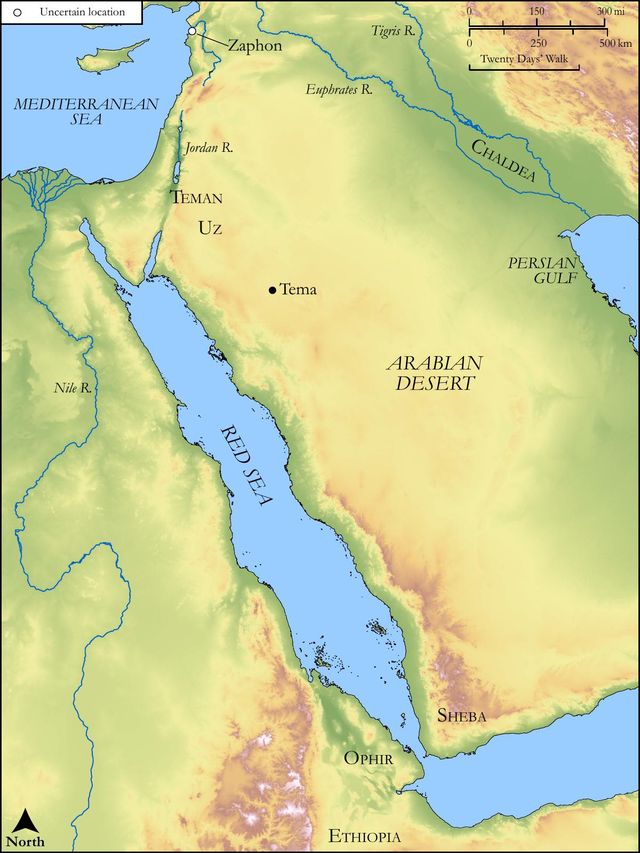
See on the biblical-era map
Study this verse
Public-domain commentary
Matthew Henry
From his Commentary on the Whole Bible. Henry comments on passages, not single verses — this entry covers Job 40:15–24. His three-level outline is real structure in the source text, so it is rendered as structure.
God, for the further proving of his own power and disproving of Job's pretensions, concludes his discourse with the description of two vast and mighty animals, far exceeding man in bulk and strength, one he calls behemoth, the other leviathan. In these verses we have the former described. "Behold now behemoth, and consider whether thou art able to contend with him who made that beast and gave him all the power he has, and whether it is not thy wisdom rather to submit to him and make thy peace with him." Behemoth signifies beasts in general, but must here be meant of some one particular species. Some understand it of the bull; others of an amphibious animal, well known (they say) in Egypt, called the river-horse (hippopotamus), living among the fish in the river Nile, but coming out to feed upon the earth. But I confess I see no reason to depart from the ancient and most generally received opinion, that it is the elephant that is here described, which is a very strong stately creature, of very large stature above any other, of wonderful sagacity, and of so great a reputation in the animal kingdom that among so many four-footed beasts as we have had the natural history of (ch. 38 and 39) we can scarcely suppose this should be omitted. Observe,
I.The description here given of the behemoth.
1.His body is very strong and well built. His strength is in his loins, Job 40:16. His bones, compared with those of other creatures, are like bars of iron, Job 40:18. His back-bone is so strong that, though his tail be not large, yet he moves it like a cedar, with a commanding force, Job 40:17. Some understand it of the trunk of the elephant, for the word signifies any extreme part, and in that there is indeed a wonderful strength. So strong is the elephant in his back and loins, and the sinews of his thighs, that he will carry a large wooden tower, and a great number of fighting men in it. No animal whatsoever comes near the elephant for strength of body, which is the main thing insisted on in this description.
2.He feeds on the productions of the earth and does not prey upon other animals: He eats grass as an ox (Job 40:15), the mountains bring him forth food (Job 40:20), and the beasts of the field do not tremble before him nor flee from him, as from a lion, but they play about him, knowing they are in no danger from him. This may give us occasion,
(1.)To acknowledge the goodness of God in ordering it so that a creature of such bulk, which requires so much food, should not feed upon flesh (for then multitudes must die to keep him alive), but should be content with the grass of the field, to prevent such destruction of lives as otherwise must have ensued.
(2.)To commend living upon herbs and fruits without flesh, according to the original appointment of man's food, Gen 1:29. Even the strength of an elephant, as of a horse and an ox, may be supported without flesh; and why not that of a man? Though therefore we use the liberty God has allowed us, yet be not among riotous eaters of flesh, Pro 23:20.
(3.)To commend a quiet and peaceable life. Who would not rather, like the elephant, have his neighbours easy and pleasant about him, than, like the lion, have them all afraid of him?
3.He lodges under the shady trees (Job 40:21), which cover him with their shadow (Job 40:22), where he has a free and open air to breathe in, while lions, which live by prey, when they would repose themselves, are obliged to retire into a close and dark den, to live therein, and to abide in the covert of that, Job 38:40. Those who are a terror to others cannot but be sometimes a terror to themselves too; but those will be easy who will let others be easy about them; and the reed and fens, and the willows of the brook, though a very weak and slender fortification, yet are sufficient for the defence and security of those who therefore dread no harm, because they design none.
4.That he is a very great and greedy drinker, not of wine or strong drink (to be greedy of that is peculiar to man, who by his drunkenness makes a beast of himself), but of fair water.
(1.)His size is prodigious, and therefore he must have supply accordingly, Job 40:23. He drinks so much that one would think he could drink up a river, if you would give him time, and not hasten him. Or, when he drinks, he hasteth not, as those do that drink in fear; he is confident of his own strength and safety, and therefore makes no haste when he drinks, no more haste than good speed.
(2.)His eye anticipates more than he can take; for, when he is very thirsty, having been long kept without water, he trusts that he can drink up Jordan in his mouth, and even takes it with his eyes, Job 40:24. As a covetous man causes his eyes to fly upon the wealth of this world, which he is greedy of, so this great beast is said to snatch, or draw up, even a river with his eyes.
(3.)His nose has in it strength enough for both; for, when he goes greedily to drink with it, he pierces through snares or nets, which perhaps are laid in the waters to catch fish. He makes nothing of the difficulties that lie in his way, so great is his strength and so eager his appetite.
II.The use that is to be made of this description.
We have taken a view of this mountain of a beast, this over-grown animal, which is here set before us, not merely as a show (as sometimes it is in our country) to satisfy our curiosity and to amuse us, but as an argument with us to humble ourselves before the great God; for,
1.He made this vast animal, which is so fearfully and wonderfully made; it is the work of his hands, the contrivance of his wisdom, the production of his power; it is behemoth which I made, Job 40:15. Whatever strength this, or any other creature, has, it is derived from God, who therefore must be acknowledged to have all power originally and infinitely in himself, and such an arm as it is not for us to contest with. This beast is here called the chief, in its kind, of the ways of God (Job 40:19), an eminent instance of the Creator's power and wisdom. Those that will peruse the accounts given by historians of the elephant will find that his capacities approach nearer to those of reason than the capacities of any other brute-creature whatsoever, and therefore he is fitly called the chief of the ways of God, in the inferior part of the creation, no creature below man being preferable to him.
2.He made him with man, as he made other four-footed beasts, on the same day with man (Gen 1:25, Gen 1:26), whereas the fish and fowl were made the day before; he made him to live and move on the same earth, in the same element, and therefore man and beast are said to be jointly preserved by divine Providence as fellow-commoners, Psa 36:6. "It is behemoth, which I made with thee; I made that beast as well as thee, and he does not quarrel with me; why then dost thou? Why shouldst thou demand peculiar favours because I made thee (Job 10:9), when I made the behemoth likewise with thee? I made thee as well as that beast, and therefore can as easily manage thee at pleasure as that beast, and will do it whether thou refuse or whether thou choose. I made him with thee, that thou mayest look upon him and receive instruction." We need not go far for proofs and instances of God's almighty power and sovereign dominion; they are near us, they are with us, they are under our eye wherever we are.
3.He that made him can make his sword to approach to him (Job 40:19), that is, the same hand that made him, notwithstanding his great bulk and strength, can unmake him again at pleasure and kill an elephant as easily as a worm or a fly, without any difficulty, and without the imputation either of waste or wrong. God that gave to all the creatures their being may take away the being he gave; for may he not do what he will with his own? And he can do it; he that has power to create with a word no doubt has power to destroy with a word, and can as easily speak the creature into nothing as at first he spoke it out of nothing. The behemoth perhaps is here intended (as well as the leviathan afterwards) to represent those proud tyrants and oppressors whom God had just now challenged Job to abase and bring down. They think themselves as well fortified against the judgments of God as the elephant with his bones of brass and iron; but he that made the soul of man knows all the avenues to it, and can make the sword of justice, his wrath, to approach to it, and touch it in the most tender and sensible part. He that framed the engine, and put the parts of it together, knows how to take it in pieces. Woe to him therefore that strives with his Maker, for he that made him has therefore power to make him miserable, and will not make him happy unless he will be ruled by him.
Historical interpretation
Two Centuries of Reception
4 surviving comments on this verse. Each one is dated, so this reads as a timeline rather than a list.
Select a marker to jump to its quote. Markers stagger vertically where authors wrote within a few decades of each other.
29. In the body they are bones which hold the members together, and members which are held together. This beast then has flesh, it has bones also; because there are some wicked persons, who are yet retained in error by others, and others still more wicked who retain others also in error. What else then do we understand by the bones of Antichrist, but some more powerful persons in his body? in whose hearts while iniquity has become greatly hardened, the whole framework of his body is held together by them. For there appear to be many rich in this world, who while relying on their possessions and wealth, are consolidated, as it were, by strength, but by lavishing these goods by which they were supported, they lead others into their own error. At one time they allure others by their gifts to become wicked, at another they bind others by their presents to continue in wickedness. What then are these but bones of Antichrist, who while they multiply the wicked by keeping them together, support the flesh in his body? These sometimes exhibit a sweetness of speech in deceiving their hearers, because even thorns produce flowers, and that in them which smells sweetly is seen, that which wounds is hid. They blend the sweet with the bitter, the soothing with the hurtful, and though they strive to be admired, by reason of their power, yet through their skill in deceiving, they abase themselves, as if humbly, by their easy address, and by their speech insinuate that of themselves, which they deny by their outward conduct.
30. Whence also the ‘bones’ of this Behemoth are rightly compared to pipes of brass, because doubtless like insensible metal, they have the sound of right speech, but not the sense of right living. For they assert, as if humbly, that in words, which they set at nought by living haughtily. Whence it is well said by Paul; Though I speak with the tongues of men and of angels, and have not charily, I am become as sounding brass, or a tinkling cymbal. [l Cor. 13, 1] For he who speaks good things, but pursues not the same good things through love, utters a sound like brass or a cymbal; because he himself feels not the words which he utters. But there are some in the body of this beast, not illustrious from honours, not supported by riches, not adorned with the beauty of virtues, not skilled in the science of cunning, who yet aim at appearing such as they are not, and who are therefore more hurtful to the life of the righteous. Of whom it also follows,
His cartilage as plates of iron.
31. For cartilage has indeed the appearance of bone, but has not the strength of bone. What is meant then by his cartilage being compared to plates of iron, except that those in him who are most feeble, are more evilly disposed for the perpetration of wickedness? For other metals are cut by iron, and his cartilage is said to be like iron, because those in his body who are unequal to the display of mighty powers, are the more violently inflamed to cause the death of the faithful. For because they consider that they cannot with him work signs and prodigies, they prove themselves faithful to him by their cruelty, and instead of being able to corrupt by their persuasion the hearts of the innocent, they glory in destroying the bodies of the good manifoldly more than others. It is therefore well said; His cartilage is as plates of iron; because that which any one would believe to be the weaker part of his body, is the very thing which wounds the more fatally. And they are rightly compared not to iron only, but to ‘plates of iron,’ because while they go about to spread themselves out on every side in cruelty, they extend themselves, as it were, into plates of iron.
32. It seems good to us to examine with a stricter hand of enquiry these same words of the Creator, which seem already discussed, and to gather more abundant fruits of understanding for moral instruction. For since we have heard what the ancient enemy effects against men, by the man he has assumed, it remains for us now to examine what he works in men even by himself, without the aid of men.
40. What are designated by the ‘bones’ of this Behemoth, except his counsels? For as the uprightness [‘positio’] and strength of the body subsist in the bones, so does his whole malice exalt itself in crafty designs. For he does not oppress any one by force, but he destroys him by the craftiness of his deadly persuasion. And again, as the marrow strengthens the bones which it moistens, so also does the subtlety of his genius, infused by the power of a spiritual nature, strengthen his designs. But in this his ‘testicles’ differ from his ‘bones,’ that is, his suggestions from his designs, that by the former he openly inserts what is noxious, but by the latter, when counselling as if for good he leads into sin; by the former he overcomes in fight, but by the latter he supplants by advising. Whence also his ‘bones,’ that is, these very designs, are well compared to pipes of brass. For pipes of brass are usually adapted to sonorous tunes, and when on being applied to the ears they delicately utter a soothing strain, they attract the mind within to outward delights; and when the sound is sweet which they utter to the cars, they weaken the manliness of the heart with the flow of pleasure. And when the hearing is drawn on to delight, the understanding is relaxed from the firmness of its strength. So also when his crafty designs counsel, as it were, with gentle forethought, they withdraw the heart from its resolute intention, and when they utter sweet sounds, they dispose to hurtful things. They are like pipes of brass then, which when heard with pleasure plunge the mind from its inward resolution into the pleasure of outward life. For it is this, which this Behemoth specially labours at in prosecuting his deception, to be able to utter sweetly what he says, when he puts forth his scheme of wickedness as if for our good, in order that he may beguile the mind by putting forward its usefulness, and corrupt it by concealing its iniquity.
41. And we make this plainer in every respect, by briefly laying open a few of the arguments of his counsels. For behold, a person, content with his own possessions, has resolved not to be entangled with any of this world’s occupations, being greatly afraid of losing the advantages of his ease, and utterly disdaining to accumulate wealth with sin. The crafty enemy in approaching him, in order to undermine his intention of sincere devotion, secretly offers a suggestion as if for his benefit, saying, Those things which thou hast are sufficient at present, but what dost thou intend to do when these fail? For if nothing is provided after these, thou hast what must be expended at once on thy children, but yet goods must be acquired to be laid up in store. Even what thou hast can soon fail, if anxious forethought ceases to provide what is wanting. Cannot worldly business be discharged, and yet sin be avoided in the doing it, in order that it may both furnish outward means, and yet not pervert inward rectitude? He insinuates these thoughts, and flatters the while; and is already secretly concealing the snares of sin in the worldly business, which he provides. His bones are therefore like pipes of brass, because his pernicious suggestions flatter their hearer with the sweetness of a voice which is giving them counsel.
42. Another also has resolved not merely not to seek for worldly advantages, but even to resign all that he possesses, in order to exercise himself the more freely in the discipline of heavenly training, the more he has disburdened himself, and abandons and tramples under foot the things which could weigh down their possessor. The lurking enemy addresses his heart with secret suggestion, saying, Whence has arisen the boldness of such great temerity, as for thee to dare to believe that thou canst subsist, by resigning every thing? Thy Creator formed thee in one way, and thou disposest of thyself in another: He would make thee more strong and robust, if He had wished thee to follow His footsteps with the neediness of want. Do not most men never give up their earthly patrimonies, and yet purchase by these, through works of compassion, the eternal goods of a heavenly inheritance? He suggests these things with flattery; but secretly in his deceit annexes deadly pleasures to the very things he advises him to retain, before the eyes of him who retains them, in order that he may attract the deluded heart to outward pleasures, and may draw aside its secret vows of perfection. His bones, therefore, are like pipes of brass, because when his crafty designs utter outwardly a soothing sound, they inflict deadly destruction within.
43. Another having given up all his outward possessions, prepares also to crush his inmost wishes, in order that, by submitting himself to the sounder judgment of another, he may renounce not merely his evil desires, but, (to add to his perfection,) himself also even in good resolves, and may observe all his duties at the will of another. The crafty enemy addresses him the more gently, the more ardently he endeavours to push him down from his loftier position, and presently, fawning on him with deadly suggestions, he says, O what great marvels thou wilt be able to perform by thyself, if thou dost not submit thyself in any way to the judgment of another. Why dost thou check thy progress, from a desire for improvement? Why dost thou crush the goodness of thy intention, when thou endeavourest to extend it further than is necessary? For what wickednesses didst thou perpetrate, when exercising thy own will? Why then dost thou require the judgment of another over thee, since thou wilt be of thyself fully sufficient for holy living? He suggests these things in a flattering tone, but he secretly prepares, in the indulgence of his own will, causes for the exercise of pride, and, while he praises his heart for its inward rectitude, he craftily seeks out where to undermine it with sin. His bones are, therefore, like pipes of brass, because his clandestine designs, by the very means with which they flatter, as it were, and delight the mind, fatally divert it from its right intention.
44. Another, having entirely subdued his will, has already corrected many sins of the old man, both by change of life, and by the lamentation of penitence; and is inflamed with greater zeal against the sins of others, the more he is entirely dead to himself, and is not held captive by his own iniquities. The crafty enemy, observing that by his zeal for righteousness he is benefiting others besides himself, attacks him with words which advise him as if for his advantage, saying, Why dost thou extend thyself to attend to others’ concerns? Would thou mayest have strength to consider thine own! Dost thou not consider, that when thou art stretched forth to the concerns of others, thou art found unequal to attend to thine own? And of what use is it to wipe off the blood of another’s wound, and by neglect to extend the corruption of thine own? While he speaks thus, as if giving advice, he takes away the zeal of charity, and destroys, with the sword of secretly instilled sloth, all the good which could result from charity. For if we are commanded to love our neighbours as ourselves, it is right for us to be kindled against sin, with zeal for them, as for ourselves. Because then he estranges the mind from its own resolution, while he pleasingly offers advice, it is rightly said, His bones are as pipes of brass. For when by his crafty designs he utters a pleasing sound to the mind of the hearer, he sings, as it were, with a pipe of brass, so as to deceive by means of his allurements. But this Behemoth engages much more gently in the contest, when, under the cloke of infirmity, he exercises himself in ambush. But he then arouses harder temptations, when he conceals the sources of iniquity, before the eyes of him who is tempted, under the semblance of virtue. Whence it is also rightly subjoined,
His cartilage as plates of iron.
45. For what but his simulation is understood by cartilage? For cartilage presents the appearance of bone, but it has not the strength of bone. And there are some vices which present an appearance of rectitude, but which proceed from the weakness of sin. For the malice of our enemy clokes itself with such art, as frequently to make faults appear as virtues before the eyes of the deluded mind; so that a person expects, as it were, rewards, for the very conduct for which he deserves to meet with eternal punishments. For cruelty is frequently exercised in punishing sins, and it is counted justice; and immoderate anger is believed to be the meritoriousness [‘meritum’] of righteous zeal; and when sinners ought to be carefully made straight from their crooked habits, they are snapped by being violently bent. Frequently negligent remissness is regarded as gentleness and forbearance, and while delinquents are spared temporally more than is proper, they are cruelly reserved to eternal punishments. Lavishness is sometimes believed to be compassion, and though it is a fault to be over saving, there is no fear of that which has been given being more wickedly lavished. Tenacity is sometimes considered frugality, and since it is a grievous fault not to give, it is considered a virtue to retain what has been received. The pertinacity of the wicked is often termed constancy, and when a mind does not submit to be turned from its wickedness, it glories as if in defending what is right. Inconstancy is often regarded as tractability, and because a person does not keep his word to any one, he considers himself on that account a friend to all men. Sometimes incompetent fear is believed to be humility, and when any one, oppressed by temporal fear, shrinks in silence from the defence of the truth, he thinks, that, according to the order of God, he demeans himself humbly to his superiors. Sometimes haughtiness of voice is counted freedom for the truth; and when through pride the truth is spoken against, forwardness in speaking is thought a defence of the truth. Sloth is frequently looked upon as a maintenance of peace, and though it is a grievous fault not to be zealous in doing what is right, it is believed to be a most meritorious virtue, merely to abstain from evil conduct. Restlessness of spirit is frequently termed a watchful solicitude, and when a person cannot endure rest, he thinks that he performs an exercise of virtue which is due from him, by doing what he likes. Incautious precipitation in things which must be done, is believed to be the warmth of praiseworthy zeal, and though a desired advantage is marred by unseasonable acting, it is considered that the quicker a thing is done, the better. Slowness in promoting goodness, is counted judgment, and when progress is expected to le made by reconsideration, delay lurks in ambush and disappoints it. When a fault then appears like virtue, we must needs consider that the mind abandons its fault the more slowly, in proportion as it does not blush at what it is doing; and that the mind abandons its fault the more slowly, in proportion as, having been deceived by the semblance of virtue, it seeks therefrom the recompense of rewards. But a fault is easily corrected, which is also blushed at; because it is felt to be a fault. Since, therefore, error is corrected with more difficulty, when it is believed to be a virtue, it is rightly said, His cartilage as plates of iron. For the more craftily this Behemoth exhibits his cunning under the cloke of virtue, the more firmly does he enthral the mind in sin.
46. Hence it is that sometimes those who seek after the way of holiness, when they have fallen into error, are improved but slowly. For they consider what they do to be right, and devote their perseverance to the practice of vice, as they do to the cultivation of virtue. They consider what they do to be right, and therefore promote the more earnestly their own judgment. Accordingly when Jeremiah said, Her Nazarites were whiter than snow, purer than milk, more ruddy than old ivory, more beautiful than the sapphire: their visage is made blacker than coals; and they are not known in the streets; he rightly added immediately, Their skin cleared to their bones, it is withered, and has become as a stick. [Lam. 4, 7. 8.] For what is signified by the word ‘Nazarites’ but the life of the abstinent, and continent, which is said to be whiter than snow and milk? For snow is congealed from water, coming as it does from above; but milk is squeezed from flesh which is nourished by things below. What then is pointed out by ‘snow’ but the brightness of the heavenly life, and what by ‘milk’ but the ordering of the temporal stewardship? And because continent men in the Church frequently perform such wonderful works, that many who have maintained a heavenly life, many who have dispensed aright the things of earth, seem to be surpassed by them, they are said to be both whiter than snow, and purer than milk. And since they sometimes appear by the fervour of their spirit to surpass the conduct of the ancient and mighty fathers, it is rightly subjoined, More ruddy than old ivory. For where the word ‘ruddiness’ is used, the flame of holy desire is signified. But we are not ignorant that ivory is the tusk of great animals. They are therefore more ruddy than old ivory, because they frequently appear before human eyes as of more fervent zeal than some of the preceding fathers. Of whom it is added, that the whole may be set forth at once; More beautiful than the sapphire. For the sapphire is of the colour of the heaven. And because they surpass many who precede them, and who are aiming at things above by a heavenly conversation, they are said to have been more beautiful than the sapphire. But when the abundance of virtues increases more than is expedient, the mind is frequently led to a kind of self-confidence, and, deceived by presuming on itself, is suddenly darkened by sin stealing it away. Whence it is rightly subjoined; Their visage is made blacker than coals. For they become black after whiteness, because having lost the righteousness of God, when they presume about themselves, they fall soon even into those sins which they understand not; and because, after the fire of love, they come to the chill of numbness, they are, in comparison, preferred to extinguished coals. For sometimes when they lose the fear of God through self-confidence, they become even colder than cold minds. Of whom it is rightly subjoined; They are not known in the streets. For a street (platea), according to the Greek tongue, is put for breadth [platea from platuV.]. But what is straiter for the mind of man, than for it to crush its own will? Of which crushing the Truth says; Enter ye in at the strait gate. [Matt. 7, 13] But what is broader than not to struggle against any of our wills, and to spread one’s self forth without restraint, wherever the impulse of choice may have led? They, therefore, who through confidence in their holiness follow themselves, and put aside the opinion of their betters, proceed as it were along the broad streets [‘plateas.’]. But they are not known in the streets, because they had made their life appear different, when by crushing their own wills they used to keep themselves in the narrow path. And it is well added; Their skin cleaved to their bones. What is expressed by ‘bone,’ but the hardness of strength; what by ‘skin,’ but the softness of infirmity? Their skin is said, therefore, to cleave to their bones, because through their depraved judgment the infirmity of vice is considered by them the hardness of virtue. For their doings are weak, but from being deceived by the confidence of pride, they connect them with notions of strength, and because they think highly of themselves, they scorn to be reformed of their wickedness. Whence it is also rightly added; It hath grown dry, and is become as a stick. For their fault is rendered the less perceptible, the more it is considered by them to be even deserving of praise. And He rightly declares that it is ‘dry,’ because it never grows green by self-reflection. That then which by Jeremiah is called ‘skin’ by reason of its weakness, is called ‘cartilage’ by blessed Job by reason of its frailness; and that which there is termed ‘bones’ from its hardness, is here said to be ‘plates of iron.’ But let us hear of what nature, and what origin [‘conditionis’] is this Behemoth, who by his members exerts himself against the Elect of God with such skill in iniquity at the last time, and who also in his own person displays himself with such great craftiness of stratagems. For he would not be able to work such wonders even in working wickedness, if he did not exist from some mighty origin.
“This is the beginning of the ways of God. He who made him provided him with his sword.” The sword of this Behemoth is his own malice in inflicting harm. But he who made him good in his nature provided him with his sword, because, according to divine will, his malice is limited, so that he is not allowed to strike human beings as much as he would like to. Now, if our enemy can do much but strikes less, this is due to the fact that the mercy of our Creator sets a limit to his sword. Therefore, [the devil] hides inside his conscience, and his malice, through which he makes people die, does not exceed the proper limits set by God.
The words “its strength is in its cover” [mean] its strength and vigor are precisely in the animal itself. Animals usually take shelter in different places, but [the author] says this animal does not need a shelter at all.
Continue studying Job 40:18 across the web’s major study libraries — every link below opens this exact verse, chapter, or book on the destination site.
Read & Compare
 BibleGatewayThis verse in more than 200 translations and 70 languages.
 Bible.comThe YouVersion reader — hundreds of translations, reading plans, and highlights.
 ESV.orgCrossway's official English Standard Version reader.
 NET BibleThe NET translation with 60,000+ translators' notes on every rendering decision.
 STEP BibleTyndale House's free study tool — original text, vocabulary, and scholarly resources.
 BibliaLogos Bible Software's free web reader.
 USCCBThe New American Bible (Revised Edition) with the U.S. bishops' study notes.
Commentaries
 BibleHub CommentariesDozens of classic commentaries on this verse, gathered on one page.
 StudyLightMore than 100 commentary sets — the largest collection on the web.
 BibleRefPlain-English commentary on what this verse means, verse by verse.
 Enduring WordDavid Guzik's free commentary on this chapter, widely used by Bible teachers.
 Bible Study ToolsVerse commentary alongside Greek and Hebrew study aids.
Original Language & Research
- BibleHub InterlinearThe verse word by word — original language, transliteration, and English.
- BibleHub LexiconEvery word's original-language definition and Strong's entry.
 Blue Letter BibleDeep-study tools — Strong's numbers, concordance, and word studies.
 SefariaThe Hebrew text with Rashi and centuries of Jewish commentary.
Sermons, Hymns & Audio


TrulyRandomVerse is not affiliated with these sites and doesn’t control their content. They’re linked because they’re genuinely useful.
Summary
Job 40:18 provides a breathtaking description of Behemoth's unparalleled physical strength, depicting its bones as "strong pieces of brass" and "bars of iron." This vivid imagery is part of God's profound discourse to Job, meticulously crafted to unveil His own immeasurable creative power and absolute sovereignty through the sheer might of His creatures. The verse powerfully underscores the formidable, unyielding nature of Behemoth, serving as an undeniable testament to a Creator whose wisdom, might, and dominion far transcend human comprehension, thereby humbling Job and inviting all who read to stand in profound awe of the Almighty.
Context
ShowHideLiterary Context
This verse is intricately woven into the climactic section of the Book of Job, specifically within God's direct and awe-inspiring address to Job, which commences in Job 38:1. Following extensive dialogues where Job and his friends grapple with the profound mysteries of suffering and divine justice, God intervenes, not to provide a direct explanation for Job's trials, but to assert His unchallenged sovereign power and wisdom over all creation. Job 40:18 is an integral part of God's detailed portrayal of Behemoth, a magnificent creature first introduced in Job 40:15. This description, immediately preceding that of Leviathan in Job 41, serves a crucial theological purpose: to demonstrate that if Job cannot even comprehend or control these powerful, divinely fashioned creatures, he is certainly incapable of grasping the intricate ways and infinite wisdom of their Creator. The overarching narrative flow is meticulously designed to lead Job, and by extension the reader, to a posture of profound humility and unwavering trust in God's inscrutable, yet perfect, wisdom.
Historical & Cultural Context
In the ancient Near East, brass (more accurately, bronze, an alloy primarily of copper and tin) and iron represented the pinnacle of known material strength and durability. These metals were indispensable for crafting essential tools, formidable weapons, and robust construction elements, thus symbolizing immense resilience, permanence, and unyielding power. The comparison of Behemoth's bones to these metals would have instantly communicated an image of unparalleled structural integrity and formidable, almost indestructible, power to an ancient audience. Furthermore, the concept of massive, untamable creatures resonated deeply with various ancient mythologies, often representing chaotic forces. However, in Job, God presents these creatures unequivocally as His own creations, entirely subject to His will, thereby asserting His supreme authority and dominion over all perceived forces of chaos or might. The prevailing cultural understanding of divine power often manifested through a deity's absolute control over the natural world, making God's meticulously detailed descriptions of these creatures a profound and undeniable demonstration of His omnipotence.
Key Themes
ShowHideJob 40:18 profoundly contributes to several overarching theological themes woven throughout the Book of Job. Firstly, it emphatically highlights the Divine Power in Creation, underscoring God's absolute and unparalleled ability to fashion beings of extraordinary might, durability, and intricate design, far beyond any human capacity to create or control. Secondly, it vividly illustrates the Incomprehensibility of God's Works and Ways. The awe-inspiring description of Behemoth's unyielding strength serves as a powerful metaphor for the vast chasm between God's infinite wisdom and Job's finite understanding, echoing the theological truth articulated in Isaiah 55:9. If God's creation is so immensely powerful and shrouded in mystery, how much more unfathomable are His grand plans and ultimate purposes for humanity? Finally, the verse implicitly, yet powerfully, calls for Humility Before God. By showcasing Behemoth's incredible, divinely endowed might, God encourages Job—and all subsequent readers—to acknowledge their own inherent weakness and the absolute necessity of humility in the face of such a powerful, wise, and utterly sovereign Creator, ultimately leading to Job's profound repentance and submission in Job 42:1-6.
Exposition and Analysis
ShowHideKey Word Analysis
ShowHideThe Hebrew עֶצֶם (‘etsem, H6106) refers primarily to the physical skeletal structure, the foundational framework of a body. However, its semantic range extends to denote the "essence," "substance," or "very being" of something, implying an inherent, core quality. In Job 40:18, it emphasizes that Behemoth's strength is not superficial but deeply intrinsic, an unyielding durability built into its fundamental constitution, signifying a creature of profound and unshakeable inner power.
The Hebrew נְחֻשָׁה (nᵉchûwshâh, H5154) is often translated as "copper" or, more commonly in ancient contexts, "bronze," which is an alloy of copper and tin. Bronze was a highly esteemed and exceptionally strong metal in the ancient world, widely utilized for durable tools, resilient armor, and formidable weapons. Comparing Behemoth's bones to bronze conveys an immediate sense of extraordinary hardness, density, and remarkable resistance to breakage, far surpassing the strength of any ordinary bone.
The Hebrew בַּרְזֶל (barzel, H1270) refers to iron, a metal that, once its metallurgy was mastered, proved to be even stronger and more challenging to work with than bronze in ancient times. The mention of "bars of iron" (with mᵉṭîyl, H4300, for "bars") evokes images of solid, dense, and utterly unyielding rods. This comparison emphasizes an ultimate degree of rigidity and unbreakable strength, suggesting that Behemoth's skeletal structure possesses an almost indestructible quality, a testament to its divinely engineered might.
Verse Breakdown
ShowHide"His bones [are as] strong pieces of brass"
This initial clause immediately establishes the extraordinary robustness of Behemoth's skeletal structure through a vivid simile. The comparison to "brass" (bronze) signifies a foundational, inherent strength and remarkable durability. It implies that Behemoth's very framework is divinely engineered with immense power and resilience, far exceeding that of any known earthly creature. This phrase speaks to an unyielding, intrinsic quality that forms the core of its being.
"his bones [are] like bars of iron"
This second clause powerfully reinforces and intensifies the imagery introduced in the first. By likening the bones to "bars of iron," the text conveys an even greater degree of hardness, density, and unbreakability. Iron was the strongest and most formidable metal known in that era, and "bars" suggests solid, heavy, and utterly unbending components. The deliberate repetition of "his bones" underscores that this unparalleled strength is not merely an external attribute but is fundamental to the creature's very essence, rendering it virtually indestructible by human means.
Literary Devices
ShowHideJob 40:18 masterfully employs several potent literary devices to convey the immense, almost mythical, strength of Behemoth. The most prominent device is Simile, clearly evidenced by the use of "as" and "like" to draw direct comparisons between Behemoth's bones and "strong pieces of brass" and "bars of iron." These comparisons leverage the audience's understanding of the hardest and most durable materials known to them, making the creature's power tangible, formidable, and awe-inspiring. Hyperbole is also significantly at play, as the description likely exaggerates the literal properties of the creature's bones to emphasize its extraordinary, almost supernatural, strength. This deliberate exaggeration serves to magnify the boundless creative power of God. Furthermore, the strategic Repetition of the phrase "his bones" and the consistent metallic imagery ("brass," "iron") serves to underscore and intensify the central message of unparalleled strength and durability, driving home the point with emphatic force. Finally, the verse is rich in evocative Imagery, painting a vivid mental picture of a creature whose very skeleton functions as an unyielding, impenetrable fortress, thereby evoking a profound sense of wonder, reverence, and even fear.
Theological and Thematic Connections
ShowHideJob 40:18, in its vivid portrayal of Behemoth's formidable strength, serves as a profound theological statement about God's omnipotence and the inherent limits of human understanding. The creature's unyielding bones, likened to the strongest metals known, are a direct and undeniable testament to the Creator's boundless power, intricate design, and sovereign control over all things. This divine display is not merely for show but is strategically intended to humble Job, demonstrating that if humanity cannot contend with, or even fully comprehend, God's powerful creations, how much less can they grasp the infinite wisdom, perfect justice, and ultimate purposes of the Creator Himself. It unequivocally invites a posture of profound awe, reverence, and unwavering trust in a God whose ways are often inscrutable yet always perfect, reminding us that even in the midst of inexplicable suffering, His power remains absolute and His purposes extend far beyond our finite grasp.
Reflection and Application
ShowHideJob 40:18, deeply embedded within God's awe-inspiring discourse, issues a powerful call to cultivate a deeper and more profound reverence for the Creator. In a contemporary world that often strives to dissect, explain, and ultimately control every aspect of existence, this verse serves as a crucial reminder that there are fundamental facets of God's creation, and indeed of God Himself, that will forever remain beyond our complete comprehension and finite control. Behemoth's immense, divinely engineered strength functions as a humbling mirror, reflecting our own inherent limitations and inviting us to embrace a posture of profound awe rather than an exhaustive need for understanding. When confronted with life's often inexplicable challenges, particularly the perplexing reality of suffering, this passage encourages us to place our unwavering trust in the boundless wisdom and omnipotent power of a God who can create and sustain such formidable beings. It compels us to recognize that His ways are infinitely higher than our ways, and His thoughts far beyond our thoughts. Ultimately, it is an invitation to marvel at the sheer magnitude of divine power and to discover profound peace in surrendering our relentless need for complete answers to a God who is infinitely greater than all our questions combined.
Questions for Reflection
ShowHideFAQ
ShowHideWhat is Behemoth, and why is its exact identity important for understanding Job 40:18?
ShowHideThe precise zoological identity of Behemoth has been a long-standing subject of extensive scholarly debate. Common interpretations range from a hippopotamus or an elephant to a large extinct creature (such as a dinosaur), or even a composite mythical creature symbolizing untamed power. However, for the theological purpose of Job 40:18, its exact zoological classification is ultimately less important than its symbolic and illustrative role within God's discourse to Job. The vivid description of Behemoth's bones as "brass" and "iron" is primarily employed to convey an unparalleled, divinely endowed strength, resilience, and unyielding nature, regardless of whether it corresponds to a literal animal or a more symbolic entity. The fundamental purpose is not to provide a zoological lesson but to powerfully demonstrate God's absolute and unchallenged power over even the mightiest and most untamable of creatures, thereby humbling Job and unequivocally asserting divine sovereignty over all creation. The focus remains squarely on the attributes of the creature—its immense power, colossal size, and invincibility to human efforts—as a profound reflection of its Creator's incomparable glory and omnipotence.
Christ-Centered Fulfillment
ShowHideWhile Behemoth in Job 40:18 stands as an awe-inspiring testament to God's raw creative power and absolute sovereignty over creation, its formidable strength ultimately serves as a profound pointer to the infinitely greater, redemptive power embodied in Jesus Christ. The "strong pieces of brass" and "bars of iron" describing Behemoth's unyielding bones are but a faint, earthly echo of the unyielding, eternal power of the Son of God, through whom "all things were created, in heaven and on earth, visible and invisible, whether thrones or dominions or rulers or authorities—all things were created through him and for him" (Colossians 1:16). If Behemoth's physical might demonstrates God's ability to create and control the most powerful earthly beings, then Christ's power extends infinitely further, encompassing the spiritual realm, triumphing decisively over sin, death, and the grave. He is the one who "upholds the universe by the word of his power" (Hebrews 1:3), and who, in His glorious resurrection, shattered the "bars of iron" of death's grip, proving His ultimate and eternal dominion over all things (Acts 2:24). Thus, the immense strength of Behemoth in Job 40:18 functions as a magnificent shadow, preparing our hearts to marvel at the supreme, all-encompassing, redemptive, and sustaining power of Christ, in whom all the fullness of God dwells bodily (Colossians 2:9).