


Job 40:16
- הִנֵּהhi·nehthere!H2009PrtParticle Interjection
- נָאna'pleaseH4994PrtParticle Interjection
- כֹחוֹkho·Choits strengthH3581N-msc ¦ 3msNoun Singular Masculine Constructכֹחstrengthוֹits
- בְמָתְנָיוve·ma·te·Nav[is] in its loinsH4975Prep-b ¦ N-mdc ¦ 3msNoun Dual Masculine Constructבְ[is] inמָתְנָיloinsוits
- וְאֹנוֹve·'o·Noand its powerH202Conj-w ¦ N-msc ¦ 3msNoun Singular Masculine Constructוְandאֹנpowerוֹits
- בִּשְׁרִירֵיbish·ri·Reiin [the] muscles ofH8306Prep-b ¦ N-mpcNoun Plural Masculine Constructבִּinשְׁרִירֵי[the] muscles of
- בִטְנוֹvit·Noits bellyH990N-fsc ¦ 3msNoun Singular Feminine Constructבִטְנbellyוֹits
English is a literal word-by-word gloss of the Hebrew, not the KJV's wording. Why?
This is the original text the KJV's translators worked from — each Hebrew word with its own literal English meaning in this verse, prepared by scholars at Tyndale House, Cambridge. The KJV translates whole sentences, not word by word, so its wording differs: one Hebrew word can become several English words, and the KJV may choose “the LORD” where the gloss reads “Yahweh”. Both are faithful — they answer different questions. For the KJV's own rendering, switch to the KJV text.
Details
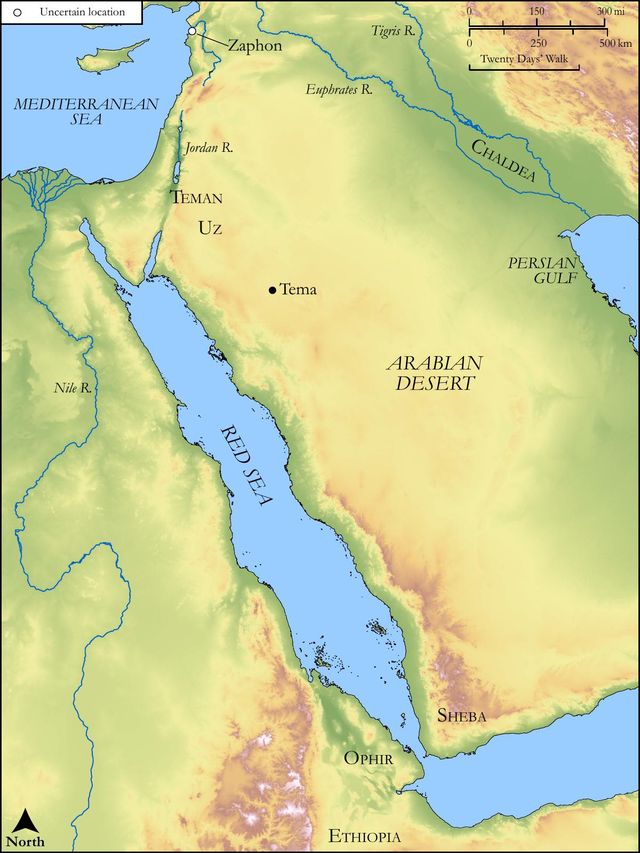
See on the biblical-era map
Study this verse
Public-domain commentary
Matthew Henry
From his Commentary on the Whole Bible. Henry comments on passages, not single verses — this entry covers Job 40:15–24. His three-level outline is real structure in the source text, so it is rendered as structure.
God, for the further proving of his own power and disproving of Job's pretensions, concludes his discourse with the description of two vast and mighty animals, far exceeding man in bulk and strength, one he calls behemoth, the other leviathan. In these verses we have the former described. "Behold now behemoth, and consider whether thou art able to contend with him who made that beast and gave him all the power he has, and whether it is not thy wisdom rather to submit to him and make thy peace with him." Behemoth signifies beasts in general, but must here be meant of some one particular species. Some understand it of the bull; others of an amphibious animal, well known (they say) in Egypt, called the river-horse (hippopotamus), living among the fish in the river Nile, but coming out to feed upon the earth. But I confess I see no reason to depart from the ancient and most generally received opinion, that it is the elephant that is here described, which is a very strong stately creature, of very large stature above any other, of wonderful sagacity, and of so great a reputation in the animal kingdom that among so many four-footed beasts as we have had the natural history of (ch. 38 and 39) we can scarcely suppose this should be omitted. Observe,
I.The description here given of the behemoth.
1.His body is very strong and well built. His strength is in his loins, Job 40:16. His bones, compared with those of other creatures, are like bars of iron, Job 40:18. His back-bone is so strong that, though his tail be not large, yet he moves it like a cedar, with a commanding force, Job 40:17. Some understand it of the trunk of the elephant, for the word signifies any extreme part, and in that there is indeed a wonderful strength. So strong is the elephant in his back and loins, and the sinews of his thighs, that he will carry a large wooden tower, and a great number of fighting men in it. No animal whatsoever comes near the elephant for strength of body, which is the main thing insisted on in this description.
2.He feeds on the productions of the earth and does not prey upon other animals: He eats grass as an ox (Job 40:15), the mountains bring him forth food (Job 40:20), and the beasts of the field do not tremble before him nor flee from him, as from a lion, but they play about him, knowing they are in no danger from him. This may give us occasion,
(1.)To acknowledge the goodness of God in ordering it so that a creature of such bulk, which requires so much food, should not feed upon flesh (for then multitudes must die to keep him alive), but should be content with the grass of the field, to prevent such destruction of lives as otherwise must have ensued.
(2.)To commend living upon herbs and fruits without flesh, according to the original appointment of man's food, Gen 1:29. Even the strength of an elephant, as of a horse and an ox, may be supported without flesh; and why not that of a man? Though therefore we use the liberty God has allowed us, yet be not among riotous eaters of flesh, Pro 23:20.
(3.)To commend a quiet and peaceable life. Who would not rather, like the elephant, have his neighbours easy and pleasant about him, than, like the lion, have them all afraid of him?
3.He lodges under the shady trees (Job 40:21), which cover him with their shadow (Job 40:22), where he has a free and open air to breathe in, while lions, which live by prey, when they would repose themselves, are obliged to retire into a close and dark den, to live therein, and to abide in the covert of that, Job 38:40. Those who are a terror to others cannot but be sometimes a terror to themselves too; but those will be easy who will let others be easy about them; and the reed and fens, and the willows of the brook, though a very weak and slender fortification, yet are sufficient for the defence and security of those who therefore dread no harm, because they design none.
4.That he is a very great and greedy drinker, not of wine or strong drink (to be greedy of that is peculiar to man, who by his drunkenness makes a beast of himself), but of fair water.
(1.)His size is prodigious, and therefore he must have supply accordingly, Job 40:23. He drinks so much that one would think he could drink up a river, if you would give him time, and not hasten him. Or, when he drinks, he hasteth not, as those do that drink in fear; he is confident of his own strength and safety, and therefore makes no haste when he drinks, no more haste than good speed.
(2.)His eye anticipates more than he can take; for, when he is very thirsty, having been long kept without water, he trusts that he can drink up Jordan in his mouth, and even takes it with his eyes, Job 40:24. As a covetous man causes his eyes to fly upon the wealth of this world, which he is greedy of, so this great beast is said to snatch, or draw up, even a river with his eyes.
(3.)His nose has in it strength enough for both; for, when he goes greedily to drink with it, he pierces through snares or nets, which perhaps are laid in the waters to catch fish. He makes nothing of the difficulties that lie in his way, so great is his strength and so eager his appetite.
II.The use that is to be made of this description.
We have taken a view of this mountain of a beast, this over-grown animal, which is here set before us, not merely as a show (as sometimes it is in our country) to satisfy our curiosity and to amuse us, but as an argument with us to humble ourselves before the great God; for,
1.He made this vast animal, which is so fearfully and wonderfully made; it is the work of his hands, the contrivance of his wisdom, the production of his power; it is behemoth which I made, Job 40:15. Whatever strength this, or any other creature, has, it is derived from God, who therefore must be acknowledged to have all power originally and infinitely in himself, and such an arm as it is not for us to contest with. This beast is here called the chief, in its kind, of the ways of God (Job 40:19), an eminent instance of the Creator's power and wisdom. Those that will peruse the accounts given by historians of the elephant will find that his capacities approach nearer to those of reason than the capacities of any other brute-creature whatsoever, and therefore he is fitly called the chief of the ways of God, in the inferior part of the creation, no creature below man being preferable to him.
2.He made him with man, as he made other four-footed beasts, on the same day with man (Gen 1:25, Gen 1:26), whereas the fish and fowl were made the day before; he made him to live and move on the same earth, in the same element, and therefore man and beast are said to be jointly preserved by divine Providence as fellow-commoners, Psa 36:6. "It is behemoth, which I made with thee; I made that beast as well as thee, and he does not quarrel with me; why then dost thou? Why shouldst thou demand peculiar favours because I made thee (Job 10:9), when I made the behemoth likewise with thee? I made thee as well as that beast, and therefore can as easily manage thee at pleasure as that beast, and will do it whether thou refuse or whether thou choose. I made him with thee, that thou mayest look upon him and receive instruction." We need not go far for proofs and instances of God's almighty power and sovereign dominion; they are near us, they are with us, they are under our eye wherever we are.
3.He that made him can make his sword to approach to him (Job 40:19), that is, the same hand that made him, notwithstanding his great bulk and strength, can unmake him again at pleasure and kill an elephant as easily as a worm or a fly, without any difficulty, and without the imputation either of waste or wrong. God that gave to all the creatures their being may take away the being he gave; for may he not do what he will with his own? And he can do it; he that has power to create with a word no doubt has power to destroy with a word, and can as easily speak the creature into nothing as at first he spoke it out of nothing. The behemoth perhaps is here intended (as well as the leviathan afterwards) to represent those proud tyrants and oppressors whom God had just now challenged Job to abase and bring down. They think themselves as well fortified against the judgments of God as the elephant with his bones of brass and iron; but he that made the soul of man knows all the avenues to it, and can make the sword of justice, his wrath, to approach to it, and touch it in the most tender and sensible part. He that framed the engine, and put the parts of it together, knows how to take it in pieces. Woe to him therefore that strives with his Maker, for he that made him has therefore power to make him miserable, and will not make him happy unless he will be ruled by him.
Historical interpretation
Two Centuries of Reception
4 surviving comments on this verse. Each one is dated, so this reads as a timeline rather than a list.
Select a marker to jump to its quote. Markers stagger vertically where authors wrote within a few decades of each other.
What is understood by the loins except the delight of the flesh? Hence the Psalmist also asks, saying: "Burn my loins." For if he had not known that the pleasure of lust resides in the loins, he would by no means have asked that they be burned. Hence, because the power of the devil has prevailed over the human race especially through lust, it is said of him by the voice of the Lord: "His power is in his loins." Therefore he who eats the Passover ought to have his loins girded, so that he who celebrates the solemnity of resurrection and incorruption may no longer be subject to corruption through any vices, may subdue pleasures, and may restrain the flesh from lust.
20. The places for the seed of coition are said to be in the loins with men, but in the navel with women. For hence it is that the Truth says to His disciples; Let your loins be girded about. [Luke 12, 35] Hence Peter, when keeping away lust from the heart, admonished, saying, Girded up in the loins of your mind. [1 Pet. 1, 13] Hence Paul, when saying that the priesthood of Levi was tithed by the sacrifice of Abraham in the time of Melchisedec, said, in showing where Levi was then concealed in the body of his father; For he was yet in the loins of his father. But that the seed-vessel of lust is with women contained in the navel, the Prophet witnesses, who, reproving the wantonness of Judaea, under the character of a prostituted woman, says; In the day of thy birth thy navel was not cut. [Ez. 16, 4] For to cut the navel in the day of birth, is to cut off the lust of the flesh at the time of conversion. For since it is difficult to correct evil beginnings, and to mould into a better shape things that have once been shapen amiss, Judaea is blamed from her birth, as having, while born of God, retained her navel unsevered, because she lopped not off the loosenesses [‘fluxa’] of lust. Because therefore both sexes are grievously overcome by the infirmity of lust, through the power of the devil, his strength is both said to be in his loins, against men, and his force in his navel, against women.
21. But why, when He had first mentioned this Behemoth as eating hay, did He subjoin the fatal effects of lust, as the first arguments of his deception? Except that it is plain to all, that after pride has once seized the spirit of a man, he immediately stretches forth to the pollution of the flesh. Which we observe even in the first man and woman; who, by covering their shameful parts, after the commission of pride, plainly showed that after they had endeavoured in themselves to grasp at high things within, they presently were subject in the flesh to what bringeth shame without. This Behemoth therefore, who rages insatiably, and seeks to devour the whole man at once, at one time exalts his mind to pride at another corrupts his flesh with the pleasure of lust. But his strength is well said not to be in the loins or the navel of them who are overcome; but, his strength is in his loins, and his force is in the navel of his belly. As if it were plainly said, His strength is in his own loins, and his force is in the navel of his own belly; because they doubtless specially become his body, who, being deceived by the blandishments of base suggestions, submit to him through the loosenesses of lust.
“This is the beginning of the ways of God. He who made him provided him with his sword.” The sword of this Behemoth is his own malice in inflicting harm. But he who made him good in his nature provided him with his sword, because, according to divine will, his malice is limited, so that he is not allowed to strike human beings as much as he would like to. Now, if our enemy can do much but strikes less, this is due to the fact that the mercy of our Creator sets a limit to his sword. Therefore, [the devil] hides inside his conscience, and his malice, through which he makes people die, does not exceed the proper limits set by God.
The words “its strength is in its cover” [mean] its strength and vigor are precisely in the animal itself. Animals usually take shelter in different places, but [the author] says this animal does not need a shelter at all.
Continue studying Job 40:16 across the web’s major study libraries — every link below opens this exact verse, chapter, or book on the destination site.
Read & Compare
 BibleGatewayThis verse in more than 200 translations and 70 languages.
 Bible.comThe YouVersion reader — hundreds of translations, reading plans, and highlights.
 ESV.orgCrossway's official English Standard Version reader.
 NET BibleThe NET translation with 60,000+ translators' notes on every rendering decision.
 STEP BibleTyndale House's free study tool — original text, vocabulary, and scholarly resources.
 BibliaLogos Bible Software's free web reader.
 USCCBThe New American Bible (Revised Edition) with the U.S. bishops' study notes.
Commentaries
 BibleHub CommentariesDozens of classic commentaries on this verse, gathered on one page.
 StudyLightMore than 100 commentary sets — the largest collection on the web.
 BibleRefPlain-English commentary on what this verse means, verse by verse.
 Enduring WordDavid Guzik's free commentary on this chapter, widely used by Bible teachers.
 Bible Study ToolsVerse commentary alongside Greek and Hebrew study aids.
Original Language & Research
- BibleHub InterlinearThe verse word by word — original language, transliteration, and English.
- BibleHub LexiconEvery word's original-language definition and Strong's entry.
 Blue Letter BibleDeep-study tools — Strong's numbers, concordance, and word studies.
 SefariaThe Hebrew text with Rashi and centuries of Jewish commentary.
Sermons, Hymns & Audio


TrulyRandomVerse is not affiliated with these sites and doesn’t control their content. They’re linked because they’re genuinely useful.
Summary
Job 40:16, a vivid stroke in God's majestic discourse to Job from the whirlwind, meticulously details the formidable physical strength of Behemoth, a creature presented as an irrefutable testament to divine power. By pinpointing the creature's core strength in its loins and belly, the verse powerfully underscores Behemoth's robust, foundational might, thereby magnifying the even greater, incomprehensible power and sovereignty of its Creator, who alone possesses the authority to command such a being. This precise depiction serves to humble Job, redirecting his gaze from the confines of his own suffering and limited understanding to the boundless wisdom and omnipotence of God.
Context
ShowHideLiterary Context
Job 40:16 is intricately woven into the fabric of God's climactic monologue, which commences in Job 38:1. Following Job's profound laments and the exhaustive theological debates with his friends, God responds not with a direct explanation for suffering, but with a series of rhetorical questions and awe-inspiring descriptions of creation. These divine speeches are meticulously crafted to highlight God's unchallengeable power, wisdom, and cosmic sovereignty. Chapters 40 and 41 specifically focus on two magnificent creatures, Behemoth and Leviathan, presented as unparalleled examples of God's creative might. The description of Behemoth, initiated in Job 40:15, elaborates on its immense size, formidable nature, and feeding habits, with verse 16 precisely identifying the seat of its extraordinary physical power. This entire section functions as a culminating argument for God's absolute sovereignty, designed to humble Job and lead him to a posture of trust and submission, ultimately culminating in Job's profound repentance and confession in Job 42:1-6.
Historical & Cultural Context
The setting of the book of Job in the land of Uz, likely within the ancient Near East, places the narrative in a region where large, powerful animals such as hippopotamuses or elephants were known, and where the concept of divine mastery over chaotic forces was a prevalent theological theme. In ancient Near Eastern cosmologies, the ability to control powerful, often monstrous, creatures was a defining characteristic of the supreme deity, symbolizing ultimate authority over creation and chaos. The vivid descriptions of Behemoth and Leviathan in Job resonate deeply with this cultural understanding, presenting these creatures not merely as biological specimens but as potent symbolic representations of raw, untamed power that only God can manage. The emphasis on Behemoth's physical core strength in its "loins" and "belly" would have profoundly resonated with an audience familiar with the ancient understanding of these areas as vital centers of life, strength, and procreation, further underscoring the creature's formidable nature and, by extension, the Creator's unparalleled might.
Key Themes
ShowHideJob 40:16 significantly contributes to several overarching themes within the book of Job. Firstly, it powerfully underscores Divine Omnipotence, showcasing God's absolute and limitless power to create creatures of overwhelming might. The detailed description of Behemoth's concentrated strength highlights that if God can fashion and control such a beast, His power is truly beyond human comprehension, a theme echoed throughout the divine speeches, as seen in Job 38:4-7. Secondly, the verse points to God's Unfathomable Wisdom in creation. The existence of a creature like Behemoth, whose strength is so perfectly designed and concentrated, speaks to the intricate and unsearchable depths of God's wisdom, which far surpasses human understanding, a concept also articulated in Psalm 104:24. Finally, and most crucially for Job's narrative trajectory, it calls for Human Humility. By presenting Behemoth as an unmanageable force for humans, God challenges Job's perspective, demonstrating that if Job cannot even begin to contend with or fully comprehend one of God's creatures, how much less can he truly grasp or question the ways of the Almighty Creator? This serves to humble Job, reminding him of his finite understanding and capacity, and calling him to a posture of trust in God's sovereign plan, as Job himself later admits in Job 42:3.
Exposition and Analysis
ShowHideKey Word Analysis
ShowHideThis Hebrew term (H3581) denotes vigor, force, or power. It speaks to an inherent, robust energy that defines the creature's very being, signifying not just potential but active, manifest physical capacity. Its use here emphasizes the sheer, raw physical might of Behemoth.
This word (H202), often used in parallel with kôach, also signifies ability, power, or might. It can carry connotations of successful effort or vital energy. Its parallel use with kôach in this verse intensifies the description, suggesting an overflowing, foundational energy that emanates from the creature's core.
In biblical anthropology, the loins (H4975), referring to the waist or small of the back, are consistently depicted as the seat of physical strength, vitality, and often, procreative power. To state that Behemoth's strength is in its loins means it is deeply rooted, foundational, and robust—the core from which powerful movements originate.
Verse Breakdown
ShowHide"Lo now, his strength [is] in his loins"
This opening clause immediately draws Job's undivided attention to Behemoth's extraordinary power. The interjection "Lo now" (הִנֵּה־נָא, hinneh-na') serves as a command for Job to observe and consider. The declaration that its "strength" (כֹּחַ) is concentrated in its "loins" (מָתְנָיו) points to the lower back and pelvic region as the primary source of its physical might. This area is understood as crucial for stability, powerful movement, and bearing immense weight, indicating a creature of profound foundational power and endurance.
"and his force [is] in the navel of his belly."
This second clause functions in powerful parallelism to the first, reinforcing and expanding upon the description of Behemoth's might. "Force" (אוֹן) reiterates the idea of vigor and might, while "the navel of his belly" (referring to the abdominal region, specifically shârîyr for navel and beṭen for belly) signifies that Behemoth's power is not merely concentrated in its limbs but emanates from its very center, its trunk. This combined imagery of loins and belly portrays a being whose strength is deeply ingrained and central to its entire physical constitution, suggesting a creature of incredible mass, stability, and internal power.
Literary Devices
ShowHideJob 40:16 masterfully employs several potent literary devices to convey Behemoth's formidable nature and, by extension, God's supreme power. The most prominent is Parallelism, specifically synonymous parallelism, where the phrase "his strength [is] in his loins" is powerfully echoed and reinforced by "and his force [is] in the navel of his belly." This repetition, with its subtle variation in word choice, intensifies the message, emphasizing the creature's concentrated and pervasive power. Imagery is also vividly employed, as the verse paints a clear mental picture of a creature whose physical might is deeply rooted in its very core—the loins and belly. This concrete imagery helps the listener grasp the sheer scale of Behemoth's power and its formidable, unyielding nature. Furthermore, the description functions as a form of Hyperbole or Exaggeration, not necessarily in the literal sense of the creature's anatomy, but in its symbolic representation of untamed, overwhelming power. Behemoth is presented as an ultimate example of physical might, designed to impress upon Job the vastness of creation and the even greater, incomparable power of its Creator, who alone can control such a magnificent and terrifying beast.
Theological and Thematic Connections
ShowHideJob 40:16 transcends a mere zoological description; it is a profound theological statement embedded within the natural world. It serves as an undeniable reminder that God's power is not an abstract concept but is tangibly demonstrated and experienced throughout the physical creation He has brought into being. The immense, concentrated strength of Behemoth, a creature portrayed as utterly beyond human control or comprehension, points unequivocally to the infinitely greater power of its Maker. This passage challenges any anthropocentric view of the cosmos, reminding humanity of its inherent finitude and limited understanding when confronted with divine omnipotence. It underscores that God's sovereignty extends even over the most formidable and seemingly chaotic elements of His creation, providing a robust foundation for trust even when His ways are inscrutable. The very existence of such a creature, designed with such robust power, speaks to God's meticulous and masterful design, inviting profound awe and humility from all who contemplate it.
Reflection and Application
ShowHideJob 40:16, though describing an ancient creature, imparts timeless lessons for our contemporary lives. In an age where we often feel a pervasive sense of control or believe we can comprehend all things through human reason, this verse serves as a powerful and necessary corrective. It calls us to pause, to humble ourselves, and to genuinely consider the sheer, unbridled power that God has infused into His creation, even into a single creature like Behemoth. If one of God's creations possesses such formidable, foundational strength, how much more infinite and unsearchable is the power of the Creator Himself? This reflection should cultivate a deep, abiding sense of awe and reverence within us, leading us to humble ourselves before the Almighty. When we inevitably face circumstances that seem overwhelming, daunting, or utterly beyond our control, remembering the God who commands Behemoth can instill profound and unwavering trust. Our challenges, no matter how immense, are never too great for the One whose strength is limitless, whose wisdom is perfect, and whose sovereignty is absolute. This humility and trust are not a surrender to fatalism but a liberating embrace of the profound truth that our lives are held securely in the hands of the all-powerful, all-wise God.
Questions for Reflection
ShowHideFAQ
ShowHideWhat is Behemoth, and why does God describe it to Job?
ShowHideBehemoth, vividly described in Job 40:15-24, is a creature of immense size and power, presented by God as a prime example of His creative might. While its exact identification remains a subject of scholarly debate (with suggestions ranging from a hippopotamus or elephant to a mythical creature symbolizing chaotic power), the biblical text consistently emphasizes its colossal strength, unyielding nature, and invulnerability to human efforts. God describes Behemoth (and later Leviathan in Job 41) to Job not to directly answer the "why" of Job's suffering, but to profoundly demonstrate His own unparalleled power and absolute sovereignty over all creation. The core point is that if Job cannot even begin to contend with or comprehend one of God's creatures, how can he possibly question or truly grasp the ways of the Almighty Creator? This divine discourse serves to humble Job, reminding him of his finite perspective compared to God's infinite wisdom and control, ultimately leading Job to a place of repentance and renewed trust in God's unsearchable wisdom (Job 42:1-6).
Christ-Centered Fulfillment
ShowHideThe description of Behemoth's immense and concentrated strength in Job 40:16, showcasing God's absolute power over creation, finds its ultimate fulfillment and deepest theological meaning in the person of Jesus Christ. While the Old Testament reveals God's power through the magnificent works of His creation, the New Testament reveals that this very power is perfectly and fully incarnated in the Son. Colossians 1:16-17 profoundly declares that "by him all things were created, in heaven and on earth, visible and invisible... all things were created through him and for him. And he is before all things, and in him all things hold together." This means the very power that fashioned Behemoth, meticulously placing strength in its core, is the power of Christ himself. He is not merely a creature, but the eternal Creator, the very embodiment of divine strength, wisdom, and sustaining power. Furthermore, just as God's control over Behemoth demonstrates His sovereignty over physical might, Christ's earthly ministry demonstrates His ultimate authority over all forces—spiritual, natural, and even death itself. His authoritative calming of the storm (Mark 4:39), His powerful casting out of demons (Luke 4:36), and His triumphant resurrection over the grave (Romans 6:9) all point to a power far surpassing that of any created being. In Christ, we witness the Creator's power not only displayed in creation but also wielded redemptively, offering salvation and eternal life to all who believe, securing a victory that even the mightiest Behemoth could never achieve (Hebrews 2:14-15).