


Job 40:21
- תַּחַתta·chatunderH8478N-mscNoun Singular Masculine Construct
- צֶאֱלִיםtze·'e·Limthorny lotus plantsH6628N-mpNoun Plural Masculine Absolute
- יִשְׁכָּבyish·Kavit liesH7901V-Qal-Imperf-3msVerb Qal Imperfect 3rd Singular Masculine
- בְּסֵתֶרbe·Se·terin a hiding place ofH5643Prep-b ¦ N-mscNoun Singular Masculine Constructבְּinסֵתֶרa hiding place of
- קָנֶהka·Nehreed[s]H7070N-msNoun Singular Masculine Absolute
- וּבִצָּהu·vi·Tzahand swampH1207Conj-w ¦ N-fsNoun Singular Feminine Absoluteוּandבִצָּהswamp
English is a literal word-by-word gloss of the Hebrew, not the KJV's wording. Why?
This is the original text the KJV's translators worked from — each Hebrew word with its own literal English meaning in this verse, prepared by scholars at Tyndale House, Cambridge. The KJV translates whole sentences, not word by word, so its wording differs: one Hebrew word can become several English words, and the KJV may choose “the LORD” where the gloss reads “Yahweh”. Both are faithful — they answer different questions. For the KJV's own rendering, switch to the KJV text.
Details
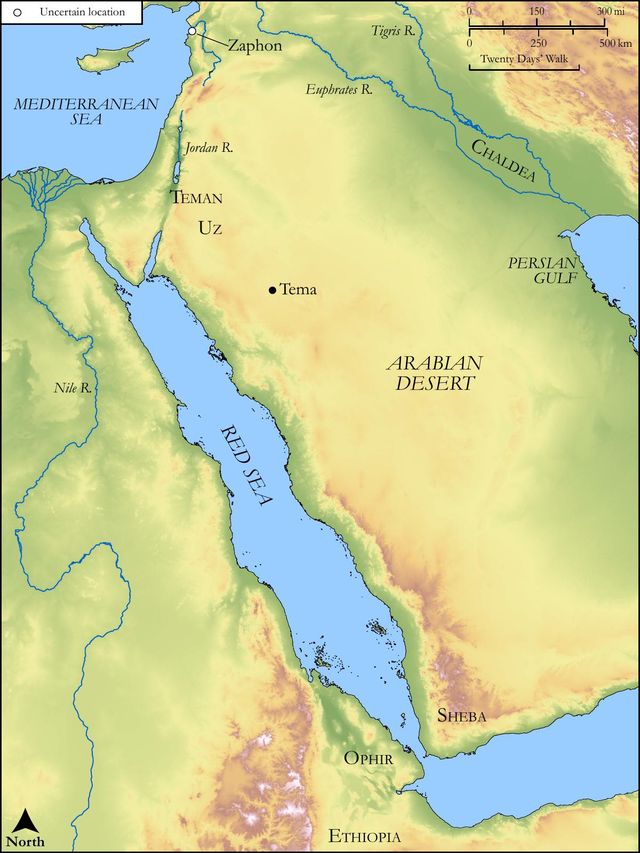
See on the biblical-era map
Study this verse
Public-domain commentary
Matthew Henry
From his Commentary on the Whole Bible. Henry comments on passages, not single verses — this entry covers Job 40:15–24. His three-level outline is real structure in the source text, so it is rendered as structure.
God, for the further proving of his own power and disproving of Job's pretensions, concludes his discourse with the description of two vast and mighty animals, far exceeding man in bulk and strength, one he calls behemoth, the other leviathan. In these verses we have the former described. "Behold now behemoth, and consider whether thou art able to contend with him who made that beast and gave him all the power he has, and whether it is not thy wisdom rather to submit to him and make thy peace with him." Behemoth signifies beasts in general, but must here be meant of some one particular species. Some understand it of the bull; others of an amphibious animal, well known (they say) in Egypt, called the river-horse (hippopotamus), living among the fish in the river Nile, but coming out to feed upon the earth. But I confess I see no reason to depart from the ancient and most generally received opinion, that it is the elephant that is here described, which is a very strong stately creature, of very large stature above any other, of wonderful sagacity, and of so great a reputation in the animal kingdom that among so many four-footed beasts as we have had the natural history of (ch. 38 and 39) we can scarcely suppose this should be omitted. Observe,
I.The description here given of the behemoth.
1.His body is very strong and well built. His strength is in his loins, Job 40:16. His bones, compared with those of other creatures, are like bars of iron, Job 40:18. His back-bone is so strong that, though his tail be not large, yet he moves it like a cedar, with a commanding force, Job 40:17. Some understand it of the trunk of the elephant, for the word signifies any extreme part, and in that there is indeed a wonderful strength. So strong is the elephant in his back and loins, and the sinews of his thighs, that he will carry a large wooden tower, and a great number of fighting men in it. No animal whatsoever comes near the elephant for strength of body, which is the main thing insisted on in this description.
2.He feeds on the productions of the earth and does not prey upon other animals: He eats grass as an ox (Job 40:15), the mountains bring him forth food (Job 40:20), and the beasts of the field do not tremble before him nor flee from him, as from a lion, but they play about him, knowing they are in no danger from him. This may give us occasion,
(1.)To acknowledge the goodness of God in ordering it so that a creature of such bulk, which requires so much food, should not feed upon flesh (for then multitudes must die to keep him alive), but should be content with the grass of the field, to prevent such destruction of lives as otherwise must have ensued.
(2.)To commend living upon herbs and fruits without flesh, according to the original appointment of man's food, Gen 1:29. Even the strength of an elephant, as of a horse and an ox, may be supported without flesh; and why not that of a man? Though therefore we use the liberty God has allowed us, yet be not among riotous eaters of flesh, Pro 23:20.
(3.)To commend a quiet and peaceable life. Who would not rather, like the elephant, have his neighbours easy and pleasant about him, than, like the lion, have them all afraid of him?
3.He lodges under the shady trees (Job 40:21), which cover him with their shadow (Job 40:22), where he has a free and open air to breathe in, while lions, which live by prey, when they would repose themselves, are obliged to retire into a close and dark den, to live therein, and to abide in the covert of that, Job 38:40. Those who are a terror to others cannot but be sometimes a terror to themselves too; but those will be easy who will let others be easy about them; and the reed and fens, and the willows of the brook, though a very weak and slender fortification, yet are sufficient for the defence and security of those who therefore dread no harm, because they design none.
4.That he is a very great and greedy drinker, not of wine or strong drink (to be greedy of that is peculiar to man, who by his drunkenness makes a beast of himself), but of fair water.
(1.)His size is prodigious, and therefore he must have supply accordingly, Job 40:23. He drinks so much that one would think he could drink up a river, if you would give him time, and not hasten him. Or, when he drinks, he hasteth not, as those do that drink in fear; he is confident of his own strength and safety, and therefore makes no haste when he drinks, no more haste than good speed.
(2.)His eye anticipates more than he can take; for, when he is very thirsty, having been long kept without water, he trusts that he can drink up Jordan in his mouth, and even takes it with his eyes, Job 40:24. As a covetous man causes his eyes to fly upon the wealth of this world, which he is greedy of, so this great beast is said to snatch, or draw up, even a river with his eyes.
(3.)His nose has in it strength enough for both; for, when he goes greedily to drink with it, he pierces through snares or nets, which perhaps are laid in the waters to catch fish. He makes nothing of the difficulties that lie in his way, so great is his strength and so eager his appetite.
II.The use that is to be made of this description.
We have taken a view of this mountain of a beast, this over-grown animal, which is here set before us, not merely as a show (as sometimes it is in our country) to satisfy our curiosity and to amuse us, but as an argument with us to humble ourselves before the great God; for,
1.He made this vast animal, which is so fearfully and wonderfully made; it is the work of his hands, the contrivance of his wisdom, the production of his power; it is behemoth which I made, Job 40:15. Whatever strength this, or any other creature, has, it is derived from God, who therefore must be acknowledged to have all power originally and infinitely in himself, and such an arm as it is not for us to contest with. This beast is here called the chief, in its kind, of the ways of God (Job 40:19), an eminent instance of the Creator's power and wisdom. Those that will peruse the accounts given by historians of the elephant will find that his capacities approach nearer to those of reason than the capacities of any other brute-creature whatsoever, and therefore he is fitly called the chief of the ways of God, in the inferior part of the creation, no creature below man being preferable to him.
2.He made him with man, as he made other four-footed beasts, on the same day with man (Gen 1:25, Gen 1:26), whereas the fish and fowl were made the day before; he made him to live and move on the same earth, in the same element, and therefore man and beast are said to be jointly preserved by divine Providence as fellow-commoners, Psa 36:6. "It is behemoth, which I made with thee; I made that beast as well as thee, and he does not quarrel with me; why then dost thou? Why shouldst thou demand peculiar favours because I made thee (Job 10:9), when I made the behemoth likewise with thee? I made thee as well as that beast, and therefore can as easily manage thee at pleasure as that beast, and will do it whether thou refuse or whether thou choose. I made him with thee, that thou mayest look upon him and receive instruction." We need not go far for proofs and instances of God's almighty power and sovereign dominion; they are near us, they are with us, they are under our eye wherever we are.
3.He that made him can make his sword to approach to him (Job 40:19), that is, the same hand that made him, notwithstanding his great bulk and strength, can unmake him again at pleasure and kill an elephant as easily as a worm or a fly, without any difficulty, and without the imputation either of waste or wrong. God that gave to all the creatures their being may take away the being he gave; for may he not do what he will with his own? And he can do it; he that has power to create with a word no doubt has power to destroy with a word, and can as easily speak the creature into nothing as at first he spoke it out of nothing. The behemoth perhaps is here intended (as well as the leviathan afterwards) to represent those proud tyrants and oppressors whom God had just now challenged Job to abase and bring down. They think themselves as well fortified against the judgments of God as the elephant with his bones of brass and iron; but he that made the soul of man knows all the avenues to it, and can make the sword of justice, his wrath, to approach to it, and touch it in the most tender and sensible part. He that framed the engine, and put the parts of it together, knows how to take it in pieces. Woe to him therefore that strives with his Maker, for he that made him has therefore power to make him miserable, and will not make him happy unless he will be ruled by him.
Historical interpretation
Four Centuries of Reception
3 surviving comments on this verse. Each one is dated, so this reads as a timeline rather than a list.
Select a marker to jump to its quote. Markers stagger vertically where authors wrote within a few decades of each other.
“And when he has gone up to a steep mountain, he causes joy to the quadrupeds in the deep.” This means the wild animals have raised their heads only when this animal has withdrawn to the mountains. If [God] has created these two enormous beasts, he did so in order that you might know that he may create all of them according to their own type. But God does not do so because his creation is oriented to provide what is useful to you. Notice how these beasts observe their proper laws: they haunt that part of the sea which is not navigable. But one may ask, What is their use? We ignore what is the mysterious utility of these monsters, but, if we want to take the risk of an explanation, we may say that they lead toward the knowledge of God.
5. Overshadowing is sometimes used in Holy Scripture for the Incarnation of the Lord, or the cooling of the mind from the heat of carnal thoughts; whence by the expression ‘shadow’ this cooling of the heart in consequence of heavenly protection is usually spoken of. But sometimes ‘shadow’ is taken to mean the numbness of the frozen minds when charity departs. For that the Incarnation of the Lord is signified by the term overshadowing, still preserving the truth of the history, the word of the Angel attests, who says to Mary, The Power of the Highest shall overshadow thee. [Luke 1, 35] For because a shadow is caused in no other way than by a light and a body, the Power of the Highest overshadowed her, because the incorporeal Light assumed a body in her womb. By which overshadowing in truth she received in herself every refreshment of mind. Again, by ‘shadow’ is expressed the refreshment of the heart by reason of heavenly protection, as the Psalmist says, Hide me under the shadow of Thy wings. [Ps. 17, 8] Or as the Bride in the Song of Songs, having waited for the coming of the Bridegroom, announces, saying, I sat down under the shadow of Him, Whom I had longed for. [Cant. 2, 3] As if she said, I rested under the protection of His coming from the heat of carnal desires. Again, by ‘shadow’ is expressed the numbness of the frozen mind, when charity departs, as is said of sinful man, that he sought the shadow. For man, flying from the warmth of charity, has forsaken the sun of truth, and hid himself under the shade of inward cold. Whence it is said by the voice of the same Truth, Iniquity shall abound, and the love of many shall wax cold. [Matt. 24, 12] Whence the first man, after his sin, is found hid amidst the trees of paradise at the cool after midday [‘ad auram’]. [Gen. 3, 8] For since he had lost the midday warmth of charity, he was already benumbed beneath the shadow of sin, as if under the cold of the air.
6. Because then this Behemoth finds a kind of rest in those, whom he chills by withdrawing from the light of the true Sun, he is said to sleep under the shadow. But sometimes by ‘shadow,’ if used with the addition of the word ‘death,’ is expressed either the death of the flesh, or any reprobates, who by their eagerness in evil doing imitate the darkness of the ancient enemy. Whence it is said by the Psalmist with the voice of the Martyrs; Thou hast humbled us in the place of affliction, and the shadow of death hath covered us. [Ps. 44, 19] For the shadow of death covers the Elect of God, when the death of the flesh, which is the image of eternal death, cuts them off from this life; because as that separates the soul from God, so does this separate the body from the soul. Or certainly the shadow of death covers them, because it is written of the ancient enemy, His name was death. [Rev. 6, 8] All reprobates are therefore the shadow of death, because they imitate the malice of his wickedness, and shadow forth his image, as it were, when they take in themselves a resemblance of his malice. And they cover the Elect of God, when they gain strength against them for a time, in the cruelty of persecution. But in this place ‘shadow’ is taken for the slumber of wickedness, and this Behemoth slumbers therein, because he watches anxiously against hearts glowing with charity, but lies securely in minds benumbed with cold. For he cannot slumber in the minds of Saints, because, even if he places himself therein for a short moment, the very warmth of heavenly desires wearies him, and he is pricked, as it were, to make him depart, as often as they sigh after eternal things with inmost love. And as many holy thoughts as cry aloud from their minds unto heaven, are as so many voices to rouse him. Whence it is, that, frightened by the arms of good deeds, and smitten with the darts of sighs, he takes his flight, and that, returning to the frozen hearts of the reprobate, he seeks for that shadow of wickedness to occupy in security. And where it is found by him, is shown by its being immediately subjoined, In the covert of the reeds.
7. In Holy Scripture, by the expression ‘cane’ [‘calamus’] or ‘reed’ [‘arundo’] is sometimes understood the Abiding Word, sometimes the skill of the learned, sometimes the changeableness of the mind, sometimes the brightness of temporal glory. For by ‘cane’ is designated the eternity of the Word, when it is said by the Psalmist with the voice of the Father, My tongue is the reed [‘calamus’] of a swift writer. [Ps. 45, 1] For since that which we speak passes away, but that which we write remains, the tongue of the Father is called the reed of a writer, because from Him is the Word Coeternal with Himself, and begotten without transition [‘transitu’]. Again, by ‘reed’ is expressed the learning of writers, as the Prophet promises concerning Holy Church, saying, In the lairs in which dragons used before to dwell, there will spring up the greenness of the reed, and rush. [Is. 35, 7] For in this sentence, as we said a long way above in this work, by ‘reed’ is expressed the doctrine of writers, by ‘rush’ the freshness of hearers [see Bk. 29, §. 51]. Again, by ‘cane,’ or certainly by ‘reed,’ is expressed changeableness of mind, as is said by the Lord to the crowds of the Jews in praise of John, What went ye out into the wilderness to see? a reed shaken with the wind? [Matt. 11, 7] in order, namely, that it should be understood, ‘No.’ For John was not in truth a reed shaken with the wind, because no breath of tongues inclined on different sides his mind, which was made firm by the Holy Spirit. Again, by ‘rush’ or ‘reed’ is expressed the brightness of temporal glory, as is said of the righteous by Wisdom, the righteous shall shine, and run to and fro like sparks in the reed-bed. [Wisd. 3, 7] For He terms a ‘reed-bed’ the life of the worldly, who like reeds, outwardly increase to a height by temporal glory, but are inwardly bereft of the solidity of truth. Whence also the kingdom of the Jews is compared to a reed, when it is said by the Prophet, on the Lord appearing in the truth of the flesh, A bruised reed shall He not break, and the smoking flax shall He not quench. [Is. 2, 43] For what does he set forth by the name ‘reed’ but the temporal kingdom of the Jewish people, brilliant indeed without, but empty within? And because in this people the royal race had already failed, and a stranger was possessing its kingdom, He fitly calls the same kingdom a broken reed. But what is expressed by ‘flax,’ except it be its priesthood, which doubtless wore linen vestments? And because at the coming of the Lord, it had lost the warmth of charity, it was not burning but smoking, having already lost, as it were, the fire of faith. But the Incarnate Lord broke not the bruised reed, and quenched not the smoking flax, because He smote not with the might of judgment the kingdom of Judæa, which had been already well nigh destroyed, and its priesthood which retained not the fire of faith, but endured them with the long-suffering of patience.
8. What else, therefore, is designated in this place by the term ‘reed’ but the minds of the worldly, which are devoted to temporal glory? For they are the more empty in themselves within, the more they appear tall and beautiful without; for while they melt away into external glory on the surface, they are not strengthened by any solidity within. For like reed they are, through their folly, hollow within, but are outwardly beautiful through show and appearance; but the more studiously outward glory is sought for by them, the more are their minds agitated with sharper pangs of thought. Whence this Behemoth is now rightly said to slumber in the covert of the reed, because he silently possesses the hearts of those, whose desires he excites to seek after temporal splendor and dignity; and he himself sleeps, as it were, quietly in that spot, where he does not allow those whom he possesses to remain at rest. For whilst they go about to surpass others by the loftiness of their goods, while through the brightness of outward cleanliness they surpass the righteous in appearance, as a reed surpasses the bark of solid trees; by remaining hollow within, they make a fitting place for this Behemoth to rest within them. Whence also the Lord says in the Gospel, that the spirit who went forth and found no rest in barren and dry places, because he found the house which he had left empty, and swept clean, entered it in more abundant measure. [Matt. 12, 43-45] For because the earth which is watered becomes moist, the barren and dry places are the hearts of the righteous, which by the power of discipline are drained dry of all the moisture of carnal concupiscence. Whence here also the place where this Behemoth slumbers is still further pointed out, where it is immediately added, In moist places.
9. For ‘moist places’ are the minds of earthly men, which the moisture of carnal concupiscence makes fluid, because it fills them. In which this Behemoth plants deeper the footsteps of his iniquity, the more as in passing he sinks [‘pertransitus ejus’] in their minds as in wet earth. For ‘moist places’ are voluptuous deeds. For the foot does not slip on dry ground, but when planted in slippery ground it is hardly supported. They therefore journey through this life in moist places, who cannot herein stand upright in righteousness. Behemoth, therefore, sleeps in these moist places, because he rests in the slippery doings of reprobate men. But some suppose that by ‘moist places’ are meant the genitals. But if this is so, what else is plainly designated by moist places but lust, so that by a ‘reed’ is expressed the glory of pride, and by ‘moist places’ the lust of the body? For these in truth are two sins, which hold cruel sway over the human race, one, namely, of the spirit, and the other of the flesh. For pride exalts the spirit, lust corrupts the flesh. The ancient enemy, therefore, specially oppressing mankind either by pride or by lust, sleeps in the covert of the reed, and in moist places, because he holds ruined man under the sway of his domination, either by pride of spirit, or by corruption of flesh. But some he possesses in both ways, because when the spirit of pride exalts them, not even shame for their corruption brings them down from pride at their high estate. But are not the teachers of virtues continually watchful against them within the bounds of Holy Church? Do they cease to reprove grovelling pleasures, and to recommend the joys of the heavenly country? But the minds of the wicked refuse the more obstinately to listen to the highest things, the more closely they have cleaved to those that are basest. Nor are they contented with merely perishing themselves, but, (which is worse,) when they see others convinced and improved, they also oppose the reproofs of the righteous, to keep others at least from being corrected.
The words “the shadows surround it.” Because of the size of the animal, [the author says], anywhere it goes, it casts shadows around it. The words “the crows like a torrent surround it.” [This is said] because the habit of these birds is to approach and croak anytime they see something terrifying.
Continue studying Job 40:21 across the web’s major study libraries — every link below opens this exact verse, chapter, or book on the destination site.
Read & Compare
 BibleGatewayThis verse in more than 200 translations and 70 languages.
 Bible.comThe YouVersion reader — hundreds of translations, reading plans, and highlights.
 ESV.orgCrossway's official English Standard Version reader.
 NET BibleThe NET translation with 60,000+ translators' notes on every rendering decision.
 STEP BibleTyndale House's free study tool — original text, vocabulary, and scholarly resources.
 BibliaLogos Bible Software's free web reader.
 USCCBThe New American Bible (Revised Edition) with the U.S. bishops' study notes.
Commentaries
 BibleHub CommentariesDozens of classic commentaries on this verse, gathered on one page.
 StudyLightMore than 100 commentary sets — the largest collection on the web.
 BibleRefPlain-English commentary on what this verse means, verse by verse.
 Enduring WordDavid Guzik's free commentary on this chapter, widely used by Bible teachers.
 Bible Study ToolsVerse commentary alongside Greek and Hebrew study aids.
Original Language & Research
- BibleHub InterlinearThe verse word by word — original language, transliteration, and English.
- BibleHub LexiconEvery word's original-language definition and Strong's entry.
 Blue Letter BibleDeep-study tools — Strong's numbers, concordance, and word studies.
 SefariaThe Hebrew text with Rashi and centuries of Jewish commentary.
Sermons, Hymns & Audio


TrulyRandomVerse is not affiliated with these sites and doesn’t control their content. They’re linked because they’re genuinely useful.
Summary
Job 40:21 is a pivotal moment in God's majestic discourse to Job, where the Creator challenges human understanding by vividly describing the immense and formidable Behemoth. This verse specifically details Behemoth's preferred habitat—a secluded, water-rich environment of "shady trees," "reed," and "fens"—thereby emphasizing its untamed nature and the secure, hidden realm over which God alone exercises dominion. It serves to powerfully underscore God's absolute sovereignty, His intricate design in creation, and the inherent limits of human power and comprehension in the face of His divine majesty.
Context
ShowHideLiterary Context
Job 40:21 is situated within God's second and climactic speech to Job, which commences in Job 38 and extends through Job 41. Following Job's initial responses and renewed laments, God finally addresses him directly from a whirlwind, not by explaining the specific reasons for Job's suffering, but by overwhelmingly showcasing His own infinite wisdom, power, and intricate control over creation. The detailed descriptions of Behemoth (Job 40:15-24) and Leviathan (Job 41:1-34) serve as the pinnacle of this divine revelation. These creatures are presented as prime examples of God's unmatched might, so powerful and untameable by human hands that only the Creator Himself can control them. Verse 21, specifically, contributes to the awe-inspiring portrait of Behemoth by illustrating its natural, unassailable dwelling, further cementing the creature's wildness and the Creator's unique authority over it, thereby humbling Job and the reader alike.
Historical & Cultural Context
In the ancient Near East, large, powerful, and often fearsome creatures held significant symbolic weight, frequently representing untamed forces of nature, primeval chaos, or even divine judgment. While the precise zoological identification of Behemoth remains a subject of scholarly debate (with common suggestions including the hippopotamus or elephant due to its immense size and preferred habitat), its symbolic function within the text is paramount. The imagery of "shady trees," "reed," and "fens" accurately depicts the marshy, riverine environments common in regions like the Nile or Mesopotamian deltas, known for their dense vegetation and formidable wildlife. For an ancient audience, such a description would evoke a creature of immense power, thriving in an environment difficult or dangerous for humans to navigate or control. This context highlights God's authority not just over domesticated animals or human endeavors, but over the wildest, most formidable, and seemingly chaotic aspects of His creation, profoundly reinforcing His transcendence above human understanding and control.
Key Themes
ShowHideThe description of Behemoth's habitat in Job 40:21 contributes significantly to several overarching themes in the Book of Job and the broader biblical narrative. Firstly, it powerfully underscores God's Unchallengeable Power and Sovereignty. If humanity cannot even contend with a creature like Behemoth, how can they possibly question the Creator who fashioned and controls it? This theme is echoed throughout scripture, reminding us that God's understanding is infinite and His power beyond measure. Secondly, it emphasizes Nature's Wildness and God's Dominion over Chaos. Behemoth thrives in a "covert" of "reed and fens," a place of untamed, dense wilderness, signifying that God's order extends even to the most formidable and seemingly chaotic elements of His creation. This demonstrates that no aspect of the created order is outside His providential care and command. Finally, the verse contributes to the theme of Human Humility and the Limits of Human Comprehension. By presenting such a creature, God impresses upon Job (and the reader) the vastness of His wisdom and power, fostering a profound sense of humility in the face of His magnificent and often mysterious works, as His judgments are unsearchable and His ways past finding out.
Exposition and Analysis
ShowHideKey Word Analysis
ShowHideThis primitive root verb signifies "to lie down" for various purposes, including rest, repose, or security. In the context of Behemoth, it conveys a sense of secure, undisturbed rest and mastery within its environment. Behemoth is not merely present but is comfortably and confidently "lying down," implying a creature utterly at ease and unthreatened in its chosen domain, highlighting its formidable nature and the absence of any human challenge to its peace.
This term refers to a specific type of tree, often identified as the lotus tree or thorny acacia, known for its dense foliage and preference for water-rich environments. The emphasis here is on the deep, impenetrable shade and cover these trees provide. They serve as a natural fortress, a place of safety, concealment, and cool refuge for this colossal creature, underscoring its secure and hidden dwelling place.
Meaning "hiding place," "secret place," or "shelter." This word profoundly emphasizes the security and inaccessibility of Behemoth's habitat. It's not merely a place where Behemoth lies, but a place intrinsically designed for concealment and protection, reinforcing the creature's untamed nature and the inherent difficulty for any human to approach, observe, or subdue it. It speaks to the creature's unassailable sanctuary.
This intensive term denotes marshy, swampy, or boggy ground. It paints a vivid picture of a water-logged, wild, and often treacherous environment. The "fens" are an integral part of Behemoth's domain, indicating a creature perfectly adapted to and thriving in a habitat that is typically inhospitable or challenging for humans. This further underscores Behemoth's formidable and wild character, as it is perfectly at home in a realm where humanity is not.
Verse Breakdown
ShowHide"He lieth under the shady trees"
This opening clause establishes Behemoth's posture and primary resting place, immediately conveying a sense of security and dominion. The verb "lieth" suggests a state of repose, confidence, and mastery over its environment, rather than vulnerability or fear. The "shady trees" provide not only physical cover from the elements but also a symbolic sense of deep concealment and unassailability, indicating a creature that remains largely hidden from human observation and control, thriving in its natural, undisturbed state.
"in the covert of the reed"
This phrase further specifies the nature of Behemoth's impenetrable hiding place. The "covert" emphasizes a place of secret refuge and secure shelter, while "reed" (Hebrew: qaneh) refers to tall, dense marsh vegetation. This imagery portrays Behemoth as perfectly camouflaged and protected within its natural habitat, making it virtually unassailable by human means. It highlights the creature's seamless integration into an environment that offers it ultimate protection.
"and fens"
This concluding phrase broadens the scope of Behemoth's domain to include the surrounding swampy, marshland environment. The "fens" represent the wild, untamed, and often treacherous terrain that Behemoth inhabits and thrives in. This reinforces the creature's immense power and its complete adaptation to a formidable natural world, a realm where humanity is typically at a disadvantage. It underscores that this creature is perfectly at home and sovereign within its wild, watery domain, a testament to God's diverse and powerful creation.
Literary Devices
ShowHideJob 40:21 masterfully employs several potent literary devices to convey its message and impress upon the reader God's overwhelming power. Imagery is central, painting a vivid and sensory-rich picture of Behemoth's habitat with specific details like "shady trees," "reed," and "fens." This detailed description allows the reader to visualize the creature's secure, wild, and watery domain, evoking a sense of its unassailable nature. This contributes to the powerful Symbolism at play, where Behemoth itself becomes a symbol of God's untamed power and the forces of nature that are utterly beyond human control or full comprehension. The creature's hidden, inaccessible dwelling further symbolizes the limits of human knowledge and the vastness of God's creation that remains mysterious and sovereignly managed by Him alone. The verse also utilizes precise Description to build a profound sense of awe and wonder, not just at Behemoth's formidable presence, but ultimately at the Creator who designed and sustains such a magnificent and formidable creature in its perfectly suited, impenetrable environment.
Theological and Thematic Connections
ShowHideJob 40:21, in its detailed portrayal of Behemoth's impenetrable habitat, serves as a profound theological statement on God's absolute sovereignty over all creation, including its most formidable and untamed aspects. It challenges the human tendency to believe we can fully comprehend or control the world around us, let alone the God who made it. The verse highlights that God's power is not limited to the orderly or the comprehensible but extends to the wild, the hidden, and the seemingly chaotic. This understanding cultivates a deep sense of awe and humility, reminding us that God's wisdom and might far surpass our own, and that even in the most obscure corners of His creation, His design and dominion are perfectly evident. It compels us to worship a God whose power is not just vast, but also intricately detailed in His providential care for every creature and every corner of His cosmos.
Reflection and Application
ShowHideJob 40:21 invites us to step back from our often anthropocentric view of the world and marvel at the sheer scale and diversity of God's creation, particularly those aspects that remain beyond our control or full comprehension. In a world where we often strive for mastery and understanding, the image of Behemoth in its unassailable "covert" serves as a powerful reminder of our inherent limitations and God's infinite power. This contemplation can foster a profound sense of humility, moving us away from self-reliance and towards a deeper trust in the Creator. When we face our own "Behemoths"—the overwhelming challenges, uncertainties, or seemingly uncontrollable circumstances in our lives—this verse encourages us to remember that the same God who effortlessly controls the mightiest creatures of the wild also holds our lives in His sovereign hand. This realization can bring immense comfort and peace, knowing that even in the "fens" of our darkest experiences, God is present, powerful, and utterly in control, working all things according to His perfect will.
Questions for Reflection
ShowHideFAQ
ShowHideWhat is Behemoth? Is it a real animal?
ShowHideBehemoth, as described in Job 40:15-24, is a creature of immense power and size, whose exact zoological identification has been debated for centuries. Many scholars suggest it refers to a hippopotamus or elephant, given its size, strength, and association with water-rich, marshy environments like those described in Job 40:21. Others propose it might be a mythical or legendary creature, or even a symbolic representation of a primeval force. Regardless of its precise biological identity, the primary purpose of Behemoth in the Book of Job is symbolic: it represents a creature so powerful and untameable by human hands that it serves as a testament to God's unparalleled might and sovereignty over all creation. God uses Behemoth (and Leviathan in Job 41) to humble Job and demonstrate that if humanity cannot control these creatures, they certainly cannot question or comprehend the Creator who brought them into being.
Why does God describe Behemoth and Leviathan to Job instead of answering his questions directly about his suffering?
ShowHideGod's purpose in describing Behemoth and Leviathan is not to provide a direct explanation for Job's suffering, but rather to re-establish His infinite wisdom, power, and sovereignty in a way that humbles Job and shifts his perspective. Job had been demanding an explanation from God for his inexplicable pain, essentially putting God on trial. Instead of a legal defense, God responds by showcasing His incomprehensible creative power and control over the universe, including its most formidable and untamed elements. By presenting creatures like Behemoth, which are beyond human control and comprehension, God illustrates the vast chasm between His divine wisdom and Job's finite understanding. This divine discourse forces Job to recognize his own limitations and God's absolute authority, leading Job to repent of his presumptuous questioning in Job 42:1-6. The point is not to explain suffering, but to affirm God's unchallengeable nature, fostering trust rather than demanding answers and ultimately calling Job to a deeper, more humble faith in the Creator.
Christ-Centered Fulfillment
ShowHideThe profound truth revealed in Job 40:21, concerning God's absolute sovereignty over the most formidable and untamed elements of creation, finds its ultimate and most glorious fulfillment in the person and work of Jesus Christ. While Behemoth exemplifies a creature beyond human control, demonstrating God's power, Jesus Christ is the very embodiment of that divine power and wisdom. He is the one through whom "all things were created, in heaven and on earth, visible and invisible, whether thrones or dominions or rulers or authorities—all things were created through him and for him" (Colossians 1:16). The same divine power that sustains Behemoth in its hidden "covert" is manifested in Christ's authority over all creation, from calming the raging storm with a word (Mark 4:39) to casting out demons and healing all manner of disease. Furthermore, the untamed forces that Behemoth symbolizes—chaos, wildness, and elements beyond human mastery—find their ultimate conqueror in Christ. He is the "Lamb of God, who takes away the sin of the world!" (John 1:29), who triumphed over the spiritual "behemoths" of sin, death, and the devil, disarming principalities and powers and leading them in triumph (Colossians 2:15). Thus, the security and refuge Behemoth finds in its natural habitat foreshadow the ultimate "covert" and "refuge" humanity finds in Christ, who invites all who are weary and burdened to find rest in Him (Matthew 11:28-30). He is the one who truly holds all things together, demonstrating God's power not just in creation, but supremely in redemption and the promise of a new heaven and new earth where His perfect order will reign eternally.