


Luke 22:64
- καὶkaiAndG2532CONJConjunction
- περικαλύψαντεςperikalupsanteshaving blindfoldedG4028V-AAP-NPMVerb Aorist Active Participle Nominative Plural Masculine
- αὐτὸνautonHimG846P-ASMPersonal pronoun Accusative Singular Masculine
- ἔτυπτονetuptonthey were strikingG5180V-IAI-3PVerb Imperfect Active Indicative 3rd Plural
- αὐτοῦautouof himG846P-GSMPersonal pronoun Genitive Singular Masculine
- τὸto<the>G3588T-ASNDefinite article Accusative Singular Neuter
- πρόσωπονprosōponfaceG4383N-ASNNoun Accusative Singular Neuter
- καὶkaiandG2532CONJConjunction
- ἐπηρώτωνepērōtōnthey were questioningG1905V-IAI-3PVerb Imperfect Active Indicative 3rd Plural
- αὐτόνautonhimG846P-ASMPersonal pronoun Accusative Singular Masculine
- λέγοντες·legontessayingG3004V-PAP-NPMVerb Present Active Participle Nominative Plural Masculine
- προφήτευσονprophēteusondo prophesyG4395V-AAM-2SVerb Aorist Active Imperative 2nd Singular
- τίςtiswhoG5101I-NSMInterrogative pronoun Nominative Singular Masculine
- ἐστινestinisG1510V-PAI-3SVerb Present Active Indicative 3rd Singular
- ὁhothe [one]G3588T-NSMDefinite article Nominative Singular Masculine
- παίσαςpaisashaving struckG3817V-AAP-NSMVerb Aorist Active Participle Nominative Singular Masculine
- σε;seYou?G4771P-2ASPersonal pronoun Accusative 2nd Singular
English is a literal word-by-word gloss of the Greek, not the KJV's wording. Why?
This is the original text the KJV's translators worked from — each Greek word with its own literal English meaning in this verse, prepared by scholars at Tyndale House, Cambridge. The KJV translates whole sentences, not word by word, so its wording differs: one Greek word can become several English words, and the KJV may choose “charity” where the gloss reads “love”. Both are faithful — they answer different questions. For the KJV's own rendering, switch to the KJV text.
Details
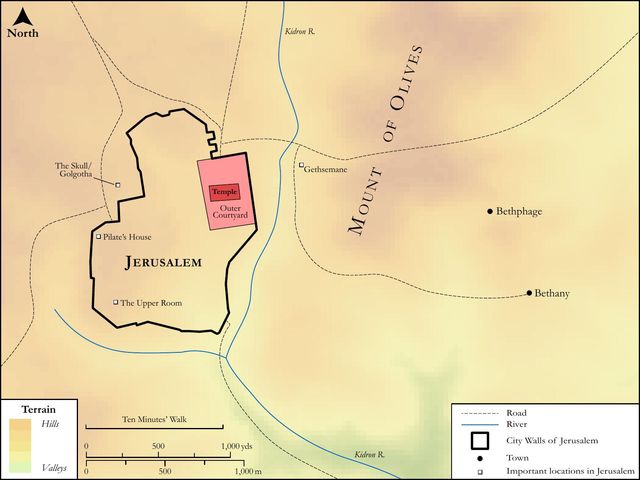
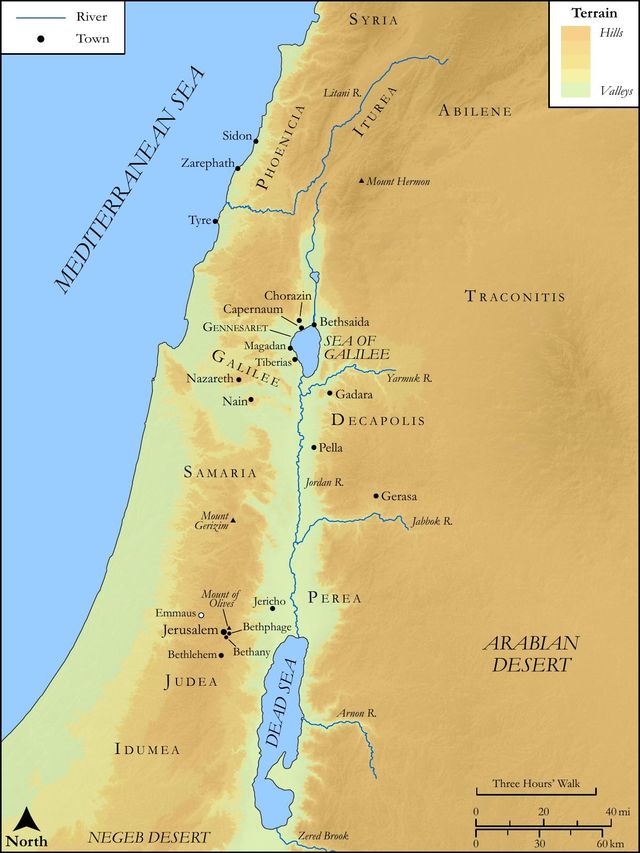
See on the biblical-era map

Study this verse
Public-domain commentary
Matthew Henry
From his Commentary on the Whole Bible. Henry comments on passages, not single verses — this entry covers Luke 22:63–71. His two-level outline is real structure in the source text, so it is rendered as structure.
We are here told, as before in the other gospels,
I.How our Lord Jesus was abused by the servants of the high priest.
The abjects, the rude and barbarous servants, gathered themselves together against him. They that held Jesus, that had him in custody till the court sat, they mocked him, and smote him (Luk 22:63), they would not allow him to repose himself one minute, though he had had no sleep all night, nor to compose himself, though he was hurried to his trial, and no time given him to prepare for it. They made sport with him: this sorrowful night to him shall be a merry night to them; and the blessed Jesus, like Samson, is made the fool in the play. They hood-winked him, and then, according to the common play that young people have among them, they struck him on the face, and continued to do so till he named the person that smote him (Luk 22:64), intending hereby an affront to his prophetical office, and that knowledge of secret things which he was said to have. We are not told that he said any thing, but bore every thing; hell was let loose, and he suffered it to do its worst. A greater indignity could not be done to the blessed Jesus, yet this was but one instance of many; for many other things blasphemously spoke they against him, Luk 22:65. They that condemned him for a blasphemer were themselves the vilest blasphemers that ever were.
II.How he was accused and condemned by the great sanhedrim, consisting of the elders of the people, the chief priests, and the scribes, who were all up betimes, and got together as soon as it was day, about five of the clock in the morning, to prosecute this matter. They were working this evil upon their beds, and, as soon as ever the morning was light, practised it, Mic 2:1. They would not have been up so early for any good work. It is but a short account that we have here of his trial in the ecclesiastical court.
1.They ask him, Art thou the Christ? He was generally believed by his followers to be the Christ, but they could not prove it upon him that he had ever said so totidem verbis - in so many words, and therefore urge him to own it to them, Luk 22:67. If they had asked him this question with a willingness to admit that he was the Christ, and to receive him accordingly if he could give sufficient proof of his being so, it had been well, and might have been for ever well with them; but they asked it with a resolution not to believe him, but a design to ensnare him.
2.He justly complained of their unfair and unjust usage of him, Luk 22:67, Luk 22:68. They all, as Jews, professed to expect the Messiah, and to expect him at this time. No other appeared, or had appeared, that pretended to be the Messiah. He had no competitor, nor was he likely to have any. He had given amazing proofs of a divine power going along with him, which made his claims very well worthy of a free and impartial enquiry. It had been but just for these leaders of the people to have taken him into their council, and examined him there as a candidate for the messiahship, not at the bar as a criminal. "But," saith he, (1.) "If I tell you that I am the Christ, and give you ever such convincing proofs of it, you are resolved that you will not believe. Why should the cause be brought on before you who have already prejudged it, and are resolved, right or wrong, to run it down, and to condemn it?" (2.) "If I ask you what you have to object against the proofs I produce, you will not answer me." Here he refers to their silence when he put a question to them, which would have led them to own his authority, Luk 20:5-7. They were neither fair judges, nor fair disputants; but, when they were pinched with an argument, would rather be silent than own their conviction: "You will neither answer me nor let me go; if I be not the Christ, you ought to answer the arguments with which I prove that I am; if I be, you ought to let me go; but you will do neither."
3.He referred them to his second coming, for the full proof of his being the Christ, to their confusion, since they would not now admit the proof of it, to their conviction (Luk 22:69): "Hereafter shall the Son of man sit, and be seen to sit, on the right hand of the power of God, and then you will not need to ask whether he be the Christ or no."
4.Hence they inferred that he set up himself as the Son of God, and asked him whether he were so or no (Luk 22:70): Art thou then the Son of God? He called himself the Son of man, referring to Daniel's vision of the Son of man that came near before the Ancient of days, Dan 7:13, Dan 7:14. But they understood so much as to know that if he was that Son of man, he was also the Son of God. And art thou so? By this it appears to have been the faith of the Jewish church that the Messiah should be both Son of man and Son of God.
5.He owns himself to be the Son of God: Ye say that I am; that is, "I am, as ye say." Compare Mar 14:62. Jesus said, I am. This confirms Christ's testimony concerning himself, that he was the Son of God, that he stood to it, when he knew he should suffer for standing to it.
6.Upon this they ground his condemnation (Luk 22:71): What need we any further witness? It was true, they needed not any further witness to prove that he said he was the Son of God, they had it from his own mouth; but did they not need proof that he was not so, before they condemned him as a blasphemer for saying that he was so? Had they no apprehension that it was possible he might be so, and then what horrid guilt they should bring upon themselves in putting him to death? No, they know not, neither will they understand. They cannot think it possible that he should be the Messiah, though ever so evidently clothed with divine power and grace, if he appear not, as they expect, in worldly pomp and grandeur. Their eyes being blinded with the admiration of that, they rush on in this dangerous prosecution, as the horse into the battle.
Historical interpretation
Seven Centuries of Reception
9 surviving comments on this verse. Each one is dated, so this reads as a timeline rather than a list.
Select a marker to jump to its quote. Markers stagger vertically where authors wrote within a few decades of each other.
The Lord had rather prove Himself a King than call Himself one, that they might have no excuse for condemning Him, when they confess the truth of that which they lay against Him. It follows, And he said, Ye say that I am.
Jesus, the Lord of heaven and earth, sustains and suffers the mockings of the ungodly, giving us an example of patience.
(de Con. Ev. lib. iii. c. 7.) The temptation of Peter which took place between the mockings of our Lord is not related by all the Evangelists in the same order. For Matthew and Mark first mention those, then Peter's temptation; but Luke has first described the temptations of Peter, then the mockings of our Lord, saying, And the men that held Jesus mocked him, &c.
"Now the men who were holding Jesus mocked him and beat him; they also blindfolded him and asked him, 'Prophesy! Who is it that struck you?' " "When he was reviled, he did not revile in return; when he suffered, he did not threaten; but he trusted to him who judges justly." We should say what the holy prophets said about certain men, "Be appalled, O heavens, at this, be shocked, be utterly desolate, says the Lord." He is the Lord of earth and heaven, the Creator and Architect of all, the King of kings and Lord of lords. He is of surpassing greatness in glory and majesty, the foundation of everything, and that in which all things exist and remain. All things exist in him. He is the breath of all the holy spirits in heaven. This One is despised as one of us, patiently endures beatings, and submits to the ridicule of the wicked. He offers himself to us as a perfect pattern of patience. He rather reveals the incomparable greatness of his godlike gentleness.
Perhaps even Christ endures this to rebuke our minds' weakness and to show that human things fall as far below the divine excellencies as our nature is inferior to his. We of earth, mere corruption and ashes, immediately attack those who would disturb us, as we have a heart full of fierceness like savage beasts. He, who in nature and glory transcends the limits of our understanding and our powers of speech, patiently endured those officers when they not only mocked but also hit him. It says, "Now the men who were holding Jesus mocked him and beat him; they also blindfolded him and asked him, 'Prophesy! Who is it that struck you?' " They ridicule, as if he were some ignorant person, him who is the giver of all knowledge and even sees what is hidden within us. He has somewhere said by one of the holy prophets, "Who is this that darkens counsel by words without knowledge?" He who tries hearts and minds and is the giver of all prophecy, how could he not know who hit him? As Christ said, "Darkness has blinded their eyes, and their minds are blinded." One may say of them, "Woe to them that are drunk, but not with wine! Their vine is of the vine of Sodom and of Gomorrah."
And they asked him, saying: Prophesy, who is it that struck you? And many other things blaspheming, they said against him. They did these things as a mockery of him, who wished to be regarded as a prophet by the people: but as he himself, who suffers, ordains, all things are done for us, so that as Peter exhorts, having suffered Christ in the flesh, we should arm ourselves with the same thought. And also heretics, or Jews to this day who deny Jesus as God, and evil Catholics, who, by their reproachful deeds, provoking him, do not believe that their thoughts and works of darkness are seen by him, as if mocking him, they say: Prophesy, who is it that struck you?
And the men who held Him mocked Him, beating Him, and blindfolded Him, and struck His face. The prophecy is fulfilled that says: "With a rod they strike the judge of Israel on the cheek" (Micah 5). But He who was struck then by the blows of the Jews is also struck now by the blasphemies of false Christians. But they blindfolded Him, not so that He would not see their wickedness, but to hide His own face from them as they once did to Moses. For if they believed Moses, they might perhaps have believed in the Lord as well. But this veil remains over their hearts to this day, not revealed to them, but taken away from us who believe in Christ. For not in vain, at His death, was the temple veil torn in two.
They wished not for truth, but were contriving calumny. Because they expected that Christ would come only as man, of the root of David, they sought this of Him, that if He should say, "I am the Christ," they might falsely accuse Him of claiming to Himself the kingly power.
For He had often declared Himself to be the Christ; as when he said, l and my Father are one, (John 10:30.) and other such like things. And if I also ask you, ye will not answer me. For He had asked them how they said Christ was the Son of David, whereas David in the Spirit called Him his Lord. But they wished neither to believe His words nor to answer His questions. However, because they sought to accuse falsely the seed of David, they hear something still farther; as it follows, Hereafter shall the Son of man sit on the right hand of the power of God.
They understood that He called Himself the Son of God in these words, The Son of man shall sit on the right hand of the power of God.
Likewise the Lord of prophets is derided as a false prophet. It follows, And they blindfolded him. This they did as a dishonour to Him who wished to be accounted by the people as a prophet. But He who was struck with the blows of the Jews, is struck also now by the blasphemies of false Christians. And they blindfolded Him, not that He should not see their wickedness, but that they might hide His face from them. But heretics, and Jews, and wicked Catholics, provoke Him with their vile actions, as it were mocking Him, saying, Who smote thee? while they flatter themselves that their evil thoughts and works of darkness are not known by Him.
He knew the secrets of their hearts, that they who had not believed His works would much less believe His words. Hence it follows, And he said unto them, If I tell you, ye will not believe, &c.
As if he said, There is no time left to you any longer for discourses and teaching, but hereafter shall be the time of judgment, when ye shall see Me, the Son of man, sitting on the right hand of the power of God.
When then they heard this, they ought to have been afraid, but after these words they are the more frantic; as it follows, All said, &c.
Whereby it is manifest, that the disobedient reap no advantage, when the more secret mysteries are revealed to them, but rather incur the heavier punishment. Wherefore such things ought to be concealed from them.
Continue studying Luke 22:64 across the web’s major study libraries — every link below opens this exact verse, chapter, or book on the destination site.
Read & Compare
 BibleGatewayThis verse in more than 200 translations and 70 languages.
 Bible.comThe YouVersion reader — hundreds of translations, reading plans, and highlights.
 ESV.orgCrossway's official English Standard Version reader.
 NET BibleThe NET translation with 60,000+ translators' notes on every rendering decision.
 STEP BibleTyndale House's free study tool — original text, vocabulary, and scholarly resources.
 BibliaLogos Bible Software's free web reader.
 USCCBThe New American Bible (Revised Edition) with the U.S. bishops' study notes.
Commentaries
 BibleHub CommentariesDozens of classic commentaries on this verse, gathered on one page.
 StudyLightMore than 100 commentary sets — the largest collection on the web.
 BibleRefPlain-English commentary on what this verse means, verse by verse.
 Enduring WordDavid Guzik's free commentary on this chapter, widely used by Bible teachers.
 Bible Study ToolsVerse commentary alongside Greek and Hebrew study aids.
Original Language & Research
- BibleHub InterlinearThe verse word by word — original language, transliteration, and English.
- BibleHub LexiconEvery word's original-language definition and Strong's entry.
 Blue Letter BibleDeep-study tools — Strong's numbers, concordance, and word studies.
 CNTR CollationThe earliest Greek manuscripts of this verse, collated letter by letter.
Sermons, Hymns & Audio


TrulyRandomVerse is not affiliated with these sites and doesn’t control their content. They’re linked because they’re genuinely useful.
Summary
Luke 22:64 vividly portrays the profound humiliation and physical abuse Jesus endured during His illegal trial before the Jewish Sanhedrin. After being blindfolded, His captors subjected Him to blows on the face, followed by a cruel taunt, challenging Him to "Prophesy, who is it that smote thee?" This act was a deliberate attempt to mock His divine claims and prophetic authority, designed not only to inflict pain but also to discredit Him publicly and emotionally.
Context
ShowHideLiterary Context
This verse is situated within the intensely dramatic Passion narrative in Luke's Gospel, specifically following Jesus' arrest in the Garden of Gethsemane and His initial interrogation by the high priest Caiaphas and the assembled Sanhedrin. The immediate preceding verses (Luke 22:54-62) detail Peter's three denials in the courtyard below, creating a stark contrast between Peter's faltering faith and Jesus' steadfast endurance. The events of this night, culminating in Jesus' appearance before Pilate and Herod (Luke 23:1-25), are characterized by escalating injustice, false accusations, and a relentless tide of violence directed against Jesus. This particular scene of physical abuse and verbal taunts is also powerfully recounted in the synoptic parallels, such as Matthew 26:67-68 and Mark 14:65, underscoring its significant and brutal reality in the Gospel accounts.
Historical & Cultural Context
The abuse depicted in Luke 22:64 occurred during a night trial, which violated several established Jewish legal procedures, including the prohibition of trials at night, on feast days, or before the morning sacrifice. The Sanhedrin, the supreme Jewish judicial and ecclesiastical council, was supposed to uphold justice, yet here they are complicit in, or at least permitting, acts of physical abuse and mockery. Blindfolding a prisoner and striking them while demanding identification was a common form of humiliating torture, designed to break the spirit and expose perceived weakness. The challenge to "prophesy" was particularly cutting in a culture that revered true prophets as spokespersons for God, directly mocking Jesus' claims to divine knowledge and authority. This public degradation was intended to strip Jesus of any dignity and legitimacy in the eyes of His captors and onlookers.
Key Themes
ShowHideLuke 22:64 powerfully contributes to several overarching themes within Luke's Gospel and the broader biblical narrative. Firstly, it starkly highlights The Suffering and Humiliation of Christ, portraying the physical and emotional agony Jesus willingly endured. He was subjected to demeaning treatment, blindfolded, struck, and mocked, emphasizing the profound depth of His sacrificial love and humiliation for humanity's redemption. Secondly, the challenge "Prophesy, who is it that smote thee?" exemplifies the Mockery of Divine Authority and Prophecy. This taunt directly assails Jesus' identity as the Messiah, who was expected to possess divine wisdom and prophetic insight. His tormentors dared Him to use His supposed supernatural knowledge to identify His attackers, attempting to expose Him as a fraud. Ironically, this act confirmed His prophetic suffering, as foretold in scriptures like Isaiah 50:6, where the servant of the Lord offers His back to those who strike Him and His cheeks to those who pull out His beard. Lastly, the scene reveals the Profound Injustice and Cruelty of those who opposed Jesus. Their actions were not merely judicial but deeply personal and malicious, driven by hatred and a desire to destroy Him, showcasing the human capacity for depravity in rebellion against divine truth.
Exposition and Analysis
ShowHideKey Word Analysis
ShowHideFrom περί and καλύπτω, meaning "to cover all around, i.e., entirely (the face, a surface)." This action was not merely to obscure vision but served as a deliberate act of dehumanization, setting the stage for the cruel game that followed. It symbolized the spiritual blindness of His accusers who, despite being in the presence of God incarnate, could not "see" Him for who He truly was.
A primary verb meaning "to 'thump,' i.e., cudgel or pummel (properly, with a stick or bastinado), but in any case by repeated blows." This word implies a sustained, forceful, and repeated physical assault, distinguishing it from a single, isolated blow. It underscores the brutal and prolonged nature of the abuse Jesus suffered, emphasizing the malice behind the actions of His tormentors.
From προφήτης, meaning "to foretell events, divine, speak under inspiration, exercise the prophetic office." The command "Prophesy!" was a direct and mocking challenge to Jesus' perceived claims of divine knowledge and prophetic insight. His tormentors demanded a parlor trick—that He use His supposed supernatural abilities to identify His hidden assailants—thereby attempting to expose Him as a fraud and ridicule His divine authority.
Verse Breakdown
ShowHide"And when they had blindfolded him"
This initial act signifies a deliberate attempt to strip Jesus of His dignity and humanity. By covering His eyes, His captors rendered Him vulnerable and anonymous, setting the stage for a cruel game of physical and verbal abuse, highlighting their contempt and intent to humiliate.
"they struck him on the face"
This clause describes the direct physical violence inflicted upon Jesus. The striking of the face is a particularly demeaning act, designed to cause pain, shame, and public dishonor. It reveals the raw brutality and hatred harbored by His captors, moving beyond mere interrogation to outright assault.
"and asked him, saying, Prophesy, who is it that smote thee?"
This final part of the verse encapsulates the profound irony and mockery of the scene. The demand to "prophesy" is a sarcastic challenge to Jesus' claims of divine insight and prophetic authority. They are daring Him to use His supernatural knowledge to identify His unseen assailant, turning His sacred role into a cruel game. This taunt simultaneously ridicules His identity as the Christ and underscores the spiritual blindness of those who questioned Him.
Literary Devices
ShowHideLuke 22:64 is rich with literary devices that amplify its theological significance. Irony is perhaps the most prominent, as the captors demand a prophetic word from the very One who embodies the fullness of prophecy and divine truth. Their challenge to "Prophesy!" is a profound mockery of His true identity as the Messiah, who perfectly fulfills all Old Testament prophecies, yet they treat Him as a charlatan. Symbolism is also evident; the blindfold not only facilitates the cruel game but also powerfully symbolizes the spiritual blindness of Jesus' accusers, who are unable to recognize the Son of God standing before them. The physical striking of Jesus' face and the subsequent taunts serve as a stark contrast between His meek and silent endurance and their unbridled cruelty and malice. This scene also functions as foreshadowing, hinting at the greater suffering and injustice Jesus would endure on the cross, where He would again be subjected to physical abuse and verbal taunts, ultimately fulfilling the prophecies of the suffering servant.
Theological and Thematic Connections
ShowHideLuke 22:64 stands as a poignant testament to the depth of Christ's suffering and His unwavering commitment to His redemptive mission. Theologically, it reveals the profound contrast between divine humility and human depravity. Jesus, the Son of God, willingly submits to physical abuse and mockery, demonstrating the extent of His self-emptying love (Philippians 2:7) and His perfect obedience to the Father's will, even unto death. This scene underscores the reality of human sin and rebellion against God, as those entrusted with upholding the law become instruments of injustice and cruelty against the very source of truth. Thematically, it connects to the broader biblical narrative of the suffering servant, whose humiliation and pain are not accidental but purposeful, forming a crucial part of God's plan for salvation. It reminds us that God's sovereignty is at work even in moments of profound evil, as Jesus' suffering was foretold and ultimately served to accomplish the greatest good.
Reflection and Application
ShowHideLuke 22:64 offers a profound opportunity for reflection on the nature of suffering, the depth of divine love, and the call to Christ-like endurance. Jesus' silent and dignified endurance in the face of such profound injustice and humiliation provides a powerful model for believers. When we encounter personal attacks, mockery, or unjust treatment, this verse challenges us to respond not with anger or retaliation, but with the quiet strength and unwavering purpose that characterized our Lord. It compels us to remember that our suffering, when united with Christ's, can be redemptive and transformative. Furthermore, contemplating the immense cost of our salvation—the physical pain, the emotional agony, and the profound humiliation Jesus willingly embraced—deepens our appreciation for God's immeasurable love for humanity, as demonstrated in the sacrifice of His Son. This scene also serves as a sobering mirror, exposing the human heart's capacity for cruelty and rebellion when it rejects divine truth, urging us to examine our own hearts for any seeds of pride or malice that might lead to similar spiritual blindness.
Questions for Reflection
ShowHideFAQ
ShowHideWhy did they blindfold Jesus before striking Him?
ShowHideThe act of blindfolding Jesus served multiple purposes for His captors. Primarily, it facilitated the cruel game they were playing, making it impossible for Him to identify His assailants and thus allowing them to taunt Him with the challenge, "Prophesy, who is it that smote thee?" Beyond the game, the blindfold was a deliberate act of dehumanization and humiliation. It stripped Jesus of His ability to see, making Him vulnerable and anonymous in their eyes, further emphasizing their contempt for Him. This physical act of obscuring His vision also symbolically underscored their own spiritual blindness to His true identity as the Messiah.
Was this physical abuse a legal part of Jesus' trial?
ShowHideAbsolutely not. The physical abuse and mockery inflicted upon Jesus in Luke 22:64 were entirely illegal and contrary to Jewish legal procedures of the time. Jewish law stipulated that trials were to be conducted with strict adherence to justice, with no physical harm to the accused. The Sanhedrin's proceedings against Jesus were riddled with irregularities: they were held at night (which was forbidden), based on false testimonies, and culminated in acts of violence and mockery that were a gross perversion of justice. This scene highlights the profound injustice and lawlessness that characterized the religious leaders' determination to condemn Jesus.
Christ-Centered Fulfillment
ShowHideLuke 22:64, though a scene of profound human depravity and suffering, finds its ultimate Christ-centered fulfillment in Jesus' perfect embodiment of the Suffering Servant prophesied in the Old Testament, particularly in Isaiah 53. The blindfolding and striking, coupled with the mocking demand to "Prophesy!", are not random acts of cruelty but part of God's sovereign plan, revealing Jesus as the true Prophet who foreknew and willingly embraced His destiny. He is the one who "gave his back to those who strike, and his cheeks to those who pull out the beard" (Isaiah 50:6). This scene foreshadows the greater humiliation and physical torment of the cross, where the Lamb of God, who takes away the sin of the world, would endure the full wrath of human sin and divine judgment. In His meek submission, Jesus perfectly fulfills the divine will, demonstrating the ultimate act of humility and obedience, setting the pattern for believers to "have the same mindset as Christ Jesus" (Philippians/2-5). His endurance in this moment of intense mockery and abuse is a testament to His unwavering focus on the joy set before Him—the redemption of humanity (Hebrews/12-2).