


John 18:25
- ἦνēnWasG1510V-IAI-3SVerb Imperfect Active Indicative 3rd Singular
- δὲdenowG1161CONJConjunction
- ΣίμωνSimōnSimonG4613N-NSM-PNoun Nominative Singular Masculine Individual
- ΠέτροςPetrosPeterG4074N-NSM-PNoun Nominative Singular Masculine Individual
- ἑστὼςhestōsalready standingG2476V-RAP-NSMVerb Perfect Active Participle Nominative Singular Masculine
- καὶkaiandG2532CONJConjunction
- θερμαινόμενοςthermainomenoswarming himselfG2328V-PMP-NSMVerb Present Middle Participle Nominative Singular Masculine
- εἶπονeiponThey saidG2036V-2AAI-3PVerb 2nd Aorist Active Indicative 3rd Plural
- οὖνounthereforeG3767CONJConjunction
- αὐτῷ·autōto himG846P-DSMPersonal pronoun Dative Singular Masculine
- μὴmēSurelyG3361PRT-NNegative Particle Negative
- καὶkaialsoG2532CONJConjunction
- σὺsuyou yourselfG4771P-2NSPersonal pronoun Nominative 2nd Singular
- ἐκekofG1537PREPPreposition
- τῶνtōntheG3588T-GPMDefinite article Genitive Plural Masculine
- μαθητῶνmathētōndisciplesG3101N-GPMNoun Genitive Plural Masculine
- αὐτοῦautouof HimG846P-GSMPersonal pronoun Genitive Singular Masculine
- εἶ;eiare?G1510V-PAI-2SVerb Present Active Indicative 2nd Singular
- ἠρνήσατοērnēsatoDeniedG720V-ADI-3SVerb Aorist Middle Deponent Indicative 3rd Singular
- ἐκεῖνοςekeinosheG1565D-NSMDemonstrative pronoun Nominative Singular Masculine
- καὶkaiandG2532CONJConjunction
- εἶπεν·eipensaidG2036V-2AAI-3SVerb 2nd Aorist Active Indicative 3rd Singular
- οὐκoukNotG3756PRT-NNegative Particle Negative
- εἰμίeimiI amG1510V-PAI-1SVerb Present Active Indicative 1st Singular
English is a literal word-by-word gloss of the Greek, not the KJV's wording. Why?
This is the original text the KJV's translators worked from — each Greek word with its own literal English meaning in this verse, prepared by scholars at Tyndale House, Cambridge. The KJV translates whole sentences, not word by word, so its wording differs: one Greek word can become several English words, and the KJV may choose “charity” where the gloss reads “love”. Both are faithful — they answer different questions. For the KJV's own rendering, switch to the KJV text.
Details
See on the biblical-era map
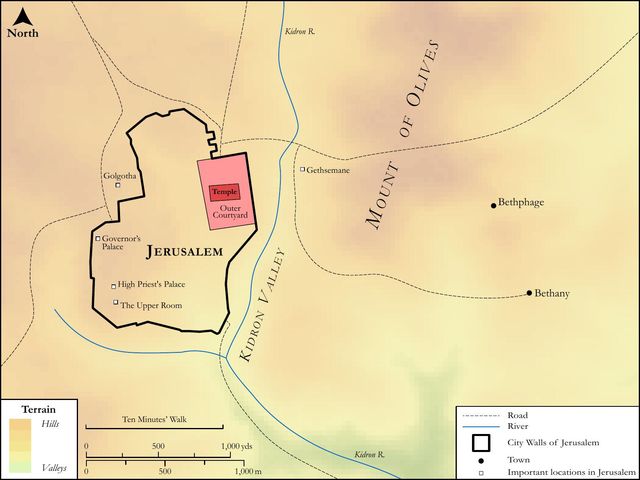
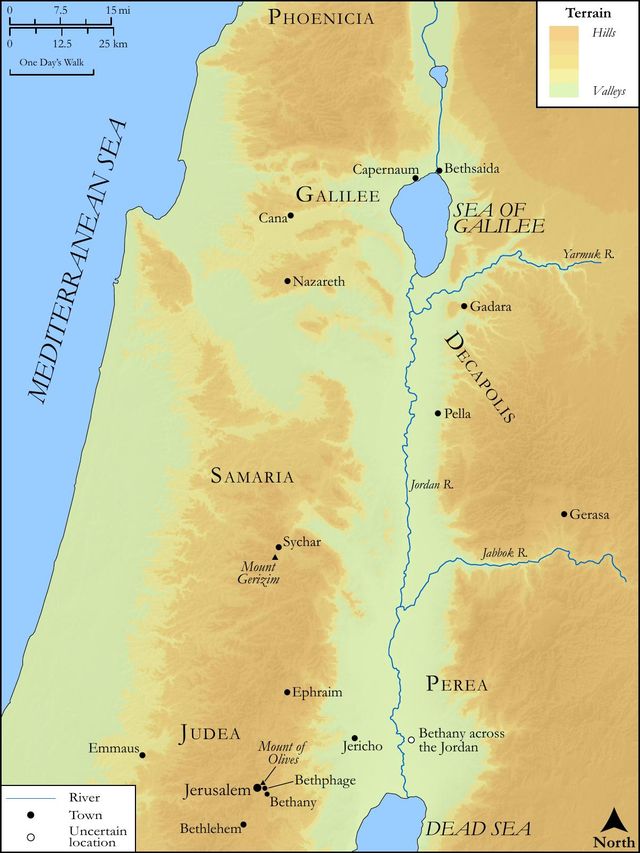
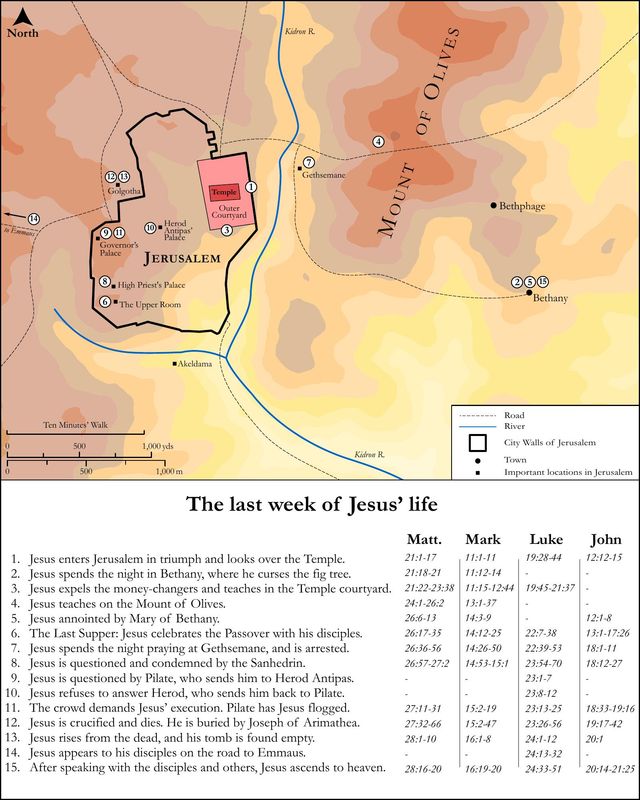
Study this verse
Public-domain commentary
Matthew Henry
From his Commentary on the Whole Bible. Henry comments on passages, not single verses — this entry covers John 18:13–27. His four-level outline is real structure in the source text, so it is rendered as structure.
We have here an account of Christ's arraignment before the high priest, and some circumstances that occurred therein which were omitted by the other evangelists; and Peter's denying him, which the other evangelists had given the story of entire by itself, is interwoven with the other passages. The crime laid to his charge having relation to religion, the judges of the spiritual court took it to fall directly under their cognizance. Both Jews and Gentiles seized him, and so both Jews and Gentiles tried and condemned him, for he died for the sins of both. Let us go over the story in order.
I.Having seized him, they led him away to Annas first, before they brought him to the court that was sat, expecting him, in the house of Caiaphas, v. 13. 1. They led him away, led him in triumph, as a trophy of their victory; led him as a lamb to the slaughter, and they led him through the sheep-gate spoken of Neh. iii. 1. For through that they went from the mount of Olives into Jerusalem. They hurried him away with violence, as if he had been the worst and vilest of malefactors. We had been led away of our own impetuous lusts, and led captive by Satan at his will, and, that we might be rescued, Christ was led away, led captive by Satan's agents and instruments. 2. They led him away to their masters that sent them. It was now about midnight, and one would think they should have put him in ward (Lev. xxiv. 12), should have led him to some prison, till it was a proper time to call a court; but he is hurried away immediately, not to the justices of peace, to be committed, but to the judges to be condemned; so extremely violent was the prosecution, partly because they feared a rescue, which they would thus not only leave no time for, but give a terror to; partly because they greedily thirsted after Christ's blood, as the eagle that hasteth to the prey. 3. They led him to Annas first. Probably his house lay in the way, and was convenient for them to call at to refresh themselves, and, as some think, to be paid for their service. I suppose Annas was old and infirm, and could not be present in council with the rest at that time of night, and yet earnestly desired to see the prey. To gratify him therefore with the assurance of their success, that the old man might sleep the better, and to receive his blessing for it, they produce their prisoner before him. It is sad to see those that are old and sickly, when they cannot commit sin as formerly, taking pleasure in those that do. Dr. Lightfoot thinks Annas was not present, because he had to attend early that morning in the temple, to examine the sacrifices which were that day to be offered, whether they were without blemish; if so, there was a significancy in it, that Christ, the great sacrifice, was presented to him, and sent away bound, as approved and ready for the altar. 4. This Annas was father-in-law to Caiaphas the high priest; this kindred by marriage between them comes in as a reason either why Caiaphas ordered that this piece of respect should be done to Annas, to favour him with the first sight of the prisoner, or why Annas was willing to countenance Caiaphas in a matter his heart was so much upon. Note, Acquaintance and alliance with wicked people are a great confirmation to many in their wicked ways.
II.Annas did not long detain them, being as willing as any of them to have the prosecution pushed on, and therefore sent him bound to Caiaphas, to his house, which was appointed for the rendezvous of the sanhedrim upon this occasion, or to the usual place in the temple where the high priest kept his court; this is mentioned, v. 24. But our translators intimate in the margin that it should come in here, and, accordingly, read it there, Annas had sent him. Observe here,
1.The power of Caiaphas intimated (v. 13). He was high priest that same year. The high priest's commission was during life; but there were now such frequent changes, by the Simoniacal artifices of aspiring men with the government, that it was become almost an annual office, a presage of its final period approaching; while they were undermining one another. God was overturning them all, that he might come whose right it was. Caiaphas was high priest that same year when Messiah was to be cut off, which intimates,
(1.)That when a bad thing was to be done by a high priest, according to the foreknowledge of God, Providence so ordered it that a bad man should be in the chair to do it.
(2.)That, when God would make it to appear what corruption there was in the heart of a bad man, he put him into a place of power, where he had temptation and opportunity to exert it. It was the ruin of Caiaphas that he was high priest that year, and so became a ringleader in the putting of Christ to death. Many a man's advancement has lost him his reputation, and he had not been dishonoured if he had not been preferred.
2.The malice of Caiaphas, which is intimated (v. 14) by the repeating of what he had said some time before, that, right or wrong, guilty or innocent, it was expedient that one man should die for the people, which refers to the story ch. xi. 50. This comes in here to show,
(1.)What a bad man he was; this was that Caiaphas that governed himself and the church by rules of policy, in defiance of the rules of equity.
(2.)What ill usage Christ was likely to meet with in his court, when his case was adjudged before it was heard, and they were already resolved what to do with him; he must die; so that his trial was a jest. Thus the enemies of Christ's gospel are resolved, true or false, to run it down.
(3.)It is a testimony to the innocency of our Lord Jesus, from the mouth of one of his worst enemies, who owned that he fell a sacrifice to the public good, and that it was not just he should die, but expedient only.
3.The concurrence of Annas in the prosecution of Christ. He made himself a partaker in guilt,
(1.)With the captain and officers, that without law or mercy had bound him; for he approved it by continuing him bound when he should have loosed him, he not being convicted of any crime, nor having attempted an escape. If we do not what we can to undo what others have ill done, we are accessaries ex post facto—after the fact. It was more excusable in the rude soldiers to bind him than in Annas, who should have known better, to continue him bound.
(2.)With the chief priest and council that condemned him, and prosecuted him to death. This Annas was not present with them, yet thus he wished them good speed, and became a partaker of their evil deeds.
III.In the house of Caiaphas, Simon Peter began to deny his Master, v. 15-18.
1.It was with much ado that Peter got into the hall where the court was sitting, an account of which we have v. 15, 16. Here we may observe,
(1.)Peter's kindness to Christ, which (though it proved no kindness) appeared in two things:—[1.] That he followed Jesus when he was led away; though at first he fled with the rest, yet afterwards he took heart a little, and followed at some distance, calling to mind the promises he had made to adhere to him, whatever it should cost him. Those that had followed Christ in the midst of his honours, and shared with him in those honours, when the people cried Hosanna to him, ought to have followed him now in the midst of his reproaches, and to have shared with him in these. Those that truly love and value Christ will follow him all weathers and all ways. [2.] When he could not get in where Jesus was in the midst of his enemies, he stood at the door without, willing to be as near him as he could, and waiting for an opportunity to get nearer. Thus when we meet with opposition in following Christ we must show our good-will. But yet this kindness of Peter's was no kindness, because he had not strength and courage enough to persevere in it, and so, as it proved, he did but run himself into a snare: and even his following Christ, considering all things, was to be blamed, because Christ, who knew him better than he knew himself, had expressly told him (ch. xiii. 36), Whither I go thou canst not follow me now, and had told him again and again that he would deny him; and he had lately had experience of his own weakness in forsaking him. Note, We must take heed of tempting God by running upon difficulties beyond our strength, and venturing too far in a way of suffering. If our call be clear to expose ourselves, we may hope that God will enable us to honour him; but, if it be not, we may fear that God will leave us to shame ourselves.
(2.)The other disciple's kindness to Peter, which yet, as it proved, was no kindness neither. St. John several times in this gospel speaking of himself as another disciple, many interpreters have been led by this to fancy that this other disciple here was John; and many conjectures they have how he should come to be known to the high-priest; propter generis nobilitatem—being of superior birth, saith Jerome, Epitaph. Marcel., as if he were a better gentleman born than his brother James, when they were both the sons of Zebedee the fisherman; some will tell you that he had sold his estate to the high priest, others that he supplied his family with fish, both which are very improbable. But I see no reason to think that this other disciple was John, or one of the twelve; other sheep Christ had, which were not of the fold; and this might be, as the Syriac read it, unus ex discipulis aliis—one of those other disciples that believe in Christ, but resided at Jerusalem, and kept their places there; perhaps Joseph of Arimathea, or Nicodemus, known to the high priest, but not known to him to be disciples of Christ. Note, As there are many who seem disciples and are not so, so there are many who are disciples and seem not so. There are good people hid in courts, even in Nero's, as well as hid in crowds. We must not conclude a man to be no friend to Christ merely because he has acquaintance and conversation with those that were his known enemies. Now,
[1.]This other disciple, whoever he was, showed a respect to Peter, in introducing him, not only to gratify his curiosity and affection, but to give him an opportunity of being serviceable to his Master upon his trial, if there were occasion. Those that have a real kindness for Christ and his ways, though their temper may be reserved and their circumstances may lead them to be cautious and retired, yet, if their faith be sincere, they will discover, when they are called to it, which way their inclination lies, by being ready to do a professed disciple a good turn. Peter perhaps had formerly introduced this disciple into conversation with Christ, and now he requites his kindness, and is not ashamed to own him, though, it should seem, he had at this time but a poor downcast appearance.
[2.]But this kindness proved no kindness, nay a great diskindness; by letting him into the high priest's hall, he let him into temptation, and the consequence was bad. Note, The courtesies of our friends often prove a snare to us, through a misguided affection.
2.Peter, having got in, was immediately assaulted with the temptation, and foiled by it, v. 17. Observe here,
(1.)How slight the attack was. It was but a silly maid, of so small account that she was set to keep the door, that challenged him, and she only asked him carelessly, Art not thou one of this man's disciples? probably suspecting it by his sheepish look, and coming in timorously. We should many a time better maintain a good cause if we had a good heart on it, and could put a good face on it. Peter would have had some reason to take the alarm if Malchus had set upon him, and had said, "This is he that cut off my ear, and I will have his head for it;" but when a maid only asked him, Art not thou one of them? he might without danger have answered, And what if I am? Suppose the servants had ridiculed him, and insulted over him, upon it, those can bear but little for Christ that cannot bear this; this is but running with the footmen.
(2.)How speedy the surrender was. Without taking time to recollect himself, he suddenly answered, I am not. If he had had the boldness of the lion, he would have said, "It is my honour that I am so;" or, if he had had the wisdom of the serpent, he would have kept silence at this time, for it was an evil time. But, all his care being for his own safety, he thought he could not secure this but by a peremptory denial: I am not; he not only denies it, but even disdains it, and scorns her words.
(3.)Yet he goes further into the temptation: And the servants and officers stood there, and Peter with them v. 18.
[1.]See how the servants made much of themselves; the night being cold, they made a fire in the hall, not for their masters (they were so eager in persecuting Christ that they forgot cold), but for themselves to refresh themselves. They cared not what became of Christ; all their care was to sit and warm themselves, Amos vi. 6.
[2.]See how Peter herded himself with them, and made one among them. He sat and warmed himself. First, It was a fault bad enough that he did not attend his Master, and appear for him at the upper end of the hall, where he was now under examination. He might have been a witness for him, and have confronted the false witnesses that swore against him, if his Master had called him; at least, he might have been a witness to him, might have taken an exact notice of what passed, that he might relate it to the other disciples, who could none of them get in to hear the trial; he might have learned by his Master's example how to carry himself when it should come to his turn to suffer thus; yet neither his conscience nor his curiosity could bring him into the court, but he sits by, as if, like Gallio, he cared for none of these things. And yet at the same time we have reason to think his heart was as full of grief and concern as it could hold, but he had not the courage to own it. Lord, lead us not into temptation. Secondly, It was much worse that he joined himself with those that were his Master's enemies: He stood with them, and warmed himself; this was a poor excuse for joining with them. A little thing will draw those into bad company that will be drawn to it by the love of a good fire. If Peter's zeal for his Master had not frozen, but had continued in the heat it seemed to be of but a few hours before, he had not had occasion to warm himself now. Peter was much to be blamed, 1. Because he associated with these wicked men, and kept company with them. Doubtless they were diverting themselves with this night's expedition, scoffing at Christ, at what he had said, at what he had done, and triumphing in their victory over him; and what sort of entertainment would this give to Peter? If he said as they said, or by silence gave consent, he involved himself in sin; if not, he exposed himself to danger. If Peter had not so much courage as to appear publicly for his Master, yet he might have had so much devotion as to retire into a corner, and weep in secret for his Master's sufferings, and his own sin in forsaking him; if he could not have done good, he might have kept out of the way of doing hurt. It is better to abscond than appear to no purpose, or bad purpose. 2. Because he desired to be thought one of them, that he might not be suspected to be a disciple of Christ. Is this Peter? What a contradiction is this to the prayer of every good man, Gather not my soul with sinners! Saul among the prophets is not so absurd as David among the Philistines. Those that deprecate the lot of the scornful hereafter should dread the seat of the scornful now. It is ill warming ourselves with those with whom we are in danger of burning ourselves, Ps. cxli. 4.
IV.Peter, Christ's friend, having begun to deny him, the high priest, his enemy, begins to accuse him, or rather urges him to accuse himself, v. 19-21. It should seem, the first attempt was to prove him a seducer, and a teacher of false doctrine, which this evangelist relates; and, when they failed in the proof of this, then they charged him with blasphemy, which is related by the other evangelists, and therefore omitted here. Observe,
1.The articles or heads upon which Christ was examined (v. 19): concerning his disciples and his doctrine. Observe,
(1.)The irregularity of the process; it was against all law and equity. They seize him as a criminal, and now that he is their prisoner they have nothing to lay to his charge; no libel, no prosecutor; but the judge himself must be the prosecutor, and the prisoner himself the witness, and, against all reason and justice, he is put on to be his own accuser.
(2.)The intention. The high priest then (oun—therefore, which seems to refer to v. 14), because he had resolved that Christ must be sacrificed to their private malice under colour of the public good, examined him upon those interrogatories which would touch his life. He examined him,
[1.]Concerning his disciples, that he might charge him with sedition, and represent him as dangerous to the Roman government, as well as to the Jewish church. He asked him who were his disciples—what number they were—of what country—what were their names and characters, insinuating that his scholars were designed for soldiers, and would in time become a formidable body. Some think his question concerning his disciples was, "What is now become of them all? Where are they? Why do they not appear?" upbraiding him with their cowardice in deserting him, and thus adding to the affliction of it. There was something significant in this, that Christ's calling and owning his disciples was the first thing laid to his charge, for it was for their sakes that he sanctified himself and suffered.
[2.]Concerning his doctrine, that they might charge him with heresy, and bring him under the penalty of the law against false prophets, Deut. xiii. 9, 10. This was a matter properly cognizable in that court (Deut. xvii. 12), therefore a prophet could not perish but at Jerusalem, where that court sat. They could not prove any false doctrine upon him; but they hoped to extort something from him which they might distort to his prejudice, and to make him an offender for some word or other, Isa. xxix. 21. They said nothing to him concerning his miracles, by which he had done so much good, and proved his doctrine beyond contradiction, because of these they were sure they could take no hold. Thus the adversaries of Christ while they are industriously quarrelling with his truth, willfully shut their eyes against the evidences of it, and take no notice of them.
2.The appeal Christ made, in answer to these interrogatories. (1.) As to his disciples, he said nothing, because it was an impertinent question; if his doctrine was sound and good, his having disciples to whom to communicate it was no more than what was practised and allowed by their own doctors. If Caiaphas, in asking him concerning his disciples, designed to ensnare them, and bring them into trouble, it was in kindness to them that Christ said nothing of them, for he had said, Let these go their way. If he meant to upbraid him with their cowardice, no wonder that he said nothing, for
he would say nothing to condemn them, and could say nothing to justify them. (2.) As to his doctrine, he said nothing in particular, but in general referred himself to those that heard him, being not only made manifest to God, but made manifest also in their consciences, v. 20, 21.
[1.]He tacitly charges his judges with illegal proceedings. He does not indeed speak evil of the rulers of the people, nor say now to these princes, You are wicked; but he appeals to the settled rules of their own court, whether they dealt fairly by him. Do you indeed judge righteously? Ps. lviii. 1. So here, Why ask you me? Which implies two absurdities in judgment: First, "Why ask you me now concerning my doctrine, when you have already condemned it?" They had made an order of court for excommunicating all that owned him (ch. ix. 22), had issued out a proclamation for apprehending him; and now they come to ask what his doctrine is! Thus was he condemned, as his doctrine and cause commonly are, unheard. Secondly, "Why ask you me? Must I accuse myself, when you have no evidence against me?"
[2.]He insists upon his fair and open dealing with them in the publication of his doctrine, and justifies himself with this. The crime which the sanhedrim by the law was to enquire after was the clandestine spreading of dangerous doctrines, enticing secretly, Deut. xiii. 6. As to this, therefore, Christ clears himself very fully. First, As to the manner of his preaching. He spoke openly, parresia—with freedom and plainness of speech; he did not deliver things ambiguously, as Apollo did his oracles. Those that would undermine the truth, and spread corrupt notions, seek to accomplish their purpose by sly insinuation, putting queries, starting difficulties, and asserting nothing; but Christ explained himself fully, with, Verily, verily, I say unto you; his reproofs were free and bold, and his testimonies express against the corruptions of the age. Secondly, As to the persons he preached to: He spoke to the world, to all that had ears to hear, and were willing to hear him, high or low, learned or unlearned, Jew or Gentile, friend or foe. His doctrine feared not the censure of a mixed multitude; nor did he grudge the knowledge of it to any (as the masters of some rare invention commonly do), but freely communicated it, as the sun does his beams. Thirdly, As to the places he preached in. When he was in the country, he preached ordinarily in the synagogues—the places of meeting for worship, and on the sabbath-day-the time of meeting; when he came up to Jerusalem, he preached the same doctrine in the temple at the time of the solemn feasts, when the Jews from all parts assembled there; and though he often preached in private houses, and on mountains, and by the sea-side, to show that his word and worship were not to be confined to temples and synagogues, yet what he preached in private was the very same with what he delivered publicly. Note, The doctrine of Christ, purely and plainly preached, needs not be ashamed to appear in the most numerous assembly, for it carries its own strength and beauty along with it. What Christ's faithful ministers say they would be willing all the world should hear. Wisdom cries in the places of concourse, Prov. i. 21; viii. 3; ix. 3. Fourthly, As to the doctrine itself. He said nothing in secret contrary to what he said in public, but only by way of repetition and explication: In secret have I said nothing; as if he had been either suspicious of the truth of it, or conscious of any ill design in it. He sought no corners, for he feared no colours, nor said any thing that he needed to be ashamed of; what he did speak in private to his disciples he ordered them to proclaim on the house-tops, Matt. x. 27. God saith of himself (Isa. xlv. 19), I have not spoken in secret; his commandment is not hidden, Deut. xxx. 11. And the righteousness of faith speaks in like manner, Rom. x. 6. Veritas nihil metuit nisi abscondi—truth fears nothing but concealment.—Tertullian.
[3.]He appeals to those that had heard him, and desires that they might be examined what doctrine he had preached, and whether it had that dangerous tendency that was surmised: "Ask those that heard me what I said unto them; some of them may be in court, or may be sent for out of their beds." He means not his friends and followers, who might be presumed to speak in his favour, but, Ask any impartial hearer; ask your own officers. Some think he pointed to them, when he said, Behold, they know what I said, referring to the report which they had made of his preaching (ch. vii. 46), Never man spoke like this man. Nay, you may ask some upon the bench; for it is probable that some of them had heard him, and had been put to silence by him. Note, The doctrine of Christ may safely appeal to all that know it, and has so much right and reason on its side that those who will judge impartially cannot but witness to it.
V.While the judges were examining him, the servants that stood by were abusing him, v. 22, 23.
1.It was a base affront which one of the officers gave him; though he spoke with so much calmness and convincing evidence, this insolent fellow struck him with the palm of his hand, probably on the side of his head or face, saying, Answerest thou the high priest so? as if he had behaved himself rudely to the court.
(1.)He struck him, edoke rhapisma—he gave him a blow. Some think it signifies a blow with a rod or wand, from rhabdos, or with the staff which was the badge of his office. Now the scripture was fulfilled (Isa. l. 6), I gave my cheeks, eis rhapismata (so the LXX.) to blows, the word here used. And Mic. v. 1, They shall smite the judge of Israel with a rod upon the cheek; and the type answered (Job xvi. 10), They have smitten me upon the cheek reproachfully. It was unjust to strike one that neither said nor did amiss; it was insolent for a mean servant to strike one that was confessedly a person of account; it was cowardly to strike one that had his hands tied; and barbarous to strike a prisoner at the bar. Here was a breach of the peace in the face of the court, and yet the judges countenanced it. Confusion of face was our due; but Christ here took it to himself: "Upon me be the curse, the shame."
(2.)He checked him in a haughty imperious manner: Answerest thou the high priest so? As if the blessed Jesus were not good enough to speak to his master, or not wise enough to know how to speak to him, but, like a rude and ignorant prisoner, must be controlled by the jailor, and taught how to behave. Some of the ancients suggest that this officer was Malchus, who owed to Christ the healing of his ear, and the saving of his head, and yet made him this ill return. But, whoever it was, it was done to please the high priest, and to curry favour with him; for what he said implied a jealousy for the dignity of the high priest. Wicked rulers will not want wicked servants, who will help forward the affliction of those whom their masters persecute. There was a successor of this high priest that commanded the bystanders to smite Paul thus on the mouth, Acts xxiii. 2. Some think this officer took himself to be affronted by Christ's appeal to those about him concerning his doctrine, as if he would have vouched him to be a witness; and perhaps he was one of those officers that had spoken honourably of him (ch. vii. 46), and, lest he should now be thought a secret friend to him, he thus appears a bitter enemy.
2.Christ bore this affront with wonderful meekness and patience (v. 23): "If I have spoken evil, in what I have now said, bear witness of the evil. Observe it to the court, and let them judge of it, who are the proper judges; but if well, and as it did become me, why smitest thou me?" Christ could have answered him with a miracle of wrath, could have struck him dumb or dead, or have withered the hand that was lifted up against him. But this was the day of his patience and suffering, and he answered him with the meekness of wisdom, to teach us not to avenge ourselves, not to render railing for railing, but with the innocency of the dove to bear injuries, even when with the wisdom of the serpent, as our Saviour, we show the injustice of them, and appeal to the magistrate concerning them. Christ did not here turn the other cheek, by which it appears that that rule, Matt. v. 39, is not to be understood literally; a man may possibly turn the other cheek, and yet have his heart full of malice; but, comparing Christ's precept with his pattern, we learn,
(1.)That in such cases we must not be our own avengers, nor judges in our own cause. We must rather receive than give the second blow, which makes the quarrel; we are allowed to defend ourselves, but not to avenge ourselves: the magistrate (if it be necessary for the preserving of the public peace, and the restraining and terrifying of evil-doers) is to be the avenger, Rom. xiii. 4.
(2.)Our resentment of injuries done us must always be rational, and never passionate; such Christ's here was; when he suffered, he reasoned, but threatened not. He fairly expostulated with him that did him the injury, and so may we.
(3.)When we are called out to suffering, we must accommodate ourselves to the inconveniences of a suffering state, with patience, and by one indignity done us be prepared to receive another, and to make the best of it.
VI.While the servants were thus abusing him, Peter was proceeding to deny him, v. 25-27. It is a sad story, and none of the least of Christ's sufferings.
1.He repeated the sin the second time, v. 25. While he was warming himself with the servants, as one of them, they asked him, Art not thou one of his disciples? What dost thou here among us? He, perhaps, hearing that Christ was examined about his disciples, and fearing he should be seized, or at least smitten, as his Master was, if he should own it, flatly denied it, and said, I am not.
(1.)It was his great folly to thrust himself into the temptation, by continuing in the company of those that were unsuitable for him, and that he had nothing to do with. He staid to warm himself; but those that warm themselves with evil doers grow cold towards good people and good things, and those that are fond of the devil's fire-side are in danger of the devil's fire. Peter might have stood by his Master at the bar, and have warmed himself better than here, at the fire of his Master's love, which many waters could not quench, Cant. viii. 6, 7. He might there have warmed himself with zeal for his Master, and indignation at his persecutors; but he chose rather to warm with them than to warm against them. But how could one (one disciple) be warm alone? Eccl. iv. 11.
(2.)It was his great unhappiness that he was again assaulted by the temptation; and no other could be expected, for this was a place, this an hour, of temptation. When the judge asked Christ about his disciples, probably the servants took the hint, and challenged Peter for one of them, "Answer to thy name." See here,
[1.]The subtlety of the tempter in running down one whom he saw falling, and mustering a greater force against him; not a maid now, but all the servants. Note, Yielding to one temptation invites another, and perhaps a stronger. Satan redoubles his attacks when we give ground.
[2.]The danger of bad company. We commonly study to approve ourselves to those with whom we choose to associate; we value ourselves upon their good word and covet to stand right in their opinion. As we choose our people we choose our praise, and govern ourselves accordingly; we are therefore concerned to make the first choice well, and not to mingle with those whom we cannot please without displeasing God.
(3.)It was his great weakness, nay, it was his great wickedness, to yield to the temptation, and to say, I am not one of his disciples, as one ashamed of that which was his honour, and afraid of suffering for it, which would have been yet more his honour. See how the fear of man brings a snare. When Christ was admired, and caressed, and treated with respect, Peter pleased himself, and perhaps prided himself, in this, that he was a disciple of Christ, and so put in for a share in the honours done to his Master. Thus many who seem fond of the reputation of religion when it is in fashion are ashamed of the reproach of it; but we must take it for better and worse.
2.He repeated the sin the third time, v. 26, 27. Here he was attacked by one of the servants, who was kinsman to Malchus, who, when he heard Peter deny himself to be a disciple of Christ, gave him the lie with great assurance: "Did not I see thee in the garden with him? Witness my kinsman's ear." Peter then denied again, as if he knew nothing of Christ, nothing of the garden, nothing of all this matter.
(1.)This third assault of the temptation was more close than the former: before his relation to Christ was only suspected, here it is proved upon him by one that saw him with Jesus, and saw him draw his sword in his defence. Note, Those who by sin think to help themselves out of trouble do but entangle and embarrass themselves the more. Dare to be brave, for truth will out. A bird of the air may perhaps tell the matter which we seek to conceal with a lie. Notice is taken of this servant's being akin to Malchus, because this circumstance would make it the more a terror to Peter. "Now," thinks he, "I am gone, my business is done, there needs no other witness nor prosecutor." We should not make any man in particular our enemy if we can help it, because the time may come when either he or some of his relations may have us at their mercy. He that may need a friend should not make a foe. But observe, though here was sufficient evidence against Peter, and sufficient provocation given by his denial to have prosecuted him, yet he escapes, has no harm done him nor attempted to be done. Note, We are often drawn into sin by groundless causeless fears, which there is no occasion for, and which a small degree of wisdom and resolution would make nothing of.
(2.)His yielding to it was no less base than the former: He denied again. See here,
[1.]The nature of sin in general: the heart is hardened by the deceitfulness of it, Heb. iii. 13. It was a strange degree of effrontery that Peter had arrived to on a sudden, that he could with such assurance stand in a lie against so clear a disproof; but the beginning of sin is as the letting forth of water, when once the fence is broken men easily go from bad to worse.
[2.]Of the sin of lying in particular; it is a fruitful sin, and upon this account exceedingly sinful: one lie needs another to support it, and that another. It is a rule in the devil's politics Male facta male factis tegere, ne perpluant—To cover sin with sin, in order to escape detection.
Historical interpretation
Three Centuries of Reception
6 surviving comments on this verse. Each one is dated, so this reads as a timeline rather than a list.
Select a marker to jump to its quote. Markers stagger vertically where authors wrote within a few decades of each other.
(Hom. lxxxiii) Or, He means that the once fervid disciple was now too torpid, to move even when our Lord was carried away: showing thereby how weak man's nature is, when God forsakes him. Asked again, he again denies: They said therefore unto him, Art not thou also one of His disciples? He denied it, and said, I am not.
"And Simon Peter stood and warmed himself." Wonderful, by what a lethargy that hot and furious one was possessed, when Jesus was being led away! After such things as had taken place, he doth not move, but still warms himself, that thou mayest learn how great is the weakness of our nature if God abandoneth. And, being questioned, he denies again.
(Tr. cxiii) After the Evangelist has said that they sent Jesus bound from Annas to Caiaphas, he returns to Peter and his three denials, which took place in the house of Annas: And Simon Peter stood and warmed himself. He repeats what he had said before.
(de Con. Evang. iii. 6) Here we find Peter not at the gate, but at the fire, when he denies the second time: so that he must have returned after he had gone out of doors, where Matthew says he was. He did not go out, and another damsel see him on the outside, but another damsel saw him as he was rising to go out, and remarked him, and told those who were by, i. e. those who were standing with her at the fire inside the hall, This fellow also was with Jesus of Nazareth. (Matt. 26:71, 72) He heard this outside, and returned, and swore, I do not know the man. Then John continues: They said therefore unto him, Art not thou also one of His disciples? which words we suppose to have been said to him when he had come back, and was standing at the fire. And this explanation is confirmed by the fact, that besides the other damsel mentioned by Matthew and Mark in the second denial, there was another person, mentioned by Luke, who also questioned him. So John uses the plural: They said therefore unto him. And then follows the third denial: One of the servants of the high priest, being his kinsman whose ear Peter cut off, saith, Did not I see thee in the garden with Him? That Matthew and Mark speak of the party who here question Peter in the plural number, whereas Luke mentions only one, and John also, adding that that one was the kinsman of him whose ear Peter cut off, is easily explained by supposing that Matthew and Mark used the plural number by a common form of speech for the singular; or that one who had observed him most strictly put the question first, and others followed it up, and pressed Peter with more.
(Tr. cxiii) Lo, the prophecy of the Physician is fulfilled, the presumption of the sick man demonstrated. That which Peter had said he would do, he had not done. I will lay down my life for Thy sake; but what our Lord had foretold had come to pass, Thou shall deny Me thrice. (Luke 22:34)
But the evangelist, after saying that Annas sent Him bound unto Caiaphas, returns to the place of his narrative, where he had left Peter, in order to explain what had taken place in Annas' house in regard to his threefold denial. "But Peter was standing," he says, "and warming himself." He thus repeats what he had already stated before; and then adds what follows. "They said therefore unto him, Art thou also one of his disciples? He denied, and said, I am not." He had already denied once; this is the second time. And then, that the third denial might also be fulfilled, "one of the servants of the high priest, being his kinsman whose ear Peter cut off, saith, Did I not see thee in the garden with him? Peter then denied again, and immediately the cock crew." Behold, the prediction of the Physician is fulfilled, the presumption of the sick man is brought to the light. For there is no performance of what the latter had asserted, "I will lay down my life for Thy sake;" but a performance of what the former had predicted, "Thou shall thrice deny me."
Annas therefore sent Him bound unto Caiaphas, the high priest. Now Simon Peter was standing warming himself. They said therefore unto him, Art thou also one of His disciples? He denied, and said, I am not. One of the servants of the high priest, being a kinsman of him whose ear Peter cut off, saith, Did not I see thee in the garden with Him? Peter therefore denied again: and straightway the cock crew.
The inspired Evangelist, to our profit, checks the course of his narrative, like a horse at full speed, and turns it back again. And why? Because he was bound, before narrating what next ensued, to point out to us Peter's third denial; and this event is best and most appropriately described as it occurred. He therefore designedly refers to what took place at first, and says, that Jesus was sent by Annas to Caiaphas; and shows us that Peter was questioned by the servants who were warming themselves with him at the fire, and also by a kinsman of him whom he had smitten; and that this was the occasion of his third denial. Then He mentions the crowing of the cock, making, it plain to us that no word of our Saviour ever falls to the ground; for He had foreknown and foretold the frailty of His own disciple in the midst of danger. Perhaps the divinely taught compiler of this book would have made no mention at all of this fact, had he not bethought himself of the captious spirit and ceaseless babbling of the adversaries of God. For some of those who seek to make bitter war on the glory of the Saviour would straightway have said: "Show us the denial of Peter, and how, and where, that came to pass which was foretold by Christ, Who, you say, cannot lie. For you maintain that He is Truth, and that He proceedeth from a Father Who is true." It was very essential, therefore, that the inspired Evangelist should narrate to us this occurrence, and show that Christ at all times said what was true.
But perhaps some opponent, abstaining from bringing any such attack against us, will bring a grievous charge against Peter, and accuse the well-beloved disciple of incomparable cowardice, and say that he was so ready to make this verbal repudiation of his Lord, as thrice to fall away and deny Him, when he had not so much as had any actual experience of danger, and when peril was not, indeed, nigh at hand. Talk of this sort may be suitable to those who are not yet initiated in the faith; but I will at once dismiss it, and, bidding farewell to such nonsense, will attempt to make some excuse for the Apostle's conduct, setting forth my argument for the benefit of those who are already accustomed to reflect upon the mysteries contained in the mysterious working of Divine Providence. For it was the bounden duty of the wise Evangelist to make mention of such things, that his hearers might know what even the teachers of the world were in themselves before Christ's Resurrection, and before the Holy Spirit descended upon them; and what they were thereafter, when they had received the grace of the Spirit, Which Christ called power from on high. For any one may see how very jealous they were in assuming virtue; how readily they girded up their loins to follow Christ, and to overcome perils of every sort which they so frequently encountered. But when our Saviour Christ had not yet subdued the power of death, the fear thereof was still stubborn, and altogether invincible; and they who had not yet received the Spirit, nor had their hearts steeled by grace from above, showed that their minds were not yet wholly free from human frailty, and they were not altogether unshaken by the terrors of death. For just as iron, though naturally strong, cannot encounter without injury the harder kinds of stone, if it be not strengthened in the forge; so the soul of man may be buoyed up with unslacking enthusiasm for every thing that is good, but can never be triumphant in the conflicts that so arise, except it be first perfected by the grace of the Spirit of God. Even the disciples, therefore, themselves were frail at first; but, when they had received the Spirit of Almighty God, cast aside their native weakness, and, by communion with Him, attained to exceeding boldness.
It was expedient, then, that the frailty of the Saints should be recorded to the praise and glory of God, Who changed their weakness into power, and raised up, like a strong tower, their spirits, which were easily daunted even by slight dangers, and at times broken down by the mere apprehension of suffering. And that which befell a single one, or some few of the Saints, may afford us at the same time a lesson and a consolation. For we are taught thereby, not, through dwelling on our own infirmities inconsiderately, to slacken in God's service, but rather to trust in Him Who is able to make us all strong, and to boast ourselves in His miraculous works and favour shown to us beyond hope.
Mystically, by the first denial of Peter are denoted those who before our Lord's Passion denied that He was God, by the second, those who did so after His resurrection. So by the first crowing of the cock His resurrection is signified; by the second, the general resurrection at the end of the world. By the first damsel, who obliged Peter to deny, is denoted lust, by the second, carnal delight: by one or more servants, the devils who persuade men to deny Christ.
Continue studying John 18:25 across the web’s major study libraries — every link below opens this exact verse, chapter, or book on the destination site.
Read & Compare
 BibleGatewayThis verse in more than 200 translations and 70 languages.
 Bible.comThe YouVersion reader — hundreds of translations, reading plans, and highlights.
 ESV.orgCrossway's official English Standard Version reader.
 NET BibleThe NET translation with 60,000+ translators' notes on every rendering decision.
 STEP BibleTyndale House's free study tool — original text, vocabulary, and scholarly resources.
 BibliaLogos Bible Software's free web reader.
 USCCBThe New American Bible (Revised Edition) with the U.S. bishops' study notes.
Commentaries
 BibleHub CommentariesDozens of classic commentaries on this verse, gathered on one page.
 StudyLightMore than 100 commentary sets — the largest collection on the web.
 BibleRefPlain-English commentary on what this verse means, verse by verse.
 Enduring WordDavid Guzik's free commentary on this chapter, widely used by Bible teachers.
 Bible Study ToolsVerse commentary alongside Greek and Hebrew study aids.
Original Language & Research
- BibleHub InterlinearThe verse word by word — original language, transliteration, and English.
- BibleHub LexiconEvery word's original-language definition and Strong's entry.
 Blue Letter BibleDeep-study tools — Strong's numbers, concordance, and word studies.
 CNTR CollationThe earliest Greek manuscripts of this verse, collated letter by letter.
Sermons, Hymns & Audio


TrulyRandomVerse is not affiliated with these sites and doesn’t control their content. They’re linked because they’re genuinely useful.
Summary
John 18:25 captures the second of Peter's three denials of Jesus, a poignant moment occurring in the high priest's courtyard during Jesus's trial. As Peter sought warmth among the servants and officers, he was directly challenged about his association with Jesus and unequivocally denied being one of His disciples, illustrating the profound human vulnerability to fear and pressure in the face of imminent danger.
Context
ShowHideLiterary Context
This verse is situated within the dramatic narrative of Jesus's arrest and initial interrogation. Following Jesus's apprehension in the Garden of Gethsemane, He is led to Annas, the father-in-law of the high priest Caiaphas. Peter, along with "another disciple," follows from a distance, eventually gaining entry into the high priest's courtyard (see John 18:15-16). The immediate preceding verse, John 18:24, notes Jesus being sent from Annas to Caiaphas, while Peter remains in the courtyard. Peter's first denial occurs in John 18:17 when a servant girl challenges him. This second denial, recorded in John 18:25, is prompted by a group, setting the stage for the third and final denial which immediately follows in John 18:26-27. The narrative expertly interweaves Jesus's steadfastness under unjust trial with Peter's tragic moral failure, creating a powerful juxtaposition.
Historical & Cultural Context
The scene unfolds in the courtyard of the high priest's residence in Jerusalem, likely a large, open space surrounded by rooms. It was common for trials or preliminary hearings to take place at night, especially for sensitive cases, to avoid public unrest. The presence of a charcoal fire (ἀνθρακιά, anthrakia) indicates the chill of the night, likely in late March or early April during Passover, when nights in Jerusalem can still be quite cool. Peter's attempt to "warm himself" (G2328 thermaínō) by the fire was a natural human act, but it also placed him directly among the very people who were hostile to Jesus—servants and officers of the temple guard. This environment was charged with tension and danger for anyone associated with the accused. The accusers' question, "Art not thou also one of his disciples?", reflects the common practice of identifying and questioning associates of those arrested, often to gather more information or implicate others.
Key Themes
ShowHideThis passage significantly contributes to several overarching themes in John's Gospel and the broader biblical narrative. It powerfully illustrates human weakness and the temptation of fear, showing how even a zealous disciple like Peter can falter under pressure, contrasting sharply with Jesus's unwavering resolve. The repeated denials underscore the theme of fulfillment of prophecy, as Jesus had explicitly foretold Peter's betrayal (John 13:38). This highlights God's sovereign plan unfolding even through human failure. Furthermore, the scene emphasizes the cost of discipleship and the potential for compromise when faced with societal or personal threats. Peter's journey from denial to restoration (as seen later in John 21) becomes a profound testament to God's grace and redemptive power, offering hope for all who stumble.
Exposition and Analysis
ShowHideKey Word Analysis
ShowHideMeaning "to stand (transitively or intransitively), used in various applications (literally or figuratively)." In this context, Peter's "standing" by the fire is a literal physical posture. However, it also carries a subtle ironic undertone. Peter had earlier declared his willingness to "lay down his life" for Jesus (John 13:37), implying a steadfast "standing" with Christ. Here, he stands physically, but spiritually and morally, he is about to fall.
Meaning "to heat (oneself)." This word describes Peter's physical action of seeking warmth from the charcoal fire. Beyond the literal, it can symbolize Peter's attempt to blend in, to find comfort and safety among those hostile to Jesus. His desire for physical warmth tragically parallels a spiritual coldness or a chilling fear that leads him to deny his Lord.
Meaning "to contradict, i.e. disavow, reject, abnegate." This is the pivotal action of the verse. Peter's denial is not merely a refusal to acknowledge, but a strong, emphatic rejection of any association with Jesus. This word encapsulates the essence of his betrayal, a direct contradiction of his prior fervent declarations of loyalty.
Verse Breakdown
ShowHide"And Simon Peter stood and warmed himself."
This opening clause sets the scene, placing Peter physically within the hostile environment of the high priest's courtyard. His act of warming himself by the fire is a mundane human need, yet it is precisely this act that brings him into proximity with those who recognize him, creating the opportunity for his denial. The detail highlights his vulnerability and his attempt to appear inconspicuous.
"They said therefore unto him, Art not thou also [one] of his disciples?"
This is the direct confrontation that precipitates Peter's denial. The "they" refers to the servants and officers gathered around the fire, indicating a collective accusation or suspicion. The question is phrased to elicit a negative response ("Art not thou...?") but carries the weight of an accusation, demanding a clear answer about his allegiance to Jesus.
"He denied [it], and said, I am not."
This is Peter's decisive and tragic response. The phrase "I am not" (Greek: ouk eimi) is a stark and emphatic negation. It is a direct and unequivocal rejection of the accusation, a complete disavowal of his identity as a disciple of Jesus. This statement stands in stark contrast to Jesus's own "I AM" declarations throughout John's Gospel, highlighting Peter's human weakness against Jesus's divine strength and truthfulness.
Literary Devices
ShowHideThe passage employs several potent literary devices. There is profound Irony in Peter's denial; the disciple who had so boldly declared his willingness to die for Jesus (John 13:37) now denies Him out of fear. This creates a stark Contrast between Peter's human frailty and Jesus's unwavering steadfastness and truthfulness in the face of His own trial. The scene also utilizes Foreshadowing and Fulfillment, as Peter's denial directly fulfills Jesus's earlier prophecy (John 13:38), emphasizing the divine orchestration of events even amidst human failure. The Dialogue form of the accusation and denial brings immediacy and tension to the narrative, drawing the reader into the high-stakes moment of Peter's moral test.
Theological and Thematic Connections
ShowHideJohn 18:25 serves as a profound theological statement on the reality of human weakness and the pervasive power of fear, even within the most committed followers of Christ. Peter's denial, though a personal failure, is woven into the larger tapestry of God's redemptive plan, demonstrating that divine prophecy unfolds precisely as foretold, regardless of human actions. This moment underscores the critical need for reliance not on one's own strength or resolve, but on the sustaining grace of God. It also highlights the stark contrast between human fallibility and the perfect, unwavering obedience of Jesus, who steadfastly faced His accusers and suffering without compromise. Ultimately, Peter's story, including this denial, becomes a powerful testament to the depth of God's grace and His capacity to restore even those who have gravely stumbled.
Reflection and Application
ShowHidePeter's denial in John 18:25 offers a sobering yet ultimately hopeful mirror for believers today. It reminds us that even those with great zeal and sincere intentions can falter under pressure. This passage calls us to profound humility, recognizing our own capacity for fear and compromise, and preventing us from relying on self-confidence rather than divine strength. It challenges us to examine where our allegiances truly lie when faced with uncomfortable truths or social pressures. Furthermore, Peter's subsequent restoration (as beautifully depicted in John 21) offers immense comfort and a powerful lesson in God's boundless grace. His failure is not the end of his story, nor is ours. This passage encourages vigilance against the subtle temptations of fear, urging us to cultivate a deeper reliance on Christ so that we may stand firm in our faith, even when it is costly.
Questions for Reflection
ShowHideFAQ
ShowHideWhy was Peter warming himself, and is there any deeper meaning to this act?
ShowHidePeter was literally warming himself by a charcoal fire because it was a cold night in Jerusalem during the Passover season. Beyond the physical necessity, his act of blending in with the servants and officers of the high priest's household, who were hostile to Jesus, can be seen as symbolic. It suggests an attempt to find comfort and safety within a dangerous environment, perhaps indicating his desire to remain inconspicuous and avoid drawing attention to his association with Jesus. This physical act of seeking warmth tragically precedes a spiritual coldness and denial of his Lord.
How many times did Peter deny Jesus, and how does this verse fit into that sequence?
ShowHidePeter denied Jesus three times, exactly as Jesus had prophesied (John 13:38). John 18:25 records Peter's second denial. The first denial occurs earlier in the courtyard, prompted by a servant girl, in John 18:17. The third and final denial, which is immediately followed by the crowing of the rooster, is recounted in John 18:26-27. Each denial escalates in its public nature and the intensity of the accusation.
What is the significance of Peter's statement "I am not"?
ShowHidePeter's "I am not" (Greek: ouk eimi) is a direct and emphatic negation. It is a complete disavowal of his identity as a disciple of Jesus. The significance lies in its stark contrast to Jesus's own frequent "I AM" (Greek: egō eimi) statements throughout John's Gospel (e.g., John 8:58). While Jesus boldly proclaims His divine identity, Peter, in a moment of fear, emphatically denies his identity and association with Jesus. This linguistic parallel highlights Peter's profound human weakness against Jesus's divine strength and unwavering truthfulness, even unto death.
Christ-Centered Fulfillment
ShowHidePeter's denial in John 18:25 serves as a poignant backdrop against which the perfect faithfulness of Jesus Christ shines even more brightly. While Peter, a representative of humanity, succumbs to fear and denies his Lord, Jesus, simultaneously undergoing unjust trials, remains utterly steadfast and truthful. His unwavering resolve, even when facing torture and death, stands in stark contrast to Peter's frailty. Jesus is the true and faithful disciple, the one who perfectly fulfills the will of the Father, never denying His identity or mission. Furthermore, Peter's subsequent restoration by Jesus after the resurrection, as depicted in John 21:15-19, powerfully foreshadows Christ's redemptive work for all who fail. Jesus's grace is not merely a covering for sin but a transformative power that restores and empowers, demonstrating His ultimate victory over sin and death, and His compassionate High Priestly ministry (Hebrews 4:15) for His struggling people. Peter's failure thus magnifies the perfect obedience, sacrificial love, and restorative grace of Christ, who alone is worthy of all praise.