


Mark 14:67
Bible text: King James Version (1769 Blayney text) · Public domain
Bible text: Berean Standard Bible · Public domain
Bible text: American Standard Version (1901) · Public domain
Bible text: World English Bible, Messianic edition · Public domain
Bible text: Geneva Bible (1599) · Public domain
Bible text: Young's Literal Translation · Public domain
- καὶkaiandG2532CONJConjunction
- ἰδοῦσαidousahaving seenG1492V-2AAP-NSFVerb 2nd Aorist Active Participle Nominative Singular Feminine
- τὸνton<the>G3588T-ASMDefinite article Accusative Singular Masculine
- ΠέτρονPetronPeterG4074N-ASM-PNoun Accusative Singular Masculine Individual
- θερμαινόμενονthermainomenonwarming himselfG2328V-PMP-ASMVerb Present Middle Participle Accusative Singular Masculine
- ἐμβλέψασαemblepsasahaving lookedG1689V-AAP-NSFVerb Aorist Active Participle Nominative Singular Feminine
- αὐτῷautōat himG846P-DSMPersonal pronoun Dative Singular Masculine
- λέγει·legeishe saysG3004V-PAI-3SVerb Present Active Indicative 3rd Singular
- καὶkaiAlsoG2532CONJConjunction
- σὺsuyou yourselfG4771P-2NSPersonal pronoun Nominative 2nd Singular
- μετὰmetawithG3326PREPPreposition
- τοῦtoutheG3588T-GSMDefinite article Genitive Singular Masculine
- ΝαζαρηνοῦNazarēnouNazareneG3479A-GSM-LGAdjective Genitive Singular Masculine Location Gentilic
- ἦσθαēsthayou wereG1510V-IMI-2SVerb Imperfect Middle Indicative 2nd Singular
- ἸησοῦIēsouJesusG2424N-GSM-PNoun Genitive Singular Masculine Individual
English is a literal word-by-word gloss of the Greek, not the KJV's wording. Why?
This is the original text the KJV's translators worked from — each Greek word with its own literal English meaning in this verse, prepared by scholars at Tyndale House, Cambridge. The KJV translates whole sentences, not word by word, so its wording differs: one Greek word can become several English words, and the KJV may choose “charity” where the gloss reads “love”. Both are faithful — they answer different questions. For the KJV's own rendering, switch to the KJV text.
Details
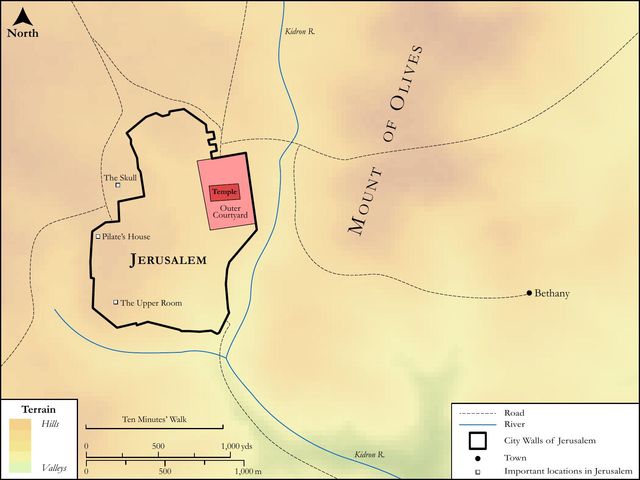
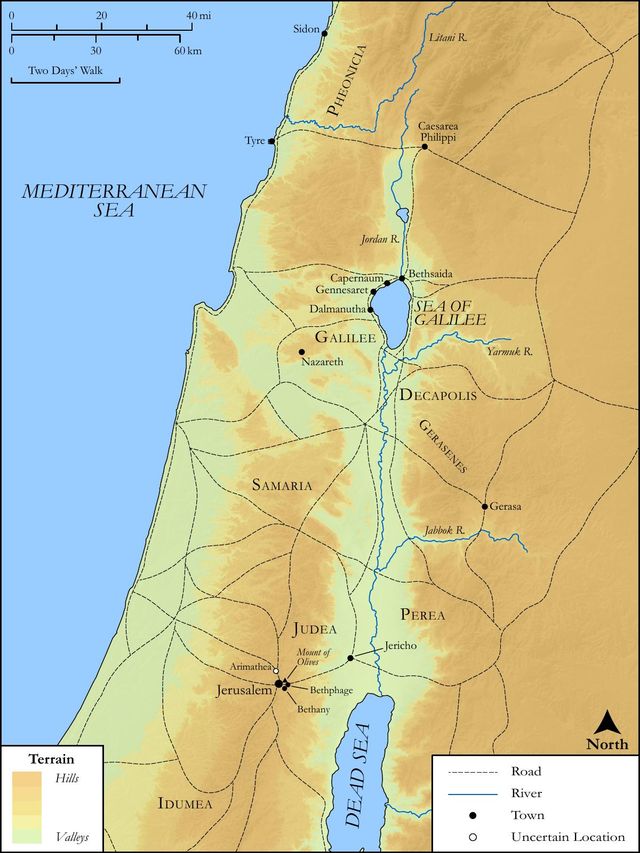
See on the biblical-era maps

Study this verse
Public-domain commentary
Matthew Henry
From his Commentary on the Whole Bible. Henry comments on passages, not single verses — this entry covers Mark 14:66–72. His two-level outline is real structure in the source text, so it is rendered as structure.
We have here the story of Peter's denying Christ.
1.It began in keeping at a distance from him. Peter had followed afar off (Mar 14:54), and now was beneath in the palace, at the lower end of the hall. Those that are shy of Christ, are in a fair way to deny him, that are shy of attending on holy ordinances, shy of the communion of the faithful, and loth to be seen on the side of despised godliness.
2.It was occasioned by his associating with the high priest's servants, and sitting among them. They that think it dangerous to be in company with Christ's disciples, because thence they may be drawn in to suffer for him, will find it much more dangerous to be in company with his enemies, because there they may be drawn in to sin against him.
3.The temptation was, his being charged as a disciple of Christ; Thou also wert with Jesus of Nazareth, Mar 14:67. This is one of them (Mar 14:69), for thou art a Galilean, one may know that by thy speaking broad, Mar 14:70. It doth not appear that he was challenged upon it, or in danger of being prosecuted as a criminal for it, but only bantered upon it, and in danger of being ridiculed as a fool for it. While the chief priests were abusing the Master, the servants were abusing the disciples. Sometimes the cause of Christ seems to fall so much on the losing side, that every body has a stone to throw at it, and even the abjects gather themselves together against it. When Job was on the dunghill, he was had in derision of those that were the children of base men, Job 30:8. Yet, all things considered, the temptation could not be called formidable; it was only a maid that casually cast her eye upon him, and, for aught that appears, without design of giving him any trouble, said, Thou art one of them, to which he needed not to have made any reply, or might have said, "And if I be, I hope that is no treason."
4.The sin was very great; he denied Christ before men, at a time when he ought to have confessed and owned him, and to have appeared in court a witness for him. Christ had often given notice to his disciples of his own sufferings; yet, when they came, they were to Peter as great a surprise and terror as if he had never heard of them before. He had often told them that they must suffer for him, must take up their cross, and follow him; and yet Peter is so terribly afraid of suffering, upon the very first alarm of it, that he will lie and swear, and do any thing, to avoid it. When Christ was admired and flocked after, he could readily own him; but now that he is deserted, and despised, and run down, he is ashamed of him, and will own no relation to him.
5.His repentance was very speedy. He repeated his denial thrice, and the third was worst of all, for then he cursed and swore, to confirm his denial; and that the third blow, which, one would think, should have stunned him, and knocked him down, startled him, and roused him up. Then the cock crew the second time, which put him in mind of his Master's words, the warning he had given him, with that particular circumstance of the cock crowing twice; by recollecting that, he was made sensible of his sin and the aggravations of it; and when he thought thereon, he wept. Some observe that this evangelist, who wrote, as some have thought, by St. Peter's direction, speaks as fully of Peter's sin as any of them, but more briefly of his sorrow, which Peter, in modesty, would not have to be magnified, and because he thought he could never sorrow enough for great a sin. His repentance here is thus expressed, epibalōn eklaie, where something must be supplied. He added to weep, so some; making it a Hebraism; he wept, and the more he thought of it, the more he wept; he continued weeping; he flung out, and wept; burst out into tears; threw himself down, and wept; he covered his face, and wept, so some; cast his garment about his head, that he might not be seen to weep; he cast his eyes upon his Master, who turned, and looked upon him; so Dr. Hammond supplies it, and it is a probable conjecture. Or, as we understand it, fixing his mind upon it, he wept. It is not a transient thought of that which is humbling, that will suffice, but we must dwell upon it. Or, what if this word should mean his laying a load upon himself, throwing a confusion into his own face? he did as the publican that smote his breast, in sorrow for sin; and this amounts to his weeping bitterly.
Historical interpretation
Four Centuries of Reception
3 surviving comments on this verse. Each one is dated, so this reads as a timeline rather than a list.
Select a marker to jump to its quote. Markers stagger vertically where authors wrote within a few decades of each other.
Peter when he had not the Spirit yielded and lost courage at the voice of a girl, though with the Spirit he was not afraid before princes and kings.
But in a mystical sense, the first maid means the wavering, the second, the assent, the third man is the act. This is the threefold denial which the remebrance of the word of the Lord washes away through tears. The cock then crows for us when some preacher up our hearts by repentance to compunction. We then begin to weep, when we are set on fire within by the spark of knowledge, and we go forth, when we cast out what we were within.
(upi. sup.) But what can be meant by his being first recognised by a woman, when men were more able to know him, if it be not that that sex might be seen to sin in the death of our Lord, and that sex be redeemed by His Passion? It goes on: But he denied, saying, I know not, neither understand I what thou sayest.
(ubi sup.) The other Evangelists do not mention this crowing of the cock; they do not however deny the fact, as also some pass over many other things in silence, which others relate. There follows: And a maid saw him again, and began to say to them that stood by, This is one of them
(ubi sup.) By this denial of Peter we learn, that not only he denies Christ, who says that He is not the Christ, but he also, who although he is a Christian, denies himself to be such. For the Lord did not say to Peter, Thou shalt deny thyself to be my disciple, but, Thou shalt deny me; he therefore denied Christ, when he said that he was not His disciple. There follows: And a little after, they that stood by said again to Peter, Surely thou art one of them, for thou art a Galilæan, and thy speech agreeth thereto. Not that the Galilæans spoke a different tongue from the inhabitants of Jerusalem, for they were both Hebrews, but that each province and region has its own peculiarities, and cannot avoid a vernacular pronunciation.
(ubi sup.) How hurtful is it to speak with the wicked. He denies before infidels that he knows the man, whom amongst the disciples, he had confessed to be God. But the Scripture is wont to point out a Sacrament of the causes of things, by the state of the time; thus Peter, who denied at midnight, repented at cock crow; wherefore it is added: And the second time the cock crew. And Peter called to mind the word which Jesus said unto him, Before the cock crow twice, thou shalt deny me thrice. And he began to weep.
The Lord allowed this to happen to him by His providence, that is, lest he should be too much elated, and at the same time, that he might prove himself merciful to sinners, as knowing from himself the result of human weakness. There follows: And he went out into the porch; and the cock crew.
Therefore Peter was seized with fear, and for-getting the word of the Lord, which said, Whosoever shall confess me before men, him will I confess before my Father, (Matt. 30, 32) he denied our Lord; wherefore there follows: But he began to curse and to swear, saying, I know not this man of whom ye speak.
For tears brought Peter by penitence to Christ. Confounded then be the Novatians, who say that he who sins after receiving baptism, is not received to the remission of his sin. For behold Peter, who had also received the Body and Blood of the Lord, is received by penitence; for the failings of saints are written, that if we fall by want of caution, we also may be able to run back through their example, and hope to be relieved by penitence.
Continue studying Mark 14:67 across the web’s major study libraries — every link below opens this exact verse, chapter, or book on the destination site.
Read & Compare
 BibleGatewayThis verse in more than 200 translations and 70 languages.
 Bible.comThe YouVersion reader — hundreds of translations, reading plans, and highlights.
 ESV.orgCrossway's official English Standard Version reader.
 NET BibleThe NET translation with 60,000+ translators' notes on every rendering decision.
 STEP BibleTyndale House's free study tool — original text, vocabulary, and scholarly resources.
 BibliaLogos Bible Software's free web reader.
 USCCBThe New American Bible (Revised Edition) with the U.S. bishops' study notes.
Commentaries
 BibleHub CommentariesDozens of classic commentaries on this verse, gathered on one page.
 StudyLightMore than 100 commentary sets — the largest collection on the web.
 BibleRefPlain-English commentary on what this verse means, verse by verse.
 Enduring WordDavid Guzik's free commentary on this chapter, widely used by Bible teachers.
 Bible Study ToolsVerse commentary alongside Greek and Hebrew study aids.
Original Language & Research
- BibleHub InterlinearThe verse word by word — original language, transliteration, and English.
- BibleHub LexiconEvery word's original-language definition and Strong's entry.
 Blue Letter BibleDeep-study tools — Strong's numbers, concordance, and word studies.
 CNTR CollationThe earliest Greek manuscripts of this verse, collated letter by letter.
Sermons, Hymns & Audio


TrulyRandomVerse is not affiliated with these sites and doesn’t control their content. They’re linked because they’re genuinely useful.
Summary
Mark 14:67 marks the initial, critical moment of Peter's denial of Jesus, directly fulfilling Jesus' earlier prophecy. As Peter seeks warmth in the high priest's courtyard amidst the chaos of Jesus' illegal trial, a sharp-eyed servant girl recognizes him, identifying him by his association with "Jesus of Nazareth" and setting in motion the painful sequence of his three denials. This verse powerfully illustrates human vulnerability under pressure and the precise unfolding of divine foreknowledge.
Context
ShowHideLiterary Context
This verse is situated immediately after Jesus' arrest in the Garden of Gethsemane and His subsequent transfer to the high priest's palace for an unlawful trial. The narrative in Mark 14 moves swiftly from Jesus' agony and betrayal to His unjust interrogation, while simultaneously tracking Peter's actions. Peter, despite his earlier bold declarations of loyalty, follows Jesus "at a distance" (Mark 14:54), entering the courtyard of the high priest. The scene is one of intense tension, fear, and impending crisis, where loyalty is tested and prophecies begin to materialize. The maid's recognition of Peter here directly precipitates the fulfillment of Jesus' prophecy in Mark 14:30 concerning Peter's three denials before the rooster crows twice.
Historical & Cultural Context
The setting is the courtyard of the High Priest, likely Caiaphas, during the Jewish Feast of Passover. This was a time of heightened religious and political sensitivity in Jerusalem, with Roman authorities ever watchful for unrest. Jewish law required trials to be held during the day, not at night, and in public, not in private residences, highlighting the illegality of Jesus' proceedings. The courtyard would have been bustling with temple guards, servants, and curious onlookers, creating a volatile environment. A servant girl (παιδίσκη, paidiskē) would have been a common fixture in such a household, responsible for various duties, including attending to the gate or the household's needs. Her role, though humble, gave her a vantage point to observe those entering and lingering. The act of "warming himself" was practical given the cool night air, but it also placed Peter in a public, exposed position.
Key Themes
ShowHideMark 14:67 contributes significantly to several major themes within the Gospel of Mark and the broader biblical narrative. Firstly, it underscores Human Weakness and Frailty, particularly in the face of fear and persecution. Despite Peter's fervent pledge to die with Jesus rather than deny Him (Mark 14:31), his resolve crumbles under the simple accusation of a servant girl. Secondly, it highlights the Infallible Fulfillment of Prophecy, as Jesus' precise foretelling of Peter's denials begins to unfold. This demonstrates divine sovereignty even amidst human failure. Thirdly, the verse subtly emphasizes the Cost of Discipleship and the pressure to conform or deny one's faith when associated with a condemned figure. Peter's attempt to blend in by warming himself with the servants ultimately fails, revealing the difficulty of concealing one's true allegiance.
Exposition and Analysis
ShowHideKey Word Analysis
ShowHideThis verb, translated "looked upon," signifies a fixed, discerning gaze, more intense than a casual glance. It implies the servant girl carefully observed Peter, recognized him, and made a deliberate identification. Her gaze was not merely seeing, but perceiving clearly, leading to her direct accusation.
The imperfect tense of the verb "to be," translated "wast," indicates a continuous or ongoing state in the past. When the servant girl says, "thou also wast with Jesus," she is referring to Peter's persistent association with Jesus, not just a momentary encounter. This implies a known, established relationship that makes Peter's denial particularly poignant.
Translated "of Nazareth," this term identifies Jesus by His hometown. While seemingly a simple geographical descriptor, "Jesus of Nazareth" was often used by those who did not fully grasp or acknowledge His divine identity, or by those who sought to dismiss Him. For the servant girl, it was a common and undeniable way to link Peter to the publicly known, yet now condemned, figure.
Verse Breakdown
ShowHide"And when she saw Peter warming himself"
This clause sets the scene for the initial confrontation. Peter, attempting to remain inconspicuous yet drawn by the need for warmth and perhaps a desire to stay near the events, places himself in a vulnerable position. The act of "warming himself" (thermaínō) is mundane, yet it makes him visible and identifiable to those around him.
"she looked upon him, and said"
This describes the servant girl's action. Her "looking upon" (emblépō) is an act of deliberate recognition, not accidental. The directness of her gaze and subsequent speech indicates her certainty in identifying Peter. This simple act by a seemingly insignificant person initiates the profound crisis for Peter.
"And thou also wast with Jesus of Nazareth."
This is the core of the accusation. The "also" (kaí) suggests that Peter is not merely present but is one of a recognized group associated with Jesus. The phrase "wast with" (ēn metá) emphasizes his prior, continuous companionship with Jesus. The identifier "Jesus of Nazareth" is a common, public designation, making Peter's connection undeniable in the eyes of the servant girl and, by extension, anyone else who might have heard her. This statement is a direct challenge to Peter's allegiance and a trigger for his subsequent denials.
Literary Devices
ShowHideThe verse employs several significant literary devices. Irony is prominent, as Peter, who had so confidently declared his unwavering loyalty to Jesus (Mark 14:31), is now exposed by a humble servant girl while seeking physical comfort. His attempt to warm himself physically contrasts sharply with the chilling realization of his spiritual coldness and impending denial. There is also a strong element of Foreshadowing and Prophecy Fulfillment, as the maid's words directly initiate the sequence of events Jesus had precisely predicted (Mark 14:30). The narrative uses Contrast between the powerful, condemned Jesus undergoing trial and the seemingly insignificant servant girl whose simple observation holds immense power to expose Peter's identity and loyalty. This highlights how divine plans can unfold through the most unexpected means.
Theological and Thematic Connections
ShowHideMark 14:67 serves as a stark reminder of the reality of human frailty and the profound pressure of discipleship. It underscores that even those closest to Jesus are susceptible to fear and failure when confronted with persecution. Theological themes of divine foreknowledge and the unfolding of God's sovereign plan are also evident, as Jesus' prophecy concerning Peter's denial begins its precise fulfillment. This moment, though painful, is not the end of Peter's story; rather, it is a necessary part of his journey of humility and eventual restoration, revealing God's grace even in the midst of human weakness.
Reflection and Application
ShowHideThe scene in Mark 14:67 is a poignant mirror for every believer. Peter, the rock, the bold disciple, succumbs to the fear of association with a condemned Jesus. This should humble us, reminding us that our own strength and resolve are insufficient when faced with genuine pressure. It challenges us to examine our own lives: are there situations where we subtly deny our association with Christ, perhaps through silence, inaction, or by conforming to worldly values? Peter's failure here is not presented to condemn him, but to illustrate the universal human struggle with fear and the profound need for divine grace. It reminds us that authentic discipleship often requires courage to stand with Christ, even when it is unpopular or dangerous. Yet, it also offers immense hope, knowing that even in our failures, God's grace is sufficient to restore and empower us, just as He later restored Peter.
Questions for Reflection
ShowHideFAQ
ShowHideWhy was it significant that a "servant girl" recognized Peter?
ShowHideIt highlights the unexpected nature of divine providence and the pervasive knowledge of Jesus' followers. It wasn't a powerful official or a Roman soldier, but a humble servant girl (paidiskē) who recognized Peter. This emphasizes that even in a chaotic and high-stakes environment, the identity of Jesus' associates was known, even by those in seemingly insignificant positions. It also adds to the irony and humiliation of Peter's denial, as he is exposed not by a formidable adversary, but by someone he might have easily dismissed, underscoring the depth of his fear.
What was the significance of the phrase "Jesus of Nazareth"?
ShowHideThe phrase "Jesus of Nazareth" was a common and widely recognized identifier for Jesus during His earthly ministry. It distinguished Him from others named Jesus and linked Him directly to His hometown in Galilee. For many, it carried connotations of His humble origins, and sometimes, a dismissive tone (e.g., John 1:46). In this context, it served as a straightforward, undeniable connection that the maid used to identify Peter's association with the accused Prophet. It was a public, undeniable fact that Peter "was with" this specific, well-known individual.
Christ-Centered Fulfillment
ShowHideMark 14:67, depicting Peter's initial denial, powerfully underscores the contrast between human frailty and Christ's unwavering faithfulness. While Peter falters under the simple accusation of a servant girl, Jesus, at the very same hour, stands resolute before His accusers, perfectly fulfilling the will of His Father. Peter's denial highlights the profound need for a Savior who is not subject to fear or weakness. Jesus, the true and faithful witness (Revelation 1:5), never denies His identity or His mission, even unto death. His suffering and eventual crucifixion are not a result of His own failure, but the very act of His perfect obedience and self-sacrifice for the sins of humanity, including the very sin of denial committed by His closest disciple. Peter's fall, therefore, points to the steadfast love and redemptive work of Christ, who, even in His agony, interceded for Peter (Luke 22:31-32), ensuring his restoration and future service. Thus, Peter's denial, rather than being the end of his story, becomes a vivid testament to the boundless grace and restorative power of the Lord Jesus Christ, who perfectly fulfills all righteousness and redeems all human failure.