


Jeremiah 7:13
- וְעַתָּהve·'a·Tahand thereforeH6258Conj-w ¦ AdvAdverbוְandעַתָּהtherefore
- יַעַןYa·'anbecauseH3282ConjConjunction
- עֲשׂוֹתְכֶם'a·sot·Khemdid youH6213V-Qal-Inf ¦ 2mpVerb Qal Infinitive Constructעֲשׂוֹתְdidכֶםyou
- אֶת'et<obj.>H853DirObjMParticle Object Indicator
- כָּלkolallH3605N-mscNoun Singular Masculine Construct
- הַמַּעֲשִׂיםha·ma·'a·Simthe deedsH4639Art ¦ N-mpNoun Plural Masculine Absoluteהַtheמַּעֲשִׂיםdeeds
- הָאֵלֶּהha·'E·leh<the> theseH428Art ¦ PrtParticle Demonstrativeהָ<the>אֵלֶּהthese
- נְאֻםne·'um[the] utterance ofH5002N-mscNoun Singular Masculine Construct
- יְהוָהYah·wehYahwehH3068N-properNoun Proper Title
- וָאֲדַבֵּרva·'a·da·Berand I spokeH1696Conj-w ¦ V-Piel-ConsecImperf-1csVerb Piel Consecutive Imperfect 1st Singular common genderוָandאֲדַבֵּרI spoke
- אֲלֵיכֶם'a·lei·Khemto youH413Prep ¦ 2mpPreposition Definiteאֲלֵיtoכֶםyou
- הַשְׁכֵּםhash·Kemrising earlyH7925V-Hiphil-InfAbsVerb Hiphil Infinitive Absolute
- וְדַבֵּרve·da·Berand speakingH1696Conj-w ¦ V-Piel-InfVerb Piel Infinitive Constructוְandדַבֵּרspeaking
- וְלֹאve·Lo'and notH3808Conj-w ¦ NegParticle Negativeוְandלֹאnot
- שְׁמַעְתֶּםshe·ma'·Temyou listenedH8085V-Qal-Perf-2mpVerb Qal Perfect 2nd Plural Masculine
- וָאֶקְרָאva·'ek·Ra'and I calledH7121Conj-w ¦ V-Qal-ConsecImperf-1csVerb Qal Consecutive Imperfect 1st Singular common genderוָandאֶקְרָאI called
- אֶתְכֶם'et·Khem<obj.> youH853DirObjM ¦ 2mpParticle Object Indicatorאֶתְ<obj.>כֶםyou
- וְלֹאve·Lo'and notH3808Conj-w ¦ NegParticle Negativeוְandלֹאnot
- עֲנִיתֶם'a·ni·Temyou answeredH6030V-Qal-Perf-2mpVerb Qal Perfect 2nd Plural Masculine
English is a literal word-by-word gloss of the Hebrew, not the KJV's wording. Why?
This is the original text the KJV's translators worked from — each Hebrew word with its own literal English meaning in this verse, prepared by scholars at Tyndale House, Cambridge. The KJV translates whole sentences, not word by word, so its wording differs: one Hebrew word can become several English words, and the KJV may choose “the LORD” where the gloss reads “Yahweh”. Both are faithful — they answer different questions. For the KJV's own rendering, switch to the KJV text.
Details
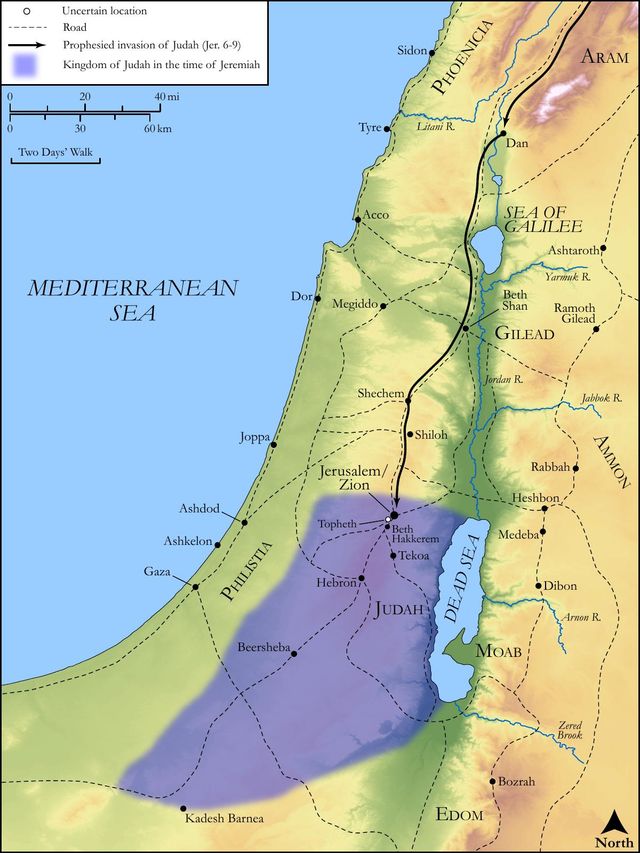
See on the biblical-era map
Study this verse
Public-domain commentary
Matthew Henry
From his Commentary on the Whole Bible. Henry comments on passages, not single verses — this entry covers Jeremiah 7:1–15. His four-level outline is real structure in the source text, so it is rendered as structure.
These verses begin another sermon, which is continued in this and the two following chapters, much to the same effect with those before, to reason them to repentance. Observe,
I.The orders given to the prophet to preach this sermon; for he had not only a general commission, but particular directions and instructions for every message he delivered. This was a word that came to him from the Lord, Jer 7:1. We are not told when this sermon was to be preached; but are told,
1.Where it must be preached - in the gate of the Lord's house, through which they entered into the outer court, or the court of the people. It would affront the priests, and expose the prophet to their rage, to have such a message as this delivered within their precincts; but the prophet must not fear the face of man, he cannot be faithful to his God if he do.
2.To whom it must be preached - to the men of Judah, that enter in at these gates to worship the Lord; probably it was at one of three feasts, when all the males from all parts of the country were to appear before the Lord in the courts of his house, and not to appear empty: then he had many together to preach to, and that was the most seasonable time to admonish them not to trust to their privileges. Note,
(1.)Even those that profess religion have need to be preached to as well as those that are without.
(2.)It is desirable to have opportunity of preaching to many together. Wisdom chooses to cry in the chief place of concourse, and, as Jeremiah here, in the opening of the gates, the temple-gates.
(3.)When we are going to worship God we have need to be admonished to worship him in the spirit, and to have no confidence in the flesh, Phi 3:3.
II.The contents and scope of the sermon itself.
It is delivered in the name of the Lord of hosts, the God of Israel, who commands the world, but covenants with his people. As creatures we are bound to regard the Lord of hosts, as Christians the God of Israel; what he said to them he says to us, and it is much the same with that which John Baptist said to those whom he baptized (Mat 3:8, Mat 3:9), Bring forth fruits meet for repentance; and think not to say within yourselves, We have Abraham to our father. The prophet here tells them,
1.What were the true words of God, which they might trust to. In short, they might depend upon it that if they would repent and reform their lives, and return to God in a way of duty, he would restore and confirm their peace, would redress their grievances, and return to them in a way of mercy (Jer 7:3): Amend your ways and your doings. This implies that there had been much amiss in their ways and doings, many faults and errors. But it is a great instance of the favour of God to them that he gives them liberty to amend, shows them where and how they must amend, and promises to accept them upon their amendment: "I will cause you to dwell quietly and peaceably in this place, and a stop shall be put to that which threatens your expulsion." Reformation is the only way, and a sure way to ruin. He explains himself (Jer 7:5-7), and tells them particularly,
(1.)What the amendment was which he expected from them. They must thoroughly amend; in making good, they must make good their ways and doings; they must reform with resolution, and it must be a universal, constant, preserving reformation - not partial, but entire - not hypocritical, but sincere - not wavering, but constant. They must make the tree good, and so make the fruit good, must amend their hearts and thoughts, and so amend their ways and doings. In particular,
[1.]They must be honest and just in all their dealings. Those that had power in their hands must thoroughly execute judgment between a man and his neighbour, without partiality, and according as the merits of the cause appeared. They must not either in judgment or in contract oppress the stranger, the fatherless, or the widow, nor countenance or protect those that did oppress, nor refuse to do them justice when they sought for it. They must not shed innocent blood, and with it defile this place and the land wherein they dwelt.
[2.]They must keep closely to the worship of the true God only: "Neither walk after other gods; do not hanker after them, nor hearken to those that would draw you into communion with idolaters; for it is, and will be, to your own hurt. Be not only so just to your God, but so wise for yourselves, as not to throw away your adorations upon those who are not able to help you, and thereby provoke him who is able to destroy you." Well, this is all that God insists upon.
(2.)He tells them what the establishment is which, upon this amendment, they may expect from him (Jer 7:7): "Set about such a work of reformation as this with all speed, go through with it, and abide by it; and I will cause you to dwell in this place, this temple; it shall continue your place of resort and refuge, the place of your comfortable meeting with God and one another; and you shall dwell in the land that I gave to your fathers for ever and ever, and it shall never be turned out either from God's house or from your own." It is promised that they shall still enjoy their civil and sacred privileges, that they shall have a comfortable enjoyment of them: I will cause you to dwell here; and those dwell at ease to whom God gives a settlement. They shall enjoy it by covenant, by virtue of the grant made of it to their fathers, not by providence, but by promise. They shall continue in the enjoyment of it without eviction or molestation; they shall not be disturbed, much less dispossessed, for ever and ever; nothing but sin could throw them out. An everlasting inheritance in the heavenly Canaan is hereby secured to all that live in godliness and honesty. And the vulgar Latin reads a further privilege here, Jer 7:3, Jer 7:7. Habitabo vobiscum - I will dwell with you in this place; and we should find Canaan itself but an uncomfortable place to dwell in if God did not dwell with us there.
2.What were the lying words of their own hearts, which they must not trust to. He cautions them against this self-deceit (Jer 7:4): "Trust no in lying words. You are told in what way, and upon what terms, you may be easy safe, and happy; now do not flatter yourselves with an opinion that you may be so on any other terms, or in any other way." Yet he charges them with this self-deceit arising from vanity (Jer 7:8): "Behold, it is plain that you do trust in lying words, notwithstanding what is said to you; you trust in words that cannot profit; you rely upon a plea that will stand you in no stead." Those that slight the words of truth, which would profit them, take shelter in words of falsehood, which cannot profit them. Now these lying words were, "The temple of the Lord, the temple of the Lord, the temple of the Lord are these. These buildings, the courts, the holy place, and the holy of holies, are the temple of the Lord, built by his appointment, to his glory; here he resides, here he is worshipped, here we meet three times a year to pay our homage to him as our King in his palace." This they thought was security enough to them to keep God and his favours from leaving them, God and his judgments from breaking in upon them. When the prophets told them how sinful they were, and how miserable they were likely to be, still they appealed to the temple: "How can we be either so or so, as long as we have that holy happy place among us?" The prophet repeats it because they repeated it upon all occasions. It was the cant of the times; it was in their mouths upon all occasions. If they heard an awakening sermon, if any startling piece of news was brought to them, they lulled themselves asleep again with this, "We cannot but do well, for we have the temple of the Lord among us." Note, The privileges of a form of godliness are often the pride and confidence of those that are strangers and enemies to the power of it. It is common for those that are furthest from God to boast themselves most of their being near to the church. They are haughty because of the holy mountain (Zep 3:11), as if God's mercy were so tied to them that they might defy his justice. Now to convince them what a frivolous plea this was, and what little stead it would stand them in,
(1.)He shows them the gross absurdity of it in itself. If they knew any thing either of the temple of the Lord or of the Lord of the temple, they must think that to plead that, either in excuse of their sin against God or in arrest of God's judgment against them, was the most ridiculous unreasonable thing that could be. [1.] God is a holy God; but this plea made him the patron of sin, of the worst of sins, which even the light of nature condemns, Jer 7:9, Jer 7:10. "What," says he, "will you steal, murder, and commit adultery, be guilty of the vilest immoralities, and which the common interest, as well as the common sense, of mankind witness against? Will you swear falsely, a crime which all nations (who with the belief of a God have had a veneration for an oath) have always had a horror of? Will you burn incense to Baal, a dunghill-deity, that sets up as a rival with the great Jehovah, and, not content with that, will you walk after other gods too, whom you know not, and by all these crimes put a daring affront upon God, both as the Lord of hosts and as the God of Israel? Will you exchange a God of whose power and goodness you have had such a long experience for gods of whose ability and willingness to help you you know nothing? And, when you have thus done the worst you can against God, will you brazen your faces so far as to come and stand before him in this house which is called by his name and in which his name is called upon - stand before him as servants waiting his commands, as supplicants expecting his favour? Will you act in open rebellion against him, and yet herd among his subjects, among the best of them? By this, it should seem, you think that either he does not discover or does not dislike your wicked practices, to imagine either of which is to put the highest indignity possible upon him. It is as if you should say, We are delivered to do all these abominations." If they had not the front to say this, totidem verbis - in so many words, yet their actions spoke it aloud. They could not but own that God, even their own God, had many a time delivered them, and been a present help to them, when otherwise they must have perished. He, in delivering them, designed to reduce them to himself, and by his goodness to lead them to repentance; but they resolved to persist in their abominations notwithstanding. As soon as they were delivered (as of old in the days of the Judges) they did evil again in the sight of the Lord, which was in effect to say, in direct contradiction to the true intent and meaning of the providences which had affected them, that God had delivered them in order to put them again into a capacity of rebelling against him, by sacrificing the more profusely to their idols. Note, Those who continue in sin because grace has abounded, or that grace may abound, do in effect their idols. Note, Those who continue in sin because grace has abounded, or that grace may abound, do in effect make Christ the minister of sin. Some take it thus: "You present yourselves before God with your sacrifices and sin-offerings, and then say, We are delivered, we are discharged from our guilt, now it shall do us no hurt; when all this is but to blind the world, and stop the mouth of conscience, that you may, the more easily to yourselves and the more plausibly before others, do all these abominations." [2.] His temple was a holy place; but this plea made it a protection to the most unholy persons: "Has this house, which is called by my name and is a standing sign of God's kingdom of sin and Satan - has this become a den of robbers in your eyes? Do you think it was built to be not only a rendezvous of, but a refuge and shelter to, the vilest of malefactors?" No; though the horns of the altar were a sanctuary to him that slew a man unawares, yet they were not so to a wilful murderer, nor to one that did aught presumptuously, Exo 21:14; Kg1 2:29. Those that think to excuse themselves in unchristian practices with the Christian name, and sin the more boldly and securely because there is a sin-offering provided, do, in effect, make God's house of prayer a den of thieves, as the priests in Christ's time, Mat 21:13. But could they thus impose upon God? No: Behold, I have seen it, saith the Lord, have seen the real iniquity through the counterfeit and dissembled piety. Note, Though men may deceive one another with the appearances of devotion, yet they cannot deceive God.
(2.)He shows them the insufficiency of this plea adjudged long since in the case of Shiloh.
[1.]It is certain that Shiloh was ruined, though it had God's sanctuary in it, when by its wickedness it profaned that sanctuary (Jer 7:12): Go you now to my place which was in Shiloh. It is probable that the ruins of that once flourishing city were yet remaining; they might, at least, read the history of it, which ought to affect them as if they saw the place. There God set his name at the first, there the tabernacle was set up when Israel first took possession of Canaan (Joh 18:1), and thither the tribes went up; but those that attended the service of the tabernacle there corrupted both themselves and others, and from them arose the wickedness of his people Israel; that fountain was poisoned, and sent forth malignant streams; and what came of it? No; God forsook it (Psa 78:60), sent his ark into captivity, cut off the house of Eli that presided there; and it is very probable that the city was quite destroyed, for we never read any more of it but as a monument of divine vengeance upon holy places when they harbour wicked people. Note, God's judgments upon others, who have really revolted from God while they have kept up a profession of nearness to him, should be a warning to us not to trust in lying words. It is good to consult precedents, and make use of them. Remember Lot's wife; remember Shiloh and the seven churches of Asia; and know that the ark and candlestick are moveable things, Rev 2:5; Mat 21:43.
[2.]It is as certain that Shiloh's fate will be Jerusalem's doom if a speedy and sincere repentance prevent it not. First, Jerusalem was now as sinful as ever Shiloh was; that is proved by the unerring testimony of God himself against them (Jer 7:13): "You have done all these works, you cannot deny it:" and they continued obstinate in their sin; that is proved by the testimony of God's return and repent, rising up early and speaking, as one in care, as one in earnest, as one who would lose no time in dealing with them, nay, who would take the fittest opportunity for speaking to them early in the morning, when, if ever, they were sober, and had their thoughts free and clear; but it was all in vain. God spoke, but they heard not, they heeded not, they never minded; he called them, but they answered not; they would not come at his call. Note, What God has spoken to us greatly aggravates what we have done against him. Secondly, Jerusalem shall shortly be as miserable as ever Shiloh was: Therefore I will do unto this house as I did to Shiloh, ruin it, and lay it waste, Jer 7:14. Those that tread in the steps of the wickedness of those that went before them must expect to fall by the like judgments, for all these things happened to them for ensamples. The temple at Jerusalem, though ever so strongly built, if wickedness was found in it, would be as unable to keep its ground and as easily conquered as even the tabernacle in Shiloh was, when God's day of vengeance had come. "This house" (says God) "is called by my name, and therefore you may think that I should protect it; it is the house in which you trust, and you think that it will protect you; this land is the place, this city the place, which I gave to you and your fathers, and therefore you are secure of the continuance of it, and think that nothing can turn you out of it; but the men of Shiloh thus flattered themselves and did but deceive themselves." He quotes another precedent (Jer 7:15), the ruin of the kingdom of the ten tribes, who were the seed of Abraham, and had the covenant of circumcision, and possessed the land which God gave to them and their fathers, and yet the idolatries threw them out and extirpated them: "And can you think but that the same evil courses will be as fatal to you?" Doubtless they will be so; for God is uniform and of a piece with himself in his judicial proceedings. It is a rule of justice, ut parium par sit ratio - that in similar cases the same judgment should proceed. "You have corrupted yourselves as your brethren the seed of Ephraim did, and have become their brethren in iniquity, and therefore I will cast you out of my sight, as I have cast them." The interpretation here given of the judgment makes it a terrible one indeed; the casting of them out of their land signified God's casting them out of his sight, as if he would never look upon them, never look after them, more. Whenever we are cast, it is well enough, if we be kept in the love of God; but, if we are thrown out of his favour, our case is miserable though we dwell in our own land. This threatening, that God would make this house like Shiloh, we shall meet with again, and find Jeremiah indicted for it, Jer 26:6.
Historical interpretation
Historical reception
3 surviving comments on this verse. Each one is dated, so this reads as a timeline rather than a list.
Select a marker to jump to its quote. Markers stagger vertically where authors wrote within a few decades of each other.
Brothers, by doing the will of God our Father, we shall belong to the first church, the spiritual one established before the sun and the moon. But if we do not do the will of the Lord, we shall verify the Scripture that says, “My house has become a den of thieves.”
(Verse 13 onwards) And now because you have done all these works, says the Lord: and I spoke to you rising up early and speaking, and you did not hear: and I called you, and you did not answer: I will do to this house, where my name has been invoked, and in which you have trusted, and to the place which I have given to you and your fathers, as I did to Shiloh: and I will cast you away from my face, just as I cast away all your brothers, the entire offspring of Ephraim (also called Israel). This, which we have set forth, is not found in the Septuagint when one rises in the morning and speaks. However, God rises in the morning, not because there is any time without dawn for Him, but so that after the rest of the night, with the strength of the body restored, the soul of man may be more lively and not occupied by pleasures and the desire for food, and may be able to hear and do what is said. Therefore, we also read this in the psalm: In the morning, you will hear my voice; in the morning, I will stand before you and see (Psalm 5:4-5). And in Isaiah: By night, or at daybreak, my spirit will rise up to you, O God: for your commandments are a light upon the earth (Isaiah 26). Therefore, Paul the apostle also calls the sons of light (Ephesians 5), and not of the night or darkness, nor of those who sleep, as the rest do, who do not perceive the commandments of God. Because God called them, rising up from the night, in order to deliver them from darkness, he threatens to do similar things to them as he did to the Temple in Jerusalem, which he made in the place of Shiloh, where the tabernacle first was: so that similar sins may be punished with the same verdict. And how the Lord rejected the seed of Ephraim, that is, the ten tribes which were called Israel, and had princes because of Jeroboam the son of Nebat from the tribe of Ephraim, which was also called the tribe of Joseph; so also Jerusalem and the tribe of Judah with Benjamin testify that they will be rejected. He rejected Shiloh, intending to reject the Temple as well: he rejected the ten tribes, intending to reject the two as well. Whatever is said to that people, let us understand it also of ourselves, if we do similar things.
“Has not this house, in which my name is invoked, been made a den of thieves before your eyes? I who am, I have seen it, says the Lord.” I believe that it was from here that the Gospel took: “It is written, ‘My father’s house will be called a house of prayer,’ but you have made it a den of thieves,” or, according to another Gospel, “a house of trade.” The church of God is turned into a den of thieves when robbery, murder, adultery, perjury, sacrilege, heretical inventions and other evils are practiced within it. When its leaders burn with greed and when cheap or not so cheap palliums [the distinctive mantle worn by archbishops] possess the riches formerly of kings. Hence, he infers, “I who am, I have seen it, says the Lord.” In other words, “My eyes have beheld what you thought was hidden. The darkness of your treasures do not escape my consciousness.” He who, though he was rich, became poor for our sake, is now ashamed at our riches and says, “Woe to you wealthy, who have your consolation now!”
Continue studying Jeremiah 7:13 across the web’s major study libraries — every link below opens this exact verse, chapter, or book on the destination site.
Read & Compare
 BibleGatewayThis verse in more than 200 translations and 70 languages.
 Bible.comThe YouVersion reader — hundreds of translations, reading plans, and highlights.
 ESV.orgCrossway's official English Standard Version reader.
 NET BibleThe NET translation with 60,000+ translators' notes on every rendering decision.
 STEP BibleTyndale House's free study tool — original text, vocabulary, and scholarly resources.
 BibliaLogos Bible Software's free web reader.
 USCCBThe New American Bible (Revised Edition) with the U.S. bishops' study notes.
Commentaries
 BibleHub CommentariesDozens of classic commentaries on this verse, gathered on one page.
 StudyLightMore than 100 commentary sets — the largest collection on the web.
 BibleRefPlain-English commentary on what this verse means, verse by verse.
 Enduring WordDavid Guzik's free commentary on this chapter, widely used by Bible teachers.
 Bible Study ToolsVerse commentary alongside Greek and Hebrew study aids.
Original Language & Research
- BibleHub InterlinearThe verse word by word — original language, transliteration, and English.
- BibleHub LexiconEvery word's original-language definition and Strong's entry.
 Blue Letter BibleDeep-study tools — Strong's numbers, concordance, and word studies.
 SefariaThe Hebrew text with Rashi and centuries of Jewish commentary.
Sermons, Hymns & Audio


TrulyRandomVerse is not affiliated with these sites and doesn’t control their content. They’re linked because they’re genuinely useful.
Summary
Jeremiah 7:13 encapsulates a poignant divine lament and indictment against the people of Judah, revealing the LORD's profound disappointment and the impending consequences of their persistent rebellion. Despite God's tireless and earnest efforts, characterized by His "rising up early and speaking," to communicate His will, warn of impending judgment, and call His people to repentance, they remained stubbornly disobedient. This verse, a critical component of Jeremiah's powerful Temple Sermon, underscores the tragic reality of spiritual apathy and the willful rejection of divine counsel, highlighting the stark contrast between God's unwavering faithfulness and humanity's entrenched resistance.
Context
ShowHideLiterary Context
Jeremiah 7:13 is a pivotal declaration within the "Temple Sermon" (Jeremiah 7:1-15), a direct and confrontational prophetic address delivered by Jeremiah at the gate of the Jerusalem Temple. This sermon specifically targets the Judahites' misplaced confidence in the physical Temple and their outward religious observances, which they erroneously believed would shield them from divine judgment, despite their rampant moral and spiritual corruption. The verses immediately preceding this one meticulously detail a litany of covenant violations, including theft, murder, adultery, perjury, idolatry, and the oppression of the vulnerable, as outlined in Jeremiah 7:8-9. God's pronouncement, "because ye have done all these works," directly references these egregious sins, establishing a clear and undeniable cause-and-effect relationship between their actions and the impending divine response. The verse thus sets the stage for the severe judgment, including the prophesied destruction of the very Temple they trusted, as elaborated in Jeremiah 7:14.
Historical & Cultural Context
The Temple Sermon was delivered during a tumultuous period in Judah's history, likely in the early years of King Jehoiakim's reign (c. 609-598 BCE). This era was characterized by significant geopolitical instability, with Judah caught between the declining Neo-Assyrian Empire and the ascendant Neo-Babylonian Empire, while Egypt also sought to exert its influence. Spiritually, the nation had largely regressed into widespread idolatry and syncretism following the brief but impactful reforms initiated by King Josiah, as documented in 2 Kings 22. The Jerusalem Temple held immense cultural, political, and religious significance, being regarded as the dwelling place of Yahweh and a potent symbol of national security and divine protection. The people's erroneous belief that the Temple's mere presence guaranteed their safety, irrespective of their moral and covenantal fidelity, is the central object of Jeremiah's scathing rebuke. The divine idiom "rising up early and speaking" is a common anthropomorphic expression in ancient Near Eastern cultures, signifying diligent, earnest, and persistent effort, often used to describe a master instructing servants or a parent guiding children, emphasizing the extraordinary lengths to which God went to warn and instruct His covenant people.
Key Themes
ShowHideJeremiah 7:13 powerfully contributes to several overarching theological and narrative themes prevalent throughout the book of Jeremiah and the broader prophetic corpus. Firstly, it profoundly illustrates God's Persistent Communication and Unwavering Patience, demonstrating His enduring commitment to His covenant people, even in the depths of their rebellion. His repeated warnings, vividly characterized by "rising up early and speaking," underscore His profound desire for their repentance and restoration rather than their destruction. Secondly, the verse starkly exposes Human Stubbornness and Spiritual Unresponsiveness, a recurring and tragic motif throughout Israel's history. The phrases "ye heard not" and "ye answered not" reveal a deep-seated spiritual deafness and a hardened heart that actively resisted divine truth, leading inevitably to judgment, as seen in other laments over their recalcitrance, such as Jeremiah 5:21. Thirdly, the verse implicitly but powerfully foreshadows the Inevitable Consequences of Disobedience and Covenant Breach. By consistently rejecting God's persistent calls to covenant faithfulness, Judah was actively sealing its own fate, leading to the fulfillment of the curses outlined in the Mosaic Covenant, particularly those found in Deuteronomy 28. This verse serves as a stark reminder that divine patience, while vast, is not infinite, and persistent rejection of God's grace ultimately culminates in righteous judgment.
Exposition and Analysis
ShowHideKey Word Analysis
ShowHideThis term (H4639) denotes an action, deed, or transaction, encompassing both righteous and unrighteous acts. In the immediate context of Jeremiah 7, "all these works" specifically refers to the comprehensive list of sinful practices and abominations enumerated in the preceding verses, such as theft, murder, adultery, perjury, and idolatry (Jeremiah 7:9). The use of the plural "works" and the qualifier "all these" emphasizes the pervasive and comprehensive nature of Judah's rebellion, indicating that their entire societal and individual conduct was characterized by actions directly contrary to God's covenant and moral law.
This primitive root (H7925) literally means "to load up (on the back of man or beast)" or "to start early in the morning." Figuratively, as employed here, it powerfully conveys the idea of diligence, earnestness, and persistent effort. It is a profound anthropomorphic expression, portraying God as making an extraordinary and proactive effort, akin to someone waking before dawn to diligently attend to an urgent and crucially important matter. This idiom underscores the intensity, frequency, and unwavering nature of God's attempts to communicate with and warn His people, signifying His profound and patient desire for their repentance and return.
This root (H8085) signifies "to hear intelligently," often carrying the strong implication of attentive listening, understanding, and, most importantly, obedience. The negation "heard not" therefore implies far more than a mere failure to perceive auditory signals; it denotes a deliberate and willful refusal to pay attention, to comprehend the divine message, and, most critically, to obey God's commands and warnings. It points to a deep spiritual deafness rooted in a hardened heart and a rebellious will that actively chose to ignore the divine voice.
Verse Breakdown
ShowHide"And now, because ye have done all these works, saith the LORD,"
This opening clause establishes the direct and undeniable causal link between the people's sinful actions ("all these works," referring to the abominations detailed in Jeremiah 7:9) and the divine pronouncement of judgment that follows. The phrase "saith the LORD" (Hebrew: nᵉʼum Yᵉhôvâh) serves as a divine oracle formula, authenticating the message as a direct and authoritative word from YHWH (H3068), the self-existent, covenant-keeping God, thereby lending it ultimate gravity and undeniable truth.
"and I spake unto you, rising up early and speaking,"
This phrase vividly portrays God's relentless, diligent, and patient efforts to communicate with His people. The repetition of "speaking" (from H1696, dâbar) combined with the powerful idiom "rising up early" (H7925, shâkam) emphasizes the frequency, earnestness, and profound urgency of God's warnings and appeals. It illustrates His deep and abiding desire for their repentance, akin to a diligent and loving parent who repeatedly and proactively warns a beloved child of imminent danger.
"but ye heard not;"
This clause highlights the tragic and willful failure of the people to respond appropriately to God's persistent communication. "Heard not" (H8085, shâmaʻ) implies not merely a lack of auditory perception, but a deliberate and stubborn refusal to listen, to understand the gravity of the divine message, and, most significantly, to obey God's commands. It signifies a profound spiritual deafness and a hardened heart that actively chose to ignore and dismiss divine counsel.
"and I called you, but ye answered not;"
This final clause powerfully reiterates and reinforces the previous one, emphasizing the people's complete and deliberate unresponsiveness. God's "calling" (H7121, qârâʼ) signifies an earnest invitation, a solemn summons, or a heartfelt plea for repentance and return. Their failure to "answer" (H6030, ʻânâh) indicates a willful and defiant rejection of His gracious invitation to repentance and restoration, thereby sealing their fate through their persistent and unyielding rebellion against their covenant Lord.
Literary Devices
ShowHideJeremiah 7:13 is rich with several powerful literary devices that amplify its theological message. Anthropomorphism is strikingly evident in the phrase "rising up early and speaking," which attributes human-like diligence, effort, and proactive engagement to God. This device makes God's earnestness relatable and underscores the extraordinary lengths to which He went to warn His people, thereby highlighting His immense patience and profound desire for their return. Repetition is also a key rhetorical feature, particularly in the parallel structure of "but ye heard not; and I called you, but ye answered not." This deliberate repetition serves to amplify the people's stubborn unresponsiveness and underscore the comprehensive nature of their rejection of God's word. The parallelism creates a powerful sense of finality and inevitability regarding the consequences of their actions. Furthermore, an underlying Irony pervades the entire Temple Sermon, and particularly this verse. The people placed their security in the physical Temple, believing it would protect them, while simultaneously engaging in "all these works" that flagrantly violated the very covenant principles the Temple was meant to represent. Their outward religious observance stood in stark and hypocritical contrast to their inward spiritual rebellion, a profound disconnect that God directly confronts.
Theological and Thematic Connections
ShowHideJeremiah 7:13 stands as a profound theological statement on the very nature of God's relationship with humanity, particularly within the sacred framework of covenant. It unveils a God who is neither distant nor indifferent, but intimately and actively engaged with His people, relentlessly communicating His divine will and extending persistent invitations to repentance. His "rising up early and speaking" vividly underscores His boundless patience, enduring love, and unwavering desire for reconciliation, even in the face of widespread apostasy and spiritual decay. However, the verse also confronts the devastating reality of human free will and the tragic consequences that inevitably arise from the willful rejection of divine grace. The people's stubborn refusal to "hear" or "answer" demonstrates a profound spiritual deafness and a hardened heart that ultimately leads to righteous judgment, affirming that God's justice is as certain and immutable as His steadfast love. This dynamic tension between divine patience and human stubbornness is a recurring and central theme throughout the entire biblical narrative, emphasizing that true faith is manifested not by mere ritualistic adherence or outward religious performance, but by a responsive, humble, and obedient heart that actively engages with God's word.
Reflection and Application
ShowHideJeremiah 7:13 serves as a timeless and piercing mirror for believers in every generation, challenging us to honestly and critically assess our own responsiveness to God's voice. Just as the LORD diligently and repeatedly spoke to ancient Judah, He continues to communicate with us today through His inspired and living Word, the gentle promptings and convicting power of the Holy Spirit, and the intricate circumstances of our daily lives. The fundamental question for us, therefore, is not whether God is speaking, but whether we are genuinely hearing, discerning, and answering His divine call. Do we, like the people of Judah, allow spiritual apathy, the relentless pursuit of worldly desires, or a false sense of security derived from mere religious routine to dull our spiritual ears and harden our hearts? This profound verse calls us to cultivate a heart that is not only eager to listen intently but also quick to obey and truly willing to repent. It serves as a powerful reminder that authentic faith is not merely intellectual assent to theological truths or outward religious observance, but a dynamic, vibrant, and relational engagement with God that manifests itself in a life characterized by active obedience and genuine responsiveness to His persistent calls. Ignoring God's earnest and patient invitations to walk in His ways ultimately leads to spiritual barrenness, broken fellowship, and painful consequences, whereas a humble, listening, and responsive heart finds abundant life, profound blessing, and deep intimacy with the Creator.
Questions for Reflection
ShowHideFAQ
ShowHideWhat does "rising up early and speaking" mean in the context of God?
ShowHideThe phrase "rising up early and speaking" (Hebrew: shâkam wᵉdâbar) is a powerful anthropomorphism, attributing a human-like action and characteristic to God. It does not imply that God literally wakes up early in a human sense, but rather it vividly conveys His extraordinary diligence, earnestness, and unwavering persistence in communicating with His people. This idiom signifies that God made every conceivable effort, repeatedly and with profound urgency, to warn Judah of their impending judgment and to call them to repentance. It paints a picture of a diligent parent or a dedicated master who rises before dawn to attend to a crucial matter or to instruct their household, emphasizing the immense depth of God's patience and His profound desire for His people to turn from their destructive ways before the inevitable judgment had to fall.
What are "all these works" that the people of Judah had done?
ShowHide"All these works" (Hebrew: maʻăseh) refers comprehensively to the extensive list of covenant violations and abominable practices meticulously detailed by Jeremiah in the preceding verses, particularly Jeremiah 7:9. These included grave transgressions such as theft, murder, adultery, perjury, burning incense to the pagan deity Baal, and following other gods previously unknown to them. These were not isolated or incidental missteps but constituted a pervasive and widespread pattern of life that directly contravened the foundational Law of Moses and fundamentally betrayed the covenant relationship God had graciously established with Israel. The phrase "all these works" emphasizes the totality and widespread nature of their rebellion, indicating that their entire societal and individual conduct was characterized by deep-seated sin, despite their outward adherence to certain religious observances and their reliance on the Temple.
Christ-Centered Fulfillment
ShowHideJeremiah 7:13, with its poignant depiction of God's persistent, "rising up early" communication met with humanity's stubborn unresponsiveness, finds its ultimate fulfillment and tragic echo in the person and redemptive mission of Jesus Christ. God's ancient and tireless efforts to speak through prophets like Jeremiah, who were sent repeatedly to call His people to repentance, culminated in His final and most perfect revelation: speaking through His own Son, as profoundly declared in Hebrews 1:1-2. Jesus, the eternal Word made flesh (John 1:14), is the very embodiment of God's persistent call to repentance, reconciliation, and salvation. He came "to seek and to save the lost" (Luke 19:10), tirelessly proclaiming the kingdom of God, performing miracles, and inviting all to believe and follow Him. Yet, just as ancient Judah "heard not" and "answered not" Jeremiah's urgent warnings, many in Jesus's own day, particularly the religious leaders, tragically rejected His divine message and refused to acknowledge Him as the promised Messiah, despite the overwhelming evidence of His miraculous works and authoritative teachings (John 1:11). The cross itself stands as the ultimate testament to both God's persistent, self-sacrificial call to humanity and humanity's ultimate, sinful rejection. Paradoxically, this very act of rejection became the means by which God provided the ultimate and definitive answer to human sin, offering eternal salvation to all who would finally "hear" and "answer" His gracious call to faith in Christ, confessing Him as Lord and believing in their hearts that God raised Him from the dead (Romans 10:9-10).