


Jeremiah 7:8
- הִנֵּהhi·Nehhere!H2009PrtParticle Interjection
- אַתֶּם'a·TemyouH859Pro-2mpPronoun Personal 2nd Plural Masculine
- בֹּטְחִיםbo·te·Chim[are] relyingH982V-Qal-Prtcpl-mpVerb Qal Participle Plural Masculine Absolute
- לָכֶםla·Khemfor <the> yourselvesPrep-l ¦ 2mpSuffix Personal 2nd Plural Masculineלָfor <the>כֶםyourselves
- עַל'alonH5921PrepPreposition
- דִּבְרֵיdiv·Rei<the> words ofH1697N-mpcNoun Plural Masculine Construct
- הַשָּׁקֶרha·Sha·ker<the> deceptionH8267Art ¦ N-msNoun Singular Masculine Absoluteהַ<the>שָּׁקֶרdeception
- לְבִלְתִּיle·vil·Tito notH1115Prep-l ¦ N-csNoun Singular common gender Absoluteלְtoבִלְתִּיnot
- הוֹעִילho·'Ilto profitH3276V-Hiphil-InfVerb Hiphil Infinitive Construct
English is a literal word-by-word gloss of the Hebrew, not the KJV's wording. Why?
This is the original text the KJV's translators worked from — each Hebrew word with its own literal English meaning in this verse, prepared by scholars at Tyndale House, Cambridge. The KJV translates whole sentences, not word by word, so its wording differs: one Hebrew word can become several English words, and the KJV may choose “the LORD” where the gloss reads “Yahweh”. Both are faithful — they answer different questions. For the KJV's own rendering, switch to the KJV text.
Details
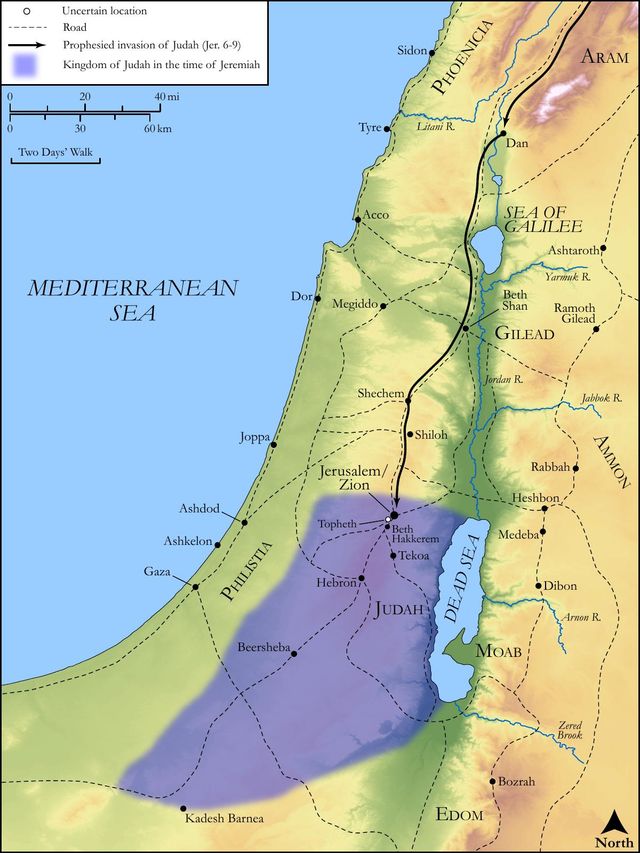
See on the biblical-era map
Study this verse
Public-domain commentary
Matthew Henry
From his Commentary on the Whole Bible. Henry comments on passages, not single verses — this entry covers Jeremiah 7:1–15. His four-level outline is real structure in the source text, so it is rendered as structure.
These verses begin another sermon, which is continued in this and the two following chapters, much to the same effect with those before, to reason them to repentance. Observe,
I.The orders given to the prophet to preach this sermon; for he had not only a general commission, but particular directions and instructions for every message he delivered. This was a word that came to him from the Lord, Jer 7:1. We are not told when this sermon was to be preached; but are told,
1.Where it must be preached - in the gate of the Lord's house, through which they entered into the outer court, or the court of the people. It would affront the priests, and expose the prophet to their rage, to have such a message as this delivered within their precincts; but the prophet must not fear the face of man, he cannot be faithful to his God if he do.
2.To whom it must be preached - to the men of Judah, that enter in at these gates to worship the Lord; probably it was at one of three feasts, when all the males from all parts of the country were to appear before the Lord in the courts of his house, and not to appear empty: then he had many together to preach to, and that was the most seasonable time to admonish them not to trust to their privileges. Note,
(1.)Even those that profess religion have need to be preached to as well as those that are without.
(2.)It is desirable to have opportunity of preaching to many together. Wisdom chooses to cry in the chief place of concourse, and, as Jeremiah here, in the opening of the gates, the temple-gates.
(3.)When we are going to worship God we have need to be admonished to worship him in the spirit, and to have no confidence in the flesh, Phi 3:3.
II.The contents and scope of the sermon itself.
It is delivered in the name of the Lord of hosts, the God of Israel, who commands the world, but covenants with his people. As creatures we are bound to regard the Lord of hosts, as Christians the God of Israel; what he said to them he says to us, and it is much the same with that which John Baptist said to those whom he baptized (Mat 3:8, Mat 3:9), Bring forth fruits meet for repentance; and think not to say within yourselves, We have Abraham to our father. The prophet here tells them,
1.What were the true words of God, which they might trust to. In short, they might depend upon it that if they would repent and reform their lives, and return to God in a way of duty, he would restore and confirm their peace, would redress their grievances, and return to them in a way of mercy (Jer 7:3): Amend your ways and your doings. This implies that there had been much amiss in their ways and doings, many faults and errors. But it is a great instance of the favour of God to them that he gives them liberty to amend, shows them where and how they must amend, and promises to accept them upon their amendment: "I will cause you to dwell quietly and peaceably in this place, and a stop shall be put to that which threatens your expulsion." Reformation is the only way, and a sure way to ruin. He explains himself (Jer 7:5-7), and tells them particularly,
(1.)What the amendment was which he expected from them. They must thoroughly amend; in making good, they must make good their ways and doings; they must reform with resolution, and it must be a universal, constant, preserving reformation - not partial, but entire - not hypocritical, but sincere - not wavering, but constant. They must make the tree good, and so make the fruit good, must amend their hearts and thoughts, and so amend their ways and doings. In particular,
[1.]They must be honest and just in all their dealings. Those that had power in their hands must thoroughly execute judgment between a man and his neighbour, without partiality, and according as the merits of the cause appeared. They must not either in judgment or in contract oppress the stranger, the fatherless, or the widow, nor countenance or protect those that did oppress, nor refuse to do them justice when they sought for it. They must not shed innocent blood, and with it defile this place and the land wherein they dwelt.
[2.]They must keep closely to the worship of the true God only: "Neither walk after other gods; do not hanker after them, nor hearken to those that would draw you into communion with idolaters; for it is, and will be, to your own hurt. Be not only so just to your God, but so wise for yourselves, as not to throw away your adorations upon those who are not able to help you, and thereby provoke him who is able to destroy you." Well, this is all that God insists upon.
(2.)He tells them what the establishment is which, upon this amendment, they may expect from him (Jer 7:7): "Set about such a work of reformation as this with all speed, go through with it, and abide by it; and I will cause you to dwell in this place, this temple; it shall continue your place of resort and refuge, the place of your comfortable meeting with God and one another; and you shall dwell in the land that I gave to your fathers for ever and ever, and it shall never be turned out either from God's house or from your own." It is promised that they shall still enjoy their civil and sacred privileges, that they shall have a comfortable enjoyment of them: I will cause you to dwell here; and those dwell at ease to whom God gives a settlement. They shall enjoy it by covenant, by virtue of the grant made of it to their fathers, not by providence, but by promise. They shall continue in the enjoyment of it without eviction or molestation; they shall not be disturbed, much less dispossessed, for ever and ever; nothing but sin could throw them out. An everlasting inheritance in the heavenly Canaan is hereby secured to all that live in godliness and honesty. And the vulgar Latin reads a further privilege here, Jer 7:3, Jer 7:7. Habitabo vobiscum - I will dwell with you in this place; and we should find Canaan itself but an uncomfortable place to dwell in if God did not dwell with us there.
2.What were the lying words of their own hearts, which they must not trust to. He cautions them against this self-deceit (Jer 7:4): "Trust no in lying words. You are told in what way, and upon what terms, you may be easy safe, and happy; now do not flatter yourselves with an opinion that you may be so on any other terms, or in any other way." Yet he charges them with this self-deceit arising from vanity (Jer 7:8): "Behold, it is plain that you do trust in lying words, notwithstanding what is said to you; you trust in words that cannot profit; you rely upon a plea that will stand you in no stead." Those that slight the words of truth, which would profit them, take shelter in words of falsehood, which cannot profit them. Now these lying words were, "The temple of the Lord, the temple of the Lord, the temple of the Lord are these. These buildings, the courts, the holy place, and the holy of holies, are the temple of the Lord, built by his appointment, to his glory; here he resides, here he is worshipped, here we meet three times a year to pay our homage to him as our King in his palace." This they thought was security enough to them to keep God and his favours from leaving them, God and his judgments from breaking in upon them. When the prophets told them how sinful they were, and how miserable they were likely to be, still they appealed to the temple: "How can we be either so or so, as long as we have that holy happy place among us?" The prophet repeats it because they repeated it upon all occasions. It was the cant of the times; it was in their mouths upon all occasions. If they heard an awakening sermon, if any startling piece of news was brought to them, they lulled themselves asleep again with this, "We cannot but do well, for we have the temple of the Lord among us." Note, The privileges of a form of godliness are often the pride and confidence of those that are strangers and enemies to the power of it. It is common for those that are furthest from God to boast themselves most of their being near to the church. They are haughty because of the holy mountain (Zep 3:11), as if God's mercy were so tied to them that they might defy his justice. Now to convince them what a frivolous plea this was, and what little stead it would stand them in,
(1.)He shows them the gross absurdity of it in itself. If they knew any thing either of the temple of the Lord or of the Lord of the temple, they must think that to plead that, either in excuse of their sin against God or in arrest of God's judgment against them, was the most ridiculous unreasonable thing that could be. [1.] God is a holy God; but this plea made him the patron of sin, of the worst of sins, which even the light of nature condemns, Jer 7:9, Jer 7:10. "What," says he, "will you steal, murder, and commit adultery, be guilty of the vilest immoralities, and which the common interest, as well as the common sense, of mankind witness against? Will you swear falsely, a crime which all nations (who with the belief of a God have had a veneration for an oath) have always had a horror of? Will you burn incense to Baal, a dunghill-deity, that sets up as a rival with the great Jehovah, and, not content with that, will you walk after other gods too, whom you know not, and by all these crimes put a daring affront upon God, both as the Lord of hosts and as the God of Israel? Will you exchange a God of whose power and goodness you have had such a long experience for gods of whose ability and willingness to help you you know nothing? And, when you have thus done the worst you can against God, will you brazen your faces so far as to come and stand before him in this house which is called by his name and in which his name is called upon - stand before him as servants waiting his commands, as supplicants expecting his favour? Will you act in open rebellion against him, and yet herd among his subjects, among the best of them? By this, it should seem, you think that either he does not discover or does not dislike your wicked practices, to imagine either of which is to put the highest indignity possible upon him. It is as if you should say, We are delivered to do all these abominations." If they had not the front to say this, totidem verbis - in so many words, yet their actions spoke it aloud. They could not but own that God, even their own God, had many a time delivered them, and been a present help to them, when otherwise they must have perished. He, in delivering them, designed to reduce them to himself, and by his goodness to lead them to repentance; but they resolved to persist in their abominations notwithstanding. As soon as they were delivered (as of old in the days of the Judges) they did evil again in the sight of the Lord, which was in effect to say, in direct contradiction to the true intent and meaning of the providences which had affected them, that God had delivered them in order to put them again into a capacity of rebelling against him, by sacrificing the more profusely to their idols. Note, Those who continue in sin because grace has abounded, or that grace may abound, do in effect their idols. Note, Those who continue in sin because grace has abounded, or that grace may abound, do in effect make Christ the minister of sin. Some take it thus: "You present yourselves before God with your sacrifices and sin-offerings, and then say, We are delivered, we are discharged from our guilt, now it shall do us no hurt; when all this is but to blind the world, and stop the mouth of conscience, that you may, the more easily to yourselves and the more plausibly before others, do all these abominations." [2.] His temple was a holy place; but this plea made it a protection to the most unholy persons: "Has this house, which is called by my name and is a standing sign of God's kingdom of sin and Satan - has this become a den of robbers in your eyes? Do you think it was built to be not only a rendezvous of, but a refuge and shelter to, the vilest of malefactors?" No; though the horns of the altar were a sanctuary to him that slew a man unawares, yet they were not so to a wilful murderer, nor to one that did aught presumptuously, Exo 21:14; Kg1 2:29. Those that think to excuse themselves in unchristian practices with the Christian name, and sin the more boldly and securely because there is a sin-offering provided, do, in effect, make God's house of prayer a den of thieves, as the priests in Christ's time, Mat 21:13. But could they thus impose upon God? No: Behold, I have seen it, saith the Lord, have seen the real iniquity through the counterfeit and dissembled piety. Note, Though men may deceive one another with the appearances of devotion, yet they cannot deceive God.
(2.)He shows them the insufficiency of this plea adjudged long since in the case of Shiloh.
[1.]It is certain that Shiloh was ruined, though it had God's sanctuary in it, when by its wickedness it profaned that sanctuary (Jer 7:12): Go you now to my place which was in Shiloh. It is probable that the ruins of that once flourishing city were yet remaining; they might, at least, read the history of it, which ought to affect them as if they saw the place. There God set his name at the first, there the tabernacle was set up when Israel first took possession of Canaan (Joh 18:1), and thither the tribes went up; but those that attended the service of the tabernacle there corrupted both themselves and others, and from them arose the wickedness of his people Israel; that fountain was poisoned, and sent forth malignant streams; and what came of it? No; God forsook it (Psa 78:60), sent his ark into captivity, cut off the house of Eli that presided there; and it is very probable that the city was quite destroyed, for we never read any more of it but as a monument of divine vengeance upon holy places when they harbour wicked people. Note, God's judgments upon others, who have really revolted from God while they have kept up a profession of nearness to him, should be a warning to us not to trust in lying words. It is good to consult precedents, and make use of them. Remember Lot's wife; remember Shiloh and the seven churches of Asia; and know that the ark and candlestick are moveable things, Rev 2:5; Mat 21:43.
[2.]It is as certain that Shiloh's fate will be Jerusalem's doom if a speedy and sincere repentance prevent it not. First, Jerusalem was now as sinful as ever Shiloh was; that is proved by the unerring testimony of God himself against them (Jer 7:13): "You have done all these works, you cannot deny it:" and they continued obstinate in their sin; that is proved by the testimony of God's return and repent, rising up early and speaking, as one in care, as one in earnest, as one who would lose no time in dealing with them, nay, who would take the fittest opportunity for speaking to them early in the morning, when, if ever, they were sober, and had their thoughts free and clear; but it was all in vain. God spoke, but they heard not, they heeded not, they never minded; he called them, but they answered not; they would not come at his call. Note, What God has spoken to us greatly aggravates what we have done against him. Secondly, Jerusalem shall shortly be as miserable as ever Shiloh was: Therefore I will do unto this house as I did to Shiloh, ruin it, and lay it waste, Jer 7:14. Those that tread in the steps of the wickedness of those that went before them must expect to fall by the like judgments, for all these things happened to them for ensamples. The temple at Jerusalem, though ever so strongly built, if wickedness was found in it, would be as unable to keep its ground and as easily conquered as even the tabernacle in Shiloh was, when God's day of vengeance had come. "This house" (says God) "is called by my name, and therefore you may think that I should protect it; it is the house in which you trust, and you think that it will protect you; this land is the place, this city the place, which I gave to you and your fathers, and therefore you are secure of the continuance of it, and think that nothing can turn you out of it; but the men of Shiloh thus flattered themselves and did but deceive themselves." He quotes another precedent (Jer 7:15), the ruin of the kingdom of the ten tribes, who were the seed of Abraham, and had the covenant of circumcision, and possessed the land which God gave to them and their fathers, and yet the idolatries threw them out and extirpated them: "And can you think but that the same evil courses will be as fatal to you?" Doubtless they will be so; for God is uniform and of a piece with himself in his judicial proceedings. It is a rule of justice, ut parium par sit ratio - that in similar cases the same judgment should proceed. "You have corrupted yourselves as your brethren the seed of Ephraim did, and have become their brethren in iniquity, and therefore I will cast you out of my sight, as I have cast them." The interpretation here given of the judgment makes it a terrible one indeed; the casting of them out of their land signified God's casting them out of his sight, as if he would never look upon them, never look after them, more. Whenever we are cast, it is well enough, if we be kept in the love of God; but, if we are thrown out of his favour, our case is miserable though we dwell in our own land. This threatening, that God would make this house like Shiloh, we shall meet with again, and find Jeremiah indicted for it, Jer 26:6.
Historical interpretation
Historical reception
3 surviving comments on this verse. Each one is dated, so this reads as a timeline rather than a list.
Select a marker to jump to its quote. Markers stagger vertically where authors wrote within a few decades of each other.
Brothers, by doing the will of God our Father, we shall belong to the first church, the spiritual one established before the sun and the moon. But if we do not do the will of the Lord, we shall verify the Scripture that says, “My house has become a den of thieves.”
“Has not this house, in which my name is invoked, been made a den of thieves before your eyes? I who am, I have seen it, says the Lord.” I believe that it was from here that the Gospel took: “It is written, ‘My father’s house will be called a house of prayer,’ but you have made it a den of thieves,” or, according to another Gospel, “a house of trade.” The church of God is turned into a den of thieves when robbery, murder, adultery, perjury, sacrilege, heretical inventions and other evils are practiced within it. When its leaders burn with greed and when cheap or not so cheap palliums [the distinctive mantle worn by archbishops] possess the riches formerly of kings. Hence, he infers, “I who am, I have seen it, says the Lord.” In other words, “My eyes have beheld what you thought was hidden. The darkness of your treasures do not escape my consciousness.” He who, though he was rich, became poor for our sake, is now ashamed at our riches and says, “Woe to you wealthy, who have your consolation now!”
(Verse 8 and following) Behold, you trust in yourselves with words of falsehood (or lies) which have not benefited you. To steal, to kill, to commit adultery, to swear falsely, to offer sacrifices to Baal, and to follow foreign gods that you do not know. And you have come and stood before me in this house, in which my name is invoked, and you have said: We are delivered (or we have ceased): because we have done all these abominations. They vainly have confidence in the temple, as the following sins show. For what profit is it to boldly enter the threshold of God's house, standing with erect neck: and not only to have a polluted heart, but also hands defiled with theft, homicide, adultery, perjury, sacrilege, and worship of those gods whom you do not know? No one doubts that these things happen spiritually in the Church, when considering the happiness of the present time, they do not consider their own sins: and they think that God is hidden, because punishment does not immediately follow; rather, they break forth into such madness, that they think themselves freed, because they have also turned away from the worship of the Lord after evil deeds.
Continue studying Jeremiah 7:8 across the web’s major study libraries — every link below opens this exact verse, chapter, or book on the destination site.
Read & Compare
 BibleGatewayThis verse in more than 200 translations and 70 languages.
 Bible.comThe YouVersion reader — hundreds of translations, reading plans, and highlights.
 ESV.orgCrossway's official English Standard Version reader.
 NET BibleThe NET translation with 60,000+ translators' notes on every rendering decision.
 STEP BibleTyndale House's free study tool — original text, vocabulary, and scholarly resources.
 BibliaLogos Bible Software's free web reader.
 USCCBThe New American Bible (Revised Edition) with the U.S. bishops' study notes.
Commentaries
 BibleHub CommentariesDozens of classic commentaries on this verse, gathered on one page.
 StudyLightMore than 100 commentary sets — the largest collection on the web.
 BibleRefPlain-English commentary on what this verse means, verse by verse.
 Enduring WordDavid Guzik's free commentary on this chapter, widely used by Bible teachers.
 Bible Study ToolsVerse commentary alongside Greek and Hebrew study aids.
Original Language & Research
- BibleHub InterlinearThe verse word by word — original language, transliteration, and English.
- BibleHub LexiconEvery word's original-language definition and Strong's entry.
 Blue Letter BibleDeep-study tools — Strong's numbers, concordance, and word studies.
 SefariaThe Hebrew text with Rashi and centuries of Jewish commentary.
Sermons, Hymns & Audio


TrulyRandomVerse is not affiliated with these sites and doesn’t control their content. They’re linked because they’re genuinely useful.
Summary
Jeremiah 7:8 delivers a scathing prophetic indictment within the Temple Sermon, directly confronting the people of Judah with their dangerous and misplaced reliance on superficial religious assurances and deceptive pronouncements. It exposes the profound folly of trusting in empty words or self-serving rationalizations that promise security and divine favor without demanding genuine repentance, covenant fidelity, or heartfelt obedience to God. The verse powerfully declares that such false hopes are utterly devoid of any true benefit, spiritual gain, or lasting salvation, inevitably leading to spiritual decay and national calamity.
Context
ShowHideLiterary Context
Jeremiah 7:8 is a pivotal statement within Jeremiah's renowned "Temple Sermon," a dramatic public address delivered at the very gate of the Lord's house (Jeremiah 7:2). This powerful discourse, spanning Jeremiah 7:1-15, represents a climactic moment in Jeremiah's early prophetic ministry. Here, he directly challenges the widespread and dangerous delusion that the mere physical presence of the Temple in Jerusalem guaranteed God's unconditional protection, irrespective of the people's pervasive moral corruption and spiritual apostasy. The verse directly echoes and amplifies the warning articulated in Jeremiah 7:4, where the people are depicted as repeatedly chanting, "The temple of the Lord, The temple of the Lord, The temple of the Lord, are these." Jeremiah 7:8 precisely identifies this chant, and the presumptuous mindset it embodies, as the very "lying words" that offer no true "profit" or security. The sermon culminates in a dire warning of impending judgment, including the prophesied destruction of the Temple itself, mirroring the historical fate of Shiloh (Jeremiah 7:12-15).
Historical & Cultural Context
The historical backdrop for this sermon is the turbulent reign of King Jehoiakim (609-598 BC), a period characterized by profound political instability, rampant oppression, widespread idolatry, and a deeply entrenched, yet superficial, religiosity in Judah. Despite repeated and urgent warnings from prophets like Jeremiah, the populace stubbornly continued to engage in covenant-breaking behaviors, including the worship of foreign gods, exploitation of the vulnerable, and disregard for God's laws, all while clinging tenaciously to the outward forms of worship and the perceived inviolability of the Jerusalem Temple. Jerusalem, as the capital city and the sacred site of the Temple, held immense religious, national, and psychological significance for the people. The deeply ingrained cultural and theological conviction was that God would never permit His chosen dwelling place to be destroyed, and therefore, He would protect His people regardless of their actions. This pervasive false sense of security, rooted in a profound misunderstanding of God's holy character and the conditional nature of His covenant, served as a significant barrier to genuine repentance and left the nation tragically vulnerable to the impending Babylonian invasion.
Key Themes
ShowHideJeremiah 7:8 contributes significantly to several overarching themes that permeate the book of Jeremiah and indeed, much of Old Testament prophetic literature. Foremost among these is the theme of False Security vs. True Obedience. The verse starkly highlights the perilous nature of placing trust in external religious symbols, rituals, or inherited status without an accompanying internal transformation and a sincere commitment to God's commands. It powerfully underscores the consistent prophetic insistence that God desires "steadfast love, and not sacrifice; the knowledge of God, rather than burnt offerings" (Hosea 6:6). Another crucial theme is the Futility of Deception and Idolatry. The "lying words" represent not only the deceitful pronouncements of false prophets who promised peace where there was none, but also the self-deception of a people who believed they could manipulate God or escape divine judgment through ritualistic adherence without genuine righteousness. This connects seamlessly to the broader condemnation of idolatry throughout Jeremiah, where reliance on false gods or any form of false hope is consistently shown to be utterly unprofitable and ultimately destructive (Jeremiah 2:8). Finally, the verse implicitly serves as a powerful call for Genuine Repentance and Covenant Faithfulness, emphasizing that true "profit" or lasting blessing comes exclusively through a sincere return to God's revealed ways and a wholehearted, obedient trust in His divine will.
Exposition and Analysis
ShowHideKey Word Analysis
ShowHideThis verb fundamentally means to hide for refuge, to be confident, secure, or sure. In the context of Jeremiah 7:8, it describes a deeply misplaced reliance, a confidence presumptuously placed in something inherently unreliable or deceptive. The people of Judah were "trusting" in a false premise, finding their security not in the Lord's character or covenant faithfulness as expressed through their obedience, but in the mere physical existence of the Temple. This trust was not a hopeful expectation grounded in God's promises, but a careless, self-assured presumption that would prove disastrous.
This noun denotes an untruth, falsehood, deceit, or a sham. It implies something that is empty, vain, or specifically intended to mislead. Here, it characterizes the "words" as not simply mistaken or erroneous, but fundamentally deceptive and without substance, whether originating from the pronouncements of false prophets, the people's own pervasive self-deception, or empty, unbiblical traditions. It powerfully emphasizes the profound lack of truth, reality, and efficacy in the object of their misplaced trust.
This primitive root means, properly, to ascend, and figuratively, to be valuable, useful, or beneficial. When negated, as it is here ("cannot profit"), it emphatically conveys utter worthlessness, futility, and a complete lack of advantage. The "lying words" offer absolutely no gain, no positive outcome, no spiritual advantage, and no protection from impending divine judgment. They are entirely unproductive in securing God's favor or true well-being.
Verse Breakdown
ShowHide"Behold, ye trust in lying words"
This opening clause functions as a stark and urgent prophetic interjection, immediately drawing the audience's attention to their fundamental error. The Hebrew interjection "Behold" (hinnēh) serves as an exclamation, demanding that the audience recognize the gravity and immediate relevance of their misplaced confidence. Their "trust" (bâṭach) is not placed in the Lord Himself, nor in His covenant, but rather "in lying words" (divrei sheqer), which are empty, deceptive assurances. These are not merely casual falsehoods but deeply ingrained beliefs that provide a false sense of security, most notably the erroneous notion that the Temple's physical presence guaranteed their safety regardless of their profound sin.
"that cannot profit."
This concluding clause delivers the devastating and inescapable consequence of such a misplaced and presumptuous trust. The phrase "cannot profit" (lo' yo'ilu) employs the verb yaʻal in the negative, emphatically declaring the utter futility, worthlessness, and ineffectiveness of these deceptive words. They offer no real advantage, no spiritual gain, no protection from the impending judgment, and no pathway to true salvation or lasting well-being. The people's persistent reliance on these falsehoods will yield absolutely no positive outcome; instead, it will lead inevitably to national disaster and spiritual ruin.
Literary Devices
ShowHideJeremiah 7:8 employs several potent literary devices to convey its urgent and condemnatory message. The use of Direct Address ("ye trust") immediately implicates the audience, making the prophetic warning personal, inescapable, and directly applicable to their behavior. The phrase "lying words" is a powerful instance of Metonymy, where "words" stand for the deceptive doctrines, false assurances, and self-deluding beliefs that the people stubbornly embraced. It also functions as a stark Condemnation, directly labeling their presumed source of security as fundamentally false, misleading, and ultimately destructive. The declaration "that cannot profit" utilizes a form of Understatement (Meiosis) to emphasize the complete and utter uselessness of their false trust; it is not merely unhelpful or ineffective, but actively detrimental and leading to ruin. Furthermore, the entire verse serves as a profound Prophetic Indictment, a formal and divine charge brought by God against His covenant people for their pervasive infidelity and spiritual blindness, highlighting the severe and inevitable consequences of their misplaced faith.
Theological and Thematic Connections
ShowHideJeremiah 7:8 profoundly underscores the timeless biblical principle that genuine faith is intrinsically demonstrated by obedience, covenant fidelity, and a sincere, living relationship with God, rather than by external rituals, religious symbols, or presumptuous claims. This verse serves as an enduring warning against the insidious dangers of self-deception and the ultimate futility of seeking security or salvation in anything other than God's revealed truth and His unwavering covenant faithfulness. It highlights the consistent divine demand for internal righteousness and a transformed heart over mere external religiosity, a theme powerfully echoed throughout the prophetic corpus. The "lying words" represent any false gospel, humanistic philosophy, or worldly ideology that promises peace, prosperity, or security apart from true repentance and humble submission to God's sovereign will. Ultimately, the verse teaches that only God's truth, His divine character, and His righteous ways lead to true "profit"—eternal life, profound peace, and lasting blessing—while all humanly devised securities and self-deceptive assurances are ultimately bankrupt and lead to ruin.
Reflection and Application
ShowHideJeremiah 7:8 issues a profound challenge for us to critically examine the true foundations of our own security, hope, and spiritual well-being. In a contemporary world saturated with information, competing ideologies, and countless promises of fulfillment, it is remarkably easy to place our trust in "lying words"—whether they emanate from political systems, economic theories, popular self-help gurus, or even subtly distorted religious teachings. This verse calls us to move decisively beyond superficial religious adherence, cultural Christianity, or mere ritualistic observance, and instead to cultivate a deep, authentic, and transformative relationship with God, rooted firmly in His revealed truth. It compels us to honestly ask ourselves if our faith is merely a comfortable tradition, a set of external rituals, or a cultural identity, or if it is a truly living, dynamic trust that actively manifests in obedience, a pursuit of righteousness, and a genuine dependence on God. The true "profit" that God offers is not found in fleeting human assurances, worldly gains, or temporal comforts, but in the eternal security, abundant life, and profound peace that come only from walking in His ways and submitting to His will. We are sternly warned against any form of spiritual complacency that presumptuously assumes God's favor without requiring genuine repentance and a heart fully devoted to Him.
Questions for Reflection
ShowHideFAQ
ShowHideWhat exactly were the "lying words" the people were trusting in?
ShowHideThe "lying words" primarily refer to the false assurances and deeply ingrained, self-deceptive beliefs that the people of Judah stubbornly held. Most prominently, this included the erroneous notion that the physical presence of the Temple in Jerusalem guaranteed their safety and God's unconditional protection, regardless of their rampant sinful behavior. This is explicitly highlighted in Jeremiah 7:4, where the people are depicted repeatedly chanting, "The temple of the Lord, The temple of the Lord, The temple of the Lord, are these." These words were "lying" because they offered a false sense of security, contradicted God's covenant demands for righteousness and obedience, and were devoid of spiritual truth. They were also likely perpetuated by false prophets who spoke comforting but deceitful messages, promising peace when there was no true peace (Jeremiah 6:14).
Why couldn't the Temple "profit" the people, given its sacred status?
ShowHideThe Temple itself was indeed sacred as God's designated dwelling place, but its sacredness and the efficacy of its rituals were always contingent upon the people's faithfulness to the covenant. God's presence within it was not automatic or unconditional. The people had tragically turned the Temple into a mere talisman or a magical charm, presumptuously believing its mere existence would protect them even as they engaged in widespread idolatry, oppression, and profound moral corruption (Jeremiah 7:9-10). The Temple could not "profit" them because they had fundamentally divorced its profound spiritual significance from the ethical and relational demands of their covenant with God. Their trust was in the physical building and its rituals, not in the holy God who dwelt there and whose character demanded genuine holiness and obedience from His people. God's impending judgment was precisely because they had defiled His house and brazenly broken His covenant, effectively transforming the Temple from a symbol of devotion into a monument to their rebellion.
Christ-Centered Fulfillment
ShowHideJeremiah 7:8, with its stark warning against trusting in "lying words" that "cannot profit," finds its ultimate fulfillment and profound resolution in the person and work of Jesus Christ. The Old Testament people, as exemplified in Judah's error, mistakenly placed their false hope in external religious structures, rituals, and presumptuous declarations, believing these could secure their standing with God and guarantee their salvation. However, Christ reveals that true profit, lasting security, and eternal salvation come not through human efforts, religious institutions, or empty pronouncements, but solely through a genuine, saving faith in Him. Jesus Himself declares, "I am the way, and the truth, and the life; no one comes to the Father except through me" (John 14:6). Any other "words," paths, or doctrines for salvation are indeed "lying words" that "cannot profit," for "there is salvation in no one else, for there is no other name under heaven given among men by which we must be saved" (Acts 4:12). The New Covenant, inaugurated and established in Christ's shed blood, replaces the old system of shadows, types, and physical temples, revealing that true worship is not bound to a specific geographical location or building but is "in spirit and truth" (John 4:23-24). Thus, Christ is the ultimate and eternal "profit" (Philippians 3:7-8), the one in whom all genuine trust is rightly placed, and through whom alone we receive eternal life, unshakeable security, and access to the Father.