


Numbers 24:16
- נְאֻםne·'Um[the] utterance ofH5002N-mscNoun Singular Masculine Construct
- שֹׁמֵעַsho·Me·a'[the] [one who] hearsH8085V-Qal-Prtcpl-msVerb Qal Participle Singular Masculine Construct
- אִמְרֵי'im·rei<of> [the] words ofH561N-mpcNoun Plural Masculine Construct
- אֵל'ElGodH410N-msNoun Singular Masculine Absolute
- וְיֹדֵעַve·yo·De·a'and [the] [one who] knowsH3045Conj-w ¦ V-Qal-Prtcpl-msVerb Qal Participle Singular Masculine Constructוְandיֹדֵעַ[the] [one who] knows
- דַּעַתDa·'at<of> [the] knowledge ofH1847N-fscNoun Singular Feminine Construct
- עֶלְיוֹןel·Yon[the] Most HighH5945Adj-msAdjective Singular Masculine Absolute
- מַחֲזֵהma·cha·Zeh<the> vision ofH4236N-mscNoun Singular Masculine Construct
- שַׁדַּיsha·Dai[the] AlmightyH7706N-properNoun Proper Title
- יֶחֱזֶהye·che·Zehhe seesH2372V-Qal-Imperf-3msVerb Qal Imperfect 3rd Singular Masculine
- נֹפֵלno·Fel[who] falls downH5307V-Qal-Prtcpl-msVerb Qal Participle Singular Masculine Absolute
- וּגְלוּיu·ge·Luiand [who] is uncovered ofH1540Conj-w ¦ V-Qal-PassPrtcpl-msVerb Qal Participle Passive Singular Masculine Constructוּandגְלוּי[who] is uncovered of
- עֵינָיִם'ei·Na·yimeyesH5869N-fdNoun Dual Feminine Absolute
English is a literal word-by-word gloss of the Hebrew, not the KJV's wording. Why?
This is the original text the KJV's translators worked from — each Hebrew word with its own literal English meaning in this verse, prepared by scholars at Tyndale House, Cambridge. The KJV translates whole sentences, not word by word, so its wording differs: one Hebrew word can become several English words, and the KJV may choose “the LORD” where the gloss reads “Yahweh”. Both are faithful — they answer different questions. For the KJV's own rendering, switch to the KJV text.
Details
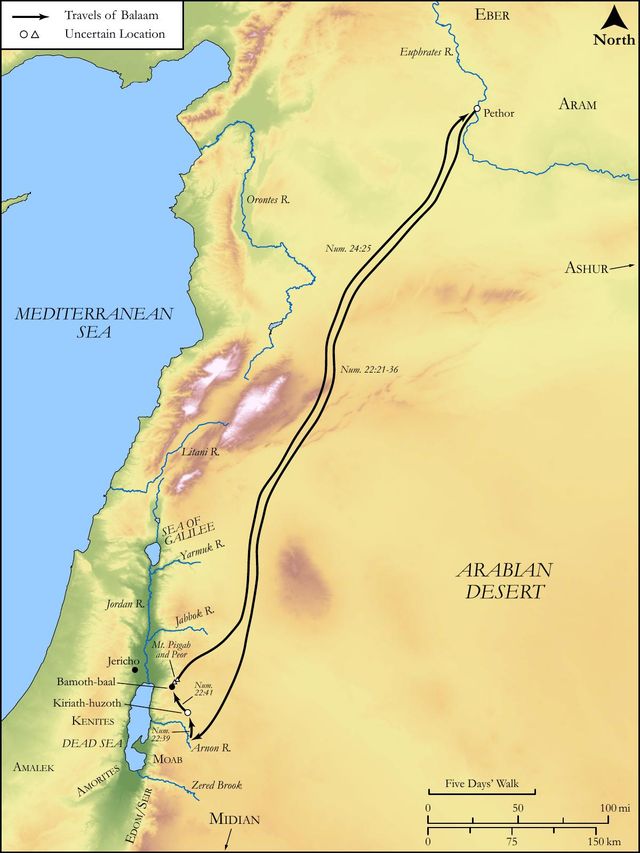
See on the biblical-era map
Study this verse
Public-domain commentary
Matthew Henry
From his Commentary on the Whole Bible. Henry comments on passages, not single verses — this entry covers Numbers 24:15–25. His three-level outline is real structure in the source text, so it is rendered as structure.
The office of prophets was both to bless and to prophesy in the name of the Lord. Balaam, as a prophet, per force had blessed Israel; here he foretels future events.
I.His preface is much the same as that, Num 24:3, Num 24:4.
He personates a true prophet admirably well, God permitting and directing him to do so, because, whatever he was, the prophecy itself was a true prophecy. He boasts,
1.That his eyes are open (Num 24:15), for prophets were in old time called seers (Sa1 9:9), because they must speak what they had seen, and therefore, before they opened their lips, it was necessary that they should have their eyes open.
2.That he has heard the words of God, which many do that do not heed them, nor hear God in them.
3.That he knew the knowledge of the Most High; this is added here. A man may be full of the knowledge of God and yet utterly destitute of the grace of God, may receive the truth in the light of it and yet be a stranger to the love of it.
4.That he saw the vision of the Almighty, but not so as to be changed into the same image. He calls God the Most High, and the Almighty; no man could speak more honourably of him, nor seem to put a greater value upon his acquaintance with him, and yet he had no true fear of him, love to him, or faith in him, so far may a man go towards heaven, and yet come short.
II.Here is his prophecy concerning him that should be the crown and glory of his people Israel, who is,
1.David in the type, who not now, not quickly, but in process of time, should smite the corners of Moab. (Num 24:17), and take possession of Mount Seir, and under whom the forces of Israel should do valiantly, Num 24:18. This was fulfilled when David smote Moab, and measured them with a line, so that the Moabites became David' servants, Sa2 8:2. And at the same time the Edomites likewise were brought into obedience to Israel, Num 24:14. But,
2.Our Lord Jesus, the promised Messiah, is chiefly pointed at in the antitype, and of him it is an illustrious prophecy; it was the will of God that notice should thus be given of his coming, a great while before, not only to the people of the Jews, but to other nations, because his gospel and kingdom were to extend themselves so far beyond the borders of the land of Israel. It is here foretold,
(1.)That while: "I shall see him, but not now; I do see him in vision, but at a very great distance, through the interposing space of 1500 years at least." Or understand it thus: - Balaam, a wicked man, shall see Christ, but shall not see him nigh, nor see him as Job, who saw him as his Redeemer, and saw him for himself, Job 19:25, Job 19:27. When he comes in the clouds every eye shall see him, but many will see him (as the rich man in hell saw Abraham) afar off.
(2.)That he shall come out of Jacob, and Israel, as a star and a sceptre, the former denoting his glory and lustre, and the bright and morning star, the latter his power and authority; it is he that shall have dominion. Perhaps this prophecy of Balaam (one of the children of the east) concerning a star that should arise out of Jacob, as the indication of a sceptre arising in Israel, being preserved by a tradition of that country, gave occasion to the wise men, who were of the east too, upon the sight of an unusual star over the land of Judea, to enquire for him that was born king of the Jews, Mat 2:2.
(3.)That his kingdom shall be universal, and victorious over all opposition, which was typified by David's victories over Moab and Edom. But the Messiah shall destroy, or, as some read it, shall rule over, all the children of Seth. (Num 24:17), that is, all the children of men, who descend from Seth, the son of Adam, the descendants of the rest of Adam's sons being cut off by the deluge. Christ shall be king, not only of Jacob and Israel, but of all the world; so that all the children of Seth shall be either governed by his golden sceptre or dashed in pieces by his iron rod. He shall set up a universal rule, authority, and power, of his own, and shall put down all opposing rule, Co1 15:24. He shall unwall all the children of Seth; so some read it. He shall take down all their defences and carnal confidences, so that they shall either admit his government or lie open to his judgments.
(4.)That his Israel shall do valiantly; the subjects of Christ, animated by his might, shall maintain a spiritual was with the powers of darkness, and be more than conquerors. The people that do know their God shall be strong, and do exploits, Dan 11:32.
III.Here is his prophecy concerning the Amalekites and Kenites, part of whose country, it is probable, he had now in view.
1.The Amalekites were now the chief of the nations (Num 24:20), therefore Agag was spoken of (Num 24:7) as an eminent prince, and they were the first that engaged Israel when they came out of Egypt; but the time will come when that nation, as great as it looks now, will be totally ruined and rooted out: His latter end shall be that he perish for ever. Here Balaam confirms that doom of Amalek which Moses had read (Exo 17:14, Exo 17:16), where God had sworn that he would have perpetual war with Amalek. Note, Those whom God is at war with will certainly perish for ever; for when God judges he will overcome.
2.The Kenites were now the securest of the nations; their situation was such as that nature was their engineer, and had strongly fortified them: "Thou puttest thy nest (like the eagle) in a rock, Num 24:21. Thou thinkest thyself safe, and yet the Kenites shall be wasted (Num 24:22) and gradually brought to decay, till they be carried away captive by the Assyrians," which was done at the captivity of the ten tribes. Note, Bodies politic, like natural bodies, though of the strongest constitutions, will gradually decay, and come to ruin at last; even a nest in a rock will be no perpetual security.
IV.Here is a prophecy that looks as far forward as the Greeks and Romans, for theirs is supposed to be meant by the coast of Chittim, v. 24.
1.The introduction to this parable; this article of his prophecy is very observable (v. 23): Alas! who shall live when God doeth this? Here he acknowledges all the revolutions of states and kingdoms to be the Lord's doing: God doeth this; whoever are the instruments, he is the supreme director. But he speaks mournfully concerning them, and has a very melancholy prospect of these events: Who shall live? Either,
(1.)These events are so distant, and so far off to come, that it is hard to say who shall live till they come; but, whoever shall live to see them, there will be amazing turns. Or,
(2.)They will be so dismal, and make such desolations, that scarcely any will escape or be left alive; who shall live when death rides in triumph? Rev 6:8. Those that live then will be as brands plucked out of the fire, and will have their lives given them as a prey. God fit us for the worst of times!
2.The prophecy itself is observable. Both Greece and Italy lie much upon the sea, and therefore their armies were sent forth mostly in ships. Now he seems here to foretell, (2.) That the forces of the Grecians should humble and bring down the Assyrians, who were united with the Persians, which was fulfilled when the eastern country was overcome, or overrun rather, by Alexander. (2.) That theirs and the Roman forces should afflict the Hebrews, or Jews, who were called the children of Eber; this was fulfilled in part when the Grecian empire was oppressive to the Jewish nation, but chiefly when the Roman empire ruined it and put a period to it. But, (3.) That Chittim, that is, the Roman empire, in which the Grecian was at length swallowed up, should itself perish for ever, when the stone cut out of the mountain without hands shall consume all these kingdoms, and particularly the feet of iron and clay, Dan 2:34. Thus (says Dr. Lightfoot) Balaam, instead of cursing the church, curses Amalek the first, and Rome the last, enemy of the church. And so let all thy enemies perish, O Lord!
Continue studying Numbers 24:16 across the web’s major study libraries — every link below opens this exact verse, chapter, or book on the destination site.
Read & Compare
 BibleGatewayThis verse in more than 200 translations and 70 languages.
 Bible.comThe YouVersion reader — hundreds of translations, reading plans, and highlights.
 ESV.orgCrossway's official English Standard Version reader.
 NET BibleThe NET translation with 60,000+ translators' notes on every rendering decision.
 STEP BibleTyndale House's free study tool — original text, vocabulary, and scholarly resources.
 BibliaLogos Bible Software's free web reader.
 USCCBThe New American Bible (Revised Edition) with the U.S. bishops' study notes.
Commentaries
 BibleHub CommentariesDozens of classic commentaries on this verse, gathered on one page.
 StudyLightMore than 100 commentary sets — the largest collection on the web.
 BibleRefPlain-English commentary on what this verse means, verse by verse.
 Enduring WordDavid Guzik's free commentary on this chapter, widely used by Bible teachers.
 Bible Study ToolsVerse commentary alongside Greek and Hebrew study aids.
Original Language & Research
- BibleHub InterlinearThe verse word by word — original language, transliteration, and English.
- BibleHub LexiconEvery word's original-language definition and Strong's entry.
 Blue Letter BibleDeep-study tools — Strong's numbers, concordance, and word studies.
 SefariaThe Hebrew text with Rashi and centuries of Jewish commentary.
Sermons, Hymns & Audio


TrulyRandomVerse is not affiliated with these sites and doesn’t control their content. They’re linked because they’re genuinely useful.
Summary
Numbers 24:16 presents Balaam's profound self-attestation, validating the divine source and authority of his impending prophecies. Despite his morally ambiguous character and mercenary intentions, this verse emphasizes his unique and direct access to God's words and profound knowledge, portraying him as one who genuinely perceives the Almighty's vision, even in an altered, trance-like state, yet with clear spiritual discernment. This powerful declaration serves to underscore the undeniable divine origin of the subsequent messianic revelation concerning Israel's future.
Context
ShowHideLiterary Context
This verse is strategically placed within Balaam's fourth and arguably most significant oracle, delivered to King Balak of Moab. The preceding narrative (Numbers 22-23) meticulously details Balak's persistent attempts to coerce Balaam into cursing Israel, and God's consistent, sovereign intervention, compelling Balaam to utter blessings instead. Each of Balaam's oracles is prefaced by an assertion of his prophetic authority, but Numbers 24:16 offers the most emphatic and detailed affirmation of his direct divine access. It functions as a solemn, weighty preamble to the climactic "Star out of Jacob" prophecy found in Numbers 24:17, thereby underscoring the undeniable divine origin and authoritative nature of the subsequent messianic revelation. The overarching narrative arc positions Balaam not as an independent agent, but as an unwilling instrument of God's sovereign will, highlighting the profound truth that even those outside the covenant community can be used for divine purposes.
Historical & Cultural Context
The setting for this declaration is the plains of Moab, where the Israelite nation stands poised to enter the Promised Land, having recently secured victories over the Amorites. King Balak, deeply apprehensive of the vast Israelite presence, employs Balaam, a renowned diviner from Pethor in Mesopotamia. This practice of seeking supernatural assistance against perceived threats was common in the ancient Near East, where kings often consulted seers and diviners. Divination and prophecy were integral components of the political and religious landscape of the era, frequently involving various rituals and altered states of consciousness. Balaam's distinctive description of his prophetic state—"falling [into a trance], but having his eyes open"—suggests a unique form of revelation, perhaps distinguishing it from the ecstatic, uncontrolled prophecies of other cults. This phrasing implies a clear, direct, and conscious reception of divine truth, even amidst a trance-like physical state, lending immense credibility to his pronouncements.
Key Themes
ShowHideNumbers 24:16 profoundly contributes to several overarching themes present throughout the book of Numbers and the broader Pentateuch. Firstly, it powerfully underscores the sovereignty of God over all creation, and crucially, over human will. Despite King Balak's desperate desire and Balaam's initial mercenary intent, God's immutable purpose for Israel—to bless them—cannot be thwarted. Secondly, the verse highlights the authenticity and authority of divine revelation. Balaam's emphatic claim to have heard "the words of God" and seen "the vision of the Almighty" serves to validate the pronouncements that follow as genuinely originating from God, not from human conjecture or pagan divination. This establishes a clear standard for true prophecy. Thirdly, it presents the profound paradox of the messenger: God can and does use imperfect, even morally compromised, individuals to accomplish His perfect will. Balaam's personal failings (later explicitly revealed in Numbers 31:16) do not negate the truth or divine origin of the words he is compelled to speak. This demonstrates God's remarkable ability to override human intentions for His own glory and for the ultimate fulfillment of His promises to Israel, particularly those concerning the future "Star out of Jacob" mentioned in Numbers 24:17.
Exposition and Analysis
ShowHideKey Word Analysis
ShowHideFrom the root yadaʻ (to know), this term (H1847) signifies more than mere acquaintance; it implies deep comprehension, understanding, and intimate familiarity. When Balaam claims to "knew the knowledge of the most High," he is asserting a profound, experiential grasp of divine wisdom and insight into God's purposes, transcending superficial hearing to encompass true comprehension. It suggests a privileged access to the very mind and counsel of God.
This majestic title for God (H5945), meaning "highest" or "exalted one," emphasizes His supreme sovereignty, transcendence, and ultimate authority over all creation and all other deities. It denotes God as the preeminent being, above all earthly and heavenly powers. Its use here underscores the unparalleled source and authority of Balaam's revelation, indicating that his knowledge comes from the absolute pinnacle of being. This title is also found in contexts like Genesis 14:18-20 where Melchizedek is described as a priest of "God Most High."
This powerful name for God (H7706), often translated as "Almighty" or "All-Sufficient One," emphasizes His omnipotence, power, and ability to fulfill His promises. It speaks to God's all-encompassing strength and His capacity to bring about His will, regardless of obstacles. The combination of "Most High" and "Almighty" in this verse serves to magnify the divine source of Balaam's prophecy, portraying God as both transcendent and immanently powerful, capable of revealing His deep knowledge and vision to whomever He chooses. This name is notably used when God establishes His covenant with Abraham in Genesis 17:1.
This unique phrase describes Balaam's prophetic state. "Falling" (from H5307, nâphal) often denotes a prostrate posture, perhaps indicating humility, awe, or the physical impact of a divine encounter, akin to a trance or deep spiritual experience. However, the crucial addition "but having his eyes open" (gâlâh H1540, meaning "to uncover" or "reveal," combined with ʻayin H5869, "eye") suggests a state of heightened spiritual perception rather than unconsciousness or blindness. It implies a direct, unfiltered, and clear reception of divine truth, where his physical eyes might be open, but his spiritual eyes are truly seeing the vision of the Almighty. This distinguishes his revelation as uniquely profound and authoritative, not a mere dream or a muddled vision.
Verse Breakdown
ShowHide"He hath said, which heard the words of God"
This initial clause immediately establishes the speaker's claim to divine revelation. Balaam asserts that his pronouncements are not his own thoughts or human wisdom, but a direct auditory reception of God's very words. This sets the authoritative tone for his subsequent oracle, emphasizing that what he is about to declare originates from the ultimate divine source, the God who speaks.
"and knew the knowledge of the most High"
Beyond merely hearing, Balaam claims to have "known" or comprehended the profound "knowledge" or "understanding" of God, specifically the "Most High" ('Elyon). This suggests a deeper, more intimate grasp of divine wisdom and insight into God's purposes, transcending superficial hearing to encompass true comprehension. It implies a privileged, profound access to the very mind and counsel of God, indicating a level of spiritual intimacy.
"[which] saw the vision of the Almighty"
This clause shifts from auditory reception to visual perception. Balaam declares that he has not only heard God's words and understood His knowledge but has also "seen" a "vision" from the "Almighty" (Shaddai). This emphasizes the direct, experiential nature of his encounter with God, suggesting a profound visual revelation that imparts divine truth, further validating the authenticity and power of his prophetic message as coming from the all-powerful and sovereign God.
"falling [into a trance], but having his eyes open"
This final, descriptive phrase details the physical and spiritual state in which Balaam receives these revelations. The "falling" suggests a prostrate or trance-like state, indicating the overwhelming nature of the divine encounter and the physical impact of God's presence. Crucially, "but having his eyes open" implies that even in this altered state, his spiritual perception remained clear and active. It's not a blind or unconscious trance, but one where his spiritual "eyes" are fully open to receive and comprehend the divine vision, making his revelation uniquely direct, lucid, and authoritative.
Literary Devices
ShowHideNumbers 24:16 employs several potent literary devices to underscore the divine authority and extraordinary nature of Balaam's prophecy. Anaphora is subtly utilized through the implied repetition of the subject's experience ("He hath said, which heard... and knew... which saw"), linking each aspect of Balaam's divine access—hearing, knowing, seeing—back to the same singular subject, thereby emphasizing the comprehensive nature of his revelation. Climax or Ascension is achieved through the accumulation of parallel phrases ("heard the words of God," "knew the knowledge of the Most High," "saw the vision of the Almighty"), each building upon the last to create an escalating sense of the profundity and authenticity of Balaam's prophetic experience, culminating in the direct visual encounter. The phrase "falling [into a trance], but having his eyes open" presents a striking paradox or oxymoron. While "falling into a trance" typically implies a loss of ordinary consciousness or vision, the counterpoint "having his eyes open" suggests a unique state where physical incapacitation is paired with heightened spiritual clarity. This device highlights the extraordinary, supernatural nature of Balaam's encounter, distinguishing it from common human perception and powerfully validating the divine origin of his words.
Theological and Thematic Connections
ShowHideNumbers 24:16 serves as a powerful testament to God's absolute sovereignty over revelation and His ability to use any instrument, even an unwilling or morally compromised one, to accomplish His divine purposes. It underscores that true prophecy originates solely from God, emphasizing His transcendence ("Most High") and omnipotence ("Almighty"). This verse highlights that God's plan for Israel, rooted in His covenant promises, is immutable and cannot be thwarted by human or demonic opposition. Balaam's unique prophetic state, where he receives direct, clear vision even in a trance, sets a high standard for authentic divine communication, distinguishing it from mere human conjecture or pagan divination. Theologically, it reminds us that the messenger's character, while important, does not negate the truth of a message genuinely from God, though it does raise crucial questions about the messenger's ultimate standing before God and the potential for personal judgment despite being used by Him.
Reflection and Application
ShowHideNumbers 24:16 offers profound insights for contemporary believers, challenging our assumptions about divine communication and human instruments. It reminds us that God is sovereign over His revelation, choosing to speak through various means and individuals, even those we might consider unlikely or flawed. This truth should cultivate a posture of humility and discernment within us, recognizing that divine truth can emerge from unexpected places, yet always aligning with God's unchanging character and purposes as revealed in His complete Word. Rather than focusing solely on the messenger's perceived worthiness, we are called to discern the message's divine origin and its consistency with the revealed Word of God. This verse also challenges us to consider the depth of our own spiritual perception. Do we merely hear about God, or do we truly seek to know His knowledge and see His vision, allowing His truth to penetrate our deepest being? It encourages a pursuit of genuine spiritual encounter, recognizing that true revelation transcends ordinary human understanding and provides vital insight into God's grand, unfolding plan for humanity.
Questions for Reflection
ShowHideFAQ
ShowHideWho was Balaam, and why is he described in such a unique prophetic state?
ShowHideBalaam was a non-Israelite diviner or prophet from Pethor in Mesopotamia, renowned for his ability to bless or curse. He was hired by King Balak of Moab to curse the Israelites as they approached the Promised Land (Numbers 22:5-6). However, God repeatedly intervened, compelling Balaam to bless Israel instead. The description of his unique prophetic state—"falling [into a trance], but having his eyes open"—highlights the direct and authoritative nature of his revelation. Unlike many pagan diviners who might enter an unconscious or frenzied state, Balaam's "eyes open" suggests a clear, conscious spiritual perception even while in a trance, emphasizing that his words were not his own, but directly from the "Most High" and "Almighty." This unique state authenticates the divine origin of his prophecies, particularly the messianic one that follows in Numbers 24:17.
What is the significance of the titles "Most High" and "Almighty" in this verse?
ShowHideThe use of "Most High" (Hebrew: ‘Elyon') and "Almighty" (Hebrew: Shaddai') is highly significant. "Most High" emphasizes God's supreme transcendence and sovereignty over all creation, indicating that He is the ultimate authority and source of all power and knowledge. It positions Him as superior to all other gods or earthly powers. "Almighty" speaks to God's omnipotence and self-sufficiency, His boundless power to accomplish His will and fulfill His promises. Together, these titles underscore the unparalleled majesty, power, and authority of the God who is revealing Himself to Balaam. They convey that the source of Balaam's prophecy is not merely a powerful deity, but the one true, all-powerful, and utterly sovereign God, lending immense weight and infallibility to the words Balaam is about to speak concerning Israel's future. These titles are found throughout the Old Testament, such as in Genesis 14:18-20 for "Most High" and Genesis 17:1 for "Almighty."
Christ-Centered Fulfillment
ShowHideNumbers 24:16, with its emphatic declaration of Balaam's direct access to the "words of God" and "vision of the Almighty," serves as a powerful prelude to the messianic prophecy of the "Star out of Jacob" in Numbers 24:17. While Balaam himself was a flawed prophet, his divinely compelled pronouncements ultimately point to the coming of the true Prophet, the ultimate embodiment of divine revelation: Jesus Christ. Unlike Balaam, who merely heard and saw visions, Jesus is the very "Word of God" incarnate (John 1:1, John 1:14). He doesn't just receive knowledge of the Most High; He is one with the Most High God, declaring, "I and the Father are one" (John 10:30). The "vision of the Almighty" that Balaam saw finds its ultimate fulfillment in Christ, who is the "image of the invisible God" (Colossians 1:15) and through whom God has spoken His final, complete word to humanity (Hebrews 1:1-3). Balaam's unique prophetic state, seeing with "eyes open" even in a trance, foreshadows the perfect, unhindered clarity of Christ's revelation, for He perfectly knows the Father and perfectly reveals Him (Matthew 11:27). Thus, Numbers 24:16, by establishing the supreme authority of the divine word, prepares the reader for the ultimate and complete revelation of God found in the person and work of Jesus Christ, the true Star and Scepter who reigns eternally.