


Nehemiah 4:4
Bible text: King James Version (1769 Blayney text) · Public domain
Bible text: Berean Standard Bible · Public domain
Bible text: American Standard Version (1901) · Public domain
Bible text: World English Bible, Messianic edition · Public domain
Bible text: Geneva Bible (1599) · Public domain
Bible text: Young's Literal Translation · Public domain
- שְׁמַעshe·Ma'hearH8085V-Qal-Imp-2msVerb Qal Imperative 2nd Singular Masculine
- אֱלֹהֵינוּ'e·lo·Hei·nuour O GodH430N-mpc ¦ 1cpNoun Plural Masculine ConstructאֱלֹהֵיO Godנוּour
- כִּיkiforH3588PrtParticle Conditional
- הָיִינוּha·Yi·nuwe areH1961V-Qal-Perf-1cpVerb Qal Perfect 1st Plural common gender
- בוּזָהvu·ZahcontemptH939N-fsNoun Singular Feminine Absolute
- וְהָשֵׁבve·ha·Shevand returnH7725Conj-w ¦ V-Hiphil-Imp-2msVerb Hiphil Imperative 2nd Singular Masculineוְandהָשֵׁבreturn
- חֶרְפָּתָםcher·pa·Tamtheir reproachH2781N-fsc ¦ 3mpNoun Singular Feminine Constructחֶרְפָּתָreproachםtheir
- אֶל'eltoH413PrepPreposition
- רֹאשָׁםro·Shamtheir own headH7218N-msc ¦ 3mpNoun Singular Masculine Constructרֹאשָׁown headםtheir
- וּתְנֵםu·te·Nemand give themH5414Conj-w ¦ V-Qal-Imp-2ms ¦ 3mpVerb Qal Imperative 2nd Singular Masculineוּandתְנֵgiveםthem
- לְבִזָּהle·vi·Zahto plunderH961Prep-l ¦ N-fsNoun Singular Feminine Absoluteלְtoבִזָּהplunder
- בְּאֶרֶץbe·'E·retzin a land ofH776Prep-b ¦ N-fscNoun Singular Feminine Constructבְּinאֶרֶץa land of
- שִׁבְיָהshiv·YahcaptivityH7633N-fsNoun Singular Feminine Absolute
English is a literal word-by-word gloss of the Hebrew, not the KJV's wording. Why?
This is the original text the KJV's translators worked from — each Hebrew word with its own literal English meaning in this verse, prepared by scholars at Tyndale House, Cambridge. The KJV translates whole sentences, not word by word, so its wording differs: one Hebrew word can become several English words, and the KJV may choose “the LORD” where the gloss reads “Yahweh”. Both are faithful — they answer different questions. For the KJV's own rendering, switch to the KJV text.
Details
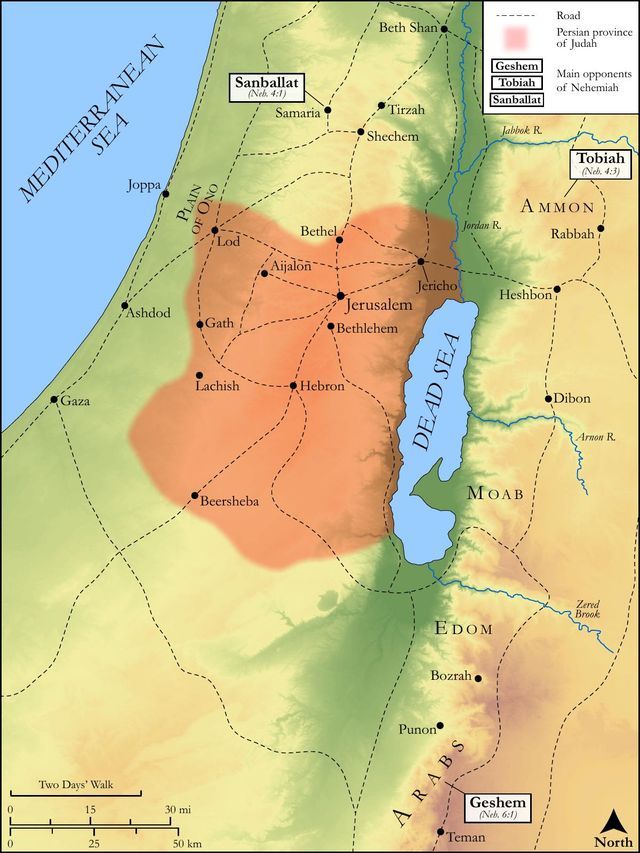
See on the biblical-era map
Study this verse
Public-domain commentary
Matthew Henry
From his Commentary on the Whole Bible. Henry comments on passages, not single verses — this entry covers Nehemiah 4:1–6. His three-level outline is real structure in the source text, so it is rendered as structure.
Here is, I. The spiteful scornful reflection which Sanballat and Tobiah cast upon the Jews for their attempt to build the wall about Jerusalem. The country rang of it presently; intelligence was brought of it to Samaria, that nest of enemies to the Jews and their prosperity; and here we are told how they received the tidings. 1. In heart. They were very angry at the undertaking, and had great indignation, Neh 4:1. It vexed them that Nehemiah came to seek the welfare of the children of Israel (Neh 2:10); but, when they heard of this great undertaking for their good, they were out of all patience. They had hitherto pleased themselves with the thought that while Jerusalem was unwalled they could swallow it up and make themselves masters of it when they pleased; but, if it be walled, it will not only be fenced against them, but by degrees become formidable to them. The strength and safety of the church are the grief and vexation of its enemies. 2. In word. They despised it, and made it the subject of their ridicule. In this they sufficiently displayed their malice; but good was brought out of it; for, looking upon it as a foolish undertaking that would sink under its own weight, they did not go about to obstruct it till it was too late. Let us see with what pride and malice they set themselves publicly to banter it. (1.) Sanballat speaks with scorn of the workmen: "These feeble Jews" (Neh 4:2), "what will they do for materials? Will they revive the stones out of the rubbish? And what mean they by being so hasty? Do they think to make the walling of a city but one day's work, and to keep the feast of dedication with sacrifice the next day? Poor silly people! See how ridiculous they make themselves!" (2.) Tobiah speaks with no less scorn of the work itself. He has his jest too, and must show his wit, Neh 4:3. Profane scoffers sharpen one another. "Sorry work," says he, "they are likely to make of it; they themselves will be ashamed of it: If a fox go up, not with his subtlety, but with his weight, he will break down their stone wall." Many a good work has been thus looked upon with contempt by the proud and haughty scorners.
II.Nehemiah's humble and devout address to God when he heard of these reflections.
He had notice brought him of what they said. It is probable that they themselves sent him a message to this purport, to discourage him, hoping to jeer him out of his attempt; but he did not answer these fools according to their folly; he did not upbraid them with their weakness, but looked up to God by prayer.
1.He begs of God to take notice of the indignities that were done them (Neh 4:4), and in this we are to imitate him: Hear, O our God! for we are despised. Note,
(1.)God's people have often been a despised people, and loaded with contempt.
(2.)God does, and will, hear all the slights that are put upon his people, and it is their comfort that he does so and a good reason why they should be as though they were deaf, Psa 38:13, Psa 38:15. "Thou art our God to whom we appeal; our cause needs no more than a fair hearing."
2.He begs of God to avenge their cause and turn the reproach upon the enemies themselves (Neh 4:4, Neh 4:5); and this was spoken rather by a spirit of prophecy than by a spirit of prayer, and is not to be imitated by us who are taught of Christ to pray for those that despitefully use and persecute us. Christ himself prayed for those that reproached him: Father, forgive them. Nehemiah here prays, Cover not their iniquity. Note,
(1.)Those that cast contempt on God's people do but prepare everlasting shame for themselves.
(2.)It is a sin from which sinners are seldom recovered. Doubtless Nehemiah had reason to think the hearts of those sinners were desperately hardened, so that they would never repent of it, else he would not have prayed that it might never be blotted out. The reason he gives is not, They have abused us, but, They have provoked thee, and that before the builders, to whom, it is likely, they sent a spiteful message. Note, We should be angry at the malice of persecutors, not because it is abusive to us, but because it is offensive to God; and on that we may ground an expectation that God will appear against it, Psa 74:18, Psa 74:22.
III.The vigour of the builders, notwithstanding these reflections, Neh 4:6.
They made such good speed that in a little time they had run up the wall to half its height, for the people had a mind to work; their hearts were upon it, and they would have it forwarded. Note,
1.Good work goes on well when people have a mind to it.
2.The reproaches of enemies should rather quicken us to our duty than drive us from it.
Historical interpretation
Historical reception
1 surviving comment on this verse from the historical church.
Hear, our God, for we have become an object of contempt, etc. Similar to that of the Psalmist about the enemies of the elect, speaking as if under the guise of one wicked person: His trouble will return on his own head, and his violence will descend on his own crown (Psalm VII).
Continue studying Nehemiah 4:4 across the web’s major study libraries — every link below opens this exact verse, chapter, or book on the destination site.
Read & Compare
 BibleGatewayThis verse in more than 200 translations and 70 languages.
 Bible.comThe YouVersion reader — hundreds of translations, reading plans, and highlights.
 ESV.orgCrossway's official English Standard Version reader.
 NET BibleThe NET translation with 60,000+ translators' notes on every rendering decision.
 STEP BibleTyndale House's free study tool — original text, vocabulary, and scholarly resources.
 BibliaLogos Bible Software's free web reader.
 USCCBThe New American Bible (Revised Edition) with the U.S. bishops' study notes.
Commentaries
 BibleHub CommentariesDozens of classic commentaries on this verse, gathered on one page.
 StudyLightMore than 100 commentary sets — the largest collection on the web.
 BibleRefPlain-English commentary on what this verse means, verse by verse.
 Enduring WordDavid Guzik's free commentary on this chapter, widely used by Bible teachers.
 Bible Study ToolsVerse commentary alongside Greek and Hebrew study aids.
Original Language & Research
- BibleHub InterlinearThe verse word by word — original language, transliteration, and English.
- BibleHub LexiconEvery word's original-language definition and Strong's entry.
 Blue Letter BibleDeep-study tools — Strong's numbers, concordance, and word studies.
 SefariaThe Hebrew text with Rashi and centuries of Jewish commentary.
Sermons, Hymns & Audio


TrulyRandomVerse is not affiliated with these sites and doesn’t control their content. They’re linked because they’re genuinely useful.
Summary
Nehemiah 4:4 captures Nehemiah's fervent and immediate prayer to God in response to the intense scorn and threats from adversaries who sought to hinder the rebuilding of Jerusalem's walls. This verse powerfully encapsulates Nehemiah's deep reliance on divine justice and vindication, appealing to God to reverse the humiliation and contempt endured by His people and to bring the consequences of their enemies' malicious intent back upon their own heads. It is a profound expression of trust in God's sovereignty amidst profound adversity, demonstrating that even in the face of overwhelming opposition, the faithful leader's first recourse is to the Almighty.
Context
ShowHideLiterary Context
Nehemiah 4:4 is a pivotal moment following the escalating opposition described in the preceding verses. In Nehemiah 4:1-3, Sanballat, Tobiah, Geshem, and their allied peoples (Ammonites, Arabs, Ashdodites) are depicted as intensely mocking and ridiculing the Jewish people's efforts to rebuild the wall. Their scorn is not merely directed at the builders but implicitly at their God, questioning the efficacy of their faith and their ability to complete such a monumental task. Nehemiah's prayer in verse 4 is a direct, impassioned response to this verbal assault, demonstrating that his first resort in the face of human opposition is to appeal to divine authority and justice, rather than engaging in immediate retaliation or despair. This prayer sets the tone for the people's continued perseverance, as they then return to work with renewed determination in Nehemiah 4:6, empowered by their leader's unwavering faith and reliance on God.
Historical & Cultural Context
The historical setting is the post-exilic period, specifically around 445 BC, when the Jewish exiles had returned from Babylon under Persian rule. Jerusalem was still largely in ruins, and the rebuilding of its walls was not merely a construction project but a symbolic act of restoring national identity, security, and the glory of God's city. This endeavor was perceived as a significant threat by neighboring peoples, particularly the Samaritans (led by Sanballat), Ammonites (Tobiah), and Arabs (Geshem), who had established their own influence in the region during the exile. Their "reproach" (Hebrew: ḥerpāh) carried significant cultural weight, implying public shame, disgrace, and a challenge to honor, which was deeply offensive in Israel. The plea for them to be given "for a prey in the land of captivity" reflects the historical memory of Israel's own past captivities and a desire for a dramatic reversal of fortunes, where the aggressors would suffer the very fate they wished upon the Jews, echoing the judgments pronounced in prophetic literature against nations that oppressed God's people (e.g., Isaiah 14:2).
Key Themes
ShowHideNehemiah 4:4 contributes significantly to several major themes within the book of Nehemiah and the broader biblical narrative. Firstly, it highlights Prayer in Adversity, demonstrating Nehemiah's consistent practice of turning to God in every challenge, from his initial burden for Jerusalem in Nehemiah 1:4 to this specific plea for justice. Secondly, the verse underscores Divine Justice and Vindication, as Nehemiah appeals to God to defend His people and His name against those who despise them. This is an example of an imprecatory prayer, where the psalmist or prophet asks God to deal with enemies according to their deeds, trusting that vengeance belongs to the Lord. Thirdly, it speaks to Perseverance Amidst Scorn, as the prayer empowers the people to continue their work despite intense opposition, knowing that God is aware of their suffering and will ultimately act on their behalf. This resilience is a recurring motif throughout the book, emphasizing that God's work will be completed despite human obstacles and malicious intent, as seen in the eventual completion of the wall in Nehemiah 6:15.
Exposition and Analysis
ShowHideKey Word Analysis
ShowHideThis feminine passive participle conveys a profound sense of contempt, scorn, and utter disdain. It indicates that the adversaries not only disagreed with the Jews' actions but actively looked down upon them, belittling their efforts, their people, and implicitly, their God. The enemies sought to strip the Jews of their dignity and discourage them through public humiliation, treating them as something scorned or an object of contempt.
cherpâh refers to shame, disgrace, or public humiliation. In Israel, honor and shame were paramount, and to be subjected to cherpâh was to suffer a significant blow to one's standing and identity. Nehemiah's prayer is a plea for God to reverse this public shame, causing the very contumely and disgrace intended for His people to recoil upon the heads of their accusers.
This primitive root is used with the greatest latitude of application, meaning "to give," but also "to put," "to make," "to appoint," or "to assign." In this context, Nehemiah is asking God to actively assign or deliver the enemies to a specific fate, transforming them into "prey." It signifies God's sovereign power to orchestrate events and to bring about a divinely appointed outcome, demonstrating His control over all circumstances.
rôʼsh literally means "the head," but figuratively refers to the chief, beginning, top, or highest part. In the phrase "turn their reproach upon their own head," it signifies that the full weight and consequence of their malicious words and actions should fall directly and completely upon themselves, impacting their very being and authority.
This feminine noun refers to exile, abstractly or concretely and collectively, signifying those who are captives or the state of captivity itself. The request to "give them for a prey in the land of captivity" is a powerful imprecation for a complete reversal of fortune, asking that those who sought to subjugate the Jews would themselves become vulnerable, captured, and subjected to the fate of the plundered, experiencing the very exile from which Israel had recently been delivered.
Verse Breakdown
ShowHide"Hear, O our God;"
This opening phrase establishes the direct, intimate, and urgent nature of Nehemiah's prayer. It is a cry of dependence, acknowledging God's omnipotence and His attentiveness to the plight of His people. It is an appeal to the covenant God of Israel, who has promised to hear and respond to their cries, emphasizing a personal relationship and trust in His divine intervention.
"for we are despised:"
This clause states the immediate cause for the prayer – the profound contempt and scorn heaped upon the Jewish people. It is a factual presentation of their suffering and humiliation, laying bare their vulnerability before God. This is not merely a complaint, but a justification for divine intervention, appealing to God's character as the defender of the oppressed and the vindicator of His covenant people.
"and turn their reproach upon their own head,"
This is a powerful imprecation, a request for divine poetic justice. Nehemiah asks God to cause the very insults, shame, and malicious intentions of the adversaries to boomerang back upon them. It is a plea for a complete reversal of fortune, where the perpetrators experience the consequences of their own wickedness. This phrase emphasizes God's justice in ensuring that evil ultimately consumes its originators, demonstrating His righteous governance over human affairs.
"and give them for a prey in the land of captivity:"
This second imprecation intensifies the request for divine judgment. It asks that the enemies, who sought to oppress and plunder the Jews, would themselves become vulnerable, captured, and subjected to the very fate of captivity that Israel had endured. This is a prayer for God to demonstrate His absolute sovereignty by bringing about a complete and humiliating downfall for those who oppose His work and His people, mirroring the experience of Israel and Judah themselves, when conquered peoples became "prey" to their victors.
Literary Devices
ShowHideNehemiah 4:4 powerfully employs several literary devices to convey its message and emotional intensity. The most prominent is Imprecatory Prayer, a common form of petition in the Old Testament (e.g., in the Psalms) where the speaker calls upon God to bring judgment or calamity upon their enemies. It is not an expression of personal revenge but a fervent appeal for divine justice against those who oppose God's righteous purposes and His people. The phrase "turn their reproach upon their own head" is a vivid Metaphor and an example of Retributive Justice, illustrating the concept of a boomerang effect where malicious intent recoils upon the perpetrator. This also contains an element of Irony, as the very shame and plunder intended for God's people are desired to befall the adversaries. The final clause, "give them for a prey in the land of captivity," uses Hyperbole to emphasize the totality of the desired reversal, calling for a complete and humiliating downfall for the enemies, akin to the fate of the vanquished, underscoring the severity of the judgment Nehemiah desires God to enact.
Theological and Thematic Connections
ShowHideNehemiah's prayer in Nehemiah 4:4 resonates deeply with the biblical understanding of God as a righteous judge who hears the cries of His people and defends them against their adversaries. While the New Testament calls believers to love their enemies and pray for those who persecute them, the Old Testament imprecations are not expressions of personal vindictiveness but rather appeals to God's ultimate justice and sovereignty over all nations. They reflect a profound trust that God will ultimately set things right, vindicating His name and His people. This prayer reminds us that when we are engaged in God's work and face opposition, our first recourse should be to lay our burdens before Him, trusting in His power to act righteously on our behalf. It underscores the truth that the battle is ultimately the Lord's, and He will ensure that His purposes prevail against all who seek to hinder them.
Reflection and Application
ShowHideNehemiah 4:4 offers profound and enduring lessons for believers navigating opposition in their spiritual journeys and service. When we encounter scorn, ridicule, or active hindrance while pursuing God's calling, our immediate and primary response should be earnest prayer, just as Nehemiah did. This verse teaches us to present our plight honestly before God, trusting in His character as a just and sovereign Lord who sees, hears, and acts. While our New Testament mandate calls us to love our enemies and pray for their salvation, Nehemiah's prayer reminds us that there is a righteous indignation against injustice and a legitimate desire for God's ultimate vindication of His name and His people. We are called to leave judgment and vengeance to God, trusting that He will, in His perfect timing and wisdom, turn the tables on those who oppose His kingdom. This empowers us to persevere in our God-given tasks, knowing that despite the scorn of others, our labor in the Lord is not in vain, and He will ultimately bring His purposes to fruition, demonstrating His faithfulness to those who trust in Him.
Questions for Reflection
ShowHideFAQ
ShowHideIs Nehemiah's prayer for vengeance appropriate for Christians today?
ShowHideNehemiah's prayer, an example of an imprecatory prayer, reflects a righteous appeal for divine justice against those actively opposing God's work and His people. While the New Testament calls believers to love their enemies (Matthew 5:44) and to leave vengeance to God (Romans 12:19), it's crucial to understand the context. Nehemiah is not seeking personal revenge, but asking God to defend His honor and His covenant people against those who are actively hindering His redemptive plan. For Christians today, this teaches us to bring all our burdens and injustices to God, trusting in His ultimate sovereignty and justice. While we pray for the salvation of our enemies, we can also pray for God's righteous hand to intervene against evil, to protect His people, and to ensure His purposes prevail, knowing that He will ultimately bring all things to account (Revelation 20:11-15).
What does "turn their reproach upon their own head" mean?
ShowHideThis phrase is a powerful idiom signifying a reversal of fortune or poetic justice. It means that the very shame, insult, or harm that the adversaries intended to inflict upon God's people would instead recoil upon themselves. It's a prayer for God to cause their malicious words and actions to boomerang, so that they experience the disgrace and consequences of their own wickedness. It underscores the biblical principle that those who dig a pit for others often fall into it themselves (Psalm 7:15). Nehemiah is appealing to God to demonstrate His justice by ensuring that the enemies' evil designs ultimately lead to their own downfall and humiliation, thereby vindicating His people and His name.
Christ-Centered Fulfillment
ShowHideNehemiah's prayer for vindication and the turning of reproach upon the enemies' heads finds its ultimate fulfillment and reinterpretation in the person and work of Jesus Christ. While Nehemiah prayed for God to bring judgment upon those who despised His people, Jesus Himself became the ultimate object of scorn and reproach, fulfilling prophecies such as Psalm 22:6. He endured the deepest humiliation, suffering the cross, where the world's reproach and the curse of sin were heaped upon Him. Yet, in His divine wisdom, Jesus did not pray for the immediate destruction of His tormentors but for their forgiveness (Luke 23:34). His resurrection, however, is the ultimate divine reversal, turning the reproach of the cross into glorious triumph and vindication. Through His victory over sin and death, Christ has disarmed and triumphed over all spiritual adversaries (Colossians 2:15), ensuring that the ultimate "reproach" of judgment will fall upon those who reject Him, while His people, united with Him, are forever vindicated and glorified (Philippians 2:8-11). Thus, Nehemiah's plea for justice is ultimately satisfied in Christ's final victory and the establishment of His kingdom, where all wrongs will be made right and God's people will dwell in everlasting peace and security.