


Mark 11:15
Bible text: King James Version (1769 Blayney text) · Public domain
Bible text: King James Version with Strong's numbers · Public domain
Bible text: Berean Standard Bible · Public domain
Bible text: American Standard Version (1901) · Public domain
Bible text: World English Bible, Messianic edition · Public domain
Bible text: Geneva Bible (1599) · Public domain
Bible text: Young's Literal Translation · Public domain
- καὶkaiAndG2532CONJConjunction
- ἔρχονταιerchontaithey comeG2064V-PNI-3PVerb Present Middle Or Passive Deponent Indicative 3rd Plural
- εἰςeistoG1519PREPPreposition
- ἹεροσόλυμαHi'erosolumaJerusalemG2414N-APN-LNoun Accusative Plural Neuter Location
- καὶkaiAndG2532CONJConjunction
- εἰσελθὼνeiselthōnhaving enteredG1525V-2AAP-NSMVerb 2nd Aorist Active Participle Nominative Singular Masculine
- ὁho<the>G3588T-NSMDefinite article Nominative Singular Masculine
- ἸησοῦςIēsousJesusG2424N-NSM-PNoun Nominative Singular Masculine Individual
- εἰςeisintoG1519PREPPreposition
- τὸtotheG3588T-ASNDefinite article Accusative Singular Neuter
- ἱερὸνhi'erontempleG2411N-ASNNoun Accusative Singular Neuter
- ἤρξατοērxatoHe beganG757V-ADI-3SVerb Aorist Middle Deponent Indicative 3rd Singular
- ἐκβάλλεινekballeinto cast outG1544V-PANVerb Present Active Infinitive
- τοὺςtousthoseG3588T-APMDefinite article Accusative Plural Masculine
- πωλοῦνταςpōlountassellingG4453V-PAP-APMVerb Present Active Participle Accusative Plural Masculine
- καὶkaiandG2532CONJConjunction
- ἀγοράζονταςagorazontasbuyingG59V-PAP-APMVerb Present Active Participle Accusative Plural Masculine
- ἐνeninG1722PREPPreposition
- τῷtōtheG3588T-DSNDefinite article Dative Singular Neuter
- ἱερῷhi'erōtempleG2411N-DSNNoun Dative Singular Neuter
- καὶkaiandG2532CONJConjunction
- τὰςtastheG3588T-APFDefinite article Accusative Plural Feminine
- τραπέζαςtrapezastablesG5132N-APFNoun Accusative Plural Feminine
- τῶνtōnof theG3588T-GPMDefinite article Genitive Plural Masculine
- κολλυβιστῶνkollubistōnmoney changersG2855N-GPMNoun Genitive Plural Masculine
- καὶkaiandG2532CONJConjunction
- τὰςtastheG3588T-APFDefinite article Accusative Plural Feminine
- καθέδραςkathedrasseatsG2515N-APFNoun Accusative Plural Feminine
- τῶνtōnof thoseG3588T-GPMDefinite article Genitive Plural Masculine
- πωλούντωνpōlountōnsellingG4453V-PAP-GPMVerb Present Active Participle Genitive Plural Masculine
- τὰςtastheG3588T-APFDefinite article Accusative Plural Feminine
- περιστερὰςperisterasdovesG4058N-APFNoun Accusative Plural Feminine
- κατέστρεψενkatestrepsenHe overturnedG2690V-AAI-3SVerb Aorist Active Indicative 3rd Singular
English is a literal word-by-word gloss of the Greek, not the KJV's wording. Why?
This is the original text the KJV's translators worked from — each Greek word with its own literal English meaning in this verse, prepared by scholars at Tyndale House, Cambridge. The KJV translates whole sentences, not word by word, so its wording differs: one Greek word can become several English words, and the KJV may choose “charity” where the gloss reads “love”. Both are faithful — they answer different questions. For the KJV's own rendering, switch to the KJV text.
Details
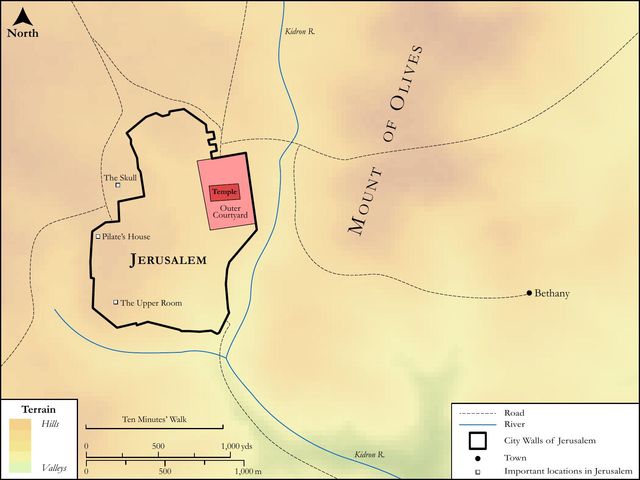
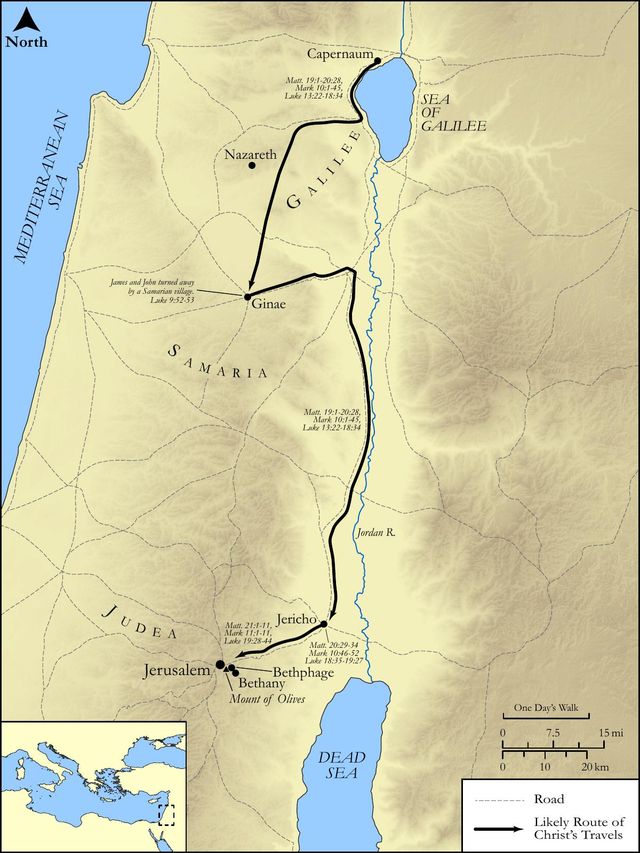
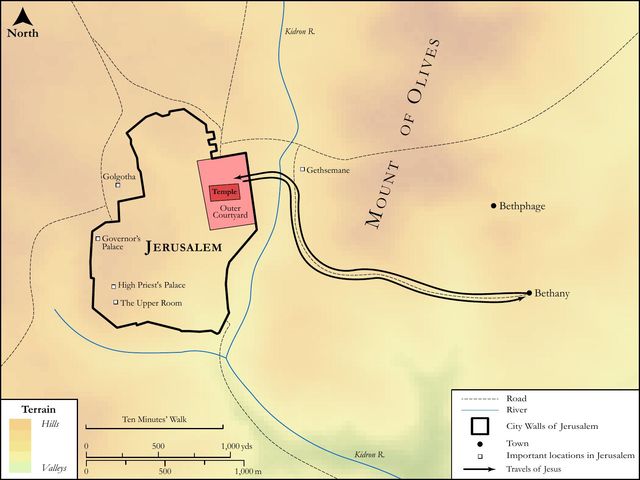
See on the biblical-era maps
Study this verse
Public-domain commentary
Matthew Henry
From his Commentary on the Whole Bible. Henry comments on passages, not single verses — this entry covers Mark 11:12–26. His four-level outline is real structure in the source text, so it is rendered as structure.
Here is, I. Christ's cursing the fruitless fig-tree. He had a convenient resting-place at Bethany, and therefore thither he went at resting-time; but his work lay at Jerusalem, and thither therefore he returned in the morning, at working-time; and so intent was he upon his work, that he went out from Bethany without breakfast, which, before he was gone far, he found the want of, and was hungry (Mar 11:12), for he was subject to all the sinless infirmities of our nature. Finding himself in want of food, he went to a fig-tree, which he saw at some distance, and which being well adorned with green leaves he hoped to find enriched with some sort of fruit. But he found nothing but leaves; he hoped to find some fruit, for though the time of gathering in figs was near, it was not yet; so that it could not be pretended that it had had fruit, but that it was gathered and gone; for the season had not yet arrived. Or, He found none, for indeed it was not a season of figs, it was no good fig-year. But this was worse than any fig-tree, for there was not so much as one fig to be found upon it, though it was so full of leaves. However, Christ was willing to make an example of it, not to the trees, but to the men, of that generation, and therefore cursed it with that curse which is the reverse of the first blessing, Be fruitful; he said unto it, Never let any man eat fruit of thee hereafter for ever, Mar 11:14. Sweetness and good fruit are, in Jotham's parable, the honour of the fig-tree (Jdg 9:11), and its serviceableness therein to man, preferable to the preferment of being promoted over the trees; now to be deprived of that, was a grievous curse. This was intended to be a type and figure of the doom passed upon the Jewish church, to which he came, seeking fruit, but found none (Luk 13:6, Luk 13:7); and though it was not, according to the doom in the parable, immediately cut down, yet, according to this in the history, blindness and hardness befell them (Rom 11:8, Rom 11:25), so that they were from henceforth good for nothing. The disciples heard what sentence Christ passed on this tree, and took notice of it. Woes from Christ's mouth are to be observed and kept in mind, as well as blessings.
II.His clearing the temple of the market-people that frequented it, and of those that made it a thoroughfare.
We do not find that Christ met with food elsewhere, when he missed of it on the fig-tree; but the zeal of God's house so ate him up, and made him forget himself, that he came, hungry as he was, to Jerusalem, and went straight to the temple, and began to reform those abuses which the day before he had marked out; to show that when the Redeemer came to Zion, his errand was, to turn away ungodliness from Jacob (Rom 11:26), and that he came not, as he was falsely accused, to destroy the temple, but to purify and refine it, and reduce his church to its primitive rectitude.
1.He cast out the buyers and sellers, overthrew the tables of the money-changers (and threw the money to the ground, the fitter place for it), and threw down the seats of them that sold doves. This he did as one having authority, as a Son in his own house. The filth of the daughter of Zion is purged away, not by might, nor by power, but by the spirit of judgment, and the spirit of burning. And he did it without opposition; for what he did, was manifested to be right and good, even in the consciences of those that had connived at it, and countenanced it, because they got money by it. Note, It may be some encouragement to zealous reformers, that frequently the purging out of corruptions, and the correcting of abuses, prove an easier piece of work than was apprehended. Prudent attempts sometimes prove successful beyond expectation, and there are not those lions found in the way, that were feared to be.
2.He would not suffer that any man should carry any vessel, any sort of goods or wares, through the temple, or any of the courts of it, because it was the nearer way, and would save them the labour of going about, Mar 11:16. The Jews owned that it was one of the instances of honour due to the temple, not to make the mountain of the house, or the court of the Gentiles, a road, or common passage, or to come into it with any bundle.
3.He gave a good reason for this; because it was written, My house shall be called of all nations, The house of prayer, Mar 11:17. So it is written, Isa 56:7. It shall pass among all people under that character. It shall be the house of prayer to all nations; it was so in the first institution of it; when Solomon dedicated it, it was with an eye to the sons of the strangers, Kg1 8:41. And it was prophesied that it should be yet more so. Christ will have the temple, as a type of the gospel-church, to be,
(1.)A house of prayer. After he had turned out the oxen and doves, which were things for sacrifice, he revived the appointment of it as a house of prayer, to teach us that when all sacrifices and offerings should be abolished, the spiritual sacrifices of prayer and praise should continue and remain for ever.
(2.)That it should be so to all nations, and not to the people of the Jews only; for whosoever shall call upon the name of the Lord, shall be saved, though not of the seed of Jacob, according to the flesh. It was therefore insufferable for them to make it a den of thieves, which would prejudice those nations against it, whom they should have invited to it. When Christ drove out the buyers and sellers at the beginning of his ministry, he only charged them with making the temple a house of merchandise (Joh 2:16); but now he chargeth them with making it a den of thieves, because since then they had twice gone about to stone him in the temple (Joh 8:59; Joh 10:31), or because the traders there were grown notorious for cheating their customers, and imposing upon the ignorance and necessity of the country people, which is no better than downright thievery. Those that suffer vain worldly thoughts to lodge within them when they are at their devotions, turn the house of prayer into a house of merchandise; but they that make long prayers for pretence to devour widows' houses, turn it into a den of thieves.
4.The scribes and the chief priests were extremely nettled at this, Mar 11:18. They hated him, and hated to be reformed by him; and yet they feared him, lest he should next overthrow their seats, and expel them, being conscious to themselves of the profaning and abusing of their power. They found that he had a great interest, that all the people were astonished at his doctrine, and that every thing he said, was an oracle and a law to them; and what durst he not attempt, what could he not effect, being thus supported? They therefore sought, not how he might make their peace with him, but how they might destroy him. A desperate attempt, and which, one would think, they themselves could not but fear was fighting against God. But they care not what they do, to support their own power and grandeur.
III.His discourse with his disciples, upon occasion of the fig-tree's withering away which he had cursed.
At even, as usual, he went out of the city (Mar 11:19), to Bethany; but it is probable that it was in the dark, so that they could not see the fig-tree; but the next morning, as they passed by, they observed the fig-tree dried up from the roots, Mar 11:20. More is included many times in Christ's curses than is expressed, as appears by the effects of them. The curse was no more than that it should never bear fruit again, but the effect goes further, it is dried up from the roots. If it bear no fruit, it shall bear no leaves to cheat people. Now observe,
1.How the disciples were affected with it. Peter remembered Christ's words, and said, with surprise, Master, behold, the fig-tree which thou cursedst is withered away, Mar 11:21. Note, Christ's curses have wonderful effects, and make those to wither presently, that flourished like the green bay-tree. Those whom he curseth are cursed indeed. This represented the character and state of the Jewish church; which, from henceforward, was a tree dried up from the roots; no longer fit for food, but for fuel only. The first establishment of the Levitical priesthood was ratified and confirmed by the miracle of a dry rod, which in one night budded, and blossomed, and brought forth almonds (Num 17:8), a happy omen of the fruitlessness and flourishing of that priesthood. And now, by a contrary miracle, the expiration of that priesthood was signified by a flourishing tree dried up in a night; the just punishment of those priests that had abused it. And this seemed very strange to the disciples, and scarcely credible, that the Jews, who had been so long God's own, his only professing people in the world, should be thus abandoned; they could not imagine how that fig-tree should so soon wither away: but this comes of rejecting Christ, and being rejected by him.
2.The good instructions Christ gave them from it; for of those even this withered tree was fruitful.
(1.)Christ teacheth them from hence to pray in faith (Mar 11:22); Have faith in God. They admired the power of Christ's word of command; "Why," said Christ, "a lively active faith would put as great a power into your prayers, Mar 11:23, Mar 11:24. Whosoever shall say to this mountain, this mount of Olives, Be removed, and be cast into the sea; if he has but any word of God, general or particular, to build his faith upon, and if he shall not doubt in his heart, but shall believe that those things which he saith, according to the warrant he has from what God hath said, shall come to pass, he shall have whatsoever he saith." Through the strength and power of God in Christ, the greatest difficulty shall be got over, and the thing shall be effected. And therefore (Mar 11:24), "What things soever ye desire, when ye pray believe that ye shall receive them; nay, believe that ye do receive them, and he that has power to give them, saith, Ye shall have them. I say unto you, Ye shall, Mar 11:24. Verily I say unto you, Ye shall," Mar 11:23. Now this is to be applied,
[1.]To that faith of miracles which the apostles and first preachers of the gospel were endued with, which did wonders in things natural, healing the sick, raising the dead, casting out devils; these were, in effect, the removing of mountains. The apostles speak of a faith which would do that, and yet might be found where holy love was not, Co1 13:2.
[2.]It may be applied to that miracle of faith, which all true Christians are endued with, which doeth wonders in things spiritual. It justifies us (Rom 5:1), and so removes the mountains of guilt, and casts them into the depths of the sea, never to rise up in judgment against us, Mic 7:19. It purifies the heart (Act 15:9), and so removes mountains of corruption, and makes them plains before the grace of God, Zac 4:7. It is by faith that the world is conquered, Satan's fiery darts are quenched, a soul is crucified with Christ, and yet lives; by faith we set the Lord always before us, and see him that is invisible, and have him present to our minds; and this is effectual to remove mountains, for at the presence of the Lord, at the presence of the God of Jacob, the mountains were not only moved, but removed, Psa 114:4-7.
(2.)To this is added here that necessary qualification of the prevailing prayer, that we freely forgive those who have been any way injurious to us, and be in charity with all men (Mar 11:25, Mar 11:26); When ye stand praying, forgive. Note, Standing is no improper posture for prayer; it was generally used among the Jews; hence they called their prayers, their standings; when they would say how the world was kept up by prayer, they expressed it thus, Stationibus stat mundus - The world is held up by standings. But the primitive Christians generally used more humble and reverent gesture of kneeling, especially on fast days, though not on Lord's days. When we are at prayer, we must remember to pray for others, particularly for our enemies, and those that have wronged us; now we cannot pray sincerely that God would do them good, if we bear malice to them, and wish them ill. If we have injured others before we pray, we must go and be reconciled to them; Mat 5:23, Mat 5:24. But if they have injured us, we go a nearer way to work, and must immediately from our hearts forgive them. [1.] Because this is a good step towards obtaining the pardon of our own sins: Forgive, that your Father may forgive you; that is, "that he may be qualified to receive forgiveness, that he may forgive you without injury to his honour, as it would be, if he should suffer those to have such benefit by his mercy, as are so far from being conformable to the pattern of it." [2.] Because the want of this is a certain bar to the obtaining of the pardon of our sins; "If ye do not forgive those who have injured you, if he hate their persons, bear them a grudge, meditate revenge, and take all occasion to speak ill of them, neither will your Father forgive your trespasses." This ought to be remembered in prayer, because one great errand we have to the throne of grace, is, to pray for the pardon of our sins: and care about it ought to be our daily care, because prayer is a part of our daily work. Our Saviour often insists on this, for it was his great design to engage his disciples to love one another.
Historical interpretation
Eight Centuries of Reception
9 surviving comments on this verse. Each one is dated, so this reads as a timeline rather than a list.
Select a marker to jump to its quote. Markers stagger vertically where authors wrote within a few decades of each other.
According to Isaiah: But ye have made it a den of thieves, (Jer. 7:11) according to Jeremiah.
(de Con. Evan. lib. ii. 67) John, however, relates this in a very different order, wherefore it is manifest that not once only, but twice, this was done by the Lord, and that the first time was related by John, this last, by all the other three.
(de Con. Evan. lib. ii. 68) In this again Mark does not keep the same order as Matthew; because however Matthew connects the facts together by this sentence, And he left them, and went out of the city into Bethany, (Matt. 21:17) returning from whence in the morning, according to his relation, Christ cursed the tree, therefore it is supposed with greater probability that he rather has kept to the order of time, as to the ejection from the temple of the buyers and sellers. Mark therefore passed over what was done the first day when He entered into the temple, and on remembering it inserted it, when he had said that He found nothing on the fig tree but leaves, which was done on the second day, as both testify.
This account of the many sellers who were cast out of the temple was reported by all the Evangelists, including John, but in his case he introduces it in a completely different order.… John proceeds to tell us that he went up to Jerusalem at the season of the Jews’ passover, and when he had made a scourge of small cords drove out of the temple those who were selling in it. This makes it evident that this act was performed by the Lord not on a single occasion, but twice over. Only in the first instance was it recorded by John, but in the last by the other three.
Why do you not recall before the eyes of your mind that our Redeemer, entering the temple, overturned the seats of those selling doves and poured out the money of the money-changers? For who are those in the temple of God today who sell doves, if not those who in the Church receive payment for the imposition of hands? Through which imposition, namely, the Holy Spirit is given from heaven. Therefore the dove is sold, because the imposition of hands, through which the Holy Spirit is received, is offered for a price. But our Redeemer overturned the seats of those selling doves, because he destroys the priesthood of such merchants. For hence it is that the sacred canons condemn the simonian heresy, and command that those be deprived of the priesthood who seek payment for bestowing ordinations. Therefore the seat of those selling doves is overturned when those who sell spiritual grace are deprived of the priesthood, either before human eyes or before the eyes of God.
Having described this, what the Lord did is added: because, entering the temple, he began to cast out those selling and buying in it, saying to them: It is written that my house is a house of prayer, but you have made it a den of thieves. For he who foretold the evils to come and immediately entered the temple to cast out from it those selling and buying, clearly made known that the ruin of the people came chiefly from the fault of the priests. Indeed, in describing the destruction but striking at those selling and buying in the temple, he showed by the very effect of his work whence the root of perdition sprang. Moreover, as we have learned from another evangelist as witness, doves were being sold in the temple. And what is received through doves except the gift of the Holy Spirit? But he expels the sellers and buyers from the temple, because he condemns either those who grant the imposition of hands for a gift, or those who strive to buy the gift of the Spirit.
Just as the temple of God is in the city, so also is the life of religious persons among the faithful people. And often some take up the habit of religion, and when they receive a place in the sacred orders, they turn the office of holy religion into a commerce of earthly business. Those selling in the temple are they who bestow for a reward what rightly belongs to certain persons. For to sell justice is to maintain it in exchange for receiving a reward. Those buying in the temple are they who, while refusing to render to their neighbor what is just, and while disdaining to do what is rightly owed, give a reward to patrons and buy sin.
(ubi sup.) What the Lord had done in figure, when He cursed the barren fig tree, He now shows more openly, by casting out the wicked from the temple. For the fig tree was not in fault, in not having fruit before its time, but the priests were blameable; wherefore it is said, And they come to Jerusalem; and Jesus went into the temple, and began to cast out them that sold and bought in the temple. Nevertheless, it is probable that He found them buying and selling in the temple things which were necessary for its ministry. If then the Lord forbids men to carry on in the temple worldly matters, which they might freely do any where else, how much more do they deserve a greater portion of the anger of Heaven, who carry on in the temple consecrated to Him those things, which are unlawful wherever they may be done. It goes on: and overthrew the tables of the moneychangers.
(ubi sup.) Because the Holy Spirit appeared over the Lord in the shape of a dove, the gifts of the Holy Spirit are fitly pointed out under the name of doves. The Dove therefore is sold, when the laying on of hands by which the Holy Spirit is received is sold for a price. Again, He overturns the seats of them who sell doves, because they who sell spiritual grace, are deprived of their priesthood, either before men, or in the eyes of God.
(ubi sup.) He speaks of those vessels which were carried there for the purpose of merchandise. But God forbid that it should be taken to mean, that the Lord cast out of the temple, or forbade men to bring into it, the vessels consecrated to God; for here He shows a type of the judgment to come, for He thrusts away the wicked from the Church, and restrains them by His everlasting word from ever again coming in to trouble the Church. Furthermore, sorrow, sent into the heart from above, takes away from the souls of the faithful those sins which were in them, and Divine grace assists them so that they should never again commit them. It goes on: And he taught, saying unto them, My house shall be called of all nations the house of prayer. (Isa. 56:7)
(ubi sup.) He says, to all nations, not to the Jewish nation alone, nor in the city of Jerusalem alone, but over the whole world; and he does not say a house of bulls, goats, and rams, but of prayer.
(ubi sup.) For they were in the temple for this purpose, either that they might persecute with corporal pains those who did not bring gifts, or spiritually kill those who did. The mind and conscience of the faithful is also the temple and the house of God, but if it puts forth perverse thoughts, to the hurt of any one, it may be said that thieves haunt it as a den; therefore the mind of the faithful becomes the den of a thief, when leaving the simplicity of holiness, it plans that which may hurt others.
And they come to Jerusalem. And when he had entered the temple, he began to cast out those who sold and bought in the temple, and he overturned the tables of the money-changers, and the seats of those who sold doves. What the Lord did by cursing the barren fig tree as a symbol, he soon showed more clearly by casting out the wicked from the temple. For the tree did not sin in that it did not have fruit when the Lord was hungry, since the time for fruit had not yet come; but the priests sinned by conducting secular business in the house of the Lord, and they neglected to bear the fruit of piety which they owed, and which the Lord hungered for in them. The Lord withered the tree with a curse, so that those who saw or heard might more greatly understand that they would be condemned by divine judgment if they were without the fruits of deeds, but only relied on the praise of religious speech, or on the appearance and covering of flourishing leaves. But because they did not understand, he then exercised the necessary severity of deserved vengeance upon them. And he cast out the commerce of human affairs from that house, in which it was commanded that only divine things be conducted, sacrifices and prayers be offered to God, the word of God be read, heard, and sung. And indeed it is to be believed that he found only those things being sold or bought in the temple which were necessary for the ministry of the same temple, based on what we read happening elsewhere, when he entered the same temple and found in it sellers and buyers of sheep, oxen, and doves. Clearly, it is to be believed that all these things were bought by those who came from afar from the locals, so that they might be offered in the house of the Lord. If, therefore, the Lord did not even want those things to be sold in the temple which he wanted to be offered in the temple, namely because of the greed or fraud that is usually the crime of merchants, how great a punishment, do you think, would he inflict if he found anyone there engaged in laughter or idle talk, or enslaved to any other vice? For if the Lord does not allow temporal business to be conducted in his house, which can be conducted freely elsewhere, how much more do those things deserve celestial wrath that are not allowed anywhere, if they are conducted in buildings consecrated to God? But because the Holy Spirit appeared upon the Lord in the form of a dove, rightly, the gifts of the Holy Spirit are signified by doves. Who, then, are those in the temple of God today who sell doves, but those in the Church who take a price for the imposition of hands? Through this imposition, namely, the Holy Spirit is given from heaven. Therefore, the dove is sold when the imposition of hands, through which the Holy Spirit is received, is provided for a price. But our Redeemer overturned the seats of those who sold doves, because he destroys the priesthood of such merchants. Hence, sacred canons condemn the Simoniac heresy and command that those who seek a price for conferring ordinations be deprived of the priesthood. Therefore, the seat of those who sell doves is overturned, because those who sell spiritual grace are deprived of the priesthood either before humans or before the eyes of God.
He calls moneychangers, changers of a particular sort of money, for the word means a small brass coin. There follows, and the seats of them that sold doves.
But if a man by sinning gives up to the devil the grace and purity of baptism, he has sold his Dove, and for this reason is cast out of the temple. There follows, And would not suffer that any man should carry any vessel through the temple.
Further, He calls the temple, a den of thieves, on account of the money gained there; for thieves always troop together for gain. Since then they sold those animals which were offered in sacrifice for the sake of gain, He called them thieves.
Which also turns to the greater condemnation of the Jews, because though the Lord did this so many times, nevertheless they did not correct their conduct.
(non occ.) But the Evangelist shows what effect the correction of the Lord had on the ministers of the temple, when he adds: And the Scribes and Chief Priests heard it, and sought how they might destroy him; according to that saying of Amos: They hate him that rebuketh in the gate, and they abhor him that speaketh uprightly. (Amos 5:10) From this wicked design, however, they were kept back for a time solely by fear. Wherefore it is added, For they feared him, because all the people were astonished at his doctrine. For he taught them as one having authority, and not as the Scribes and Pharisees, as is said elsewhere.
Continue studying Mark 11:15 across the web’s major study libraries — every link below opens this exact verse, chapter, or book on the destination site.
Read & Compare
 BibleGatewayThis verse in more than 200 translations and 70 languages.
 Bible.comThe YouVersion reader — hundreds of translations, reading plans, and highlights.
 ESV.orgCrossway's official English Standard Version reader.
 NET BibleThe NET translation with 60,000+ translators' notes on every rendering decision.
 STEP BibleTyndale House's free study tool — original text, vocabulary, and scholarly resources.
 BibliaLogos Bible Software's free web reader.
 USCCBThe New American Bible (Revised Edition) with the U.S. bishops' study notes.
Commentaries
 BibleHub CommentariesDozens of classic commentaries on this verse, gathered on one page.
 StudyLightMore than 100 commentary sets — the largest collection on the web.
 BibleRefPlain-English commentary on what this verse means, verse by verse.
 Enduring WordDavid Guzik's free commentary on this chapter, widely used by Bible teachers.
 Bible Study ToolsVerse commentary alongside Greek and Hebrew study aids.
Original Language & Research
- BibleHub InterlinearThe verse word by word — original language, transliteration, and English.
- BibleHub LexiconEvery word's original-language definition and Strong's entry.
 Blue Letter BibleDeep-study tools — Strong's numbers, concordance, and word studies.
 CNTR CollationThe earliest Greek manuscripts of this verse, collated letter by letter.
Sermons, Hymns & Audio


TrulyRandomVerse is not affiliated with these sites and doesn’t control their content. They’re linked because they’re genuinely useful.
Summary
Mark 11:15 records Jesus' powerful and decisive action upon entering the Jerusalem Temple during Passover week, where He confronted and disrupted the commercial activities of moneychangers and animal sellers. This dramatic event, often called the "cleansing of the Temple," served as a profound demonstration of Jesus' divine authority, His unwavering zeal for the sanctity and true purpose of God's house, and a prophetic indictment of a religious system that had become corrupted by greed and exploitation, neglecting its primary function as a place of prayer for all nations.
Context
ShowHideLiterary Context
This incident immediately follows Jesus' triumphal entry into Jerusalem (Mark 11:1-11), where He was hailed as the Son of David, a messianic figure. Mark's Gospel uniquely places Jesus' initial observation of the Temple (Mark 11:11) on the day of His entry, followed by the cursing of the fig tree (Mark 11:12-14) and then the Temple cleansing on the subsequent day. This chronological arrangement in Mark (compared to John's earlier account in John 2:13-16) emphasizes the deliberate nature of Jesus' actions. The cursing of the fig tree, which yielded no fruit despite its leaves, serves as a symbolic parallel to the Temple, appearing outwardly religious but lacking spiritual fruit and true worship. The Temple cleansing, therefore, is not a spontaneous outburst but a measured, prophetic act of judgment against spiritual barrenness and corruption within the religious establishment.
Historical & Cultural Context
The Temple in Jerusalem was the spiritual, cultural, and economic heart of Jewish life, especially during major pilgrimage festivals like Passover. Hundreds of thousands of pilgrims would flock to Jerusalem, many from foreign lands. For these pilgrims to offer sacrifices, they needed to exchange their foreign currency for the specific Tyrian coinage acceptable for Temple taxes and offerings, and to purchase animals for sacrifice. The outer court of the Temple, known as the Court of the Gentiles, had become a bustling marketplace. While seemingly convenient, this commercialization was rife with exploitation. Moneychangers charged exorbitant exchange rates, and animal sellers inflated prices, preying on the devout pilgrims, particularly the poor who relied on more affordable offerings like doves (Leviticus 12:8). This commercial activity, though facilitating worship, had overshadowed the Temple's primary purpose as a "house of prayer for all nations" (Mark 11:17), effectively excluding Gentiles from worship and turning a sacred space into a den of thieves.
Key Themes
ShowHideMark 11:15 contributes significantly to several overarching themes in Mark's Gospel and broader biblical theology. Firstly, it highlights the holiness and sanctity of God's dwelling place, emphasizing that the Temple was intended for reverent worship and prayer, not commercial gain. Secondly, it powerfully demonstrates Jesus' divine authority and messianic zeal. His actions are not merely those of a prophet but of one who possesses unique sovereignty over the Temple, acting with the authority of God Himself. This aligns with prophetic expectations of the Messiah cleansing the Temple (e.g., Malachi 3:1-3). Thirdly, the event underscores the theme of corruption and economic injustice within the religious system. Jesus' outrage is directed not at the act of sacrifice itself, but at the exploitation of the worshippers, particularly the vulnerable. Finally, it serves as a prophetic sign of judgment against a religious system that had become outwardly pious but inwardly corrupt and unfruitful, foreshadowing the Temple's eventual destruction and the establishment of a new covenant where God's presence dwells not in a physical building but in His people.
Exposition and Analysis
ShowHideKey Word Analysis
ShowHideThis term refers to the entire sacred precinct, including the outer courts where the commercial activity took place, distinguishing it from the inner sanctuary (ναός, naos). Jesus' cleansing of the hierón signifies His concern for the entire spiritual atmosphere and accessibility of worship, particularly for the Gentiles who were confined to the outer court. The defilement of this area directly impeded their ability to pray and worship.
Derived from ek (out of) and ballō (to throw), this word denotes a forceful, decisive expulsion or ejection. It implies a strong, authoritative action, not a gentle request or persuasion. Jesus did not merely ask them to leave; He drove them out, demonstrating His power and righteous indignation against the desecration of God's house. This verb is often used elsewhere in the Gospels for casting out demons, highlighting the spiritual nature of the defilement Jesus was addressing.
From kata (down) and strephō (to turn), this word means to turn upside down, to overturn, or to ruin. Jesus' act of overturning the tables of the moneychangers and the seats of those selling doves was a physical manifestation of His rejection of their practices and a symbolic act of judgment. It was a disruptive, destructive act aimed at dismantling a corrupt system, not merely pausing it.
Verse Breakdown
ShowHide"And they come to Jerusalem:"
This phrase sets the scene, indicating Jesus' arrival in the holy city, specifically for the Passover festival, a time of heightened religious fervor and pilgrimage. His presence in Jerusalem is deliberate and purposeful, leading to the climactic events of Holy Week.
"and Jesus went into the temple,"
Jesus' entry into the Temple is an intentional act, signifying His authority and His direct engagement with the center of Jewish worship. He does not merely pass by but enters with a specific mission, having observed the situation the previous day.
"and began to cast out them that sold and bought in the temple,"
This describes the initial phase of Jesus' action. He directly confronts those engaged in commerce, forcefully expelling both sellers and buyers. This indicates His condemnation of the entire commercial enterprise within the sacred precincts, not just the vendors. The use of "began" suggests a sustained, deliberate action rather than a momentary outburst.
"and overthrew the tables of the moneychangers,"
Jesus' action escalates to physical disruption. The moneychangers facilitated the exploitation of pilgrims, and their tables, symbols of their illicit trade, are overturned. This is a powerful, visual act of judgment against financial corruption in the guise of religious service.
"and the seats of them that sold doves;"
The overturning of the seats of dove sellers is particularly poignant. Doves were the sacrifices of the poor, and their exploitation was a direct affront to God's care for the vulnerable. This act highlights Jesus' compassion for the lowly and His condemnation of those who profit from the piety of the poor.
Literary Devices
ShowHideMark 11:15 employs several powerful literary devices. The Action itself is highly symbolic, functioning as a Prophetic Act that speaks volumes about Jesus' identity and mission. His physical disruption of the marketplace within the Temple serves as a living parable, demonstrating His zeal for God's house and His judgment against corruption. The contrast between the sacred space and the profane activities creates a strong sense of Irony, as the very place meant for worship had become a "den of robbers" (Mark 11:17). The vivid verbs "cast out" and "overthrew" contribute to the Dramatic Tension of the scene, portraying Jesus not as a passive teacher but as an active, authoritative figure. Furthermore, the mention of "doves" introduces Pathos, evoking sympathy for the poor who were being exploited, thereby deepening the moral weight of Jesus' actions.
Theological and Thematic Connections
ShowHideThe cleansing of the Temple is a profound theological statement about the nature of worship, the character of God, and the identity of Jesus. It underscores that true worship must be pure, just, and accessible to all, free from human exploitation and commercialism. Jesus' actions reveal God's zealous concern for the sanctity of His presence and His unwavering commitment to justice, particularly for the vulnerable. This event serves as a critical bridge, connecting Old Testament prophecies of a Messiah who would purify the Temple with the New Testament revelation of Jesus as the ultimate Temple, the dwelling place of God among humanity, and the one who establishes a new covenant of spiritual worship.
Reflection and Application
ShowHideThe cleansing of the Temple in Mark 11:15 is not merely a historical account but a timeless challenge to all who claim to worship God. It compels us to examine the purity of our own worship, both individually and corporately. Are our hearts and churches truly "houses of prayer," focused on God's glory and accessible to all, or have they become cluttered with distractions, self-interest, or even subtle forms of exploitation? Jesus' zeal reminds us that genuine faith demands integrity, justice, and an unwavering commitment to God's priorities over personal gain or convenience. It calls us to confront anything that hinders true communion with God or creates barriers for others seeking Him, ensuring that our spiritual spaces—our lives, our homes, our churches—reflect the holiness and selfless love of Christ.
Questions for Reflection
ShowHideFAQ
ShowHideWhy did Jesus cleanse the Temple if sacrifice was a part of Jewish worship?
ShowHideJesus' actions were not a condemnation of sacrifice itself, which was a divinely ordained aspect of Old Covenant worship. Instead, He condemned the corrupt practices surrounding the sacrificial system. The moneychangers and sellers were exploiting pilgrims, particularly the poor, by charging exorbitant rates for currency exchange and sacrificial animals. The outer court, intended as a place of prayer for Gentiles, was being used as a bustling marketplace, effectively hindering their worship. Jesus' zeal was directed at the desecration of a sacred space and the exploitation of worshippers, ensuring the Temple could fulfill its intended purpose as "a house of prayer for all nations" (Mark 11:17), rather than a "den of robbers" (Mark 11:17).
Christ-Centered Fulfillment
ShowHideThe cleansing of the Temple in Mark 11:15 finds its ultimate Christ-centered fulfillment in Jesus Himself being the true and final Temple. While the physical Temple in Jerusalem was a place where God's presence dwelt and sacrifices were offered for sin, it was always a shadow pointing to a greater reality. Jesus declares in John 2:19 to "Destroy this temple, and in three days I will raise it up," referring to the temple of His body. Through His sacrificial death on the cross, Jesus became the ultimate and perfect sacrifice, fulfilling all the Old Testament sacrificial laws and making the physical Temple obsolete (Hebrews 9:11-14). His resurrection then established Him as the new, living Temple, the very dwelling place of God among humanity (John 1:14). Furthermore, through Christ, believers are now incorporated into this new spiritual Temple, becoming living stones in a spiritual house (1 Peter 2:5), with the Holy Spirit dwelling within them (1 Corinthians 6:19). Thus, Jesus' cleansing of the physical Temple foreshadows His greater work of purifying His people, cleansing them from sin, and establishing a new covenant of worship in spirit and truth (John 4:23-24), where access to God is no longer limited by location or commercial transaction but is freely granted through Him.